Proceedings of the 57th Annual Meeting of the Association for Computational Linguistics, pages 4309–4316 4309
Inter-sentence Relation Extraction with Document-level
Graph Convolutional Neural Network
Sunil Kumar Sahu1, Fenia Christopoulou1, Makoto Miwa2,3, Sophia Ananiadou1,*
1National Centre for Text Mining,
School of Computer Science, The University of Manchester, United Kingdom
2Toyota Technological Institute, Nagoya, 468-8511, Japan 3Artificial Intelligence Research Center (AIRC),
National Institute of Advanced Industrial Science and Technology (AIST), Japan
{sunil.sahu, efstathia.christopoulou, sophia.ananiadou}@manchester.ac.uk [email protected]
Abstract
Inter-sentence relation extraction deals with a number of complex semantic relationships in documents, which require local, non-local, syntactic and semantic dependencies. Exist-ing methods do not fully exploit such depen-dencies. We present a novel inter-sentence relation extraction model that builds a la-belled edge graph convolutional neural net-work model on a document-level graph. The graph is constructed using various inter- and intra-sentence dependencies to capture local and non-local dependency information. In or-der to predict the relation of an entity pair, we utilise multi-instance learning with bi-affine pairwise scoring. Experimental results show that our model achieves comparable perfor-mance to the state-of-the-art neural models on two biochemistry datasets. Our analysis shows that all the types in the graph are effective for inter-sentence relation extraction.
1 Introduction
Semantic relationships between named entities of-ten span across multiple senof-tences. In order to extract inter-sentence relations, most approaches utilise distant supervision to automatically gen-erate document-level corpora (Peng et al., 2017;
Song et al.,2018). Recently, Verga et al. (2018) introduced multi-instance learning (MIL) (Riedel et al.,2010;Surdeanu et al.,2012) to treat multiple mentions of target entities in a document.
Inter-sentential relations depend not only on local but also on non-local dependencies. De-pendency trees are often used to extract local dependencies of semantic relations (Culotta and Sorensen,2004;Liu et al.,2015) in intra-sentence
∗
[image:1.595.338.493.262.311.2]Corresponding author.
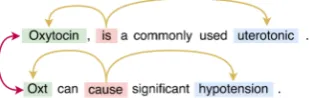
Figure 1: Sentences with non-local dependencies between named entities. The red arrow represents a relation be-tween co-referred entities and yellow arrows represent se-mantically dependent relations. Example adapted from the CDR dataset (Wei et al.,2015).
relation extraction (RE). However, such depen-dencies are not adequate for inter-sentence RE, since different sentences have different depen-dency trees. Figure 1 illustrates such a case be-tweenOxytocinandhypotension. To capture their relation, it is essential to connect the co-referring entities Oxytocin and Oxt. RNNs and CNNs, which are often used for intra-sentence RE (Zeng et al., 2014;dos Santos et al., 2015; Zhou et al.,
2016b;Lin et al.,2016), are not effective on longer sequences (Sahu and Anand,2018) thus failing to capture such non-local dependencies.
We propose a novel inter-sentence RE model that builds a labelled edge Graph CNN (GCNN) model (Marcheggiani and Titov, 2017) on a document-level graph. The graph nodes corre-spond to words and edges represent local and non-local dependencies among them. The document-level graph is formed by connecting words with local dependencies from syntactic parsing and se-quential information, as well as non-local depen-dencies from coreference resolution and other se-mantic dependencies (Peng et al., 2017). We infer relations between entities using MIL-based bi-affine pairwise scoring function (Verga et al.,
2018) on the entity node representations.
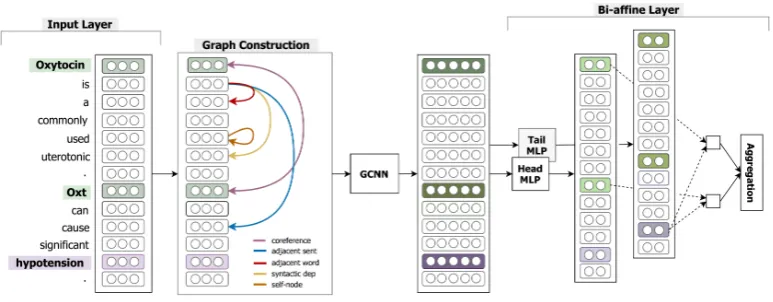
pro-Figure 2:Proposed model architecture. The input word sequence is mapped to a graph structure, where nodes are words and edges correspond to dependencies. We omit several edges, such as self-node edges of all words and syntactic dependency edges of different labels, for brevity. GCNN is employed to encode the graph and a bi-affine layer aggregates all mention pairs.
pose a novel model for inter-sentence RE using GCNN to capture local and non-local dependen-cies. Secondly, we apply the model on two bio-chemistry corpora and show its effectiveness. Fi-nally, we developed a novel, distantly supervised dataset with chemical reactant-product relations from PubMed abstracts.1
2 Proposed Model
We formulate the inter-sentence, document-level RE task as a classification problem. Let
[w1, w2,· · ·, wn] be the words in a document t and e1 and e2 be the entity pair of interest in t.
We name the multiple occurrences of these enti-ties in the document entity mentions. A relation extraction model takes a triple (e1, e2, t) as
in-put and returns a relation for the pair, including the “no relation” category, as output. We assume that the relationship of the target entities in tcan be inferred based on all their mentions. We thus apply multi-instance learning on tto combine all mention-level pairs and predict the final relation category of a target pair.
We describe the architecture of our proposed model in Figure 2. The model takes as input an entire abstract of scientific articles and two target entities with all their mentions in the input layer. It then constructs a graph structure with words as nodes and labelled edges that correspond to local and non-local dependencies. Next, it encodes the graph structure using a stacked GCNN layer and classifies the relation between the target entities by applying MIL (Verga et al.,2018) to aggregate all
1The dataset is publicly available athttp://nactem.
ac.uk/CHR/.
mention pair representations.
2.1 Input Layer
In the input layer, we map each wordiand its rela-tive positions to the first and second target entities into real-valued vectors,wi,d1i,d2i, respectively. As entities can have more than one mention, we calculate the relative position of a word from the closest target entity mention. For each wordi, we concatenate the word and position representations into an input representation,xi= [wi;d1i;d2i].
2.2 Graph Construction
In order to build a document-level graph for an entire abstract, we use the following categories of inter- and intra-sentence dependency edges, as shown with different colours in Figure2.
Syntactic dependency edge:The syntactic struc-ture of a sentence reveals helpful clues for intra-sentential RE (Miwa and Bansal,2016). We thus use labelled syntactic dependency edges between the words of each sentence, by treating each syn-tactic dependency label as a different edge type.
Coreference edge:As coreference is an important indicator of local and non-local dependencies (Ma et al.,2016), we connect co-referring phrases in a document using coreference type edges.
Adjacent sentence edge:We connect the syntac-tic root of a sentence with the roots of the previ-ous and next sentences with adjacent sentence type edges (Peng et al.,2017) for non-local dependen-cies between neighbouring sentences.
[image:2.595.106.493.62.213.2]words with adjacent word type edges.
Self-node edge: GCNN learns a node representa-tion based solely on its neighbour nodes and their edge types. Hence, to include the node informa-tion itself into the representainforma-tion, we form self-node type edges on all the self-nodes of the graph.
2.3 GCNN Layer
We compute the representation of each input word i by applying GCNN (Kipf and Welling, 2017;
Defferrard et al., 2016) on the constructed doc-ument graph. GCNN is an advanced version of CNN for graph encoding that learns semantic rep-resentations for the graph nodes, while preserv-ing its structural information. In order to learn edge type-specific representations, we use a la-belled edge GCNN, which keeps separate param-eters for each edge type (Vashishth et al., 2018). The GCNN iteratively updates the representation of each input wordias follows:
xki+1=f
X
u∈ν(i)
Wlk(i,u)xuk+bkl(i,u)
,
where xki+1 is the i-th word representation re-sulted from the k-th GCNN block, ν(i) is a set of neighbouring nodes toi,Wlk(i,u)andbkl(i,u)are the parameters of thek-th block for edge typel be-tween nodesiandu. We stackKGCNN blocks to accumulate information from distant neighbouring nodes and use edge-wise gating to control infor-mation from neighbouring nodes.
Similar to Marcheggiani and Titov (2017), we maintain separate parameters for each edge direc-tion. We, however, tune the number of model pa-rameters by keeping separate papa-rameters only for the top-Ntypes and using the same parameters for all the remaining edge types, named “rare” type edges. This can avoid possible overfitting due to over-parameterisation for different edge types.
2.4 MIL-based Relation Classification
Since each target entity can have multiple men-tions in a document, we employ a multi-instance learning (MIL)-based classification scheme to ag-gregate the predictions of all target mention pairs using bi-affine pairwise scoring (Verga et al.,
2018). As shown in Figure 2, each word i is firstly projected into two separate latent spaces using two-layered feed-forward neural networks (FFNN), which correspond to the first (head) or
second (tail) argument of the target pair.
xheadi =W(1)headReLUW(0)head xKi ,
xtaili =W(1)tail
ReLU
Wtail(0) xKi
,
wherexK
i corresponds to the representation of the i-th word after |K| blocks of GCNN encoding, W(0),W(1)are the parameters of two FFNNs for head and tail respectively andxhead
i , xtaili ∈ Rd are the resulted head/tail representations for thei -th word.
Then, mention-level pairwise confidence scores are generated by a bi-affine layer and aggregated to obtain the entity-level pairwise score.
scores(ehead, etail) =
log X
i∈Ehead, j∈Etail
expxheadi Rxtailj ,
where, R ∈ Rd×r×d is a learned bi-affine ten-sor with r the number of relation categories, and Ehead, Etail denote a set of mentions for entities eheadandetail respectively.
3 Experimental Settings
We first briefly describe the datasets where the proposed model is evaluated along with their pre-processing. We then introduce the baseline mod-els we use for comparison. Finally, we show the training settings.
3.1 Data Sets
We evaluated our model on two biochemistry datasets.
Chemical-Disease Relations dataset (CDR):
The CDR dataset is a document-level, inter-sentence relation extraction dataset developed for theBioCreative Vchallenge (Wei et al.,2015).
CHemical Reactions dataset (CHR):We created a document-level dataset with relations between chemicals using distant supervision. Firstly, we used the back-end of the semantic faceted search engine Thalia2 (Soto et al., 2018) to obtain ab-stracts annotated with several biomedical named entities from PubMed. We selected chemical com-pounds from the annotated entities and aligned them with the graph databaseBiochem4j( Swain-ston et al.,2017). Biochem4jis a freely available database that integrates several resources such as
Data Count Train Dev. Test
CDR
# Articles 500 500 500
# Positive pairs 1,038 1,012 1,066 # Negative pairs 4,198 4,069 4,119
CHR
[image:4.595.77.286.62.145.2]# Articles 7,298 1,182 3,614 # Positive pairs 19,643 3,185 9,578 # Negative pairs 69,843 11,466 33,339
Table 1:Statistics of the CDR and CHR datasets.
UniProt, KEGG and NCBI Taxonomy3. If two chemical entities have a relation inBiochem4j, we consider them as positive instances in the dataset, otherwise as negative.
3.2 Data Pre-processing
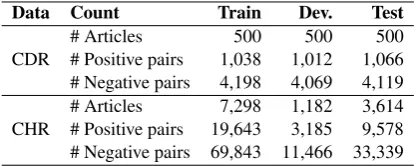
Table 1 shows the statistics for CDR and CHR datasets. For both datasets, the annotated enti-ties can have more than one associated Knowledge Base (KB) ID. If there is at least one common KB ID between mentions then we considered all these mentions to belong to the same entity. This technique results in less negative pairs. We ig-nored entities that were not grounded to a known KB ID and removed relations between the same entity (self-relations). For the CDR dataset, we performed hypernym filtering similar to Gu et al.
(2017) andVerga et al.(2018). In the CHR dataset, both directions were generated for each candidate chemical pair as chemicals can be either a reactant (first argument) or a product (second argument) in an interaction.
We processed the datasets using the GENIA Sentence Splitter4 and GENIA tagger (Tsuruoka et al.,2005) for sentence splitting and word tokeni-sation, respectively. Syntactic dependencies were obtained using the Enju syntactic parser (Miyao and Tsujii, 2008) with predicate-argument struc-tures. Coreference type edges were constructed using the Stanford CoreNLP software (Manning et al.,2014).
3.3 Baseline Models
For the CDR dataset, we compare with five state-of-the-art models: SVM (Xu et al., 2016b), en-semble of feature-based and neural-based mod-els (Zhou et al.,2016a), CNN and Maximum En-tropy (Gu et al.,2017), Piece-wise CNN (Li et al.,
2018) and Transformer (Verga et al., 2018). We additionally prepare and evaluate the following
3
http://biochem4j.org
4http://www.nactem.ac.uk/y-matsu/
geniass/
models:CNN-RE, a re-implementation fromKim
(2014) andZhou et al.(2016a) andRNN-RE, a re-implementation fromSahu and Anand(2018). In all models we use bi-affine pairwise scoring to de-tect relations.
3.4 Model Training
We used 100-dimentional word embeddings trained on PubMed with GloVe (Pennington et al.,
2014;TH et al.,2015). UnlikeVerga et al.(2018), we used the pre-trained word embeddings in place of sub-word embeddings to align with our word graphs. Due to the size of the CDR dataset, we merged the training and development sets to train the models, similarly toXu et al.(2016a) andGu et al. (2017). We report the performance as the average of five runs with different parameter ini-tialisation seeds in terms of precision (P), recall (R) and F1-score. We used the frequencies of the edge types in the training set to choose the top-N edges in Section2.3. We refer to the supplemen-tary materials for the details of the training and hyper-parameter settings.
4 Results
We show the results of our model for the CDR and CHR datasets in Table 2. We report the perfor-mance of state-of-the-art models without any ad-ditional enhancements, such as joint training with NER, model ensembling and heuristic rules, to avoid any effects from the enhancements in the comparison. We observe that the GCNN outper-forms the baseline models (CNN-RE/RNN-RE) in both datasets. However, in the CDR dataset, the performance of GCNN is 1.6 percentage points lower than the best performing system of (Gu et al., 2017). In fact, Gu et al. (2017) incorpo-rates two separate neural and feature-based mod-els for intra- and inter-sentence pairs, respec-tively, whereas we utilize a single model for both pairs. Additionally, GCNN performs compara-bly to the second state-of-the-art neural modelLi et al.(2018), which requires a two-step process for mention aggregation unlike our unified approach.
Data Model P(%) R(%) F1(%)
CDR
Xu et al.(2016a) 59.6 44.0 50.7
Zhou et al.(2016a) 64.8 49.2 56.0
Gu et al.(2017) 60.9 59.5 60.2
Li et al.(2018) 55.1 63.6 59.1
Verga et al.(2018) 49.9 63.8 55.5
CNN-RE 51.5 65.7 57.7
RNN-RE 52.6 62.9 57.3
GCNN 52.8 66.0 58.6
CHR
CNN-RE 81.2 87.3 84.1
RNN-RE 83.0 90.1 86.4
[image:5.595.75.288.61.204.2]GCNN 84.7 90.5 87.5
Table 2:Performance on the CDR and CHR test sets in com-parison with the state-of-the-art.
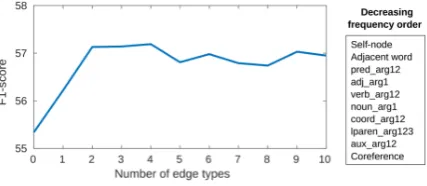
Figure 3:Performance of GCNN model on the CDR devel-opment set when using the top-N most frequent edge types and consider the rest as a single “rare” type.
Model Overall Intra Inter
GCNN(best) 57.19 63.43 36.90
−Adjacent word 55.75 62.53 35.61
−Syntactic dependency 56.12 62.89 34.75
−Coreference 56.44 63.27 35.65
−Self-node 56.85 63.84 33.20
−Adjacent sentence 57.00 63.99 35.20
Table 3:Ablation analysis on the CDR development set, in terms of F1-score (%), for intra- (Intra) and inter-sentence (Inter) pairs.
We perform ablation analysis on the CDR dataset by separating the development set to intra-and inter-sentence pairs (approximately 70% intra-and 30% of pairs, respectively). Table 3 shows the performance when removing an edge category at a time. In general, all dependency types have pos-itive effects on inter-sentence RE and the over-all performance, although self-node and adjacent sentence edges slightly harm the performance of intra-sentence relations. Additionally, coreference does not affect intra-sentence pairs.
5 Related Work
Inter-sentence RE is a recently introduced task.
Peng et al. (2017) and Song et al. (2018) used graph-based LSTM networks forn-ary RE in mul-tiple sentences for protein-drug-disease
associa-tions. They restricted the relation candidates in up to two-span sentences.Verga et al.(2018) con-sidered multi-instance learning for document-level RE. Our work is different fromVerga et al.(2018) in that we replace Transformer with a GCNN model for full-abstract encoding using non-local dependencies such as entity coreference.
GCNN was firstly proposed by Kipf and Welling (2017) and applied on citation networks and knowledge graph datasets. It was later used for semantic role labelling (Marcheggiani and Titov,2017), multi-document summarization ( Ya-sunaga et al.,2017) and temporal relation extrac-tion (Vashishth et al.,2018). Zhang et al. (2018) used a GCNN on a dependency tree for intra-sentence RE. Unlike previous work, we introduced a GCNN on a document-level graph, with both intra- and sentence dependencies for inter-sentence RE.
6 Conclusion
We proposed a novel graph-based method for inter-sentence RE using a labelled edge GCNN model on a document-level graph. The graph is constructed with words as nodes and multiple intra- and inter-sentence dependencies between them as edges. A GCNN model is employed to en-code the graph structure and MIL is incorporated to aggregate the multiple mention-level pairs . We show that our method achieves comparable perfor-mance to the state-of-the-art neural models on two biochemistry datasets. We tuned the number of la-belled edges to maintain the number of parameters in the labelled edge GCNN. Analysis showed that all edge types are effective for inter-sentence RE.
Although the model is applied to biochemistry corpora for inter-sentence RE, our method is also applicable to other relation extraction tasks. As fu-ture work, we plan to incorporate joint named en-tity recognition training as well as sub-word em-beddings in order to further improve the perfor-mance of the proposed model.
Acknowledgments
[image:5.595.74.288.245.338.2]References
Aron Culotta and Jeffrey Sorensen. 2004. Dependency tree kernels for relation extraction. In Proceed-ings of Annual Meeting on Association for Compu-tational Linguistics, pages 423–430. Association for Computational Linguistics.
Michaël Defferrard, Xavier Bresson, and Pierre Van-dergheynst. 2016. Convolutional neural networks on graphs with fast localized spectral filtering. In
Ad-vances in Neural Information Processing Systems,
pages 3844–3852.
Jinghang Gu, Fuqing Sun, Longhua Qian, and Guodong Zhou. 2017. Chemical-induced disease re-lation extraction via convolutional neural network.
Database, 2017:1–12.
Yoon Kim. 2014. Convolutional neural networks for sentence classification. In Proceedings of Confer-ence on Empirical Methods in Natural Language
Processing, pages 1746–1751. Association for
Com-putational Linguistics.
Diederik P Kingma and Jimmy Ba. 2015. Adam: A method for stochastic optimization. InProceedings of the International Conference on Learning Repre-sentations.
Thomas N Kipf and Max Welling. 2017. Semi-supervised classification with graph convolutional networks. InInternational Conference on Learning Representations.
Haodi Li, Ming Yang, Qingcai Chen, Buzhou Tang, Xiaolong Wang, and Jun Yan. 2018. Chemical-induced disease extraction via recurrent piecewise convolutional neural networks. BMC Medical Infor-matics and Decision Making, 18(2):60.
Yankai Lin, Shiqi Shen, Zhiyuan Liu, Huanbo Luan, and Maosong Sun. 2016. Neural relation extraction with selective attention over instances. In Proceed-ings of Annual Meeting of the Association for Com-putational Linguistics, volume 1, pages 2124–2133. Association for Computational Linguistics.
Yang Liu, Furu Wei, Sujian Li, Heng Ji, Ming Zhou, and Houfeng Wang. 2015. A dependency-based neural network for relation classification. In Pro-ceedings of the 53rd Annual Meeting of the Associ-ation for ComputAssoci-ational Linguistics and the 7th In-ternational Joint Conference on Natural Language
Processing, pages 285–290. Association for
Com-putational Linguistics.
Xuezhe Ma, Zhengzhong Liu, and Eduard Hovy. 2016. Unsupervised ranking model for entity coreference resolution. In Proceedings of the Conference of the North American Chapter of the Association for Computational Linguistics: Human Language
Tech-nologies, pages 1012–1018. Association for
Compu-tational Linguistics.
Christopher D Manning, Mihai Surdeanu, John Bauer, Jenny Finkel, Steven Bethard, and David McClosky. 2014. The Stanford CoreNLP natural language pro-cessing toolkit. In Proceedings of 52nd Annual Meeting of the Association for Computational
Lin-guistics: System Demonstrations, pages 55–60.
As-sociation for Computational Linguistics.
Diego Marcheggiani and Ivan Titov. 2017. Encoding sentences with graph convolutional networks for se-mantic role labeling. InProceedings of Conference on Empirical Methods in Natural Language
Pro-cessing, pages 1506–1515. Association for
Compu-tational Linguistics.
Makoto Miwa and Mohit Bansal. 2016. End-to-end re-lation extraction using lstms on sequences and tree structures. In Proceedings of the Annual Meeting
of the Association for Computational Linguistics,
pages 1105–1116. Association for Computational Linguistics.
Yusuke Miyao and Jun’ichi Tsujii. 2008. Feature for-est models for probabilistic HPSG parsing. Compu-tational Linguistics, 34(1):35–80.
Nanyun Peng, Hoifung Poon, Chris Quirk, Kristina Toutanova, and Wen-tau Yih. 2017. Cross-sentence n-ary relation extraction with Graph LSTMs. Trans-actions of the Association for Computational Lin-guistics, 5:101–115.
Jeffrey Pennington, Richard Socher, and Christopher D Manning. 2014. GloVe: Global vectors for word representation. In Proceedings of the Conference on Empirical Methods in Natural Language
Pro-cessing, pages 1532–1543. Association for
Compu-tational Linguistics.
Sebastian Riedel, Limin Yao, and Andrew McCallum. 2010. Modeling relations and their mentions with-out labeled text. In Joint European Conference on Machine Learning and Knowledge Discovery in Databases, pages 148–163. Springer.
Sunil Kumar Sahu and Ashish Anand. 2018. Drug-drug interaction extraction from biomedical texts us-ing long short-term memory network. Journal of Biomedical Informatics, 86:15 – 24.
Cıcero Nogueira dos Santos, Bing Xiang, and Bowen Zhou. 2015. Classifying relations by ranking with convolutional neural networks. In Proceedings of the Annual Meeting of the Association for Com-putational Linguistics and the International Joint
Conference on Natural Language Processing, pages
626–634. Association for Computational Linguis-tics.
Linfeng Song, Yue Zhang, Zhiguo Wang, and Daniel Gildea. 2018. N-ary relation extraction using graph-state LSTM. InProceedings of Conference on
Em-pirical Methods in Natural Language Processing,
Axel J Soto, Piotr Przybyła, and Sophia Ananiadou. 2018. Thalia: Semantic search engine for biomedi-cal abstracts. Bioinformatics.
Mihai Surdeanu, Julie Tibshirani, Ramesh Nallapati, and Christopher D Manning. 2012. Multi-instance multi-label learning for relation extraction. In Pro-ceedings of the Joint Conference on Empirical Meth-ods in Natural Language Processing and
Computa-tional Natural Language Learning, pages 455–465.
Association for Computational Linguistics.
Neil Swainston, Riza Batista-Navarro, Pablo Car-bonell, Paul D Dobson, Mark Dunstan, Adrian J Jervis, Maria Vinaixa, Alan R Williams, Sophia Ananiadou, Jean-Loup Faulon, et al. 2017. biochem4j: Integrated and extensible biochemical knowledge through graph databases. PloS one, 12(7):e0179130.
MUNEEB TH, Sunil Sahu, and Ashish Anand. 2015. Evaluating distributed word representations for cap-turing semantics of biomedical concepts. In Pro-ceedings of BioNLP, pages 158–163. Association for Computational Linguistics.
Yoshimasa Tsuruoka, Yuka Tateishi, Jin-Dong Kim, Tomoko Ohta, John McNaught, Sophia Ananiadou, and Jun’ichi Tsujii. 2005. Developing a robust part-of-speech tagger for biomedical text. In
Panhel-lenic Conference on Informatics, pages 382–392.
Springer.
Shikhar Vashishth, Shib Sankar Dasgupta, Swayambhu Nath Ray, and Partha Talukdar. 2018. Dating documents using graph convolution networks. In Proceedings of the Annual Meeting
of the Association for Computational Linguistics,
pages 1605–1615. Association for Computational Linguistics.
Patrick Verga, Emma Strubell, and Andrew McCallum. 2018. Simultaneously self-attending to all men-tions for full-abstract biological relation extraction.
In Proceedings of Conference of the North
Ameri-can Chapter of the Association for Computational
Linguistics: Human Language Technologies, pages
872–884. Association for Computational Linguis-tics.
Chih-Hsuan Wei, Yifan Peng, Robert Leaman, Al-lan Peter Davis, Carolyn J Mattingly, Jiao Li, Thomas C Wiegers, and Zhiyong Lu. 2015. Overview of the BioCreative V chemical disease relation (CDR) task. In Proceedings of the fifth
BioCreative challenge evaluation workshop, pages
154–166.
Jun Xu, Yonghui Wu, Yaoyun Zhang, Jingqi Wang, Hee-Jin Lee, and Hua Xu. 2016a. CD-REST: a sys-tem for extracting chemical-induced disease relation in literature. Database, 2016:1–10.
Kun Xu, Siva Reddy, Yansong Feng, Songfang Huang, and Dongyan Zhao. 2016b. Question answering
on freebase via relation extraction and textual ev-idence. In Proceedings of the 54th Annual Meet-ing of the Association for Computational LMeet-inguis- Linguis-tics, pages 2326–2336. Association for Computa-tional Linguistics.
Michihiro Yasunaga, Rui Zhang, Kshitijh Meelu, Ayush Pareek, Krishnan Srinivasan, and Dragomir Radev. 2017. Graph-based neural multi-document summarization. InProceedings of the 21st
Confer-ence on Computational Natural Language Learning,
pages 452–462. Association for Computational Lin-guistics.
Daojian Zeng, Kang Liu, Siwei Lai, Guangyou Zhou, and Jun Zhao. 2014. Relation Classification via Convolutional Deep Neural Network. In Proceed-ings of the International Conference on Computa-tional Linguistics, pages 2335–2344.
Yuhao Zhang, Peng Qi, and Christopher D Manning. 2018. Graph convolution over pruned dependency trees improves relation extraction. InProceedings of the 2018 Conference on Empirical Methods in
Nat-ural Language Processing, pages 2205–2215.
Asso-ciation for Computational Linguistics.
Huiwei Zhou, Huijie Deng, Long Chen, Yunlong Yang, Chen Jia, and Degen Huang. 2016a. Exploit-ing syntactic and semantics information for chem-ical–disease relation extraction. Database, 2016:1– 12.
A Training and Hyper-parameter Settings
We implemented all models using Tensorflow5. The development set was used for hyper-parameter tuning. For all models, parameters were optimised using the Adam optimisation algo-rithm with exponential moving average (Kingma and Ba, 2015), learning rate of 0.0005, learn-ing rate decay of 0.75 and gradient clipping 10. We used early stopping with patience equal to
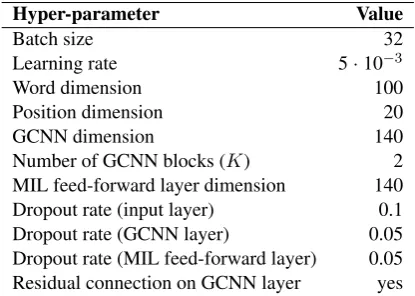
5 epochs in order to determine the best training epoch. For other hyper-parameters, we performed a non-exhaustive hyper-parameter search based on the development set. We used the same hyper-parameters of both CDR and CHR datasets. The best hyper-parameter values are shown in Table4.
Hyper-parameter Value
Batch size 32
Learning rate 5·10−3
Word dimension 100
Position dimension 20
GCNN dimension 140
Number of GCNN blocks (K) 2
MIL feed-forward layer dimension 140
Dropout rate (input layer) 0.1
Dropout rate (GCNN layer) 0.05
[image:8.595.77.285.298.446.2]Dropout rate (MIL feed-forward layer) 0.05 Residual connection on GCNN layer yes
Table 4:Best performing hyper-parameters used in the pro-posed model.