722
SP-10K: A Large-scale Evaluation Set for
Selectional Preference Acquisition
Hongming Zhang, Hantian Ding, and Yangqiu Song Department of CSE, HKUST
[email protected], [email protected], [email protected]
Abstract
Selectional Preference (SP) is a commonly ob-served language phenomenon and proved to be useful in many natural language processing tasks. To provide a better evaluation method for SP models, we introduce SP-10K, a large-scale evaluation set that provides human rat-ings for the plausibility of 10,000 SP pairs over five SP relations, covering 2,500 most fre-quent verbs, nouns, and adjectives in Ameri-can English. Three representative SP acquisi-tion methods based on pseudo-disambiguaacquisi-tion are evaluated with SP-10K. To demonstrate the importance of our dataset, we investi-gate the relationship between SP-10K and the commonsense knowledge in ConceptNet5 and show the potential of using SP to represent the commonsense knowledge. We also use the Winograd Schema Challenge to prove that the proposed new SP relations are essential for the hard pronoun coreference resolution problem.
1 Introduction
Selectional Preference (SP) is a common phe-nomenon in human language that has been shown to be related to semantics (Wilks,1975). Here by SP we mean that, given a word and a dependency relation, human beings have preferences for which words are likely to be connected. For instance, when seeing the verb ‘sing’, it is highly plausi-ble that its object is ‘a song’, and when seeing the noun ‘air’, it is highly plausible that its modifier is ‘fresh’.
SP has been shown to be useful over a variety of tasks including sense disambiguation (Resnik, 1997), semantic role classification (Zapirain et al., 2013), coreference clustering (Hobbs,1978;Inoue et al., 2016; Heinzerling et al., 2017), and ma-chine translation (Tang et al., 2016). Given the importance of SP, the automatic acquisition of SP has become a well-known research subject in the
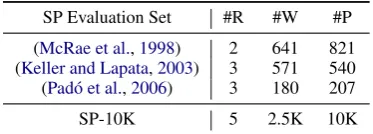
SP Evaluation Set #R #W #P
(McRae et al.,1998) 2 641 821 (Keller and Lapata,2003) 3 571 540 (Pad´o et al.,2006) 3 180 207
[image:1.595.323.510.222.289.2]SP-10K 5 2.5K 10K
Table 1: Statistics of Human-labeled SP Evaluation Sets. #R, #W, and #P indicate the number of SP re-lation types, words, and pairs, respectively.
NLP community. However, current SP acquisition models are limited based on existing evaluation methods. We discuss two broadly used evalua-tion methods, human-labeled evaluaevalua-tion sets and the pseudo-disambiguation task.
First, the most straightforward way to evalu-ate SP models is by asking human annotators. McRae et al. (1998), Keller and Lapata (2003), and Pad´o et al. (2006) proposed human-labeled SP evaluation sets containing hundreds of SP pairs (numbers are shown in Table1). However, these datasets are too small to cover the diversity of the SP task adequately. Moreover, they only consid-ered one-hop relations, such as ‘verb-object’ and ‘modifier-noun’ pairs. Aside from these relations, we believe that higher-order dependency relations may also reflect meaningful commonsense knowl-edge. Consider the following two examples of hard pronoun resolution problems from the Wino-grad Schema Challenge (Levesque et al.,2011):
• (A) The fish ate the worm. It was hungry.
• (B) The fish ate the worm. It was tasty.
and ‘verb-subject-modifier’, which have not been investigated in previous works.
Second, pseudo-disambiguation has been a pop-ular alternative evaluation method for the SP ac-quisition task (Ritter et al.,2010;de Cruys,2014). This way of SP acquisition trains a model based on pairs from a training corpus as positive exam-ples and randomly generates fake pairs as negative examples, and then evaluates the model based on its ability on a test corpus by constructing posi-tive and negaposi-tive examples in the same way. How-ever, the pseudo-disambiguation task only evalu-ates how well a model fits the data, which could be biased. The problem is that changing the cor-pus of training and testing may result in different conclusions. Thus, it is less robust than collecting SP pairs by asking expert annotators as (McRae et al.,1998), (Keller and Lapata,2003), and (Pad´o et al.,2006), or even asking many ordinary people to vote for a commonsense agreement.
The problems of these methods motivate the creation of a large-scale human-labeled SP eval-uation set based on crowdsourcing, which can be used as the ground truth for the SP acquisition task.
In this paper, we present SP-10K, which is un-precedented in both size and the number of SP relations. It contains 10,000 selectional triplets consisting of 2,500 frequent verbs, nouns, and adjectives in American English. Besides com-monly used one-hop SP relations (‘dobj’, ‘nsubj’, and ‘amod’), we introduce two novel two-hop SP relations (‘dobj amod’ and ‘nsubj amod’). We first evaluate three representative SP acquisition methods using SP-10K and compare the capac-ity of the state-of-the-art pseudo-disambiguation approaches. We then show the relationship be-tween SP-10K and commonsense knowledge us-ing ConceptNet5 (Speer and Havasi, 2012) to demonstrate the potential of using SP to rep-resent commonsense knowledge. Finally, we use a subset of the Winograd Schema Chal-lenge (Levesque et al., 2011) to prove that the proposed two-hop SP relations are essential for the hard pronoun coreference resolution. SP-10K is available at: https://github.com/ HKUST-KnowComp/SP-10K.
2 Design of SP-10K
As discussed in (Hill et al.,2015), a high-quality evaluation resource should be: (1) clearly defined;
(2) representative; and (3) consistent and reliable. First, similar to existing human-labeled SP eval-uation sets (McRae et al.,1998;Keller and Lapata, 2003;Pad´o et al.,2006), SP-10K uses the plausi-bility of selectional pairs as the annotation. Hence, SP-10K is clearly defined. Second, compared to these existing evaluation sets, as shown in Table1, SP-10K covers a larger number of relations and SP pairs, making it a more representative evalua-tion set. Finally, as discussed in Secevalua-tion3.4, the annotation of SP-10K is consistent and reliable.
2.1 Selectional Relations
Traditionally, the study of SP has focused on three selectional relations: verb-subject, verb-object, and noun-adjective. As demonstrated in Section1, some verbs have a preference for the properties of their subjects and objects. For example, it is plausible to say that the subject of ‘eat’ is hun-gry and the object of ‘eat’ is tasty, but not the other way round. To capture such preferences, we propose two novel two-hop dependency rela-tions, ‘dobj amod’ and ‘nsubj amod’. Examples of these relations are presented in Table2. In to-tal, SP-10K contains five SP relations.
Following previous approaches (McRae et al., 1998;Pad´o et al.,2006), for the ‘dobj’ and ‘nsubj’ relations, we take a verb as the head and a noun as the dependent. Similarly, for ‘dobj amod’ and ‘nsubj amod’ relations, we take a verb as the head and an adjective as the dependent. Moreover, for the ‘amod’ relation, we take a noun as the head and an adjective as the dependent.
2.2 Candidate SP Pairs
The selected vocabulary consists of 2,500 verbs, nouns, and adjectives from the 5,000 most fre-quent words1 in the Corpus of Contemporary American English.
For each SP relation, we provide two types of SP pairs for our annotators to label: frequent pairs and random pairs. For each selectional relation, we first select the 500 most frequent heads. We then match each head with its two most frequently-paired dependents, as well as two randomly se-lected dependents from our vocabulary. As such, we retrieve 2,000 pairs for each relation. Alto-gether, we retrieve 10,000 pairs for five selectional relations. These pairs are composed of 500 verbs,
Relation Frequent Random
‘dobj’ (ask, question) (ask, voting) (ask, time) (ask, stability)
‘nsubj’ (people, eat) (textbook, eat) (husband, eat) (stream, eat)
‘amod’ (fresh, air) (rational, air) (cold, air) (original, air)
‘dobj amod’ (design, new) (design, official) (design, original) (design, civil)
[image:3.595.319.513.61.155.2]‘nsubj amod’ (friendly, smile) (young, smile) (symbolic, smile) (civilian, smile)
Table 2: Examples of candidate pairs for annotation. For the ease of understanding, the order of head and dependent may be different for various relations.
1,343 nouns, and 657 adjectives. Examples of sampled pairs are presented in Table2.
3 Annotation of SP Pairs
We employ the Amazon Mechanical Turk plat-form (MTurk) for our annotations.2
3.1 Survey Design
Following the SimLex-999 annotation guide-lines (Hill et al.,2015), we invite at least 11 anno-tators to score each SP pair. We divide our 10,000 pairs into 100 surveys. Each survey contains 103 questions, three of which are checkpoint questions selected from the examples to control the labeling quality. Within a survey, all the questions are de-rived from the same selectional relation to improve the efficiency of survey completion.
Each survey consists of three parts. We begin by explaining the task to the annotators, including how to deal with the special case like multi-word expressions. Then, we present three examples to help the annotators better understand the task. Fi-nally, we ask questions using the following tem-plates (VERB, ADJ, and NOUN are place holders and will be replaced with the corresponding heads and dependents in the actual surveys.):
• dobj: How suitable do you think it is if we use NOUN as the object of the verb VERB?
• nsubj:How suitable do you think it is if we use NOUN as the subject of the verb VERB?
2According to (Peer et al., 2017), Amazon MTurk
(https://www.mturk.com/) has the largest worker population and highest annotation quality compared to other crowd-sourcing services.
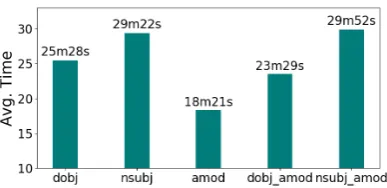
Figure 1: Average annotation time per 100 questions. ‘m’ indicates minutes and ‘s’ indicates seconds.
• amod:How suitable do you think it is if we use ADJ to describe the noun NOUN?
• dobj amod: How suitable do you think it is if we use ADJ to describe the object of the verb VERB?
• nsubj amod: How suitable do you think it is if we use ADJ to describe the subject of the verb VERB?
For each question, the annotator is asked to se-lect one of the following options: Perfectly match (5), Make sense (4), Normal (3), Seems weird (2), It’s not applicable at all (1). We randomize the or-der of frequent and random pairs to prevent anno-tators from simply memorizing the question order.
3.2 Participants and Annotation
We require that our annotators are ‘Master Work-ers’, indicating reliable annotation records3, and that our annotators are either native English speak-ers or currently live and/or work in English-speaking locales. Based on these criteria, we identified 125 valid annotators. These annota-tors produced 130,575 ratings for a total cost of USD1,182.80. We support the multiple par-ticipation of annotators by ensuring that subse-quent surveys are generated with their previously-unanswered questions.
From our annotation statistics, we notice that different selectional relations take different time to annotate. As shown in Figure 1, the annota-tors spent the least time on the ‘amod’ relation, suggesting that the modifying relation is relatively easy to understand and judge. Another interesting finding is that the annotators spend more time on relations involving subjects than those involving objects, which is consistent with the observation proposed by (Jackendoff, 1992) that verbs have clearer preferences for objects than subjects.
[image:3.595.77.284.63.204.2]SP Pair Plausibility
(eat, meal) 10.00 (close, door) 8.50 (convince, people) 7.75 (touch, food) 5.50 (hate, investment) 4.00 (confront, impulse) 2.78 (eat, mail) 0.00
(a) dobj
SP Pair Plausibility
(singer, sing) 10.00 (law, permit) 7.78 (women, pray) 5.83 (realm, remain) 3.06 (victim, contain) 2.22 (bar, act) 1.39 (textbook, eat) 0.00
(b) nsubj
SP Pair Plausibility
(fresh, air) 9.77 (new, method) 8.89 (young, people) 6.82 (medium, number) 4.09 (immediate, food) 2.50 (eager, price) 1.36 (secret, wind) 0.75
(c) amod
SP Pair Plausibility
(lift, heavyobject) 9.17 (design, newobject) 8.00 (recall, previousobject) 7.05 (attack, smallobject) 5.23 (drag, drunkobject) 4.25 (inform, weirdobject) 3.64 (earn, rubberobject) 0.63
(d) dobj amod
SP Pair Plausibility
(friendlysubject, smile) 10.00 (evilsubject, attack) 9.00 (recentsubject, demonstrate) 6.00 (randomsubject, bear) 4.00 (happysubject, steal) 2.25 (stablesubject, understand) 1.75 (sunnysubject, make) 0.56
[image:4.595.98.501.67.279.2](e) nsubj amod
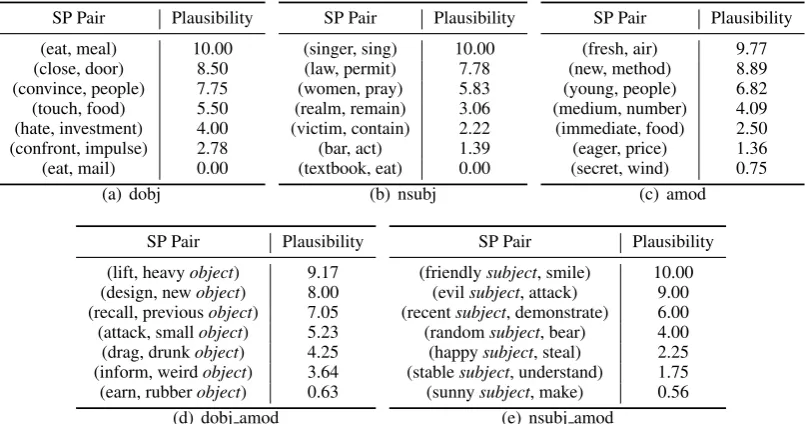
Table 3: Sampled SP pairs from SP-10K and their plausibility ratings.objectandsubjectare place holders to help understand the two-hop SP relations.
dobj nsubj amod d a n a overall
IAA 0.83 0.77 0.81 0.71 0.63 0.75
Table 4: Overall Inter-Annotator Agreement (IAA) of SP-10K. ‘d a’ stands for dobj amod and ‘n a’ stands for nsubj amod.
3.3 Post-processing
We excluded ratings from annotators who (1) pro-vided incorrect answers to any of the checkpoint questions or (2) demonstrated suspicious annota-tion patterns (e.g., marking all pairs as ‘normal’). After excluding based on this criteria, we obtained 100,532 valid annotations with an overall accep-tance rate of 77%. We calculate the plausibility for each SP pair by taking the average rating for the pair over all (at least 10) valid annotations, then linearly scaling this average from the 1-5 to 0-10 interval. This approach is similar to the post-processing in (Hill et al.,2015). We present a sam-ple of SP pairs in Table3. Some of the pairs are interesting. For example, for the dobj amod rela-tion, annotators agree that lifting a heavy object is a usually used expression, while earning a rubber object is rare.
3.4 Inner-Annotator Agreement
Following standard practices from previous datasets WSIM-203 (Reisinger and Mooney, 2010) and Simlex-999 (Hill et al., 2015), we employ Inter-Annotator Agreement (IAA), which
computes the average correlation of an annotator with the average of all the other annotators, to evaluate the overall annotation quality. As presented in Table4, the overall IAA of SP-10K is
ρ= 0.75, which is comparable to existing datasets WSIM-203 (0.65) and Simlex-999 (0.78).
Unsurprisingly, the IAA is not uniform across different SP relations. As shown in Table4, com-plicated two-hop SP relations are more challeng-ing and achieve relatively lower correlations than the simpler one-hop relations. This experimen-tal result shows that two-hop relations are more difficult than one-hop SP relations. We also no-tice that the agreements among annotators for SP relations involving the subjects of verbs are rela-tively low. The above observations are consistent with our earlier discussion on annotation time, and further support the claim that verbs have stronger preferences for their objects than their subjects.
4 Evaluation of SP Acquisition Methods
To show the performance of existing SP acquisi-tion methods and demonstrate the effect of dif-ferent training corpora, we evaluate representative SP acquisition methods on SP-10K with following training corpora:
(1) Wiki: Wikipedia is the largest free knowl-edge dataset. For this experiment, we select the English version of Wikipedia4and filter out pages
Wiki Yelp NYT
[image:5.595.93.272.63.144.2]#(sentence) 82m 41m 56m #(dobj pairs) 69m 33m 49m #(nsubj pairs) 97m 70m 86m #(amod pairs) 119m 31m 65m #(dobj amod pairs) 21m 8.1m 14m #(nsubj amod pairs) 16m 4.8m 12m
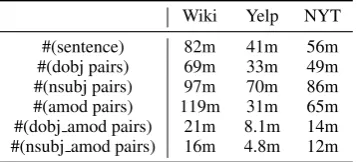
Table 5: Training corpus statistics. ‘m’ means millions.
containing fewer than 100 tokens and fewer than five hyperlinks. After filtering, our dataset con-tains over three million Wikipedia pages.
(2) Yelp: Yelp is a social media platform where users can write reviews for businesses, e.g., restau-rants, hotels, etc. The latest release of the Yelp dataset5contains over five million reviews.
(3) New York Times (NYT):The NYT (Sand-haus and Evan, 2008) dataset contains over 1.8 million news articles from the NYT throughout 20 years (1987 - 2007).
We parsed these raw corpora using the Stanford dependency parser (Schuster and Manning,2016). Detailed statistics are shown in Table5.
4.1 Methods
We now introduce SP acquisition methods. Posterior Probability (PP): Resnik (1997) proposes PP as a means of acquiring SP knowl-edge from raw corpora. Given a headh, a relation
r, and a dependentd, PP uses the following prob-ability to predict the plausibility:
Pr(d|h) =
Cr(h, d)
Cr(h)
, (1)
whereCr(h)andCr(h, d)mean how many times
pand the head-dependent pair (h,d) appear in the relationrrespectively.
Distributional Similarity (DS): Erk et al. (2010) describes a method that uses corpus-driven DS metrics for the induction of SP. Given a head
h, a relation r, and a dependent d, DS uses the following equation to predict the plausibility:
S(h, r, d) = X
d0∈Or,h
w(d, d0)
Zr,h
·s(d, d0), (2)
whereOr,his the set of dependents that have been attested with headpand relationr,w(d, d0)is the weight function, andZr,his the normalization fac-tor. We use the frequency of a pair of (h, d0) as
5https://www.yelp.com/dataset/challenge
the weighting function and the cosine similarity of their GloVe embedding (Pennington et al.,2014) as the similarity functions(d, d0), given the rela-tive popularity of these embeddings.
Neural Network (NN): de Cruys(2014) pro-poses a NN-based method for the SP acquisition task. The main framework is a two-layer fully-connected NN. For each SP pair (h,d), the frame-work uses the concatenation of embeddings [vh,
vd] as the input to the NN, wherevh,vdare ran-domly initialized word embeddings for words h
and d respectively. The ranking-loss (Collobert and Weston, 2008) is used as the training objec-tive, where positive examples consist of all the SP pairs in the corpus and negative examples are randomly generated. During the training process, both model parameters and embeddings are jointly updated. We use the original paper’s experimental setting to conduct our experiment.
4.2 Results and Analysis
We report the average Spearman ρ in Table 6 as our performance measure. We have following in-teresting observations.
(1) Choice of training corpus can influence the SP acquisition models. For the same method, the general corpora, i.e., Wiki and NYT, outperform the domain specific corpus, i.e., Yelp. Yelp per-forms best on the ‘dobj’ relation and comparably on the ‘dobj amod’ relation, which indicates the language use on Yelp may better reflect the plau-sibility of objects rather than of subjects.
(2) As reported by (de Cruys, 2014), the NN-based method performs very well on the pseudo-disambiguation task. However, this method has limited effectiveness on our dataset, which shows that pseudo-disambiguation cannot effec-tively represent ground truth SP. This further demonstrates the value of SP-10K as an evaluation set of SP acquisition.
(3) The overall performance of existing meth-ods is quite lackluster, suggesting that these mod-els insufficiently address the SP acquisition task. We hope that the release of our dataset will mo-tivate efforts at deriving knowledge from SP and exploring the SP acquisition task.
5 SP and Commonsense Knowledge
knowl-Model Wiki Yelp NYT
PP 0.74?† 0.76?†
0.74? DS 0.65 0.55 0.63 NN 0.68 0.55 0.71
(a) dobj
Model Wiki Yelp NYT
PP 0.75?
0.66?† 0.73?† DS 0.59 0.46 0.59 NN 0.70 0.54 0.69
(b) nsubj
Model Wiki Yelp NYT
PP 0.75?†
0.71?† 0.74?† DS 0.67 0.47 0.62 NN 0.68 0.50 0.69
(c) amod
Model Wiki Yelp NYT
PP 0.65? 0.62?† 0.63? DS 0.55 0.47 0.55 NN 0.62 0.52 0.64
(d) dobj amod
Model Wiki Yelp NYT
PP 0.52?† 0.36 0.54?† DS 0.46 0.33 0.47 NN 0.46 0.32 0.47
(e) nsubj amod
Model Wiki Yelp NYT
PP 0.68?† 0.62?† 0.68?† DS 0.58 0.46 0.57 NN 0.63 0.49 0.64
[image:6.595.310.523.287.367.2](f) overall
Table 6: Performance of different corpora and methods on SP-10K. Average Spearmanρscores are reported. ? indicates statistical significant (p<0.005) over DS and†indicates statistical significant (p<0.005) over NN. For each SP relation, rows represent different acquisition methods and columns represent different corpora. The best performed model for each relation is annotated withboldfont.
edge dataset is the Open Mind Common Sense (OMCS) from the ConceptNet 5 (Speer and Havasi,2012) knowledge base. The OMCS con-tains 600k crowdsourced commonsense triplets such as (food, UsedFor, eat) and (wind, Capa-bleOf, blow to east). All of the relations in OMCS are human-defined. In comparison, SP only re-lies on naturally occurring dependency relations, which can be accurately identified using existing parsing tools (Schuster and Manning,2016).
We aim to demonstrate how SP related to com-monsense knowledge. Building relationships be-tween SP and human-defined relations has two ad-vantages: (1) We may be able to directly acquire commonsense knowledge through SP acquisition techniques. (2) We may be able solve common-sense reasoning tasks from the perspective of SP, as illustrated through the two Winograd examples in Section1. These advantages motivate explor-ing the potential of usexplor-ing SP to represent common-sense knowledge.
5.1 SP Pairs and OMCS Triplets
We hypothesize that the plausibility of an SP pair relates to how closely the pair aligns with hu-man commonsense knowledge. As such, the more plausible pairs in SP-10K should be more likely to be covered by the OMCS dataset.
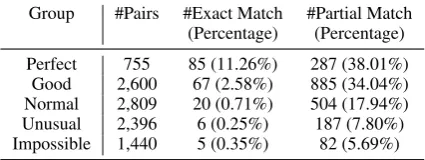
Using plausibility as our criterion, we split the 10,000 SP pairs into five groups: Perfect (8-10), Good (6-8), Normal (4-6), Unusual (2-4), and Im-possible (0-2). As OMCS triplets contain phrases and SP pairs only contain words, we use two meth-ods to match SP pairs with OMCS triplets. (1) Exact Match: we identify triplets in OMCS where
Group #Pairs #Exact Match #Partial Match (Percentage) (Percentage)
Perfect 755 85 (11.26%) 287 (38.01%) Good 2,600 67 (2.58%) 885 (34.04%) Normal 2,809 20 (0.71%) 504 (17.94%) Unusual 2,396 6 (0.25%) 187 (7.80%) Impossible 1,440 5 (0.35%) 82 (5.69%)
Table 7: Matching statistics of SP pairs by plausibility.
the two dependents are exactly the same as the two words in an SP pair. (2) Partial Match: we iden-tify triplets in OMCS where the two dependents contain the two words in an SP pair. We count SP pairs that fulfill either of these matching methods as covered by OMCS. Note that exact matches are not double-counted as partial matches.
As shown in Table7, almost 50% of SP pairs in the perfect group are covered by OMCS. In con-trast, only about 6% of SP pairs from the impossi-ble group are covered. More plausiimpossi-ble selectional preference pairs are more likely to be covered by OMCS, which supports our hypothesis of more plausible SP pairs being more closely aligned with human commonsense knowledge.
5.2 SP and Human-defined Relations
To show the connection between SP relations and human-defined relations, we visualize all match-ing (SP pair, OMCS triplet) tuples in Figure2. A darker color indicates a greater number of matched tuples, which in turn suggests a stronger connec-tion between the two relaconnec-tions.
(a) Exact Match (b) Partial Match
Figure 2: Matched SP relations and OMCS relations. Interesting relation matches such as ‘dobj’ versus ‘UserFor’, ‘nsubj’ versus ‘CapableOf’, and ‘amod’ versus ‘HasProperty’ are observed.
SP relation SP pair versus OMCS triplets
‘dobj’ (sing, song) (9.25/10) (song, UsedFor, sing)
‘nsubj’ (phone, ring) (8.75/10) (phone, CapableOf, ring)
‘amod’ (cold, water) (8.86/10) (water, HasProperty, cold)
‘dobj amod’ (create, new) (8.25/10) (create idea, UsedFor, invent new things)
‘nsubj amod’ (hungry, eat) (10.00/10) (eat, MotivatedByGoal, are hungry) (a) Perfect group (Plausibility: 8-10)
SP relation SP pair versus OMCS triplets
‘dobj’ (eat, mail) (0.00/10) (mail letter, HasSubevent, eat cheese)
‘nsubj’ (library, love) (1.25/10) (love, Atlocation, library)
‘amod’ (red, child) (0.68/10) (child wagon, HasProperty, red)
‘dobj amod’ (drive, bottom) (1.50/10) (drive car, HasSubevent, bottom out)
‘nsubj amod’ (fun, hurt) (1.50/10) (having fun, HasSubevent, get hurt) (b) Impossible group (Plausibility: 0-2)
Table 8: Examples of OMCS-covered SP pairs and their corresponding OMCS triplets.
demonstrates that some simple human-defined relations like ‘UsedFor’, ‘CapableOf’, and ‘HasProperty’ are related to corresponding SP relations. We also notice that the five SP relations in SP-10K seldom match some OMCS relations such as ‘HasA’ and ‘HasSubevent’, which indi-cates a need for additional SP relations or even the combination of different SP relations. We leave it for our future work.
5.3 Case Study
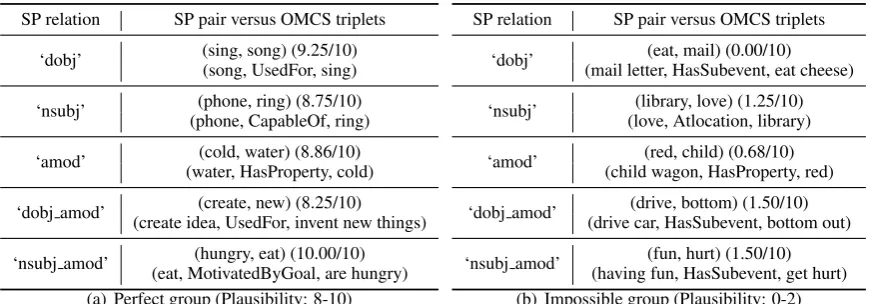
We present a selection of covered pairs from the perfect and impossible groups in Table8. For the perfect group, we find that human-defined com-monsense triplets often have neatly corresponding SP pairs. On the other hand, for the impossible group, SP pairs are covered by OMCS either be-cause of incidental overlap with a non-keyword, e.g., ‘child’ in ‘child wagon’, or because of the low quality of some OMCS triplets. This further illustrates that OMCS still has room for improve-ment and that SP may provide an effective way to improve commonsense knowledge.
6 Importance of Multi-hop SP
As introduced in Section 1, one novel contribu-tion of this paper is the two-hop Seleccontribu-tional Pref-erence relations: ‘nsubj amod’ and ‘dobj amod’. To demonstrate their effectiveness, we select a subset6 of the Winograd Schema Challenge dataset (Levesque et al., 2011), which leverages the two-hop selectional preference knowledge to solve. In total, we have 72 questions out of overall 285 questions. The selected Winograd question is defined as follows: Given one sentences contain-ing two candidates (n1, n2) and one pronoun p,
which is described with one adjectivea, we need to find which candidate is the pronoun referring to. One example is as follows:
• Jimyelled atKevinbecausehewas so upset.
We need to correctly finds out he refers to Jim
6
[image:7.595.82.518.243.395.2]Model Correct Wrong NA Ap Ao
Stanford 33 35 4 48.5% 48.6% End2end 36 36 0 50.0% 50.0%
PP 36 19 17 65.5% 61.8%
SP-10K 13 0 59 100% 59.0%
Table 9: Result of different models on the subset of Winograd Schema Challenge. N A means that the model cannot give a prediction, Ap means the accu-racy of predict examples withoutN A examples, and Aomeans the overall accuracy.
rather than Kevin. These tasks are quite chal-lenging as both the Stanford coreNLP coreference system and the current state-of-the-art end-to-end coreference model (Lee et al.,2018) cannot solve them. To solve that problem from the perspective of selectional preference (SP), we first parse the sentence and get the dependency relations related to the two candidates. If they appear as the subject or the object of the verbh, we will then check the SP score of the head-dependent pair (h,d) on rela-tions ‘nsubj amod’ and ‘dobj amod’ respectively. After that, we compare the SP score of two can-didates and select the higher one as the prediction result. If they have the same SP score, we will make no prediction.
We show the result of collected human-labeled data in ‘SP-10K’ and the best-performed model, Posterior Probability (PP), trained with Wikipedia corpus in Table 9. From the result, we can see that ‘SP-10K’ can solve that problem with very high precision. But as we only label 4,000 multi-hop pairs, the overall coverage is limited. On the other hand, automatic SP acquisition method PP can cover more questions, but the precision also drops due to the noise of the collected SP knowl-edge. The experimental result shows that if we can automatically build a good multi-hop SP model, we could make some steps towards solving the hard pronoun coreference task, which is viewed a vital task of natural language understanding.
7 Related Work
As one important language phenomenon, SP is considered related to the Semantics Fit (McRae et al., 1998) and has been proved helpful in a series of downstream tasks including ma-chine translation (Tang et al., 2016), sense dis-ambiguation (Resnik, 1997), coreference resolu-tion (Hobbs,1978;Inoue et al., 2016;Zhang and
Song,2018), and semantic role classification (Za-pirain et al.,2013).
Several algorithms attempt to acquire SP auto-matically from raw corpora (Resnik,1997;Rooth et al.,1999;Erk et al.,2010;Santus et al.,2017). However, (Mechura,2008) reveals that creating a high-quality SP model is difficult due to the nois-iness and ambiguity of raw corpora. Several ap-proaches attempt to address this issue by applying state-of-the-art word embeddings and neural net-works to the automatic acquisition of SP (Levy and Goldberg, 2014; de Cruys, 2014). Despite these efforts, the quality of learned SP models re-mains questionable due to the shortcomings of ex-isting SP acquisition evaluation methods.
Currently, the most popular evaluation method for SP acquisition is the pseudo-disambiguation (Ritter et al., 2010; de Cruys, 2014). However, pseudo-disambiguation can be easily influenced by the aforementioned noisiness of evaluation corpora and cannot represent ground truth SP. Experiments in this paper prove that the model performs well on the pseudo-disambiguation task may not correlate well with the human-labeled ground truth. As for the ground truth, there are three human-labeled ground truth SP evaluation sets (McRae et al., 1998;Keller and Lapata,2003;Pad´o et al.,2006). These evaluation sets score SP pairs based on their plausibility as determined by human evaluators. However, these datasets are of small sizes. Com-pared to current evaluation methods, SP-10K is a human-annotated large-scale evaluation set and contains 10,000 SP pairs over five SP relations.
8 Conclusion
Ackowledgment
This paper was supported by the Early Ca-reer Scheme (ECS, No.26206717) from Research Grants Council in Hong Kong. In addition, Hong-ming Zhang has been supported by the Hong Kong Ph.D. Fellowship. We thank Victor Wing-chuen KWAN and other anonymous reviewers for their valuable comments and suggestions that help im-proving the quality of this paper.
References
Ronan Collobert and Jason Weston. 2008. A unified architecture for natural language processing: deep neural networks with multitask learning. In Pro-ceedings of ICML, pages 160–167.
Tim Van de Cruys. 2014. A neural network approach to selectional preference acquisition. In Proceedings of EMNLP, pages 26–35.
Katrin Erk, Sebastian Pad´o, and Ulrike Pad´o. 2010. A flexible, corpus-driven model of regular and inverse selectional preferences. Computational Linguistics, 36(4):723–763.
Benjamin Heinzerling, Nafise Sadat Moosavi, and Michael Strube. 2017. Revisiting selectional pref-erences for coreference resolution. InProceedings of EMNLP, pages 1332–1339.
Felix Hill, Roi Reichart, and Anna Korhonen. 2015. Simlex-999: Evaluating semantic models with (gen-uine) similarity estimation. Computational Linguis-tics, 41(4):665–695.
Jerry R Hobbs. 1978. Resolving pronoun references.
Lingua, 44(4):311–338.
Naoya Inoue, Yuichiroh Matsubayashi, Masayuki Ono, Naoaki Okazaki, and Kentaro Inui. 2016. Model-ing context-sensitive selectional preference with dis-tributed representations. In Proceedings of COL-ING, pages 2829–2838.
Ray Jackendoff. 1992. Semantic structures, volume 18. MIT press.
Frank Keller and Mirella Lapata. 2003. Using the web to obtain frequencies for unseen bigrams. Computa-tional Linguistics, 29(3):459–484.
Kenton Lee, Luheng He, and Luke Zettlemoyer. 2018. Higher-order coreference resolution with coarse-to-fine inference. arXiv preprint arXiv:1804.05392.
Hector J Levesque, Ernest Davis, and Leora Morgen-stern. 2011. The winograd schema challenge. In
Aaai spring symposium: Logical formalizations of commonsense reasoning, volume 46, page 47.
Omer Levy and Yoav Goldberg. 2014. Dependency-based word embeddings. In Proceedings of ACL, pages 302–308.
Ken McRae, Michael J Spivey-Knowlton, and Michael K Tanenhaus. 1998. Modeling the influ-ence of thematic fit (and other constraints) in on-line sentence comprehension. Journal of Memory and Language, 38(3):283–312.
Michal Mechura. 2008. Selectional Preferences, Cor-pora and Ontologies. Ph.D. thesis, Ph. D. thesis, Trinity College, University of Dublin.
Ulrike Pad´o, Frank Keller, and Matthew W Crocker. 2006. Combining syntax and thematic fit in a prob-abilistic model of sentence processing. In Proceed-ings of CogSci, pages 657–662.
Eyal Peer, Laura Brandimarte, Sonam Samat, and Alessandro Acquisti. 2017. Beyond the turk: Al-ternative platforms for crowdsourcing behavioral re-search. Journal of Experimental Social Psychology, 70:153–163.
Jeffrey Pennington, Richard Socher, and Christo-pher D. Manning. 2014. Glove: Global vectors for word representation. In Proceedings of EMNLP, pages 1532–1543.
Joseph Reisinger and Raymond J. Mooney. 2010. A mixture model with sharing for lexical semantics. In
Proceedings of EMNLP, pages 1173–1182.
Philip Resnik. 1997. Selectional preference and sense disambiguation. Tagging Text with Lexical Seman-tics: Why, What, and How?
Alan Ritter, Mausam, and Oren Etzioni. 2010. A la-tent dirichlet allocation method for selectional pref-erences. InProceedings of ACL, pages 424–434.
Mats Rooth, Stefan Riezler, Detlef Prescher, Glenn Carroll, and Franz Beil. 1999. Inducing a semanti-cally annotated lexicon via em-based clustering. In
Proceedings of ACL, pages 104–111.
Sandhaus and Evan. 2008. The new york times anno-tated corpus ldc2008t19.
Enrico Santus, Emmanuele Chersoni, Alessandro Lenci, and Philippe Blache. 2017. Measuring the-matic fit with distributional feature overlap. arXiv preprint arXiv:1707.05967.
Sebastian Schuster and Christopher D. Manning. 2016. Enhanced english universal dependencies: An im-proved representation for natural language under-standing tasks. InProceedings of LREC.
Robert Speer and Catherine Havasi. 2012. Represent-ing general relational knowledge in conceptnet 5. In
Proceedings of LREC, pages 3679–3686.
Yorick Wilks. 1975. A preferential, pattern-seeking, semantics for natural language inference. Artificial intelligence, 6(1):53–74.
Be˜nat Zapirain, Eneko Agirre, Llu´ıs M`arquez, and Mi-hai Surdeanu. 2013. Selectional preferences for se-mantic role classification. Computational Linguis-tics, 39(3):631–663.
Hongming Zhang and Yangqiu Song. 2018. A dis-tributed solution for winograd schema challenge. In