567
Classification and Clustering of Arguments with
Contextualized Word Embeddings
Nils Reimers, Benjamin Schiller, Tilman Beck, Johannes Daxenberger, Christian Stab, Iryna Gurevych
Ubiquitous Knowledge Processing Lab (UKP-TUDA)
Department of Computer Science, Technische Universit¨at Darmstadt www.ukp.tu-darmstadt.de
Abstract
We experiment with two recent contextual-ized word embedding methods (ELMo and BERT) in the context of open-domain argu-ment search. For the first time, we show how to leverage the power of contextual-ized word embeddings to classify and cluster topic-dependent arguments, achieving impres-sive results on both tasks and across multiple datasets. For argument classification, we im-prove the state-of-the-art for the UKP Senten-tial Argument Mining Corpus by 20.8 percent-age points and for the IBM Debater - Evidence Sentences dataset by 7.4 percentage points. For the understudied task of argument clus-tering, we propose a pre-training step which improves by 7.8 percentage points over strong baselines on a novel dataset, and by 12.3 per-centage points for the Argument Facet Simi-larity (AFS) Corpus.1
1 Introduction
Argument mining methods have been applied to different tasks such as identifying reasoning struc-tures (Stab and Gurevych, 2014), assessing the quality of arguments (Wachsmuth et al., 2017), or linking arguments from different documents (Cabrio and Villata,2012). Broadly speaking, ex-isting methods either approach argument mining from the discourse-level perspective (aiming to an-alyze local argumentation structures), or from an information-seeking perspective (aiming to detect arguments relevant to a predefined topic). While discourse-level approaches mostly focus on the analysis of single documents or document col-lections (Eger et al., 2017), information-seeking approaches need to be capable of dealing with heterogeneous sources and topics (Shnarch et al.,
2018) and also face the problem of redundancy, as
1Code and models available:https://github.com/UKPLab/
acl2019-BERT-argument-classification-and-clustering
arguments might be repeated across sources. As a result, this perspective naturally calls for a subse-quent clustering step, which is able to identify and aggregate similar arguments for the same topic. In this work, we focus on the latter perspective, re-ferring to it asopen-domainargument search, and show how contextualized word embeddings can be leveraged to overcome some of the challenges in-volved in topic-dependent argument classification and clustering.
Identifying arguments for unseen topics is a challenging task for machine learning systems. The lexical appearance for two topics, e.g. “net neutrality” and “school uniforms”, is vastly dif-ferent. Hence, in order to perform well, systems must develop a deep semantic understanding of both the topic as well as the sources to search for arguments. Even more so, clustering similar argu-ments is a demanding task, as fine-grained seman-tic nuances may determine whether two arguments (talking about the same topic) are similar. Figure
1gives an example of arguments on the topic “net neutrality”. Both arguments center around the as-pect of “equal access for every Internet user” but are differently phrased.
A1The ultimate goal is fast, affordable, open In-ternet access for everyone, everywhere.
A2If this does not happen, we will create an In-ternet where only users able to pay for privileged access enjoy the network’s full capabilities.
Figure 1: Similarproarguments for the topic “net neu-trality”.
GloVe (Pennington et al., 2014), these methods compute the embeddings for a sentence on the fly by taking the context of a target word into account. This yields word representations that better match the specific sense of the word in a sentence. In cross-topic scenarios, with which we are dealing in open-domain argument search, contextualized representations need to be able to adapt to new, unseen textual topics. We thus analyze ELMo and BERT in a cross-topic scenario for the tasks of ar-gument classification and clustering on four differ-ent datasets. For argumdiffer-ent classification, we use the UKP Sentential Argument Mining Corpusby
Stab et al.(2018b) and theIBM DebaterR:
Evi-dence Sentencescorpus byShnarch et al.(2018). For argument clustering, we introduce a novel corpus on aspect-based argument clustering and evaluate the proposed methods on this corpus as well as on theArgument Facet Similarity Corpus
(Misra et al.,2016).
The contributions in this publications are: (1) We frame the problem of open-domain argu-ment search as a combination of topic-dependent argument classification and clustering and dis-cuss how contextualized word embeddings can help to improve these tasks across four different datasets. (2) We show that our suggested methods improve the state-of-the-art for argument classifi-cation when fine-tuning the models, thus signif-icantly reducing the gap to human performance. (3) We introduce a novel corpus on aspect-based argument similarity and demonstrate how contex-tualized word embeddings help to improve cluster-ing similar arguments in a supervised fashion with little training data.
We present the four different datasets used in this work in Section3, before we discuss our ex-periments and results on argument classification and clustering in Sections 4and5. We conclude our findings for open-domain argument search in Section6.
2 Related Work
In the following, we concentrate on the funda-mental tasks involved in open-domain argument search. First, we discuss work that experiments with sentence-level argument classification. Sec-ond, we review work that provides us with the nec-essary tools to cluster extracted arguments by their similarity. Third, we take a deeper look into con-textualized word embeddings.
Argument Classification, as viewed in this work, aims to identify topic-related, sentence-level arguments from (heterogeneous) documents.
Levy et al. (2014) identify context-dependent claims (CDCs) by splitting the problem into smaller sub-problems. Rinott et al.(2015) extend this work with a pipeline of feature-based mod-els that find and rank supporting evidence from Wikipedia for the CDCs. However, neither of these approaches leverage the potential of word embeddings in capturing semantic relations be-tween words.
Shnarch et al. (2018) aim to identify topic-dependent evidence sentences by blending large automatically generated training sets with man-ually annotated data as initialization step. They use a BiLSTM with GloVe embeddings and inte-grate the topic via attention. For topic-dependent argument detection, Stab et al.(2018b) deploy a modified LSTM-cell that is able to directly in-tegrate topic information. They show the im-portance of topic information by outperforming a BiLSTM baseline by around 4.5pp. Yet, their best model only shows mediocre recall for arguments, while showing an even lower precision when com-pared to their baseline. As argument classification is the first logical step in open-domain argument search, a low performance would eventually prop-agate further down to the clustering of similar ar-guments. Hence, in this work, we aim to tackle this problem by leveraging superior contextualized language models to improve on precision and re-call of argumentative sentences.
Argument Clustering aims to identify sim-ilar arguments. Previous research in this area mainly used feature-based approaches in com-bination with traditional word embeddings like word2vec or GloVe. Boltuˇzi´c and ˇSnajder(2015) applied hierarchical clustering on semantic simi-larities between users’ posts from a two-side on-line debate forum using word2vec. Wachsmuth et al.(2018) experimented with different word em-beddings techniques for (counter)argument simi-larity. Misra et al. (2016) presented a new cor-pus on argument similarity on three topics. They trained a Support Vector Regression model us-ing different hand-engineered features includus-ing custom trained word2vec. Trabelsi and Za¨ıane
cluster-ing to group similar viewpoints of topics.
In contrast to previous work, we apply argu-ment clustering on a dataset containing both rel-evant and non-relrel-evant arguments for a large num-ber of different topics which is closer to a more realistic setup.
Contextualized word embeddings compute a representation for a target word based on the spe-cific context the word is used within a sentence. In contrast, traditional word embedding methods, like word2vec or GloVe, words are always mapped to the same vector. Contextualized word embed-dings tackle the issue that words can have differ-ent senses based on the context. Two approaches that became especially popular are ELMo (Peters et al.,2018) and BERT (Devlin et al.,2018).
ELMo (Embeddings from Language Models) representations are derived from a bidirectional language model, that is trained on a large corpus. Peters et al. combine a character-based CNN with two bidirectional LSTM layers. The ELMo repre-sentation is then derived from all three layers.
BERT (Bidirectional Encoder Representations from Transformers) uses a deep transformer net-work (Vaswani et al., 2017) with 12 or 24 lay-ers to derive word representations. Devlin et al. presented two new pre-training objectives: the “masked language model” and the “next sentence prediction” objectives. They demonstrate that the pre-trained BERT models can be fine-tuned for various tasks, including sentence classification and sentence-pair classification.
ELMo and BERT were primarily evaluated on datasets where the test and training sets have com-parable distributions. In cross-topic setups, how-ever, the distributions for training and testing are vastly different. It is unclear, whether ELMo and BERT will be able to adapt to this additional chal-lenge for cross-topic argument mining.
3 Datasets
No dataset is available that allows evaluating open-domain argument search end-to-end. Hence, we analyze and evaluate the involved steps (argu-ment classification and clustering) independently.
3.1 Argument Classification
To our knowledge, to date there are only two suit-able corpora for the task of topic-dependent argu-ment classification.
UKP Corpus. The UKP Sentential Argument
Mining Corpus by Stab et al. (2018b) (hence-forth: UKP corpus) annotated 400 documents with 25,492 sentences on eight controversial top-ics with the labels:pro/con/no argument.
IBM Corpus. The IBM DebaterR: Evidence
Sentences by Shnarch et al. (2018) (henceforth:
IBM corpus) contains 118 topics drawn from dif-ferent debate portals. For each topic, Shnarch et al. (2018) extracted sentences from Wikidata that were in turn annotated by crowd-workers (10 for each topic-sentence pair) with one of the two labels: evidence or no evidence in regard to the topic.
3.2 Argument Clustering
Topic-dependent argument clustering is an under-studied problem with few resources available. Ar-guments on controversial topics usually address a limited set of aspects, for example, many ar-guments on “nuclear energy” address safety con-cerns. Argument pairs addressing the same aspect should be assigned a high similarity score, and ar-guments on different aspects a low score. To date, the only available resource of that kind we are aware of, is the Argument Facet Similarity (AFS) Corpus (Misra et al.,2016).
AFS Corpus. The AFS corpus annotates simi-larities of arguments pairwise. Misra et al.(2016) aimed to create automatic summaries for contro-versial topics. As an intermediate step, they ex-tracted 6,000 sentential argument pairs from cu-rated online debating platforms for three topics and annotated them on a scale from 0 (“different topic”) to 5 (“completely equivalent”). A draw-back of this corpus is that the arguments are cu-rated, i.e., the dataset does not include noise or non-relevant arguments. Furthermore, the corpus covers only three different topics.
UKP ASPECT Corpus. To remedy these shortcomings, we create a new corpus with anno-tations on similar and dissimilar sentence-level ar-guments (Stab et al.,2018b), referred to as the Ar-gument Aspect Similarity (UKP ASPECT) Corpus in the following.2 The UKP ASPECT corpus con-sists of sentences which have been identified as ar-guments for given topics using the ArgumenText system (Stab et al., 2018a). The ArgumenText system expects as input an arbitrary topic (query) and searches a large web crawl for relevant
docu-2The dataset is available at
ments. Finally, it classifies all sentences contained in the most relevant documents for a given query intopro,conor non-arguments (with regard to the given topic).
We picked 28 topics related to currently dis-cussed issues from technology and society. To bal-ance the selection of argument pairs with regard to their similarity, we applied a weak supervision approach. For each of our 28 topics, we applied a sampling strategy that picks randomly twopro
orcon argument sentences at random, calculates their similarity using the system by Misra et al.
(2016), and keeps pairs with a probability aim-ing to balance diversity across the entire similarity scale. This was repeated until we reached 3,595 arguments pairs, about 130 pairs for each topic.
The argument pairs were annotated on a range of three degrees of similarity (no, some, and high similarity) with the help of crowd workers on the Amazon Mechanical Turk platform. To ac-count for unrelated pairs due to the sampling pro-cess, crowd workers could choose a fourth op-tion.3 We collected seven assignments per pair and used Multi-Annotator Competence Estimation (MACE) with a threshold of 1.0 (Hovy et al.,
2013) to consolidate votes into a gold standard. About 48% of the gold standard pairs are labeled withno similarity, whereas about 23% resp. 13% are labeled with someresp. high similarity. Fur-thermore, 16% of the pairs were labeled as con-taining invalid argument(s) (e.g. irrelevant to the topic at hand).
We asked six experts (graduate research staff fa-miliar with argument mining) to annotate a ran-dom subset of 50 pairs from 10 topics. The result-ing agreement among experts was Krippendorff’s
α = 0.43 (binary distance) resp. 0.47 (weighted distance4), reflecting the high difficulty of the task. Krippendorff’sα agreement between experts and the gold standard from crowd workers was deter-mined as 0.54 (binary) resp. 0.55 (weighted dis-tance).
4 Argument Classification
As a first task in our pipeline of open-domain argument search, we focus on topic-dependent, sentence-level argument classification. To prevent
3The exact layout of the Human Intelligence Task (HIT)
guidelines, as well as agreement statistics can be seen in the appendix.
4Reduced distance of 0.5 between
highandsome similar-ity, otherwise 1.
the propagation of errors to the subsequent task of argument clustering, it is paramount to reach a high performance in this step.
4.1 Experimental Setup
For the UKP Corpus, we use the proposed evalua-tion scheme byStab et al.(2018b): The models are trained on the train split (70% of the data) of seven topics, tuned on the dev split (10%) of these seven topics, and then evaluated on the test split (20%) of the eighth topic. A macroF1-score is computed for the 3-label classes and scores are averaged over all topics and over ten random seeds. For the IBM Corpus, we use the setup byShnarch et al.(2018): Training on 83 topics (4,066 sentences) and test-ing on 35 topics (1,719 sentences). We train for five different random seeds and report the average accuracy over all runs.
4.2 Methods
We experiment with a number of different models and distinguish between models which use topic information and ones that do not.
bilstm.This model was presented as a baseline by Stab et al. (2018b). It trains a bi-directional LSTM network on the sentence, followed by a softmax classifier and has no information about the topic. As input, pre-trained word2vec embed-dings (Google News dataset) were used.
biclstm. Stab et al.(2018b) presented the con-textualized LSTM (clstm), which adds topic infor-mation to thei-andc-cells of the LSTM. The topic information is represented by using pre-trained word2vec embeddings.
IBM.Shnarch et al.(2018) blend large automat-ically generated training sets with manually anno-tated data in the initialization step. They use an LSTM with 300-d GloVe embeddings and inte-grate the topic via attention. We re-implemented their system, as no official code is available.
We experiment with these three models by re-placing the word2vec / GloVe embeddings with ELMo and BERT embeddings. The ELMo em-beddings are obtained by averaging the output of the three layers from the pre-trained 5.5B ELMo model. For each token in a sentence, we gener-ate a BERT embedding with the pre-trained BERT-large-uncased model.
Further, we evaluate fine-tuning the transformer network from BERT for our datasets:
net-work for three epochs with a batch size of 16 and a learning rate of 2e-5. We only present the sen-tence to the BERT model.
BERTtopic. We add topic information to the BERT network by changing the input to the net-work. We concatenate the topic and the sentence (separated by a special [SEP]-token) and fine-tune the network as mentioned before.
4.3 Results and Analysis
In the following, we present and analyze the re-sults.
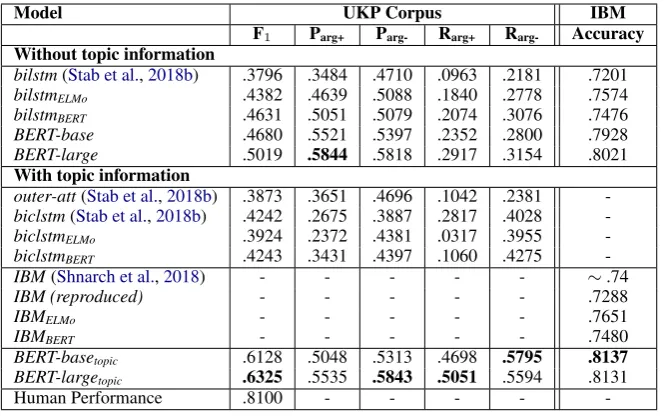
UKP Corpus. Replacing traditional embed-dings in the bilstm by contextualized word em-beddings improves the model’s performance by around 6pp and 8pp in F1 for ELMo and BERT (see Table 1). The fine-tuned BERT-large im-proves by even 12pp over the baselinebilstmand by this also outperforms bilstmBERT by around
4pp. Hence, using an intermediary BiLSTM layer for theBERT model even hurts the performance.
Using ELMo and BERT embeddings in the topic-integrating biclstm model significantly de-creases the performance, as compared to their per-formance in thebilstm. The contextualized word embedding for a topic is different to the one of a topic appearing in a sentence and thebiclstmfails to learn a connection between them.
Including the topic into the fine-tuned BERT models increases the F1 score by approx. 14.5pp and 13pp forBERT-baseandBERT-large. This is due to a vast increase in recall for both models; while changes in precision are mostly small, re-call for positive and negative arguments increases by at least 21pp for both models. As such, BERT-largetopicalso beats thebiclstmby almost 21pp in
F1 score and represents a new state-of-the-art on this dataset.
While the gap to human performance remains at around 18pp in F1, our proposed approach de-creases this gap significantly as compared to the previous state-of-the-art. Based on preliminary experimental results, we suspect that this gap can be further reduced by adding more topics to the training data.
The results show that (1) theBERT-[base/large]
models largely improve F1 and precision for argu-ments and (2) leveraging topic-information yields another strong improvement on the recall of ar-gumentative sentences. The usefulness of topic-information has already been shown byStab et al.
(2018b) through their biclstm and stems from a much higher recall of arguments while losing some of the precision when compared to their bil-stm. Yet, their approach cannot hold to BERT’s superior architecture; the topic-integrating BERT models BERT-basetopic and BERT-largetopic not
only compensate for the biclstm’s drop in preci-sion, but also increase the recall for proand con
arguments by at least 18pp and 15pp. We ac-count this performance increase to BERT’s multi-head attention between all word pairs, where every word in a sentence has an attention value with the topic (words).
IBM corpus. As a baseline for models that do not use any topic information, we train three simple BiLSTMs with ELMo, BERT, and 300-d GloVe embeddings and compare them to the fine-tuned base and large BERT models. As Table
1 shows, BERT and ELMo embeddings perform around 2.7 and 3.7pp better in accuracy than the GloVe embeddings. BERT-base yields even 7pp higher accuracy, while its difference to the large model is only +1pp.
Both BERT-base and BERT-large outperform the baselineIBM set byShnarch et al.(2018) al-ready by more than 6pp in accuracy5. The topic in-tegrating modelsIBMELM oandIBMBERT do not
improve much over their BiLSTM counterparts, which do not use any topic information. Simi-lar to the conclusion for the UKP corpus, we at-tribute this to the different embedding vectors we retrieve for a topic as compared to the vectors for a topic mention within a sentence.BERT-basetopic
andBERT-largetopicshow the largest improvement
with 8pp over the baseline and represent a new state-of-the-art on this dataset. The fine-tuned BERT models show vast improvements over the baseline, which is on par with the findings for the UKP corpus.
Yet, in contrast to the results on the UKP cor-pus, adding topic information to the fine-tuned BERT models has only a small effect on the score. This can be explained with the different composi-tion of both corpora: while sentences in the UKP corpus may only be implicitly connected to their related topic (only 20% of all sentences contain their related topic), sentences in IBM’s corpus all contain their related topic and are thus explicitly
5Please note that we refer to our reproduced baseline.
Model UKP Corpus IBM F1 Parg+ Parg- Rarg+ Rarg- Accuracy
Without topic information
bilstm(Stab et al.,2018b) .3796 .3484 .4710 .0963 .2181 .7201
bilstmELMo .4382 .4639 .5088 .1840 .2778 .7574
bilstmBERT .4631 .5051 .5079 .2074 .3076 .7476
BERT-base .4680 .5521 .5397 .2352 .2800 .7928
BERT-large .5019 .5844 .5818 .2917 .3154 .8021
With topic information
outer-att(Stab et al.,2018b) .3873 .3651 .4696 .1042 .2381 -biclstm(Stab et al.,2018b) .4242 .2675 .3887 .2817 .4028
-biclstmELMo .3924 .2372 .4381 .0317 .3955
-biclstmBERT .4243 .3431 .4397 .1060 .4275
-IBM(Shnarch et al.,2018) - - - ∼.74
IBM (reproduced) - - - .7288
IBMELMo - - - .7651
IBMBERT - - - .7480
BERT-basetopic .6128 .5048 .5313 .4698 .5795 .8137
BERT-largetopic .6325 .5535 .5843 .5051 .5594 .8131
Human Performance .8100 - - - -
-Table 1: Results of each model for sentence-level argument classification using cross-topic evaluation on the UKP Sentential Argument Mining Corpus and on the IBM DebaterR - Evidence Sentences dataset. Blank fields result from dataset-specific models.P: precision,R: recall,arg+:pro-arguments,arg-:con-arguments.
connected to it (although topics are masked with a placeholder). Hence, in the IBM corpus, there is much less need for the additional topic infor-mation in order to recognize the relatedness to a sentence.
5 Argument Clustering
Having identified a large amount of argumentative text for a topic, we next aim at grouping the argu-ments talking about the same aspects.
For any clustering algorithm, a meaningful similarity between argument pairs is crucial and needs to account for the challenges regarding ar-gument aspects, e.g., different aspect granular-ities, context-dependency or aspect multiplicity. Another requirement is the robustness for topic-dependent differences.
Therefore, in this section, we study how sentence-level argument similarity and clustering can be improved by using contextualized word embeddings. We evaluate our methods on the
UKP ASPECT and the AFS corpus (see Sec-tion3.2).
5.1 Clustering Method
We use agglomerative hierarchical clustering (Day and Edelsbrunner,1984) to cluster arguments.
We use the average linkage criterion to com-pute the similarity between two clusterAandB:
1
|A||B|
P
a∈A
P
b∈Bd(a, b), for a given similarity
metricd. As it is a priori unknown how many
dif-ferent aspects are discussed for a topic (number of clusters), we apply a stopping threshold which is determined on the train set.
We also tested the k-means and the DBSCAN clustering algorithms, but we found that agglom-erative clustering generally yielded better perfor-mances in preliminary experiments.
Agglomerative clustering uses a pairwise sim-ilarity metricdbetween arguments. We propose and evaluate various similarity metrics in two se-tups: (1) Without performing a clustering, i.e. the quality of the metric is directly evaluated (without clusteringsetup), and (2) in combination with the described agglomerative clustering method (with clusteringsetup).
5.2 Experimental Setup
We differentiate between unsupervised and super-vised methods. Our unsupersuper-vised methods include no pre-training whereas the supervised methods use some data for fine-tuning the model. For the UKP ASPECT corpus, we binarize the four labels to only indicate similar and dissimilar argument pairs. Pairs labeled withsomeandhigh similarity
were labeled as similar, pairs with no similarity
anddifferent topicasdissimilar.
[image:6.595.134.467.61.269.2]Without Clustering With Clustering Model Fmean Fsim Fdissim Fmean Fsim Fdissim Human Performance .7834 .7474 .8194 .7070 .6188 .7951 Random predictions .4801 .3431 .6171 .4253 .3162 .5344 Unsupervised Methods
Tf-Idf .6118 .5230 .7007 .5800 .4892 .6708
InferSent - fastText .6621 .5866 .7376 .6344 .5443 .7584 InferSent - GloVe .6494 .5472 .7517 .6149 .4587 .7711 GloVe Embeddings .6468 .5632 .7304 .5926 .4605 .7246
ELMo Embeddings .6447 .5355 .7538 .6366 .5347 .7384
BERT Embeddings .6539 .5232 .7848 .6070 .4818 .7323
Supervised Methods: Cross-Topic Evaluation
BERT-base .7401 .6695 .8107 .7007 .6269 .7746
[image:7.595.153.441.61.206.2]BERT-large .7244 .6297 .8191 .7135 .6125 .8146
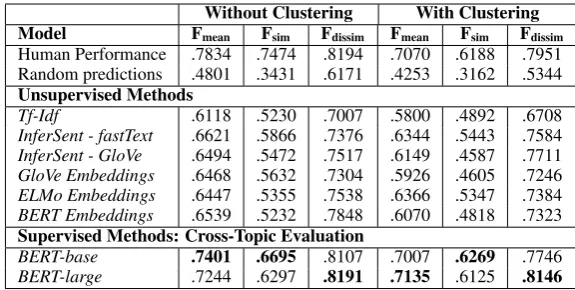
Table 2:F1scores on the UKP ASPECT Corpus.
their experiments on the AFS corpus,Misra et al.
(2016) only performed a within-topic evaluation by using 10-fold cross-validation. As we are pri-marily interested in cross-topic performances, we evaluate our methods also cross-topic: we train on two topics, and evaluate on the third.
5.3 Evaluation
For the UKP ASPECT dataset we compute the marco-average Fmean for the F1-scores for the
similar-label (Fsim) and for thedissimilar
-label (Fdissim).
In thewithout clusteringsetup, we compute the similarity metric (d(a, b)) for an argument pair di-rectly, and assign the labelsimilarif it exceeds a threshold, otherwisedissimilar. The thresh-old is determined on the train set of a fthresh-old for un-supervised methods. For un-supervised methods, we use a held-out dev set.
In the with clustering setup, we use the simi-larity metric to perform agglomerative clustering. This assigns each argument exactly one cluster ID. Arguments pairs in the same cluster are assigned the labelsimilar, and argument pairs in differ-ent clusters are assigned the labeldissimilar. We use these labels to compute Fsim and Fdissim
given our gold label annotations.
For the AFS dataset, Misra et al.(2016) com-puted the correlation between the predicted simi-larity and the annotated simisimi-larity score. They do not mention which correlation method they used. In our evaluation, we show Pearson correlation (r) and Spearman’s rank correlation coefficient (ρ).
5.4 Similarity Metrics
We experiment with the following methods to compute the similarity between two arguments.
Tf-Idf. We computed the most common words
(without stop-words) in our training corpus and compute the cosine similarity between the Tf-Idf vectors of a sentence.
InferSent. We compute the cosine-similarity between the sentence embeddings returned by In-ferSent (Conneau et al.,2017).
Average Word Embeddings. We compute the cosine-similarity between the average word em-beddings for GloVe, ELMo and BERT.
BERT.We fine-tune the BERT-uncased model to predict the similarity between two given argu-ments. We add a sigmoid layer to the special
[CLS] token and trained it on some of the top-ics. We fine-tuned for three epochs, with a learn-ing rate of 2e-5 and a batch-size of 32.
Human Performance. We approximated the human upper bound on the UKP ASPECT cor-pus in the following way: we randomly split the seven pair-wise annotations in two groups, com-puted their corresponding MACE (Hovy et al.,
2013) scores and calculated Fsim, Fdissimand Fmean.
We repeated this process ten times and averaged over all runs (without clustering setup). For the
with clustering setup, we applied agglomerative hierarchical clustering on the MACE scores of one of both groups and computed the evaluation met-rics using the other group as the gold label. For the AFS dataset,Misra et al.(2016) computed the correlation between the three human annotators.
5.5 Results and Analysis
fast-Average
r ρ
Human Performance .6767
-Unsupervised Methods
Tf-Idf .4677 .4298
InferSent - fastText .2519 .2423
InferSent - GloVe .2708 .2663
GloVe Embeddings .3240 .3400
ELMo Embeddings .2827 .2675
BERT Embeddings .3539 .3507
Supervised Methods: Within-Topic Evaluation
SVR(Misra et al.,2016) .6333
-BERT-base .7475 .7318
BERT-large .7256 .6959
Supervised Methods: Cross-Topic Evaluation
BERT-base .5849 .5723
[image:8.595.83.279.60.235.2]BERT-large .6202 .6034
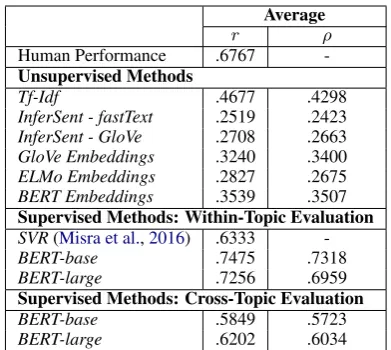
Table 3: Pearson correlation r and Spearman’s rank correlationρon the AFS dataset (Misra et al., 2016) averaged over the three topics.
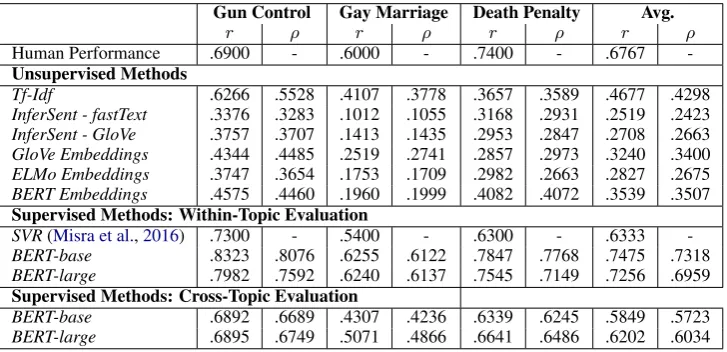
Text embeddings. Tf-Idf shows the worst perfor-mance. In Table3, we show the performances for the AFS corpus (detailed results in the appendix, Table5). In contrast to the ASPECT Corpus, the
Tf-Idf method achieves the best performance and
InferSent - fastTextembeddings achieved the worst performance. As for the ASPECT Corpus, ELMo and BERT embeddings do not lead to an improve-ment compared to averaged GloVe embeddings.
Unsupervised methods compute some type of similarity between sentence pairs. However, as our experiments shows, this similarity notion is not necessarily the notion needed for the task.
Supervised Methods. We fine-tune the BERT model for some of the topics and study the per-formance on unseen topics. For the ASPECT Corpus, we observe a performance increase of 7.8pp. Identifying dissimilar arguments (Fdissim)
is on-par with the human performance, and iden-tifying similar arguments achieves an F-score of .67, compared to .75 for human annotators. For the AFS dataset, we observe that fine-tuning the BERT model significantly improves the perfor-mance by 11pp compared to the previous state-of-the-art fromMisra et al.(2016).
In a cross-topic evaluation setup on the AFS dataset, we observe that the performance drops to .57 Spearman correlation. This is still significantly larger than the best unsupervised method.
We evaluated the effect of the training set size on the performance of the BERT model for the ASPECT Corpus. A certain number of topics were randomly sampled and the performance was eval-uated on distinct topics. This process was repeated
10 times with different random seeds (Reimers and Gurevych,2018). Table4shows the averaged results.
By allowing fine-tuning on five topics we are able to improve the Fmean-score to .71 compared to
.65 when using BERT without fine-tuning (without clusteringsetup). Adding more topics then slowly increases the performance.
w/o Clustering With Clustering #Topics Fmean Fmean
1 0.6244 0.5943
3 0.6817 0.6322
5 0.7134 0.6563
7 0.7164 0.6703
9 0.7151 0.6697
11 0.7305 0.6988
13 0.7350 0.6964
15 0.7370 0.7010
[image:8.595.322.509.181.295.2]17 0.7401 0.7034
Table 4: F1scores on the UKP ASPECT Corpus with increasing training set sizes (BERT model).
With Clustering. We studied how the perfor-mance changes on the ASPECT corpus if we com-bine the similarity metric with agglomerative clus-tering (Table2). We notice that the performances drop by up to 7.64pp. Agglomerative clustering is a strict partitioning algorithm, i.e., each object belongs to exactly one cluster. However, an argu-ment can address more than one aspect of a topic, therefore, arguments could belong to more than one cluster. Hence, strict partitioning clustering methods introduce a new source of errors.
We can estimate this source of error by evaluat-ing the transitivity in our dataset. For a strict par-titioning setup, if argument A∼B, and B∼C are similar, then A∼C are similar. This transitivity property is violated in 376 out of 1,714 (21.9%) cases, indicating that strict partitioning is a sub-optimal setup for the ASPECT dataset. This also explains why the human performance in thewith clustering setup is significantly lower than in the
without clusteringsetup. As Table2shows, a bet-ter similarity metric must not necessarily lead to a better clustering performance with agglomerative clustering. Humans are better than the proposed BERT-model at estimating the pairwise similarity of arguments. However, when combined with a clustering method, the performances are on-par.
6 Conclusion
a challenging research problem. The first chal-lenge is to identify suitable arguments. Previ-ous methods achieved low F1-scores in a cross-topic scenario, e.g., Stab et al.(2018b) achieved anF1-score of .27 for identifyingpro-arguments. We could significantly improve this performance to .53 by using contextualized word embeddings. The main performance gain came from integrating topic information into the transformer network of BERT, which added 13pp compared to the setup without topic information.
The second challenge we addressed is to decide whether two arguments on the same topic are sim-ilar. Previous datasets on argument similarity used curated lists of arguments, which eliminates noise from the argument classification step. In this pub-lication, we annotated similar argument pairs that came from an argument search engine. As the annotation showed, about 16% of the pairs were noisy and did not address the target topic.
Unsupervised methods on argument similarity showed rather low performance scores, confirm-ing that fine-grained semantic nuances and not the lexical overlap determines the similarity between arguments. We were able to train a supervised similarity function based on the BERT transformer network that, even with little training data, signif-icantly improved over unsupervised methods.
While these results are very encouraging and stress the feasibility of open-domain argument search, our work also points to some weaknesses of the current methods and datasets. A good ar-gument similarity function is only the first step to-wards argument clustering. We evaluated the ag-glomerative clustering algorithm in combination with our similarity function and identified it as a new source of errors. Arguments can address mul-tiple aspects and therefore belong to mulmul-tiple clus-ters, something that is not possible to model using partitional algorithms. Future work should thus study the overlapping nature of argument cluster-ing. Further, more realistic datasets, that allow end-to-end evaluation, are required.
Acknowledgments
The authors would like to sincerely thank Joy Mahapatra, who carried out the initial anno-tation study. This work has been supported by the German Research Foundation through the German-Israeli Project Cooperation (DIP, grant DA 1600/1-1 and grant GU 798/17-1)
and within the project “Open Argument Min-ing” (GU 798/25-1), associated with the Priority Program “Robust Argumentation Machines (RA-TIO)” (SPP-1999). It has been co-funded by the German Federal Ministry of Education and Re-search (BMBF) under the promotional references 01UG1816B (CEDIFOR) and 03VP02540 (Argu-menText).
References
Filip Boltuˇzi´c and Jan ˇSnajder. 2015. Identifying prominent arguments in online debates using seman-tic textual similarity. In Proceedings of the 2nd Workshop on Argumentation Mining, pages 110– 115.
Elena Cabrio and Serena Villata. 2012. Natural Lan-guage Arguments: A Combined Approach. In Pro-ceedings of the 20th European Conference on Artifi-cial Intelligence, pages 205–210.
Alexis Conneau, Douwe Kiela, Holger Schwenk, Lo¨ıc Barrault, and Antoine Bordes. 2017. Supervised learning of universal sentence representations from natural language inference data. InProceedings of the 2017 Conference on Empirical Methods in Nat-ural Language Processing, pages 670–680.
William H. E. Day and Herbert Edelsbrunner. 1984.
Efficient algorithms for agglomerative hierarchi-cal clustering methods. Journal of Classification, 1(1):7–24.
Jacob Devlin, Ming-Wei Chang, Kenton Lee, and Kristina Toutanova. 2018. BERT: Pre-training of deep bidirectional transformers for language under-standing.arXiv preprint arXiv:1810.04805.
Steffen Eger, Johannes Daxenberger, and Iryna Gurevych. 2017. Neural end-to-end learning for computational argumentation mining. In Proceed-ings of the 55th Annual Meeting of the Association for Computational Linguistics (Volume 1: Long Pa-pers), pages 11–22.
Dirk Hovy, Taylor Berg-Kirkpatrick, Ashish Vaswani, and Eduard Hovy. 2013. Learning whom to trust with MACE. In Proceedings of the 2013 Confer-ence of the North American Chapter of the Associ-ation for ComputAssoci-ational Linguistics: Human Lan-guage Technologies, pages 1120–1130.
Ran Levy, Yonatan Bilu, Daniel Hershcovich, Ehud Aharoni, and Noam Slonim. 2014. Context depen-dent claim detection. InProceedings of COLING 2014, the 25th International Conference on Compu-tational Linguistics: Technical Papers, pages 1489– 1500.
Amita Misra, Brian Ecker, and Marilyn A. Walker. 2016. Measuring the similarity of sentential ar-guments in dialogue. In Proceedings of the SIG-DIAL 2016 Conference, The 17th Annual Meeting of the Special Interest Group on Discourse and Di-alogue, 13-15 September 2016, Los Angeles, CA, USA, pages 276–287.
Jeffrey Pennington, Richard Socher, and Christo-pher D. Manning. 2014. GloVe: Global Vectors for Word Representation. InEmpirical Methods in Nat-ural Language Processing (EMNLP), pages 1532– 1543.
Matthew Peters, Mark Neumann, Mohit Iyyer, Matt Gardner, Christopher Clark, Kenton Lee, and Luke Zettlemoyer. 2018. Deep contextualized word rep-resentations. In Proceedings of the 2018 Confer-ence of the North American Chapter of the Associ-ation for ComputAssoci-ational Linguistics: Human Lan-guage Technologies, Volume 1 (Long Papers), pages 2227–2237.
Nils Reimers and Iryna Gurevych. 2018. Why com-paring single performance scores does not allow to draw conclusions about machine learning ap-proaches. arXiv preprint arXiv:1803.09578.
Ruty Rinott, Lena Dankin, Carlos Alzate Perez, Mitesh M. Khapra, Ehud Aharoni, and Noam Slonim. 2015. Show me your evidence - an auto-matic method for context dependent evidence detec-tion. InProceedings of the 2015 Conference on Em-pirical Methods in Natural Language Processing, pages 440–450.
Eyal Shnarch, Carlos Alzate, Lena Dankin, Mar-tin Gleize, Yufang Hou, Leshem Choshen, Ranit Aharonov, and Noam Slonim. 2018. Will it Blend? Blending Weak and Strong Labeled Data in a Neu-ral Network for Argumentation Mining. In Proceed-ings of the 56th Annual Meeting of the Association for Computational Linguistics (Volume 2: Short Pa-pers), volume 2, pages 599–605.
Christian Stab, Johannes Daxenberger, Chris Stahlhut, Tristan Miller, Benjamin Schiller, Christopher Tauchmann, Steffen Eger, and Iryna Gurevych. 2018a. ArgumenText: Searching for Arguments in Heterogeneous Sources. InProceedings of the 2018 Conference of the North American Chapter of the Association for Computational Linguistics: System Demonstrations, pages 21–25.
Christian Stab and Iryna Gurevych. 2014. Identify-ing Argumentative Discourse Structures in Persua-sive Essays.Proceedings of the 2014 Conference on Empirical Methods in Natural Language Processing (EMNLP), pages 46–56.
Christian Stab, Tristan Miller, Benjamin Schiller, Pranav Rai, and Iryna Gurevych. 2018b.Cross-topic argument mining from heterogeneous sources. In
Proceedings of the 2018 Conference on Empirical Methods in Natural Language Processing, volume Long Papers, pages 3664–3674.
Amine Trabelsi and Osmar R Za¨ıane. 2015.Extraction and clustering of arguing expressions in contentious text. Data & Knowledge Engineering, 100:226– 239.
Ashish Vaswani, Noam Shazeer, Niki Parmar, Jakob Uszkoreit, Llion Jones, Aidan N Gomez, Ł ukasz Kaiser, and Illia Polosukhin. 2017. Attention is all you need. In I. Guyon, U. V. Luxburg, S. Bengio, H. Wallach, R. Fergus, S. Vishwanathan, and R. Gar-nett, editors, Advances in Neural Information Pro-cessing Systems 30, pages 5998–6008.
Henning Wachsmuth, Nona Naderi, Ivan Habernal, Yufang Hou, Graeme Hirst, Iryna Gurevych, and Benno Stein. 2017. Argumentation quality assess-ment: Theory vs. practice. In Proceedings of the 55th Annual Meeting of the Association for Compu-tational Linguistics (Volume 2: Short Papers), pages 250–255.
A Appendices
A.1 UKP ASPECT Corpus: Amazon Mechanical Turk Guidelines and Inter-annotator Agreement
The annotations required for the UKP ASPECT Corpus were acquired via crowdsourcing on the Amazon Mechanical Turk platform. Workers par-ticipating in the study had to be located in the US, with more than 100 HITs approved and an overall acceptance rate of 90% or higher. We paid them at the US federal minimum wage of $7.25/hour. Workers also had to qualify for the study by pass-ing a qualification test consistpass-ing of twelve test questions with argument pairs. Figure2shows the instructions given to workers.
A.2 AFS Corpus: Detailed Results
Gun Control Gay Marriage Death Penalty Avg.
r ρ r ρ r ρ r ρ
Human Performance .6900 - .6000 - .7400 - .6767
-Unsupervised Methods
Tf-Idf .6266 .5528 .4107 .3778 .3657 .3589 .4677 .4298
InferSent - fastText .3376 .3283 .1012 .1055 .3168 .2931 .2519 .2423
InferSent - GloVe .3757 .3707 .1413 .1435 .2953 .2847 .2708 .2663
GloVe Embeddings .4344 .4485 .2519 .2741 .2857 .2973 .3240 .3400
ELMo Embeddings .3747 .3654 .1753 .1709 .2982 .2663 .2827 .2675
BERT Embeddings .4575 .4460 .1960 .1999 .4082 .4072 .3539 .3507
Supervised Methods: Within-Topic Evaluation
SVR(Misra et al.,2016) .7300 - .5400 - .6300 - .6333
-BERT-base .8323 .8076 .6255 .6122 .7847 .7768 .7475 .7318
BERT-large .7982 .7592 .6240 .6137 .7545 .7149 .7256 .6959
Supervised Methods: Cross-Topic Evaluation
BERT-base .6892 .6689 .4307 .4236 .6339 .6245 .5849 .5723
[image:12.595.118.482.94.270.2]BERT-large .6895 .6749 .5071 .4866 .6641 .6486 .6202 .6034
Table 5: Pearson correlationrand Spearman’s rank correlationρon the AFS dataset. Within-Topic Evaluation: 10-fold cross-validation. Cross-Topic Evaluation: System trained on two topics, evaluated on the third.
Read each of the following sentence pairs and indicate whether they argue about the same aspect with respect to the given topic (given as “Topic Name” on top of the HIT). There arefour options, of which one needs to be assigned to each pair of sentences (arguments). Please read the following for more details.
• Different Topic/Can’t decide: Either one or both of the sentences belong to a topic different than the given one, or you can’t understand one or both sentences. If you choose this option, you need to very briefly explain, why you chose it (e.g. “The second sentence is not grammatical”, “The first sentence is from a different topic” etc.). For example,
Argument A: “I do believe in the death penalty, tit for tat”.
Argument B: “Marriage is already a civil right everyone has, so like anyone you have it too”.
• No Similarity: The two arguments belong to the same topic, but they don’t show any similarity, i.e. they speak about completely different aspects of the topic. For example,
Argument A: “If murder is wrong then so is the death penalty”.
Argument B: “The death penalty is an inappropriate way to work against criminal activity”.
• Some Similarity: The two arguments belong to the same topic, showing semantic similarity on a few aspects, but the central message is rather different, or one argument is way less specific than the other. For example,
Argument A: “The death penalty should be applied only in very extreme cases, such as when someone commands genocide”.
Argument B: “An eye for an eye: He who kills someone else should face capital punishment by the law”.
• High Similarity: The two arguments belong to the same topic, and they speak about the same aspect, e.g. using different words. For example, Argument A: “An ideal judiciary system would not sentence innocent people”.
Argument B: “The notion that guiltless people may be sentenced is indeed a judicial system problem”.
Your rating should not be affected by whether the sentences attack (e.g. “Animal testing is cruel and inhumane” for the topic “Animal testing”) or support (e.g. “Animals do not have rights, therefore animal testing is fair” for the topic “Animal testing”) the topic, but only by the aspect they are using to support or attack the topic.