22
Improving Multi-turn Dialogue Modelling with Utterance ReWriter
Hui Su1∗, Xiaoyu Shen2∗, Rongzhi Zhang3, Fei Sun4, Pengwei Hu5 Cheng Niu1and Jie Zhou1
1Pattern Recognition Center, Wechat AI, Tencent Inc, China
2MPI Informatics & Spoken Language Systems (LSV), Saarland Informatics Campus
3Institute of Software, University of Chinese Academy of Science
4Alibaba Group 5IBM Research, China
[email protected],[email protected]
Abstract
Recent research has made impressive progress in single-turn dialogue modelling. In the multi-turn setting, however, current models are still far from satisfactory. One major chal-lenge is the frequently occurred coreference and information omission in our daily con-versation, making it hard for machines to un-derstand the real intention. In this paper, we propose rewriting the human utterance as a pre-process to help multi-turn dialgoue mod-elling. Each utterance is first rewritten to re-cover all coreferred and omitted information. The next processing steps are then performed based on the rewritten utterance. To properly train the utterance rewriter, we collect a new dataset with human annotations and introduce a Transformer-based utterance rewriting archi-tecture using the pointer network. We show the proposed architecture achieves remarkably good performance on the utterance rewriting task. The trained utterance rewriter can be eas-ily integrated into online chatbots and brings general improvement over different domains.1
1 Introduction
Dialogue systems have made dramatic progress in recent years, especially in single-turn chit-chat and
FAQ matching (Shang et al., 2015;
Ghazvinine-jad et al.,2018;Molino et al.,2018;Chen et al.,
2019). Nonethless, multi-turn dialogue modelling
still remains extremely challenging (Vinyals and
Le, 2015;Serban et al., 2016, 2017;Shen et al.,
2018a,b). The challenge is multi-sided. One most important difficulty is the frequently oc-curred coreference and information omission in our daily conversations, especially in pro-drop languages like Chinese or Japanese. From our pre-liminary study of 2,000 Chinese multi-turn
con-∗
Both authors contributed equally.
1The code is available on https://github.com/ chin-gyou/dialogue-utterance-rewriter.
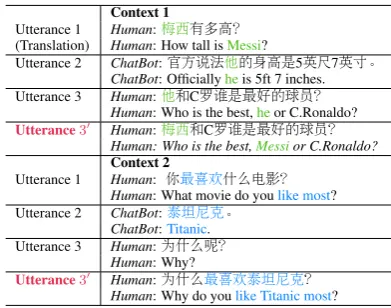
Context 1
Utterance 1 Human:梅西有多高?
(Translation) Human: How tall isMessi?
Utterance 2 ChatBot:官方说法他的身高是5英尺7英寸。
ChatBot: Officiallyheis 5ft 7 inches. Utterance 3 Human:他和C罗谁是最好的球员?
Human: Who is the best,heor C.Ronaldo?
Utterance30 Human
:梅西和C罗谁是最好的球员?
Human: Who is the best,Messior C.Ronaldo? Context 2
Utterance 1 Human: 你最喜欢什么电影?
Human: What movie do youlike most? Utterance 2 ChatBot:泰坦尼克。
ChatBot:Titanic. Utterance 3 Human:为什么呢?
Human: Why?
Utterance30 Human:为什么最喜欢泰坦尼克?
[image:1.595.317.513.220.374.2]Human: Why do youlike Titanic most?
Table 1: An example of multi-turn dialogue. Each ut-terance 3 is rewritten intoUtterance30. Green means coreference and blue means omission.
versations, different degrees of coreference and
omission exist in more than70%of the utterances.
Capturing the hidden intention beneath them re-quires deeper understanding of the dialogue con-text, which is difficult for current neural
network-based systems. Table1shows two typical
exam-ples in multi-turn dialogues. “他”(he) from
Con-text 1 is a coreference to “梅西”(Messi) and “为什
么”(Why) from Context 2 omits the further
ques-tion of “为什么最喜欢泰坦尼克”(Why do you
like Tatanic most)?. Without expanding the coref-erence or omission to recover the full information, the chatbot has no idea how to continue the talk.
To address this concern, we propose simplifying
the multi-turn dialogue modelling into a
single-turn problem by rewriting the current utterance.
The utterance rewriter is expected to perform (1) coreference resolution and (2) information com-pletion to recover all coreferred and omitted
men-tions. In the two examples from Table1, each
ut-terance 3 will be rewritten into utut-terance 30.
Af-terwards, the system will generate a reply by only
looking into the utterance 30 without considering
con-text while still maintaining necessary information needed to provide proper responses, which we be-lieve will help ease the difficulty of multi-turn di-alogue modelling. Compared with other methods
like memory networks (Sukhbaatar et al.,2015) or
explicit belief tracking (Mrkˇsi´c et al., 2017), the trained utterance rewriter is model-agnostic and can be easily integrated into other black-box dia-logue systems. It is also more memory-efficient because the dialogue history information is re-flected in a single rewritten utterance.
To get supervised training data for the utterance rewriting, we construct a Chinese dialogue dataset containing 20k multi-turn dialogues. Each utter-ance is paired with corresponding manually anno-tated rewritings. We model this problem as an ex-tractive generation problem using the Pointer
Net-work (Vinyals et al., 2015). The rewritten
utter-ance is generated by copying words from either the dialogue history or the current utterance based on
the attention mechanism (Bahdanau et al.,2014).
Inspired by the recently proposed Transformer
architecture (Vaswani et al., 2017) in machine
translation which can capture better intra-sentence word dependencies, we modify the Transformer architecture to include the pointer network mech-anism. The resulting model outperforms the re-current neural network (RNN) and original Trans-former models, achieving an F1 score of over 0.85 for both the coreference resolution and informa-tion compleinforma-tion. Furthermore, we integrate our trained utterance rewriter into two online chatbot platforms and find it leads to more accurate inten-tion detecinten-tion and improves the user engagement. In summary, our contributions are:
1. We collect a high-quality annotated dataset for coreference resolution and information completion in multi-turn dialogues, which might benefit future related research.
2. We propose a highly effective Transformer-based utterance rewriter outperforming sev-eral strong baselines.
3. The trained utterance rewriter, when inte-grated into two real-life online chatbots, is shown to bring significant improvement over the original system.
In the next section, we will first go over some re-lated work. Afterwards, in Section 3 and 4, our collected dataset and proposed model are intro-duced. The experiment results and analysis are
presented in Section 5. Finally, some conclusions are drawn in Section 6.
2 Related Work
2.1 Sentence Rewriting
Sentence rewriting has been widely adopted in various NLP tasks. In machine translation, people have used it to refine the output generations from
seq2seq models (Niehues et al., 2016;
Junczys-Dowmunt and Grundkiewicz,2017;Grangier and Auli, 2017;Gu et al., 2017). In text summariza-tion, reediting the retrieved candidates can provide
more accurate and abstractive summaries (See
et al., 2017; Chen and Bansal, 2018; Cao et al.,
2018). In dialogue modelling,Weston et al.(2018)
applied it to rewrite outputs from a retrieval model, but they pay no attention to recovering the hidden information under the coreference and omission.
Concurrent with our work, Rastogi et al. (2019)
adopts a similar idea on English conversations to simplify the downstream SLU task by reformulat-ing the original utterance. Rewritreformulat-ing the source input into some easy-to-process standard format has also gained significant improvements in
in-formation retrieval (Riezler and Liu, 2010),
se-mantic parsing (Chen et al.,2016) or question
an-swering (Abujabal et al.,2018), but most of them
adopt a simple dictionary or template based rewrit-ing strategy. For multi-turn dialogues, due to the complexity of human languages, designing suit-able template-based rewriting rules would be time-consuming.
2.2 Coreference Resolution
Coreference resolution aims to link an antecedent for each possible mention. Traditional approaches often adopt a pipeline structure which first iden-tify all pronouns and entities then run clustering
algorithms (Haghighi and Klein,2009;Lee et al.,
2011; Durrett and Klein, 2013; Bj¨orkelund and
Kuhn, 2014). At both stages, they rely
heav-ily on complicated, fine-grained features.
Re-cently, several neural coreference resolution
sys-tems (Clark and Manning, 2016a,b) utilize
dis-tributed representations to reduce human labors.
self-attention mechanism which could implicitly cap-ture inter-word dependencies in an unsupervised
way (Vaswani et al.,2017). However, when
mul-tiple coreferences occur, it has problems properly distinguishing them. Our proposed architecture is built upon the Transformer architecture, but per-form coreference resolution in a supervised setting to help deal with ambiguous mentions.
3 Dataset
To get parallel training data for the sentence rewriting, we crawled 200k candidate multi-turn conversational data from several popular Chinese social media platforms for human annotators to
work on. Sensitive information is filtered
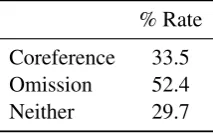
be-forehand for later processing. Before starting the annotation, we randomly sample 2,000 conversa-tional data and analyze how often coreference and
omission occurs in multi-turn dialogues. Table2
lists the statistics. As can be seen, only less than 30% utterances have neither coreference nor omis-sion and quite a few utterances have both. This further validates the importance of addressing the these situations in multi-turn dialogues.
% Rate
Coreference 33.5
Omission 52.4
[image:3.595.128.235.408.475.2]Neither 29.7
Table 2: Proportion of utterances containing corefer-ence and omission in multi-turn conversation
In the annotation process, human annotators need to identify these two situations then rewrite the utterance to cover all hidden information. An
example is shown in Table1. Annotators are
re-quired to provide the rewritten utterance30 given
the original conversation [utterance 1,2 and 3]. To ensure the annotation quality, 10% of the annota-tions from each annotator are daily examined by a project manager and feedbacks are provided. The annotation is considered valid only when the ac-curacy of examined results surpasses 95%. Apart from the accuracy examination, the project man-age is also required to (1) select topics that are more likely to be talked about in daily conversa-tions, (2) try to cover broader domains and (3) bal-ance the proportion of different coreference and omission patterns. The whole annotation takes 4 months to finish. In the end, we get 40k
high-quality parallel samples. Half of them are
nega-tivesamples which do not need any rewriting. The
other half arepositivesamples where rewriting is
needed. Table3lists the statistics. The rewritten
utterance contains 10.5 tokens in average, reduc-ing the context length by 80%.
Dataset size: 40,000
Avg. length of original conversation: 48.8
Avg. length of rewritten utterance: 10.5
Table 3: Statistics of dataset. Length is counted in the unit of Chinese characters.
4 Model
4.1 Problem Formalization
We denote each training sample as(H, Un→R).
H ={U1, U2, . . . , Un−1}represents the dialogue
history containing the first n − 1 turn of
utter-ances. Un is the nth turn of utterance, the one
that needs to be rewritten. R is the rewritten
ut-terance after recovering all corefernced and
omit-ted information inUn. Rcould be identical toUn
if no coreference or omission is detected (nega-tive sample). Our goal is to learn a mapping func-tion p(R|(H, Un))that can automatically rewrite
Unbased on the history informationH. The
pro-cess is to first encode(H, Un) into s sequence of
vectors, then decodeRusing the pointer network.
The next section will explain the steps in order.
4.2 Encoder
We unfold all tokens in (H, Un) into
(w1, w2, . . . , wm). m is the number of
to-kens in the whole dialogue. An end-of-turn
delimiter is inserted between each two turns. The unfolded sequence of tokens are then encoded with Transformer. We concatenate all tokens in (H, Un)as the input, in hope that the Transformer can learn rudimentary coreference information within them by means of the self-attention
mech-anism. For each token wi, the input embedding
is the sum of its word embedding, position embedding and turn embedding:
I(wi) =W E(wi) +P E(wi) +T E(wi)
The word embeddingW E(wi) and position
em-beddingP E(wi)are the same as in normal
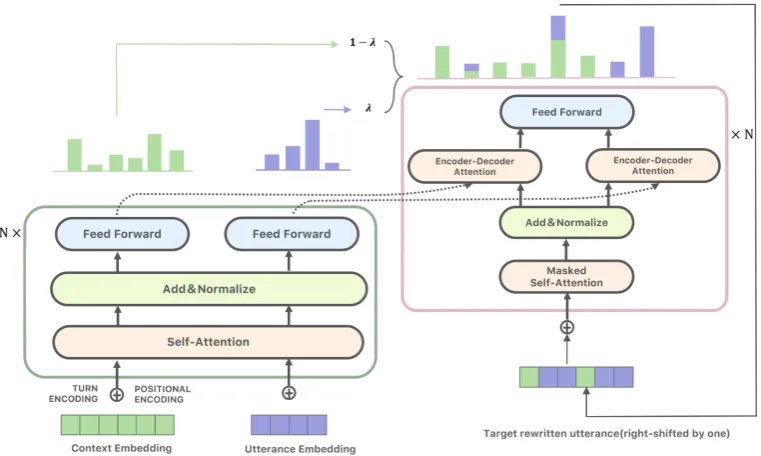
Figure 1: Architecture of our proposed model. Green box is the Transformer encoder and pink box is the decoder. The decoder computes the probabilityλat each step to decide whether to copy from the context or utterance.
add an additional turn embeddingT E(wi) to
in-dicate which turn each token belongs to.
To-kens from the same turn will share the same turn embedding. The input embeddings are then
for-warded into L stacked encoders to get the final
encoding representations. Each encoder contains a self-attention layer followed by a feedforward neural network.:
E(0) = h
I(w1), I(w2), . . . , I(wm)
i
E(l)= FNN(MultiHead(E(l−1),E(l−1),E(l−1)))
FNN is the feedforward neural network and
MultiHead(Q,K,V) is a multi-head attention
function taking a query matrixQ, a key matrixK,
and a value matrixVas inputs. Each self-attention
and feedforward component comes with a residual connection and layer-normalization step, which
we refer toVaswani et al.(2017) for more details.
The final encodings are the output from the Lth
encoderE(L).
4.3 Decoder
The decoder also containsLlayers, each layer is
composed of three sub-layers. The first sub-layer is a multi-head self-attention:
Ml= MultiHead(D(l−1),D(l−1),D(l−1))
D(0) = R. The second sub-layer is
encoder-decoder attention that integratesE(L) into the
de-coder. In our task, asHandUnserve different
pur-poses, we use separate key-value matrix for tokens
coming from the dialogue history H and those
coming fromUn. The encoded sequenceE(L)
ob-tained from the last section is split intoE(HL)
(en-codings of tokens fromH) and E(UL)
n (encodings
of tokens fromUn) then processed separately. The
encoder-decoder vectors are computed as follows:
C(H)l = MultiHead(M(l),E(HL),E(HL))
C(Un)l= MultiHead(M(l),E
(L)
Un,E
(L)
Un)
The third sub-layer is a position-wise fully con-nected feed-forward neural network:
D(l)= FNN([C(H)l◦C(Un)l])
where◦denotes vector concatenation.
4.4 Output Distribution
In the decoding process, we hope our model could
learn whether to copy words from H or Un at
different steps. Therefore, we impose a soft
gat-ing weightλto make the decision. The decoding
atten-tion distribuatten-tion from the last decoding layer:
p(Rt=w|H, Un, R<t)=λ X i:(wi=w)∧(wi∈H)
at,i
+(1−λ) X
j:(wj=w)∧(wj∈Un)
a0t,j
a= Attention(M(L),E(UL)
n)
a0 = Attention(M(L),E(HL))
λ=σ w>dDLt +w>HC(H)Lt +wU>C(Un)Lt
aanda0 are the attention distribution over tokens
inH andUn respectively. wd,wH, and wU are
parameters to be learned, σ is the sigmoid
func-tion to output a value between 0 and 1. The
gat-ing weight λ works like a sentinel to inform the
decoder whether to extract information from the
dialogue history H or directly copy fromUn. If
Un contains neither coreference nor information
omission. λwould be always 1 to copy the
origi-nalUnas the output. Otherwiseλbecomes 0 when
a coreference or omission is detected. The atten-tion mechanism is then responsible of finding the proper coreferred or omitted information from the dialogue history. The whole model is trained
end-to-end by maximizingp(R|H, Un).
5 Experiments
We train our model to perform the utterance rewriting task on our collected dataset. In this section, we focus on answering the following two questions: (1) How accurately our proposed model can perform coreference resolution and informa-tion compleinforma-tion respectively and (2) How good the trained utterance rewriter is at helping off-the-shelf dialogue systems provide more appropriate responses. To answer the first question, we com-pare our models with several strong baselines and test them by both automatic evaluation and hu-man judgement. For the second question, we in-tegrate our rewriting model to two online dialogue systems and analyze how it affects the human-computer interactions. The following section will first introduce the compared models and basic set-tings, then report our evaluation results.
5.1 Compared Models
When choosing compared models, we are mainly curious to see (1) whether the self-attention based Transformer architecture is superior to other net-works like LSTMs, (2) whether the pointer-based
generator is better than pure generation-based models and (3) whether it is preferred to split the
attention by a coefficientλas in our model. With
these intentions, we implement the following four types of models for comparison:
1. (L/T)-Gen: Pure generation-based model. Words are generated from a fixed vocabulary.
2. (L/T)-Ptr-Net: Pure pointer-based model as inVinyals et al. (2015). Words can only be copied from the input.
3. (L/T)-Ptr-Gen: Hybrid pointer+generation
model as in See et al. (2017). Words can
be either copied from the input or generated from a fixed vocabulary.
4. (L/T)-Ptr-λ: Our proposed model which split the attention by a coefficientλ.
(L/T) denotes the encoder-decoder structure is the LSTM or Transformer. For the first three types of models, we unfold all tokens from the dialogue as the input. No difference is made between the dialogue history and the utterance to be rewritten.
5.2 Experiment Settings
Transformer-based models We set the hidden size as 512. The attention has 8 individual heads and the encoder/decoder have 6 individual stacked layers. Models are optimized with the Adam opti-mizer. The initial learning rate is 0.0001 and batch size is 64. All hyperparameters are tuned base on the performance on the validation data.
LSTM-based Models We encode words with a single-layer bidirectional LSTM and decode with a uni-directional LSTM. We use 128-dimensional word embeddings and 256-dimensional hidden
states for both the encoder and decoder.2 The
batch size is set as 128. Models are trained using Adagrad with learning rate 0.15 and initial
accu-mulator value 0.1, same as in See et al.(2017).
General Setup We built our vocabulary based on character-based segmentation for Chinese
scripts. For non-Chinese characters, like
fre-quently mentioned entity names “Kobe” and “NBA”, we split them by space and keep all unique tokens which appear more than twice. The resulting vocabulary size is 5629 (4813 Chinese
BLEU-1 BLEU-2 BLEU-4 ROUGE-1 ROUGE-2 ROUGE-L EM
L-Gen 65.49 55.38 38.69 65.57 48.57 66.38 47.14|80.18
L-Ptr-Gen 69.78 59.25 43.07 68.24 54.13 70.36 47.35|84.09
L-Ptr-Net 71.70 60.29 44.72 70.81 56.35 72.33 48.24|91.94
L-Ptr-λ 72.26 62.15 47.11 73.47 57.51 74.55 51.66|93.01
T-Gen 68.74 59.09 42.57 69.12 50.92 69.70 48.59|87.61
T-Ptr-Gen 70.67 62.80 45.17 73.96 53.14 72.07 49.86|89.62
T-Ptr-Net 75.10 66.89 48.11 76.10 58.51 75.54 53.30|94.71
[image:6.595.77.522.65.203.2]T-Ptr-λ 77.85 68.21 52.47 78.49 60.53 77.70 55.84|98.14
Table 4: BLEU, ROUGE (F1), and EM scores on the test set. EM score is split into the results on the positive (left)
and negative (right) test samples. The first half is LSTM-based models and the second half is Transformer-based. Bold denotes best results.
characters and 816 other tokens), including the end-of-turn delimiter and a special UNK token for all unknown words. In the testing stage, all mod-els decode words by beam search with beam size set to 4.
5.3 Quality of Sentence ReWriting
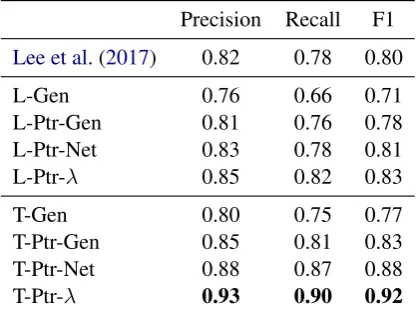
Precision Recall F1
Lee et al.(2017) 0.82 0.78 0.80
L-Gen 0.76 0.66 0.71
L-Ptr-Gen 0.81 0.76 0.78
L-Ptr-Net 0.83 0.78 0.81
L-Ptr-λ 0.85 0.82 0.83
T-Gen 0.80 0.75 0.77
T-Ptr-Gen 0.85 0.81 0.83
T-Ptr-Net 0.88 0.87 0.88
T-Ptr-λ 0.93 0.90 0.92
Table 5: Precision, recall and F1 score of corefer-ence resolution. First row is the current state-of-the-art coreference resolution model
Accuracy of Generation We first evaluate the accuracy of generation leveraging three metrics: BLEU, ROUGE, and the exact match score(EM) (the percentage of decoded sequences that exactly match the human references). For the EM score, we report separately on the positive and negative samples to see the difference. We report BLEU-1, 2, 4 scores and the F1 scores of ROUGE-1, 2, L.
The results are listed in Table4. We can have
sev-eral observations in response to the three questions
proposed in the beginning of Section5.1:
1. Transformer-based models lead to
signif-icant improvement compare with
LSTM-based counterparts. This implies the
self-attention mechanism is helpful in identifying
coreferred and omitted information. More
analysis on how it helps coreference resolu-tion can be seen in the next secresolu-tion.
2. The generation mode does not work well in our setting since all words can be retrieved
from either H or Un. Pointer-based
mod-els outperform the more complex generation-based and hybrid ones.
3. Separately processing H and Un then
com-bine their attention with a learnedλperforms
better than treating the whole dialogue tokens as s single input, though the improvement is less significant compared with previous two mentions.
Overall our proposed model achieves remarkably
good performance, with 55.84% of its
genera-tions exactly matches the human reference on the positive samples. For negative samples, our model properly copied the the original utterances
in98.14%of the cases. It suggests our model is
already able to identify the utterances that do not need rewriting. Future work should work on im-proving the rewriting ability on positive samples.
Coreference Resolution Apart from the stan-dard metrics for text generation, we specifically test the precision, recall and F1 score of coref-erence resolution on our task. A pronoun or a noun is considered as properly coreferred if the rewritten utterance contains the correct mention in the corresponding referent. The result is shown
[image:6.595.77.286.373.530.2]state-of-the-History U1:你看莎士比亚吗U2:特别喜欢罗密欧与朱丽叶 U1:你玩英雄联盟吗U2:是的
(Translation) U1: Do you read Shakespeare U2: I especially like Romeo and Juliet U1: Do you play League of Legends U2: Yes.
Utterance U3:喜欢哪个角色 U3:什么时候开始的
U3: Which character do you like U3: When did it start Ground Truth 你喜欢罗密欧与朱丽叶哪个角色 什么时候开始玩英雄联盟的
Which character do you like in Romeo and Juliet When did you start to play League of Legends L-Gen 你喜欢莎士比亚吗// Do you like Shakespeare 什么时候开始开始开始// When start start start L-Ptr-Gen 你喜欢罗密欧角色角色// You like Romeo character character 什么时候开始的// When did it start
L-Ptr-Net 你喜欢罗密欧与朱丽叶// You like Romeo and Juliet 什么时候英雄联盟开始的// When did League of Legends start
L-Ptr-λ 你喜欢罗密欧与朱丽叶角色// You like Romeo and Juliet character 什么什什么么时时时候候候开始开开始始玩玩玩英英英雄雄雄联联联盟盟盟的的的//When did you start to play League of Legends
T-Gen 你喜欢罗密欧与朱丽叶// You like Romeo and Juliet 是的什么时候开始玩的// Yes When start to play T-Ptr-Gen 你喜欢罗密欧与朱丽叶哪个// Which do you like in Romeo and Juliet 什么时候开始的// When did it start
[image:7.595.75.527.61.177.2]T-Ptr-Net 你喜欢罗密欧与朱丽叶角色// Character you like Romeo and Juliet 英雄联盟什么时候开始玩的// League of Legends When did you start to play T-Ptr-λ 你你你喜喜喜欢欢欢罗罗罗密密密欧欧欧与与与朱朱朱丽丽丽叶叶叶哪哪哪个个个角角角色色色//Which character do you like Romeo and Juliet 什什什么么么时时时候候候开开开始始始玩玩玩英英英雄雄雄联联联盟盟盟的的的//When did you start to play League of Legends
Table 6: Examples of rewritten utterances. Highlighted utterances are exactly the same as the ground truth.
Figure 2: Visualization of the self-attention weights in Transformer. “他”(he) is properly aligned to “梅
西”(Messi).
art models. We train the model from Lee et al.
(2017) on our task and report the results on the first row. The result is quite consistent with the find-ings from the last section. Our final model outper-forms the others by a large margin, reaching a pre-cision score of 93% and recall score of 90%. It im-plies our model is already quite good at finding the proper coreference. Future challenges would be
more about information completion. Figure2
fur-ther provides an examples of how the Transformer can help implicitly learn the coreference resolu-tion through the self-attenresolu-tion mechanism. The
same example is also shown in Table1. The
pro-noun “他”(he) in the utterance is properly aligned
to the mention “梅西”(Messi) in the dialogue
his-tory, also partially to “球员”(player) which is the
occupation of him. The implicitly learned coref-erence relation should be part of the reason that Transformers outperform LSTM models on the coreference resolution task.
Model Recall Precision F1 Fluency
L-Gen 0.65 0.70 0.67 4.31 L-Ptr-Gen 0.70 0.74 0.72 4.52 L-Ptr-Net 0.78 0.81 0.79 4.74 L-Ptr-λ 0.80 0.82 0.81 4.82
T-Gen 0.71 0.74 0.73 4.74 T-Ptr-Gen 0.77 0.81 0.79 4.85 T-Ptr-Net 0.82 0.84 0.83 4.87 T-Ptr-λ 0.85 0.87 0.86 4.90
[image:7.595.78.288.217.415.2]Human - - - 4.97
Table 7: Recall, Precision, F1 score on information completion and Human evaluation results on fluency.
Information Completion Similar as corefer-ence resolution, we evaluate the quality of infor-mation completeness separately. One omitted in-formation is considered as properly completed if the rewritten utterance recovers the omitted words. Since it inserts new words to the original utter-ance, we further conduct a human evaluation to measure the fluency of rewritten utterances. We randomly sample 600 samples from our positive test set. Three participants were asked to judge whether the rewritten utterance is a fluent sentence with the score 1(not fluent)-5(fluent). The fluency score for each model is averaged over all human evaluated scores.
The results are shown in Table 7. Basically
the condition is similar as in Table 5. T-Ptr-λ
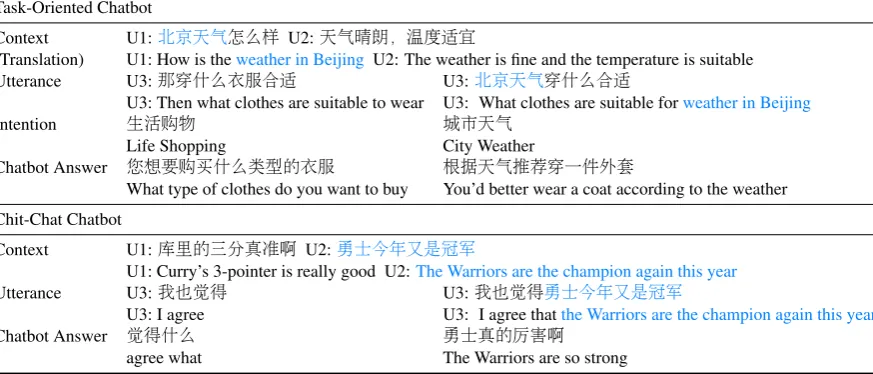
[image:7.595.310.525.218.365.2]Exam-Task-Oriented Chatbot
Context U1:北京天气怎么样 U2:天气晴朗,温度适宜
(Translation) U1: How is theweather in Beijing U2: The weather is fine and the temperature is suitable Utterance U3:那穿什么衣服合适 U3:北京天气穿什么合适
U3: Then what clothes are suitable to wear U3: What clothes are suitable forweather in Beijing
Intention 生活购物 城市天气
Life Shopping City Weather
Chatbot Answer 您想要购买什么类型的衣服 根据天气推荐穿一件外套
What type of clothes do you want to buy You’d better wear a coat according to the weather
Chit-Chat Chatbot
Context U1:库里的三分真准啊 U2:勇士今年又是冠军
U1: Curry’s 3-pointer is really good U2:The Warriors are the champion again this year
Utterance U3:我也觉得 U3:我也觉得勇士今年又是冠军
U3: I agree U3: I agree thatthe Warriors are the champion again this year
Chatbot Answer 觉得什么 勇士真的厉害啊
[image:8.595.82.519.67.254.2]agree what The Warriors are so strong
Table 8: Examples of integrated test. Left column is the original system and right is the one with utterance rewriter. Blue words denote completed information by the utterance rewriter.
Model Intention Precision CPS
Original 80.77 6.3
With Rewrite 89.91 7.7
Table 9: Results of integrated testing. Intention precision for task-oriented and conversation-turns-per-session (CPS) for chitchat.
ples of rewritten utterances are shown in Table6.
5.4 Integration Testing
In this section, we study how the proposed utter-ance rewriter can be integrated into off-the-shelf online chatbots to improve the quality of
gener-ated responses. We use our best model T-Ptr-λto
rewrite each utterance based on the dialogue con-text. The rewritten utterance is then forwarded to the system for response generation. We apply on both a task-oriented and chitchat setting. The re-sults are compared with the original system having no utterance rewriter.
Task-oriented Our task-oriented dialogue sys-tem contains an intention classifier built on
Fast-Text(Bojanowski et al., 2017) and a set of
tem-plates that perform policy decision and slot-value filling sequentially. Intention detection is a most important component in task-oriented dialogues and its accuracy will affect all the following steps. We define 30 intention classes like weather, ho-tel booking and shopping. The training data con-tains 35,447 human annotations. With the combi-nation of our rewriter, the intention classier is able
to achieve a precision of 89.91%, outperforming the original system by over 9%. The improved in-tention classification further lead to better
conver-sations. An example is shown in Table8, a
multi-turn conversation about the weather. The user first asks “How is the weather in Beijing”, then follows with a further question about “Then what clothes are suitable to wear”. The original system wrongly classified the user intention as shopping since this is a common conversational pattern in shopping. In contrast, our utterance rewriter is able to re-cover the omitted information “under the weather in Beijing”. Based on the rewritten utterance, the classifier is able to correctly detect the intention and provide proper responses.
Chitchat Our social chatbot contains two sep-arate engines for multi-turn and single-turn dia-logues. Each engine is a hybrid retrieval and
gen-eration model. In real-life applications, a user
details about our system. The whole test lasted
one month. Table9shows the Conversation-turns
Per Session (CPS), which is the average num-ber of conversation-turns between the chatbot and the user in a session. The utterance rewriter in-creases the average CPS from 6.3 to 7.7, indicat-ing the user is more engaged with the integrated
model. Table8shows an example of how the
ut-terance rewriter helps with the generation. After the rewriting, the model can better understand the dialogue is about the NBA team Warriors, but the original model feels confused and only provides a generic response.
6 Conclusion
In this paper, we propose improving multi-turn di-alogue modelling by imposing a separate utterance
rewriter. The rewriter is trained to recover the
coreferred and omitted information of user utter-ances. We collect a high-quality manually anno-tated dataset and designed a Transformer-pointer based architecture to train the utterance rewriter. The trained utterance rewriter performs remark-ably well and, when integrated into two online chatbot applications, significantly improves the in-tention detection and user engagement. We hope the collected dataset and proposed model can ben-efit future related research.
Acknowledgments
We thank all anonymous reviewers and the dia-logue system team of Wechat AI for valuable com-ments. Xiaoyu Shen is supported by IMPRS-CS fellowship.
References
Abdalghani Abujabal, Rishiraj Saha Roy, Mohamed Yahya, and Gerhard Weikum. 2018. Never-ending learning for open-domain question answering over knowledge bases. InProceedings of the 2018 World Wide Web Conference on World Wide Web, pages 1053–1062. International World Wide Web Confer-ences Steering Committee.
Dzmitry Bahdanau, Kyunghyun Cho, and Yoshua Ben-gio. 2014. Neural machine translation by jointly learning to align and translate. arXiv preprint arXiv:1409.0473.
Anders Bj¨orkelund and Jonas Kuhn. 2014. Learn-ing structured perceptrons for coreference resolution with latent antecedents and non-local features. In
Proceedings of the 52nd Annual Meeting of the As-sociation for Computational Linguistics (Volume 1: Long Papers), volume 1, pages 47–57.
Piotr Bojanowski, Edouard Grave, Armand Joulin, and Tomas Mikolov. 2017. Enriching word vectors with subword information. Transactions of the Associa-tion for ComputaAssocia-tional Linguistics, 5:135–146.
Ziqiang Cao, Wenjie Li, Sujian Li, and Furu Wei. 2018. Retrieve, rerank and rewrite: Soft template based neural summarization. InProceedings of the 56th Annual Meeting of the Association for Compu-tational Linguistics (Volume 1: Long Papers), vol-ume 1, pages 152–161.
Bo Chen, Le Sun, Xianpei Han, and Bo An. 2016. Sentence rewriting for semantic parsing. CoRR, abs/1901.02998.
Shiqian Chen, Chenliang Li, Feng Ji, Wei Zhou, and Haiqing Chen. 2019. Driven answer generation for product-related questions in e-commerce. In Pro-ceedings of the Twelfth ACM International Confer-ence on Web Search and Data Mining, pages 411– 419. ACM.
Yen-Chun Chen and Mohit Bansal. 2018. Fast abstrac-tive summarization with reinforce-selected sentence rewriting. arXiv preprint arXiv:1805.11080.
Kevin Clark and Christopher D Manning. 2016a. Deep reinforcement learning for mention-ranking corefer-ence models. arXiv preprint arXiv:1609.08667.
Kevin Clark and Christopher D Manning. 2016b. Im-proving coreference resolution by learning entity-level distributed representations. arXiv preprint arXiv:1606.01323.
Greg Durrett and Dan Klein. 2013. Easy victories and uphill battles in coreference resolution. In Proceed-ings of the 2013 Conference on Empirical Methods in Natural Language Processing, pages 1971–1982.
Marjan Ghazvininejad, Chris Brockett, Ming-Wei Chang, Bill Dolan, Jianfeng Gao, Wen-tau Yih, and Michel Galley. 2018. A knowledge-grounded neural conversation model. InThirty-Second AAAI Confer-ence on Artificial IntelligConfer-ence.
David Grangier and Michael Auli. 2017. Quickedit: Editing text & translations via simple delete actions.
arXiv preprint arXiv:1711.04805.
Jiatao Gu, Yong Wang, Kyunghyun Cho, and Vic-tor OK Li. 2017. Search engine guided non-parametric neural machine translation. arXiv preprint arXiv:1705.07267.
Marcin Junczys-Dowmunt and Roman Grundkiewicz. 2017. An exploration of neural sequence-to-sequence architectures for automatic post-editing.
arXiv preprint arXiv:1706.04138.
Heeyoung Lee, Yves Peirsman, Angel Chang, Nathanael Chambers, Mihai Surdeanu, and Dan Ju-rafsky. 2011. Stanford’s multi-pass sieve corefer-ence resolution system at the conll-2011 shared task. In Proceedings of the fifteenth conference on com-putational natural language learning: Shared task, pages 28–34. Association for Computational Lin-guistics.
Kenton Lee, Luheng He, Mike Lewis, and Luke Zettle-moyer. 2017. End-to-end neural coreference resolu-tion. arXiv preprint arXiv:1707.07045.
Piero Molino, Huaixiu Zheng, and Yi-Chia Wang. 2018. Cota: Improving the speed and accuracy of customer support through ranking and deep net-works. In Proceedings of the 24th ACM SIGKDD International Conference on Knowledge Discovery & Data Mining, pages 586–595. ACM.
Nikola Mrkˇsi´c, Diarmuid ´O S´eaghdha, Tsung-Hsien Wen, Blaise Thomson, and Steve Young. 2017. Neural belief tracker: Data-driven dialogue state tracking. InProceedings of the 55th Annual Meet-ing of the Association for Computational LMeet-inguistics (Volume 1: Long Papers), pages 1777–1788.
Jan Niehues, Eunah Cho, Thanh-Le Ha, and Alex Waibel. 2016. Pre-translation for neural machine translation. arXiv preprint arXiv:1610.05243.
Pushpendre Rastogi, Arpit Gupta, Tongfei Chen, and Lambert Mathias. 2019. Scaling multi-domain dialogue state tracking via query reformulation.
NAACL.
Stefan Riezler and Yi Liu. 2010. Query rewriting using monolingual statistical machine translation. Com-putational Linguistics, 36(3):569–582.
Abigail See, Peter J Liu, and Christopher D Man-ning. 2017. Get to the point: Summarization with pointer-generator networks. arXiv preprint arXiv:1704.04368.
Iulian V Serban, Alessandro Sordoni, Yoshua Bengio, Aaron Courville, and Joelle Pineau. 2016. Building end-to-end dialogue systems using generative hier-archical neural network models.AAAI.
Iulian Vlad Serban, Alessandro Sordoni, Ryan Lowe, Laurent Charlin, Joelle Pineau, Aaron Courville, and Yoshua Bengio. 2017. A hierarchical latent variable encoder-decoder model for generating di-alogues. AAAI.
Lifeng Shang, Zhengdong Lu, and Hang Li. 2015. Neural responding machine for short-text conversa-tion. arXiv preprint arXiv:1503.02364.
Xiaoyu Shen, Hui Su, Wenjie Li, and Dietrich Klakow. 2018a. Nexus network: Connecting the preceding and the following in dialogue generation. In Pro-ceedings of the 2018 Conference on Empirical Meth-ods in Natural Language Processing, pages 4316– 4327.
Xiaoyu Shen, Hui Su, Shuzi Niu, and Vera Demberg. 2018b. Improving variational encoder-decoders in dialogue generation. In Thirty-Second AAAI Con-ference on Artificial Intelligence.
Sainbayar Sukhbaatar, Jason Weston, Rob Fergus, et al. 2015. End-to-end memory networks. InAdvances in neural information processing systems, pages 2440–2448.
Ashish Vaswani, Noam Shazeer, Niki Parmar, Jakob Uszkoreit, Llion Jones, Aidan N Gomez, Łukasz Kaiser, and Illia Polosukhin. 2017. Attention is all you need. InAdvances in Neural Information Pro-cessing Systems, pages 5998–6008.
Oriol Vinyals, Meire Fortunato, and Navdeep Jaitly. 2015. Pointer networks. InAdvances in Neural In-formation Processing Systems, pages 2692–2700.
Oriol Vinyals and Quoc Le. 2015. A neural conversa-tional model. arXiv preprint arXiv:1506.05869.