579
Entity-Centric Joint Modeling of Japanese Coreference Resolution
and Predicate Argument Structure Analysis
Tomohide Shibata†‡ and Sadao Kurohashi†‡
†Graduate School of Informatics, Kyoto University
Yoshida-honmachi, Sakyo-ku, Kyoto, 606-8501, Japan
‡CREST, JST
4-1-8, Honcho, Kawaguchi-shi, Saitama, 332-0012, Japan
{shibata, kuro}@i.kyoto-u.ac.jp
Abstract
Predicate argument structure analysis is a task of identifying structured events. To improve this field, we need to identify a salient entity, which cannot be identified without performing coreference resolution and predicate argument structure analy-sis simultaneously. This paper presents an entity-centric joint model for Japanese coreference resolution and predicate argu-ment structure analysis. Each entity is as-signed an embedding, and when the re-sult of both analyses refers to an entity, the entity embedding is updated. The analyses take the entity embedding into consideration to access the global infor-mation of entities. Our experimental re-sults demonstrate the proposed method can improve the performance of the inter-sentential zero anaphora resolution drasti-cally, which is a notoriously difficult task in predicate argument structure analysis.
1 Introduction
Natural language often conveys a sequence of events like “who did what to whom”, and extract-ing structured events from the raw text is a kind of touchstone for machine reading. This is realized by a combination of coreference resolution (called CR, hereafter) and predicate argument structure analysis (calledPA, hereafter).
The characteristics and difficulties in the anal-yses vary among languages. In English, there are few omissions of arguments, and thus PA is rela-tively easy, around 83% accuracy (He et al., 2017), while CR is relatively difficult, around 70% accu-racy (Lee et al., 2017).
On the other hand, in Japanese and Chinese, where arguments are often omitted, PA is a
dif-ficult task, and even state-of-the-art systems only achieve around 50% accuracy. Zero anaphora res-olution (ZAR) is a difficult subtask of PA, de-tecting a zero pronoun and identifying a referent of the zero pronoun. As the following example shows, CR in English (identifying the antecedent ofit) and ZAR in Japanese (identifying the omit-ted nominative argument) are similar problems.
(1) a. John bought a car last month. It was made by Toyota.
b. ジョンは
John-TOP 先月
last month
車を
a car-ACC
買った。
bought. (φが)
(ϕ-NOM)
トヨタ製だった。
Toyota made-COPULA.
Note that CR such as the relation between “the company” and “Toyota” is also difficult in Japanese.
According to the argument position relative to the predicate, ZAR is classified into the following three types:
• intra-sentential(intrain short): an argument is located in the same sentence with the pred-icate
• inter-sentential(interin short): an argument is located in the preceding sentences, such as “車” for “トヨタ製だった” (Toyota
made-COPULA) in sentence (1b)
• exophora: an argument does not appear in a
document, such asauthorandreader
Among these three types, the analysis of interis extremely difficult because there are many candi-dates in preceding sentences, and clues such as a dependency path between a predicate and an argu-ment cannot be used.
!"#$%&'&(&&&)*+&&&,-&.&(&+/&0&1&&&&&234&&&56,&78&&&9:;&<&&&&&&=>&<?@&A !"#$%&"#'()*'+,-A "./0$%A 12132)'4,-567'8,+'39:A ;9<<0$=A 4-'>)"1A )9=?>")'$=@A 32?2%2/:2@'-7A+A
B2%:<0=A
B#CDE&&&FGH&I&&&&&&&&9J&K&&LM&<N&/?&@A C)2<0@2=:'DE8A <0@2'744A <9CC"):'-7A+A
!"#$"!! !"#$%'? ,-? 234A 2=F:&?39G2)A
OOOA
#%&'(!A H!"#$%&"#'()*I? H12132)I? H;9<<0$=I?
P&'&(&&&&&&&&=>&Q.&&&&&&&&&&J????J???&&&&&&&&&RS&@A <$12'()*'+,-A 2%2/F"='3&A </K"%")A
8,(A 8,(A
8,(A J????JA
()*?!"#$%&"#?L$<?=":?$=?"./0$%?12132)M?39:?)9=? >")?$=?2%2/F"=?>)"1?;9<<0$=?4-M?$=@?L$<?2%2/:2@*? N2?L$<?$?</K"%")?J?3&?:K2?2%2/F"=*?
[image:2.595.80.535.76.251.2]N2?<9CC"):2@?$?<0@2?">?-)2<0@2=:?B2%:<0=*A /")2>2)2=/2?)2<"%9F"=?A C)2@0/$:2?$)O912=:? <:)9/:9)2?$=$%&<0<A :)$=<%$F"=A
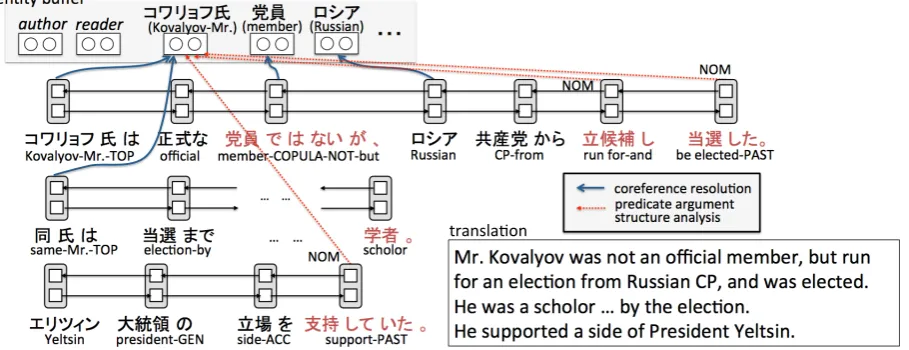
Figure 1: An overview of our proposed method. The phrases with red represent a predicate.
ZAR) needs to identify salient entities, which can-not be identified without performing CR and PA simultaneously. Our results support this claim, and suggest that the status quo of PA-exclusive re-search in Japanese is an insufficient approach.
Our work is inspired by (Wiseman et al., 2016), which described an English CR system, where entities are represented by embeddings, and they are updated by CR results dynamically. We per-form Japanese CR and PA by extending this idea. Our experimental results demonstrate the pro-posed method can improve the performance of the inter-sentential zero anaphora resolution dras-tically.
2 Related Work
Predicate Argument Structure Analysis.
Early studies have handled bothintra- and inter -sentential anaphora (Taira et al., 2008; Sasano and Kurohashi, 2011), and Hangyo et al. (2013) present a method for handlingexophora. Recent studies, however, focus on only intra-sentential anaphora (Ouchi et al., 2015; Shibata et al., 2016; Iida et al., 2016; Ouchi et al., 2017; Matsubayashi and Inui, 2017), because the analysis of inter -sentential anaphora is extremely difficult. Neural network-based approaches (Shibata et al., 2016; Iida et al., 2016; Ouchi et al., 2017; Matsubayashi and Inui, 2017) have improved its performance.
Although most of studies did not consider the notion entity, Sasano and Kurohashi (2011) con-sider an entity, and its salience score is calcu-lated based on simple rules. However, they used gold coreference links to form the entities, and
reported the salience score did not improve the performance. In contrast, we perform CR auto-matically, and capture the entity salience by using RNNs.
For Chinese, where zero anaphors are often used, neural network-based approaches (Chen and Ng, 2016; Yin et al., 2017) outperformed conven-tional machine learning approaches (Zhao and Ng, 2007).
Coreference Resolution. CR has been actively
studied in English and Chinese. Neural network-based approaches (Wiseman et al., 2016; Clark and Manning, 2016b,a; Lee et al., 2017) outper-formed conventional machine learning approaches (Clark and Manning, 2015). Wiseman et al. (2016) and Clark and Manning (2016b) learn an entity representation and integrate this into a mention-based model. Our work is inspired by Wiseman et al. (2016), which learn the entity representa-tion by using Recurrent Neural Networks (RNNs). Clark and Manning (2016b) adopt a clustering ap-proach for the entity representation. The reason why we do not use this is that if we take a cluster-ing approach in our settcluster-ing, zero pronouns need to be first identified before clustering, and thus, it is hard to perform CR and PA jointly. Lee et al. (2017) take an end-to-end approach, aiming at not relying on hand-engineering mention detec-tor (consider all spans as potential mentions). In used Japanese evaluation corpora, since the basic unit for the annotations and our analyses (CR and PA) is fixed, we do not need consider all spans.
since the use of zero pronouns is more common and problematic.
Semantic Role Labeling. Japanese PA is
simi-lar to Semantic Role Labeling (SRL) in English. Neural network-based approaches have improved the performance (Zhou and Xu, 2015; He et al., 2017). In these approaches, an appropriate argu-ment for a predicate is searched among argu-mentions in a text. The notionentityis not considered.
Other Entity-Centric Study. There are several
studies that consider the notionentityin other ar-eas: text comprehension (Kobayashi et al., 2016; Henaff et al., 2016) and language modeling (Ji et al., 2017).
3 Japanese Preliminaries
Before presenting our proposed method, we de-scribe the basics of Japanese predicate argument structure and its analysis.
Since the word order is relatively free among arguments in Japanese, an argument is followed by a case marking postposition. The postpositions が(ga),を(wo), and に(ni) indicate nominative (NOM), accusative (ACC) and dative (DAT), respec-tively. In the double nominative construction such as “私が英語が上手だ” (My English is good), “英語” (English) is regarded asNOM, and “私” (I), the outer nominative is regarded as NOM2. This paper targets these four cases.
PA is tightly related to a dependency structure of a sentence. Considering the relation between a predicate and its argument, and a necessary analy-sis can be classified into the following three cate-gories (see example sentence (2) below).
(2) ジョン は 買った パン を 食べた
John-TOP bought bread–ACC ate. D
D D
Overt case: When an argument with a case
marking postposition has a dependency relation with a predicate, PA is not necessary. In example (2), since “パン を” (bread-ACC) has a dependency
relation with “食べた” (ate), it is obvious that “食 べた” takes “パン” as itsACCargument.
Case analysis: When a topic markerは(wa) is
attached to an argument, the case marking postpo-sition disappears, and the analysis of identifying the case role becomes necessary. The analysis is calledcase analysis. In the example, although “ジ ョン は” (John-TOP) has a dependency relation with
“食べた” (ate), the analysis of identifyingNOMis
necessary. The same phenomenon happens when a relative clause is used. When an argument is mod-ified by a relative clause, we do not know its case role to the predicate in the relative clause. In the example, although “パン” has a dependency rela-tion with “買った” (bought), the analysis of iden-tifyingACCis necessary.
Zero anaphora resolution (ZAR): Some
argu-ments are not included in the phrases with which a predicate has a dependency relation. While pro-nouns are mostly used in English, they are rarely used in Japanese. This phenomenon is calledzero anaphora, and the analysis of identifying an argu-ment (referent of the zero pronoun) is calledzero
anaphora resolution (ZAR). In the example,
al-though “買った” takes “ジョン” as itsNOM argu-ment, they do not have a dependency relation, and thus zero anaphora resolution is necessary.
When dependency relations are identified by parsing, what Japanese PA has to do is case analy-sis and zero anaphora resolution.
Each predicate has a set of required cases, but not all the four cases. For example, “買う” (buy) takesNOMandACC, but neitherDATnorNOM2. PA for “買う” in sentence (2) has to find John asNOM, but also has to judge that it does not takeDATand
NOM2arguments.
Another difficulty lies in that a predicate takes a case, but in a sentence it does not take a spe-cific argument. For example, in the sentence “it is difficult to bake a bread”,NOMof “bake” is not a specific person, but means “anyone” or “in gen-eral”. In such cases, PA has to regard arguments asunspecified.
4 Overview of Our Proposed Method
An overview of our proposed model is described with a motivated example (Figure 1). Our model equips anentity bufferfor entity management. At first, it contains only special entities, author and reader.
into consideration not only the mentions in the text but also the entities in the entity buffer.
In CR, when a mention refers to an existing en-tity, the entity embedding in the entity buffer is updated. In Figure 1, “同氏” (said person) is ana-lyzed to refer to “コワリョフ氏” (Mr.Kovalyov), and the entity embedding of “コワリョフ氏” is updated. When a mention is analyzed to have no antecedent, it is registered to the entity buffer as a new entity.
In PA, when a predicate has no argument for any case, its argument is searched among any mentions in the text, author andreader. In the same way as CR, PA takes into consideration not only the mentions but also entities in the entity buffer, and updates the entity embedding.
In Figure 1, the predicate “立候補し” (run for) has no NOM argument. Our method finds “コワ
リョフ氏” as itsNOMargument, and then updates
its entity embedding. As mentioned before, the entity embedding of “コワリョフ氏” is updated by the coreference relation with “同氏” in the sec-ond sentence. In the third sentence, the predicate
“支持していた” (support) has also noNOM
argu-ment, and “コワリョフ氏” is identified as itsNOM
argument, because the frequent reference implies its salience.
5 Base Model
5.1 Input Encoding
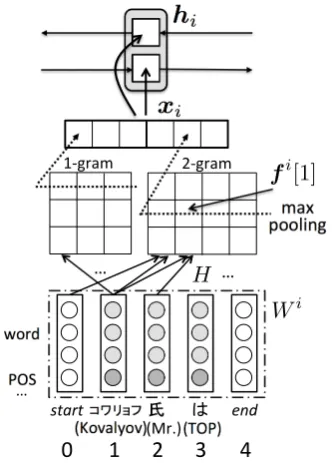
Conventional machine learning techniques have extracted features from a basic phrase, which re-quire much effort on feature engineering. Our method obtains an embedding of each basic phrase using CNN and bi-LSTM as shown in Figure 2.
Suppose the i-th basic phrase bpi consists of |bpi|words. First, the embedding of each word is represented as a concatenation of word (lemma), part of speech (POS), sub-POS and conjugation embeddings. We append start-of-phrase and end-of-phrase special words to each phrase in order to better represent prefixes and suffixes. LetWi ∈
Rd×(|bpi|+2)be an embedding matrix forbp
iwhere ddenotes the dimension of word representation.
The embedding of the basic phrase is obtained by applying CNN to the sequence of words. A fea-ture mapfiis obtained by applying a convolution betweenWi and a filterH of widthn. Them-th element offiis obtained as follows:
fi[m] = tanh(⟨Wi[∗, m:m+n−1], H⟩), (1)
!"#$%&'&
!"#$ %&&'()*&
+&,-&
./0&
x
ih
i12&3"'4&35& 16/.5&
H
Wi fi[1]
!"#$"! (& %&'! 17,85&
9$& :& ;& <$& =$&
>&
:?*,"!& ;?*,"!&
[image:4.595.332.499.64.296.2]>& >&
Figure 2: Basic phrase embedding obtained with CNN and Bi-LSTM.
whereWi[∗, m:m+n−1]denotes them-to-(m+ n−1)-th column ofWi, and⟨A, B⟩= Tr(ABT) is the Frobenius inner product. Then, to capture the most important feature for a given filter inbpi, the max pooling is applied as follows:
xi = max
m f
i[m]. (2)
The process described so far is for one filter. The multiple filters of varying widths are applied to obtain the representation ofbpi. When we seth filters,xi, the embedding of thei-th basic phrase, is represented as[xi
1,· · · , xih].
The embeddings of basic phrases are read by bi-LSTM to capture their context as follows:
− →
hi=−−−−→LST M(xi,−→hi−1),
←−
hi=←−−−−LST M(xi,←h−i+1),
(3)
and the contextualized embedding of thei-th ba-sic phrase is represented as a concatenation of the hidden layers of forward and backward LSTM.
hi = [−→hi;←h−i] (4)
This process is performed for each sentence. Since CR and PA are performed for a whole doc-ument D, the indices of basic phrases are reas-signed from the beginning to the end of D in a consecutive order:D={h1,h2,· · · ,hi,· · · }.
5.2 Coreference Resolution
We adopt a mention-ranking model that as-signs each mention its highest scoring candi-date antecedent. This model assigns a score
sm
CR(ant, mi) to a target mention mi and its
candidate antecedent ant1. The candidate an-tecedents include i) mentions precedingmi, ii)
au-thor and reader, and iii) NACR (no antecedent).
smCR(ant, mi)is calculated as follows:
smCR(ant, mi) =W2CRReLU(W1CRvCRinput), (5)
where W1CR and W2CR are weight matrices, and
vCRinput is an input vector, a concatenation of the
following vectors:
• embeddings ofmiandant
• exact match or partial match between strings ofmiandant
• sentence distance betweenmi andant. The distance is binned into one of the buckets [0, 1, 2, 3+].
• whether a pair ofmiandanthas an entry in a synonym dictionary.
When a candidate antecedent isNACR, the input vector is just the embedding of a target mention mi, and the same neural network with different weight matrices calculates a score.
The following margin objective is trained:
LCR= Nm ∑
i
max
ant∈AN T(mi)
(1+smCR(ant, mi)−smCR( ˆti, mi)),
(6) where Nm denotes the number of mentions in a document,AN T(mi)denotes the set of candidate antecedents ofmi, andtˆidenotes the highest scor-ing true antecedent ofmidefined as follows:
ˆ
ti = argmax ant∈T(mi)
smCR(ant, mi), (7)
whereT(mi) denotes the set of true antecedents ofmi.
5.3 Predicate Argument Structure Analysis
When a target phrase is a predicate phrase, PA is performed. For each case of a predicate, PA searches an appropriate argument among candi-date arguments: i) basic phrases located in the tence including the predicate and preceding sen-tences, ii)authorandreader, iii) unspecified, and
1The superscriptm ofsm
CR(ant, mi) represents a men-tion-based score, which contrasts with anentity-based score introduced in Section 6.
!"#$%&'(#!'")*+#,(-
!'(.-#+/#$$%,)!
0#1#&23,'1-!"#4#"#,-0#,(#,&#-$%0(',&#!
"#$%!&'()*+!
"#$! %!
!! ,-! ...!
&'()*!+!
6738'1938:!6;"<:! 6+#+/#":! 6"*,-43":!6',$:!
smPA(arg, mi, c)
vPAinput WPA
1,c
WPA
[image:5.595.309.536.65.224.2]2
Figure 3: A neural network for PA.
iv)NAPAwhich means the predicate takes no argu-ment of for the case.
The probability that the predicate mi takes an argumentargfor casecis defined as follows:
P(c=arg|mi) =
exp(smPA(arg, mi, c))
∑
carg∈
ARG(mi)
exp(sm
PA(carg, mi, c))
,
(8) whereARG(mi) denotes the set of candidate ar-guments ofmi, and a scoresmPA(arg, mi, c)is cal-culated by a neural network as follows (Figure 3):
smPA(arg, mi, c) =W2PAtanh(W1PA,cvPAinput), (9)
whereW1PA,c,W2PAare weight matrices, andvPAinput is an input vector, a concatenation of the following vectors:
• embeddings ofmiandarg2
• path embedding: the dependency path be-tween a predicate and an argument is an im-portant clue. Roth and Lapata (2016) learn a representation of a lexicalized dependency path for SRL. An LSTM reads words3 from an argument to a predicate along with a de-pendency path, and the final hidden state is adopted as the embedding of the dependency path.4 For case analysis, the direct depen-dency relation between a predicate and its ar-gument can be represented as the path em-bedding.
2
An embedding forNAPAis assigned a trainable one. 3
We add special words{Parent, Child}, which indicate a dependency direction between basic phrases.
4When an argument is aninterorexophora, the path
• selectional preference: selectional preference is another important clue for PA. A selec-tional preference score is learned in an un-supervised manner from automatic parses of a raw corpus (Shibata et al., 2016).
• sentence distance betweenmi andarg. The distance is binned in the same way as CR.
The objective is to minimize the cross entropy between predicted and true distributions:
LPA=−
Np
∑
i
∑
c
logP(c=darg|pi), (10)
where Np denotes the number of predicates in a document, andargddenotes a true argument.
6 Entity-Centric Model
While the base model performsmention-based CR and PA, our proposed model performsentity-based analyses as shown in Figure 1.
6.1 Entity Embedding Update
The entity embeddings are managed in an entity buffer. First, let us introduce time stampifor the entity embedding update. Time icorresponds to the analysis for the i-th basic phrase in a docu-ment. If an entity is referred to by the analysis, its embedding is updated. Lete(ik)be the embedding of an entitykat timei(after the entity embedding is updated).
In CR, following Wiseman et al. (2016), when a target phrase mi refers to the entity k, e(ik) is updated as follows:
e(ik)←LST Me(hi,e(ik−)1) (11)
where LST Me denotes an LSTM for the entity embedding update. When an antecedent isNACR, a new entity embedding is set up, initialized by a zero vector. The entity buffer maintainsKLSTMs (K is the number of entities in a document), and their parameters are shared.
The proposed method updates the entity embed-ding not only in CR but also in PA. When the ref-erent of a zero pronoun of casecof predicatepiis entityk, the entity embedding is updated by using the predicate embeddinghimultiplied by a weight matrixWcfor casecas follows:
e(ik)←LST Me(Wchi,e(i−k)1). (12)
In both CR and PA, the embeddings of entities other than the referred entity k are not updated (e(il) ←ei(−l)1(l̸=k)).
6.2 Use of Entity Embedding in CR and PA
Both CR and PA are allowed to take the entity em-beddings into consideration. In CR, let zant de-note the id of an entity to which the candidate an-tecedentantbelongs. Theentity-based scorese
CR
is calculated as follows:
seCR(ant, mi) =
{
hTie(zant)
i−1 (ant̸=NACR)
gN A(mi) (ant=NACR).
(13) The intuition behind the first case is that the dot-product of hi, the embedding of the target men-tion, ande(zant)
i−1 , the embedding of the entity that
ant belongs to indicates the plausibility of their coreference.gN A(mi)is defined as follows:
gN A(mi) =qTtanh(WN A [
hi ∑
kei−1(k)
]
), (14)
whereqis a weight vector, andWN Ais a weight matrix. The intuition is that whether a target phrase isNACRcan be judged fromhi, the embed-ding of the target mention itself, and the sum of all the current entity embeddings.se
CRis added to smCR, and the training objective is the same as the one described in Section 5.2.
In PA, the entity embedding corresponding to a candidate argument arg5 is just added to the input vectorvPAinput described in Section 5.3, and mention- andentity-based scoresmPA+e(arg, mi, c) is calculated in the same way assmPA(arg, mi, c). The training objective is again the same as the one in Section 5.3.
In Wiseman et al. (2016), the oracle entity as-signment is used for the entity embedding update in training, and the system output is used in a greedy manner in testing. Since the performance of PA is lower than that of English CR, there might be a more significant gap between training and testing. Therefore, scheduled sampling (Bengio et al., 2015) is adopted to bridge the gap: in train-ing, the oracle entity assignment is used with prob-abilityϵt(at thet-th iteration) and the system out-put otherwise. Exponential decay is used:ϵt=kt (we setk= 0.75for our experiments).
7 Experiments
7.1 Experimental Setting
The two kinds of evaluation sets were used for our experiments. One is the KWDLC (Kyoto
Uni-5WhenargisNA
PA, the entity embedding is set to a zero
versity Web Document Leads Corpus) evaluation set (Hangyo et al., 2012), and the other is Ky-oto Corpus. KWDLC consists of the first three sentences of 5,000 Web documents (15,000 sen-tences) and Kyoto Corpus consists of 550 News documents (5,000 sentences). Word segmenta-tions, POSs, dependencies, PASs, and corefer-ences were manually annotated (the closest ref-erents and antecedents were annotated for zero anaphora and coreferences, respectively). Since we want to focus on the accuracy of CR and PA, gold segmentations, POSs, and dependen-cies were used. KWDLC (Web) was divided into 3,694 documents (11,558 sents.) for training, 512 documents (1,585 sents.) for development, and 700 documents (2,195 sents.) for testing; Kyoto Corpus (News) was divided into 360 documents (3,210 sents.) for training, 98 documents (971 sents.) for development, and 100 documents (967 sents.) for testing.
The evaluation measure is an F-measure, and the evaluation of both CR and PA was relaxed using a gold coreference chain, which leads to an entity-based evaluation. We did not use the conventional CR evaluation measures (MUC, B3, CEAF and CoNLL) because our F-measure is al-most the same as MUC, which is a link-based measure, and the other measures considering sin-gletons get excessively high values6, and thus they do not accord with the actual performance in our setting.7
7.2 Implementation Detail
The dimension of word embeddings was set to 100, and the word embeddings were initialized with pre-trained embeddings by Skip-gram with a negative sampling (Mikolov et al., 2013) on a Japanese Web corpus consisting of 100M sen-tences. The dimension of POS, sub-POS and con-jugation were set to 10, respectively, and these em-beddings were initialized randomly. The dimen-sions of the hidden layer in all the neural networks were set to 100. We used filter windows of 1,2,3 with 33 feature maps each for basic phrase CNN.
6In Japanese, since zero pronouns are often used, there are
many singletons. In example sentences (1) of the Introduction section, while “a car” and “It” form one cluster in English sentences (1-a), “a car” is a singleton in Japanese sentences (1-b) because a zero pronoun is used in the second sentence.
7For the Web evaluation set, the F-measure of our
pro-posed method is 0.685, and the conventional evaluation mea-sures are as follows; MUC: 69.1, B3: 97.2, CEAF: 95.7, and
CoNLL: 87.3.
Adam (Kingma and Ba, 2014) was adopted as the optimizer. F measures were averaged over four runs.
Checkpoint ensemble (Chen et al., 2017) was adopted, where thek best models were taken in terms of validation score, and then the parame-ters from thekmodels were averaged for testing. This method requires only one training process. In our experiments,kwas set to 5, and the maximum number of epochs was set to 10.
We used a single-layer bi-LSTM for the input encoding (Section 5.1); preliminary experiments with stacked stacked bi-directional LSTM with residual connections were not favorable. Although we tried to use the character-level embedding of each word obtained with CNN, as the same way in the basic phrase embedding from the word se-quences, the performance was not improved. The synonym dictionary used for CR (Section 5.2) was constructed from an ordinary dictionary and Web corpus, and has about 7,300 entries (Sasano et al., 2007).
7.3 Experimental Result
The following three methods were compared:
• Baseline: the method described in Section 5. • “+entity (CR)”: this method corresponds to
(Wiseman et al., 2016). Entity embedding is updated based on the CR result, and CR takes the entity embedding into consideration. • “+entity (CR,PA)” (proposed method):
en-tity embedding is updated based on PA as well as CR result, and the CR and PA take the entity embedding into consideration.
The performance of CR and PA (case analysis and zero anaphora resolution (ZAR)) is shown in Table 1. The performance of CR and case anal-ysis was almost the same for all the methods. For ZAR, “+entity (CR,PA)” improved the perfor-mance drastically.
Web News
method coreference resolution
case analysis
zero anaphora resolution (ZAR)
coreference resolution
case analysis
zero anaphora resolution (ZAR)
Baseline 0.661 0.887 0.516 0.543 0.896 0.278
+entity (CR) 0.666 0.890 0.518 0.539 0.894 0.275
[image:8.595.89.513.63.123.2]+entity (CR,PA) 0.685 0.892 0.581 0.541 0.895 0.356
Table 1: Performance (F-measure) of coreference resolution, case analysis and zero anaphora resolution.
Web News
case method case
analysis
zero anaphora resolution (ZAR)
case analysis
zero anaphora resolution (ZAR) all intra inter exophora all intra inter exophora
NOM Baseline 0.942 0.575 0.466 0.083 0.695 0.939 0.316 0.455 0.042 0.261 +entity (CR) 0.945 0.579 0.475 0.117 0.693 0.940 0.315 0.452 0.037 0.239 +entity (CR,PA) 0.945 0.646 0.508 0.502 0.721 0.940 0.390 0.486 0.256 0.357 # of arguments (1,461) (2,009) (338) (393) (1,278) (905) (1,016) (451) (388) (177)
ACC Baseline 0.853 0.268 0.368 0.119 0.000 0.679 0.053 0.093 0.000 0.000 +entity (CR) 0.855 0.254 0.357 0.108 0.000 0.631 0.025 0.048 0.000 0.000 +entity (CR,PA) 0.857 0.343 0.413 0.282 0.000 0.651 0.016 0.028 0.000 0.000 # of arguments (299) (224) (106) (105) (13) (105) (97) (41) (56) (0)
DAT Baseline 0.498 0.432 0.115 0.016 0.581 0.308 0.183 0.039 0.000 0.367 +entity (CR) 0.445 0.422 0.119 0.016 0.574 0.223 0.162 0.005 0.000 0.334 +entity (CR,PA) 0.411 0.465 0.133 0.126 0.600 0.292 0.328 0.030 0.005 0.566 # of arguments (101) (576) (86) (149) (341) (26) (286) (82) (89) (115)
[image:8.595.72.534.147.394.2]NOM2 Baseline 0.478 0.216 0.259 0.000 0.245 0.098 0.000 0.000 0.000 0.000 +entity (CR) 0.501 0.212 0.226 0.000 0.257 0.069 0.000 0.000 0.000 0.000 +entity (CR,PA) 0.526 0.283 0.240 0.112 0.341 0.092 0.000 0.000 0.000 0.000 # of arguments (110) (140) (29) (28) (83) (13) (37) (17) (13) (7) all Baseline 0.887 0.516 0.400 0.074 0.654 0.896 0.278 0.394 0.032 0.291 +entity (CR) 0.890 0.518 0.405 0.093 0.654 0.894 0.275 0.396 0.027 0.265 +entity (CR,PA) 0.892 0.581 0.439 0.399 0.681 0.895 0.356 0.417 0.204 0.432 # of arguments (1,971) (2,949) (559) (675) (1,715) (1,049) (1,436) (591) (546) (299)
Table 2: Performance of case analysis and zero anaphora resolution for each case, and each argument position for zero anaphora resolution. The underlined values indicate the proposed method outperforms the baseline by a large margin.
a number of improved examples. Therefore, ZAR can benefit from the entity representation obtained by both CR and PA.
Table 2 shows performance of case analysis and zero anaphora resolution for each case, and each argument position. Unspecified was counted for
exophora. Both for the News and Web evaluation
sets, the performance forinter arguments of zero anaphora resolution, which was extremely difficult in the baseline method, was improved by a large margin by our proposed method.
7.4 Ablation Study
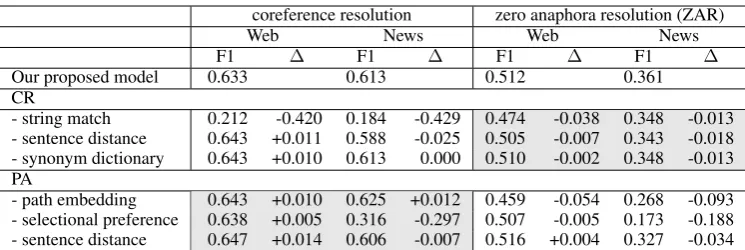
To reveal the importance of each clue for CR and PA, each clue was ablated. Table 3 shows the result on the development set. We found that, the path embedding was effective for PA, and the string match was effective for CR. The sentence distance for both CR and PA was effective for News, but not for Web since the Web evaluation corpus consists of three-sentence documents.
7.5 Comparison with Other Work
It is difficult to compare the performance of our method with other studies directly because there are no studies handling both CR and PA. The com-parisons with other studies are summarized as fol-lows:
• Shibata et al. (2016) proposed a neural-network based PA. Their target wasintraand
exophora for three major cases (NOM, ACC
andDAT), and the performance was 0.534 on the same Web corpus as ours. The perfor-mance of our proposed method for the same three cases was 0.626. Furthermore, since their model assumes a static PA graph, their model is difficult to be extended to handle CR.
coreference resolution zero anaphora resolution (ZAR)
Web News Web News
F1 ∆ F1 ∆ F1 ∆ F1 ∆
Our proposed model 0.633 0.613 0.512 0.361
CR
- string match 0.212 -0.420 0.184 -0.429 0.474 -0.038 0.348 -0.013 - sentence distance 0.643 +0.011 0.588 -0.025 0.505 -0.007 0.343 -0.018 - synonym dictionary 0.643 +0.010 0.613 0.000 0.510 -0.002 0.348 -0.013 PA
[image:9.595.111.484.60.185.2]- path embedding 0.643 +0.010 0.625 +0.012 0.459 -0.054 0.268 -0.093 - selectional preference 0.638 +0.005 0.316 -0.297 0.507 -0.005 0.173 -0.188 - sentence distance 0.647 +0.014 0.606 -0.007 0.516 +0.004 0.327 -0.034
Table 3: Ablation study on the development set. The cells shaded gray represent they are not directly affected from the ablation, but from the counterpart analysis result.
corpus contains a lot of annotation errors as pointed out in Iida et al. (2016), we did not conduct our experiments on the NAIST text corpus.
• Iida et al. (2003) reported an F-measure of about 0.7 on News domain. The possible rea-son why our performance on News (0.541) is lower than theirs is that their basic unit is a compound noun while our basic unit is a noun, and thus our setting is difficult in com-parison with theirs.
Since we handle inter as well asintra and
ex-ophoraarguments in PA, together with CR, we can
say that our experimental setting is more practical in comparison with other studies.
7.6 Error Analysis
In example (3), although theNOMargument of the predicate “通院ですよ!” (go to hospital) isauthor, our method wrongly classified it asunspecified.
(3) 毎日のように
every day
通院ですよ!
go to hospital!
私自身は
I myself-TOP とても
very
健康なんですけど。
healthy.
((I) go to hospital every day! (I am) very healthy, though.)
In the second sentence, our method correctly iden-tified the antecedent of “私” (I) asauthor, and the
NOMof “健康なんですけど” (healthy) as “私” (I).
Our method adopts the greedy search so that it cannot exploit this handy information in the anal-ysis of the first sentence. The global modeling us-ing reinforcement learnus-ing (Clark and Mannus-ing, 2016a) for a whole document is our future work.
In example (4), although theNOMargument of “装飾されています” (be decorated) in the second sentence is “ドレス” (dress) in the first sentence, our method wrongly classified it asNAPA.
(4) 大変
very
印象的な
impressive
ドレスです。
dress-COPULA. オーガンジーの
organdie-GEN
上に
top-DAT
ラインを
line-ACC
描くように
draw-as
小さな
small
ビーズで
bead-INS
装飾されています。
decorated
((This is) a very impressive dress.
(The dress) is decorated by small beads as they draw a line on its organdy.)
“オーガンジー” (organdie) has a bridging relation to “ドレス”, which might help capture the salience of “ドレス”. The bridging reference resolution is our next target and must be easily incorporated into our model.
8 Conclusion
This paper has presented an entity-centric neu-ral network-based joint model of coreference res-olution and predicate argument structure analy-sis. Each entity has its embedding, and the em-beddings are updated according to the result of both of these analyses dynamically. Both of these analyses took the entity embedding into consid-eration to access the global information of enti-ties. The experimental results demonstrated that the proposed method could improve the perfor-mance of the inter-sentential zero anaphora res-olution drastically, which has been regarded as a notoriously difficult task. We believe that our pro-posed method is also effective for other pro-drop languages such as Chinese and Korean.
Acknowledgment
References
Samy Bengio, Oriol Vinyals, Navdeep Jaitly, and Noam Shazeer. 2015. Scheduled sampling for se-quence prediction with recurrent neural networks. CoRR abs/1506.03099. http://arxiv.org/
abs/1506.03099.
Chen Chen and Vincent Ng. 2016. Chinese zero pro-noun resolution with deep neural networks. In Pro-ceedings of the 54th Annual Meeting of the Associa-tion for ComputaAssocia-tional Linguistics (Volume 1: Long Papers). Association for Computational Linguistics, Berlin, Germany, pages 778–788. http://www.
aclweb.org/anthology/P16-1074.
Hugh Chen, Scott Lundberg, and Su-In Lee. 2017. Checkpoint ensembles: Ensemble methods from a single training process. CoRR abs/1710.03282.
http://arxiv.org/abs/1710.03282.
Kevin Clark and Christopher D. Manning. 2015. Entity-centric coreference resolution with model stacking. InAssociation for Computational Linguis-tics (ACL).
Kevin Clark and Christopher D. Manning. 2016a. Deep reinforcement learning for mention-ranking coreference models. InEmpirical Methods on Nat-ural Language Processing (EMNLP).
Kevin Clark and Christopher D. Manning. 2016b. Im-proving coreference resolution by learning entity-level distributed representations. In Proceedings of the 54th Annual Meeting of the Association for Computational Linguistics (Volume 1: Long Papers). Association for Computational Linguis-tics, pages 643–653. https://doi.org/10.
18653/v1/P16-1061.
Masatsugu Hangyo, Daisuke Kawahara, and Sadao Kurohashi. 2012. Building a diverse document leads corpus annotated with semantic relations. In Proceedings of the 26th Pacific Asia Conference on Language, Information, and Computation. Fac-ulty of Computer Science, Universitas Indonesia, Bali,Indonesia, pages 535–544. http://www.
aclweb.org/anthology/Y12-1058.
Masatsugu Hangyo, Daisuke Kawahara, and Sadao Kurohashi. 2013. Japanese zero reference resolution considering exophora and author/reader mentions. InProceedings of the 2013 Conference on Empirical Methods in Natural Language Processing. Associa-tion for ComputaAssocia-tional Linguistics, Seattle, Wash-ington, USA, pages 924–934. http://www.
aclweb.org/anthology/D13-1095.
Luheng He, Kenton Lee, Mike Lewis, and Luke Zettle-moyer. 2017. Deep semantic role labeling: What works and what’s next. InProceedings of the An-nual Meeting of the Association for Computational Linguistics.
Mikael Henaff, Jason Weston, Arthur Szlam, An-toine Bordes, and Yann LeCun. 2016. Track-ing the world state with recurrent entity networks. CoRR abs/1612.03969. http://arxiv.org/
abs/1612.03969.
Ryu Iida, Kentaro Inui, Hiroya Takamura, and Yuji Matsumoto. 2003. Incorporating contextual cues in trainable models for coreference resolution. In In Proceedings of the EACL Workshop on The Compu-tational Treatment of Anaphora. pages 23–30.
Ryu Iida, Kentaro Torisawa, Jong-Hoon Oh, Cana-sai Kruengkrai, and Julien Kloetzer. 2016. Intra-sentential subject zero anaphora resolution using multi-column convolutional neural network. In Proceedings of the 2016 Conference on Empiri-cal Methods in Natural Language Processing. As-sociation for Computational Linguistics, Austin, Texas, pages 1244–1254. https://aclweb.
org/anthology/D16-1132.
Yangfeng Ji, Chenhao Tan, Sebastian Martschat, Yejin Choi, and Noah A. Smith. 2017. Dy-namic entity representations in neural language models. In Proceedings of the 2017 Conference on Empirical Methods in Natural Language Pro-cessing. Association for Computational Linguistics, pages 1831–1840. http://www.aclweb.org/
anthology/D17-1195.
Diederik P. Kingma and Jimmy Ba. 2014. Adam: A method for stochastic optimization. CoRR abs/1412.6980. http://arxiv.org/abs/
1412.6980.
Sosuke Kobayashi, Ran Tian, Naoaki Okazaki, and Kentaro Inui. 2016. Dynamic entity representation with max-pooling improves machine reading. In Proceedings of the NAACL HLT 2016.
Kenton Lee, Luheng He, Mike Lewis, and Luke Zettle-moyer. 2017. End-to-end neural coreference res-olution. In Proceedings of the 2017 Conference on Empirical Methods in Natural Language Pro-cessing. Association for Computational Linguistics, pages 188–197. http://www.aclweb.org/
anthology/D17-1018.
Yuichiroh Matsubayashi and Kentaro Inui. 2017. Revisiting the design issues of local models for japanese predicate-argument structure analy-sis. In Proceedings of the Eighth International Joint Conference on Natural Language Process-ing (Volume 2: Short Papers). Asian Federation of Natural Language Processing, Taipei, Taiwan, pages 128–133. http://www.aclweb.org/
anthology/I17-2022.
Hiroki Ouchi, Hiroyuki Shindo, Kevin Duh, and Yuji Matsumoto. 2015. Joint case argument identifica-tion for Japanese predicate argument structure anal-ysis. In Proceedings of the 53rd Annual Meet-ing of the Association for Computational LMeet-inguistics and the 7th International Joint Conference on Natu-ral Language Processing (Volume 1: Long Papers). Association for Computational Linguistics, Beijing, China, pages 961–970. http://www.aclweb.
org/anthology/P15-1093.
Hiroki Ouchi, Hiroyuki Shindo, and Yuji Matsumoto. 2017. Neural modeling of multi-predicate interac-tions for Japanese predicate argument structure anal-ysis. InProceedings of the 55th Annual Meeting of the Association for Computational Linguistics (Vol-ume 1: Long Papers). Association for Computa-tional Linguistics, Vancouver, Canada, pages 1591–
1600. http://aclweb.org/anthology/
P17-1146.
Michael Roth and Mirella Lapata. 2016. Neural se-mantic role labeling with dependency path em-beddings. In Proceedings of the 54th Annual Meeting of the Association for Computational Lin-guistics (Volume 1: Long Papers). Association for Computational Linguistics, Berlin, Germany, pages 1192–1202. http://www.aclweb.org/
anthology/P16-1113.
Ryohei Sasano, Daisuke Kawahara, and Sadao Kuro-hashi. 2007. Improving coreference resolution us-ing bridgus-ing reference resolution and automatically acquired synonyms. InDAARC.
Ryohei Sasano and Sadao Kurohashi. 2011. A dis-criminative approach to Japanese zero anaphora res-olution with large-scale lexicalized case frames. In Proceedings of 5th International Joint Conference on Natural Language Processing. Asian Federation of Natural Language Processing, Chiang Mai, Thai-land, pages 758–766. http://www.aclweb.
org/anthology/I11-1085.
Tomohide Shibata, Daisuke Kawahara, and Sadao Kurohashi. 2016. Neural network-based model for Japanese predicate argument structure analy-sis. In Proceedings of the 54th Annual Meet-ing of the Association for Computational Lin-guistics (Volume 1: Long Papers). Association for Computational Linguistics, Berlin, Germany, pages 1235–1244. http://www.aclweb.org/
anthology/P16-1117.
Hirotoshi Taira, Sanae Fujita, and Masaaki Nagata. 2008. A Japanese predicate argument struc-ture analysis using decision lists. In Proceed-ings of the 2008 Conference on Empirical Meth-ods in Natural Language Processing. Association for Computational Linguistics, Honolulu, Hawaii, pages 523–532. http://www.aclweb.org/
anthology/D08-1055.
Sam Wiseman, Alexander M. Rush, and Stuart M. Shieber. 2016. Learning global features for
coreference resolution. In Proceedings of the 2016 Conference of the North American Chap-ter of the Association for Computational Linguis-tics: Human Language Technologies. Association for Computational Linguistics, San Diego, Califor-nia, pages 994–1004. http://www.aclweb.
org/anthology/N16-1114.
Qingyu Yin, Yu Zhang, Weinan Zhang, and Ting Liu. 2017. Chinese zero pronoun resolution with deep memory network. In Proceedings of the 2017 Conference on Empirical Methods in Natural Language Processing. Association for Computational Linguistics, Copenhagen, Denmark, pages 1320–1329. https://www.aclweb.
org/anthology/D17-1136.
Shanheng Zhao and Hwee Tou Ng. 2007. Identifica-tion and resoluIdentifica-tion of Chinese zero pronouns: A ma-chine learning approach. InProceedings of the 2007 Joint Conference on Empirical Methods in Natural Language Processing and Computational Natural Language Learning (EMNLP-CoNLL). Association for Computational Linguistics, Prague, Czech Re-public, pages 541–550. http://www.aclweb.
org/anthology/D/D07/D07-1057.
Jie Zhou and Wei Xu. 2015. End-to-end learning of semantic role labeling using recurrent neural net-works. In Proceedings of the 53rd Annual Meet-ing of the Association for Computational LMeet-inguis- Linguis-tics and the 7th International Joint Conference on Natural Language Processing (Volume 1: Long Pa-pers). Association for Computational Linguistics, Beijing, China, pages 1127–1137. http://www.