Joakim Nivre
∗ Uppsala UniversityYoav Goldberg
∗∗ Bar-Ilan UniversityRyan McDonald
† GoogleArc-eager dependency parsers process sentences in a single left-to-right pass over the input and have linear time complexity with greedy decoding or beam search. We show how such parsers can be constrained to respect two different types of conditions on the output dependency graph: span constraints, which require certain spans to correspond to subtrees of the graph, and arc constraints, which require certain arcs to be present in the graph. The constraints are incorporated into the arc-eager transition system as a set of preconditions for each transition and preserve the linear time complexity of the parser.
1. Introduction
Data-driven dependency parsers in general achieve high parsing accuracy without re-lying on hard constraints to rule out (or prescribe) certain syntactic structures (Yamada and Matsumoto 2003; Nivre, Hall, and Nilsson 2004; McDonald, Crammer, and Pereira 2005; Zhang and Clark 2008; Koo and Collins 2010). Nevertheless, there are situations where additional information sources, not available at the time of training the parser, may be used to derive hard constraints at parsing time. For example, Figure 1 shows the parse of a greedy arc-eager dependency parser trained on theWall Street Journal section of the Penn Treebank before (left) and after (right) being constrained to build a single subtree over the span corresponding to the named entity “Cat on a Hot Tin Roof,” which does not occur in the training set but can easily be found in on-line databases. In this case, adding the span constraint fixes both prepositional phrase attachment errors. Similar constraints can also be derived from dates, times, or other measurements that can often be identified with high precision using regular expressions (Karttunen et al. 1996), but are under-represented in treebanks.
∗Uppsala University, Department of Linguistics and Philology, Box 635, SE-75126, Uppsala, Sweden. E-mail:[email protected].
∗∗Bar-Ilan University, Department of Computer Science, Ramat-Gan, 5290002, Israel. E-mail:[email protected].
†Google, 76 Buckingham Palace Road, London SW1W9TQ, United Kingdom. E-mail:[email protected].
Submission received: 26 June 2013; accepted for publication: 10 October 2013.
Figure 1
Span constraint derived from a title assisting parsing. Left: unconstrained. Right: constrained.
In this article, we examine the problem of constraining transition-based dependency parsers based on the arc-eager transition system (Nivre 2003, 2008), which perform a single left-to-right pass over the input, eagerly adding dependency arcs at the earliest possible opportunity, resulting in linear time parsing. We consider two types of con-straints:span constraints, exemplified earlier, require the output graph to have a single subtree over one or more (non-overlapping) spans of the input;arc constraintsinstead require specific arcs to be present in the output dependency graph. The main contri-bution of the article is to show that both span and arc constraints can be implemented as efficiently computed preconditions on parser transitions, thus maintaining the linear runtime complexity of the parser.1
Demonstrating accuracy improvements due to hard constraints is challenging, be-cause the phenomena we wish to integrate as hard constraints are by definition not available in the parser’s training and test data. Moreover, adding hard constraints may be desirable even if it does not improve parsing accuracy. For example, many organi-zations have domain-specific gazetteers and want the parser output to be consistent with these even if the output disagrees with gold treebank annotations, sometimes because of expectations of downstream modules in a pipeline. In this article, we con-centrate on the theoretical side of constrained parsing, but we nevertheless provide some experimental evidence illustrating how hard constraints can improve parsing accuracy.
2. Preliminaries and Notation
Dependency Graphs.Given a setLof dependency labels, we define adependency graph for a sentence x=w1,. . .,wn as a labeled directed graph G=(Vx,A), consisting of a set of nodesVx={1,. . .,n}, where each nodeicorresponds to the linear position of a wordwiin the sentence, and a set of labeled arcsA⊆Vx×L×Vx, where each arc (i,l,j) represents a dependency with headwi, dependentwj, and labell. We assume that the final wordwnis always a dummy word ROOTand that the corresponding nodenis a designated root node.
Given a dependency graph G for sentence x, we say that a subgraph G[i,j]=
(V[i,j],A[i,j]) ofGis a projective spanning treeover the interval [i,j] (1≤i≤j≤n) iff
(i)G[i,j]contains all nodes corresponding to words betweenwiandwjinclusive, (ii)G[i,j]
is a directed tree, and (iii) it holds for every arc (i,l,j)∈G[i,j]that there is a directed path
fromi to every nodeksuch that min(i,j)<k<max(i,j) (projectivity). We now define two constraints on a dependency graphGfor a sentencex:
r
Gis aprojective dependency tree(PDT) if and only if it is a projective spanning tree over the interval [1,n] rooted at noden.r
Gis aprojective dependency graph(PDG) if and only if it can be extended to a projective dependency tree simply by adding arcs.It is clear from the definitions that everyPDTis also aPDG, but not the other way around. EveryPDGcan be created by starting with aPDTand removing some arcs.
Arc-Eager Transition-Based Parsing.In the arc-eager transition system of Nivre (2003), a parser configurationis a triplec=(Σ|i,j|β,A) such thatΣandBare disjoint sublists of the nodesVxof some sentencex, andAis a set of dependency arcs overVx(and some label setL). Following Ballesteros and Nivre (2013), we take the initial configuration for a sentencex=w1,. . .,wnto becs(x)=([ ], [1,. . .,n],{ }), wherenis the designated root node, and we take a terminal configuration to be any configuration of the form c=([ ], [n],A) (for any arc setA). We will refer to the listΣas thestackand the listB as thebuffer, and we will use the variablesσand βfor arbitrary sublists ofΣand B, respectively. For reasons of perspicuity, we will writeΣwith its head (top) to the right andBwith its head to the left. Thus,c=(σ|i,j|β,A) is a configuration with the nodeion top of the stackΣand the nodejas the first node in the bufferB.
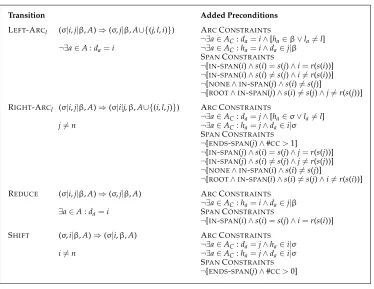
There are four types of transitionsfor going from one configuration to the next, defined formally in Figure 2 (disregarding for now the Added Preconditions column):
r
LEFT-ARCladds the arc (j,l,i) toA, whereiis the node on top of the stack andjis the first node in the buffer, and pops the stack. It has as a
precondition that the tokenidoes not already have a head.
r
RIGHT-ARCladds the arc (i,l,j) toA, whereiis the node on top of the stack andjis the first node in the buffer, and pushesjonto the stack. It has as a precondition thatj6=n.
r
REDUCEpops the stack and requires that the top token has a head.
r
SHIFTremoves the first node in the buffer and pushes it onto the stack, with the precondition thatj6=n.Atransition sequencefor a sentencexis a sequenceC0,m =(c0,c1,. . .,cm) of configu-rations, such thatc0is the initial configurationcs(x),cmis a terminal configuration, and there is a legal transitiontsuch thatci=t(ci−1) for everyi, 1≤i≤m. The dependency graph derived byC0,misGcm =(Vx,Acm), whereAcmis the set of arcs incm.
Complexity and Correctness. For a sentence of length n, the number of transitions in the arc-eager system is bounded by 2n (Nivre 2008). This means that a parser using greedy inference (or constant width beam search) will run inO(n) time provided that transitions plus required precondition checks can be performed inO(1) time. This holds for the arc-eager system and, as we will demonstrate, its constrained variants as well.
Transition Added Preconditions
LEFT-ARCl (σ|i,j|β,A)⇒(σ,j|β,A∪{(j,l,i)}) ARCCONSTRAINTS
¬∃a∈AC:da=i∧[ha∈β∨la6=l] ¬∃a∈A:da=i ¬∃a∈AC:ha=i∧da∈j|β
SPANCONSTRAINTS
¬[IN-SPAN(i)∧s(i)=s(j)∧i=r(s(i))] ¬[IN-SPAN(i)∧s(i)6=s(j)∧i6=r(s(i))] ¬[NONE∧IN-SPAN(j)∧s(i)6=s(j)]
¬[ROOT∧IN-SPAN(j)∧s(i)6=s(j)∧j6=r(s(j))] RIGHT-ARCl (σ|i,j|β,A)⇒(σ|i|j,β,A∪{(i,l,j)}) ARCCONSTRAINTS
¬∃a∈AC:da=j∧[ha∈σ∨la6=l]
j6=n ¬∃a∈AC:ha=j∧da∈i|σ
SPANCONSTRAINTS ¬[ENDS-SPAN(j)∧#CC>1]
¬[IN-SPAN(j)∧s(i)=s(j)∧j=r(s(j))] ¬[IN-SPAN(j)∧s(i)6=s(j)∧j6=r(s(j))] ¬[NONE∧IN-SPAN(i)∧s(i)6=s(j)]
¬[ROOT∧IN-SPAN(i)∧s(i)6=s(j)∧i6=r(s(i))] REDUCE (σ|i,j|β,A)⇒(σ,j|β,A) ARCCONSTRAINTS
¬∃a∈AC:ha=i∧da∈j|β ∃a∈A:da=i SPANCONSTRAINTS
¬[IN-SPAN(i)∧s(i)=s(j)∧i=r(s(i))] SHIFT (σ,i|β,A)⇒(σ|i,β,A) ARCCONSTRAINTS
¬∃a∈AC:da=j∧ha∈i|σ
i6=n ¬∃a∈AC:ha=j∧da∈i|σ
[image:4.486.50.424.59.348.2]SPANCONSTRAINTS ¬[ENDS-SPAN(j)∧#CC>0]
Figure 2
Transitions for the arc-eager transition system with preconditions for different constraints. The symbolsha,la, anddaare used to denote the head node, label, and dependent node, respectively, of an arca(that is,a=(ha,la,da));IN-SPAN(i) is true ifiis contained in a span inSC;END-SPAN(i) is true ifiis the last word in a span inSC;s(i) denotes the span containingi(with a dummy span for all words that are not contained in any span);r(s) denotes the designated root of spans (if any); #CCrecords the number of connected components in the current span up to and including the last word that was pushed onto the stack;NONEandROOTare true if we allow no outgoing arcs from spans and if we allow outgoing arcs only from the span root, respectively.
some transition sequence (completeness).2 In constrained parsing, we want to restrict the system so that, when applied to a sentencex, it is sound and complete for the subset ofPDTs that satisfy all constraints.
3. Parsing with Arc Constraints
Arc Constraints. Given a sentence x=w1,. . .,wn and a label set L, an arc constraint set is a setAC of dependency arcs (i,l,j) (1≤i,j≤n,i6=j6=n,l∈L), where each arc is required to be included in the parser output. Because the arc-eager system can only derivePDTs, the arc constraint set has to be such that theconstraint graphGC=(Vx,AC) can be extended to aPDT, which is equivalent to requiring thatGC is aPDG. Thus, the task of arc-constrained parsing can be defined as the task of deriving a PDT Gsuch
thatGC⊆G. An arc-constrained transition system is sound if it only derives proper extensions of the constraint graph and complete if it derives all such extensions.
Added Preconditions.We know that the unconstrained arc-eager system can derive any
PDT for the input sentence x, which means that any arc inVx×L×Vx is reachable from the initial configuration, including any arc in the arc constraint setAC. Hence, in order to make the parser respect the arc constraints, we only need to add preconditions that block transitions that would make an arc in AC unreachable.3 We achieve this through the following preconditions, defined formally in Figure 2 under the heading ARCCONSTRAINTSfor each transition:
r
LEFT-ARClin a configuration (σ|i,j|β,A) adds the arc (j,l,i) and makes unreachable any arc that involvesiand a node in the buffer (other than (j,l,i)). Hence, we permit LEFT-ARClonly if no such arc is inAC.
r
RIGHT-ARClin a configuration (σ|i,j|β,A) adds the arc (i,l,j) and makes unreachable any arc that involvesjand a node on the stack (other than (i,l,j)). Hence, we permit RIGHT-ARClonly if no such arc is inAC.
r
REDUCEin a configuration (σ|i,j|β,A) popsifrom the stack and makes unreachable any arc that involvesiand a node in the buffer. Hence, we permit REDUCEonly if no such arc is inAC.r
SHIFTin a configuration (σ,i|β,A) movesito the stack and makes unreachable any arc that involvesjand a node on the stack. Hence, we permit SHIFTlonly if no such arc is inAC.Complexity and Correctness.Because the transitions remain the same, the arc-constrained parser will terminate after at most 2ntransitions, just like the unconstrained system. However, in order to guarantee termination, we must also show that at least one transition is applicable in every non-terminal configuration. This is trivial in the un-constrained system, where the SHIFT transition can apply to any configuration that has a non-empty buffer. In the arc-constrained system, SHIFTwill be blocked if there is an arca∈AC involving the nodei to be shifted and some node on the stack, and we need to show that one of the three remaining transitions is then permissible. Ifa involvesi and the node on top of the stack, then either LEFT-ARCl and RIGHT-ARCl
is permissible (in fact, required). Otherwise, either LEFT-ARCl or REDUCE must be permissible, because their preconditions are implied by the fact thatACis aPDG.
In order to obtain linear parsing complexity, we must also be able to check all pre-conditions in constant time. This can be achieved by preprocessing the sentencexand arc constraint setAC and recording for each nodei∈Vx its constrained head (if any), its leftmost constrained dependent (if any), and its rightmost constrained dependent (if any), so that we can evaluate the preconditions in each configuration without having to scan the stack and buffer linearly. Because there are at mostO(n) arcs in the arc constraint set, the preprocessing will not take more thanO(n) time but guarantees that all permissibility checks can be performed inO(1) time.
Finally, we note that the arc-constrained system is sound and complete in the sense that it derives all and onlyPDTs compatible with a given arc constraint setACfor a sen-tencex. Soundness follows from the fact that, for every arc (i,l,j)∈AC, the preconditions
force the system to reach a configuration of the form (σ|min(i,j), max(i,j)|β,A) in which either LEFT-ARCl (i>j) or RIGHT-ARCl (i<j) will be the only permissible transition. Completeness follows from the observation that everyPDTGcompatible withACis also aPDGand can therefore be viewed as a larger constraint set for which every transition sequence (given soundness) derivesGexactly.
Empirical Case Study: Imperatives. Consider the problem of parsing commands to personal assistants such as Siri or Google Now. In this setting, the distribution of utterances is highly skewed towards imperatives making them easy to identify. Unfortunately, parsers trained on treebanks like the Penn Treebank (PTB) typically do a poor job of parsing such utterances (Hara et al. 2011). However, we know that if the first word of a command is a verb, it is likely the root of the sentence. If we take an arc-eager beam search parser (Zhang and Nivre 2011) trained on the PTB, it gets 82.14 labeled attachment score on a set of commands.4 However, if we constrain
the same parser so that the first word of the sentence must be the root, accuracy jumps dramatically to 85.56. This is independent of simply knowing that the first word of the sentence is a verb, as both parsers in this experiment had access to gold part-of-speech tags.
4. Parsing with Span Constraints
Span Constraints. Given a sentencex=w1,. . .,wn, we take aspan constraint setto be a set SC of non-overlapping spans [i,j] (1≤i<j≤n). The task of span-constrained parsing can then be defined as the task of deriving a PDTGsuch that, for every span [i,j]∈SC,G[i,j]is a (projective) spanning tree over the interval [i,j]. A span-constrained
transition system is sound if it only derives dependency graphs compatible with the span constraint set and complete if it derives all such graphs. In addition, we may add the requirement that no word inside a span may have dependents outside the span (NONE), or that only the root of the span may have such dependents (ROOT).
Added Preconditions.Unlike the case of arc constraints, parsing with span constraints cannot be reduced to simply enforcing (and blocking) specific dependency arcs. In this sense, span constraints are more global than arc constraints as they require en-tire subgraphs of the dependency graph to have a certain property. Nevertheless, we can use the same basic technique as before and enforce span constraints by adding new preconditions to transitions, but these preconditions need to refer to vari-ables that are updated dynamically during parsing. We need to keep track of two things:
r
Which word is the designated root of a span? A word becomes the designated rootr(s) of its spansif it acquires a head outside the span or if it acquires a dependent outside the span under theROOTcondition.r
How many connected components are in the subgraph over the current span up to and including the last word pushed onto the stack? A variable #CCis set to 1 when the first span word enters the stack, incremented by 1 for every SHIFTand decremented by 1 for every LEFT-ARCl.Given this information, we need to add preconditions that guarantee the following:
r
The designated root must not acquire a headinsidethe span.r
No word except the designated root may acquire a headoutsidethe span.r
The designated root must not be popped from the stack before the last word of the span has been pushed onto the stack.r
The last word of a span must not be pushed onto the stack in a RIGHT-ARCltransition if #CC>1.r
The last word of a span must not be pushed onto the stack in a SHIFT transition if #CC>0.In addition, we must block outside dependents of all words in a span under the NONE
condition, and of all words in a span other than the designated root under the ROOT
condition. All the necessary preconditions are given in Figure 2 under the heading SPANCONSTRAINTS.
Complexity and Correctness.To show that the span-constrained parser always terminates after at most 2n transitions, it is again sufficient to show that there is at least one permissible transition for every non-terminal configuration. Here, SHIFTis blocked if the wordito be shifted is the last word of a span and #CC>0. But in this case, one of the other three transitions must be permissible. If #CC=1, then RIGHT-ARClis permissible; if #CC>1 and the word on top of the stack does not have a head, then LEFT-ARCl is permissible; and if #CC>1 and the word on top of the stack already has a head, then REDUCEis permissible (as #CC>1 rules out the possibility that the word on top of the stack has its head outside the span). In order to obtain linear parsing complexity, all preconditions should be verifiable in constant time. This can be achieved during initial sentence construction by recording the spans(i) for every wordi(with a dummy span for words that are not inside a span) and by updatingr(s) (for every spans) and #CCas described herein.
Finally, we note that the span-constrained system is sound and complete in the sense that it derives all and onlyPDTs compatible with a given span constraint setSCfor a sentencex. Soundness follows from the observation that failure to have a connected subgraphG[i,j]for some span [i,j]∈SC can only arise from pushingjonto the stack in a SHIFTwith #CC>0 or a RIGHT-ARClwith #CC>1, which is explicitly ruled out by the added preconditions. Completeness can be established by showing that a transition sequence that derives aPDTGcompatible withSCin the unconstrained system cannot violate any of the added preconditions, which is straightforward but tedious.
Figure 3
Parsing a Korean sentence (the man writes the policy decisions) using span constraints derived from original white space cues indicating phrasal chunks.
increases from an already high 94.10 without constraints to 94.92, and labeled attach-ment score increases from 89.91 to 90.75.
Combining Constraints. What happens if we want to add arc constraints on top of the span constraints? In principle, we can simply take the conjunction of the added preconditions from the arc constraint case and the span constraint case, but some care is required to enforce correctness. First of all, we have to check that the arc constraints are consistent with the span constraints and do not require, for example, that there are two words with outside heads inside the the same span. In addition, we need to update the variables r(s) already in the preprocessing phase in case the arc constraints by themselves fix the designated root because they require a word inside the span to have an outside head or (under the ROOT condition) to have an outside dependent.
5. Conclusion
We have shown how the arc-eager transition system for dependency parsing can be modified to take into account both arc constraints and span constraints, without affecting the linear runtime and while preserving natural notions of soundness and completeness. Besides the practical applications discussed in the introduction and case studies, constraints can also be used as partial oracles for parser training.
References
Ballesteros, Miguel and Joakim Nivre. 2013. Getting to the roots of dependency parsing.Computational Linguistics, 39:5–13.
Eisner, Jason and Giorgio Satta. 1999. Efficient parsing for bilexical context-free grammars and head automaton grammars. InProceedings of the 37th Annual Meeting of the Association for Computational Linguistics, pages 457–464, Santa Cruz, CA.
Eisner, Jason M. 1996. Three new probabilistic models for dependency parsing: An exploration. InProceedings of the 16th International Conference on Computational Linguistics (COLING), pages 340–345, Copenhagen. Goldberg, Yoav and Joakim Nivre.
2012. A dynamic oracle for arc-eager dependency parsing. InProceedings
of the 24th International Conference on Computational Linguistics, pages 959–976, Shanghai.
Goldberg, Yoav and Joakim Nivre. 2013. Training deterministic parsers with non-deterministic oracles.Transactions of the Association for Computational Linguistics, 1:403–414.
Hara, Tadayoshi, Takuya Matsuzaki, Yusuke Miyao, and Jun’ichi Tsujii. 2011. Exploring difficulties in parsing imperatives and questions. InProceedings of the 5th International Joint Conference on Natural Language Processing, pages 749–757, Chiang Mai.
Koo, Terry and Michael Collins. 2010. Efficient third-order dependency parsers. InProceedings of the 48th Annual Meeting of the Association for Computational Linguistics, pages 1–11, Uppsala.
McDonald, Ryan, Koby Crammer, and Fernando Pereira. 2005. Online large-margin training of dependency parsers. InProceedings of the 43rd Annual Meeting of the Association for Computational Linguistics, pages 91–98, Ann Arbor, MI. McDonald, Ryan, Joakim Nivre, Yvonne
Quirmbach-Brundage, Yoav Goldberg, Dipanjan Das, Kuzman Ganchev, Keith Hall, Slav Petrov, Hao Zhang, Oscar T¨ackstr ¨om, Claudia Bedini, N ´uria Bertomeu Castell ´o, and Jungmee Lee. 2013. Universal dependency annotation for multilingual parsing. InProceedings of the 51st Annual Meeting of the Association for Computational Linguistics (Volume 2: Short Papers), pages 92–97, Sofia. Nivre, Joakim. 2003. An efficient algorithm
for projective dependency parsing. In Proceedings of the 8th International Workshop on Parsing Technologies, pages 149–160, Nancy.
Nivre, Joakim. 2008. Algorithms for deterministic incremental dependency parsing.Computational Linguistics, 34:513–553.
Nivre, Joakim, Johan Hall, and Jens Nilsson. 2004. Memory-based dependency parsing. InProceedings of the 8th Conference on Computational Natural Language Learning, pages 49–56, Boston, MA.
Petrov, Slav and Ryan McDonald. 2012. Overview of the 2012 shared task on parsing the web. InNotes of the First Workshop on Syntactic Analysis of Non-Canonical Language (SANCL), Montreal.
Yamada, Hiroyasu and Yuji Matsumoto. 2003. Statistical dependency analysis with support vector machines. InProceedings of the 8th International Workshop on Parsing Technologies, pages 195–206, Nancy.
Zhang, Yue and Stephen Clark. 2008. A tale of two parsers: Investigating and combining graph-based and transition-based dependency parsing. InProceedings of the Conference on Empirical Methods in Natural Language Processing (EMNLP), pages 562–571, Honolulu, HI.