on Entity-Centric, Precision-Ranked Rules
Heeyoung Lee
∗ Stanford UniversityAngel Chang
∗ Stanford UniversityYves Peirsman
∗∗ University of LeuvenNathanael Chambers
† United States Naval AcademyMihai Surdeanu
‡ University of ArizonaDan Jurafsky
§Stanford University
We propose a new deterministic approach to coreference resolution that combines the global information and precise features of modern machine-learning models with the transparency and modularity of deterministic, rule-based systems. Our sieve architecture applies a battery of deterministic coreference models one at a time from highest to lowest precision, where each model builds on the previous model’s cluster output. The two stages of our sieve-based architecture, a mention detection stage that heavily favors recall, followed by coreference sieves that are precision-oriented, offer a powerful way to achieve both high precision and high recall. Further, our approach makes use of global information through an entity-centric model that encourages the sharing of features across all mentions that point to the same real-world entity. Despite its simplicity, our approach gives state-of-the-art performance on several corpora and genres, and has also been incorporated into hybrid state-of-the-art coreference systems for Chinese and
∗Stanford University, 450 Serra Mall, Stanford, CA 94305. E-mail:[email protected], [email protected].
∗∗University of Leuven, Blijde-Inkomststraat 21 PO Box 03308, B-3000 Leuven, Belgium. E-mail:[email protected].
†United States Naval Academy, 121 Blake Road, Annapolis, MD 21402. E-mail:[email protected].
‡University of Arizona, PO Box 210077, Tucson, AZ 85721-0077. E-mail:[email protected].
§Stanford University, 450 Serra Mall, Stanford, CA 94305. E-mail:[email protected].
Submission received: 27 May 2012; revised submission received: 22 October 2012; accepted for publication: 20 November 2012.
Arabic. Our system thus offers a new paradigm for combining knowledge in rule-based systems that has implications throughout computational linguistics.
1. Introduction
Coreference resolution, the task of finding all expressions that refer to the same entity in a discourse, is important for natural language understanding tasks like summarization, question answering, and information extraction.
The long history of coreference resolution has shown that the use of highly precise lexical and syntactic features is crucial to high quality resolution (Ng and Cardie 2002b; Lappin and Leass 1994; Poesio et al. 2004a; Zhou and Su 2004; Bengtson and Roth 2008; Haghighi and Klein 2009). Recent work has also shown the importance of global inference—performing coreference resolution jointly for several or all mentions in a document—rather than greedily disambiguating individual pairs of mentions (Morton 2000; Luo et al. 2004; Yang et al. 2004; Culotta et al. 2007; Yang et al. 2008; Poon and Domingos 2008; Denis and Baldridge 2009; Rahman and Ng 2009; Haghighi and Klein 2010; Cai, Mujdricza-Maydt, and Strube 2011).
Modern systems have met this need for carefully designed features and global or entity-centric inference with machine learning approaches to coreference resolution. But machine learning, although powerful, has limitations. Supervised machine learning systems rely on expensive hand-labeled data sets and generalize poorly to new words or domains. Unsupervised systems are increasingly more complex, making them hard to tune and difficult to apply to new problems and genres as well. Rule-based models like Lappin and Leass (1994) were a popular early solution to the subtask of pronominal anaphora resolution. Rules are easy to create and maintain and error analysis is more transparent. But early rule-based systems relied on hand-tuned weights and were not capable of global inference, two factors that led to poor performance and replacement by machine learning.
We propose a new approach that brings together the insights of these modern supervised and unsupervised models with the advantages of deterministic, rule-based systems. We introduce a model that performs entity-centric coreference, where all men-tions that point to the same real-world entity are jointly modeled, in a rich feature space using solely simple, deterministic rules. Our work is inspired both by the seminal early work of Baldwin (1997), who first proposed that a series of high-precision rules could be used to build a high-precision, low-recall system for anaphora resolution, and by more recent work that has suggested that deterministic rules can outperform machine learning models for coreference (Zhou and Su 2004; Haghighi and Klein 2009) and for named entity recognition (Chiticariu et al. 2010).
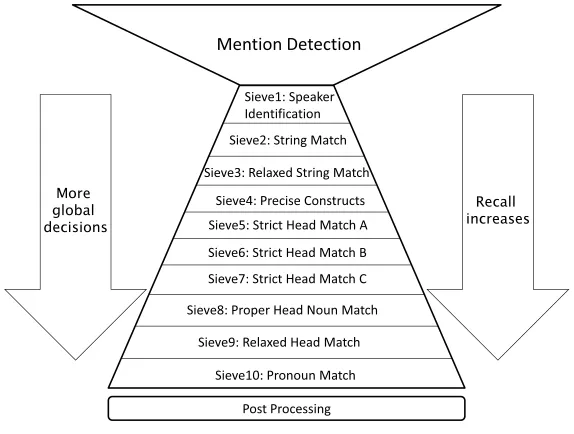
Figure 1 illustrates the two main stages of our new deterministic model: mention detection and coreference resolution, as well as a smaller post-processing step. In the mention detection stage, nominal and pronominal mentions are identified using a high-recall algorithm that selects all noun phrases (NPs), pronouns, and named entity mentions, and then filters out non-mentions (pleonasticit, i-within-i, numeric entities, partitives, etc.).
Figure 1
The architecture of our coreference system.
Crucially, our approach is entity-centric—that is, our architecture allows each coref-erence decision to be globally informed by the previously clustered mentions and their shared attributes. In particular, each deterministic rule is run on the entire discourse, using and extending clusters (i.e., groups of mentions pointing to the same real-world entity, built by models in previous tiers). Thus, for example, in deciding whether two mentionsiandjshould corefer, our system can consider not just the local features of
iand jbut also any information (head word, named entity type, gender, or number) about the other mentions already linked toiandjin previous steps.
Finally, the architecture is highly modular, which means that additional coreference resolution models can be easily integrated.
1963) and theTAGGITtagger (Greene and Rubin 1971), which begin with a high-recall list of all possible tags for words, and then used high-precision rules to filter likely tags based on context.
In the next section we walk through an example of our system applied to a simple made-up text. We then describe our model in detail and test its performance on three different corpora widely used in previous work for the evaluation of coreference resolution. We show that our model outperforms the state-of-the-art on each corpus. Furthermore, in these sections we describe analytic and ablative experiments demonstrating that both aspects of our algorithm (the entity-centric aspect that allows the global sharing of features between mentions assigned to the same cluster and the precision-based ordering of sieves) independently offer significant improvements to coreference, perform an error analysis, and discuss the relationship of our work to previous models and to recent hybrid systems that have used our algorithm as a component to resolve coreference in English, Chinese, and Arabic.
2. Walking Through a Sample Coreference Resolution
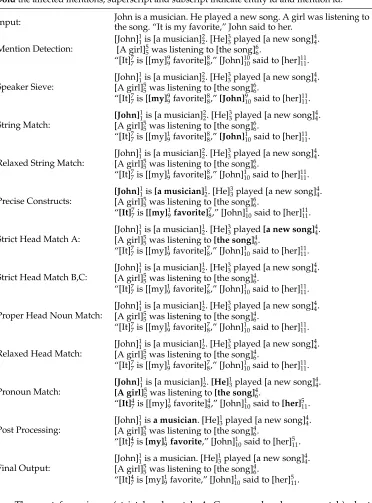
Before delving into the details of our method, we illustrate the intuition behind our approach with the simple pedagogical example listed in Table 1.
In the mention detection step, the system extracts mentions by inspecting all noun phrases (NP) and other modifier pronouns (PRP) (see Section 3.1 for details). In Table 1, this step identifies 11 different mentions and assigns them initially to distinct entities (Entity id and mention id in each step are marked by superscript and subscript). This component also extracts mention attributes—for example,John:{ne:person}, and
A girl:{gender:female, number:singular}. These mentions form the input for the following sequence of sieves.
The first coreference resolution sieve (the speaker or quotation sieve) matches pronominal mentions that appear in a quotation block to the corresponding speaker. In general, in all the coreference resolution sieves we traverse mentions left-to-right in a given document (see Section 3.2.1). The first match for this model is my9
9, which is
merged with John10
10 into the same entity (entity id: 9). This illustrates the advantages
of our incremental approach: by assigning a higher priority to the quotation sieve, we avoid linkingmy99withA girl55, a common mistake made by generic coreference models, since anaphoric candidates (especially in subject position) are generally preferred to cataphoric ones (Hobbs 1978).
The next sieve searches for anaphoric antecedents that have the exact same string as the mention under consideration. This component resolves the tenth mention,John910, by linking it withJohn1
1. When searching for antecedents, we sort candidates in the same
sentential clause from left to right, and we prefer sentences that are closer to the mention under consideration (see Section 3.2.2 for details). Thus, the sorted list of candidates for
John910 isIt77,My favorite88,My99, A girl55,the song66,He33,a new song44, John11, a musician22. The algorithm stops as soon as a matching antecedent is encountered. In this case, the algorithm findsJohn11and does not inspecta musician22.
The relaxed string match sieve searches for mentions satisfying a looser set of string matching constraints than exact match (details in Section 3.3.3), but makes no change because there are no such mentions. The precise constructs sieve searches for several high-precision syntactic constructs, such as appositive relations and predicate nominatives. In this example, there are two predicate nominative relations in the first and fourth sentences, so this component clusters togetherJohn1
1anda musician22, andIt77
Table 1
A sample run-through of our approach, applied to a made-up sentence. In each step we mark in
boldthe affected mentions; superscript and subscript indicate entity id and mention id.
Input: John is a musician. He played a new song. A girl was listening tothe song. “It is my favorite,” John said to her.
Mention Detection:
[John]1
1is [a musician]22. [He]33played [a new song]44.
[A girl]5
5was listening to [the song]66.
“[It]7
7is [[my]99favorite]88,” [John]1010said to [her]1111.
Speaker Sieve:
[John]1
1is [a musician]22. [He]33played [a new song]44.
[A girl]5
5was listening to [the song]66.
“[It]7
7is [[my]99favorite]88,”[John]910said to [her]1111.
String Match:
[John]1
1is [a musician]22. [He]33played [a new song]44.
[A girl]5
5was listening to [the song]66.
“[It]7
7is [[my]19favorite]88,”[John]110said to [her]1111.
Relaxed String Match:
[John]1
1is [a musician]22. [He]33played [a new song]44.
[A girl]5
5was listening to [the song]66.
“[It]7
7is [[my]19favorite]88,” [John]110said to [her]1111.
Precise Constructs:
[John]11is[a musician]12. [He]33played [a new song]44.
[A girl]5
5was listening to [the song]66.
“[It]7
7is[[my]19favorite]78,” [John]110said to [her]1111.
Strict Head Match A:
[John]1
1is [a musician]12. [He]33played[a new song]44.
[A girl]5
5was listening to[the song]46.
“[It]7
7is [[my]19favorite]78,” [John]110said to [her]1111.
Strict Head Match B,C:
[John]1
1is [a musician]12. [He]33played [a new song]44.
[A girl]5
5was listening to [the song]46.
“[It]7
7is [[my]19favorite]78,” [John]110said to [her]1111.
Proper Head Noun Match:
[John]1
1is [a musician]12. [He]33played [a new song]44.
[A girl]5
5was listening to [the song]46.
“[It]7
7is [[my]19favorite]78,” [John]110said to [her]1111.
Relaxed Head Match:
[John]1
1is [a musician]12. [He]33played [a new song]44.
[A girl]5
5was listening to [the song]46.
“[It]77is [[my]19favorite]78,” [John]110said to [her]1111.
Pronoun Match:
[John]1
1is [a musician]12.[He]13played [a new song]44.
[A girl]5
5was listening to[the song]46.
“[It]4
7is [[my]19favorite]48,” [John]110said to[her]511.
Post Processing:
[John]1
1isa musician. [He]13played [a new song]44.
[A girl]5
5was listening to [the song]46.
“[It]4
7is[my]19favorite,” [John]110said to [her]511.
Final Output:
[John]1
1is a musician. [He]13played [a new song]44.
[A girl]5
5was listening to [the song]46.
“[It]4
7is [my]19favorite,” [John]110said to [her]511.
The next four sieves (strict head match A–C, proper head noun match) cluster mentions that have the same head word with various other constraints.a new song44
andthe song6
6are linked in this step.
The last resolution component in this example addresses pronominal coreference resolution. The three pronouns in this text, He3
compatible antecedents based on their attributes, such as gender, number, and animacy. In this step we assignHe33andher1111to entities 1 and 5, respectively (same gender), and
It7
7to entity 4, which represents an inanimate concept.
The system concludes with a post-processing component, which implements corpus-specific rules. For example, to align our output with the OntoNotes annotation standard, we remove mentions assigned to singleton clusters (i.e., entities with a single mention in text) and links obtained through predicate nominative patterns. Note that even though we might remove some coreference links in this step, these links serve an important purpose in the algorithm flow, as they allow new features to be discovered for the corresponding entity and shared between its mentions. See Section 3.2.3 for details on feature extraction.
3. The Algorithm
We first describe our mention detection stage, then introduce the general architecture of the coreference stage, followed by a detailed examination of the coreference sieves. In describing the architecture, we will sometimes find it helpful to discuss the precision of individual components, drawn from our later experiments in Section 4.
3.1 Mention Detection
As we suggested earlier, the recall of our mention detection component is more impor-tant than its precision. This is because for the OntoNotes corpus and for many practical applications, any missed mentions are guaranteed to affect the final score by decreas-ing recall, whereas spurious mentions may not impact the overall score if they are assigned to singleton clusters, because singletons are deleted during post-processing. Our mention detection algorithm implements this intuition via a series of simple yet broad-coverage heuristics that take advantage of syntax, named entity recognition and manually written patterns. Note that those patterns are built based on the OntoNotes annotation guideline because mention detection in general depends heavily on the annotation policy.
We start by marking all NPs, pronouns, and named entity mentions (see the named entity tagset in Appendix A) that were not previously marked (i.e., they appear as modifiers in other NPs) as candidate mentions. From this set of candidates we remove the mentions that match any of the following exclusion rules:
1. We remove a mention if a larger mention with the same head word exists (e.g., we removeThe five insurance companiesinThe five insurance companies approved to be established this time).
2. We discard numeric entities such as percents, money, cardinals, and quantities (e.g., 9%,$10, 000, Tens of thousands, 100 miles).
3. We remove mentions with partitive or quantifier expressions (e.g.,a total of 177 projects, none of them, millions of people).1
4. We remove pleonasticitpronouns, detected using a small set of patterns (e.g.,It is possible that . . . , It seems that . . . , It turns out . . .). The complete set of patterns, using the tregex2notation, is shown in Appendix B.
5. We discard adjectival forms of nations or nationality acronyms (e.g.,
American, U.S., U.K.), following the OntoNotes annotation guidelines. 6. We remove stop words from the following list determined by error
analysis on mention detection:there, ltd., etc, ’s, hmm.
Note that some rules change depending on the corpus we use for evaluation. In particular, adjectival forms of nations are valid mentions in the Automated Content Extraction (ACE) corpus (Doddington et al. 2004), thus they would not be removed when processing this corpus.
3.2 Resolution Architecture
Traditionally, coreference resolution is implemented as a quadratic problem, where potential coreference links between any two mentions in a document are consid-ered. This is not ideal, however, as it increases both the likelihood of errors and the processing time. In this article, we argue that it is better to cautiously construct high-quality mention clusters,3 and use an entity-centric model that allows the
shar-ing of information across these incrementally constructed clusters. We achieve these goals by: (a) aggressively filtering the search space for which mention to consider for resolution (Section 3.2.1) and which antecedents to consider for a given men-tion (Secmen-tion 3.2.2), and (b) constructing features from partially built menmen-tion clusters (Section 3.2.3).
3.2.1 Mention Selection in a Given Sieve.Recall that our model is a battery of resolution sieves applied sequentially. Thus, in each given sieve, we have partial mention clusters produced by the previous model. We exploit this information for mention selection, by considering only mentions that are currently first in textual order in their cluster. For example, given the following ordered list of mentions,{m11,m22,m23,m34,m15,m26}, where the superscript indicates cluster id, our model will attempt to resolve onlym22andm34(m11
is not resolved because it is the first mention in a text). These two are the only mentions that currently appear first in their respective clusters and have potential antecedents in the document. The motivation behind this heuristic is two-fold. First, early mentions are usually better defined than subsequent ones, which are likely to have fewer modifiers or be pronouns (Fox 1993). Because several of our models use features extracted from NP modifiers, it is important to prioritize mentions that include such information. Second, by definition, first mentions appear closer to the beginning of the document, hence there are fewer antecedent candidates to select from, and thus fewer opportunities to make a mistake.
We further prune the search space using a simple model ofdiscourse salience. We disable coreference for mentions appearing first in their corresponding clusters that: (a) are or start with indefinite pronouns (e.g.,some,other), (b) start with indefinite articles
2http://nlp.stanford.edu/software/tregex.shtml.
(e.g.,a,an), or (c) are bare plurals. One exception to (a) and (b) is the model deployed in the Exact String Match sieve, which only links mentions if their entire extents match exactly (see Section 3.3.2). This model is triggered for all nominal mentions regardless of discourse salience, because it is possible that indefinite mentions are repeated in a document when concepts are discussed but not instantiated, e.g., a sports barin the following:
Hanlon, a longtime Broncos fan, thinks it is the perfect place fora sports barand has put up a blue-and-orange sign reading, “Wanted Broncos Sports Bar On This Site.” . . . In a Nov. 28 letter, Proper states “while we have no objection to your advertising the property as a location fora sports bar, using the Broncos’ name and colors gives the false impression that the bar is or can be affiliated with the Broncos.”
3.2.2 Antecedent Selection for a Given Mention.Given a mentionmi, each model may either
decline to propose a solution (in the hope that one of the subsequent models will solve it) or deterministically select a single best antecedent from a list of previous mentions
m1, . . . , mi−1. We sort candidate antecedents using syntactic information provided by
the Stanford parser. Candidates are sorted using the following criteria:
r
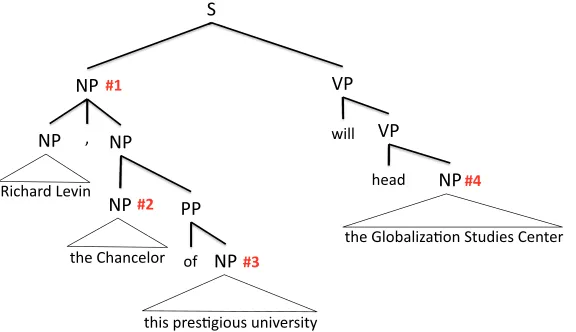
In a given sentential clause (i.e., parser constituents whose label startswithS), candidates are sorted using a left-to-right breadth-first traversal of the corresponding syntactic constituent (Hobbs 1978). Figure 2 shows an example of candidate ordering based on this traversal. The left-to-right ordering favors subjects, which tend to appear closer to the beginning of the sentence and are more probable antecedents. The breadth-first traversal promotes syntactic salience by preferring noun phrases that are closer to the top of the parse tree (Haghighi and Klein 2009).
r
If the sentence containing the anaphoric mention contains multiple [image:8.486.51.339.457.623.2]clauses, we repeat the previous heuristic separately in eachS*constituent, starting with the one containing the mention.
Figure 2
r
Clauses in previous sentences are sorted based on their textual proximityto the anaphoric mention.
The sorting of antecedent candidates is important because our algorithm stops at the first match. Thus, low-quality sorting negatively impacts the actual coreference links created.
This antecedent selection algorithm applies to all the coreference resolution sieves described in this article, with the exception of the speaker identification sieve (Sec-tion 3.3.1) and the sieve that applies appositive and predicate nominative patterns (Section 3.3.4).
3.2.3 Feature Sharing in the Entity-Centric Model.In a significant departure from previous work, each model in our framework gets (possibly incomplete) entity information for each mention from the clusters constructed by the earlier coreference models. In other words, each mention mi may already be assigned to an entity Ej containing a set
of mentions:Ej={mj1,. . .,m j
k};mi∈Ej. Unassigned mentions are unique members of
their own cluster. We use this information to share information between same-entity mentions.
This is especially important for pronominal coreference resolution (discussed later in this section), which can be severely affected by missing attributes (which introduce precision errors because incorrect antecedents are selected due to missing information) and incorrect attributes (which introduce recall errors because correct links are not generated due to attribute mismatch between mention and antecedent). To address this issue, we perform a union of all mention attributes (e.g., number, gender, animacy) for a given entity and share the result with all corresponding mentions. If attributes from different mentions contradict each other we maintain all variants. For example, our naive number detection assigns singularto the mention a group of studentsand pluraltofive students. When these mentions end up in the same cluster, the resulting number attributes becomes the set{singular,plural}. Thus this cluster can later be merged with both singular and plural pronouns.
3.3 Coreference Resolution Sieves
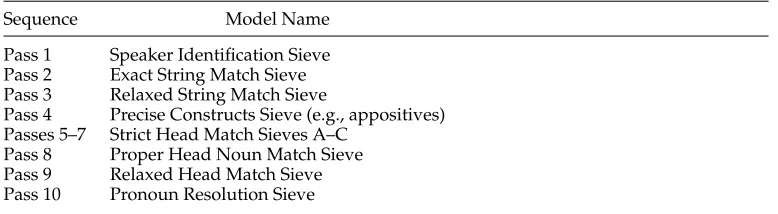
[image:9.486.52.441.557.664.2]We describe next the sequence of coreference models proposed in this article. Table 2 lists all these models in the order in which they are applied. We discuss their individual contribution to the overall system later, in Section 4.4.3.
Table 2
Sequence of sieves as they are applied in the overall model.
Sequence Model Name
Pass 1 Speaker Identification Sieve Pass 2 Exact String Match Sieve Pass 3 Relaxed String Match Sieve
Pass 4 Precise Constructs Sieve (e.g., appositives) Passes 5–7 Strict Head Match Sieves A–C
3.3.1 Pass 1 – Speaker Identification.This sieve matches speakers to compatible pronouns, using shallow discourse understanding to handle quotations and conversation transcripts, following the early work of Baldwin (1995, 1997). We begin by identifying
speakerswithin text. In non-conversational text, we use a simple heuristic that searches for the subjects of reporting verbs (e.g., say) in the same sentence or neighboring sentences to a quotation. In conversational text, speaker information is provided in the data set.
The extracted speakers then allow us to implement the following sieve heuristics:
r
I s4assigned to the same speaker are coreferent.r
you s with the same speaker are coreferent.r
The speaker andI s in her text are coreferent.Thus for exampleI,my, andshein the following sentence are coreferent:“[I] voted for [Nader] because [he] was most aligned with [my] values,” [she] said.
In addition to this sieve, we impose speaker constraints on decisions made by subsequent sieves:
r
The speaker and a mention which is notI in the speaker’s utterancecannot be coreferent.
r
TwoI s (or twoyou s, or twowe s) assigned to different speakerscannot be coreferent.
r
Two different person pronouns by the same speaker cannot be coreferent.r
Nominal mentions cannot be coreferent withI ,you , orwe in thesame turn or quotation.
r
In conversations,you can corefer only with the previous speaker.The constraints result in causing [my]and [he] to not be coreferent in the earlier example (due to the third constraint).
3.3.2 Pass 2 – Exact Match.This model links two mentions only if they contain exactly the same extent text, including modifiers and determiners (e.g.,[the Shahab 3 ground-ground missile]and[the Shahab 3 ground-ground missile]). As expected, this model is very precise, with a precision over 90%B3(see Table 8 in Section 4.4.3).
3.3.3 Pass 3 – Relaxed String Match. This sieve considers two nominal mentions as coreferent if the strings obtained by dropping the text following their head words (such as relative clauses and PP and participial postmodifiers) are identical (e.g.,[Clinton]and
[Clinton, whose term ends in January]).
3.3.4 Pass 4 – Precise Constructs.This model links two mentions if any of the following conditions are satisfied:
r
Appositive– the two nominal mentions are in an appositive construction(e.g.,[Israel’s Deputy Defense Minister], [Ephraim Sneh] , said . . .). We use the standard Haghighi and Klein (2009) definition to detect appositives: third children of a parent NP whose expansion begins with(NP , NP), when there is not a conjunction in the expansion.
r
Predicate nominative– the two mentions (nominal or pronominal) arein a copulative subject–object relation (e.g.,[The New York-based College Board] is [a nonprofit organization that administers the SATs and promotes higher education][Poon and Domingos 2008]).
r
Role appositive– the candidate antecedent is headed by a noun andappears as a modifier in an NP whose head is the current mention (e.g.,
[[actress] Rebecca Schaeffer]). This feature is inspired by Haghighi and Klein (2009), who triggered it only if the mention is labeled as a person by the Stanford named entity recognizer (NER). We constrain this heuristic more in our work: We allow this feature to match only if: (a) the mention is labeled as a person, (b) the antecedent is animate (we detail animacy detection in Section 3.3.9), and (c) the antecedent’s gender is not neutral.
r
Relative pronoun– the mention is a relative pronoun that modifies thehead of the antecedent NP (e.g.,[the finance street [which] has already formed in the Waitan district]).
r
Acronym– both mentions are tagged as NNP and one of them is anacronym of the other (e.g.,[Agence France Presse] . . . [AFP]). Our acronym detection algorithm marks a mention as an acronym of another if its text equals the sequence of upper case characters in the other mention. The algorithm is simple, but our error analysis suggests it nonetheless does not lead to errors.
r
Demonym5– one of the mentions is a demonym of the other (e.g.,[Israel] . . . [Israeli]). For demonym detection we use a static list of countries and their gentilic forms from Wikipedia.6All of these constructs are very precise; we show in Section 4.4.3 that theB3precision of the overall model after adding this sieve is approximately 90%. In the OntoNotes corpus, this sieve does not enhance recall significantly, mainly because appositions and predicate nominatives are not annotated in this corpus (they are annotated in ACE). Regardless of annotation standard, however, this sieve is important because it grows entities with high quality elements, which has a significant impact on the entity’s features (as discussed in Section 3.2.3).
3.3.5 Pass 5 – Strict Head Match.Linking a mention to an antecedent based on the naive matching of their head words generates many spurious links because it completely ignores possibly incompatible modifiers (Elsner and Charniak 2010). For example,Yale University and Harvard University have similar head words, but they are obviously different entities. To address this issue, this pass implements several constraints that must all be matched in order to yield a link:
r
Entity head match– the mention head word matchesanyhead word ofmentions in the antecedent entity. Note that this feature is actually more relaxed than naive head matching in a pair of mentions because here it is satisfied when the mention’s head matches the head of any mention in the candidate entity. We constrain this feature by enforcing a conjunction with the following features.
5 Demonym is not annotated in OntoNotes but we keep it in the system.
r
Word inclusion– all the non-stop7words in the current entity to be solvedare included in the set of non-stop words in the antecedent entity. This heuristic exploits the discourse property that states that it is uncommon to introduce novel information in later mentions (Fox 1993). Typically, mentions of the same entity become shorter and less informative as the narrative progresses. For example, based on this constraint, the model correctly clusters together the two mentions in the following text:
. . . intervene in the [Florida Supreme Court]’s move . . . does look like very dramatic change made by [the Florida court]
and avoids clustering the two mentions in the following text:
The pilot had confirmed . . . he had turned onto [the correct runway] but pilots behind him say he turned onto [the wrong runway].
r
Compatible modifiers only– the mention’s modifiers are all included inthe modifiers of the antecedent candidate. This feature models the same discourse property as the previous feature, but it focuses on the two individual mentions to be linked, rather than their corresponding entities. For this feature we only use modifiers that are nouns or adjectives.
r
Not i-within-i– the two mentions are not in an i-within-i construct, that is,one cannot be a child NP in the other’s NP constituent (Chomsky 1981).
This pass continues to maintain high precision (over 86%B3) while improving recall significantly (approximately 4.5B3points).
3.3.6 Passes 6 and 7 – Variants of Strict Head Match.Sieves 6 and 7 are different relaxations of the feature conjunction introduced in Pass 5, that is, Pass 6 removes thecompatible modifiers onlyfeature, and Pass 7 removes theword inclusionconstraint. All in all, these two passes yield an improvement of 0.9B3F1 points, due to recall improvements. Table 8 in Section 4.4.3 shows that the word inclusion feature is more precise than compatible modifiers only, but the latter has better recall.
3.3.7 Pass 8 – Proper Head Word Match. This sieve marks two mentions headed by proper nouns as coreferent if they have the same head word and satisfy the following constraints:
r
Not i-within-i- same as in Pass 5.r
No location mismatches- the modifiers of two mentions cannot containdifferent location named entities, other proper nouns, or spatial modifiers. For example,[Lebanon]and[southern Lebanon]are not coreferent.
r
No numeric mismatches- the second mention cannot have a number thatdoes not appear in the antecedent, e.g.,[people]and[around 200 people]are not coreferent.
3.3.8 Pass 9 – Relaxed Head Match.This pass relaxes the entity head match heuristic by allowing the mention head to match any word in the antecedent entity. For example, this heuristic matches the mentionSandersto an entity containing the mentions{Sauls,
the judge,Circuit Judge N. Sanders Sauls}. To maintain high precision, this pass requires that both mention and antecedent be labeled as named entities and the types co-incide. Furthermore, this pass implements a conjunction of the given features withword inclusionand not i-within-i. This pass yields less than 0.4 point improvement in most metrics.
3.3.9 Pass 10 – Pronominal Coreference Resolution.With one exception (Pass 1), all the previous coreference models focus on nominal coreference resolution. It would be incor-rect to say that our framework ignores pronominal coreference in the previous passes, however. In fact, the previous models prepare the stage for pronominal coreference by constructing precise entities with shared mention attributes. These are crucial factors for pronominal coreference.
We implement pronominal coreference resolution using an approach standard for many decades: enforcing agreement constraints between the coreferent mentions. We use the following attributes for these constraints:
r
Number– we assign number attributes based on: (a) a static list forpronouns; (b) NER labels: mentions marked as a named entity are considered singular with the exception of organizations, which can be both singular and plural; (c) part of speech tags:NN*Stags are plural and all otherNN*tags are singular; and (d) a static dictionary from Bergsma and Lin (2006).
r
Gender– we assign gender attributes from static lexicons from Bergsmaand Lin (2006), and Ji and Lin (2009).
r
Person– we assign person attributes only to pronouns. We do not enforcethis constraint when linking two pronouns, however, if one appears within quotes. This is a simple heuristic for speaker detection (e.g.,Iandshepoint to the same person in“[I] voted my conscience,” [she] said).
r
Animacy– we set animacy attributes using: (a) a static list for pronouns;(b) NER labels (e.g.,PERSONis animate whereasLOCATIONis not); and (c) a dictionary bootstrapped from the Web (Ji and Lin 2009).
r
NER label– from the Stanford NER.r
Pronoun distance- sentence distance between a pronoun and itsantecedent cannot be larger than 3.
When we cannot extract an attribute, we set the corresponding value tounknownand treat it as a wildcard—that is, it can match any other value. As expected, pronominal coreference resolution has a big impact on the overall score (e.g., 5B3 F1 points in the
development partition of OntoNotes).
3.4 Post Processing
step is deployed only for the OntoNotes corpus and it contains the following two operations:
r
We discard singleton clusters.r
We discard the shorter mentions in appositive patterns and the mentionsthat appear later in text in copulative relations. For example, in the text
[[Yongkang Zhou] , the general manager]or[Mr. Savoca] had been [a
consultant. . . ], the mentionsYongkang Zhouanda consultant. . . are removed in this stage.
4. Experimental Results
We start this section with overall results on three corpora widely used for the evaluation of coreference resolution systems. We continue with a series of ablative experiments that analyze the contribution of each aspect of our approach and conclude with error analysis, which highlights cases currently not solved by our approach.
4.1 Corpora
We used the following corpora for development and formal evaluation:
r
OntoNotes-Dev– development partition of OntoNotes v4.0 provided inthe CoNLL2011 shared task (Pradhan et al. 2011).
r
OntoNotes-Test– test partition of OntoNotes v4.0 provided in theCoNLL-2011 shared task.
r
ACE2004-Culotta-Test– partition of the ACE 2004 corpus reserved fortesting by several previous studies (Culotta et al. 2007; Bengtson and Roth 2008; Haghighi and Klein 2009).
r
ACE2004-nwire– newswire subset of the ACE 2004 corpus, utilized byPoon and Domingos (2008) and Haghighi and Klein (2009) for testing.
r
MUC6-Test– test corpus from the sixth Message UnderstandingConference (MUC-6) evaluation.
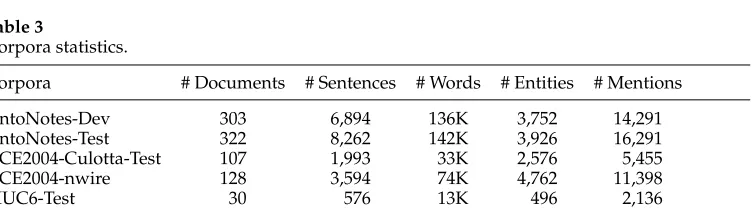
[image:14.486.57.433.555.664.2]The corpora statistics are shown in Table 3. We used the first corpus (OntoNotes-Dev) for development and all others for the formal evaluation. We parsed all documents in the ACE and MUC corpora using the Stanford parser (Klein and Manning 2003) and the Stanford NER (Finkel, Grenager, and Manning 2005). We used the provided parse
Table 3
Corpora statistics.
Corpora # Documents # Sentences # Words # Entities # Mentions
OntoNotes-Dev 303 6,894 136K 3,752 14,291
OntoNotes-Test 322 8,262 142K 3,926 16,291
ACE2004-Culotta-Test 107 1,993 33K 2,576 5,455
ACE2004-nwire 128 3,594 74K 4,762 11,398
trees and named entity labels (not gold) in the OntoNotes corpora to facilitate the com-parison with other systems.
4.2 Evaluation Metrics
We use five evaluation metrics widely used in the literature.B3 and CEAF have im-plementation variations in how to take system mentions into account. We followed the same implementation as used in CoNLL-2011 shared task.
r
MUC(Vilain et al. 1995) – link-based metric which measures how manypredicted and gold mention clusters need to be merged to cover the gold and predicted clusters, respectively.
R=
(|Gi|−|p(Gi)|)
(|Gi|−1) (Gi: a gold mention cluster,p(Gi): partitions ofGi) P=
(|Si|−|p(Si)|)
(|Si|−1) (Si: a system mention cluster,p(Si): partitions ofSi) F1= 2PR
P+R
r
B3(Bagga and Baldwin 1998) – mention-based metric which measures the proportion of overlap between predicted and gold mention clusters for a given mention. WhenGmi is the gold cluster of mentionmiandSmiis the system cluster of mentionmi,R=i|Gmi|G∩Smi|
mi| ,P=
i
|Gmi∩Smi|
|Smi| ,F1=P+R2PR
r
CEAF(Constrained Entity Aligned F-measure) (Luo 2005) – metric basedon entity alignment.
For best alignmentg∗=argmaxg∈GmΦ(g) (Φ(g): total similarity ofg, a one-to-one mapping fromG: gold mention clusters toS: system mention clusters),
R= Φ(g∗)
iφ(Gi,Gi),P= Φ(g∗)
iφ(Si,Si),F1= 2PR P+R
If we useφ(G,S)=|G∩S|, it is called mention-based CEAF (CEAF-φ3), if we useφ(G,S)=|2R|R|+∩|SS||, it is called entity-based CEAF (CEAF-φ4).
r
BLANC(BiLateral Assessment of NounPhrase Coreference) (Recasens andHovy 2011) – metric applying the Rand index (Rand 1971) to coreference to deal with imbalance between singletons and coreferent mentions by considering coreference and non-coreference links.
Pc = rc+wcrc ,Pn= rn+wnrn ,Rc = rc+wnrc ,Rn= rn+wcrn , Fc= P2Pc+RcRcc,Fn=
2PnRn
Pn+Rn,BLANC= Fc+Fn
2
(rc: the number of correct coreference links,wc: the number of incorrect coreference links,rn: the number of correct non-coreference links,wn: the number of incorrect non-coreference links)
r
CoNLL F1Average of MUC,B3, and CEAF-φ4F1. This was the official
metric in the CoNLL-2011 shared task (Pradhan et al. 2011).
4.3 Experimental Results
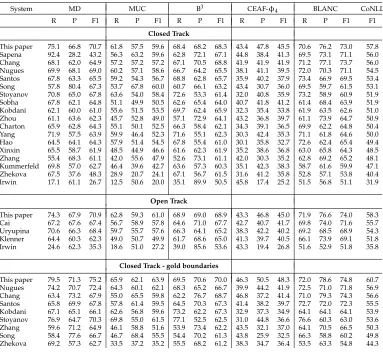
Table 4
Performance of the top systems in the CoNLL-2011 shared task. All these systems use automatically detected mentions. We report results for both the closed and the open tracks, which allowed the use of resources not provided by the task organizers. MD indicates mention detection, and gold boundaries indicate that mention boundary information is given.
System MD MUC B3 CEAF-φ
4 BLANC CoNLL
R P F1 R P F1 R P F1 R P F1 R P F1 F1
Closed Track
This paper 75.1 66.8 70.7 61.8 57.5 59.6 68.4 68.2 68.3 43.4 47.8 45.5 70.6 76.2 73.0 57.8 Sapena 92.4 28.2 43.2 56.3 63.2 59.6 62.8 72.1 67.1 44.8 38.4 41.3 69.5 73.1 71.1 56.0 Chang 68.1 62.0 64.9 57.2 57.2 57.2 67.1 70.5 68.8 41.9 41.9 41.9 71.2 77.1 73.7 56.0 Nugues 69.9 68.1 69.0 60.2 57.1 58.6 66.7 64.2 65.5 38.1 41.1 39.5 72.0 70.3 71.1 54.5 Santos 67.8 63.3 65.5 59.2 54.3 56.7 68.8 62.8 65.7 35.9 40.2 37.9 73.4 66.9 69.5 53.4 Song 57.8 80.4 67.3 53.7 67.8 60.0 60.7 66.1 63.2 43.4 30.7 36.0 69.5 59.7 61.5 53.1 Stoyanov 70.8 65.0 67.8 63.6 54.0 58.4 72.6 53.3 61.4 32.0 40.8 35.9 73.2 58.9 60.9 51.9 Sobha 67.8 62.1 64.8 51.1 49.9 50.5 62.6 65.4 64.0 40.7 41.8 41.2 61.4 68.4 63.9 51.9 Kobdani 62.1 60.0 61.0 55.6 51.5 53.5 69.7 62.4 65.9 32.3 35.4 33.8 61.9 63.5 62.6 51.0 Zhou 61.1 63.6 62.3 45.7 52.8 49.0 57.1 72.9 64.1 43.2 36.8 39.7 61.1 73.9 64.7 50.9 Charton 65.9 62.8 64.3 55.1 50.1 52.5 66.3 58.4 62.1 34.3 39.1 36.5 69.9 62.2 64.8 50.4 Yang 71.9 57.5 63.9 59.9 46.4 52.3 71.6 55.1 62.3 30.3 42.4 35.3 71.1 61.8 64.6 50.0 Hao 64.5 64.1 64.3 57.9 51.4 54.5 67.8 55.4 61.0 30.1 35.8 32.7 72.6 62.4 65.4 49.4 Xinxin 65.5 58.7 61.9 48.5 44.9 46.6 61.6 62.3 61.9 35.2 38.6 36.8 63.0 65.8 64.3 48.5 Zhang 55.4 68.3 61.1 42.0 55.6 47.9 52.6 73.1 61.1 42.0 30.3 35.2 62.8 69.2 65.2 48.1 Kummerfeld 69.8 57.0 62.7 46.4 39.6 42.7 63.6 57.3 60.3 35.1 42.3 38.3 58.7 61.6 59.9 47.1 Zhekova 67.5 37.6 48.3 28.9 20.7 24.1 67.1 56.7 61.5 31.6 41.2 35.8 52.8 57.1 53.8 40.4 Irwin 17.1 61.1 26.7 12.5 50.6 20.0 35.1 89.9 50.5 45.8 17.4 25.2 51.5 56.8 51.1 31.9
Open Track
This paper 74.3 67.9 70.9 62.8 59.3 61.0 68.9 69.0 68.9 43.3 46.8 45.0 71.9 76.6 74.0 58.3 Cai 67.2 67.6 67.4 56.7 58.9 57.8 64.6 71.0 67.7 42.7 40.7 41.7 69.8 74.0 71.6 55.7 Uryupina 70.6 66.3 68.4 59.7 55.7 57.6 66.3 64.1 65.2 38.3 42.2 40.2 69.2 68.5 68.9 54.3 Klenner 64.4 60.3 62.3 49.0 50.7 49.9 61.7 68.6 65.0 41.3 39.7 40.5 66.1 73.9 69.1 51.8 Irwin 24.6 62.3 35.3 18.6 51.0 27.2 39.0 85.6 53.6 43.3 19.4 26.8 51.6 52.9 51.8 35.8
Closed Track - gold boundaries
This paper 79.5 71.3 75.2 65.9 62.1 63.9 69.5 70.6 70.0 46.3 50.5 48.3 72.0 78.6 74.8 60.7 Nugues 74.2 70.7 72.4 64.3 60.1 62.1 68.3 65.2 66.7 39.9 44.2 41.9 72.5 71.0 71.8 56.9 Chang 63.4 73.2 67.9 55.0 65.5 59.8 62.2 76.7 68.7 46.8 37.2 41.4 71.0 79.3 74.3 56.6 Santos 65.8 69.9 67.8 57.8 61.4 59.5 64.5 70.3 67.3 41.4 38.2 39.7 72.7 72.0 72.3 55.5 Kobdani 67.1 65.1 66.1 62.6 56.8 59.6 73.2 62.2 67.3 32.9 37.3 34.9 64.1 64.1 64.1 53.9 Stoyanov 76.9 64.7 70.3 69.8 55.0 61.5 77.1 52.5 62.5 31.0 44.8 36.6 76.6 60.3 63.0 53.6 Zhang 59.6 71.2 64.9 46.1 58.8 51.6 53.9 73.4 62.2 43.5 32.1 37.0 64.1 70.5 66.5 50.3 Song 58.4 77.6 66.7 46.7 68.4 55.5 54.4 70.2 61.3 43.8 25.9 32.5 66.3 58.8 60.2 49.8 Zhekova 69.2 57.3 62.7 33.5 37.2 35.2 55.5 68.2 61.2 38.3 34.7 36.4 53.5 63.3 54.8 44.3
resources. For the closed track, the organizers provided dictionaries for gender and number information, in addition to parse trees and named entity labels (Pradhan et al. 2011). For the open track, we used the following additional resources: (a) a hand-built list of genders of first names that we created, incorporating frequent names from census lists and other sources (Vogel and Jurafsky 2012) (b) an animacy list (Ji and Lin 2009), (c) a country and state gazetteer, and (d) a demonym list. These resources were also used for the results reported in Table 5.
A significant difference between Tables 4 and 5 is that in the former (other than its last block) we used predicted mentions (detected with the algorithm described in Section 3.1), whereas in the latter we used gold mentions. The only reason for this distinction is to facilitate comparison with previous work (all systems listed in Table 5 used gold mention boundaries).
our system scores 1.8 CoNLL F1 points higher than the next system in the closed track and 2.6 points higher than the second-ranked system in the open track. The Chang et al. (2011) system has marginally higher B3 and BLANC F1 scores, but does not
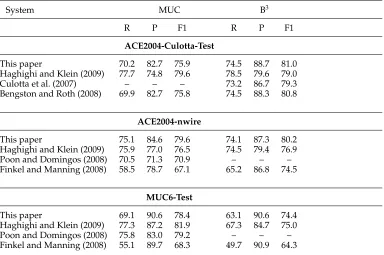
outperform our model on the other two metrics and the average F1 score. Table 5 shows that our model has higher B3 F1 scores than all the other models in the two
ACE corpora. The model of Haghighi and Klein (2009) minimally outperforms ours by 0.6B3 F1 points in the MUC corpus. All in all, these results prove that our approach
compares favorably with a wide range of models, which include most aspects deemed important for coreference resolution, among other things, supervised learning using rich feature sets (Sapena, Padr ´o, and Turmo 2011; Chang et al. 2011), joint inference using spectral clustering (Cai, Mujdricza-Maydt, and Strube 2011), and deterministic rule-based models (Haghighi and Klein 2009). We discuss in more detail the similarities and differences between our approach and previous work in Section 6.
Table 4 shows that using additional resources yields minimal improvement: There is a difference of only 0.5 CoNLL F1 points between our open-track and closed-track systems. We show in Section 5 that the explanation of this modest improvement is that most of the remaining errors require complex, context-sensitive semantics to be solved. Such semantic models cannot be built with our shallow feature set that relies on simple semantic dictionaries (e.g., animacy or even hyponymy).
[image:17.486.54.438.409.664.2]It is not trivial to compare the mention detection system alone because its score is affected by the performance of the coreference resolution model. For example, even if we start with a perfect set of gold mentions, if we miss all coreference relations in a text, every mention will remain as a singleton and will be removed by the OntoNotes post
Table 5
Comparison of our system with the other reported results on the ACE and MUC corpora. All these systems use gold mention boundaries.
System MUC B3
R P F1 R P F1
ACE2004-Culotta-Test
This paper 70.2 82.7 75.9 74.5 88.7 81.0 Haghighi and Klein (2009) 77.7 74.8 79.6 78.5 79.6 79.0 Culotta et al. (2007) – – – 73.2 86.7 79.3 Bengston and Roth (2008) 69.9 82.7 75.8 74.5 88.3 80.8
ACE2004-nwire
This paper 75.1 84.6 79.6 74.1 87.3 80.2 Haghighi and Klein (2009) 75.9 77.0 76.5 74.5 79.4 76.9 Poon and Domingos (2008) 70.5 71.3 70.9 – – – Finkel and Manning (2008) 58.5 78.7 67.1 65.2 86.8 74.5
MUC6-Test
processing, resulting in zero mentions in the final output. Therefore, we included the score using gold mention boundaries in the last part of Table 4 (“Closed Track – gold boundaries”) to isolate the performance of the coreference resolution component. This experiment shows that our system outperforms the others with a considerable margin, demonstrating that our coreference resolution model, rather than the mention detection component, is the one responsible for the overall performance.
4.4 Analysis
In this section, we present a series of analytic and ablative experiments that demonstrate that both aspects of our algorithm (the entity-centric approach and the multi-pass model with precision-ordered sieves) independently offer significant improvements to coreference. We also analyze the contribution of each proposed sieve and of the features deployed in our model. We conclude with an experiment that measures the performance drop as we move from an oracle system that uses gold information for mention boundaries, syntactic analysis, and named entity labels, to the actual system where all this information is predicted. For all the experiments reported here we used the OntoNotes-Dev corpus.
4.4.1 Contribution of the Entity-Centric Model. Table 6 shows the impact of our entity-centric approach, which enables the sharing of features between mentions assigned to the same cluster (detailed in Section 3.2.3). As a baseline, we use a typical mention-pair model where this sharing is disabled. That is, when two mentions are com-pared, this model uses only the features that were extracted from the corresponding textual extents. The table shows that feature sharing has a considerable impact on all evaluation metrics, with an overall contribution of approximately 3.4 CoNLL F1 points. This is further proof that an entity-centric approach is beneficial for coreference resolution.
As an illustration, the following text shows an example where the incorrect decision is taken if feature sharing is disabled:
Thiswas the best result of a Chinese gymnast in 4 days of competition. . . .Itwas the best result for Greek gymnasts since they began taking part in gymnastic internationals.
[image:18.486.51.432.601.661.2]In the example text, the mention-pair model incorrectly linksThisandIt, because all the features that can be extracted locally are compatible (e.g., number is singular for both pronouns). On the other hand, the entity-centric model avoids this decision because, in a previous sieve driven by predicate nominative relations, these pronouns are each
Table 6
Comparison of our entity-centric model against a baseline that handles mention pairs
independently. The former model shares mention features across entities as they are constructed. The latter model does not.
MUC B3 CEAF-φ
4 BLANC CoNLL
R P F1 R P F1 R P F1 R P F1 F1
Table 7
Impact of the multi-pass model. The single-pass baseline uses the same sequence of sieves as the multi-pass model (i.e., all the sieves introduced in Section 3 with the exception of the optional ones) but it applies all of them at the same time.
MUC B3 CEAF-φ
4 BLANC CoNLL
R P F1 R P F1 R P F1 R P F1 F1
Multi-pass 59.6 60.9 60.3 68.6 73.3 70.9 47.5 46.2 46.9 73.5 79.3 76.0 59.3 Single-pass 44.7 63.1 52.3 55.1 80.1 65.3 51.2 34.8 41.5 64.2 78.4 68.5 53.0
linked to incompatible noun phrases, i.e.,the best result of a Chinese gymnastandthe best result for Greek gymnasts.
4.4.2 Impact of the Multi-Pass Model.Table 7 shows the contribution of our multi-pass model. We compare this model with a single-pass baseline, which uses the same sieves as the multi-pass system but applies all of them at the same time. That is, for each mention under consideration, we select the first antecedent that matches any of the available sieves. This experiment shows that our multi-pass model, which sorts and deploys sieves using precision-based ordering, yields improvements across the board, with more than 6 CoNLL F1 points overall improvement.
This multi-pass model goes hand-in-hand with the entity-centric approach. That is, the higher the quality of mention clusters built in the previous sieves, the better the features extracted from these clusters will be in the current sieve—and, of course, better features drive better clustering decisions in the next sieve, and so on. This incremental process is highlighted in the given example: Because the sieve based on predicate nomi-native patterns runs before pronominal coreference resolution, the two pronouns under consideration have additional, high-quality features that stops the incorrect clustering decision.
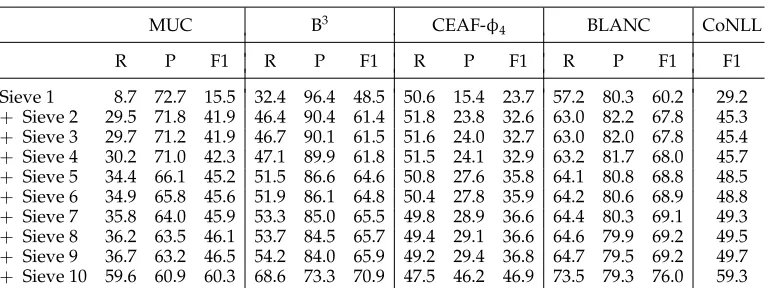
[image:19.486.54.444.516.661.2]4.4.3 Contribution of Individual Sieves.Table 8 lists the performance of our system as ten sieves are incrementally added. This table illustrates our tuning process, which allowed us to deploy the sieves in descending order of their precision. With respect to individual
Table 8
Cumulative performance as sieves are added to the system.
MUC B3 CEAF-φ
4 BLANC CoNLL
R P F1 R P F1 R P F1 R P F1 F1
Sieve 1 8.7 72.7 15.5 32.4 96.4 48.5 50.6 15.4 23.7 57.2 80.3 60.2 29.2
+ Sieve 2 29.5 71.8 41.9 46.4 90.4 61.4 51.8 23.8 32.6 63.0 82.2 67.8 45.3
+ Sieve 3 29.7 71.2 41.9 46.7 90.1 61.5 51.6 24.0 32.7 63.0 82.0 67.8 45.4
+ Sieve 4 30.2 71.0 42.3 47.1 89.9 61.8 51.5 24.1 32.9 63.2 81.7 68.0 45.7
+ Sieve 5 34.4 66.1 45.2 51.5 86.6 64.6 50.8 27.6 35.8 64.1 80.8 68.8 48.5
+ Sieve 6 34.9 65.8 45.6 51.9 86.1 64.8 50.4 27.8 35.9 64.2 80.6 68.9 48.8
+ Sieve 7 35.8 64.0 45.9 53.3 85.0 65.5 49.8 28.9 36.6 64.4 80.3 69.1 49.3
+ Sieve 8 36.2 63.5 46.1 53.7 84.5 65.7 49.4 29.1 36.6 64.6 79.9 69.2 49.5
+ Sieve 9 36.7 63.2 46.5 54.2 84.0 65.9 49.2 29.4 36.8 64.7 79.5 69.2 49.7
contributions, this analysis highlights three significant performance increases. The first is caused by Sieve 2, exact string match. This sieve accounts for approximately 16 CoNLL F1 points improvement, which proves that a significant percentage of mentions in text are indeed repetitions of previously seen concepts. The second big jump in performance, almost 3 CoNLL F1 points, is caused by Sieve 5, strict head match, which is the first pass that compares individual headwords. These results are consistent with error analyses from earlier work which have shown the importance of string match in general (Zhou and Su 2004; Bengtson and Roth 2008; and Recasens, Can, and Jurafsky 2013) and the high precision of strict head match (Recasens and Hovy 2010).
Lastly, pronominal coreference resolution (Sieve 10) is responsible for approxi-mately 9.5 CoNLL F1 points improvement. Thus it would be possible to build an even simpler system, with just three sieves, that achieves 97% of the performance of our best model (based on the CoNLL score). This suggests that what is most important for coreference resolution, at least relative to today’s state of the art, is not necessarily the clustering decision mechanism, but rather the entire architecture behind it, and in particular the use of cautious decision-making based on high precision information, entity-centric modeling, and so forth.
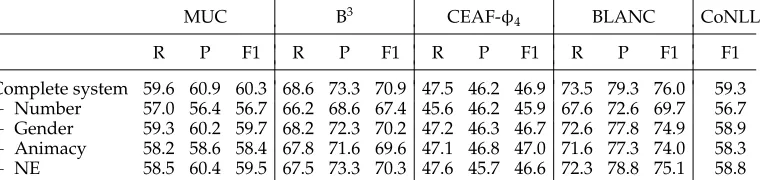
4.4.4 Contribution of Feature Groups. Table 9 lists the results of an ablative experiment where each feature group was individually removed from the complete model. When a feature is eliminated, two mentions under consideration are always considered compat-ible with respect to that feature. For example, singular and plural mentions are number compatible when the number feature is removed.
[image:20.486.54.434.570.660.2]As the table shows, the most significant feature in our model is the number feature. This feature alone is responsible for 2.6 CoNLL F1 points. Removing this feature has a considerable negative impact on the pronoun resolution sieve, which makes a consid-erable number of errors without it (e.g., linking ourandJiaju Hou). The second most relevant feature is animacy, with an overall contribution of 1 CoNLL F1 point. Animacy helps disambiguate clustering decisions where the two mentions under consideration are otherwise number and gender compatible. For example, animacy enables the linking offirms from Taiwanandthey, and avoids the linking of17 yearandshe. Lastly, the NE and gender features contribute 0.5 and 0.4 F1 points, respectively. This relatively minor contribution is caused by the overlap with the other features (e.g., many errors corrected by using NE information are corrected also by a combination of animacy and number). Nevertheless, these features are still useful. For example, the NE feature covers many mentions that do not exist in our animacy dictionaries, which helps in several decisions, e.g., avoiding linkingitandSaddam Hussein.
Table 9
Contribution of each feature group. This is an ablative experiment, that is, each feature group is analyzed by removing it from the complete system listed in the first row.
MUC B3 CEAF-φ
4 BLANC CoNLL
R P F1 R P F1 R P F1 R P F1 F1
Complete system 59.6 60.9 60.3 68.6 73.3 70.9 47.5 46.2 46.9 73.5 79.3 76.0 59.3
− Number 57.0 56.4 56.7 66.2 68.6 67.4 45.6 46.2 45.9 67.6 72.6 69.7 56.7
− Gender 59.3 60.2 59.7 68.2 72.3 70.2 47.2 46.3 46.7 72.6 77.8 74.9 58.9
− Animacy 58.2 58.6 58.4 67.8 71.6 69.6 47.1 46.8 47.0 71.6 77.3 74.0 58.3
Table 10
The relevance of gold information. The “no gold” system is our final system used in the formal evaluation. The system with “gold annotations” uses gold part-of-speech tags, syntactic analysis, and named entity labels.
MUC B3 CEAF-φ4 BLANC CoNLL
R P F1 R P F1 R P F1 R P F1 F1
No gold 59.6 60.9 60.3 68.6 73.3 70.9 47.5 46.2 46.9 73.5 79.3 76.0 59.3
Gold NE 60.3 61.1 60.7 69.0 73.3 71.1 47.5 46.7 47.1 74.0 79.5 76.4 59.6
Gold syntax 62.3 62.5 62.4 69.9 73.5 71.7 47.8 47.6 47.7 74.8 80.0 77.1 60.6
Gold annotations 62.8 62.6 62.7 70.3 73.5 71.9 47.9 48.1 48.0 75.1 80.1 77.4 60.9
Gold mentions 73.0 90.3 80.7 69.1 89.5 78.0 79.2 51.4 62.4 78.8 89.4 83.1 73.7
4.4.5 Gold versus Predicted Information. We conclude this section with an analysis of the performance penalty suffered when using predicted information as input in our system (a realistic scenario) versus using gold information. We consider both linguistic information (i.e., part of speech tags, named entity labels, and syntax) and mention boundaries. Table 10 shows the results when various inputs were replaced with gold information.
The table shows that, out of the linguistic resources, syntax is the most important. This is to be expected, because we use a constituent parser for mention identification, mention traversal, and for some of the sieves (e.g., the precise constructs model). All in all, if all linguistic information is replaced with gold annotations, the performance of the system increases by 1.6 CoNLL F1 points, or 2.7% relative improvement. We consider this relatively small difference a success story for the quality of natural language pro-cessors, especially considering our heavy reliance on such tools throughout the entire system. On the other hand, the difference between our actual system and the oracle system with gold mentions is 14.4 F1 points. This is because the gold mentions include the anaphoricity information, detection of which is already a hard task by itself.
4.4.6 Automatic Ordering.The ordering of our sieves was determined using linguistic intuition about how precise each sieve is (for example exact match is clearly more precise than partial match). We also supplemented this intuition, early on in our design process, by measuring the actual precision of some of the sieves on a development set from ACE.
But because this development set, not to mention our intuition, may not match the circumstances in the OntoNotes corpus, we performed a study to see if an automatically learned ordering for sieves could result in superior performance.
We used greedy search to find an ordering, choosing the best precision sieve at each pass. We tuned the ordering on OntoNotes-Train data, and evaluated this comparison on the OntoNotes-Dev set.
Our optimization resulted in 0.1 CoNLL F1 improvement, and gave a very similar ordering to our hand-built order:
Hand Ordered:
Speaker Match, String Match, Relaxed String Match, Precise Constructs, Strict Head MatchA-C, Proper Head Noun Match, Relaxed Head Match, Pronoun Match
Learned Ordering:
The main change is that the learned ordering downplays the importance of the precise constructs sieves, which is easily explained by the fact that OntoNotes does not annotate appositive or predicate nominative relations.
This experiment confirms that hand ordering sieves by linguistic intuition of how precise they are does remarkably well at choosing an ordering, despite the fact that the ordering was originally designed for ACE, a completely different corpus.
5. Error Analysis
To understand the errors in the system, we analyzed and categorized them into five distinct groups. The distribution of the errors is given in Table 11, with specific examples for each category given in Table 12. For this analysis, we inspected 115 precision and recall errors.
Semantics, discourse.Whereas simple examples can be solved by using shallow semantics such as knowledge about the semantic compatibility of headwords (e.g., McCain –
senator), most of the errors in this class require context-dependent semantics or dis-course. For example, to know that the thrift and his property are coreferent, we need to understand the context and that both the thrift and his property are being seized, involving relations not only between the coreferent words, but also between other parts of the sentence as well.
Pronominal resolution errors. Our pronominal resolution algorithm includes several strong heuristics that model the matching of attributes (e.g., gender, number, animacy), the position of mentions in discourse (e.g., we model only the first mention in text for a given entity), or the distance between pronouns and antecedents. This is still far from language understanding, however. Table 12 shows that our approach often generates incorrect links when it finds other compatible antecedents that appear closer, according to our antecedent ordering, to the pronoun under consideration. In the example shown in the table,the landis selected as the antecedent for the pronounits, becausethe land
appears earlier than the correct antecedent,the ANC, in the sentence. Implementing a richer model of pronominal anaphora using syntactic and discourse information is an important next step.
[image:22.486.52.433.554.664.2]Non-referential mentions. The third significant cause of errors is due to non-referential mentions such as pleonastic it or generic mentions. Our mention detection model removes some of these non-referential mentions, but there are still many left, which generate precision errors. For example, in Table 12, the pronounyouis generic, but our system incorrectly links them. The large number of these errors suggests the need to
Table 11
Distribution of errors.
Error type Percentage
Semantics, discourse 41.7 Pronominal resolution errors 28.7 Non-referential mentions 14.8
Event mentions 6.1
Table 12
Examples of errors in each class. The mention to be resolved is inboldface, its correct antecedent is initalics, and we underlined the incorrect antecedent from our system result.
Error type Example
Semantics, discourse
•Lincoln’s parent company, American Continental Corp., entered bankruptcy - law proceedings this April 13, and regulators seizedthe thriftthe next day. . . . Mr. Keating has filed his own suit, alleging thathis propertywas taken illegally.
•New picturesreveal the sheer power of that terrorist bomb . . . Inthese photos obtained by NBC News, the damage much larger than first imagined . . .
•Of all the one-time expenses incurred by a corporation or professional firm, few are larger or longer term thanthe purchase of real estate or the signing of a commercial lease. . . To take full advantage of the financial opportunities in
this commitment, . . .
Pronominal resolution errors
Under the laws of the land,the ANCremains an illegal organization , anditsheadquarters are still in Lusaka, Zambia.
Non-referential mentions When you become a federal judge, all of a suddenrelegated to a paltry sum. youare
Event mentions
“Supportthe troops, not the regime”That’s a noble idea until you’re supporting the weight of an armoured vehicle on your chest.
Miscellaneous (inconsistent annotations, parser or NER errors, enumerations)
•Inconsistent annotation - Inclusion of’s: . . . that’s without adding in [Business Week ’s] charge . . . Small wonder that [Britain] ’s Labor Party wants credit controls.
•Parser or NER error: Um alright uhMister Zaliskodoyou
know anything from your personal experience of having been on the cruise as to what happened? –Mister Zaliskois not recognized as a PERSON
•Enumerations: This year, the economies of the five large special economic zones, namely, Shenzhen, Zhuhai, Shantou, Xiamen and Hainan, have maintained strong growth momentum. . . . A three dimensional traffic frame inZhuhai
has preliminarily taken shape and the investment environment improves daily.
add more sophisticated anaphoricity detection to our system (Vieira and Poesio 2000; Ng and Cardie 2002a; Poesio et al. 2004b; Boyd, Gegg-Harrison, and Byron 2005; Gupta, Purver, and Jurafsky 2007; Bergsma, Lin, and Goebel 2008; Ng 2009).
is coreferent with the event mentionSupport. Our system fails to detect the latter event mention and, as a consequence, incorrectly linksThattothe regime.
Miscellaneous.There are several other reasons for errors, including inconsistent annota-tions, parse or NER errors, and incorrect processing of enumerations. For example, the possessive (’s) is annotated inconsistently in several cases: sometimes it is included in the possessor mention in the gold mention annotation, but sometimes it is not. This will penalize the final score twice (once for recall due to the missed mention and once for precision due to the incorrectly detected mention).
Another considerable source of errors is caused by incorrect NER labels or parse trees. NER errors can result in incorrect pronoun resolution due to incorrect attributes. Parser errors are responsible for many additional coreference resolution errors. First, in-correct syntactic attachments lead to inin-correct mention boundaries, which are penalized by our strict scorer. Second, parser errors often lead to the selection of an incorrect head word for a given constituent, which influences many of our sieves. Thirdly, because our parser does not always distinguish between coordinated nominal phrases and appo-sitions, our system sometimes takes an entire coordinated phrase as a single mention, leading to a series of mention errors. For example, the last example in the table shows a compounded syntactic error: first, the parser failed to identify the entire construct (Shenzhen, Zhuhai, Shantou, Xiamen, and Hainan) as a single enumeration. Second, our system believed that Zhuhai, Shantou, Xiamenis an appositive phrase and kept it as a single mention, rather than separate it into three distinct mentions.
Lastly, our processing of enumerations needs to be improved. Because we prefer to assign content words as head words of syntactic constituents, we take the head word of the first noun phrase in the enumeration to be the head word of the coordinated nominal phrase (Kuebler, McDonald, and Nivre 2009; de Marneffe and Manning 2008). Because of this, the coordinated phrase is often linked to another mention of the first element in the enumeration. For example, our system marksZhuhai, Shantou, Xiamenas a unique mention and incorrectly links it toZhuhai, because they have the same headword.
6. Comparison with Previous Work
Algorithms for coreference (or just pronominal anaphora) include rule-based systems (Hobbs 1978; Brennan, Friedman, and Pollard 1987; Lappin and Leass 1994; Baldwin 1995; Zhou and Su 2004; Haghighi and Klein 2009, inter alia), supervised systems (Connolly, Burger, and Day 1994; McCarthy and Lehnert 1995; Kehler 1997; Soon, Ng, and Lim 2001; Ng and Cardie 2002b; Rahman and Ng 2009, inter alia), and unsupervised approaches (Cardie and Wagstaff 1999; Haghighi and Klein 2007; Ng 2008; Kobdani et al. 2011a). Our deterministic system draws from all of these, but specifically from three strands in the literature that cross-cut this classification.