Anaphora Resolution
Xiaofeng Yang
∗Institute for Infocomm Research
Jian Su
∗∗Institute for Infocomm Research
Chew Lim Tan
† School of Computing,National University of Singapore
The traditional single-candidate learning model for anaphora resolution considers the antecedent candidates of an anaphor in isolation, and thus cannot effectively capture the preference relation-ships between competing candidates for its learning and resolution. To deal with this problem, we propose a twin-candidate model for anaphora resolution. The main idea behind the model is to recast anaphora resolution as a preference classification problem. Specifically, the model learns a classifier that determines the preference between competing candidates, and, during resolution, chooses the antecedent of a given anaphor based on the ranking of the candidates. We present in detail the framework of the twin-candidate model for anaphora resolution. Further, we explore how to deploy the model in the more complicated coreference resolution task. We evaluate the twin-candidate model in different domains using the Automatic Content Extraction data sets. The experimental results indicate that our twin-candidate model is superior to the single-candidate model for the task of pronominal anaphora resolution. For the task of coreference resolution, it also performs equally well, or better.
1. Introduction
Anaphora is reference to an entity that has been previously introduced into the dis-course (Jurafsky and Martin 2000). The referring expression used is called theanaphor and the expression being referred to is its antecedent. The anaphor is usually used to refer to the same entity as the antecedent; hence, they are coreferentialwith each other. The process of determining the antecedent of an anaphor is called anaphora resolution. As a key problem in discourse and language understanding, anaphora resolution is crucial in many natural language applications, such as machine translation, text summarization, question answering, information extraction, and so on. In recent
∗21 Heng Mui Keng Terrace, Singapore, 119613. E-mail: [email protected]. ∗∗21 Heng Mui Keng Terrace, Singapore, 119613. E-mail: [email protected].
†3 Science Drive 2, Singapore 117543. E-mail: [email protected].
tion, and they have achieved considerable success (Aone and Bennett 1995; McCarthy and Lehnert 1995; Connolly, Burger, and Day 1997; Kehler 1997; Ge, Hale, and Charniak 1998; Soon, Ng, and Lim 2001; Ng and Cardie 2002b; Strube and Mueller 2003; Luo et al. 2004; Ng et al. 2005).
The strength of learning-based anaphora resolution is that resolution regularities can be automatically learned from annotated data. Traditionally, learning-based ap-proaches to anaphora resolution adopt the single-candidate model, in which the po-tential antecedents (i.e., antecedent candidates) are considered in isolation for both learning and resolution. In such a model, the purpose of classification is to determine if a candidate is the antecedent of a given anaphor. A training or testing instance is formed by an anaphor and each of its candidates, with features describing the properties of the anaphor and the individual candidate. During resolution, the antecedent of an anaphor is selected based on the classification results for each candidate.
One assumption behind the single-candidate model is that whether a candidate is the antecedent of an anaphor is completely independent of the other competing candidates. However, anaphora resolution can be more accurately represented as a ranking problem in which candidates are ordered based on their preference and the best one is the antecedent of the anaphor (Jurafsky and Martin 2000). The single-candidate model, which only considers the candidates of an anaphor in isolation, is incapable of effectively capturing the preference relationship between candidates for its training. Consequently, the learned classifier cannot produce reliable results for preference deter-mination during resolution.
To deal with this problem, we propose a twin-candidate learning model for anaphora resolution. The main idea behind the model is to recast anaphora resolution as a preference classification problem. The purpose of the classification is to determine the preference between two competing candidates for the antecedent of a given anaphor. In the model, an instance is formed by an anaphor and two of its antecedent candidates, with features used to describe their properties and relationships. The antecedent is selected based on the judged preference among the candidates.
In the article we focus on two issues about the twin-candidate model. In the first part, we will introduce the framework of the twin-candidate model for anaphora reso-lution, including detailed training procedures and resolution schemes. In the second part, we will further explore how to deploy the twin-candidate model in the more complicated task of coreference resolution. We will present an empirical evaluation of the twin-candidate model in different domains, using the Automatic Content Extraction (ACE) data sets. The experimental results indicate that the twin-candidate model is superior to the single-candidate model for the task of pronominal anaphora resolution. For the coreference resolution task, it also performs equally well, or better.
2. Related Work
scheme to search for antecedents. Compared with Connolly, Burger, and Day (1997), they adopted richer features in which centering information was incorporated to cap-ture contextual knowledge. Their system achieved an accuracy of around 70% on a data set drawn from a corpus of newspaper articles. Both of these studies were carried out on uncommon data sets, which makes it difficult to compare their results with other baseline systems. In contrast to the previous work, we will explore the twin-candidate model comprehensively by describing the model in more detail, trying more effective resolution schemes, deploying the model in the more complicated coreference resolution task, performing more extensive experiments, and evaluating the model in more depth.
Denis and Baldridge (2007) proposed a pronoun resolution system that directly used a ranking learning algorithm (based on Maximal Entropy) to train a preference classifier for antecedent selection. They reported an accuracy of around 72–76% for the different domains in the ACE data set. In our study, we will also investigate the solution of using a general ranking learner (e.g., Ranking-SVM). By comparison, the twin-candidate model is applicable to any discriminative learning algorithm, no matter whether it is capable of ranking learning or not. Moreover, as the model is trained and tested on pairwise candidates, it can effectively capture various relationships between candidates for better preference learning and determination.
Ng (2005) presented a ranking model for coreference resolution. The model focused on the preference between the potential partitions of NPs, instead of the potential antecedents of an NP as in our work. Given an input document, the model first em-ployednpre-selected coreference resolution systems to generatencandidate partitions of NPs. The model learned a preference classifier (trained using Ranking-SVM) that could distinguish good and bad partitions during testing. The best rank partition would be selected as the resolution output of the current text. The author evaluated the model on the ACE data set and reported an F-measure of 55–69% for the different domains. Although ranking-based, Ng’s model is quite different from ours as it operates at the cluster-level whereas ours operates at the mention-level. In fact, the result of our twin-candidate system can be used as an input to his model.
3. The Twin-Candidate Model for Anaphora Resolution 3.1 The Single-Candidate Model
Learning-based anaphora resolution uses a machine learning method to obtainp(ante (Ck)|ana,C1,C2,. . .,Cn), the probability that a candidate Ck is the antecedent of the
anaphor ana in the context of its antecedent candidates, C1,C2,. . .,Cn. The
single-candidate model assumes that the probability that Ck is the antecedent is only
de-pendent on the anaphor ana and Ck, and independent of all the other candidates.
That is:
p(ante(Ck)|ana,C1,C2,. . .,Cn)=p(ante(Ck)|ana,Ck) (1)
Thus, the probability of a candidateCkbeing the antecedent can be approximated using
the classification result on the instance describing the anaphor andCkalone.
Table 1
A sample text for anaphora resolution.
[1Those figures] are almost exactly what [2 the government]
proposed to [3legislators] in [4September]. If [5the government] can
stick with [6them], [7it] will be able to halve this year’s 120 billion
[image:4.486.52.433.198.338.2]ruble (US $193 billion) deficit.
Table 2
Training instances generated under the single-candidate model for anaphora resolution.
Anaphor Training Instance Label
i{[6them] , [1Those figures]} 1
[6them] i{[6them] , [2the government]} 0
i{[6them] , [3legislators]} 0
i{[6them] , [4September]} 0
i{[6them] , [5the government]} 0
i{[7it] , [1Those figures]} 0
i{[7it] , [3legislators]} 0
[7it] i{[7it] , [4September]} 0
i{[7it] , [5the government]} 1
i{[7it] , [6them]} 0
baseline a system for pronominal anaphora resolution based on the single-candidate model.
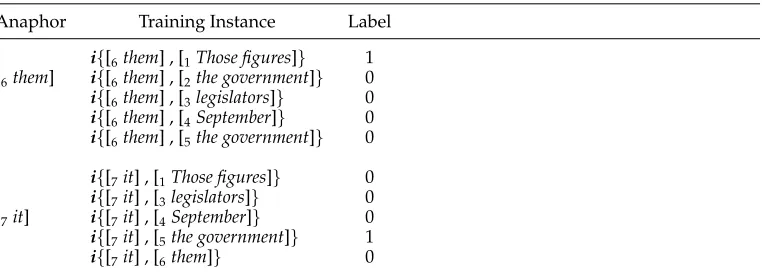
In the single-candidate model, an instance has the form ofi{ana,candi}, whereana is an anaphor andcandiis an antecedent candidate.1For training, instances are created for each anaphor occurring in an annotated text. Specifically, given an anaphoranaand its antecedent candidates, a set of negative instances (labeled “0”) is formed by pairing anaand each of the candidates that is not coreferential withana. In addition, a single positive instance (labeled “1”) is formed by pairinganaand the closest antecedent, that is, the closest candidate that is coreferential withana.2 Note that it is possible that an anaphor has two or more antecedents, but we only create one positive instance for the closest antecedent as its reference relationship with the anaphor is usually the most direct and thus the most confident.
As an example, consider the text in Table 1.
Here, [6them] and [7it] are two anaphors. [1Those figures] and [5the government] are their closest antecedents, respectively. Supposing that the antecedent candidates of the two anaphors are just all their preceding NPs in the current text, the training instances to be created for the text segment are listed in Table 2.
1 In our study, we only consider anaphors whose antecedents are noun phrases. Typically, all the NPs preceding an anaphor can be taken as the initial antecedent candidates. For better learning and resolution, however, candidates can be filtered so that only those “confident” NPs, which occur in the specified search scope and meet constraints such as number/gender agreement, are considered. The details of candidate selection in our system will be discussed later in the section on experiments. 2 We assume that at least one antecedent exists in the candidate set of an anaphor. However, for real
Table 3
Feature set for pronominal anaphora resolution.
ana Reflexive whether the anaphor is a reflexive pronoun
ana PronType type of the anaphor if it is a pronoun (he,she,itorthey?) candi Def whether the candidate is a definite description
candi Indef whether the candidate is an indefinite NP candi Name whether the candidate is a named entity candi Pron whether the candidate is a pronoun
candi FirstNP whether the candidate is the first mentioned NP in the sentence
candi Subject whether the candidate is the subject of a sentence, the subject of a clause, or not. candi Oject whether the candidate is the object of a verb, the object of a preposition,
or not
candi ParallelStruct whether the candidate has an identical collocation pattern with the anaphor candi SentDist the sentence distance between the candidate and the anaphor
candi NearestNP whether the candidate is the candidate closest to the anaphor in position
Note that for [7 it], we do not use [2 the government] to create a positive training instance as it is not the closest candidate that is coreferential with the anaphor.
A vector of features is specified for each training instance. The features may describe the characteristics of the anaphor and the candidate, as well as their relationships from lexical, syntactic, semantic, and positional aspects. Table 3 lists the features used in our study. All these features can be computed with high reliability, and have been proven effective for pronoun resolution in previous work.
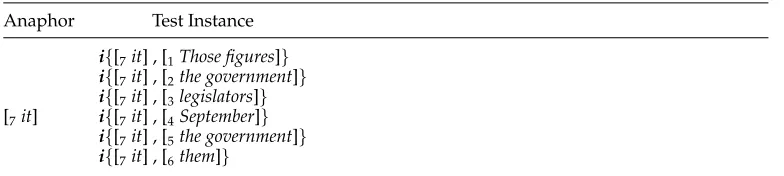
Based on the generated feature vectors, a classifier is trained using a certain learning algorithm. During resolution, given a newly encountered anaphor, a test instance is formed for each of the antecedent candidates. The instance is passed to the classifier, which then returns a confidence value indicating the likelihood that the candidate is the antecedent of the anaphor. The candidate with the highest confidence is selected as the antecedent. For example, suppose [7it] is an anaphor to be resolved. Six test instances will be created for its six antecedent candidates, as listed in Table 4. The learned classifier is supposed to give the highest confidence toi{[7it] , [5the government]}, indicating the candidate [5the government] is the antecedent of [7it].
3.2 A Problem with the Single-Candidate Model
[image:5.486.52.444.576.664.2]As described, the assumption behind the single-candidate model is that the probability of a candidate being the antecedent of a given anaphor is completely independent of
Table 4
Test instances generated under the single-candidate model for anaphora resolution.
Anaphor Test Instance
i{[7it] , [1Those figures]}
i{[7it] , [2the government]}
i{[7it] , [3legislators]}
[7it] i{[7it] , [4September]}
i{[7it] , [5the government]}
antecedent is often subject to preference among the candidates (Jurafsky and Martin 2000). Whether a candidate is the antecedent depends on whether it is the “best” among the candidate set, that is, whether there exists no other candidate that is preferred over it. Hence, simply considering one candidate individually is an indirect and unreliable way to select the correct antecedent.
The idea of preference is common in linguistic theories on anaphora. Garnham (2001) summarizes different factors that influence the interpretation of anaphoric expressions. Some factors such as morphology (gender, number, animacy, and case) or syntax (e.g., the role of binding and commanding relations [Chomsky 1981]) are “eliminating,” forbidding certain NPs from being antecedents. However, many others are “preferential,” giving more preference to certain candidates over others; examples include:
r
Sentence-based factors: Pronouns in one clause prefer to refer to the NP that is the subject of the previous clause (Crawley, Stevenson, and Kleinman 1990). Also, the NP that is the first-mentioned expression is preferred regardless of the syntactic and semantic role played by the referring expression (Gernsbacher and Hargreaves 1988).r
Stylistic factors: Pronouns preferentially take parallel antecedents that play the same role as the anaphor in their respective clauses (Grober, Beardsley, and Caramazza 1978; Stevenson, Nelson, and Stenning 1995).r
Discourse-based factors: Items currently in focus are the prime candidates for providing antecedents for anaphoric expressions. According to centering theory (Grosz, Joshi, and Weinstein 1995), each utterance has a set of forward-looking centers that have higher preference to be referred to in later utterances. The forward-looking centers can be ranked based on grammatical roles or other factors.r
Distance-based factors: Pronouns prefer candidates in the previous sentence compared with those two or more sentences back (Clark and Sengul 1979).As a matter of fact, “eliminating” factors could also be considered “preferential” if we think of the act of eliminating candidates as giving them low preference.
Preference-based strategies are also widely seen in earlier manual approaches to pronominal anaphora resolution. For example, the SHRDLU system by Winograd (1972) prefers antecedent candidates in the subject position over those in the object position. The system by Wilks (1973) prefers candidates that satisfy selectional restrictions with the anaphor. Hobbs’s algorithm (Hobbs 1978) prefers candidates that are closer to the anaphor in the syntax tree, and the RAP algorithm (Lappin and Leass 1994) prefers candidates that have a high salience value computed by aggregating the weights of different factors.
candidates in the candidate set, Ci is the antecedent and forms a positive instance.
Otherwise, Ci is not selected as the antecedent and thus forms a negative instance.
Simply looking at a candidate alone cannot explain this, and may possibly result in inconsistent training instances (i.e., the same feature vector but different class labels). Consequently, the confidence values returned by the learned classifier cannot reliably reflect the preference relationship between candidates.
3.3 The Twin-Candidate Model
To address the problem with the single-candidate model, we propose a twin-candidate model to handle anaphora resolution. As opposed to the single-candidate model, the model explicitly learns a preference classifier to determine the preference relationship between candidates. Formally, the model considers the probability that a candidate is the antecedent as the probability that the candidate is preferred over all the other competing candidates. That is:
p(ante(Ck)|ana,C1,C2,. . .,Cn)
=p(Ck {C1,. . .,Ck−1,Ck+1,. . .Cn} |ana,C1,C2,. . .,Cn) (2)
=p(CkC1,. . .,CkCk−1,CkCk+1,. . .,CkCn|ana,C1,C2,. . .,Cn)
Assuming that the preference between Ck and Ci is independent of the preference
betweenCkand the candidates other thanCi, we have:
p(CkC1,. . .,CkCk−1,CkCk+1,. . .,CkCn|ana,C1,C2,. . .,Cn)
=
1<i<n,i=k
p(CkCi|ana,Ck,Ci) (3)
Thus:
lnp(ante(Ck)|ana,C1,C2,. . .,Cn)
=
1<i<n,i=k
lnp(CkCi|ana,Ck,Ci) (4)
This suggests that the probability that a candidateCkis the antecedent can be
esti-mated using the classification results on the set of instances describingCkand each of
the other competing candidates. To do this, we learn a classifier that, given any two can-didates of a given anaphor, can determine which one is preferred to be the antecedent of the anaphor. The final antecedent is identified based on the classified preference relationships among the candidates. This is the main idea of the twin-candidate model. In such a model, each instance consists of three elements:i{ana,Ci,Cj}, whereana
is an anaphor, and Ci and Cj are two of its antecedent candidates. The class label of
an instance represents the preference between the two candidates for the antecedent, for example, “01” indicatingCjis preferred overCiand “10” indicatingCiis preferred.
Table 5
A sample text for anaphora resolution.
[1Those figures] are almost exactly what [2the government]
proposed to [3legislators] in [4September]. If [5the government]
can stick with [6them], [7it] will be able to halve this year’s
120 billion ruble (US $193 billion) deficit.
a class label, either “01” or “10”, accordingly. In the next section, we will introduce in detail a system based on the twin-candidate model for anaphora resolution.
3.4 Framework of the Twin-Candidate Model
3.4.1 Instance Representation. In the twin-candidate model, an instance takes the form i{ana,Ci,Cj}, whereanais an anaphor andCiandCjare two of its antecedent candidates. We stipulate thatCjshould be closer toanathanCiin position (i.e.,i<j). An instance is labeled “10” ifCiis preferred overCjas the antecedent, or “01” if otherwise.
A feature vector is associated with an instance, and it describes different properties and relationships betweenanaand each of the candidates, Ci orCj. In our study, the
system with the twin-candidate model adopts the same feature set as the baseline system with the single-candidate model (shown in Table 3). The difference is that a feature for the single candidate, candi X, has to be replaced by a pair of features for the twin candidates, candi1 X and candi2 X. For example, feature candi Pron, which describes whether a candidate is a pronoun, will be replaced by two featurescandi1 Pron andcandi2 Pron, which describe whetherCiandCjare pronouns, respectively.
3.4.2 Training Instances Creation.To learn a preference classifier, a training instance for an anaphor should be composed of two candidates with an explicit preference relationship, for example, one being an antecedent and the other being a non-antecedent. A pair of candidates that are both antecedents or both non-antecedents are not suitable for instance creation because their preference cannot be explicitly represented for training, although it does exist.
Based on this idea, during training, for an encountered anaphorana, we take the closest antecedent, Cante, as the anchor candidate.3 Cante is paired with each of the
candidates Cnc that is not coreferential with ana. If Cante is closer toana thanCnc, an
instance i{ana, Cnc, Cante} is created and labeled “01”. Otherwise, if Cnc is closer, an
instancei{ana,Cante,Cnc}is created and labeled “10” instead.
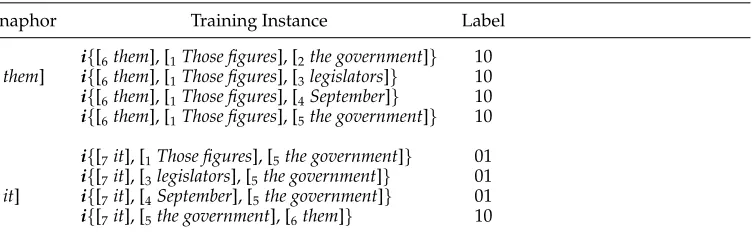
Consider again the sample text given in Table 1, which is repeated in Table 5. For the anaphor [7 it], the closest antecedent, [5 the government] (denoted asNP5), is chosen as the anchor candidate. It is paired with the four non-coreferential candidates (i.e.,NP1,
NP3,NP4, andNP6) to create four training instances. Among them, the instances formed withNP1,NP3orNP4are labeled “01” and the one withNP6is labeled “10”. Table 6 lists all the training instances to be generated for the text.
3.4.3 Classifier Generation. Based on the feature vectors for the generated training in-stances, a classifier can be trained using a discriminative learning algorithm. Given a test instancei{ana,Ci,Cj}(i<j), the classifier is supposed to return a class label of “10”,
Table 6
Training instances generated under the twin-candidate model for anaphora resolution.
Anaphor Training Instance Label
i{[6them], [1Those figures], [2the government]} 10
[6them] i{[6them], [1Those figures], [3legislators]} 10
i{[6them], [1Those figures], [4September]} 10
i{[6them], [1Those figures], [5the government]} 10
i{[7it], [1Those figures], [5the government]} 01
i{[7it], [3legislators], [5the government]} 01
[7it] i{[7it], [4September], [5the government]} 01
i{[7it], [5the government], [6them]} 10
indicating thatCiis preferred overCjfor the antecedent ofana, or “01”, indicating that
Cjis preferred.
3.4.4 Antecedent Identification. After training, the preference classifier can be used to resolve anaphors. The process of determining the antecedent of a given anaphor, called antecedent identification, could be thought of as a tournament, a competition in which many participants play against each other in individual matches. The candidates are like players in a tournament. A series of matches between candidates is held to determine the champion of the tournament, that is, the final antecedent of the anaphor under con-sideration. Here, the preference classifier is like the referee who judges which candidate wins or loses in a match.
If an anaphor has only one antecedent candidate, it is resolved to the candidate directly. For anaphors that have more than one candidate, two possible schemes can be employed to find the antecedent.
Tournament Elimination Tournament Elimination is a type of tournament where the loser in a match is immediately eliminated. Such a scheme is also applicable to antecedent identification. In the scheme, candidates are compared linearly from the beginning to the end. Specifically, the first candidate is compared with the second one, forming a test instance, which is then passed to the classifier to determine the prefer-ence. The “losing” candidate that is judged less preferred by the classifier is eliminated and never considered. The winner, that is, the preferred candidate, is compared with the third candidate. The process continues until all the candidates are compared, and the candidate that wins in the last comparison is selected as the antecedent.
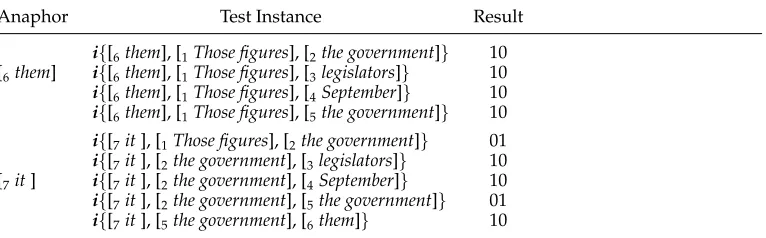
For demonstration, we use the text in Table 5 as a test example. Suppose we have a “perfect” classifier that can correctly determine the preference between candidates. That is, the candidates that are coreferential with the anaphor will be classified as preferred over those that are not. (If the two candidates are both coreferential or both non-coreferential with the anaphor, the one closer to the anaphor in position is preferred.) To resolve the anaphor [7it], the candidateNP1is first compared withNP2. The formed instance is classified as “01”, indicatingNP2 is preferred. Thus,NP1 is eliminated and
NP2 continues to compete withNP3andNP4until it fails in the comparison withNP5. Finally,NP5 beatsNP6 in the last match and is selected as the antecedent. All the test instances to be generated in sequence for the resolution of [6them] and [7it] are listed in Table 7.
Table 7
Test instances generated under the twin-candidate model with the Tournament Elimination scheme.
Anaphor Test Instance Result
i{[6them], [1Those figures], [2the government]} 10
[6them] i{[6them], [1Those figures], [3legislators]} 10
i{[6them], [1Those figures], [4September]} 10
i{[6them], [1Those figures], [5the government]} 10
i{[7it], [1Those figures], [2the government]} 01
i{[7it], [2the government], [3legislators]} 10
[7it] i{[7it], [2the government], [4September]} 10
i{[7it], [2the government], [5the government]} 01
i{[7it], [5the government], [6them]} 10
of candidates to be processed. However, as our twin-candidate model imposes no constraints that enforce transitivity of the preference relation, the preference classifier would likely outputC1C2,C2 C3, andC3C1. Hence, it is unreliable to eliminate a candidate once it happens to lose in one comparison, without considering all of its winning/losing results against the other candidates.
Round RobinIn Section 3.3, we have shown that the probability that a candidate is the antecedent can be calculated using the preference classification results between the candidate and its opponents. The candidate with the highest preference is selected as the antecedent, that is:
Antecedent(ana)=argimaxp(ante(Ci)|ana,C1,C2,. . .,Cn)
∝argimax
j=i
CF(i{ana,Ci,Cj},Ci) (5)
where CF(i{ana,Ci,Cj},Ci) is the confidence with which the classifier determinesCito be preferred overCjas the antecedent ofana. If we define the score ofCias:
Score(Ci)=
j=i
CF(i{ana,Ci,Cj},Ci) (6)
Then, the most preferred candidate is the candidate that has the maximum score. If we simply use 1 to denote the result thatCiis classified as preferred overCj, and−1 ifCjis preferred otherwise, then:
Score(Ci)=|{Cj|CiCj}| − |{Cj|CjCi}| (7)
Table 8
Test instances generated under the twin-candidate model with the Round Robin scheme.
Anaphor Test Instance Result
i{[7it], [1Those figures], [2the government]} 01
i{[7it], [1Those figures], [3legislators]} 01
i{[7it], [1Those figures], [4September]} 01
i{[7it], [1Those figures], [5the government]} 01
i{[7it], [1Those figures], [6them]} 01
i{[7it], [2the government], [3legislators]} 10
i{[7it], [2the government], [4September]} 10
[7it] i{[7it], [2the government], [5the government]} 01
i{[7it], [2the government], [6them]} 10
i{[7it], [3legislators], [4September]} 01
i{[7it], [3legislators], [5the government]} 01
i{[7it], [3legislators], [6them]} 01
i{[7it], [4September], [5the government]} 01
i{[7it], [4September], [6them]} 01
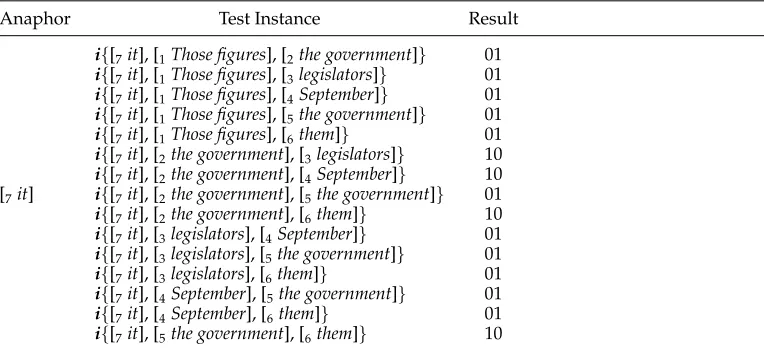
i{[7it], [5the government], [6them]} 10
result against every other candidate is recorded. Its score increases by one if it wins a match, or decreases by one if it loses. The candidate with the highest score is selected as the antecedent.
Antecedent identification carried out in such a way corresponds to a type of tourna-ment called Round Robin in which each participant plays every other participant once, and the final champion is selected based on the winning–losing records of the players. In contrast to the Elimination scheme, the Round Robin scheme is more reliable in that the preference of a candidate is determined by overall comparisons with the other competing candidates. The computational complexity of the scheme is O(N2), whereN is the number of the candidates.
To illustrate this, consider the example in Table 5 again. The test instances to be generated for resolving the anaphor [7 it] are listed in Table 8. As shown, each of the candidates is compared with every other competing candidate. The scores of the candidates are summarized in Table 9. Here, the candidateNP5beats all the opponents in the comparisons and obtains the maximum score of five. Thus it will be selected as the antecedent.
[image:11.486.53.445.577.664.2]An extension of the above Round Robin scheme is called the Weighted Round Robin scheme. In the weighted version, the confidence values returned by the classifier,
Table 9
Scores for the candidates under the Round Robin scheme.
NP1 NP2 NP3 NP4 NP5 NP6 Score
NP1 −1 −1 −1 −1 −1 −5
NP2 +1 +1 +1 −1 +1 +3
NP3 +1 −1 −1 −1 −1 −3
NP4 +1 −1 +1 −1 −1 −1
NP5 +1 +1 +1 +1 +1 +5
Table 10
Statistics for the training and testing data sets.
NWire NPaper BNews
# Tokens 85k 72k 67k
Train
# Files 130 76 216
# Tokens 20k 18k 18k
Test
# Files 29 17 51
instead of the simple 0 and 1, are employed to calculate the score of a candidate based on the formula
Score(Ci)=
CiCj
CF(CiCj)−
CkCi
CF(CkCi) (8)
Here, CF is the confidence value that the classifier returns for the corresponding instance.
3.5 Evaluation
3.5.1 Experimental Setup.We used the ACE (Automatic Content Extraction)4coreference data set for evaluation. All the experiments were done on the ACE-2 V1.0 corpus. It contains two data sets, training and devtest, which were used for training and testing, respectively. Each of these sets is further divided into three domains: newswire (NWire), newspaper (NPaper), and broadcast news (BNews). Statistics for the data sets are sum-marized in Table 10.
For both training and resolution, a raw input document was processed by a pipeline of NLP modules including a Tokenizer, Part-of-Speech tagger, NP chunker, Named-Entity (NE) Recognizer, and so on. These preprocessing modules were meant to determine the boundary of each NP in a text, and to provide the necessary information about an NP for subsequent processing. Trained and tested on the UPEN WSJ TreeBank, the POS tagger (Zhou and Su 2000) could obtain an accuracy of 97% and the NP chunker (Zhou and Su 2000) could produce an F-measure above 94%. Evaluated for the MUC-6 and MUC-7 Named-Entity task, the NER module (Zhou and Su 2002) could provide an F-measure of 96.6% (MUC-6) and 94.1% (MUC-7).
In our experiments, we focused on the resolution of the third-personal pronominal anaphors, includingshe,he,it,theyas well as their morphologic variants (such asher,his, him,its,itself,them, etc.). For both training and testing, we considered all the pronouns that had at least one preceding NP in their respective annotated coreferential chains. We used the accuracy rate as the evaluation metric, and defined it as follows:
Accuracy= number of anaphors being correctly resolved
total number of anaphors to be resolved (9)
Here, an anaphor is deemed “correctly resolved” if the found antecedent is in the co-referential chain of the anaphor.
Table 11
Statistics of the training instances generated for the pronominal anaphora resolution task.
NWire NPaper BNews
0 instances 8,200 11,648 6,037
Single-Candidate 1 instances 1,241 1,466 1,291
01 instances 6,899 9,861 5,004
Twin-Candidate 10 instances 1,301 1,787 1,033
For pronoun resolution, the distance between the closest antecedent and the anaphor is usually short, predominantly (98% for the current data set) limited to only one or two sentences (McEnery, Tanaka, and Botley 1997). For this reason, given an anaphor, we only took the NPs occurring within the current and previous two sentences as initial antecedent candidates. The candidates with mismatched number and gender agreement were filtered automatically from the candidate set. Also, pronouns or NEs that disagreed in person with the anaphor were removed in advance. For training, there were 1,241 (NWire), 1,466 (NPaper), and 1,291 (BNews) anaphors found with at least one antecedent in the candidate set. For testing, the numbers were 313 (NWire), 399 (NPaper), and 271 (BNews). On average, an anaphor had nine antecedent candidates.
Table 11 summarizes the statistics of the training instances as well as the class distribution. Note that for the single-candidate model, the number of “1” instances was identical to the number of anaphors in the training data, because we only used the closest antecedents of anaphors to create the positive instances. The number of “0” instances was equal to the total number of “01” and “10” training instances for the twin-candidate model.
We examined three different learning algorithms: C5 (Quinlan 1993), Maximum Entropy (Berger, Della Pietra, and Della Pietra 1996), and SVM (linear kernel) (Vapnik 1995),5 using the software See5,6OpenNlp.MaxEnt,7 and SVM-light,8 respectively. All the classifiers were learned with the default learning parameters set in the respective learning software.
3.5.2 Results and Discussions. Table 12 lists the performance of the different anaphora resolution systems with the single-candidate (SC) and the twin-candidate (TC) models. For the TC model, two antecedent identification schemes, Tournament Elimination and Round Robin, were compared.
From the table, we can see that our baseline system with the single-candidate model can obtain accuracy of up to 72.9% (NWire), 77.1% (NPaper), and 74.9% (BNews).
5 As MaxEnt learns a probability model, we used the returned probability as the confidence of a candidate being the antecedent. For C5, the confidence value of a candidate was estimated based on the following smoothed ratio:
CF=p+1 t+2
wherecwas the number of positive instances andtwas the total number of instances stored in the corresponding leaf node. For SVM, the returned value was used as the confidence value: the lower (maybe negative) the less confident.
6http://www.rulequest.com/see5-info.html
7http://MaxEnt.sourceforge.net/
Table 12
Accuracy in percent for the pronominal anaphora resolution.
NWire NPaper BNews Average
C5 SC 71.6 75.6 69.5 72.7
TC
- Elimination 71.6 81.3 74.5 76.4
- Round Robin 72.9 81.3 74.9 76.9
- Weighted Round Robin 72.9 80.5 75.6 76.7
MaxEnt SC 72.9 77.1 74.9 75.2
TC
- Elimination 75.1 79.1 77.5 77.4
- Round Robin 75.1 79.1 77.5 77.4
- Weighted Round Robin 75.7 78.6 77.1 77.3
SVM SC 72.9 77.3 74.2 75.1
TC
- Elimination 73.5 82.0 78.9 78.5
- Round Robin 74.4 82.0 78.9 78.7
- Weighted Round Robin 74.6 79.3 78.2 77.5
Rank SVM 73.5 79.3 76.4 76.7
The average accuracy is comparable to that reported by Kehler et al. (2004) (around 75%), who also used the single-candidate model to do pronoun resolution with similar features (using MaxEnt) on the ACE data sets. By contrast, the systems with the twin-candidate model are able to achieve accuracy of up to 75.7% (NWire), 82.0% (NPaper), and 78.9% (BNews). The average accuracy is 76.9% for C5, 77.4% for MaxEnt, and 78.7% for SVM, which is statistically significantly9better than the results of the baselines (4.2%, 2.2%, and 3.6% in accuracy). These results confirm our claim that the twin-candidate model is more effective than the single-candidate model for the task of pronominal anaphora resolution.
We see no significant difference between the accuracy rates (less than 1.0% accuracy) produced by the two antecedent identification schemes, Tournament Elimination and Round Robin. This is in contrast to our belief that the Round Robin scheme, which is more reliable than the Tournament Elimination, should lead to much better results. One possible reason could be that the classifier in our systems can make a correct preference judgement (with accuracy above 92% as in our test) in the cases where one candidate is the antecedent and the other is not. As a consequence, the simple linear search can find the final antecedent as well as the Round Robin method. These results suggest that we can use the Elimination scheme in a practical system to make antecedent identification more efficient. (Recall that the Elimination scheme requires complexity ofO(N), instead ofO(N2) as in Round Robin.)
Ranking-SVMIn our experiments, we were particularly interested in comparing the results using the twin-candidate model and those directly using a preference learn-ing algorithm. For this purpose, we built a system based on Ranklearn-ing-SVM (Joachims 2002), an extension of SVM capable of preference learning.
The system uses a similar framework to the single-candidate-based system. For training, given an anaphor, a set of instances is created for each of the antecedent candi-dates. To learn the preference between competing candidates, a “query-ID” is specified for each training instance in such a way that the instances formed by the candidates of the same anaphor bear the same query-ID. The label of an instance represents the rank of the candidate in the candidate set; here, “1” for the instances formed by the candidates that are the antecedents, and “0” for the instances formed by the others. The training instances are associated with features as defined in Table 3, to which the Ranking-SVM algorithm is then applied to generate a preference classifier. During resolution, for each candidate of a given anaphor, a test instance is formed and passed to the learned classifier, which in turn returns a value to represent the rank of the candidate among all the candidates. The anaphor is resolved to the one with the highest value.
In fact, if we look into the learning mechanism of Ranking-SVM, we can find that the algorithm will, in the background, pair any two instances that have the same query-ID but different rank labels. This is quite similar to the twin-candidate model, which creates an instance by putting together two candidates with different preferences. However, one advantage of the twin-candidate model is that it can explicitly record various relationships between two competing candidates, for example, “which one of the two candidates is closer to the anaphor in position/syntax/semantics?”10 Such inter-candidate information can make the preference between candidates clearer, and thus facilitate both preference learning and determination. In contrast, Ranking-SVM, which constructs instances in the single-candidate form, cannot effectively capture this kind of information.
The last line of Table 12 shows the results from such a system based on Ranking-SVM. We can see that the system achieves an average accuracy of 76.7%, statistically significantly better than the baseline system with the single-candidate model by 1.6% (0.4% for NWire, 2.0% for NPaper, and 2.2% for BNews). The results lend support to our claim that the preference relationships between candidates, if taken into consideration for classifier training, can lead to better resolution performance. Still, we observe that our twin-candidate model beats Ranking-SVM in average accuracy by 1.8% (Elimina-tion scheme) and 2.0% (Round Robin).
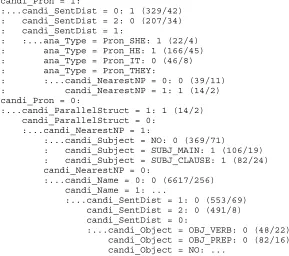
Decision Tree One advantage of the C5 learning algorithm is that the generated classifier can be easily interpreted by humans, and the importance of the features can be visually illustrated. In Figures 1 and 2, we show the decision trees (top four levels) output by C5 for the NWire domain, based on the single-candidate and the twin-candidate models, respectively. As the twin-candidate model uses a larger pool of features, the tree for the twin-candidate model is more complicated (180 nodes) than the one for the single-candidate model (36 nodes).
From the two trees, we can see that both models rely on similar features such as lexi-cal, positional, and grammatical properties for pronoun resolution. However, we can see that the preferential factors (e.g., subject preference, parallelism preference, and distance preference as discussed in Section 3.2) are more clearly presented in the twin-candidate-based tree. For example, if two candidates are both pronouns, the twin-candidate-twin-candidate-based tree will suggest that the one closer to the anaphor has a higher preference to be the antecedent. By contrast, such a preference relationship has to be implicitly represented
Figure 1
Decision tree generated for pronoun resolution under the single-candidate model. For feature ana Type, the values PRON SHE,PRON SHE,PRON SHE, and PRON THEY represent whether the anaphor is a pronoun such asshe,he,it, andthey, respectively. Forcandi Subject, the values SUBJ MAIN, SUBJ CLAUSE and NO represent whether the candidate is the subject of a main sentence, or the subject of a clause, or not. Forcandi Object, the values OBJ VERB, OBJ PREP, and NO represent whether the candidate is the object of a verb, a preposition, or not, respectively. For other features, 0 and 1 represent yes/no.
in the single-candidate-based tree, with different confidence values being assigned to the candidates in different sentences.
Learning CurveIn our experiments, we were also concerned about how training data size might influence anaphora resolution performance. For this purpose, we di-vided the anaphors in the training documents into 10 batches, and then performed resolution using the classifiers trained with 1, 2, . . . , 10 b atches of anaphors. Figure 3 plots the learning curves of the systems with the single-candidate model and the twin-candidate model (Round Robin scheme) for the NPaper domain. Each accuracy rate shown in the figure is the average of the results from three trials trained on different anaphors.
Figure 2
Decision tree generated for pronoun resolution under the twin-candidate model.
Figure 3
[image:17.486.54.358.377.625.2]Table 13
A sample text for coreference resolution.
[1Globalstar] still needs to raise [2$600 million], and
[3Schwartz] said [4that company] would try to raise [5the
money] in [6the debt market].
single-candidate model when trained with more than two batches of anaphors. This figure further demonstrates that the twin-candidate model is reliable and effective for the pronominal anaphora resolution task.
4. Deploying the Twin-Candidate Model to Coreference Resolution
One task that is closely related to anaphora resolution is coreference resolution, the process of identifying all the coreferential expressions in texts.11Coreference resolution is different from anaphor resolution. The latter focuses on how an anaphor can be suc-cessfully resolved, and the resolution is done on given anaphors. The former, in contrast, focuses on how the NPs that are coreferential with each other can be found correctly and completely, and the resolution is done on all possible NPs. In a text, many NPs, especially the non-pronouns, are non-anaphors that have no antecedent to be found in the previous text. Hence, the task of coreference resolution is a more complicated challenge than anaphora resolution, as a solution should not only be able to resolve an anaphor to the correct antecedent, but should also refrain from resolving a non-anaphor. In this section, we will explore how to deploy the learning models for anaphor resolution in the coreference resolution task. As pronouns are usually anaphors, we will focus mainly on the resolution of non-pronouns.
4.1 Coreference Resolution Based on the Single-Candidate Model
In practice, the single-candidate model can be applied to coreference resolution directly, using the similar training and testing procedures to those used in anaphora resolution (described in Section 2).
For training, we create “0” and “1” training instances for each encountered anaphor, that is, the NP that is coreferential with at least one preceding NP. Specifically, given an anaphor and its antecedent candidates, a positive instance is generated for the closest antecedent and a set of negative instances is generated for each of the candidates that is not coreferential with the anaphor.12
Consider the text in Table 13 as an example. In the text, [4 that company] and [5 the money] are two anaphors, with [1Globalstar] and [2$600 million] being their antecedents, respectively. Table 14 lists the training instances to be created for this text.
11 In our study, we only consider within-document noun phrase coreference resolution.
Table 14
Training instances generated under the single-candidate model for coreference resolution.
Anaphor Training Instance Label
i{[4that company] , [1Globalstar]} 1
[4that company] i{[4that company] , [2$600 million]} 0
i{[4that company] , [3Schwartz]} 0
i{[5the money] , [1Globalstar]} 0
[5the money] i{[5the money] , [2$600 million]} 1
i{[5the money] , [3Schwartz]} 0
i{[5the money] , [4that company]} 0
Table 15
Feature set for coreference resolution.
ana Def whether the possible anaphor is a definite description ana Indef whether the possible anaphor is an indefinite NP
ana Name whether the possible anaphor is a named entity
candi Def whether the candidate is a definite description candi Indef whether the candidate is an indefinite description candi Name whether the candidate is a named-entity
candi SentDist the sentence distance between the possible anaphor and the candidate candi NameAlias whether the candidate and the candidate are aliases for each other candi Appositive whether the possible anaphor and the candidate are in an appositive
structure
candi NumberAgree whether the possible anaphor and the candidate agree in number candi GenderAgree whether the possible anaphor and the candidate agree in gender candi HeadStrMatch whether the possible anaphor and the candidate have the same head
string
candi FullStrMatch whether the possible anaphor and the candidate contain the same strings (excluding the determiners)
candi SemAgree whether the possible anaphor and the candidate belong to the same semantic category in WordNet
In Table 15, we list the features used in our study for coreference resolution, which are similar to those proposed in Soon, Ng, and Lim’s (2001) system.13All these features are domain independent and the values can be computed with low cost but high reliability.
After training, the learned classifier can be directly used for coreference resolution. Given an NP to be resolved, a test instance is generated for each of its antecedent candidates. The classifier, being given the instance, will determine the likelihood that the candidate is the antecedent of the possible anaphor. If the confidence is below a pre-specified threshold, the candidate is discarded. In the case where none of the candidates have a confidence higher than the threshold, the current NP is deemed a
highest confidence.14
4.2 Coreference Resolution Based on the Twin-Candidate Model
The twin-candidate model presented in the previous section focuses on the preference between candidates. The model will always select a “best” candidate as the antecedent, even if the current NP is a non-anaphor. To deal with this problem, we will teach the preference classifier how to identify non-anaphors, by incorporating non-anaphors to create a special class of training instances. For resolution, if the newly learned classifier returns the special class label, we will know that the current NP is a non-anaphor, and no preference relationship holds between the two candidates under consideration. In this way, the twin-candidate model is capable of carrying out both antecedent identification and anaphoricity determination by itself, and thus can be deployed for coreference resolution directly. In this section, we will describe the modified training and resolution procedures of the twin-candidate model.
4.2.1 Training. As with anaphora resolution, an instance of the twin-candidate model for coreference resolution takes the formi{ana,Ci,Cj}, whereanais a possible anaphor, and Cjand Cj are two of its antecedent candidates (i<j). The feature set is similar to
that for the single-candidate model as defined in Table 15, except that acandi Xfeature is replaced by a pair of features,cand1 x and candi2 x, for the two competing candi-dates, respectively.
During training, if an encountered NP is an anaphor, we create “01” or “10” training instances in the same way as in the original learning framework. If the NP is a non-anaphor, we do the following:
r
From the antecedent candidates,15randomly select one as the anchor candidate.r
Create a set of instances by pairing the anchor candidate and each of the other non-coreferential candidates.The instances formed by the non-anaphors are labeled “00.”
Consider the sample text in Table 13. For the two anaphors [4 that company] and [5 the money], we create the “01” and “10” instances as usual. For the non-anaphors [3Schwartz] and [6the debt market], we generate two sets of “00” instances. Table 16 lists all the training instances for the text (supposing [1Globalstar] and [2$600 million] are the anchor candidates for [3Schwartz] and [6the debt market], respectively).
The “00” training instances are used together with the “01” and “10” ones to train a classifier. Given a test instance i{ana, Ci, Cj} (i<j), the newly learned classifier is
supposed to return “01” (or “10”), indicatinganais an anaphor andCi(orCj) is preferred
as its antecedent, or return “00”, indicating anais a non-anaphor and no preference exists betweenCiandCj.
14 Other clustering strategies are also available, for example, “closest-first” where a possible anaphor is resolved to the closest candidate with the confidence above the specified threshold, if any (Soon, Ng, and Lim 2001).
Table 16
Training instances generated under the twin-candidate model for coreference resolution.
Possible Anaphor Training Instance Label
i{[4that company], [1Globalstar], [2$600 million]} 10
[4that company] i{[4that company], [1Globalstar], [3Schwartz]} 10
i{[5the money], [1Globalstar], [2$600 million]} 01
[5the money] i{[5the money], [2$600 million], [3Schwartz]} 10
i{[5the money], [2$600 million], [4that company]} 10
[3Schwartz] i{[3Schwartz], [1Globalstar], [2$600 million]} 00
i{[6the debt market], [1Globalstar], [2$600 million]} 00
i{[6the debt market], [2$600 million], [3Schwartz]} 00
[6the debt market] i{[6the debt market], [2$600 million], [4that company]} 00
i{[6the debt market], [2$600 million], [5the money]} 00
4.2.2 Antecedent Identification.Accordingly, we make a modification to the original Tour-nament Elimination and the Round Robin schemes:
Tournament Elimination SchemeAs with anaphora resolution, given an NP to be resolved, candidates are compared linearly from the beginning to the end. If an instance for two competing candidates is classified as “01” or “10”, the preferred candidate will be compared with subsequent competitors while the loser is eliminated immediately. If the instance is classified as “00”, both the two candidates are discarded and the comparison restarts with the next two candidates.16The process continues until all the candidates have been compared. If both of the candidates in the last match are judged to be “00”, the current NP is left unresolved. Otherwise, the NP will be resolved to the final winner, on the condition that the highest confidence that the winner has ever obtained is above a pre-specified threshold.
Round Robin Scheme In the Round Robin scheme, each candidate is compared with every other candidate. If two candidates are labeled “00” in a match, both candi-dates receive a penalty of −1 in their respective scores. If no candidate has a positive final score, then the NP is considered non-anaphoric and left unresolved. Otherwise, it is resolved to the candidate with the highest score as usual. Here, we can also use a threshold. That is, we will update the scores of the two candidates in a match if and only if the preference confidence returned by the classifier is higher than a pre-specified threshold.
In rare cases where an NP to be resolved has only one antecedent candidate, a pseudo-instance is created by pairing the candidate with itself. The NP will be resolved to the candidate unless the instance is labeled “00”.
4.3Evaluation
4.3.1 Experimental Setup. We used the same ACE data sets for coreference resolution evaluation, as described in the previous section for anaphora resolution. A raw input document was processed in advance by the same pipeline of NLP modules including
Table 17
Statistics of the training instances generated for coreference resolution (non-pronoun).
NWire NPaper BNews
0 instances 78,191 105,152 33,748 Single-Candidate
1 instances 3,197 3,792 2,094
00 instances 296,000 331,957 159,752
Twin-Candidate 01 instances 50,499 70,433 21,170
10 instances 27,692 34,719 12,578
POS-tagger, NP chunker, NE recognizer, and so on, to obtain all possible NPs and related information (see Section 3.5.1).
For evaluation, we adopted Vilain et al.’s (1995) scoring algorithm in whichrecall andprecision17 were computed by comparing the key chains (i.e., the annotated “stan-dard” coreferential chains) and the response chains (i.e., the chains generated by the coreference resolution system).
As already mentioned, the twin-candidate model described in this section is mainly meant for non-pronouns that are often not anaphoric. To better examine the utility of the model in our experiments, we first focused on coreference resolution for non-pronominal NPs. The recall and precision to be reported were computed based on the response chains and the key chains from which all the pronouns are removed. We will later show the results of overall coreference resolution for whole NPs by combining the resolution of pronouns and non-pronouns.
In non-pronoun resolution, an anaphor and its antecedent do not often occur a short distance apart as they do in pronoun resolution. For this reason, during training, we took as antecedent candidates all the preceding non-pronominal NPs18 in the current and previous four sentences; while during testing, we used all the preceding non-pronouns, regardless of distance, as candidates.19The statistics of the training instances for each data set are summarized in Table 17.
Again, we examined the three learning algorithms: C5, MaxEnt, and SVM.20 As both the single-candidate and the twin-candidate models used a threshold to block low-confidence coreferential pairs, we performed three-fold cross-evaluation on the training data to determine the thresholds for the coreference resolution systems.
4.3.2 Results and Discussions. Table 18 lists the results for the different systems on the non-pronominal NP coreference resolution. We used as the baseline the system with the single-candidate model described in Section 4.1. As mentioned, the system was trained
17 The overall F-measure was defined as
2∗Recall∗Precision Recall+Precision
18 As suggested in Ng and Cardie (2002b), we did not include pronouns in the candidate set of a non-pronoun, because a pronoun is usually anaphoric and cannot give much information about the entity to which it refers.
Table 18
Recall (R), Precision (P), and F-measure (F) in percent for coreference resolution (non-pronoun).
NWire NPaper BNews
R P F R P F R P F
C5 SC
- baseline 63.3 48.1 54.7 63.8 42.2 50.8 63.5 53.7 58.2
- with non-anaphors 40.9 81.5 54.4 39.8 81.4 53.4 35.1 76.8 48.2
TC
- Elimination 50.8 63.0 56.2 56.6 60.1 58.3 44.6 71.2 54.9
- Round Robin 58.7 57.9 58.3 56.5 60.5 58.4 49.0 70.1 57.7
MaxEnt SC
- baseline 62.1 52.3 56.8 56.4 58.8 57.6 61.8 54.1 57.7
- with non-anaphors 59.6 54.0 56.7 54.2 62.6 58.1 53.8 58.4 56.0
TC
- Elimination 59.1 55.4 57.2 52.2 69.0 59.5 53.5 61.9 57.4
- Round Robin 58.7 55.9 57.2 53.4 65.9 59.0 54.3 62.8 58.3
SVM SC
- baseline 64.1 49.0 55.5 65.5 42.1 51.3 63.5 53.7 58.2
- with non-anaphors 42.3 70.0 52.7 40.0 76.6 52.5 35.7 77.0 48.8
TC
- Elimination 57.8 53.2 55.4 51.7 56.5 54.0 63.3 53.8 58.2
- Round Robin 54.3 56.9 55.6 56.1 58.1 57.1 63.7 53.8 58.3
on the instances formed by anaphors. For better comparison with the twin-candidate model, we built another single-candidate-based system in which the non-anaphors were also incorporated for training. Specifically, for each encountered non-anaphor during training, we created a set of “0” instances by pairing the non-anaphor with each of the candidates. These instances were added to the original instances formed by anaphors to learn a classifier,21which was then applied for the resolution as usual.
The results for the two single-candidate based systems are listed in Table 18. When trained with the instances formed only by anaphors, the system could achieve recall above 60% and precision of around 50% for the three domains. When trained with the instances formed by both anaphors and non-anaphors, the system yielded a significant improvement in precision. In the case of using C5 and SVM, the system is capable of producing precision rates of up to 80%. The increase in precision is reasonable since the classifier tends to be stricter in blocking non-anaphors. Unfortunately, however, at the same time recall drops significantly, and no apparent improvement can be observed in the resulting overall F-measure.
When trained with non-anaphors incorporated, the systems with the twin-candidate model, described in Section 4.2, are capable of yielding higher precision against the baseline. Although recall also drops at the same time, the increase in precision can compensate it well: We observe that in most cases, the system with the twin-candidate model can achieve a better F-measure than the baseline system with the single-candidate model. Also, the improvement is statistically significant (t-test, p<0.05) in the NWire domain when C5 is used (3.6%), and in the NPaper domain
is used. These results suggest that our twin-candidate model can effectively identify non-anaphors and block their invalid resolution, without affecting the accuracy of determining antecedents for anaphors.
Compared with the pronoun resolution described in the previous section, here we find that for non-pronoun resolution the superiority of the twin-candidate model against the single-candidate model is not apparent. In some domains such as BNews, the difference between the two models is not statistically significant. One possible explanation is that for non-pronoun resolution, the features that really matter are quite limited, that is, NameAlias, String-Matching, and Appositive (we will later show this in the decision trees). A candidate that has any one of these features is most likely the antecedent, regardless of the other competing candidates. In this situation, the single-candidate model, which considers single-candidates in isolation, does as well as the twin-candidate model. Still, the results suggest that the twin-twin-candidate model is suitable for both resolution tasks, no matter whether the features involved are strongly indicative (as with non-pronoun resolution) or not (as with pronoun resolution).
As with anaphora resolution, we do not observe any apparent performance differ-ence between the two twin-candidate identification schemes, Tournament Elimination and Round Robin. The Round Robin scheme performs better than Elimination when trained using C5 and SVM, by up to 2.8% and 2.9% in F-measure, respectively. However, the Elimination scheme, when trained using MaxEnt, is capable of performing equally well or slightly better (0.5% F-measure) than the Round Robin scheme.
Recall vs. PrecisionAs discussed, the results in Table 18 show different recall and precision patterns for different systems. The baseline system with the single-candidate model tends to yield higher recall while the system with the twin-candidate model tends to produce higher precision. Thus, a fairer comparison of the two systems is to examine the precision rates that these systems achieve under the same recall rates. For this purpose, in Figure 4, we plot the variant recall and precision rates that the two systems are capable of obtaining (tested using MaxEnt, Round Robin scheme, for the NPaper domain), focusing on precision rates above 50% and recall rates above 40%. From the figure, we find that the system with the twin-candidate model achieves higher precision for recall rates ranging from 40% and 55%, and performs equally well for recall rates above 55%, which further proves the reliability of our twin-candidate model for coreference resolution.
Decision TreesIn Figures 5 and 6, we show the two decision trees (NWire domain) generated by the systems with the single-candidate model and the twin-candidate model, respectively. The tree from the single-candidate model contains only 13 nodes, considerably smaller than that from the twin-candidate model, which contains around 1.2k nodes. From the figure, we can see that both models heavily rely on string-matching, name-alias, and appositive features to perform non-pronoun resolution, in contrast to pronoun resolution where lexical and positional features seem more impor-tant (as shown in Figures 1 and 2).
Figure 4
Various recall (%) and precision (%) of different models for non-pronoun resolution.
Figure 5
Decision tree generated for non-pronoun resolution under the single-candidate model.
the twin-candidate model also yields a consistently better F-measure than the single-candidate model.
Overall Coreference Resolution Having demonstrated the performance of the twin-candidate model on coreference resolution for non-pronouns, we now further examine overall coreference resolution for whole NPs, combining both pronoun resolution and non-pronoun resolution. Specifically, given an input test document, we check each encountered NP from beginning to end. If it is a pronoun,22 we use
[image:25.486.54.283.352.473.2]Figure 6
Decision tree generated for non-pronoun resolution under the twin-candidate model.
Figure 7
Learning curves of different models for non-pronoun resolution.
[image:26.486.52.358.301.552.2]Table 19
Recall (R), Precision (P), and F-Measure (F) in percent for coreference resolution.
NWire NPaper BNews
R P F R P F R P F
C5 SC 62.2 52.6 57.0 64.9 50.6 56.9 62.9 58.5 60.6
TC
- Elimination 53.8 65.9 59.2 61.2 64.4 62.8 53.1 70.9 60.7
- Round Robin 59.0 61.2 60.1 62.0 64.3 63.1 56.0 69.9 62.2
MaxEnt SC 60.7 56.0 58.3 60.8 62.2 61.5 63.8 60.6 62.2
TC
- Elimination 59.5 59.2 59.3 58.6 67.8 62.9 59.3 66.4 62.7
- Round Robin 60.6 57.9 59.2 59.4 69.2 63.3 61.7 64.5 63.0
SVM SC 62.3 53.3 57.5 66.2 50.5 57.3 64.7 60.1 62.3
TC
- Elimination 57.6 57.0 57.3 58.5 62.6 60.5 65.0 60.6 62.7
- Round Robin 56.0 60.6 58.2 60.4 63.6 62.0 65.4 60.7 63.0
Table 19 lists the coreference resolution results of the systems with different learning models. We observe that the results for overall coreference resolution are better than those of non-pronoun coreference resolution as shown in Table 18, which is due to the comparatively high accuracy of the resolution of pronouns.
In line with the previous results for pronoun resolution and non-pronoun resolu-tion, the twin-candidate model outperforms the single-candidate model in coreference resolution for whole NPs. Consider the system trained with MaxEnt as an example. The single-candidate-based system obtains F-measures of 58.3%, 61.5%, and 62.2% for the NWire, NPaper, and BNews domains.23 By comparison, the twin-candidate-based system (Round Robin scheme) can achieve F-measures of 59.2%, 63.3%, and 63.0% for the three domains. The improvement over the single-candidate model in F-measure (0.9%, 1.8%, and 0.8%) is larger than that for non-pronoun resolution (0.4%, 1.4%, and 0.6% as shown in Table 18), owing to the higher gains obtained from pronoun resolution. For the systems trained using C5 and SVM, similar patterns of performance improvement may be observed.
5. Conclusion
In this article, we have presented a twin-candidate model for learning-based anaphora resolution. The traditional single-candidate model considers candidates in isolation, and thus cannot accurately capture the preference relationships between competing candidates to provide reliable resolution. To deal with this problem, our proposed twin-candidate model recasts anaphora resolution as a preference classification problem. It learns a classifier that can explicitly determine the preference between competing candidates, and then during resolution, choose the antecedent of an anaphor based on the ranking of the candidates.