1
Body-self-unity and gender differences
Body-self-unity: Gender difference concerning the body-self-unity.
Do the genders differ in the evaluation of their self and body?
Inga Haubrock
S0159182
Bachelorthesis: Safety and Health; University of Twente Enschede, July 2009
Supervisors: Christina Bode, Erik Taal
Abstract:
Body-self-unity refers to an integrated view of body and self in a unity which is expected to be balanced
in healthy individuals. Body-self-unity is related to body-esteem and self-esteem. The present study aims
to examine the differences between men and women on the concept of body-self-unity and the concepts
of body-esteem and self-esteem. The relationship between body-esteem and body-self-unity was assessed
on the basis of sources of body-evaluation in men and women as well. The underlying theoretical
framework was evaluated for validity. We further assumed women to have a lower self-unity,
body-esteem and self-body-esteem in contrast to men. These hypotheses were significantly confirmed. Further we
assumed women to evaluate their body primarily on aspects of their physical attractiveness and men on
aspects of their physical fitness. These hypotheses were not confirmed. Women and men were found not
to be differing in their sources of body-evaluation.
Keywords: Body-self-unity; body-esteem; self-esteem; gender differences
Abstract (NL):
Lichaam-zelf-eenheid is de integratie van lichaam en zelf in een eenheid. Het wordt verwacht dat deze
eenheid uitgebalanceerd is in gezonde individuen. Dit onderzoek wil de verschillen tussen mannen en
vrouwen op het concept lichaam-zelf-eenheid en de concepten lichaamswaardering en zelfwaardering
onderzoeken. De relatie tussen de constructen lichaamswaardering en lichaam-zelf-eenheid werd
onderzocht op basis van de bronnen van lichaamsevaluatie bij mannen en vrouwen. Verder werd het
onderliggende theoretische kader op validiteit geëvalueerd. We zijn ervan uitgegaan dat vrouwen een
lager lichaams-zelf-eenheid, lichaamswaardering en zelfwaardering hebben in vergelijking met mannen.
Deze hypothesen werden significant bevestigd. Verder zijn we ervan uitgegaan dat vouwen hun lichaam
evalueren via hun fysische attractiviteit en mannen op basis van hun fysische fitness. Deze hypothesen
werden niet bevestigd. Het werd gevonden dat vrouwen en mannen niet verschillen in hun bronnen of
lichaams-evaluatie.
Introduction
The discussion of the human body as separate of the
self is already many years old. The French
phenomenologist Merleau-Ponty stated that “all
human perception is embodied, we cannot perceive
anything and our senses cannot function
independently of our bodies. This does not imply that
they are somehow ‘glued’ together, as the Cartesian
notion of the body might suggest, but rather there is
something of an oscillation between the two”
(Watson & Nettleton, 1998, p. 9).
Sally Gadow elaborated this statement and used it
as the basis for her notion of body-self unity.
According to Gadow, the self is anchored in the body.
Body and self form a unit (Gadow, 1980). Gadow
distinguishes between different states of embodiment.
In the condition of the so called “Lived Body” there
exists no decomposition between body and self. The
body is experienced as a matter of course and the
individual does not really think about it. A disruption
of this unity is experienced when the body behaves in
an unexpected manner (Hudak, McKeever, & Wright,
2007). This can be caused by an injury or a disease.
The so called “Object Body” represents such a
condition. The individual experiences tension
between body and self (Gadow, 1980). The body
becomes separated of the self and is viewed as an
object acting opposed to it (Bloom, 1992). The
individual experiences a splitting of the self and the
body which leads to an unpleasant condition.
Body-self-unity is on the one hand composed of the body
and on the other hand of the self. If one of these two
aspects is deranged, the unity can become imbalanced.
There are some closely related concepts such as
body esteem and self esteem. Self esteem refers to
the thoughts and feelings of one’s own worth and
importance. It reflects one’s positive or negative
attitude toward oneself (Rosenberg, 1965). Body
esteem applies to the self evaluation of one’s body or
appearance on a global dimension (Mendelson, White,
& Mendelson, 2001). Self-esteem and body-esteem
are significantly interrelated to each other
(Mendelson, White, & Mendelson, 1996). Since the
body is experienced as the expression of the self
(Fallon, 1990), a negative attitude toward one’s body
also implicates lower self-esteem (Mintz & Bety,
1986). Many studies have shown the positive
outcomes of high and body-esteem. High
self-esteem is positively related to good social
relationships (Neyer & Asendorpf, 2001),
occupational status (Judge & Bono, 2001) and
feelings of wellbeing (DeNeve & Cooper, 1999).
Further body-esteem and self-esteem are positively
correlated. Negative feelings about one’s body have
been shown to predict negative self-perception and
low quality of life (Huang, Norman, Zabinski, Calfas,
& Patrick, 2007). Yet, there are some conditions in
which the experience of body or self changes.
A serious illness could result in changing
perceptions of body-esteem or self-esteem. Charmaz
(1983) stated that chronic illness affects self-esteem.
The loss of control of life, caused by an illness
typically results in a derangement of the self.
According to her, ill individuals experience a
heightened self awareness; comparing the old self
with the new one. In this case the old self represents
the self in healthy condition which they have lost and
the new self represents the self in ill condition
(Charmaz, 1983). It is empirically supported that
chronic illness leads to a diminished body-esteem as
well (Taleporos & McCabe, 2001). We considered
3
Body-self-unity and gender differences
stated by Charmaz (1983) is caused by the change in
body experience (body-esteem) which in turn initiates
a derangement of the body-self-unity and therefore
leads to low self-esteem.
We stated that body-esteem and self-esteem must
be in balance, integrated in a whole (body-self-unity),
so that there can be a healthy state for the individual.
This statement can also be drawn out of the definition
of the “Lived Body” (Hudak, McKeever, & Wright,
2007; Gadow, 1980) which means that in normal
condition the individual does not experience a
disruption of body and self. The theoretical
framework of the concept body-self unity assumes
that the body-esteem component has direct influence
on the unity of body and self. Self-esteem is formed
out of this unity. Additionally, there exists a causal
relationship between body-esteem and self-esteem
(see Figure 1).
Figure 1: Body esteem, in women composed of sexual
attractiveness, in men composed of physical fitness is directly
related to body‐self‐unity which in turn influences self‐esteem.
Body‐esteem and self‐esteem are positive interrelated.
There are differences in individuals which lead to
differential perception of body-esteem and
self-esteem. Bolognini et. al stated that young women
between 12 and 14 years experience a more global
dimension of self-esteem including body-esteem
(Bolognini, Plancherel, Bettschart, & Halfon, 1996).
This means that these two concepts body-esteem and
self-esteem are not perceived as separated from each
other but rather as a global dimension of self-esteem
with the subunit body-esteem.We conclude that there
also must be a higher correlation between self-esteem
and body-esteem in this sample of adult women
because they experience it as one single domain. If
one concept is deranged, it has greater influence on
the other. Further Bolognini stated that boys
experience the concepts of body-esteem and
self-esteem as more differentiated (Bolognini, Plancherel,
Bettschart, & Halfon, 1996). They experience the
concept self-esteem more separately of the concept
body-esteem so that a changing perception of one
concept does not necessarily lead to a changing
perception of the other concept. We could thus
assume that the link between self-esteem and
body-esteem is less strong in men than in women. If one
concept is deranged, it does not necessarily lead to a
disruption of the other concept.
Evaluating the two gender studies by Mendelson et
al. (1996) and Henriques and Calhoun (1999) one can
also see that there are differences in how men and
women experience body-esteem and self-esteem.
These two studies clearly show adolescent and
youngster women scoring significantly lower on
self-esteem and body-self-esteem scales than men of the same
age do. This study was conducted on a sample of
college students and youngsters from high school.
The results of these studies formed our basis for the
assumption that women score lower on body-self
unity scales.
A possible explanation for this phenomenon is
given by the objectification theory which states that
the exposure to chronic sexual objectification through
media environment and beauty ideal of the society
Body
‐
self
‐
unity
Self‐
esteem
Body‐
evokes an objectified image of women’s bodies, even
regarding their own ones. The objectified view results
in habitual body monitoring and has negative
consequences for women’s psychological, emotional
and behavioural functioning (Calogero & Thompson,
2009). The “third-person-perspective” might lead to
“increased opportunities for shame and anxiety,
reduced opportunities for ”optimal experience” and
“diminished awareness of internal bodily states”
(Fredrickson, Noll, Roberts, Quinn, & Twenge, 1998).
Thus we could assume that the experience of the
body as an object implicates a splitting of body and
self which was stated by Bloom (1992) as well. This
disturbed body-self unity causes self-esteem to
diminish.
Another reason for the difference between the
genders might be that the sources of body-esteem
vary. Men’s body evaluation is characterized by their
body’s capability rather than by their outer
appearance (John & Ebbeck, 2008; Mendelson,
White, & Mendelson, 1996). In contrast, women’s
body-esteem is more likely to be formed by their
physical or sexual attractiveness (Silberstein,
Striegel-Moore, Timko, & Rodin, 1988). Western
culture imprints women to be thin. The enduring
exposure to this beauty ideal via media results in
body dissatisfaction (Bessenoff, 2006). Women gain
feedback regarding their outer appearance through
social interaction (Wade & Cooper, 1999). The
restriction of the personality to outer appearance and
attractiveness leads to dissatisfaction which is
reflected by lower body-esteem. Lower body-esteem
diminishes the body-self unity and can result in a low
self-esteem.
The evolutionary theory gives us another explanation
why men and women differ in the evaluation of their
body. The various mate selection techniques have
socialized men and women to view different aspects
to be attractive. Individuals focus on whether their
body fulfills the evolutionary relevant features for
mate competition (Wade & McCrea, 1999). Women
who are physically attractive are evolutionarily
regarded as much more fertile. Outer appearance
represents a key reproductive resource (Buss, 1988).
This could probably be the reason for women to form
their body-esteem mainly out of their physical
attractiveness (Wade & Cooper, 1999). The main role
of the prehistoric man was hunting and the protection
of the family (Euler & Hoier, 2008) which could have
resulted in emphasizing the power of the body as the
major aspect of attractiveness. Further, women had to
be sure that the man was able to nourish the family.
Intrasexual mate competition helps us to understand
which aspects men and women consider to be
attractive to the other sex and which they accentuate
to impress their mate. During intrasexual mate
competition members of the same sex compete
against each other to gain mating access to the
member of the opposite sex (Buss, 1988). Several
studies showed that men more often use their
occupational status and resource possession during
intrasexual mate competition to impress women
(Buss, 1988). The body-attractiveness of men was
much less important. Together these different
perspectives might give an explanation for the
difference between the genders with respect to body –
and self evaluation. The beauty ideal of the society
might be formed by the evolutionary background
which leads to the importance for women to be
attractive and for men to be occupationally successful
today, and years ago, powerful and strong. This might have caused women and men to evaluate themselves
by taking different sources into account. For women
5
Body-self-unity and gender differences
which is an indication for her fertility. For men
physical fitness and their occupational status are
more important because it demonstrates in which way
the man is able to protect and nourish the family.
Society and media leads women to focus on their
body to fulfill the given beauty ideal which is nearly
impossible. These results in women experiencing
their bodies as an object separated from their self.
Body-esteem gets lower and causes the
body-self-unity to become low which in turn has a negative
influence on self-esteem.
Our conceptual model states that body esteem in
women formed out of their sexual attractiveness and
in men out of their physical fitness directly influences
the body-self-unity. If the body-self-unity is high, the
individual experiences a high sense of self-esteem
which in turn has a positive influence on his/her
body-esteem. Body-esteem and self-esteem are
positively related to each other.
We hypothesized women to experience lower
body-self-unity in contrast to men (1). Further we expected
women to have lower body-esteem (2) and
self-esteem (3) in contrast to men. We assumed that
higher body-esteem would imply higher
body-self-unity. We hypothesized a stronger positive relation
between body-esteem-attractiveness and
body-self-unity in women than in men (4a) and a stronger
positive relation between
body-esteem-physical-fitness and body-self-unity in men than in women
(4b). Further we hypothesized a positive relation
between body-self-unity and self-esteem (5). Finally,
we expected the relation between body-esteem and
self-esteem to be stronger in women than in men (6).
Methods:
Participants:
The participants were drawn from the University of
Twente, Netherlands. The participants were Dutch
speaking ranging from age 17 to age 31 and had an
average age of 22. The sample included in total 109
students with 54 women and 55 men. The sample
consisted of 5 respondents which were under
psychological treatment, 6 respondents which were
under treatment because of an acute health problem
and 4 respondents which had a chronic disease. The
sample consisted of 50.5 percent respondents which
had a partner.
Procedure:
In total 150 questionnaires were handed out. The
participants were recruited on the Campus. They
were asked to answer the questionnaire in public
space by giving a short explanation about the topic of
the questionnaire. In total 27 percent of the sample
did not want to answer the questionnaire because of
lack in time.
The participants were instructed how to fill in the
questionnaire. Additionally they were asked to give
the first answer which comes to mind. The researcher
was available to answer questions.
Measures:
Self-esteem:
To assess the concept of self-esteem, we used the
Rosenberg 10-item Self-Esteem Scale (RSE)
(Rosenberg, 1965). This scale is the most widely used
self-report scale to assess the global self-esteem
(Marsh, 1996). The scale consists of 10 items, 5 of
A sample item is “I feel that I`m a person of worth, at
least on an equal basis with others.” The items
answer format ranges from strongly disagree (1) to
strongly agree (4) with a range from 10 to 40 where a
high score implies high self-esteem. The total score
was computed by adding up all individual items
scores. Cronbach’s alpha in the present study is .89
which indicates a very good internal consistency. The
scale was translated into Dutch by a Dutch and
English native speaker using the forward backward
translation methodology.
Body-esteem:
The concept body-esteem was assessed by using the
“body-esteem scale for adolescents and adults”
(BESAA) (Mendelson, White, & Mendelson, 1997).
This scale was developed by Mendelson et al. in 1982
to test children but was refined and tested over the
past 19 years to become an instrument for testing
adolescents and adults as well (Sullivan, 2007). The
scale consists of three subscales that measure
“general feelings about appearance”
(BE_Appearance), “weight satisfaction” (BE_Weight)
and “positive evaluations about one’s body and
appearance with regard to other people perception”
(BE_Attribution) on a 5 point Likert scale. The
answer format of the scale ranges from never (1) to
always (5). A sample item for the subscale
“BE_appearance” includes “I like what I look like in
pictures” the subscale ranges from 10 to 50 and
includes 10 items (1,6,7,9,11,13,15,17,21,23 see
Appendix). One sample item for the “BE_weight”
subscale is “I am preoccupied with trying to change
my body weight”. The subscale consists of 8 items
(3,4,8,10,16,18,19,22) and has a range from 8 to 40.
A sample item for the subscale “BE_attribution” is
“Other people consider me good looking”. The
“BE_attribution” subscale consists of 5 items
(2,5,12,14,20) with a range from 5 to 25. Some items
(4,7,9,11,13,17,18,19,21) were negatively worded
and had to be recoded for scoring. The total score for
the body-esteem scale, including all subscales, ranges
from 30 to 150 with higher scores indicating higher
body esteem. The total score was computed by
adding up all individual items scores. The
body-esteem questionnaire assesses facets of attractiveness
with its three subscales “Attractiveness”, “Attribution”
and “Weight”. To measure the concept of
body-esteem on the basis of the fitness component as well,
we developed 7 items (24-30) with an adjusted
answer format. The “BE_fitness” subscale ranges
from 7 to 35. Cronbach’s alpha coefficient for the
“BE_fitness” subscale is .87.
Cronbach’s alpha is .94 for the “BE_weight” subscale and .70 for the
“BE_attribution” subscale which indicates an
adequate internal consistency. Cronbachs alpha
coefficient for the “BE_appearance”subscale is 0.90
and cronbach`s alpha for the total body-esteem scale
in the present sample is .95. The body-esteem scale
was translated into Dutch by a Dutch and English
native speaker using the forward backward
translation methodology.
Body-self-unity:
To measure the concept of body-self unity, we used
the Body Experience Questionnaire (BEQ) developed
by Anouk van der Heij (2007). The scale consists of
2 subscales with one measuring the “Alienation of
body and self” and the other assessing “the Harmony
between body and self”. The scale consists of 10
items ranged from totally disagree (1) to totally agree
(4) on a 4-point Likert scale. The total score was
computed by adding up all individual items scores. A
7
Body-self-unity and gender differences
body is a burden to me”. The subscale consists of 6
items ranges from 6 to 24. Cronbach`s alpha for this
subscale is .76 which indicates a good internal
consistency. A sample item for the “Harmony” scale
is: “My body feels familiar to me”. Originally the
scale consisted of 4 items. The alpha coefficient
computed by reliability analysis showed an
inadequate internal consistency so we had to delete
one item (“I think about what is good for my body”.)
to obtain an alpha coefficient of .65. The “Harmony”
subscale ranges from 3 to12. Cronbach’s alpha
coefficient computed for the total scale is .80 .
Data Analysis:
To test a normal distribution we used the
Kolmogorov-Smirnov test. With p >.05 we could not
assume a normal distribution for the sample on the
body-experience questionnaire and the corresponding
subscales. Further the sample had a normal
distribution on the self-esteem scale and on the
body-esteem scale. To analyze the mean difference
between the genders on the body-esteem and the
self-esteem scale we used an “Independent sample T-test” and compared the total means for men and women.
To assess the difference between men and women on
the body-experience questionnaire, we use a
nonparametric Mann Whitney U test and compared the mean scores. The correlation coefficients were
assessed by using a bivariate correlation analysis
distinctive for the relations between body-esteem and
body-self-unity, body-self-unity and self-esteem and
self-esteem and body-esteem. All correlation
coefficients concerning the concept body-self-unity
were indicated in Spearman’s rho because the sample
does not show a normal distribution on this concept.
The rest of the correlation coefficients were indicated
in a Pearson correlation. To compare the correlation
coefficients we used Fisher’s Z-transformation as
implemented in the program MedCalc for Windows
version 10.4. Other data were analyzed by using the
statistical program SPSS version 16.0 for Windows.
Results:
Hypotheses:
1) We hypothesized women to have a lower
body-self-unity in contrast to men.
2) We hypothesized women to have lower
body-esteem in contrast to men.
3) We hypothesized women to have lower
self-esteem in contrast to men.
4a) We hypothesized a stronger positive relation
between body-esteem-attractiveness and
body-self-unity in women than in women.
4b) We hypothesized a stronger positive relation
between body-esteem-physical fitness and
body-self-unity in men than in women.
5) We hypothesized a positive relation between
body-self-unity and self-esteem.
6) We hypothesized a stronger positive relation
between body-esteem and self-esteem in women than
in men.
Analysis was conducted to assess the difference
between the genders concerning the three concepts.
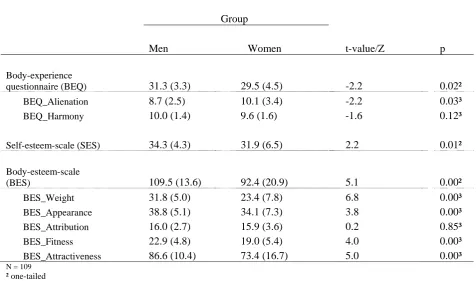
Table 1 presents the mean values of men and women
on the three scales and corresponding subscales.
Table 2 shows the correlation between the concepts
for the two genders.
Table 1 presents the means values for men and
women. It was evident that women score significantly
lower on body-self-unity in contrast to men. This
outcome confirmed our first hypothesis that women
score lower on the concept body-self-unity in contrast
to men (1). Further the data showed that women score
which supported our second hypothesis (2). Our third
hypothesis was also supported because it was shown
that women score significantly lower on the concept
of self-esteem in comparison to men (3). All
differences regarding these measures were significant
[image:8.595.64.541.246.527.2]at the 0.05 level.
Table 1
Mean Score and Standard Deviations, t-value/Z and p-value on the BEQ, the SES the BES and
corresponding subscales of men and women computed with Independent Sample T-Test and
Mann Whitney U
Group
Men
Women
t-value/Z
p
Body-experience
questionnaire (BEQ)
31.3 (3.3)
29.5 (4.5)
-2.2
0.02²
BEQ_Alienation
8.7 (2.5)
10.1 (3.4)
-2.2
0.03³
BEQ_Harmony
10.0 (1.4)
9.6 (1.6)
-1.6
0.12³
Self-esteem-scale (SES)
34.3 (4.3)
31.9 (6.5)
2.2
0.01²
Body-esteem-scale
(BES)
109.5 (13.6)
92.4 (20.9)
5.1
0.00²
BES_Weight
31.8 (5.0)
23.4 (7.8)
6.8
0.00³
BES_Appearance
38.8 (5.1)
34.1 (7.3)
3.8
0.00³
BES_Attribution
16.0 (2.7)
15.9 (3.6)
0.2
0.85³
BES_Fitness
22.9 (4.8)
19.0 (5.4)
4.0
0.00³
BES_Attractiveness
86.6 (10.4)
73.4 (16.7)
5.0
0.00³
N = 109
² one-tailed
³
two-tailedCorrelation analysis was used to examine the relation
between the concepts BE-attractiveness and
body-self-unity separate for men and women. We
hypothesized that the correlation might be stronger
for women than for men (4a). The results are shown
in Table2. The positive correlation between
BE-attractiveness and body-self-unity was found to be
statistically significant for both men (r(107) =.43,
p<.01) and women (r(107) =.66, p<.01). By
comparison of the correlation coefficients the data
showed that the difference is not significant which
stands in contrast to our hypothesis. The comparison
showed a tendency in women correlation stronger
than in men with p = 0.05. The correlation between
BE-fitness and body-self-unity is found to be
significant in women(r(107) =.32, p<.01) but not in
men (r(107) =.15, p>.05). Through comparison of the
correlation coefficients it is shown that they do not
significantly differ. These results are in contrast to
our hypothesis (4b). We further hypothesized a
positive correlation between body-esteem (BES) and
9
Body-self-unity and gender differences
significantly (r(107) =.66, p<.01) confirmed. We
stated that the correlation between body-esteem and
self-esteem might be stronger for women than for
men (6). The correlations are found to be significant
for men (r(107) =.44, p<.01) and for women (r(107)
=.73, p<.01). By comparison of the two correlation
coefficients it is shown that the correlation is
significantly stronger for women than for men. This
result supports our assumption that the correlation
between these two concepts might be stronger for
women than for men (5).
Table 2
Intercorrelations between psychological relevant variables for men and women
Correlation coefficient
z-statistics¹ p-value
men women
Body-experience-questionnaire (BEQ)
-body-esteem-attractiveness(BE_A)
.43** .66**
-1.67
0.05
Body-experience-questionnaire (BEQ) -body-esteem-fitness
(BE_F)
.15 .32*
-0.92 0.18
Body-esteem (BES_T)–
Self-esteem (SES)
.44** .73**
-2.32 0.01
**p < .01 (one-tailed)
*p < .05 (one-tailed)
¹ Fisher transformation: ‘z’ as statistical value of testing a significant difference between the correlation coefficients N = 109
Table 3
Pearson and Spearman’s correlations between the scales and subscales for men and women
BEQ_T
BEQ_A BEQ_HSE_T BES_T
BE_W BE_Ap BE_At BE_F BE_ABEQ_T¹
1 -.93** .71** .45** .52** .50** .55** .28** .32** .56**BEQ_A¹ 1 -.42** -.37** -.50** -.48** -.55** -.23* -.32** -.54**
BEQ_H¹ 1 .44** .45** .43** .43** .30** .29** .48**
SE_T²
1 .66** .55** .69** .45** .46** .67**BES_T²
1 .91** .89** .63** .82** .98**BE_W² 1 .73** .41** .71** .91**
BE_Ap² 1 .57** .57** .92**
BE_At² 1 .41** .66**
BE_F² 1 .69**
BE_A² 1
BEQ_A = alienation; BEQ_H = harmony; BE_W = weight; BE_Ap = appearance; BE_At = attribution; BE_F = fitness; BE_A = attractiveness **p< .01 (two-tailed)
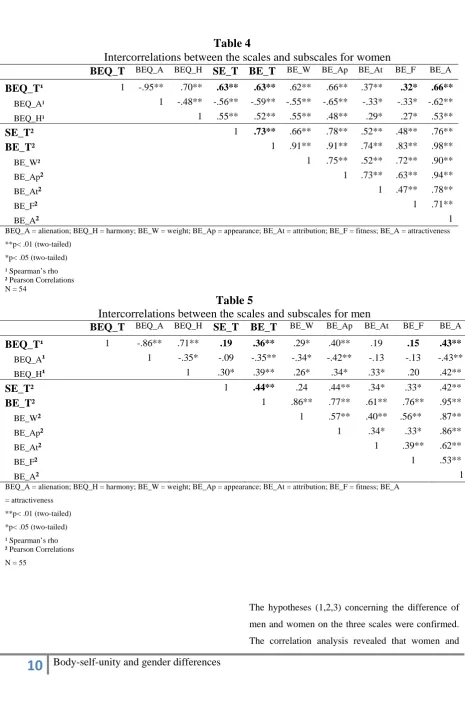
Table 4
Intercorrelations between the scales and subscales for women
BEQ_T
BEQ_A BEQ_HSE_T
BE_T
BE_W BE_Ap BE_At BE_F BE_ABEQ_T¹
1 -.95** .70** .63** .63** .62** .66** .37** .32* .66**BEQ_A¹ 1 -.48** -.56** -.59** -.55** -.65** -.33* -.33* -.62**
BEQ_H¹ 1 .55** .52** .55** .48** .29* .27* .53**
SE_T²
1 .73** .66** .78** .52** .48** .76**BE_T²
1 .91** .91** .74** .83** .98**BE_W² 1 .75** .52** .72** .90**
BE_Ap
²
1 .73** .63** .94**BE_At
²
1 .47** .78**BE_F
²
1 .71**BE_A
²
1BEQ_A = alienation; BEQ_H = harmony; BE_W = weight; BE_Ap = appearance; BE_At = attribution; BE_F = fitness; BE_A = attractiveness **p< .01 (two-tailed)
*p< .05 (two-tailed) ¹ Spearman’s rho ² Pearson Correlations N = 54
Table 5
Intercorrelations between the scales and subscales for men
BEQ_T
BEQ_A BEQ_HSE_T BE_T
BE_W BE_Ap BE_At BE_F BE_ABEQ_T¹
1 -.86** .71** .19 .36** .29* .40** .19 .15 .43**BEQ_A
¹
1 -.35* -.09 -.35** -.34* -.42** -.13 -.13 -.43**BEQ_H
¹
1 .30* .39** .26* .34* .33* .20 .42**SE_T²
1 .44** .24 .44** .34* .33* .42**BE_T²
1 .86** .77** .61** .76** .95**BE_W
²
1 .57** .40** .56** .87**BE_Ap
²
1 .34* .33* .86**BE_At
²
1 .39** .62**BE_F
²
1 .53**BE_A
²
1BEQ_A = alienation; BEQ_H = harmony; BE_W = weight; BE_Ap = appearance; BE_At = attribution; BE_F = fitness; BE_A = attractiveness
**p< .01 (two-tailed) *p< .05 (two-tailed) ¹ Spearman’s rho ² Pearson Correlations N = 55
The hypotheses (1,2,3) concerning the difference of
men and women on the three scales were confirmed.
[image:10.595.67.522.142.315.2]11
Body-self-unity and gender differences
men do not differ in the correlation between
body-esteem-fitness/attractiveness and body-self-unity (4a,
4b). The positive relation between body-esteem and
self-esteem was supported in the study (5) and was
found to be stronger in women than in men (6).
Discussion
This exploratory study revealed similarities and
differences between men and women on the concepts
self-esteem, body-esteem and body-self-unity. A
gender difference on all three concepts was found. It
was shown that women have a lower body-self-unity.
The reason might be the unrealizable beauty ideal
given by the society. Not achieving the beauty ideal
results in a “third-person-perspective” of the body
(Frederickson, Noll, Roberts, Quinn & Twenge, 1998)
and therefore in the disunity of body and self.
Another explanation for the present effect might be
that women experience greater self-attention. This
means that they are more aware of their self and
much more self-reflective in contrast to men. Ingram
et. al showed in their study that women are more
disposed to direct attention internally (Ingram, Cruet,
Johnson, & Wisnicki, 1988). Because “women react
more strongly to situational factors that induce
self-focus” (Csank & Conway, 2004), they are much more
critical to themselves which prompts them score
lower on the three scales. Women are more
self-attentive concerning their body which is reflected in
taking a “third-person-perspective” and observing the
own body. They are more self-attentive concerning
their self as well (Ingram, Cruet, Johnson, &
Wisnicki, 1988). The increased self-attention leads to
higher demands toward the self and the body so that
not achieving results in a disrupted body-self-unity.
Contrary to our assumption the correlation between
the concept esteem-attractiveness and
body-self-unity was not found to be significantly different
in men and women. The results showed a tendency in
women correlation somewhat stronger than in men,
but the difference was not significant. We assume
that the importance of attractiveness is the same for
men and women concerning their body-evaluation.
Further it is shown that the correlation between
body-fitness and body-self-unity did not significantly differ
in men and women. The correlation is actually
somewhat stronger for women than for men but this
relationship was not found to be significant. This
effect stands in contrast to our supposition. We
assumed the importance of the fitness component
with regard to the body-self-unity to be stronger for
men than for women. Wade & Cooper (1999) showed
in their study that women’s belief about their body’s
health also has predictive influence on their perceived
attractiveness. Physical fitness is an indicator of a
healthy body (Blair, Cheng, & Holder, 1994; Wade
T.,2000) which explains the importance of the fitness
component for womens body-evaluation. Women and
men possibly do not differ in their sources of
self-evaluation. Both genders include attractiveness and
physical-fitness in gaining an evaluation of their body.
The different views of attractive features in men and
women based on the evolutionary theory might be
false nowadays. We could assume the evolutionary
perspective to be antiquated because of the changing
prototypes of men and women during the years.
Women are no more only accountable for the familiy
and child bearing. They have become more
emancipated and independet of men whereas men are
more involved in houseworking (Bianchi, Milkie,
Sayer, & Robinson, 2000) These new gender roles
are formed by the interaction with the evironment
(Ridgeway & Smith-Lovin, 1999). As the
gender roles are shaped. There might be a
convergence of the genders concerning the gender
prototype which makes the evolutionary theory not
applicable on the present sample.
A significant difference is found in the correlation
between body-esteem and self-esteem for men and
women. The correlation between the two concepts is
significantly positive which supports our conceptual
model. The correlation is stronger for women than for
men, which shows that self perceived attractiveness
and self-esteem are strongly linked to the body for
women, but weakly for men (Wade, 2000). This
outcome supports also the expectation that women
experience self-esteem as a global domain (Bolognini,
1996) because of the stronger correlation between the
concepts. We can assume that body-esteem forms a
part of their self-esteem.
A shortcoming in the present study is the self-report
character of the scales. An objective measure of the
psychological variables was impossible. The selective
sample of students makes it difficult to generalize the
outcomes, which forms another shortcoming of the
study. The sample consisted of high educated
individuals which could have had an effect on
self-esteem. Bachman et. al found educational attainment
to be positively correlated with self-esteem in young
men (Bachman & O'Malley, 1977). This could also
be the case in women so that the present sample
might have had higher self-esteem. We propose that a
study with a lower educated sample could result in
different outcomes. Additionally, the used
body-experience questionnaire, developed to assess the
body-self-unity in a rheumatism population, reduces
the validity on the present study. The fact that we had
to delete one item shows that the underlying construct
does not meant the same in a healthy sample. In the
rheumatism sample the item “I think about what is
good for my body” measured the “Harmony”
between body and self. In healthy condition high
scoring on this item indicated disharmony with the
body. As a healthy individual explicitly thinks about
his/her body, it might be a “pre-stage” of the “object
body” (Hudak, McKeever & Wright, 2007) in which
the body becomes objectified so that the
body-self-unity becomes disrupted.
A practical implication for further studies is the use
of a body-self-unity-scale which is more sensitive for
measuring the concept in a healthy sample. Further it
might be interesting to verify the outcomes within a
less selective sample
13
Body-self-unity and gender differences
the Impact of Educational and Occupational Attainment. Journal of Personality and Social
Psychology 35 (6) , 365-380.
Bessenoff, G. R. (2006). Can the media affect us? Social comparison self-discrepancy, and the thin
ideal. Psychology of Women Quarterly 30 , 239-251. Bianchi, S. M., Milkie, M. M., Sayer, L. C., & Robinson, J. P. (2000). Is Anyone Doing the Houswork? Trends in the Gender Division of Houshold Labor. Social Forces 79 (1) , 191-228. Blair, S. N., Cheng, Y., & Holder, J. S. (1994). Is physical activity of physical fitness more important in defining health benefits? Medicine & Science in Sport & Exercise.
Bloom, L. R. (1992). "How can we know the dancer from the dance?":Discourses of the self-body.
Kluwer Academic Publishers , 313-334.
Buss, D. M. (1988). The Evolution of Human Intrasexual Competition: Tactics of Mate Attraction.
Journal of Personality and Social Psychology 54 ( 4) ,
616-628.
Bolognini, M., Plancherel, B., Bettschart, W., & Halfon, O. (1996). Self-esteem and mental health in early adolescence:development and gender
differences. Journal of Adolescence 19 , 233-245. Calogero, R. M., & Thompson, J. K. (2009). Potential implications of the objectification of women's bodies for women's sexual satisfaction.
Body Image , doi:10.1016/j.bodyim.2009.01.001.
Charmaz, K. (1983). Loss of self: a fundamental form of suffering in the chronically ill. Sociology of
Health and Illness Vol.5 No. 2 .
Csank, P. A., & Conway, M. (2004). Engaging in Self-Reflection Changes Self-Concept Clarity: On Differences Between Women and Men, and Low- and High-Clarity Individuals. Sex Roles, 50 , 469- 480.
Euler, H. E., & Hoier, S. (2008). Die evolutionäre Psychologie von Anlage und Umwelt. Anlage und
Umwelt , 7-25.
Fallon, A. (1990). Culture in the Mirror:
Sociocultural Determinants of Body Image.In: Bos, A., Valkenburcht, I., Mayer, B., Steenhuis, I., & Derks, D. (2005). De weerspiegeling van het uiterlijk in het zelf: Lichaamswaardering, zelfwaardering en sociale vergelijking. Nederlands Tijdschrift voor
Psychologie 60 , 78-87.
Fredrickson, B. L., Noll, S. M., Roberts, T.-A., Quinn, D. M., & Twenge, J. M. (1998). That Swimsuit Becomes You: Sex Differences in Self-Objectification, Restrained Eating, and Math Performance. Journal of Personality and Social
Psychology 75( 1) , 269-284.
Gadow, S. (1980). Body and Self: A Dialectic.
The Journal of Medicine and Philosophy 5(3) ,
172-185.
van der Heij, A. (2007). Reuma: een strijd met of een strijd tegen het eigen lichaam? Lichaam-Zelf eenheid en betekenisverlening bij reumapatiënten.
Unpublished master’s thesis, University of Twente, Enschede, the Netherlands.
Henriques, G. R., & Calhoun, L. G. (1999). Gender and Ethnic Differences in the Relationship Between Body-Esteem and Self-Esteem. The Journal of
Psychology 133(4) , 357-368.
Huang, J., Norman, G., Zabinski, M., Calfas, K., & Patrick, K. (2007). Body image and self-esteem among adolescents undergoing an intervention targeting dietary and physical activity behaviours.
Journal of Adolescent Health 40 (3) , 245-251.
Hudak, P. L., McKeever, P., & Wright, J. G. (2007). Unstable Embodiements: A
Phenomenological Interpreation of Patient
Satisfacton with Treatment Outcome. J Med Humanit 28 , 31-44.
Ingram, R. E., Cruet, D., Johnson, B. R., & Wisnicki, K. S. (1988). Self-Focused Attention, Gender, Gender Role, and Vulnerability to Negative Affect. Journal of Personality and Social Psychology
55( 6) , 967-978.
Consciousness, Self-Conceptions and Physical Activity. Sex Roles 59 , 623-632.
Judge, T., & Bono, J. (2001). Relationship of core evaluations traits - esteem, generalized self-efficacy, locus of control and emotional stability - with job satisfaction and job performance: A meta analysis. Journal of Applied Psychology 86 , 80-92. Marsh, H. W. (1996). Positive and negative self-esteem: A substantively meaningful distinction or artifactors? Journal of Personality and Social
Psychology 70 , 810-819.
Mendelson, B. K., White, D. R., & Mendelson, M. J. (2001). Body-Esteem Scale for Adolescents and Adults. Journal of Personality Assessment 76 (1) , 90-106.
Mendelson, B., White, D., & Mendelson, M. (1997). Manual for the Body-Esteem Scale for Adolescents and Adults. Res. Bull. 16 (2) .
Mendelson, B. K., White, D. R., & Mendelson, M. J. (1996). Self-Esteem and Body Esteem: Effects of Gender, Age, and Weight. Journal of Applied
Developmental Psychology 17 , 321-346.
Mintz, L. B., & Bety, N. E. (1986). Sex differences in Nature, Realism, and Correlates of Body Image. Sex Roles 15(3-4) , 185-195. DeNeve, K., & Cooper, H. (1999). The happy personality: A metaanalysis of 137 personality traits and subjective well-being. Psychological Bulletin 124 , 197-229.
Neyer, F., & Asendorpf, J. (2001). Personality -Relationship Transaction in Young Adulthood.
Journal of Personality and Social Psychology 81 ,
1190-1204.
Rachel M. Calogero, J. K. (2009). Potential implications of the objectification of womens's bodies for women's sexual satisfaction. Body image . Ridgeway, C. L., & Smith-Lovin, L. (1999). the Gender System And Interaction. Annunal Review of
Sociology 25 , 191-216.
Rosenberg, M. (1965). Society and the adolescent
self image. Princeton: NJ. Princeton University Press.
Silberstein, L. R., Striegel-Moore, R. H., Timko, C., & Rodin, J. (1988). Behavioural and
Psychological Implications of Body Dissatisfaction: Do Men and Women Differ? Sex Roles 19 (3/4) . Sullivan, M. L. (2007). Examining the relationship between self-esteem, satisfaction with body weight, and adherence to weight gain recommendations in pregnant women: a proposal for prospecftive study.
The University of Arizona.
Taleporos, G., & McCabe, M. P. (2001). The Impact of Physical Disablity on Body Esteem.
Sexuality and Disability 19 (4) , 293-306.
Wade, T. J., & Cooper, M. (1999). Sex differences in the links between attractiveness, self-esteem and body. Personality and Individual Differences 27 , 1047-1056.
Wade, T., & McCrea, S. (1999). Intrasexual competition and contrasts effects on men's self-ratings of attractiveness and social ascendancy.
Psychology,Evolution and Gender 1.3 , 229-243.
Wade, T. (2000). Evolutionary theory and Self-perception: Sex Differences in Body Esteem Predictors of Self-perceived Physical and Sexual Attractiveness and Self-Esteem. International
Journal of Psychology 35 (1), 36-45.
Watson, J., & Nettleton, S. (1998). The Body in
Everyday Life. New York: Routledge.
15
Body-self-unity and gender differences
Beste
medestudent
In
het
kader
van
mijn
bachelortheses
ga
ik
een
onderzoek
uitvoeren
met
betrekking
tot
lichaamsbeleving.
Het
doel
van
mijn
studie
is
het
valideren
van
drie
vragenlijsten
in
verschillende
populaties.
De
vragenlijsten
bevatten
stellingen
die
dienen
te
worden
beantwoord.
Elke
stelling
geeft
vier
antwoordmogelijkheden
van
“helemaal
oneens”
tot
“helemaal
eens”.
Let
op
dat
je
de
vragen
eerlijk
en
zo
goed
mogelijk
beantwoord.
Kies
het
antwoord
dat
als
eerste
in
je
op
komt.
Voorbeeld:
helemaal oneens beetje oneens beetje eens helemaal eens
5)
Ik
voel
me
niet
heel.
X
O
O
O
Het
invullen
van
de
vragenlijst
duurt
ongeveer
15
minuten.
De
antwoorden
worden
anoniem
behandeld
en
alleen
maar
in
dit
onderzoek
gebruikt.
Als
er
nog
vragen
zijn
wil
ik
die
graag
beantwoorden.
Aan
het
eind
van
de
vragenlijst
bestaat
er
nog
een
mogelijkheid
voor
opmerkingen
en
suggesties.
Hartelijk
bedankt
voor
jouw
medewerking!
Leeftijd:
_______
jaar
Geslacht:
man
O
vrouw
O
Studie:
_______________
Partner
relatie:
ja
O
Nee
O
Ben
je
op
dit
moment
in
behandeling
bij
een
arts
of
therapeut?
Nee
O
Ja
O
Indien
`JA`waarom?______________________
Let op! Dit document is tweezijdig!!!
helemaal
oneens beetje oneens beetje eens helemaal eens1)
Ik
denk
na
over
wat
goed
is
voor
O
O
O
O
mijn
lichaam.
2)
Mijn
lichaam
is
mij
tot
last.
O
O
O
O
3)
Het
voelt
alsof
mijn
lichaam
niet
van
mij
is.
O
O
O
O
4)
Ik
voel
me
niet
heel.
O
O
O
O
5)
Mijn
lichaam
laat
mij
weten
wat
goed
is.
O
O
O
O
6)
Mijn
lichaam
is
onvoorspelbaar.
O
O
O
O
7)
Ik
voel
me
verraden
door
mijn
lichaam.
O
O
O
O
8)
Ik
zou
graag
een
ander
lichaam
willen.
O
O
O
O
9)
Ik
voel
mijn
lichaam
goed
aan.
O
O
O
O
10)
Mijn
lichaam
voelt
vertrouwd.
O
O
O
O
Let op! Dit document is tweezijdig!!!
17
Body-self-unity and gender differences
helemaal
oneens beetje oneens beetje eens helemaal eens1)
Ik
vind
dat
ik
een
waardevol
persoon
ben,
O
O
O
O
minstens
even
waardevol
als
anderen.
2)
Ik
vind
dat
ik
een
aantal
goede
O
O
O
O
kwaliteiten
heb.
3)
Al
met
al
ben
ik
geneigd
om
te
denken
O
O
O
O
dat
ik
een
mislukking
ben.
4)
Ik
kan
de
dingen
even
goed
doen
als
O
O
O
O
de
meeste
mensen.
5)
Ik
vind
dat
ik
niet
veel
heb
om
trots
O
O
O
O
op
te
zijn.
6)
Ik
neem
een
positieve
houding
aan
O
O
O
O
tegenover
mezelf.
7)
Alles
bij
elkaar
ben
ik
tevreden
O
O
O
O
met
mezelf.
8)
Ik
wou
dat
ik
meer
respect
kon
O
O
O
O
hebben
voor
mezelf.
9)
Soms
voel
ik
me
beslist
nutteloos.
O
O
O
O
10)
Soms
denk
ik
dat
ik
totaal
O
O
O
O
niets
waard
ben.
Let op! Dit document is tweezijdig!!!
Nooit zelden soms vaak altijd
1)
Het
bevalt
me
hoe
ik
eruit
O
O
O
O
O
zie
op
foto’s.
2)Anderen
vinden
dat
ik
O
O
O
O
O
er
knap
uit
zie.
3)
Ik
ben
trots
op
mijn
lichaam.
O
O
O
O
O
4)
Mijn
aandacht
is
erop
O
O
O
O
O
gericht
mijn
lichaamsgewicht
te
verminderen.
5)
Ik
denk
dat
mijn
uiterlijk
me
O
O
O
O
O
kan
helpen
een
baan
te
krijgen.
6)
Ik
ben
blij
met
wat
ik
zie
als
O
O
O
O
O
ik
in
de
spiegel
kijk.
7)
Er
is
veel
dat
ik
zou
O
O
O
O
O
veranderen
aan
mijn
uiterlijk
als
het
kon.
8)
Ik
ben
tevreden
met
O
O
O
O
O
mijn
gewicht.
9)
Ik
zou
willen
dat
ik
er
beter
O
O
O
O
O
uit
zag.
10)
Mijn
gewicht
bevalt
me
O
O
O
O
O
best
goed.
11)
Ik
wens
me
dat
ik
eruit
zag
O
O
O
O
O
als
iemand
anders.
Let op! Dit document is tweezijdig!!!
19
Body-self-unity and gender differences
12)
Mensen
van
mijn
leeftijd
O
O
O
O
O
vinden
dat
ik
een
goed
uiterlijk
heb.
13)
Mijn
uiterlijk
maakt
me
O
O
O
O
O
van
streek.
14)
Ik
zie
er
net
zo
goed
uit
als
O
O
O
O
O
de
meeste
mensen.
15)
Ik
ben
best
blij
met
hoe
O
O
O
O
O
ik
eruit
zie.
16)
Ik
vind
dat
ik
een
goed
O
O
O
O
O
gewicht
heb
voor
mijn
lengte.
17)
Ik
schaam
me
voor
mijn
O
O
O
O
O
uiterlijk.
18)
Mezelf
wegen
maakt
me
O
O
O
O
O
ongelukkig.
19)Mijn
gewicht
maakt
me
O
O
O
O
O
ongelukkig.
20)
Mijn
uiterlijk
helpt
me
om
O
O
O
O
O
afspraakjes
te
krijgen.
21)
Ik
maak
me
zorgen
over
O
O
O
O
O
mijn
uiterlijk.
22)
Ik
vind
dat
ik
een
goed
O
O
O
O
O
lichaam
heb.
Let op! Dit document is tweezijdig!!!
23)
Ik
zie
er
zo
leuk
uit
als
ik
zou
O
O
O
O
O
willen.
24)
Ik
voel
mezelf
lichamelijk
fit.
O
O
O
O
O
25)
Ik
heb
een
goed
getrainde
O
O
O
O
O
lichaam.
26)
Anderen
zijn
jaloers
op
mijn
O
O
O
O
O
getrainde
lichaam.
27)
Ik
wens
me
om
getrainder
O
O
O
O
O
uit
te
zien.
28)
Ik
schaam
me
voor
mijn
O
O
O
O
O
ongetrainde
lichaam.
29)
Ik
ben
trots
op
mijn
O
O
O
O
O
gespierde
lichaam.
30)
Anderen
vinden
dat
ik
O
O
O
O
O
sportief
ben.
Hartelijk
bedankt
voor
jouw
medewerking!!!!
Ruimte
voor
opmerkingen
of
vragen.
_________________________________________________________________________________
_________________________________________________________________________________
_________________________________________________________________________________