Proceedings of the 23rd Conference on Computational Natural Language Learning, pages 574–581 574
Roll Call Vote Prediction with Knowledge Augmented Models
Pallavi Patil♦ Kriti Myer♦ Ronak Zala♦ Arpit Singh♦
Sheshera Mysore♦ Andrew McCallum♦ Adrian Benton♠ Amanda Stent♠
♦College of Information and Computer Sciences
University of Massachusetts Amherst
♠Bloomberg LP
{ppatil,kmyer,rzala,arpitsingh,smysore,mccallum}@cs.umass.edu
{abenton10,astent}@bloomberg.net
Abstract
The official voting records of United States congresspeople are preserved as roll call votes. Prediction of voting behavior of politicians for whom no voting record exists, such as individ-uals running for office, is important for fore-casting key political decisions. Prior work has relied on past votes cast to predict future votes, and thus fails to predict voting patterns for politicians without voting records. We ad-dress this by augmenting a prior state of the art model with multiple sources of external knowledge so as to enable prediction on un-seen politicians. The sources of knowledge we use are news text and Freebase, a man-ually curated knowledge base. We propose augmentations based on unigram features for news text, and a knowledge base embedding method followed by a neural network com-position for relations from Freebase. Em-pirical evaluation of these approaches indi-cate that the proposed models outperform the prior system for politicians with complete his-torical voting records by 1.0% point of ac-curacy (8.7% error reduction) and for politi-cians without voting records by 33.4% points of accuracy (66.7% error reduction). We also show that the knowledge base augmented ap-proach outperforms the news text augmented approach by 4.2% points of accuracy.
1 Introduction
Roll call votes are official records of how politi-cians vote on bills (potential laws) in the United States House of Representatives and Senate. Reli-able prediction of these votes, using historical vot-ing records and the text of bills, can be used to forecast political decisions on key issues, which can be informative for the electorate and other po-litical stakeholders. Prior work has used politi-cians’ voting records as a means to study their ide-ological stances (Poole and Rosenthal,1985;
Clin-ton et al., 2004), as well as roll call votes com-bined with the text of the corresponding bills to predict votes on newly drafted bills (Gerrish and Blei, 2012; Kraft et al., 2016; Kornilova et al.,
2018). However, these approaches fail to make good predictions for the votes of politicians whose records are not established, such as new candidates for office – a time when this information can be most useful for the electorate. We hypothesize that additional sources of knowledge about new politi-cians can predict their future votes.
In this work we explore two sources of addi-tional knowledge about politicians to better pre-dict roll call votes: news article text about the politicians, and Freebase (Bollacker et al.,2008), which is a manually curated knowledge base (KB). Relevant news articles may contain words that are indicative of a politician’s stance with respect to specific issues. A KB such as Freebase is likely to contain rich information such as events a con-gressperson attends, people they are related to, and personal details such as schools they were educated at; this information may be correlated with a politician’s stance on specific issues ( Sun-shine Hillygus, 2005; Duckitt and Sibley, 2010;
Kraut and Lewis,1975). Information in a KB is likely to be more restricted, but more reliable, than information extracted from news articles.
train-ing time, which is similar to the setttrain-ing of prior work (Kraft et al., 2016; Kornilova et al., 2018) and (2) where a subset of politicians’ voting pat-terns are never observed at training time, repre-senting the new candidate for office setting. We establish a new state-of-the-art under the evalua-tion framework used by most prior work (Setting 1). We also show that our approach outperforms a state-of-the-art model in our evaluation frame-work (Setting 2). Compared to the previous state-of-the-art model for roll call prediction, in Setting (1) our best approach gives an improvement in ac-curacy of 1.0% (an error reduction of 8.7%), and in Setting (2) our best approach gives an improve-ment in accuracy of 33.4% (an error reduction of 66.7%). Additionally, in Setting (2), augmentation via KB gives 4.2% more accurate predictions than augmentation from news text.
Code to reproduce our experiments can be found here: https://github.com/ronakzala/ universal-schema-bloomberg/.
2 Models
All the models we explore take as input the vot-ing record (denotedV) for a politicianp, the text of a bill b, and (optional) knowledge about the politician (denoted K), and output a probability P(y = Yea|b,V,K) that politician p will vote
Yeaon billb. In this discussion, all features (vot-ing record and knowledge augmentation) as well as labels (vote predictions) are specific to p, but for ease of reading we don’t subscript top.
We start with a baseline model that does not use any additional knowledge. We augment this model with knowledge from news articles mentioningp
(denoted N) and from parts of the Freebase KB relevant to p (denoted F) (i.e. N ⊂ K and
F ⊂ K). In our augmented models, vector rep-resentations of this additional knowledge are de-noted asvN andvF. These vectors can be read as
complementary representations of politicianp, de-rived from how the politician appears in news ar-ticles and in curated sources of world knowledge, rather than by prior voting behavior. These vectors are used in conjunction with the politician’s repre-sentation in terms of their historical voting record, denoted asvV, which is learned as a model
param-eter. Now, we describe the forms of the baseline and augmented models.
2.1 Baseline Model
Our baseline is the model proposed byKraft et al.
(2016). This model represents a politician pby a vectorvV and a billbusing a bag of words of the
1,000 most frequent unigrams across all bills, after excluding stopwords and single-character tokens. The model is defined as follows:
vb = X
w∈b
ew/|b|
Zb =Wbill·vb+dbill
P(y =yea|b,V) =σ(Zb·vV)
Here, ew ∈ Rdword is initialized to pre-trained
GloVe word embeddings1 and finetuned as a model parameter. vV ∈ Rdemb is the
embed-ding for politician p and is initialized uniformly at random in[−10−2,10−2]. Billbis represented as vb, the average of word embeddings ew, and then transformed into the same space as vV via
weight matrixWbill ∈ Rdemb×dword and bias
vec-tordbill ∈Rdemb, i.e.Zb∈Rdemb.
2.2 News Text Augmented Model
We incorporate knowledge about politicianpfrom relevant news articles in the form of unigram fea-tures extracted from the set of news articles that mention p, denoted N. This model represents each articleaj ∈ N as a bag of words of the most frequent 2,000 unigrams across all articles for all politicians, after excluding stopwords and single-character tokens. The news augmented model is formulated as:
vb = X
w∈b
ew/|b|
Zb =Wbill·vb+dbill
ZN =Wnews·vN +dnews
P(y=yea|b,V,N) =σ(Zb·[vV+ZN])
Most of the notation above is same as the one for the baseline model in§2.1. Here,vN is a
vec-tor representing the knowledge aboutpcontained in N. ZN ∈ Rdemb represents v
N transformed
into the space ofvVvia weight matrixWnewsand bias vectordnews. We experiment with two vari-ations for computingvN. First we computevN
as the mean GloVe vectors of all unigrams inN
1http://nlp.stanford.edu/data/glove.
(model denoted by NWGL):
vGloVeN = P 1 a∈N|a|
X
a∈N
X
w∈a
ew
whereew represents the GloVe vector for wordw in articlea. We also consider a variant where each articlea∈ N is represented as a vector of relative frequencies of the words ina(model denoted by NWFR):
vFREQ
N =
X
a∈N fa
wherefa is a vector of unigram relative frequen-cies in articlea∈ N.
2.3 Knowledge Base Augmented Model
Building on the baseline model, the knowledge base augmented model (denoted by KBUS) rep-resents the contextual information for politicianp
as a vectorvF. The KB augmented model is
for-mulated as:
vb = X
w∈b
ew/|b|
Zb =Wbill·vb+dbill
P(y=yea|b,V,F) =σ(Zb·[vV+ZF])
Most of the notation above remains the same as the baseline model in§2.1. ZF is created from an
embedded subgraph of the Freebase KB. Freebase consists of relation triples of the form (e1, r, e2), where e1, and e2 denote entities (e.g., Barack Obama, Columbia University) and r de-notes a relation (e.g.,graduate of). These re-lation triples are embedded in a vector space by Universal Schema (Riedel et al., 2013), giving vector representations ve1, ve2, and vr for the
elements of the triple, e1, e2, and r. Universal Schema embeddings for entities and relations are trained for the KB completion task, to maximize the probability of triples existing in the KB param-eterized byP(r, e1, e2) =σ(vTr[ve1;ve2]).
The KB knowledge vector ZF is derived from
the Universal Schema entity embeddings. For each politician p, we consider the subset of rela-tions in which the politician is eithere1 ore2,
de-notedF. We linkpto a KB entity in Freebase by exact textual match onp’s name. Letri be a rela-tion in a triple inF andoibe the entity that isnot
politicianpin that triple; we computeZF as:
ZF =
X
i∈F
ti·P(ri, oi, p)
ti=FFN([vri;voi])
Here [; ] denotes concatenation, vri the
Univer-sal Schema embedding for relationri, andvoi the
Universal Schema embedding foroi. ti is the em-bedding of theith triple and is computed by pass-ingvriandvoithrough a shallow feed forward
net-work (FFN) of the form: tanh(Wx+b). The parameters of this FFN are learned in the course of model training, and the dimensionality ofti is a hyperparameter. The final representation for the contextual knowledge from the KB for politicianp
is therefore a sum of the Freebase triple Universal Schema embeddings weighted by the probability thatpwould participate in each triple.
3 Experiment Description
We evaluate the proposed knowledge augmented models under two evaluation protocols (§3.3): one where all politicians’ voting records are observed in the training data (Setting 1) and another in which some politicians are unobserved at training time, representing the new candidate for office set-ting (Setset-ting 2). We also evaluate the performance of simple baseline methods and previous state-of-the-art methods (§3.2) in both settings. Finally, we perform a close comparison of baseline methods against the proposed methods and highlight indi-vidual politicians for which the knowledge aug-mented models better predict voting behavior than the baselines (§4.0.4).
3.1 Datasets
Our data comes from three sources: roll call voting records from Congress Sessions 106-109, news ar-ticles from the Concretely Annotated New York Times Corpus (Ferraro et al.,2014), and the KB from Freebase. Here we briefly describe each source and major preprocessing decisions.
3.1.1 Roll Call Votes
The roll call votes dataset was compiled to re-semble the one used by Kraft et al.(2016). The dataset covers the 106th-109th Congress (1999-2006), where each session spans 2 years, and was created by querying GovTrack2 using
pub-2Online Roll Call Votes: https://www.govtrack.
licly available tools3. Bill texts, bill metadata, and lists of roll call votes were all queried separately and matched using bill IDs. The resulting dataset contains voting records for 709 unique politicians across sessions and almost 1 million politician-bill-vote examples. In order to facilitate future re-search on this data we make our tools and raw data available to the community, a component absent from prior work4.
3.1.2 New York Times Corpus
We use the The Concretely Annotated NYT Cor-pus (Ferraro et al., 2014) as a source of knowl-edge contained in news articles. This corpus con-tains approximately 1.8 million articles for the pe-riod 1987-2007, which includes the sessions of Congress for which we report experimental re-sults. The corpus is automatically annotated using the CoreNLP package with a host of annotations such as part of speech and named entity tags.
To obtain the set of politician-relevant articles for the news article augmented model (§2.2), we first construct a list of politician names from our roll call vote data and Wikipedia aliases for these names. We identify candidate names in each arti-cle by extracting all spans in the artiarti-cle annotated with thePersonentity type tag. We then look for exact string matches to the list of politician names in the candidate names extracted from each arti-cle. By this means, we identify a total of 50,800 relevant articles. Each article is represented as a bag of words from the 2,000 most frequent words across all articles after dropping stop words and single character words. When training and evalu-ating our models, we conservatively include only the subset of relevant articles published before the congressional session from which the bill comes; this way, information from news text necessarily predates the congressional votes and does not in-form about the model about voting outcomes.
3.1.3 Freebase
We use Freebase as a source of KB knowledge. Freebase is a large, structured knowledge base that consists of relation triples created by human con-tributors. It contains about 46 million unique enti-ties and 332 million relation triples.
In extracting relations relevant to politicians in
3
Tools to query online congressional data sources:
https://github.com/unitedstates/congress
4https://github.com/ronakzala/
universal-schema-bloomberg/
our roll call vote data, we first filter to only rela-tions that mention a politician explicitly as one of the entities. We add to this set relations one hop away from the politicians in the knowledge base (the politicians do not directly participate in this set of one hop away relations). The combination of direct and one hop away relations gives about 800,000 relation triples. This subset of Freebase is embedded with Universal Schema, following which only the direct politician relations, along with the scores learned by Universal Schema for these relations, are used in our KB augmented model (§2.3). Although Freebase relations are not temporally marked, Freebase does not con-tain politicians’ voting records, so vote informa-tion cannot ”bleed into” our models from Free-base.
3.2 Baselines
We compare the performance of the proposed models against several baseline and previous state-of-the-art models. These are:
KJR16: The model fromKraft et al.(2016). The
numbers we report for KJR16 are based on our re-implementation of the original model. We also apply slightly different preprocess-ing decisions to the text of bills. For exam-ple, we drop stop words and single-character tokens, unlike the original paper.
MAJ: This baseline model predicts the majority class (Yea) for all votes on all bills.
PARTYM: This baseline predicts that a con-gressperson will vote for a bill in the direc-tion of their party’s majority vote for that bill. A congressperson can have a party affiliation of Republican, Democrat, or Independent. A politician’s party is generally a very strong predictor of their voting behavior. We com-pare against this baseline specifically to mea-sure how much gain contextual knowledge about a politician can bring over just predict-ing that a congressperson will toe the party line. This baseline operates in a slightly unre-alistic setting, since the party majority vote is determinedafterall the votes have been cast for a given bill.
3.3 Experimental Setup
Session Majority Class Accuracy (%) Precision (%) Recall (%) F1 (%)
KJR16 BP KJR16 BP KJR16 BP KJR16 BP
106 83.03 85.90 86.49 90.46 89.14 92.78 95.32 91.60 92.13
107 85.86 91.10 91.63 91.65 92.57 98.06 98.51 95.06 95.44
108 87.10 90.64 91.68 91.88 93.64 97.27 97.15 94.38 95.36
109 83.48 86.24 88.07 91.85 92.28 91.26 93.05 91.05 92.66
Average 84.87 88.47 89.47 91.46 91.91 94.84 96.00 93.02 93.89
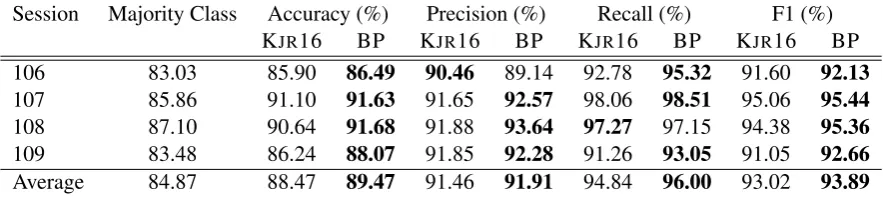
Table 1: Performance of KJR16 (our reimplementation ofKraft et al.(2016)) compared to our Best Proposed (BP) model (News augmented-Glove, NWGL), in evaluation Setting (1).
on the next Congress session; even in this case, they restricted their evaluation sets to only those politicians that were observed at training time.
We use a train/dev/test split of60%/20%/20%; every session of Congress contains about 250,000 politician-bill-vote examples given that each congress contains between 500-650 bills, and ap-proximately 550 politicians. All of the reported numbers are averaged over four random restarts of the models.
As noted earlier, we evaluate the models under two settings: (Setting 1) in this setting all politi-cians are present in both training and test data (this is the setting used in all prior work); and (Setting 2) in this setting, votes from5%of the politicians, chosen at random for each session of Congress, are removed from the training set5, resulting in a re-duction of around 7,000 politician-bill-vote exam-ples from each session of Congress. All of these politicians are still present in the test set.
3.4 Model Hyperparameters and Training
All the models we train (KJR16, NWGL, NWFR, KBUS) use a bill embedding (vb) of size 50, and a per-politician embedding vV of size 10. The
NWGL model additionally uses a mean GloVe vector (vGloVe
N ) of size 50, whereas the NWFR
model uses a word frequency vector (vNFREQ) of size 2,000. The KBUS model has an entity em-bedding (vo) of size 25, and relation embedding (vr) of size 25, resulting in a KB knowledge vec-tor (ZF) of size 10 using the FFN architecture: {50, 10}. These settings were chosen without ex-ploration; further hyperparameter tuning may re-sult in different model performance.
All models were trained using vanilla SGD with a learning rate of 0.1 for up to 20 epochs6. We
5
On average, 2-10% of politicians are newcomers during every session, making our removal of 5% politicians realistic.
6No momentum or minibatching was used.
trained with early stopping based on the accuracy on the development set of politician-bill pairs.
For all models, we report accuracy, precision, recall, and F averaging over all vote predictions (i.e. we micro-average).
4 Results and Analysis
Our experiments attempt to answer several ques-tions: (1) Setting 1: Does politician-related knowledge augmentation improve predictive per-formance when voting records of all politicians are observed (§4.0.1)? (2) Setting 2: Does politician-related knowledge augmentation improve perfor-mance when voting records of some politicians are not observed (§4.0.2)? (3) Does knowledge aug-mentation from a manually curated KB improve model performance compared to knowledge aug-mentation using unstructured text (§4.0.3)? (4) Finally, for which politicians are our knowledge augmented models more effective than predicting a party majority (PARTYM) vote (§4.0.4)?
4.0.1 Setting 1: All Voting Records Observed
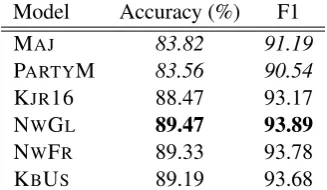
Tables 1 and 2a display the performance of our proposed models when the voting patterns of all politicians are observed. Our best proposed model NWGLoutperforms KJR16 in all sessions of Congress according to most metrics (Table 1). NWGL outperforms KJR16 by 1% point of ac-curacy on average, an error reduction of 8.7%. Knowledge augmentation in any form (NWGL,
NWFR and KBUS) gives small improvements in roll call vote prediction over KJR16 (Table2a).
4.0.2 Setting 2: Some Voting Records Absent
[image:5.595.78.520.62.162.2]Model Accuracy (%) F1
MAJ 83.82 91.19
PARTYM 83.56 90.54
KJR16 88.47 93.17
NWGL 89.47 93.89
NWFR 89.33 93.78
KBUS 89.19 93.68
(a) Setting 1: All politicians in the test set are present in the training set.
All Absent from train Present in train
Model Accuracy (%) F1 (%) Accuracy (%) F1 (%) Accuracy (%) F1 (%)
MAJ 83.82 91.19 83.65 91.07 83.82 91.19
PARTYM 83.56 90.54 84.59 91.07 83.53 90.52
KJR16 84.31 90.73 49.96 62.37 85.51 91.48
NWGL 85.24 91.23 78.40 86.79 85.48 91.38
NWFR 83.65 90.54 79.13 87.66 83.80 90.64
KBUS 85.98 91.96 83.36 90.52 86.07 92.01
[image:6.595.217.381.63.158.2](b) Setting 2: An arbitrary 5% of politicians in every session of Congress are absent from the training set.
Table 2: Performance of our proposed models: News augmented-Glove (NWGL), News augmented-Word Fre-quency (NWFR) and KB Augmented-US (KBUS). These are compared to baselines Majority Class (MAJ) and Majority Party (PARTYM), and to the model fromKraft et al.(2016) (KJR16) for both evaluation settings. Here we report performance averaged across all four sessions of Congress, and highlight the best model excluding MAJ
and PARTYM, which are unrealistic solutions.
successfully predict many of the votes of unseen politicians. The KB augmented model, KBUS,
outperforms KJR16 by 33.4% points of accuracy, an error reduction of 66.7%.
MAJ and PARTYM outperform the proposed models in Setting 2. However, PARTYM is based on knowledge of the future and so is impractical, and MAJhas no discriminative power for individ-ual politicians.
4.0.3 Comparison of Augmented Models
The KB augmented model KBUSrelies on
struc-tured contextual information present in relation triples while the news text augmented models NWGLand NWFRrely on unstructured
represen-tations of contextual information (average of un-igram embeddings). Also, the KB is manually curated while the news augmented models rely on noisier automatically selected and processed sources of information.
In Setting 1 (the setting in which all politi-cians are present in the training data) all three augmented models perform similarly, with NWGL
and KBUS slightly outperforming NWFR (Ta-ble 2a). However, in Setting 2 (where some politicians are unseen in the training data) KBUS
clearly outperforms NWGLand NWFR, both over-all (85.98%accuracy) and specifically on the un-seen politicians (83.36%accuracy). We conclude that the structured nature of the additional knowl-edge provided to this model might allow for more effective use of contextual knowledge. This also suggests that the news text augmented model can be improved by improving the quality of news text features or learning a more clever weighting of un-igram embeddings, for example by the CNN em-bedding approach used inKornilova et al.(2018).
4.0.4 Comparison with PARTYM
Here we present a deeper analysis of specific politicians to highlight cases where rich contex-tual information aids prediction as compared to a model only relying on party affiliation.
We examine results for the 108th Congress, where our KB augmented model KBUS achieves an accuracy of91.39%, while the PARTYM
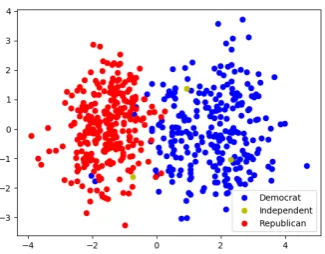
base-line has accuracy of only 85.26%. The con-gressperson embeddings learned by KBUS also appear to capture party affiliation (as demonstrated by the near-linear separability of parties evident in Figure 1), but they strictly outperform PAR
Figure 1: 2-dimensional PCA projected congressper-son embeddings by the KBUS model for the 108th congress. Points are colored by party affiliation.
PARTYM primarily err under two circumstances: politicians who do not always vote the party line, and those who identify themselves as Independent. We examine a handful of individual politicians to highlight cases where the proposed models outper-form the PARTYM baseline:
Politicians straying party lines : Joe Baca was a congressman from California (D-CA) who was a Democrat during the 108th Congress, but has since changed party twice, due to his Republican-leaning ideology. For Con-gressman Baca KBUS’s accuracy is 90.9%, compared to PARTYM’s accuracy of79.09%. As another example, Jeff Flake (R-AZ) was at that time a congressman recog-nized as a traditional conservative, but voted with Democrats on issues such as immi-gration and employment non-discrimination. For Congresssman Flake, KBUS’s accuracy is 83.92% while PARTYM’s accuracy is
76.78%.
Independent candidates : Joseph Lieberman was an Independent senator from Connecti-cut (I-CT). For Senator Lieberman, KBUS’s accuracy is 91.67% while PARTYM’s accu-racy is83.33%. Votes cast by Independents cannot be reliably predicted by considering how other Independents would vote on the same bill.
These results further highlight the importance of a model that is able to combine voting history with rich contextual knowledge in order to accurately predict votes.
5 Related Work
Prior work on predicting roll call votes on bills is primarily focused on using Ideal Point Mod-els, which assume that a politician’s ideology and the ideology reflected in a bill lie along a sin-gle dimension. InClinton et al. (2004), an Ideal Point model was trained over both politicians and bills/issues, and at inference time the similarity be-tween politician and bill was used to determine how likely the politician was to vote for the bill. However, most politicians have distinct views on different issues, meaning that the views of one politician cannot be captured in a single dimen-sion. Recent work has taken this into account. For example,Gerrish and Blei(2012) created a model in which each politician’s ideal point is adjusted per issue, based on the bill text.
Kraft et al. (2016) used an embedding based model which jointly learns bill and politician em-beddings, and can predict how a politician will vote on a bill. As demonstrated in this paper, this model works well when a politician’s voting track record has already been established. However, it fails for politicians not in the training data, such as those who have never been elected to office or voted on bills relevant to the issues in the target bill. Although we did not implement any Ideal Point Models, they obviously share this weakness. There have also been approaches that incorpo-rate additional knowledge about politicians and bills to yield extra insight into politicians’ vot-ing patterns. Kornilova et al.(2018) enhanced the embeddings learned by their model by providing bill sponsorship information along with a CNN architecture for learning bill embeddings, while
Nguyen et al.(2015) supplemented their model by taking into consideration the type of language leg-islators use. However, these models share the in-ability of earlier models to predict voting behavior for new politicians or political candidates. In fact,
Kornilova et al. (2018) explicitly note that their model cannot handle unobserved politicians: they say, ”During testing, we only include legislators present in the training data”. The contributions ofKornilova et al.(2018), among them the CNN-based bill representation and the incorporation of bill metadata, are orthogonal to those in this paper. We leave the exploration of how to combine these two approaches to future work.
pre-diction performance. The model described by
Kraft et al. (2016) serves as our baseline model, and our proposed augmented models build on this baseline by supplementing it with additional knowledge about the politicians. UnlikeKornilova et al.(2018), the additional knowledge we inject is about politicians rather than bills. This allows our proposed models to generalize to politicians un-seen at training time.
6 Conclusion and Future Work
In this paper we proposed methods for augment-ing a state of the art model (Kraft et al.,2016) for roll call vote prediction with rich sources of addi-tional knowledge to facilitate prediction in cases where the voting record for a politician is unavail-able at training time. This is typically the case for new candidates for office or newly elected politi-cians. We demonstrate that our proposed models outperform a previous state-of-the-art model both when the voting record for all politicians in the test set is known and when the voting record of some politicians is not available at training time.
We propose several avenues for future research. First, researchers could explore richer representa-tions for text, both bill text and news text - for ex-ample, CNNs or contextual language models like BERT (Devlin et al.,2019). Second, researchers could explore methods for knowledge augmenta-tion using open informaaugmenta-tion extracaugmenta-tion or other ways of automatically constructing KBs, to reduce reliance on manually curated knowledge sources which are subject to bias and quickly become out of date. And third, models could be explored that can take into account interactions between politi-cians (e.g. changes in majority party, changes in politicians’ affiliation, party movement leftward or rightward), between bills (e.g. bill combination or revision), and between politicians and bills across sessions of Congress (e.g. bill revision).
References
Kurt Bollacker, Colin Evans, Praveen Paritosh, Tim Sturge, and Jamie Taylor. 2008. Freebase: A col-laboratively created graph database for structuring human knowledge. InProceedings of the ACM SIG-MOD International Conference on Management of Data.
Joshua Clinton, Simon Jackman, and Douglas Rivers. 2004. The statistical analysis of roll call data. Amer-ican Political Science Review, 98(2):355–370.
Jacob Devlin, Ming-Wei Chang, Kenton Lee, and Kristina Toutanova. 2019. BERT: Pre-training of deep bidirectional transformers for language under-standing. In Proceedings of The Conference of the North American Chapter of the Association for Computational Linguistics: Human Language Tech-nologies (NAACL-HLT).
John Duckitt and Chris G. Sibley. 2010. Person-ality, ideology, prejudice, and politics: A dual-process motivational model. Journal of Personality, 78(6):1861–1894.
Francis Ferraro, Max Thomas, Matthew Gorm-ley, Travis Wolfe, Craig Harman, and Benjamin. Van Durme. 2014. Concretely annotated corpora. Presented at the NIPS Workshop on Automated Knowledge Base Construction (AKBC).
Sean Gerrish and David M. Blei. 2012. How they vote: Issue-adjusted models of legislative behavior. In
Advances in Neural Information Processing Systems 25.
Anastassia Kornilova, Daniel Argyle, and Vladimir Ei-delman. 2018. Party matters: Enhancing legislative embeddings with author attributes for vote predic-tion. InProceedings of the Annual Meeting of the Association for Computational Linguistics (ACL).
Peter Kraft, Hirsh Jain, and Alexander M. Rush. 2016. An embedding model for predicting roll-call votes. In Proceedings of the Conference on Empirical Methods in Natural Language Processing (EMNLP).
Robert E Kraut and Steven H Lewis. 1975. Alternate models of family influence on student political ide-ology. Journal of Personality and Social Psychol-ogy, 31(5):791.
Viet-An Nguyen, Jordan Boyd-Graber, Philip Resnik, and Kristina Miler. 2015. Tea party in the house: A hierarchical ideal point topic model and its applica-tion to Republican legislators in the 112th Congress. InProceedings of the Annual Meeting of the Associ-ation for ComputAssoci-ational Linguistics and the Interna-tional Joint Conference on Natural Language Pro-cessing (ACL-IJCNLP).
Keith T Poole and Howard Rosenthal. 1985. A spa-tial model for legislative roll call analysis. American Journal of Political Science, pages 357–384.
Sebastian Riedel, Limin Yao, Andrew McCallum, and Benjamin M. Marlin. 2013.Relation extraction with matrix factorization and universal schemas. In Pro-ceedings of the Conference of the North American Chapter of the Association for Computational Lin-guistics: Human Language Technologies (NAACL-HLT).