Instance Selection Improves Cross-Lingual Model Training for
Fine-Grained Sentiment Analysis
Roman Klinger*‡
*Institute for Natural Language Processing University of Stuttgart
70569 Stuttgart, Germany
Philipp Cimiano‡
‡Semantic Computing Group, CIT-EC Bielefeld University
33615 Bielefeld, Germany
[email protected] [email protected]
Abstract
Scarcity of annotated corpora for many languages is a bottleneck for training fine-grained sentiment analysis models that can tag aspects and subjective phrases. We pro-pose to exploit statistical machine transla-tion to alleviate the need for training data by projecting annotated data in a source language to a target language such that a supervised fine-grained sentiment analysis system can be trained. To avoid a nega-tive influence of poor-quality translations, we propose a filtering approach based on machine translation quality estimation mea-sures to select only high-quality sentence pairs for projection. We evaluate on the language pair German/English on a corpus of product reviews annotated for both lan-guages and compare to in-target-language training. Projection without any filtering leads to 23 %F1 in the task of detecting
aspect phrases, compared to 41 %F1 for
in-target-language training. Our approach obtains up to 47 %F1. Further, we show
that the detection of subjective phrases is competitive to in-target-language training without filtering.
1 Introduction
An important task in fine-grained sentiment anal-ysis and opinion mining is the extraction of men-tioned aspects, evaluative subjective phrases and the relation between them. For instance, in the sentence
“I really like the display but the battery seems weak to me.”
the task is to detect evaluative (subjective) phrases (in this example “really like” and “seems weak”) and aspects (“display” and “battery”) as well as their relation (that “really like” refers to “display” and “seems weak” refers to “battery”).
Annotating data for learning a model to extract such detailed information is a tedious and time-consuming task. Therefore, given the scarcity of such annotated corpora in most languages, it is in-teresting to generate models which can be applied on languages without manually created training data. In this paper, we perform annotation pro-jection, which is one of the two main categories for cross-language model induction (next to direct model transfer (Agi´c et al., 2014)).
Figure 1 shows an example of a sentence to-gether with its automatically derived translation (source language on top, target language on bot-tom) and the alignment between both. Such an alignment can be used to project annotations across languages,e. g., from a source to target language, to produce data to train a system for the target lan-guage. As shown in the example, translation errors as well as alignment errors can occur. When using a projection-based approach, the performance of a system on the target language crucially depends on the quality of the translation and the alignment. In this paper we address two questions:
• What is the performance on the task when training data for the source language is pro-jected into a target language, compared to an approach where training data for the target language is available?
• Can the performance be increased by selecting only high-quality translations and alignments? Towards answering these questions, we present the following contributions:
Es gibt mit Sicherheit bessere Maschinen , aber die bietet das beste Preis-Leistungs-Verh¨altnis .
[image:2.595.75.519.63.116.2]There are certainly better machines , but o↵ers the best price-performance ratio .
Figure 1: Example for the projection of an annotation from the source language to the target language. The translation has been generated with the Google translate API (https://cloud.google.com/translate/). The alignment is induced with FastAlign (Dyer et al., 2013).
• We propose to use a supervised approach to in-duce a fine-grained sentiment analysis model to predict aspect and subjective phrases on some target language, given training data in some source language. This approach relies on automatic translation of source training data and projection of annotations to the tar-get language data.
• We present an instance selection method that only selects sentences with a certain trans-lation quality. For this, we incorporate dif-ferent measures of translation and alignment confidence. We show that such an instance selection method leads to increased perfor-mance compared to a system without instance selection for the prediction of aspects. Re-markably, for the prediction of aspects the performance is comparable to an upper base-line using manually annotated target language data for training (we refer to the latter setting asin-target-language training).
• In contrast, for the prediction of subjective phrases, we show that, while a competitive re-sult compared to target language training can be observed when training with the projected training data, there is no beneficial effect of the filtering.
In the following, we describe our methodology in detail, including the description of the machine translation, annotation projection, and quality esti-mation methods (Section 2), and present the evalu-ation on manually annotated data (Section 3). Re-lated work is discussed in Section 4. We conclude with Section 5 and mention promising future steps.
2 Methods
2.1 Supervised Model for Aspect and Subjective Phrase Detection
We use a supervised model induced from training data to detect aspect phrases, subjective (evaluative)
phrases and their relations. The structure follows the proposed pipeline approach by Klinger and Cimiano (2013).1 However, in contrast to their
work, we focus on the detection of phrases only, and exploit the detection of relations only during inference, such that the detection of relations has an effect on the detection of phrases, but is not evaluated directly.
The phrase detection follows the idea of semi-Markov conditional random fields (Sarawagi and Cohen, 2004; Yang and Cardie, 2012) and models phrases as spans over tokens as variables. Factor templates for spans of typeaspectandsubjective take into account token strings, prefixes, suffixes, the inclusion of digits, and part-of-speech tags, both as full string and as bigrams, for the spans and their vicinity. In addition, the length of the span is modeled by cumulative binning. The rela-tion template indicates how close an aspect is to a subjective phrase based on token distance and on the length of the shortest path in the dependency tree. The edge names of the shortest path are also included as features. It is further checked if no other noun than the aspect is close to the subjective phrase.
Inference during training and testing is done via Markov Chain Monte Carlo (MCMC). In each sam-pling step (with options of adding a span, removing a span, adding an aspect as target to a subjective phrase), the respective factors lead to an associated model score. The model parameters are adapted based on sample rank (Wick et al., 2011) using an objective function which computes the fraction of correctly predicted tokens in a span. For details on the model configuration and its implementation in FACTORIE(McCallum et al., 2009), we refer to
the description in the original paper (Klinger and Cimiano, 2013). The objective function to evaluate a spanrduring training is
f(r) = max
g∈s
|r∩g|
|g| −α· |r\g|,
where g is the set of all gold spans, and |r∩g| is the number of tokens shared by gold and pre-dicted span and|r\g|the number of predicted to-kens which are not part of the gold span. The parameterαis set to 0.1 as in the original paper.2.
The objective for the predictions in a whole sen-tencescontaining spans isf(s) =Pr∈sf(r).
This model does not take into account language-specific features and can therefore be trained for different languages. In the following, we explain our procedure for inducing a model for a target language for which no annotations are available.
2.2 Statistical Machine Translation and Annotation Projection
Annotating textual corpora with fine-grained sen-timent information is a time-consuming and there-fore costly process. In order to adapt a model to a new domain and to a new language, corresponding training data is needed. In order to circumvent the need for additional training data when addressing a new language, we project training data automati-cally from a source to a target language. As input to our approach we require a corpus annotated for some source language and a translation from the source to a target language. As the availability of a parallel training corpus cannot be assumed in general, we use statistical machine translation (SMT) methods, relying on phrase-based transla-tion models that use large amounts of parallel data for training (Koehn, 2010).
While using an open-source system such as Moses3would have been an option, we note that
the quality would be limited by whether the sys-tem can be trained on a representative corpus. A standard dataset that SMT systems are trained on is EuroParl (Koehn, 2005). EuroParl covers 21 lan-guages and contains 1.920.209 sentences for the pair German/English. The corpus includes only 4 sentences with the term “toaster”, 12 with “knives” (mostly in the context of violence), 6 with “dish-washer” (in the context of regulations) and 0 with “trash can”. The terms “camera” and “display” are more frequent, with 208 and 1186 mentions, respec-tively, but they never occur together.4 The corpus
is thus not representative for product reviews as we consider in this paper.
2Note that the learning is independent from the actual value for all0< α <(maxg∈Corpus|g|)−1.
3www.statmt.org/moses/
4These example domains are taken from the USAGE cor-pus (Klinger and Cimiano, 2014), which is used in Section 3.
Thus, we opt for using a closed translation sys-tem that is trained on larger amounts of data, that is Google Translate, through the available API5. The
alignment is then computed as a post processing step relying on FastAlign (Dyer et al., 2013), a reparametrization of IBM Model 2 with a reduced set of parameters. It is trained in an unsupervised fashion via expectation maximization.
Projecting the annotations from the source to the target language works as follows: given an anno-tated sentence in the source languages1, . . . , sn
and some translation of this sentence t1, . . . , tm
into the target language, we induce an inductive mappinga: [1. . . n]→[1. . . m]using FastAlign. For a source language phrasesi,j =si, . . . , sj we refer bya(si,j) to the set of tokens that some
to-ken insi,j has been aligned to, that is: a(si,j) =
∪i≤k≤j{a(k)}. Note that the tokens ina(si,j)are
not necessarily consecutive, therefore the annota-tion in the target language is defined as the minimal sequence including all tokenstk∈a(si,j),i. e., the
most left and most right tokens define the span of the target annotation.
This procedure leads to the same number of span annotations in source and target language with the only exception that we exclude projected annota-tions for which|n−m|>10.
2.3 Quality Estimation-based Instance Filtering
The performance of an approach relying on pro-jection of training data from a source to a target language and using this automatically projected data to train a supervised model crucially depends on the quality of the translations and alignments. In order to reduce the impact of spurious transla-tions, we filter out low-quality sentence pairs. To estimate this quality, we take three measures into consideration (following approaches described by Shah and Specia (2014), in addition to a manual assessment of the translation quality as an upper baseline):
1. The probability of the sentence in the source language given a language model build on unannotated text in the source language (mea-suring if the language to be translated is typi-cal, referred to asSource LM).
2. The probability of the machine translated sen-tence given a language model built on
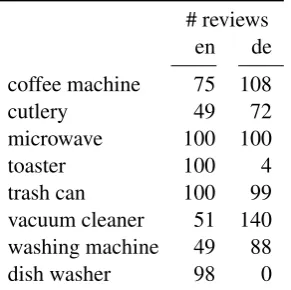
# reviews en de coffee machine 75 108
cutlery 49 72
microwave 100 100
toaster 100 4
[image:4.595.111.257.63.208.2]trash can 100 99 vacuum cleaner 51 140 washing machine 49 88 dish washer 98 0
Table 1: Frequencies of the corpus used in our experiments (Klinger and Cimiano, 2014).
tated text in the target language (measuring if the translation is typical, referred to asTarget LM).
3. The likelihood that the alignment is correct, directly computed on the basis of the align-ment probability (referred to asAlignment):
p(e | f) = Qi=1mp(ei | f, m, n), wheree
andf are source and target sentences andm
andndenote the sentence lengths (Dyer et al., 2013, Eq. 1f.).
For building the language models, we employ the toolkit SRILM (Stolcke, 2002; Stolcke et al., 2011). The likelihood for the alignment as well as the language model probability are normalized by the number of tokens in the sentence.
3 Experiments 3.1 Corpus and Setting
The proposed approach is evaluated on the lan-guage pair German/English in both directions (pro-jecting German annotations into an automatically generated English corpus and testing on English annotations and vice versa). As a resource, we use the recently published USAGE corpus (Klinger and Cimiano, 2014), which consists of 622 En-glish and 611 German product reviews from http: //www.amazon.com/ and http://www.amazon.de/, respectively. The reviews are on coffee machines, cutlery sets, microwaves, toasters, trash cans, vac-uum cleaners, washing machines, and dish washers. Frequencies of entries in the corpus are summa-rized in Table 1. Each review has been annotated by two annotators. We take into account the data generated by the first annotator in this work to avoid the design of an aggregation procedure. The
corpus is unbalanced between the product classes. The average numbers of annotated aspects in each review in the German corpus (10.4) is smaller than in English (13.7). The average number of sub-jective phrases is more similar with 8.6 and 8.3, respectively. The total number of aspects is 8545 for English and 6340 in German, the number of subjective phrases is 5321 and 5086, respectively. The experiments are performed in a leave-one-domain-out setting,e. g., testing on coffee machine reviews is based on a model trained on all other products except coffee machines. This holds for the cross-language and the in-target-language train-ing results and leads therefore to comparable set-tings. We use exact match precision, recall and F1-measure for evaluation. However, it should be
noted that partial matching scores are also com-monly applied in fine-grained sentiment analysis due to the fact that boundaries of annotations can differ substantially between annotators. For sim-plicity, we limit ourselves to the more strict evalua-tion measure.
The language models are trained on 7,413,774 German and 9,650,633 English sentences sampled from Amazon product reviews concerning the prod-uct categories in the USAGE corpus. The FastAlign model is trained on the EuroParl corpus and the automatically translated USAGE corpus in both di-rections (German translated to English and English translated to German).
3.2 Results
We evaluate and compare the impact of the three automatic quality estimation methods and compare them to a manual sentence-based judgement for the language projection from German to English (testing on English). The manual judgement was performed by assigning values ranging from 0 (not understandable), over 1 and 2 (slightly understand-able) to 8 (some flaws in translation), 9 (minor flaws in translation) to 10 (perfect translation).6
Figure 2 shows the results for all four methods (including manual quality assessment) from Ger-man to English for the product category of coffee machines compared to in-target-language training results. The x-axis corresponds to different values for the filtering threshold. Thus, when increasing the threshold, the number of sentences used for training decreases. For all quality estimation
�� ���� ���� ���� ���� ����
�� �� �� �� �� ���
��
��������
������
�� ���� ���� ���� ���� ����
�� ���� �� ���� �� ���� �� ���� ��
��
��������
���������
�� ���� ���� ���� ���� ����
�� �� �� �� �� �� �� �� ��
��
��������
���������
�� ���� ���� ���� ���� ����
�� �� �� �� �� �� �� ��
��
��������
���������
�� ���� ���� ���� ���� ����
�� ����� ����� ����� ����� ����
������������ ����������������
[image:5.595.84.505.68.333.2]�������������� ������������������
Figure 2: Complete results for the reviews for coffee machines for the projection direction German to English.
ods except for the language model for the source language, the performance on the target language increases significantly for the prediction of aspect phrases. The English in-target-language training performance represents an upper baseline, result-ing from trainresult-ing the system on manually annotated data for the target language (F1= 0.42). Without
any instance filtering, relying on all automatically produced translations to induce projected annota-tions for the target language, an F1 measure of
0.21 is reached. With filtering based on the manu-ally assigned translation quality estimation, a result of F1 = 0.43is reached. Using the alignment as
quality score for filtering, the best result obtained is F1 = 0.48. However, results start decreasing
from this threshold value on, which is likely due to the fact that the positive effect of instance filter-ing is outweighed by the performance drop due to training with a smaller dataset. The filtering based on the target language model leads to F1 = 0.42,
while the source language model cannot filter the training instances such that the performance in-creases over the initial value.
Surprisingly, instance filtering has no impact on the detection of subjective phrases. Without any filtering, for the prediction of subjective phrases we get an F1of 0.42, which is close to the performance
of in-target-language training of F1 = 0.49. For
the case of phrase detection, the difference between training with all data (21%) and in-target-language training (42%) is considerably higher. Decreas-ing the size of the trainDecreas-ing set by filterDecreas-ing only decreases the F1measure.
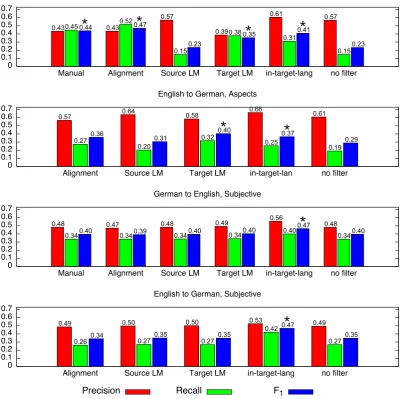
Figure 3 shows the macro-average results sum-marizing the different domains in precision, recall and F1 measure. The thresholds for the filtering
have been fixed to the best result of the product coffee machine for all products. The manual qual-ity estimation as well as the alignment and target language model lead to comparable (or superior) results compared to target language training for aspect detection. This holds for nearly all prod-uct domains, only for trash cans and cutlery the performance achieved by filtering is slightly lower for the direction German-to-English. The initial performance for the whole data set is on average higher for the projection direction English to Ger-man; therefore the values for the source language model are comparably higher than for the other projection direction.
�� ���� ���� ���� ���� ���� ���� ����
������ ��������� ��������� ��������� �������������� �������� ��������������������������
�
�
�
�
0.43 0.43
0.57
0.39
0.61 0.57
0.45 0.52
0.15
0.38
0.31
0.15 0.44 0.47
0.23
0.35 0.41
0.23
�� ���� ���� ���� ���� ���� ���� ����
��������� ��������� ��������� ������������� �������� ��������������������������
�
�
0.57 0.64 0.58 0.66 0.61
0.27
0.20
0.32
0.25
0.19 0.36
0.31
0.40 0.37
0.29
�� ���� ���� ���� ���� ���� ���� ����
������ ��������� ��������� ��������� �������������� �������� �����������������������������
�
0.48 0.47 0.48 0.49 0.56 0.48
0.340.40 0.340.39 0.340.40 0.340.40 0.40 0.34 0.47
0.40
�� ���� ���� ���� ���� ���� ���� ����
��������� ��������� ��������� �������������� �������� �����������������������������
�
0.49 0.50 0.50 0.53 0.49
0.26 0.27 0.27
0.42
0.27
0.34 0.35 0.35
0.47
0.35
��
����
����
����
����
����
����
����
������ ����� �������� �������� ������ �������
[image:6.595.99.501.80.479.2]��������� ������ ��
Figure 3: Macro-average results of cross-language training over the different domains showing precision, recall and F1measure. Significant differences of the F1results to the no-filter-baseline are marked with a
star (Welch t-test comparing the different separate domain results,p <0.05).
0.05). For English to German, in-target-language training and the target language model filtering provide improved results over the baseline that are significant. For subjective phrase detection, the in-language training is significantly better than the baseline.
It is notable that in all experiments the model’s performance without filtering is mainly limited in recall, which drops the performance in F1.
In-stance filtering therefore has mainly an effect on the recall.
3.3 Discussion
Our results show that an approach based on au-tomatic training data projection across languages is feasible and provides competitive results
com-pared to training on manually annotated target lan-guage data. We have in particular quantified the loss of performance of such an automatic approach compared to using a system trained on manually annotated data in the target language. We have shown that the performance of aspect detection of a system using all available projected training data yields a drop of≈50 % in F1-measure
data when predicting aspect phrases on the target language, increasing results from 23 % to 47 % on average. Our approach relying on instance filtering comes close to results produced by a system trained on manually annotated data for the target language on the task of predicting aspect phrases.
In contrast to these results for the aspect phrase recognition, the impact of filtering training in-stances is negligible for the detection of subjective phrases. The highest performance is achieved with the full set of training instances. Therefore, it may be concluded that for aspect name detection, high quality training is crucial. For subjective phrase detection, a greater training set is crucial. In con-trast to aspect recognition, the drop in subjective phrase recognition performance is comparatively low when training on all instances.
Filtering translations by manually provided trans-lation scores (as an upper baseline for the filtering) yields comparable results to using the alignment and the language model on the target language. Us-ing the language model on the source language for filtering does not lead to any improvement. Predict-ing the quality of translation relyPredict-ing on the proba-bility of the source sentence via a source language model therefore seems not to be a viable approach on the task in question. Using the target language model as a filter leads to the most consistent results and is therefore to be preferred over the source language model and the alignment score.
Including more presumably noisy instances by using a smaller filtering threshold leads to a creased recall throughout all methods in aspect de-tection and to a lesser extent for subjective phrase detection. The precision is affected to a smaller degree. This can as well be observed in the number of predictions the models based on different thresh-olds generate: While the number of true positive aspects for the coffee machine subdomain is 1100, only 221 are predicted with a threshold of the man-ual qman-uality assignment of 0. However, a treshold of 9 leads to 560 predictions and a threshold of 10 to 1291. This effect can be observed for subjective phrases as well. It increases from 465 to 827 while the gold number is 676. These observations hold for all filtering methods analogously.
4 Related Work
In-target-language training approaches for fine-grained sentiment analysis include those targeting the extraction of phrases or modelling it as text
classification (Choi et al., 2010; Johansson and Moschitti, 2011; Yang and Cardie, 2012; Hu and Liu, 2004; Li et al., 2010; Popescu and Etzioni, 2005; Jakob and Gurevych, 2010b). Such models are typically trained or optimized on manually an-notated data (Klinger and Cimiano, 2013; Yang and Cardie, 2012; Jakob and Gurevych, 2010a; Zhang et al., 2011). The necessary data, at least containing fine-grained annotations for aspects and subjective phrases instead of only an overall polarity score, are mainly available for the English language to a sufficient extent. Popular corpora used for training are for instance the J.D. Power and Associates Sen-timent Corpora (Kessler et al., 2010) or the MPQA corpora (Wilson and Wiebe, 2005).
Non-English resources are scarce. Examples are a YouTube corpus consisting of English and Italian comments (Uryupina et al., 2014), a not publicly available German Amazon review corpus of 270 sentences (Boland et al., 2013), in addition to the USAGE corpus (Klinger and Cimiano, 2014) we have used in this work, consisting of German and English reviews. The (non-fine-grained annotated) Spanish TASS corpus consists of Twitter messages (Saralegi and Vicente, 2012). The “Multilingual Subjectivity Analysis Gold Standard Data Set” fo-cuses on subjectivity in the news domain (Balahur and Steinberger, 2009). A Chinese corpus anno-tated at the aspect and subjective phrase level is described by Zhao et al. (2014).
There has not been too much work on ap-proaches to transfer a model either directly or via annotation projection in the area of sentiment anal-ysis. One example is based on sentence level anno-tations which are automatically translated to yield a resource in another language. This approach has been proven to work well across several languages (Banea et al., 2010; Mihalcea et al., 2007; Balahur and Turchi, 2014). Recent work approached multi-lingual opinion mining on the above-mentioned multi-lingual Youtube corpus with tree kernels pre-dicting the polarity of a comment and whether it concerns the product or the video in which the product is featured. (Severyn et al., 2015). Brooke et al. (2009) compare dictionary and classification transfer from English to Spanish in a similar classi-fication setting.
the task of identifying aspects specifically with an evaluation on manually annotated data in more than one language. The CLOpinionMiner (Zhou et al., 2015) uses an English data set which is transfered to Chinese. Models are further improved by co-training. Xu et al. (2013) perform self-training based on a projected corpus from English to Chi-nese to detect opinion holders. Due to the lack of existing manually annotated resources, to our knowledge no cross-language projection approach for fine-grained annotation at the level of aspect and subjective phrases has been proposed before.
The projection of annotated data sets has been investigated in a variety of applications. Early work includes an approach to the projection of part-of-speech tags and noun phrases (Yarowsky et al., 2001; Yarowsky and Ngai, 2001) and parsing infor-mation (Hwa et al., 2005) on a parallel corpus. Es-pecially in syntactic and semantic parsing, heuris-tics to remove or correct spuriously projected an-notations have been developed (Pad´o and Lapata, 2009; Agi´c et al., 2014). It is typical for these approaches to be applied on existing parallel cor-pora (one counter example is the work by Basili et al. (2009) who perform postprocessing of machine translated resources to improve the annotation for training semantic role labeling models). In cases in which no such parallel resources are available containing pertinent annotations, models can be transfered after training. Early work includes a cross-lingual parser adaption (Zeman and Resnik, 2008). A recent example is the projection of a metaphor detection model using a bilingual dictio-nary (Tsvetkov et al., 2014). A combination of model transfer and annotation projection for depen-dency parsing has been proposed by Kozhevnikov and Titov (2014).
To improve quality of the overall corpus of pro-jected annotations, the selection of data points for dependency parsing has been studied (Søgaard, 2011). Similarly, Axelrod et al. (2011) improve the average quality of machine translation systems by selection of promising training examples and show that such a selection approach has a positive impact. Related to the latter, a generic instance weighting scheme has been proposed for domain adaptation (Jiang and Zhai, 2007).
Other work has attempted to exploit information available in multiple languages to induce a model for a language for which sufficient training data is not available. For instance, universal tag sets take
advantage of annotations that are aligned across languages (Snyder et al., 2008). Delexicalization allows for applying a model to other languages (McDonald et al., 2011).
Focusing on cross-lingual sentiment analysis, joint training of classification models on multiple languages shows an improvement over separated models. Balahur and Turchi (2014) analyzed the impact of using different machine translation ap-proaches in such settings. Differences in sentiment expressions have been analyzed between English and Dutch (Bal et al., 2011). Co-training with non-annotated corpora has been shown to yield good results for Chinese (Wan, 2009). Ghorbel (2012) analyzed the impact of automatic translation on sentiment analysis.
Finally, SentiWordNet has been used for multi-lingual sentiment analysis (Denecke, 2008). Build-ing dictionaries for languages with scarce resources can be supported by bootstrapping approaches (Banea et al., 2008).
Estimating the quality of machine translation can be understood as a ranking problem and thus be modeled as regression or classification. An impor-tant research focus is on investigating the impact of different features on predicting translation quality. For instance, sentence length, the output probabil-ity, number of unknown words of a target language as well as parsing-based features have been used (Avramidis et al., 2011). The alignment context can also be taken into account (Bach et al., 2011). An overview on confidence measures for machine translation is for instance provided by Ueffing et al. (2003). The impact of different features has been analyzed by Shah et al. (2013). A complete system and framework for quality estimation (including a list of possible features) is QuEst (Specia et al., 2013).
For an overview of other cross-lingual applica-tions and methods, we refer to Bikel and Zitouni (2012).
5 Conclusion and Future Work
a supervised sentiment analysis approach can be trained on. We have in particular shown that our results are competitive to training with manually annotated data in the target language, both for the prediction of aspect phrases as well as subjective phrases. We have further shown that performance for aspect detection can be almost doubled by es-timating the quality of translations and selecting only the translations with highest quality for train-ing. Such an effect cannot be observed in the pre-diction of subjective phrases, which nevertheless delivers results comparable to training using tar-get language data using all automatically projected training data. Predicting translation quality by both the alignment probability and the target language model probability have been shown to deliver good results, while an approach exploiting source lan-guage model probability does not perform well.
Our hypothesis for the failure of translation filter-ing for the prediction of subjective phrases is that translation quality for subjective phrases is gener-ally higher as their coverage in standard parallel corpora is reasonable and they are often domain-independent. A further possible explanation is that subjective phrases have a more complex structure (for instance, their average length is 2.38 tokens in English and 2.57 tokens in German, while the aspect length is 1.6 and 1.3, respectively). There-fore, translation as well as filtering might be more challenging. These hypotheses should be verified and investigated further in future work.
Further work should also be devoted to the in-vestigation of other quality estimation procedures, in particular combinations of those investigated in this paper. Preliminary experiments have shown that the correlation between the filters incorporated in this paper is low. Thus, their combination could indeed have an additional impact. Similarly, the projection quality can be affected by the transla-tion itself and by the alignment. These two aspects should be analyzed separately.
In addition, instead of Boolean filtering (using an instance or not), weighting the impact of the in-stance in the learning procedure might be beneficial as lower-quality instances can still be taken into account, although with a lower impact proportional to their corresponding score or probability.
In addition to the presented approach of pro-jecting annotations, a comparison to directly trans-ferring a trained model across languages would allow for a deeper understanding of the processes
involved. Finally, it is an important and promis-ing step to apply the presented methods on other languages.
Acknowledgments
We thank Nils Reiter, John McCrae, and Matthias Hartung for fruitful discussions. Thanks to Lu-cia SpeLu-cia for her comments on quality estimation methods in our work. We thank Chris Dyer for his help with FastAlign. Thanks to the anonymous reviewers for their comments. This research was partially supported by the “It’s OWL” project (“In-telligent Technical Systems Ostwestfalen-Lippe”, http://www.its-owl.de/), a leading-edge cluster of the German Ministry of Education and Research and by the Cluster of Excellence Cognitive Interac-tion Technology ‘CITEC’ (EXC 277) at Bielefeld University, which is funded by the German Re-search Foundation (DFG).
References
ˇZeljko Agi´c, J¨org Tiedemann, Danijela Merkler, Si-mon Krek, Kaja Dobrovoljc, and Sara Moze. 2014. Cross-lingual dependency parsing of related lan-guages with rich morphosyntactic tagsets. In Work-shop on Language Technology for Closely Related Languages and Language Variants, EMNLP.
Eleftherios Avramidis, Maja Popovi´c, David Vilar, and Aljoscha Burchardt. 2011. Evaluate with confi-dence estimation: Machine ranking of translation outputs using grammatical features. InWorkshop on Statistical Machine Translation, ACL.
Amittai Axelrod, Xiaodong He, and Jianfeng Gao. 2011. Domain adaptation via pseudo in-domain data selection. InEMNLP.
Nguyen Bach, Fei Huang, and Yaser Al-Onaizan. 2011. Goodness: A method for measuring machine trans-lation confidence. InACL-HLT.
Daniella Bal, Malissa Bal, Arthur van Bunningen, Alexander Hogenboom, Frederik Hogenboom, and Flavius Frasincar. 2011. Sentiment analysis with a multilingual pipeline. InWeb Information System Engineering WISE 2011.
Alexandra Balahur and Ralf Steinberger. 2009. Re-thinking sentiment analysis in the news: from theory to practice and back. InProceeding of Workshop on Opinion Mining and Sentiment Analysis (WOMSA).
Alexandra Balahur and Marco Turchi. 2014. Compar-ative experiments using supervised learning and ma-chine translation for multilingual sentiment analysis.
Carmen Banea, Rada Mihalcea, and Janyce Wiebe. 2008. A bootstrapping method for building subjec-tivity lexicons for languages with scarce resources. InLREC.
Carmen Banea, Rada Mihalcea, and Janyce Wiebe. 2010. Multilingual subjectivity: Are more lan-guages better? InCOLING.
Roberto Basili, Diego De Cao, Danilo Croce, Bonaven-tura Coppola, and Alessandro Moschitti. 2009. Cross-language frame semantics transfer in bilin-gual corpora. InCICLING, volume 5449 ofLecture Notes in Computer Science. Springer Berlin Heidel-berg.
Daniel Bikel and Imed Zitouni, editors. 2012. Multi-lingual Natural Language Processing Applications: From Theory to Practice. IBM Press, 1st edition. Katarina Boland, Andias Wira-Alam, and Reinhard
Messerschmidt. 2013. Creating an annotated corpus for sentiment analysis of german product reviews. Technical Report 2013/05, GESIS Institute.
Julian Brooke, Milan Tofiloski, and Maite Taboada. 2009. Cross-linguistic sentiment analysis: From english to spanish. InRANLP, Borovets, Bulgaria, September. Association for Computational Linguis-tics.
Yoonjung Choi, Seongchan Kim, and Sung-Hyon Myaeng. 2010. Detecting Opinions and their Opin-ion Targets in NTCIR-8. InNTCIR8.
Kerstin Denecke. 2008. Using sentiwordnet for multi-lingual sentiment analysis. InICDEW.
Chris Dyer, Victor Chahuneau, and Noah A. Smith. 2013. A simple, fast, and effective reparameteriza-tion of ibm model 2. InNAACL.
Hatem Ghorbel. 2012. Experiments in cross-lingual sentiment analysis in discussion forums. In Karl Aberer, Andreas Flache, Wander Jager, Ling Liu, Jie Tang, and Christophe Guret, editors, Social Infor-matics, volume 7710 ofLecture Notes in Computer Science. Springer Berlin Heidelberg.
Minqing Hu and Bing Liu. 2004. Mining and summa-rizing customer reviews. InACM SIGKDD.
Rebecca Hwa, Philip Resnik, Amy Weinberg, Clara Cabezas, and Okan Kolak. 2005. Bootstrapping parsers via syntactic projection across parallel texts.
Nat. Lang. Eng., 11(3), September.
Niklas Jakob and Iryna Gurevych. 2010a. Extracting opinion targets in a single- and cross-domain setting with conditional random fields. InEMNLP. Niklas Jakob and Iryna Gurevych. 2010b. Using
anaphora resolution to improve opinion target iden-tification in movie reviews. InACL.
Jing Jiang and ChengXiang Zhai. 2007. Instance weighting for domain adaptation in nlp. InACL.
Richard Johansson and Alessandro Moschitti. 2011. Extracting opinion expressions and their polarities: exploration of pipelines and joint models. In ACL-HLT.
Jason S. Kessler, Miriam Eckert, Lyndsie Clark, and Nicolas Nicolov. 2010. The 2010 ICWSM JDPA Sentment Corpus for the Automotive Domain. In
Proc. od the 4th International AAAI Conference on Weblogs and Social Media Data Workshop Chal-lenge (ICWSM-DWC 2010).
Roman Klinger and Philipp Cimiano. 2013. Bi-directional inter-dependencies of subjective expres-sions and targets and their value for a joint model. InACL.
Roman Klinger and Philipp Cimiano. 2014. The usage review corpus for fine grained multi lingual opinion analysis. InLREC.
Philipp Koehn. 2005. Europarl: A Parallel Corpus for Statistical Machine Translation. InConference Proceedings: the tenth Machine Translation Summit. AAMT.
Philipp Koehn. 2010. Statistical Machine Translation. Cambridge University Press, New York, NY, USA, 1st edition.
Mikhail Kozhevnikov and Ivan Titov. 2014. Cross-lingual model transfer using feature representation projection. InACL.
Fangtao Li, Minlie Huang, and Xiaoyan Zhu. 2010. Sentiment analysis with global topics and local de-pendency. InAAAI.
Andrew McCallum, Karl Schultz, and Sameer Singh. 2009. FACTORIE: Probabilistic programming via imperatively defined factor graphs. InNIPS. Ryan McDonald, Slav Petrov, and Keith Hall. 2011.
Multi-source transfer of delexicalized dependency parsers. InEMNLP.
Rada Mihalcea, Carmen Banea, and Janyce Wiebe. 2007. Learning multilingual subjective language via cross-lingual projections. InACL.
Sebastian Pad´o and Mirella Lapata. 2009. Cross-lingual annotation projection for semantic roles.
Journal of Artificial Intelligence Research (JAIR), 36.
Ana-Maria Popescu and Oren Etzioni. 2005. Extract-ing product features and opinions from reviews. In
HLT-EMNLP.
Xabier Saralegi and I˜naki San Vicente. 2012. Tass: Detecting sentiments in spanish tweets. In Work-shop on Sentiment Analisis at SEPLN (TASS). SE-PLN, 09/2012.
Aliaksei Severyn, , Alessandro Moschitti, Olga Uryupina, Barbara Plank, and Katja Filippova. 2015. Multi-lingual opinion mining on youtube. Informa-tion Processing and Management. in press.
Kashif Shah and Lucia Specia. 2014. Quality esti-mation for translation selection. In Conference of the European Association for Machine Translation, EAMT, Dubrovnik, Croatia.
Kashif Shah, Trevor Cohn, and Lucia Specia. 2013. An investigation on the effectiveness of features for translation quality estimation. In Machine Transla-tion Summit XIV.
Benjamin Snyder, Tahira Naseem, Jacob Eisenstein, and Regina Barzilay. 2008. Unsupervised multilin-gual learning for POS tagging. InEMNLP.
Anders Søgaard. 2011. Data point selection for cross-language adaptation of dependency parsers. In ACL-HLT.
Lucia Specia, Kashif Shah, Jose G.C. de Souza, and Trevor Cohn. 2013. Quest - a translation quality estimation framework. InACL.
Andreas Stolcke, Jing Zheng, Wen Wang, and Victor Abrash. 2011. SRILM at sixteen: Update and outlook. In Proceedings IEEE Automatic Speech Recognition and Understanding Workshop.
Andreas Stolcke. 2002. Srilm-an extensible language modeling toolkit. InProceedings International Con-ference on Spoken Language Processing.
Yulia Tsvetkov, Leonid Boytsov, Anatole Gershman, Eric Nyberg, and Chris Dyer. 2014. Metaphor de-tection with cross-lingual model transfer. InACL.
Nicola Ueffing, Klaus Macherey, and Hermann Ney. 2003. Confidence measures for statistical machine translation. InIn Proc. MT Summit IX.
Olga Uryupina, Barbara Plank, Aliaksei Severyn, Agata Rotondi, and Alessandro Moschitti. 2014. Sentube: A corpus for sentiment analysis on youtube social media. InLREC.
Xiaojun Wan. 2009. Co-training for cross-lingual sen-timent classification. In Keh-Yih Su, Jian Su, and Janyce Wiebe, editors,ACL/IJCNLP.
M. Wick, K. Rohanimanesh, K. Bellare, A. Culotta, and A. McCallum. 2011. SampleRank: Training factor graphs with atomic gradients. InICML.
Theresa Wilson and Janyce Wiebe. 2005. Annotating attributions and private states. InCorpusAnno, ACL.
Ruifeng Xu, Lin Gui, Jun Xu, Qin Lu, and Kam-Fai Wong. 2013. Cross lingual opinion holder extrac-tion based on multi-kernel svms and transfer learn-ing. World Wide Web Journal.
Bishan Yang and Claire Cardie. 2012. Extracting opin-ion expressopin-ions with semi-markov conditopin-ional ran-dom fields. InEMNLP-CoNLL.
David Yarowsky and Grace Ngai. 2001. Inducing mul-tilingual pos taggers and np bracketers via robust projection across aligned corpora. InNAACL. David Yarowsky, Grace Ngai, and Richard
Wicen-towski. 2001. Inducing multilingual text analysis tools via robust projection across aligned corpora. In
HLT.
Daniel Zeman and Philip Resnik. 2008. Cross-language parser adaptation between related lan-guages. InIJCNLP-08 Workshop on NLP for Less Privileged Languages.
Qi Zhang, Yuanbin Wu, Yan Wu, and Xuanjing Huang. 2011. Opinion mining with sentiment graph. In
Proceedings of the 2011 IEEE/WIC/ACM Interna-tional Conferences on Web Intelligence and Intelli-gent AIntelli-gent Technology - Volume 01.
Y. Zhao, B. Qin, and T. Liu. 2014. Creating a fine-grained corpus for chinese sentiment analysis. Intel-ligent Systems, IEEE, PP(99).