Abstract – This paper looks at the design and optimal control of an electromechanical linear actuator to be used in a six-degrees-of-freedom motion platform application intended for simulation technology. The paper reacts to recent calls in the simulation industry to replace hydraulic cylinders by electromechanical actuators while keeping the kinematic and dynamic parameters unaffected. The paper provides a comparison of both system types with a description of the design of optimal control for electromechanical actuators.
Keywords – electromechanical linear actuator, Stewart platform, simulation technology, optimal control
I.INTRODUCTION
A. History
Motion platforms with six degrees of freedom, also known as hexapods, are possibly the most popular robotic manipulators used in simulation technology. This parallel mechanism was first described by V. E. Gough [1], who constructed an octahedral hexapod to test the behaviour of tyres subjected to forces created during airplane landings. The first document providing a detailed description of this structure used as an airplane cockpit simulator was published in 1965 by D. Stewart [2] (hence the name of the structure).
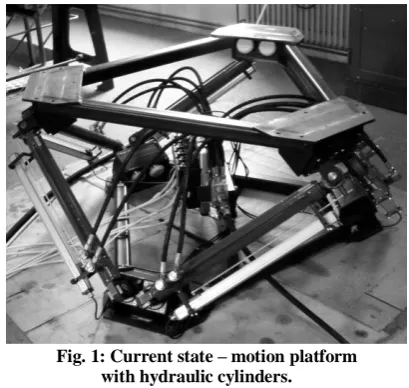
The Stewart platform is a closed kinematic system with six degrees of freedom and six arms with adjustable length (see Fig. 1). Compared to other similar structures, its main advantage is high rigidity and a high input-power-to-device-weight ratio.
Manuscript received June 30, 2010.
[image:1.595.330.535.193.387.2]Evžen Thöndel is with the Department of Electric Drives and Traction, Czech Technical University in Prague, Czech Republic (e-mail: [email protected]) and he is with the company
Fig. 1: Current state – motion platform with hydraulic cylinders.
Until the nineties of the last century, the main obstacle hindering more intensive application development was insufficient computing power of the available hardware. Determining the position of a hexapod is significantly more difficult than that of conventional serial structures. With regard to the device being controlled in real time, the main challenges are the transformation of coordinates and speed of resolving mathematical procedures [3]. Despite the computing power issue having been more or less removed in recent years, direct kinematic transformation (i.e. transforming the length of arms to the position of the frame) still remains a challenge.
B. Use in Simulation Technology
The Stewart platform is frequently used in simulation technology to simulate motion effects in vehicle or airplane simulators. By using this equipment, it is possible to simulate the forces acting upon the pilot (driver) during the flight (journey), thus bringing the simulator even closer to reality. The concept and role of motion effect simulation in training is discussed, for instance, in [4]; apart from describing the structure of simulators, the book expressly underlines the role of this aspect during emergency event training. With motion effects being generally perceived before other kinds of percepts [5], they provide the first possibility of detecting undesired and dangerous behaviour of the airplane or vehicle.
C. Current Status
With respect to the significant weight of the
Electric Motion Platform for Use in Simulation
Technology – Design and Optimal Control of a
Linear Electromechanical Actuator
equipment and controls (the weight of the cockpit described in [6], for instance, amounts to 1.5 tonnes) and the need to achieve high dynamics levels, the platform‟s linear actuators are usually implemented as hydraulic cylinders in simulation technology applications. In spite of this solution meeting the above requirements of sufficient power and dynamics levels, it also suffers from the fundamental drawbacks of all hydraulic systems.
These include, in particular, higher spatial, temporal and financial installation requirements resulting from the need to employ a sufficiently powerful hydraulic aggregate and piping. In addition, hydraulic solutions suffer from relatively high noise levels, which cannot be avoided by separating the aggregate from the platform, as this would inevitably result in losses in the hydraulic piping, translating into decreases in dynamics. Moreover, the aggregate cannot be closed in a sound-proof box with regard to this solution not ensuring sufficient dissipation of excess heat; installing the aggregate in a closed room requires an air-conditioning unit to be used, further increasing the costs.
The drawbacks of hydraulic systems include environmental aspects, too. In particular, hydraulic oil has to be replaced after a certain number of operation hours and can, in case of system malfunctions and breakdowns, cause local pollution. Therefore, any malfunctions of hydraulic systems have to be resolved with utmost care and attention.
Hence, in instances where it is envisaged that the device will be transported on a regular basis (such as the light sports aircraft simulator described in [7]) it is often more suitable to use an electric motion system, which, being more affordable and requiring significantly shorter installation times, makes the device more attractive for customers.
Compared to hydraulic solutions, electric systems benefit from many advantages – in particular much lower noisiness, higher energy efficacy and more sophisticated control methods.
However, besides their indisputable advantages, electric systems have also several cons. The electromechanical transmission is subject to higher friction, increasing the wear and tear of the actuator. Therefore, the lifetime of electric systems is typically somewhat shorter than that of hydraulic solutions. In addition, electric systems require a procedure to bring the device to a safe halt after unexpected power cuts. In case of hydraulic systems, the „safety landing‟ procedure is catered for using oil from an appropriately sized hydraulic accumulator. With regard to UPS units significantly increasing the price of the system, power failure emergencies are typically handled using mechanical locks which, in case of an unexpected power cut, fix the platform in its current position. Nonetheless, emergency descents of platforms with an electric drive still remain problematic.
With respect to their many pros, there have been growing calls to replace, in certain applications, hydraulic cylinders with electric linear actuators while
keeping their static and dynamic properties. The first certified aircraft simulator worldwide using an electric motion system was finished in 2006 and, according to [8], this trend will prevail in future as well.
The following section provides a detailed description of an electric linear actuator intended for the application mentioned above. The main emphasis has been put on the preparation of a mathematical model which will be subsequently used to design the optimal control.
II.ELECTROMECHANICAL LINEAR ACTUATOR
With regard to the forces required, the electromechanical actuator is based on converting rotary motion to linear motion via a ball screw. Benefitting from high efficiency, rigidity and accuracy ball screws are often used in machine tool construction. The design of the whole electromechanical actuator is shown in detail in Fig. 2.
Fig. 2: Electromechanical actuator.
A. Mathematical Model of the Electromechanical Actuator
In order to further analyse the electromechanical system and, in particular, with respect to the need to design the optimal control, this section deals with the mathematical model to be used. However, it is not necessary at this point to fine-tune all model parameters, the main aim being to ensure that the model reflects all significant dynamic properties of the electromechanical actuator and works with quantities which can be easily derived or directly measured in the system. The following assumptions have been made before designing the mathematical model:
quality of control with respect to the criteria used to assess regulation quality.
The differential equation of motion can be defined immediately after replacing the system with a single virtual body with the generalized mass mred subject to all forces and moments Fred. Called the „Generalized Forces Method‟, the basic equation can be written as:
red red
red
x
F
dx
dm
x
m
2
2
1
. (1)In addition, the following properties apply (see, for instance, [9]):
the kinetic energy of the generalized mass equals to the sum of all kinetic energies of the elements of the system,
the virtual work of the generalized force equals to the sum of the virtual works of all forces and moments in the system.
The kinetic energy of the mechanical system can be expressed as: 2 2 2
2
1
2
1
2
1
x
m
I
x
m
E
k
red
,
(2)
where m is the mass of the load, x the displacement of the ball screw, I the moment of inertia of the rotary parts of the system and φ the rotation angle.
The relationship between the translational position x and the rotation angle is defined by the conversion constant kmex, while:
x
k
mex
. (3)By substituting into the previous expression, we obtain the following equation:
m
k
I
m
red
mex2
. (4)According to the virtual work principle, the following relationship holds true:
x
F
x
mg
M
W
x
F
h tN j
j
red
1
(5)
where
F
t
F
t0sgn
x
is the friction force.The above expression can be used to determine the generalized force Fred:
x
F
mg
k
M
F
red
h
mex
t0sgn
, (6)where Mh is the motor torque, m the load mass and g the gravitational acceleration.
By substituting into the basic „Generalized Forces Method‟ equation we obtain the equation of motion for the mechanical part of the actuator:
I
k
mexm
x
M
hk
mexmg
F
t0sgn
x
2
.(7)
The driving torque Mh is generated by an AC servomotor controlled by a servo driver. With regard to these devices being shipped by the manufacturer with the optimum current / moment regulator settings, the device shall be modelled as a first-degree dynamic system with the time constant τ. With respect to small time constants, the remaining dynamic properties of the servo drive can be left out of consideration, playing only a negligible role in the overall behaviour of the system and being irrelevant for the control design. Servo drive dynamics can be expressed with the transfer function
s
u
s
M
s
k
s
G
el hel
1
, (8)where u is the variable corresponding to the required moment and, by the same token, the input signal of the system and kel the electric constant of the motor.
B. Design of the Optimal Control
For the sake of convenience, the mathematical model will be written using matrices of state and transformed into the discrete form. Non-linearity caused by friction forces can be compensated by adding to or subtracting from the input signal u the value uFt corresponding to the friction force Ft0, and therefore will be left out of consideration. Below are the equations of state of the system:
u
D
x
C
y
u
B
x
A
x
ˆ
ˆ
ˆ
ˆ
ˆ
, (9)
where
1
ˆ
,
ˆ
,
0
0
0
0
0
0
,
1
0
0
0
1
0
0
0
1
,
0
0
0
0
,
1
0
0
0
0
1
0
0
u
u
M
x
x
x
D
C
k
m
mg
B
m
k
A
h el red red mex
(10)The corresponding discrete form of the system for the sampling period T can be written as:
nT
C
x
nT
D
u
nT
y
nT
u
B
nT
x
A
T
n
x
d dˆ
ˆ
ˆ
ˆ
1
ˆ
, (11)
T At AT d
AT d
B
dt
e
e
B
e
A
0
. (12)
In designing the optimal control, the following quality criteria will be considered:
The regulated variable will be the displacement of the ball screw x.
In simulation technology (where the device in question is used to reproduce forces), system response time (i.e. transmission bandwidth) is the most important and essential quality parameter.
With regard to small steady-state deviations from the desired position not being perceptible for persons sitting in the simulator cockpit, regulation accuracy is not critical in this application.
In spite of this requirement not being as critical as, for instance, in machine tools control, where similar mechanisms involving ball screws are often used, unit step response should result in small overshoots only. Control has to be sufficiently robust to react flexibly to changes in the load m, which can be a value
from the preset interval
m
0
,
m
max .In terms of control theory, it is advisable to use as much information about the controlled system as possible. Ideally, we should be able either directly to measure or somehow derive all state variables. In this case, the control law equals to (see, for instance, [10]):
0
ˆ
K
ref
u
x
K
u
x
r
, (13)where Kx is the row vector, Kr the scalar, ref the
reference / desired position and
mex el
k
k
mg
u
0
theconstant compensating the effects of the load.
It can be proved that using state space control (state feedback loops) it is theoretically possible to control the behaviour of the system as required [11]. In practice, however, one is limited by the input signal, which amounts to finite values from the range
max min
,u
u
u
.The following sections focus on determining the optimal state space control to regulate the position of the electromechanical linear actuator. The optimal control is one which minimises the optimality criterion; let us now define a quadratic criterion based on the control quality requirements set forth hereinabove:
Nn
N n
overshoot n u n y n u
n u
u
J
J
J
J
J
1 1
min
min
min
(14)
where, at the optimisation horizon N, Jy penalises the deviation from the desired position:
21
y
n
ref
n
q
J
ny
, (15)with Ju penalising the input signal if it exceeds the allowed limits:
max min
min 2
min 2
max 2
max 2
0
u
u
u
u
u
u
u
q
u
u
u
u
q
J
nu , (16)and Jovershoot penalising the control in case of overshoots during positive unit step responses (i.e. non-monotonous responses):
0
0
0
23
x
x
x
q
J
novershot
, (17)
The quantities q1, q2 and q3 are the masses and, at the same time, normalisation coefficients of individual elements of the criterion.
C. Minimising the Criterion via a Genetic Algorithm Following from the above, the control strategy in equation (13) is completely described by the vector
K
xK
r
K
, with control quality beingdetermined by the criterion J. Hence, in determining the optimal control, the goal is to find the vector K with the minimum value of (the criterion) J. This issue can be approached using a genetic algorithm employing the principles of evolution biology (crossbreeding and mutation) to solve complex problems. Each individual in the population is described by their “chromosome” (in our case the vector K), with the probability of this genetic information being passed to the next generation being directly proportional to its quality (lower values of the criterion J). In addition, there is a small chance that this genetic information will mutate (random changes of genes within the chromosome).
The initial population of several randomly chosen individuals will be left to evolve under the simple evolution rules defined above. After several generations, we select the best individual whose “chromosome” contains the ideal solution of our problem (essentially, we are „breeding‟ the solution for the optimum control problem).
With regard to the nature of this paper, it is not possible to provide here comprehensive information on the properties of genetic algorithms and convergence conditions. However, a detailed description can be found, for instance, in [12].
Fig. 3: Determining the optimum control.
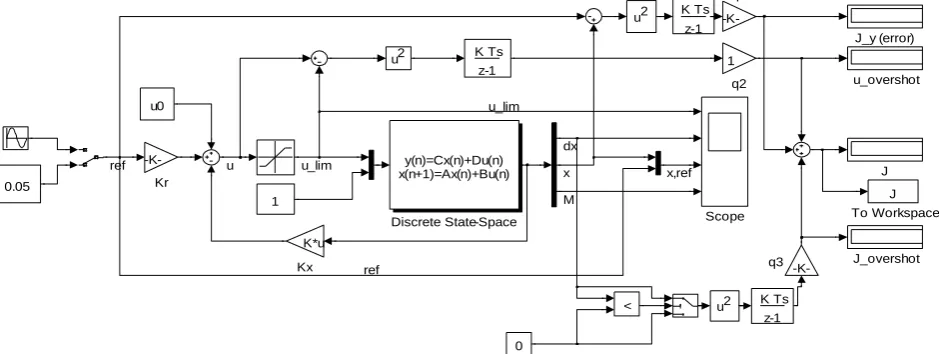
[image:5.595.67.272.61.221.2]The criterion J and the whole algorithm used to determine its minimum value can be easily implemented for example in the MATLAB-Simulink environment, as shown in Fig. 4.
Fig. 6 shows the simulation results (response to step changes of the position) of the optimal state regulator controlling the system under the parameters defined in Tab. I. These parameters correspond to the system shown in Fig. 2.
Tab. I: Parameters of the electromechanical actuator.
Name Value Unit
kmex 800π rad/m
kel 0.2 Nm/V
I 5.5429.10-4 kg.m2
m <0...512> kg
g 9.81 m/sec2
τ 0.01 s
T 0.01 s
uFt 0.4 V
Ft0 16π N
Simulation results show that step responses do not result in overshoots and only small deviations from the desired steady-state position can be observed.
D. The Robustness Condition
The designed control has to ensure that the system remains stable after a load change and for all load values from the relevant interval.
It can be proved by simulation that the system will remain stable if the force exerted by the load does not exceed the maximum force which can be generated by the drive. Therefore:
max
max
m
g
k
k
u
m
el mex
. (18)
If the above condition is met the system shall remain stable and load changes not compensated by the input signal u0 (see Equation (13)) will have an impact on the size of the steady-state deviation only.
E. Implementing the Control on a Real System In order for state space control to be possible, all state variables have to be known in each control step. In practice, however, the electromechanical system is
equipped with one sensor only, namely the position sensor fitted on the motor shaft. The remaining state variables (velocity and moment) have to be derived accordingly. Velocity can be determined by differentiating the current position, and the current moment at the shaft of the motor can be ascertained based on the input signal u via relationship (8).
F. Comparing Dynamic Properties of Electromechanical and Hydraulic Systems
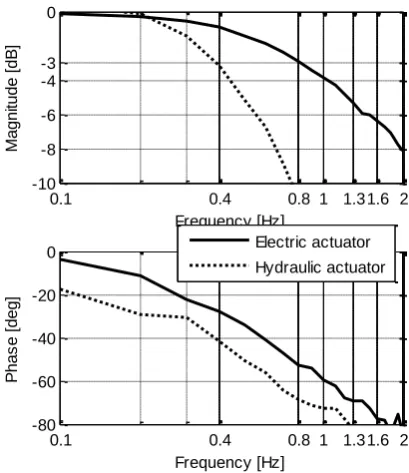
In this case, dynamic properties cover, in particular, the transmission bandwidth, in other words the input signal frequency range which can be transmitted by the system unchanged / undamped. In literature, this maximum frequency is defined as the frequency when the amplitude of the output signal drops to -3 dB.
Fig. 5 shows and compares the results of frequency characteristics measurements conducted for hydraulic and electromechanical actuators. The position of the hydraulic actuator is controlled by a typical PID regulator, whereas the electromechanical actuator uses
0 100 200 300 400 4.5
5 5.5 6 6.5 7 7.5
Iteration
F
u
n
c
ti
o
n
v
a
lu
e
[image:5.595.63.533.324.501.2]Best Function Value: 4.6952
Fig. 4: Implementation of the model of the electromechanical actuator.
u_overshot
q3 -K-q2 1
q1
-K-To Workspace J Scope
< u2
u2
u2
Kx K*u Kr
-K-J_y (error)
J_overshot J K Ts
z-1
K Ts z-1 K Ts
z-1
Discrete State-Space y(n)=Cx(n)+Du(n) x(n+1)=Ax(n)+Bu(n)
0 u0
0.05
1 u
M dx u_lim
u_lim
x,ref x
the results of the optimal state space regulator described here. As given in the Figure, the transmission frequency bandwidth of the electromechanical actuator equals to twice that of the hydraulic system.
III.CONCLUSION
This paper describes the process of designing an electromechanical actuator which can be used as a suitable replacement of hydraulic cylinders in simulation technology applications using six-degree-of-freedom motion platforms. Providing a description of the optimal state space control, the paper compares the operational and dynamic properties of hydraulic and electromechanical systems, proving that the latter can achieve better dynamics results. However, one has to take into consideration a decrease in the lifetime of the device as a consequence of increased wear and tear resulting from mechanical friction.
[image:6.595.331.534.57.434.2]In addition, ensuring a safe shut-down procedure in case of unexpected power cuts can be quite costly. In spite of these drawbacks, current trends and customer demand show that electromechanical motion platforms will gradually replace current hydraulic systems, the main reasons, apart from better dynamic properties, being significantly lower noisiness, ease of installation and better energy efficiency.
Fig. 5: Measured frequency characteristics of the real system (signal 10 %).
Fig. 6: Simulation results.
REFERENCES
[1] E. Gough, Contribution to Discussion of Papers on Research in Automobile Stability, Control and Tyre performance, Proc. Auto Div. Inst. Mech. Eng., pages 392-394, 1956-1957.
[2] D. Stewart, A Platform with Six Degrees of Freedom, UK Institution of Mechanical Engineers Proceedings 1965-66, Vol 180.
[3] K. Liu, J. M. Fitzgerald, F. L. Lewis, Kinematic Analysis of a Stewart Platform. IEEE Transactions on Robotics, vol. 40, No 2, 282 – 293.
[4] A. T. Lee, Flight Simulation. Ashgate Publishing Limited, 2005. [5] E. Thöndel, Simulace pohybových vjemů na pilotním trenažéru.
Thesis, 1981, p. 206.
[6] E. Thöndel, Simulating Motion Effects Using a Hydraulic Platform with Six Degrees of Freedom. In Sborník mezinárodní konference IASTED Modelling and Simulation 2008, 8 – 10 Sept., 2008 Gaborone, Botswana: ISBN 978-0-88986-763-5. [7] E. Thöndel, Simulátor lehkého a ultralehkého sportovního
letadla. [online]
http://www.pragolet.cz/clanky/flight_simulator_of_light_and_ul tralight_aircraft.html
[8] S. Murthy, Electric Actuators Replace Hydraulics in Flight Simulators. [online] <http://machinedesign.com/article/electric-actuators-replace-hydraulics-in-flight-simulators-0120>. [9] J. Nožička, Mechanika a termodynamika. Prague: ČVUT, 1991,
ISBN 80-01-00417-1, 317 p.
[10] J. A. Rossiter, Model Based Predictive Control. CRC Press, 2003, ISBN 0-8493-1291-4, 318 p.
[11] Havlena, V.; Štecha, J.: Teorie dynamických systémů. Prague: ČVUT, 2002, ISBN 80-01-01971-3, 248 p.
[12] V. Mařík, O. Štěpánková, J. Lažanský, Umělá inteligence 3. Academia, 2003, ISBN 80-200-0472-6, 475 p.
0.1 0.4 0.8 1 1.31.6 2
-10 -8 -6 -4 -3 0
M
a
g
n
itu
d
e
[
d
B
]
Frequency [Hz]
0.1 0.4 0.8 1 1.31.6 2
-80 -60 -40 -20 0
Frequency [Hz]
P
h
a
s
e
[
d
e
g
]
Electric actuator Hydraulic actuator
0 0.2 0.4 0.6 0.8 1 -10
0 10
u
[
V
]
0 0.2 0.4 0.6 0.8 1 -0.2
0 0.2
d
x
/d
t
[m
/s
e
c
]
0 0.2 0.4 0.6 0.8 1 0
0.05 0.1
x
[
m
]
0 0.2 0.4 0.6 0.8 1 -2
0 2
M
[
N
m
]
time [s]
[image:6.595.66.271.385.622.2]