Feature Selection for Short Text Classification using Wavelet Packet
Transform
Anuj Mahajan
Indian Institute of Technology, Delhi
Hauz Khas, New Delhi 110016
India
[email protected]
Sharmistha, Shourya Roy
Xerox Research Centre India
Bangalore - 560103
India
{
sharmistha.jat,shourya.roy
}
@xerox.com
Abstract
Text classification tasks suffer from curse of dimensionality due to large feature space. Short text data further exacerbates the prob-lem due to their sparse and noisy nature. Fea-ture selection thus becomes an important step in improving the classification performance. In this paper, we propose a novel feature se-lection method using Wavelet Packet Trans-form. Wavelet Packet Transform (WPT) has been used widely in various fields due to its efficiency in encoding transient signals. We demonstrate how short text classification task can be benefited by feature selection using WPT due to their sparse nature. Our technique chooses the most discriminating features by computing inter-class distances in the trans-formed space. We experimented extensively with several short text datasets. Compared to well known techniques our approach reduces the feature space size and improves the overall classification performance significantly in all the datasets.
1 Introduction
Text classification task consists of assigning a docu-ment to one or more classes. This can be done us-ing machine learnus-ing techniques by trainus-ing a model with labelled documents. Documents are usually repre-sented as vectors with a variety of techniques like bag-of-words(unigram, bigram), TFIDF representation, etc. Typically, text corpora have very high dimensional document representation equal to the size of vocabu-lary. This leads to curse of dimensionality1in machine
learning models, thereby degrading the performance. Short text corpora, like SMS, tweets, etc., in partic-ular suffer from sparse high dimensional feature space, due to large vocabulary and short document length. To give an idea as to how these factors affect the size of the feature space we compare Reuters with Twitter data corpus. In Reuters-21578 corpus there are approx-imately 2.5 Million words in total and 14506 unique vocabulary entries after standard preprocessing steps
1https://en.wikipedia.org/wiki/Curse_
of_dimensionality
(which is the dimensionality of the feature space). However, Twitter 1 corpus, we used for experiments has approximately 15,000 words in total and feature space size of 7423 words. Additionally, the average length of an English tweet is 10-12 words whereas the average length of a document in Reuters-21578 news classification corpus is 200 words. Therefore, the di-mensionality is extremely high even for small corpora with short texts. In addition, the average number of words in a document is significantly less in short text data leading to higher sparsity of feature space repre-sentation of documents.
Owing to this high dimensionality problem, one of the important steps in text classification workflows is feature selection. Feature selection techniques for tradi-tional documents have been aplenty and a few seminal survey articles have been written on this topic (Blitzer, 2008). In contrast, for short text there is much less work on statistical feature selection but more focus has gone to feature engineering towards word normaliza-tion, canonicalization etc. (Han and Baldwin, 2011).
In this paper, we propose a dimensionality reduc-tion technique for short text using Wavelet packet trans-form called Improvised Adaptive Discriminant Wavelet Packet Transform (IADWPT). IAWDPT does dimen-sionality reduction by selecting discriminative features (wavelet coefficients) from the Wavelet Packet Trans-form (WPT) representation. Short text data resembles transient signals in vector representation and WPT en-codes transient signals (signals lasting for very short duration) well (Learned and Willsky, 1995), using very few coefficients. This leads to considerable decrease in the dimensionality of the feature space along with in-crease in classification accuracy. Additionally, we op-timise the procedure to select the most discriminative features from WPT representation. To the best of our knowledge this is the first attempt to apply an algorithm based on wavelet packet transform to the feature selec-tion in short text classificaselec-tion.
2 Related Work
Feature selection has been widely adopted for dimen-sionality reduction of text datasets in the past. Yim-ing Yang et al. (Yang and Pedersen, 1997) performed a comparative study of some of these methods includ-ing, document frequency, information gain(IG), mutual
information(MI),χ2-test(CHI) and term strength(TS).
They concluded that IG and CHI are the most effective in aggressive dimensionality reduction. The mRMR technique proposed by (Peng et al., 2005) selects the best feature subset by increasing relevancy of feature with target class and reducing redundancy between chosen features.
Wavelet transform provides time-frequency repre-sentation of a given signal. The time-frequency rep-resentation is useful for describing signals with time varying frequency content. Detailed explanation of wavelet transform theory is beyond the scope of this paper. For detailed theory, refer to Daubechies (Daubechies, 2006; Daubechies, 1992; Coifman and Wickerhauser, 2006) and Robi Polikar (Polikar, ). First use of wavelet transform for compression was proposed by Ronald R Coifman et al. (Coifman et al., 1994). Hammad Qureshi et al. (Qureshi et al., 2008) pro-posed an adaptive discriminant wavelet packet trans-form(ADWPT) for feature reduction.
In past wavelet transform has been applied to natural language processing tasks. A survey on wavelet appli-cations in data mining (Li et al., 2002), discusses the basics and properties of wavelets which make it a very effective technique in Data Mining. CC Aggarwal (Ag-garwal, 2002) uses wavelets for strings classification. He notes that wavelet technique creates a hierarchical decomposition of the data which can capture trends at varying levels of granularity and thus helps classifica-tion task with the new representaclassifica-tion. Geraldo Xexeo et al. (Xexeo et al., 2008) used wavelet transform to represent documents for classification.
3 Wavelet Packet Transform for
Short-text Dimensionality Reduction
Feature selection performs compression of feature space to preserve maximum discriminative power of features for classification. We use this analogy to do compression of document feature space using Wavelet Packet Transform. Vector format(e.g. dictionary en-coded vector) representation of a document is equiv-alent to a digital representation. This vector format can then be processed using wavelet transform to get a compressed representation of the document in terms of wavelet coefficients. Document features are trans-formed into wavelet coefficients. Wavelet coefficients are ranked and selected based on their discrimination power between classes. Classification model is trained on these highly informative coefficients. Results show a considerable improvement in model accuracy using our dimensionality reduction technique.
Typically, vector representation of short text will have very few non-zero entries due to short length of the documents. If we plot count of each word in the dic-tionary on y-axis v/s distinct words on x-axis. Just like transient signals, the resulting graph will have very few spikes. Transient signals last for a very little time in the whole duration of the observation. (Learned and
Will-sky, 1995) show the efficacy of wavelet packet trans-form in representing transient signal. This motivates our use of Wavelet Packet Transform to encode short text.
Wavelet transform is a popular choice for feature representation in image processing. Our approach is in-spired by a related work by (Qureshi et al., 2008). They propose Adaptive Discriminant Wavelet Packet Trans-form (ADWPT) based representation for meningioma subtype classfication. ADWPT obtains a wavelet based representation by optimising the discrimination power of the various features. Proposed technique IADWPT differs from ADWPT in the way discriminative fea-ture are selected. Next section provides details about the proposed approach IADWPT.
4 IADWPT - Improvised Adaptive
Discriminant Wavelet Packet
Transform
This section presents the proposed short text feature selection technique IADWPT. IADWPT uses wavelet packet transform of the data to extract useful discrimi-native features from the sub-bands at various depths.
Natural language processing tasks usually represent their documents in dictionary encoded bag-of-words representation. This numerical vector representation of a document is equivalent to signal representation. In or-der to get IADWPT representation of the document fol-lowing steps should be computed:
1) Compute full wavelet packet transform of the doc-ument vector representation.
2) Compute the discrimination power of each coeffi-cient in wavelet packet transform representation.
3) Select the most discriminative coefficients to rep-resent all the documents in the corpus.
Once the 1-D wavelet transform is computed at a de-sired levell, wavelet packet transform (WPT) produces
2l different sets of coefficients (nodes in WPT tree).
These coefficients represent the magnitude of various frequencies present in the signal at a given time. We select the most discriminative coefficients to represent all the documents in the corpus by calculating the dis-criminative power of each coefficient.
The classification task consists ofc classes with d
documents. 1-D Wavelet Packet Transform of thedth k
document yieldsl levels withf sub bands consisting of m coefficients in each sub band. xm,f,l represent
the coefficients of Wavelet Packet Transform. Follow-ing terms are defined for Algorithm 1.
• probability density estimates (Sm,f,l) of a
partic-ular sub-band in a levella training sample docu-mentdi
kof a given Classciis given by:
Sk
m,f,l= (x
k m,f,l)2
P
j(xkj,f,l)2
Here, xm,f,l is the mth coefficient in fth
sub-band oflthlevel of documentd
Algorithm 1IADWPT Algorithm for best discriminative feature selection
1: for allclassesCdo
2: Calculate Wavelet Packet Transform for all the documentsdkin classci 3: for allDocumentsdkdo
4: Calculate probability density estimatesSk m,f,l
5: end for
6: for allLevels of WPTland their sub bandsfdo
7: for allWavelet Packet Transform Coefficientsmin subbandf do 8: Calculate average probability densityAci
m,f,l
9: end for
10: end for
11: end for
12: for allClass Pairsca, cbdo
13: Calculate discriminative powerDm,f,la,b
14: end for
15: Select topm0coefficients for representing documents in corpus
over the length of sub-band. Wavelet supports vary with the bands, Normalization ensures that the feature selection done gives uniform weightage to the features from different bands. This step cal-culates the normalised value of coefficients in a sub-band.
• Average probability density (Aci
m,f,l) estimates are
derived using all the training samplesdkin a given
classci.
Aci
m,f,l=
P
kSm,f,lk
d
for, coefficientm in sub-bandf for classci and
dis the total number of documents in the class.k
varies over the number of documents in the class. It measures the average value of a coefficient in all the documents belonging to a class.
• Discriminative power (Da,bm,f,l) of each coefficient inlthlevel’sfthsub band’smthcoefficient,
be-tween classesaandbis defined as follows:
Dm,f,la,b =|qAa m,f,l−
q
Ab
m,f,l|
Discriminative power is the hellinger distance be-tween the average probability density estimates of a coefficient for the two classes. It quantifies the difference in the average value of a coeffi-cient between a pair of classes. More the differ-ence, better the discriminative power of the coef-ficient. Thus discriminative features tend to have a higher average probability density in one of the classes whereas redundant features cancel out in taking the difference in computing the distance. (Rajpoot, 2003) have shown efficacy of Hellinger distance applied to ADWPT.
Selecting coefficients with greater discriminative power helps the classifier perform well. Full algorithm is mentioned in algorithm 1.
Multi class classification can then be handled in this framework using one-vs-one classification. We select
the topm0features from the wavelet representation for
representing the data in the classification task. Time complexity of the algorithm is polynomial. The method is based on adaptive discriminant wavelet packet trans-form (ADWPT) (Qureshi et al., 2008). Therefore, we name it as improvised adaptive discriminant wavelet packet transform (IADWPT). ADWPT uses best basis for classification which is a union of the various sub-bands selected that can span the transformed space, so noise is still retained in the signal whereas IADWPT selects coefficients from the sub-band having maximal discriminative power thus improving the classification results. As opposed to ADWPT, IADWPT is a one way transform, original signal cannot be recovered from the transform domain. Experimental results confirm that IADWPT performs better than ADWPT in short text datasets.
4.1 IADWPT Example
Figure 1 Gives intuition of the workings of IAD-WPT transform. Uppermost graph displays the Aver-age probability density in positive class samples. Mid-dle graph in the Figure 1 shows the Average probabil-ity densprobabil-ity in negative class samples. These two energy values are then subtracted, resulting values are shown in the bottom most component of Figure 1. Peak posi-tive and negaposi-tive values in the bottommost graph rep-resent the most discriminant features. Absolute value of the discriminative power can then be used to select the most discriminative features to represent each doc-ument in corpus.
5 Experiments and Results
We used multiple short text datasets to prove efficacy of proposed algorithm against state of the art algorithms for feature selection.
0 500 1000 1500 2000 2500 0
0.2 0.4
0 500 1000 1500 2000 2500
0 0.2 0.4
0 500 1000 1500 2000 2500
−0.5 0 0.5
Wavelet Features
Energy
[image:4.595.112.485.68.219.2]Calculation of Discriminative features in Wavelet Packet Transform Representation
Figure 1: x-axis represents the wavelet packet transform coefficients, y-axis represents amplitude. From top to bottom, 1) Average probability densityAa
m,f,lvalue of coefficients in positive class a), 2) Average probability
densityAb
[image:4.595.163.435.308.490.2]m,f,lvalue of coefficients in negative class (b), 3) Difference betweenAam,f,landAbm,f,l
Table 1: CLASSIFICATIONRESULTS- SUPPORTVECTORMACHINE(SVM)ANDLOGISTICREGRESSION(LR)
Dataset Baseline MI-avg χ2 PCA ADWPT IADWPT
Classification accuracy - SVM
Twitter 1 47.04 47.57 45.62 59.28 46 63.44
SMS Spam 1 - HAM Accuracy 99.82 99.71 99.77 99.87 99.63 99.94 SMS Spam 1 - SPAM Accuracy 83.10 83.32 82.96 83.81 83.57 83.92 SMS Spam 2 - HAM Accuracy 55.2 56.31 55.62 81.12 54.1 87.7 SMS Spam 2 - SPAM Accuracy 46.6 46.7 46.49 92.39 47.3 99.42 Total dimensions in best classification accuracy result - SVM
Twitter 1 7423 2065 515 540 7423 23
SMS Spam 1 9394 3540 550 750 9394 815
SMS Spam 2 10681 2985 490 855 1068 250
Classification accuracy - Logistic Regression
Twitter 1 75.8 74.97 75.21 76.28 68.2 76.72
SMS Spam 1 - HAM Accuracy 97.91 94.67 95.28 98.71 98.03 99.61 SMS Spam 1 - SPAM Accuracy 95.48 85.34 86.37 91.37 82.2 87.54 SMS Spam 2 - HAM Accuracy 96.02 89.54 92.76 71.21 95.09 98.5 SMS Spam 2 - SPAM Accuracy 91.2 88.37 91.38 89.15 92.2 94.51 Total dimensions in best classification accuracy result - Logistic Regression
Twitter 1 7423 5600 3250 3575 7423 2749
SMS Spam 1 9394 7545 1755 2350 9394 1680
SMS Spam 2 10681 6550 3000 3050 10681 9981
2) SMS Spam 1: UCI spam dataset (Almeida, )
consists of 5,574 instances of SMS classified into SPAM and HAM classes. SPAM class is defined as messages which are not useful and HAM is the class of useful messages. We compare our results with the results they published in their paper (Almeida et al., 2013). Therefore, we followed the same experiment procedure as cited in the paper. First 30% samples were used in train and the rest in test set as reported in the paper.
3)SMS Spam 2: The dataset was published by Ya-dav et al. (YaYa-dav et al., 2011). It consists of 2000 SMS, 1000 SPAM and 1000 HAM messages. Experiment set-tings are same as that of dataset SMS Spam 1.
The goal of our experiments is to examine the ef-fectiveness of the proposed algorithm in feature selec-tion for short text datasets. We measure the effective-ness of the feature selection technique with respect to the increase in accuracy in the final machine learning task. Our method does not depend on a specific classi-fier used in the final classification. Therefore, we used
50 100 150 200 250 300 350 400 450 500 0
0.1 0.2 0.3 0.4 0.5 0.6 0.7 0.8 0.9 1
Comparision of different feature selection methods: Spam Accuracy
Number of dimensions
Spam Accuracy
MRMR IADWPT PCA Chi MI
[image:4.595.333.503.563.674.2]50 100 150 200 250 300 350 400 450 500 0
0.1 0.2 0.3 0.4 0.5 0.6 0.7 0.8 0.9 1
Number of Dimensions
Ham Accuracy
Comparision of different feature selection methods: Ham Accuracy
[image:5.595.316.524.59.164.2]MRMR IADWPT PCA Chi MI
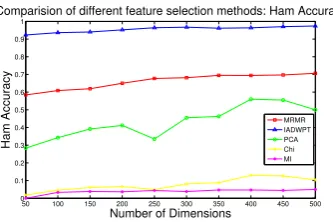
Figure 3: Ham Classification Accuracy comparison across various feature selection algorithm for SMS Spam 2 dataset
popular classifiers like Support Vector Machine (RBF kernel with grid search) (Cortes and Vapnik, 1995) and Logistic Regression with and without dimensionality reduction for unigram representation to benchmark the performance. All the experiments were done with 10 fold cross validation and grid search onC parameter. We report results with respect to classification accuracy which is measured as #correctly classified datapoints#total datapoints .
We conducted detailed experiments comparing IAD-WPT using Coiflets of order 2 with other feature selec-tion techniques such as PCA, Mutual Informaselec-tion,χ2,
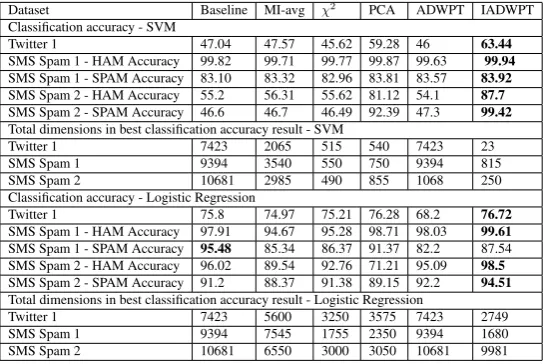
mRMR (Peng et al., 2005) and ADWPT (Qureshi et al., 2008). Results are reported in Table 1. The table reports best accuracy values and respective feature set size selected by the technique. It can be observed that IADWPT gives best accuracy in most of the cases with very few features.
We compared performance of our algorithm with mRMR. Results for SMS Spam 2 dataset are shown in Figure 2 and Figure 3. The plots prove efficacy of our algorithm versus state of the art mRMR algorithm. mRMR technique could not finish execution for the rest of the datasets. It can also be observed from results in Table 1 and Figure 1,2 that performance of feature selection algorithms follow consistent pattern in short text. Following is observed order of performance of al-gorithms in decreasing order, IADWPT, mRMR, PCA, Chi Square, MI. Further, it is observed that IADWPT performs well at feature selection without losing dis-criminative information, even when the dimensional-ity of feature space is reduced to as far as 1/40th of original feature space and steadily maintains the ac-curacy as dimensionality is reduced, which makes it a suitable technique for aggressive dimensionality reduc-tion. This also helps in learning ML (machine learn-ing) models faster due to reduced dimensionality. We plotted the discrimination power of coefficients in each dataset. Plot suggested that very few coefficients con-tained most of the discriminative power. And, therefore just working with these coefficients can help in getting good accuracies resulting in aggressive dimensionality reduction. Results establish the effectiveness of IAD-WPT for applicability in compressing short text feature representation and reducing noise to improve
classifi-Figure 4: Plot of Discriminative Power (Da,bm,f,l) ar-ranged in descending order
cation accuracy.
5.1 IADWPT Effectiveness
Short text data is noisy and consists of many features which are irrelevant to the task of classification of data. IADWPT effectively gets rid of the noise in approxima-tions(as Signal strength is greater than the noise), the feature selection step at the sub-band level as described in Algorithm 1, it enforces selection of good discrim-inative features and thus improves classifier accuracy, reducing feature space dimensionality at the same time. Features from sub-bands of the signal are chosen based on their discriminative power, therefore, the original signal information is lost and the transform is not re-versible.
IADWPT gives good compression of data and with-out losing discriminative information, even when the dimensionality of space is reduced to as far as 1/40th of original feature space and is thus steadily maintain-ing the accuracy as dimensionality is reduced, which makes it a suitable technique for dimensionality re-duction. This also helps learning machine learning models faster due to reduced dimensionality. Figure 4 shows the plot of Discriminative PowerDa,bm,f,l val-ues for coefficients arranged in descending order for SMS Spam 2 dataset. Other datasets displayed similar graph for Discriminative Power. From the figure it can be observed that few coefficients hold most of the dis-criminative power, and thus aggressive dimensionality reduction is possible with IADWPT algorithm. Results establish the effectiveness of IADWPT for applicabil-ity in compressing short text feature representation and reducing noise.
6 Conclusion and Future Work
[image:5.595.99.266.61.172.2]References
Charu C. Aggarwal. 2002. On effective classification of strings with wavelets.
Tiago A Almeida. Sms spam collection v.1.
http://www.dt.fee.unicamp.br/
˜tiago/smsspamcollection/,[Online;
accessed 10-September-2014].
T. Almeida, J. M. G. Hidalgo, and T. P. Silva. 2013. Towards sms spam filtering: Results under a new dataset. International Journal of Information Secu-rity Science.
John Blitzer. 2008. A survey of dimensional-ity reduction techniques for natural language.
http://john.blitzer.com/papers/
wpe2.pdf,[Online; accessed 10-September-2014].
R. R. Coifman and M. V. Wickerhauser. 2006. Entropy-based algorithms for best basis selection.
IEEE Trans. Inf. Theor., 38(2):713–718, September.
RonaldR. Coifman, Yves Meyer, Steven Quake, and M.Victor Wickerhauser. 1994. Signal process-ing and compression with wavelet packets. In J.S. Byrnes, JenniferL. Byrnes, KathrynA. Hargreaves, and Karl Berry, editors,Wavelets and Their Applica-tions, volume 442 ofNATO ASI Series, pages 363– 379. Springer Netherlands.
Corinna Cortes and Vladimir Vapnik. 1995. Support-vector networks. Mach. Learn., 20(3):273–297, September.
Ingrid Daubechies. 1992. Ten Lectures on Wavelets. Society for Industrial and Applied Mathematics, Philadelphia, PA, USA.
I. Daubechies. 2006. The wavelet transform, time-frequency localization and signal analysis. IEEE Trans. Inf. Theor., 36(5):961–1005, September.
Bo Han and Timothy Baldwin. 2011. Lexical normal-isation of short text messages. InProceedings of the 49th Annual Meeting of the Association for Compu-tational Linguistics: Human Language Technologies - Volume 1, HLT ’11, pages 368–378, Stroudsburg, PA, USA. Association for Computational Linguis-tics.
Rachel E. Learned and Alan S. Willsky. 1995. A wavelet packet approach to transient signal classifi-cation. Applied and Computational Harmonic Anal-ysis, 2(3):265 – 278.
Tao Li, Qi Li, Shenghuo Zhu, and Mitsunori Ogihara. 2002. A survey on wavelet applications in data min-ing. SIGKDD Explor. Newsl., 4(2):49–68, Decem-ber.
Preslav Nakov, Zornitsa Kozareva, Alan Ritter, Sara Rosenthal, Veselin Stoyanov, and Theresa Wilson. Semeval-2013 task 2: Sentiment analysis in twitter.
Hanchuan Peng, Fuhui Long, and Chris Ding. 2005. Feature selection based on mutual information: cri-teria of max-dependency, max-relevance, and min-redundancy. IEEE Transactions on Pattern Analysis and Machine Intelligence, 27:1226–1238.
Robi Polikar. Wavelet Tutorial. http: //users.rowan.edu/˜polikar/
wavelets/wttutorial.html,[Online;
accessed 10-January-2015].
Hammad Qureshi, Olcay Sertel, Nasir Rajpoot, Roland Wilson, and Metin Gurcan. 2008. Adaptive dis-criminant wavelet packet transform and local binary patterns for meningioma subtype classification. In Dimitris N. Metaxas, Leon Axel, Gabor Fichtinger, and Gbor Szkely, editors,MICCAI (2), volume 5242 ofLecture Notes in Computer Science, pages 196– 204. Springer.
NM Rajpoot. 2003. Local discriminant wavelet packet basis for texture classification. InSPIE Wavelets X, pages 774–783. SPIE.
Geraldo Xexeo, Jano de Souza, Patricia F. Castro, and Wallace A. Pinheiro. 2008. Using wavelets to classify documents. Web Intelligence and Intel-ligent Agent Technology, IEEE/WIC/ACM Interna-tional Conference on, 1:272–278.
Kuldeep Yadav, Ponnurangam Kumaraguru, Atul Goyal, Ashish Gupta, and Vinayak Naik. 2011. Sm-sassassin: Crowdsourcing driven mobile-based sys-tem for sms spam filtering. InProceedings of the 12th Workshop on Mobile Computing Systems and Applications, HotMobile ’11, pages 1–6, New York, NY, USA. ACM.