Intelligent E-learning for Training Electrical Power
Operators
Abstract— A SCORM compliant system called Intelligent System SI-Aprende (SI-Aprende in Spanish) has been developed and implanted at Comisión Federal de Electricidad (CFE) to build a collection of training objects for electric power operators. This paper presents the design and architecture of the intelligent E-learning SI-Aprende composed by computer based training components labeled as reusable learning objects; a learning object repository; a tutor module based on decision networks to select the best pedagogical action for each operator. The general aim of our work is to provide operators of complex industrial environments with a suitable training to certify operators in knowledge, skills, expertise, abilities and attitudes for the operation of power systems. The appropriate response is selected using Dynamic Decision Networks. The design, implementation and architecture of SI-Aprende are described.
Index Terms— adaptive learning, industrial application, learning objects, tutor model.
I. INTRODUCTION
An e-learning environment refers to the use of Internet technologies that provide a wide range of solutions to acquire knowledge [1]. E-learning systems facilitate learning without time or space restrictions, characteristics that cause impact onorganizations to extend the option of learning to a greater number of workers and explore new models of training.
The training requirements for utilities ask for powerful interfaces, a more efficient and better adaptive training, by means of incorporating artificial intelligence (AI) techniques, adaptive interfaces, simulation tools, learning objects based on multimedia and virtual reality components. This is the case of CFE (Comisión Federal de Electricidad –the National
Manuscript received July 15, 2010. This work was supported by the “Instituto de Investigaciones Electricas” of Mexico.
L. Argotte is with the Instituto de Investigaciones Electricas 62490 Cuernavaca, Morelos, Mexico (e-mail: [email protected]).
G. Arroyo-Figueroa is with the Instituto de Investigaciones Electricas, 62490 Cuernavaca, Morelos, Mexico (Phone: 52 777 3623820; fax: 52 777 3189854; e-mail: [email protected]).
J. Noguez is with Tecnológico de Monterrey, Campus Ciudad de México, 14380 Mexico, D.F., Mexico (e-mail: [email protected]).
Electric Utility in Mexico) which has generated an ambitious program for learning and training of personnel.
The training impact is directed to the production efficiency increase and in the decrease of non-planned production equipment outages and failures. The constant technology changes make necessary a permanent training of the CFE personnel. CFE has a clear view of its training needs according with its expansion plans and modernization; some actions are mentioned as follows [2]:
Construction of a collection of 150 Job Skills Technical Standards (JSTS).
To have the distance training technology consolidated, including the technological infrastructure (local networks, Internet and Intranet) and the design of courses (self-instruction and traditional) to satisfy the requirements of the JSTS.
In order to have an environment with a suitable training to certify personnel in knowledge, skill, expertise, abilities and attitudes for operation of power systems, CFE has an e-learning system called SI-Aprende.
The SI-Aprende system manages, spreads and promotes the knowledge of the CFE, by mean of the search and recovery of SCORM LOs. The Sharable Content Object Reference Model (SCORM) helps define the technical basis for a learning environment based on the Web [3].
SCORM sequencing provides developers with E-learning courses with the necessary tools to create complex designs that can even adapt to individual learning needs of students, consistently applied in sequencing capabilities that offer the following models:
Model statement of activities Monitoring Model
Model sequencing definition
SCORM does not address, but does not exclude the artificial intelligence-based sequencing in itineraries, the sequence that requires information from closed systems and external services, collaborative learning, custom, or synchronization between multiple parallel learning activities.
This paper presents the design and architecture of the intelligent environment SI-Aprende for the training of power systems operators and describes one of the components of
SI-Aprende, the tutor or instructional model that allows adaptive sequencing and navigation of LOs.
II. ARCHITECTURE OF THE INTELLIGENT E-LEARNING SI-APRENDE
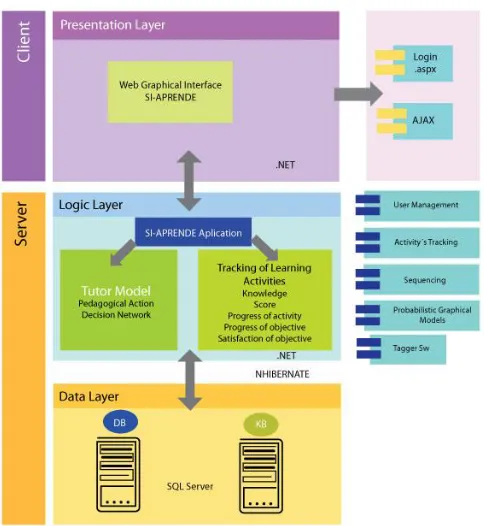
[image:2.612.315.571.71.636.2] [image:2.612.324.569.72.286.2]The architecture of the intelligent environment SI-Aprende was designed in three layers [4]: presentation, logic and data. Each one is described below and is represented in Fig. 1:
Fig. 1 Architecture of Adaptive Intelligent Environment SI-APRENDE
A. Presentation Layer
It contains the graphical interface that connects the system with the user in a Web environment. This user interface uses AJAX components that facilitate the development of it in .NET platform as well as simple and friendly interaction with the user.
The system has a Portal with access to the different profiles: administrator, instructor, and worker. Also has a search module for recover and reuse of learning object of the LOR. The Fig. 2 shows some interfaces of the SI-Aprende system.
a) Homepage
b) Instructor profile
c) Worker profile
Fig. 2 Interfaces of SI-APRENDE
B. Logic Layer
[image:2.612.55.297.197.460.2]model and monitoring of learning activities related to knowledge, skills, goal achievement and satisfaction and progress activity. This layer is associated with other components such as:
User management, monitoring of learning activities, sequencing and navigation, which are inherent components of the same application SI-Aprende.
Probabilistic Graphical Models (PGM's), it refers to applications that can create nodes and relationships and make inferences and propagation with evidences. Probabilistic Graphical Models are an elegant framework which combines uncertainty (probabilities) and logical structure (independence constraints) to compactly represent complex, real-world phenomena [5].
Tagger Software of Learning Objects (LOs), any environment or application that allows creating labels and SCORM packages.
C. Data Layer
This layer allows easy access and manipulation of information stored in databases. The technology used is: Hibernate .NET (NHibernate). Specifically, it contains access to the repository of SCORM learning objects database and SI-Aprende system. The proposed Database Manager is the Microsoft SQL Server.
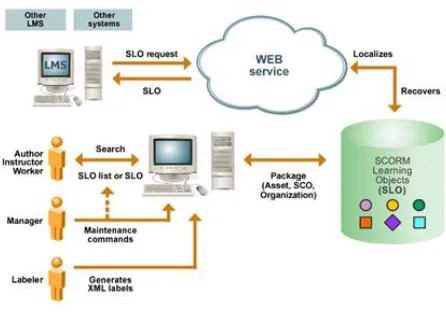
The Learning Object Repository (LOR) is a central database in which learning content (LO) is stored and managed (see Fig. 3). The Repository main component is the database and it is implemented using a relational database management system.
[image:3.612.333.556.78.234.2]The learning objects are packed and a SCORM compliant System can access them through the Web using either an HTML page or a Web service. The organization component of the manifest is a sequencing map that the LMS uses to present to the trainee the different learning items. Each item has objectives to be satisfied and rules to evaluate if a tree of learning items in the organization is completed by the student or not. Also, rules are used to allow the trainee to follow a different order than the linear top-down left-to-right order and skip items if he shows that he already has the appropriate competence to satisfy the objectives of the items to be skipped.
Fig. 3 The environment for the Learning Object Repository
By the end of the year 2009, the database was loaded with 130 power plant courses wrapped as SCORM complaint Learning Objects. The repository can be accessed nationwide through Intranet.
III. TUTOR MODULE
The tutor module [6] is the component that contains the sequence of learning objects to be presented to an operator as a self instructional nontraditional course. SI-Aprende generates this sequence which is represented as a decision network that selects the best pedagogical action for each specific operator. This System also controls the interaction with the operator, including the dialogue and the screen layouts. The main purpose of this module is to present to the operator the learning materials that better fits his learning needs.
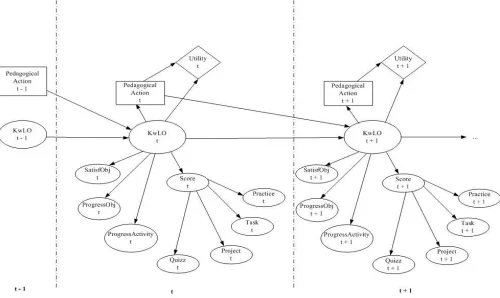
A decision network [7] represents information about the current state of the tutor, their possible actions, the state resulting from the action of the tutor and the usefulness of the resulting state, also known as influence diagram. It can be seen as an extension to Bayesian networks with random nodes, incorporating decision nodes and utility nodes. In SI-Aprende the decision network considers the following random variables (see Fig. 4):
Knowledge of LO
Satisfaction of the objective Progress of the Objective Progress of the activity Score of LO
Fig. 4 Decision Network
As the figure above shows, relations between the nodes are causal. KwLO random node has four values: Very Good, Good, Enough and Not Enough. The decision node considers the pedagogical actions that will be evaluated according to the utility function to select the best one, but have identified four possible pedagogical actions that are: LO challenge, Next LO, Repeat refined and Repetition of LO. The calibration of the decision network is given by experts in the domain. The utility table entries are set based
on the teacher experience about the best over all possible pedagogical actions according to the given knowledge state and student’s interaction.
The Fig. 5 shows the same decision network described in the previous figure but considering the evidence of LO´s Knowledge random node in the previous time as well as pedagogical action selected from the previous time, making it a dynamic decision network.
[image:4.612.56.556.400.698.2]This dynamic model allows taking into account the accumulated evidence from previous experiments with the results of the current knowledge object. The aim is to update the knowledge objects and take the best pedagogic action.
I. CONCLUSIONS AND FUTURE WORK
This paper presents the design and the architecture of Intelligent E-learning for Training Electrical Power Operators, called as SI-Aprende. The system has main layers: presentation (client), logic (server) and data (server).
The logic layer shows the contribution of this work, the development of an intelligent model for adaptive sequence of learning objects based on probabilistic networks. The use of decision networks provides a convenient way to control how the tutor makes decisions. Adjusting the conditional probabilities and the utility functions will influence how the decision is made. The intelligent model selects the best pedagogical action for each specific condition of self-learning, providing feedback to the student and generating the sequence of LO that best match the student learning process.
REFERENCES
[1] M. J. Rosenberg, “E-Learning”, in Strategies for Delivering
Knowledge in the Digital Age, E.U.A.: Mc Graw-Hill, 2001, pp. 28–
29.
[2] G. Rodríguez-Ortiz, J. Paredes-Rivera, L. Argotte-Ramos, G. Arroyo-Figueroa, “Learning Objects Planning for the Training of the Power Generation Operation and Maintenance Personnel”, IEEE
Electronics, Robotics and Automotive Mechanics Conference, vol. II,
2006, pp. 349-354.
[3] ADL, Sharable Content Object Reference Model version 1.2: The SCORM Overview, Advanced Distributed Learning, 2001. Available: http://www.adlnet.org (URL)
[4] L. Argotte, Modelo inteligente para la secuencia y navegación adaptativa de Objetos de Aprendizaje en ambientes E-learning, Instituto Tecnológico y de Estudios Superiores de Monterrey, Campus Ciudad de México, 2010.
[5] D. Koller, N. Friedman, L. Getoor and B. Taskar, Graphical Models in a Nutshell. In L. Getoor and B. Taskar, editors, Introduction to Statistical Relational Learning, 2007.
[6] P. Brusilovsky and J. Vassileva, “Course sequencing techniques for large-scale web based education”, Int. Journal Cont. Engineering Education and Lifelong Learning, Vol 13, No. 1/2, 2003, pp. 75-94. [7] S. Russell and P. Norvig, “Inteligencia Artificial: Un enfoque
moderno”, 2a. ed., Pearson Prentice- Hall, 2008.
Liliana Argotte. Degree in computer science from La Salle University. Since 1999 she is a researcher at the Institute of Electrical Research in Computer Systems Management. She has participated in courses related to information portals and e-learning graduates. Her areas of interest are Web-based educational systems, e-learning software, designing and developing databases with Internet technologies and data warehousing technologies.
Gustavo Arroyo-Figueroa. Ph.D in Computer Science from the Monterrey Institute of Technology in 1999. Since 2000, is the Head of the Computer Systems Department at the Electric Power Research Institute of Mexico. He is the author of many publications in books, journals and conferences. He has been editor of journal special issues and conference proceedings. Dr. Arroyo-Figueroa is a member of Mexican National Researchers System, Artificial Intelligence Mexican Society, IEEE Computer Society, CIGRE, and IASTED. His research interest includes uncertainty reasoning and artificial intelligent applications to power systems.