Comparative Study on the Behaviour of RC Flat
Slab Structures V/S Conventional RC
Harshitha Manjunath1, Dr. M. N Hegde2
1
PG Student, 2Professor & Dean, Department of Civil Engineering, Dr. Ambedkar Institute of Technology, Bangalore-560004
Abstract: A three- dimensional RC structure with and without flat slab is modeled using ETABS 2016. Flat slab model with shear wall and perimeter beams are analyzed for earthquake loads using Response spectrum analysis. The results like displacement, storey drift , storey shears, Base reactions are extracted. Comparisons are made. Providing shear walls and perimeter beams significantly reduces displacement and storey drift. From the results it can be concluded that R C structure with flat slabs shows a better performance and preferred to the conventional RC slab.
.Keywords: Displacement, Storey drift, Storey shear, Base reaction, ETABS-2016.
I. INTRODUCTION
The scarcity of space in urban.areas has led to the development of vertical.growth consisting of low-rise, medium-rise and tall
buildings. Generally framed.structures are used for these buildings. They are subjected to. both vertical and lateral loads. Lateral
loads.due to wind and earthquake governs the.design rather than the vertical loads. The buildings designed for vertical load.may not
have the capacity to.resist the lateral loads. The lateral loads are the premier ones because in contrast to vertical load that may be
assumed to .increase linearly with height; lateral loads are quite.variable and increase rapidly with height. Under a uniform wind and
earthquake. loads the overturning moment at the base is very.large and varies in proportion to the square of the height of the.
building. The lateral loads are considerably higher in the top. storey rather than the bottom storey due to which building.tends to act
as cantilever. These lateral forces.tend to sway the frame. In many of the seismic prone areas there are several instances of failure of
buildings which have. not been designed for earthquake loads. All these reaction makes the study of the effect of lateral loads very
important.
Pure rigid frame system or frame action.obtained by the interaction of slabs, beam and column is not adequate. The.frame alone fails
to provide the required. lateral stiffness for buildings. taller than 15 to 20 (50m to 60m) stories. It is because of the.shear taking
component of deflection produced by the bending of columns and slab causes the building to deflect excessively. There are .two ways to satisfy these requirements. First is to increase the size of members beyond and above the strength requirements and .second is to change the form of .structure into more .rigid and stable to confine deformation. First approach has its own limits, whereas second one is more elegant which increases rigidity and stability of the structure and also confine the deformation requirement. In earthquake engineering, the structure is designed .for critical force condition among the load combination.
II. OBJECTIVES
A. To study The main objective of the analysis is to. study the different forces acting on a building. The analysis is carried out in.
ETABS - 2016.
B. Conventional R.C.C structure and flat slab R.C.C for different. heights are modeled and analyzed for the different.
combinations of Dynamic loading. The comparison is made between the conventional R.C.C structure and flat slab R.C.C. Buildings are situated in seismic. zone. IV.
C. To study the vulnerability of purely. frame and purely flat-slab models under different factors such as Storey. drift, lateral
displacement, time. period and base shear have been obtained for SPECX (EX) and SPECY (EY) in zone IV. The axial load and moments in. columns have been obtained for various load combination in zone. IV.
III. METHODOLOGY
A 3D RC residential building is modeled. Flat is introduced at different levels for different models.
A. Model one with no flat slab.
B. Model two with flat slab at 1st floor
C. Model three with flat slab at 3rd floor
Flat slab model with perimeter beams are analyzed for earthquake loads.
Results like displacements, storey drifts, base reactions, response spectrum analysis, time history method are extracted. The results are compared with the conventional building.
Conclusions are made accordingly.
IV. MODELING
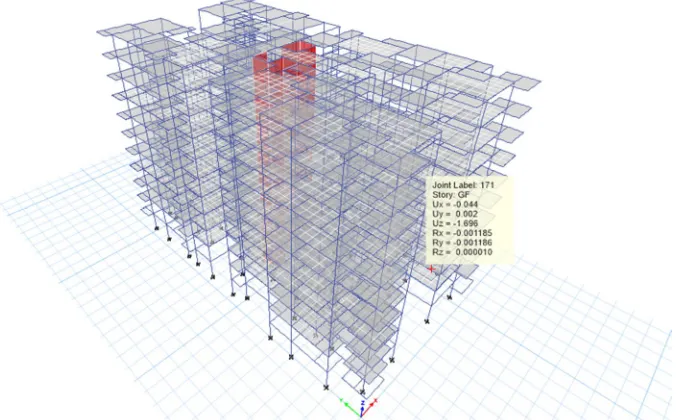
It includes the modeling of G+9 storey building. It is modeled with RCC elements.
[image:2.612.161.500.252.462.2]Following are the types of models prepared for the analysis, 1) MODEL 1: Conventional structure with no flat slab 2) MODEL 2: A structure with flat slab at first floor 3) MODEL 3: A structure with flat slab at third floor 4) MODEL 4: A structure with flat slab at seventh floor.
[image:2.612.191.443.490.715.2]V. RESULT AND DISCUSSION
A. Maximum storey displacement
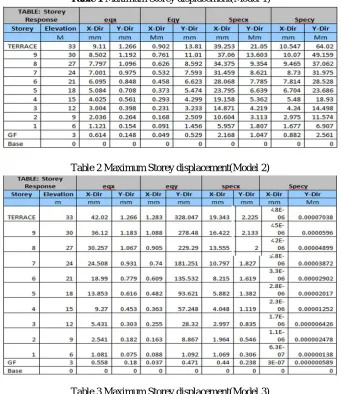
Table 1 Maximum Storey displacement(Model 1)
[image:3.612.136.478.119.513.2]Table 2 Maximum Storey displacement(Model 2)
Table 4 Maximum Storey displacement(Model 4)
From the results obtained it can be seen that displacement values are high for the conventional RC structure.
B. Maximum storey drift
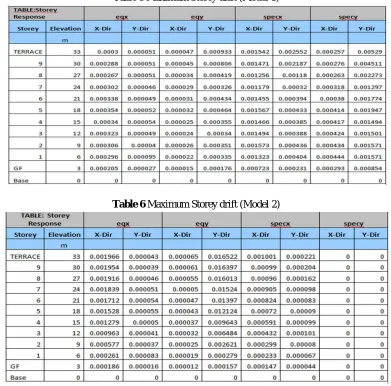
Table 5 Maximum Storey drift (Model 1)
[image:4.612.110.501.343.729.2]Table 7 Maximum Storey drift (Model 3)
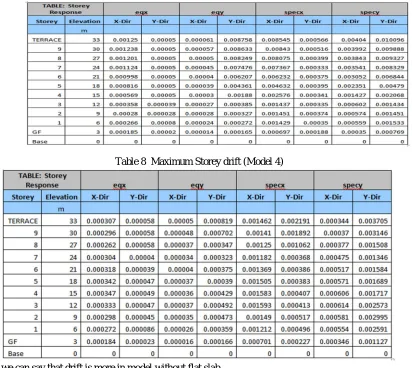
Table 8 Maximum Storey drift (Model 4)
From the results we can say that drift is more in model without flat slab.
C. Base reaction
Table 9 Base Reaction Model 1
[image:5.612.83.479.464.731.2]Table 11 Base Reaction Model 3
Table 12 Base Reaction Model 4
Moments and the forces of all models are tabulated.
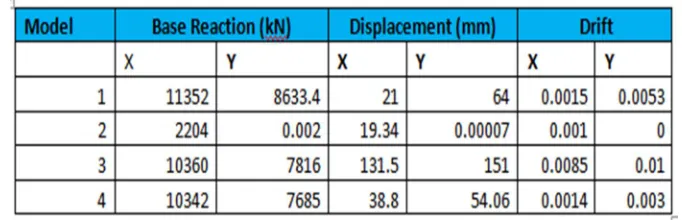
[image:6.612.134.475.439.549.2]D. Comparison Of Different Parameters
Table 13 Comparison
The above table shows the comparison of various parameters, where
1) Model 1 is the conventional RC building.
2) Models 2,3,4 are provided with flat slabs.
3) Shear wall and perimeter beams are provided for flat slab structure for reduction of displacement and storey drifts.
REFERENCES
[1] Agarwal. P. and Shirkhande.M, “Earthquake resistant Design of Structures” Printice- Hall of India Private Ltd. New Delhi, India.
[2] Alpa Sheth“Effect of perimeter frames in seismic performance of tall concrete buildings with shear wall core and flat slab system” The 14th World Conference on Earthquake Engineering October 12-17, 2008, Beijing, China.
[3] Apostolska1 R.P and Necevska-Cvetanovska G. S, “Seismic performance of flat-slab building structural systems” The 14th World Conference on Earthquake Engineering October 12-17, 2008, Beijing, China.
[4] Bhavikatti S.S, “Advance R.C.C. Design” , New Age International (p) Limited, Publishers, New Delhi, India.
[5] Ema COELHO, Paulo CANDEIAS, Raul ZAHARIAand Artur V. PINTO, “Assessment of the seismic behavior of R C flat slab building structures”, 13th World Conference on Earthquake Engineering Vancouver, B.C., Canada August 1-6, 2004 Paper No. 2630
[6] Garg c.s, Yogendrasingh, Pradeep Bhargava and Bhandari N.M, “Seismic performance of flat slab shear wall system”, Journal of structural Engineering, Vol.37, No.3, August-September2010, PP.203-207.
[7] Lan N .Robertson, “Analysis flat slab structures subjected to combined lateral and gravity load”, ACI Structural Journal.