[
344AN EXPERIMENTAL ANALYSIS OF THE FUNCTION
OF THE PSEUDOBRANCH IN TELEOSTS
BY GWYNETH PARRY* AND F. G. T. HOLLIDAYf
(.Received 16 December 1959)
I. INTRODUCTION
The pseudobranch is the remnant of the first gill arch in teleosts, situated antero-dorsally in the opercular cavity. In many fish it is buried beneath the skin and connective tissue, although in some species it hangs freely. The pseudobranch is absent in cyclostomes and elasmobranchs, and also in the Holocephali and Dipnoi. It is absent in a few teleosts such as the eel and some other eel-like fishes (Walls, 1942).
The pseudobranch is supplied with arterial blood from the first efferent gill artery, and within the pseudobranch this blood vessel is split up into a capillary system. Its efferent vessel (the ophthalmic artery) goes to the choroid gland of the eye (Graase, 1958; Barnett, 1951) which is another capillary body. This chorio-capillaris is supplied secondarily by a branch of the carotid artery, the retinal artery, which supplies also the lentiform body of the eye. The venous blood from the choroid gland, along with blood from other parts of the eye, is drained into the venous channels of the head, and thus returns to the general circulation of the body. The tissue of the pseudobranch consists almost exclusively of acidophil cells, which are of a general secretory type, thought to be the same or similar to those of the gills (the Keys-Willmer cells) (Copeland, 1951; Grasse, 1958). A recent electron-microscope study (Copeland & Dalton, 1959) clearly demonstrates that there are direct secretory ducts running between the cells and the channels of the capillary blood system. The cells are known to contain the enzyme carbonic an-hydrase, and the pseudobranchs are the principal source of this enzyme in teleost fishes (Maetz, 1953; Vervoort, 1958).
The pseudobranch has had ascribed to it a number of functions, but none has been very clearly elucidated. The principal theories put forward are as follows:
(1) That it is salt regulatory, since it contains Keys-Willmer cells.
(2) That it is respiratory, functioning either as a supplementary gill, or in some way involving the enzyme carbonic anhydrase.
(3) That it is an ocular regulator, either by controlling blood pressure in the eye, or by biochemically regulating the eye fluids via the choroid gland.
(4) That it is an endocrine organ.
II. MATERIALS AND METHODS
Experiments have been made on several species of marine and fresh-water fishes. These were the salmonids Salmo trutta (L.), as the fresh-water brown trout and as the marine sea trout, the rainbow trout 5. gatrdnerii (Richardson) in fresh water, the herring, Clupea harengus (L.), the saithe, Gadus vixens (L.) and the plaice
Pleuronectes platessa (L.) in sea water. The experiments were made in fresh-water
conditions in the Freshwater Fisheries Laboratory, London, and in sea-water conditions in the Scottish Home Department's Marine Laboratory in Aberdeen. The fish were established for some time in these aquarium conditions before being subjected to any of the operational and experimental conditions. For the operation of pseudobranchectomy, the fish were anaesthetized with ' Metacaine' (Sandoz MS 222) in a concentration of 1:10,000. The pseudobranchs were removed surgically and the fish were replaced in the fresh or sea water from which they had come. Survival was almost complete, and very soon after such operations the fish were active and feeding. In some cases fish were 'mock-operated* by scraping the opercular lining, or by cutting filaments of the first gill arch; survival of both operated and mock-operated fish was similar, and any deaths were obviously the result of handling or of too deep anaesthesia.
III. EXPERIMENTS TO TEST THE SALT-REGULATING FUNCTION The ability of operated and normal fish to osmoregulate was tested by subjecting marine and fresh-water fish to a series of sea-water dilutions and by following both their survival and the concentration changes in the blood. The survivals of control and operated fish did not differ significantly, and measurement of the freezing-point depressions of the blood at certain time intervals following the operation (by the method of Ramsay, 1949) showed that while the operated fish may initially demonstrate a wider variation in blood concentration, they did not show an impaired ability to osmoregulate after this initial period. The species used for this type of experiment in sea water were Salmo trutta and Gadus virens, and in fresh water
Salmo trutta and S. gatrdnerU. Some typical figures for such an experiment with
the saithe are shown in Table 1. These results are also expressed graphically (Fig. 1) by plotting the mean values for internal blood concentrations against that of the external medium. It is clear that both normal and operated fish are able to control the blood concentration at the usual sea-water level, over a large range of external concentration.
346 G W Y N E T H PARRY AND F. G. T. H O L L I D A Y
A further test of ion regulatory ability was made in experiments with the
radio-active isotope of sodium, MNa. In these experiments fish of similar size were taken from aquarium stocks and injected with a dose of radiosodium, in the form of
Table i . Osmoregulation in pseudobranchectomized and normal fish
(Gadut vireru (saithe) from sea water ind kept in sea-water dilution*. Freezing-point depressions
(A° C.) of blood.)
Medium (° C.) ... 0-48 0-96 i-44 1 92
Time (hr.) 1 2 4 8 3+ 7 2 96 op. 0*62 0-56 0-65 0-58 0-63 o-6i o-6i n. 0-63 0-64 0-67 0-63 0-62 0-58 0-69 op.
0 6 6 0-62 0-69 0-64 0-62 0-63 o-6o n. 0-64 0-62 0-69 0 6 5 0 6 6 0-62 0-65
o p .
0-65 o-6i 0 6 6 0-79 0-65 0-62 0-62 n. 0-63 0-65 0 6 6 0-64 0-64 0-64 0-62 op. 0-67 0-64 o-66 0-79 0-62 — 0-93 n. (o-69) (069) (0-69) (0-69) (0-69) — o-6a
Mean A° C. — 0-69 ± 0-02 for a normal population of fish in sea-water aquaria. ' op.' are pseudo-branchectomized fish, 'n.' are fish randomly selected from a natural population.
O o 1-00 5 !0-50
•A
/
cr .Normal 'Operated0-50 100 1-50 External medium, A°C.
Fig. 1. Gadus wens (saithe) after 24 hr. 200
Table 2. Ionic regulation in pseudobranchectomized and normal fish
Sample
S. trutta op. plasma S. trutta op. muscle S. trutta n. plasma
5. trutta a. muscle
S. gcardnerti op. plasma
5 . gatrdnerU op. muscle
S. gairdnern n. plasma 23s I - I 2-0 — — — S. gairdneru n. muscle — — — 0-050 0-0095 —
Some laking of blood produces high values of plasma [K]. 'op.', 'n.' as in Table 1. Ions
(m-equiv./kg.
Na
257 — 2 6 4
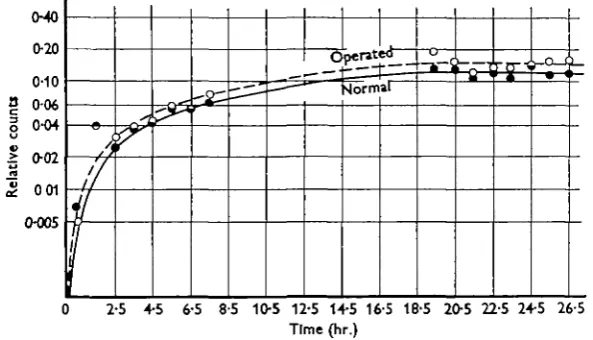
a normal saline, into the body cavity. They were then placed in tanks of sea water or fresh water and the rate at which the radiosodium was exchanged for non-active sodium measured by counting samples of the ambient water. A control tank of water with the same dose and the same volume was used. Thus two fish (one operated, one normal) of 150 g. weight each had a dose of 1 ml. saline and were placed in 50 1. water; the control tank of 50 1. water was similarly dosed with 1 ml. of the radioactive saline. The difference in counting rates of the fish tanks and the control tank was expressed as a ratio (' relative activity'), and thus calculations for decay rate were avoided. These experiments with S. trutta in fresh-water and sea-water conditions confirmed the survival experiments, since there was no evi-dence of a different rate of exchange of the radioactive ion in normal and operated fish (Fig. 2).
(HO
[image:4.451.77.374.245.415.2]0 2-5 4-5 6-5 8-5 10-5 12-5 14-5 16-5 18-5 205 22-5 24-5 26-5 Time (hr.)
Fig 2. Salmo trutta (brown trout) in static fresh water.
IV. EXPERIMENTS TO TEST THE RESPIRATORY FUNCTION* Two types of 'respiratory stress' experiments were made, in which the survival times of operated and normal fish were observed. The method of treating the data obtained in such a survival experiment has been described by Alabaster, Herbert & Hemens (1957). The two experimental conditions were: first, a medium with high carbon dioxide and a moderate oxygen concentration; and secondly, a medium of low oxygen concentration but no carbon dioxide. The concentration of gases in each experiment was controlled at such a level as to provide a reasonable spread of results, too long a survival allowing some adaptation of the fish to the environment and too short a survival concealing any differences between operated and control
fish, if they are present.
The ambient fresh water in these experiments was provided by a constant-flow
348 G W Y N E T H PARRY AND F. G. T. HOLLIDAY
apparatus, controlled by a flow-meter, and maintained at 20 ±0-5° C. throughout the experiment. The water was first forcibly aerated to drive off carbon dioxide and to aerate it fully. A part of this water was then bubbled with nitrogen so that it contained no oxygen. The oxygenated and deoxygenated waters so obtained were then mixed in fixed proportions using a dosing apparatus to provide for a flow of water of 0-7 l./min. The medium containing the high carbon dioxide concentration and moderate oxygen was similarly supplied by mixing three streams of water, one of which was saturated with carbon dioxide. The fish used in the experiments were small operated and control S. trutta and S. gairdnerii (4-5 cm.) and one experiment with larger specimens of S. gairdnerii (16-22 cm.). Ten operated and ten normal fish were used in each case, in a 40 1. tank for the larger fish and an 8 1. tank for the smaller ones.
The low-oxygen experiments had a concentration of 2-o and 1-7 p.p.m. for the small fish, and 1-4 p.p.m. for the larger fish. The high carbon dioxide experiments had a concentration of carbon dioxide between 23 and 27 p.p.m. and an oxygen concentration of about 2-0 p.p.m. Oxygen levels were checked at 30 min. intervals by the Winkler method, and carbon dioxide at the same intervals by determining bicarbonate, pH and temperature and calculating the free carbon dioxide from the nomograma given by Dye (1952).
In the first set of experiments (high carbon dioxide), no consistent differences in survival of operated and control fish could be found (Table 3). The results of one such experiment, for rainbow trout, are plotted graphically in Fig. 3, and it istclear from these fuller results that although the median periods of survival of the two groups of fish in this experiment were different, there is no consistent separation of the survival of the two lots of fish.
Table 3. The survival of pseudobranchectomized and normal trout at low
concentra-tions of dissolved oxygen in the presence of about 30 p.p.m. carbon dioxide
Species
S. gairdnem
S. trutta
Size (an.)
4-5 4-5 4-5 16-22
4-5
Dissolved oxygen
(p.p.m.)
2-1 2-2 2 - 2 1-8
2 - 2
Median period of survival (min.)
Operated
47 1 0 0 4 0 7 0
IS
Control
41 300 1 0 0 70
15
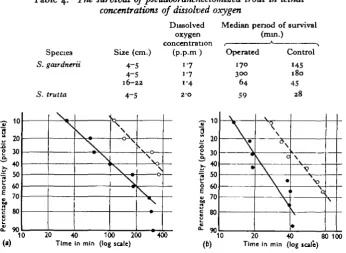
In the second set of experiments (in lethal oxygen concentrations) the results with both species of fish indicated that operated fish were able to survive con-siderably better than normal ones (Table 4). Figs. 4 a and 46 express some of the full results graphically, and demonstrate the clear separation of the two groups of control and operated fish.
349
10 'v 20 3 « 30 _o o JL4Oj T 50
E £,70 S § 80 90 \>-\ \
i^ \
\ \
\
\
\
N
\\
\°
\
20 30 60 100 Time In mln (log scale)
[image:6.451.93.368.62.299.2]200 300
[image:6.451.56.403.348.601.2]Fig. 3. Rate of mortality of rainbow trout in a concentration of dissolved oxygen at 2-0 p.p.m. and carbon dioxide at 200 C. • , Normal; O, pseudobranchectomized.
Table 4. The survival of pseudobranchectomized trout in lethal
concentrations of dissolved oxygen
Species 5. gatrdnerii
S. trutta
Dissolved Median period of survival oxygen (nun.)
concentration , * > Size (cm.) (p.p.m) Operated Control
4-5 4-5 16-22 4-5 1-7 170 300 64 59 145 1 So 45 28 scale ) a o Q. L> r* e & Kerce n 10 20 30 10 60 80 9(1 \ \ \ s \ o \0 \ \ (a) 0
10 20 40 100 200
Time in mln (log scale)
400
A
•
\\
\ •
*\
\'\
\
V \ ) \ Q • 5- 10 0 : 201 3 0
I 50
o 60
u 70
2 90
10 20 40 _ 80 100 (b) Time in min (log scale)
350 G W Y N E T H PARRY AND F. G. T. HOLLIDAY
the higher survival value of pseudobranchectomy is brought about by a reduction in metabolic activity of the fish, following the operation. It had been observed that operated fish were quiet in aquarium conditions.
V. EXPERIMENTS TO TEST THE ENDOCRINE FUNCTION
During the course of these experiments, long-term observations (up to 15 months) were made on bilaterally and unilaterally pseudobranchectomized fish. Growth and maturation processes did not appear to be affected, although the general level of activity appeared lower in the operated fish than in control fish kept in the same aquaria. The most striking effect of pseudobranchectomy, which was evident within a short time of the operation, was the total and permanent darkening of the fish due to the maximal expansion of the chromatophores. This response was shown irrespective of light conditions or the colour of the background.
The time taken for the complete expansion of the chromatophores after pseudo-branchectomy in brown trout was 12-15 Tr^n- Times of this order were also recorded
for sea trout, saithe, flounders and plaice. In brown trout, expansion of the chromatophores had begun within 5 min. of the operation and the fish were visibly darker within this time. Certain areas of chromatophores responded more quickly than others: darkening began in the head region and the dorsal midline, and spread rapidly down the sides of the fish and then to the fins. The speed of this reaction is in marked contrast to that generally reported for such changes from white to black in intact fish (Parker, 1948).
It was further observed that unilateral pseudobranchectomy did not lead to darkening, nor did the incomplete removal of the glands. Cutting either the afferent or efferent blood vessels of the pseudobranchs on both sides of the fish also produced darkening, but not if the operation was on one side only.
It is well known that 'excitement pallor' in fishes can be induced as a shock reaction. In all our experiments care was taken to identify this shock pallor, which with careful handling and the use of anaesthetics was only a momentary effect, and to differentiate it from the response to the pseudobranch factor.
Mock-operated fish, or imperfectly pseudobranchectomized fish, served as controls for the darkening reaction; such fish remained light in colour in the usual laboratory light conditions. Any shock pallor following pseudobranchectomy was reversed very quickly.
ligature, the dark phase persisted. If the ligature was left on for a longer period (about 1 hr.) the colour reversal was either very slow, or in some cases absent. This could indicate that the function of the pseudobranch had been impaired by a lengthy interruption of its blood supply.
Extracts of pseudobranch material were prepared by homogenizing freshly extracted or deep-frozen glands in saline solutions, and centrifuging to obtain a clear extract. Reinjections of such material were made into dark pseudobranch-ectomized fish. The potency of the extracts varied from one set of experiments to another. At the moment no explanation can be offered for this variation in potency. For instance, the reinjection of fresh brown trout pseudobranch material intra-muscularly into dark operated brown trout in fresh water produced a local paling of the skin around the site of the injection. Pseudobranchectomized sea trout, which had been dark for some 6 months, returned to a light grey colour 3-4 hr. after intraperitoneal and intramuscular injection of a 1 ml. extract of 2 sea trout pseudobranchs. This paling was a temporary response and the fish became dark again within 24 hr. An extract of pseudobranch material made from the deep-frozen glands of horse mackerel and cod, when injected into dark plaice, produced local temporary paling and some reintroduction of pattern, within a period of 4-5 hr. Control operated fish were injected with a saline extract of gill-tip tissue and showed no such paling response.
The saline extract of horse mackerel and cod pseudobranchs was further tested for its effects on isolated chromatophores in fragments of the dark pectoral fins taken from pseudobranchectomized sea trout and plaice. This led to the complete contraction of both the melanophores and the erythrophores within 30 min. Control pieces of fin in a saline extract of spleen or in an extract of gill tips did not show this response within the same time period, or after a much longer period of observation (up to 6 hr.).
VI. DISCUSSION
352 GWYNETH PARRY AND F. G. T. HOLLIDAY
conversely those fishes with a well-developed choroid (e.g. the horse mackerel) have large and prominent pseudobranchs (Walls, 1942).
The physiological evidence from the literature shows that the pseudobranch consists of secretory acidophil cells, producing either carbonic anhydrase or some substance involving carbonic anhydrase in its production, and secreting directly into the capillary vessels in the gland. Experimental evidence put forward in this paper establishes that an interruption in the blood supply of the gland, or the removal of the gland, brings about darkening in the fish. There is no evidence for any osmoregulatory or ion-regulating function of the gland, and no evidence of any direct respiratory effect. It may be concluded from these experiments that the pseudobranch is concerned in some way with the maintenance of the pale colour phase in normal teleost fishes. The nature of a possible chromatophore-concen-trating substance in the gland calls for further experimentation.
On the basis of the experimental evidence put forward here it is possible to formulate an hypothesis which does much to explain our observations and is not inconsistent with any of the facts so far established.
The cells of the pseudobranch produce a substance, for convenience called ' P ' . This is released into the circulation and is carried via the efferent pseudobranchial artery to the choroid gland of the eye, and from there reaches the general circula-tion. ' P ' is a substance capable of stimulating the chromatophores to contract and the amount of ' P ' circulating in the body of the fish, in conjunction with other humoral and nervous mechanisms, determines its shade and pattern in relation to the background, by the responses of the chromatophores. Some of these chromato-phores may have a lower threshold of response to ' P ' than others. The amount of ' P' in the circulation is controlled by the state of the capillaries in the choroid gland; when fully dilated there is a maximal blood flow from the pseudobranch into the general circulation and the fish is pale; when the capillaries are fully contracted the circulation through the pseudobranch is restricted and the amount of 'P' in the general circulation is thus low, and the fish is dark. Thus in this double system, the pseudobranch can be regarded as a self-replenishing reservoir of ' P ' , and the choroid gland is the ' tap' which can be opened or closed to a varying degree. The control of the 'tap' might well lie in the amount of incident light falling on to the retina, with or without pituitary intervention. Fish in the dark, or blinded fish, are then dark because of the associated restriction of the amount of 'P' released into the circulation.
This hypothesis and the observations on which it is based, recall the mechanism of colour control in the decapod Crustacea (Prosser, Brown, Bishop, Jahn & Wulff, 1950). Here the eye-stalk gland produces a hormone causing chromatophore con-traction and removal of the gland results in maximum pigment migration. It seems likely that this gland in the Crustacea is in turn controlled by the light falling on the eye.
pseudo-branch, by interrupting a major blood supply to the eye, produce results which can be, and have been, obtained by blinding the fish. However, if our hypothesis is accepted, bunding of the fish interrupts the blood supply from the pseudobranch, and thus prevents the circulation of 'P'. The experiments on isolated chromato-phores demonstrate that the effect of the pseudobranch can be independent of the eye.
This suggestion that a new organ affects colour in fish is not incompatible with the existing interpretations of colour change. Indeed such an hypothesis for colour change in those teleosts possessing a pseudobranch, with or without pituitary influence, could clarify many otherwise confusing accounts of colour phenomena in the literature.
SUMMARY
1. The effects of removal of the pseudobranch have been studied in four species of marine fish and two species of fresh-water fish.
2. No evidence was found for any direct effect upon osmoregulation or respiratory exchange.
3. Removal of the pseudobranchs was followed by the darkening of the fish, due to chromatophore expansion, and after some weeks, by the degeneration of the choroid gland in the eye.
4. It is suggested that the pseudobranch produces, or activates, a hormone affecting the chromatophores and that the entry of this hormone into the general circulation is controlled by the choroid gland.
REFERENCES
ALABASTER, J. S.( HERBERT, D. W. M. & HEMKNS, J. (1957). The survival of rainbow trout (Salmo
gatrdnerit Richardson) and perch (Perca fluviatilis L.) at various concentrations of dissolved
oxygen and carbon dioxide. Arm. Appl. Biol. 45, 177-88.
BARNETT, C. H. (1951). The structure and function of the choroidal gland of teleostean fish. J. Anat.,
Land., 85, 113-19.
COPELAND, D. E. (1951). The function of the pseudobranch in teleosts. Amer. J. Phystol. 167, 775. COPELAND, D. E. & DALTON, A. (1959). An association between mitochondria and the endoplasmic reticulum in cells of the pseudobranch of a teleost. J. Biophyt. Biochem. Cytology, 5, 393-6. DYE, J. F. (1952). Calculation of the effect of temperature on pH, free CO, and the three forms of
alkalinity. J. Amer. Wat. Wks Ass. 44, 365-72.
GOODRICH, E. S. (1930). Studies on the Structure and Development of Vertebrates. London: Macmillan and Co.
GRASSE, P. P. (1958). Traxte de Zoologie. Agnathet et Poissons, Tome xin. Pans: Masson et Cie. MAETZ, J. (1953). L'anhydrase carbonique dans deux teJebsteens voisins. C.R. Soc. Biol., Paris,
147. 204-6.
PARKER, G. W. (1948). Animal Colour Changes and their Neurohumours. Cambridge: University Press.
PFLUGFELDER, O. (1951). Weitere volumetrische Untersuchungen iiber die Wirkung der Augen-extirpation und der Dunkelhaltung auf das Mesencephalon und die Pseudobranchien von Fischen. Roux Arch. EntwMech. Organ. 145, 540-60.
PROSSER, C. L., BROWN, F. A., BISHOP, D. W., JAHN, T. L. & WULFF, V. J. (1950). Comparative
Animal Physiology. London: Philadelphia and Saunders.
RAMSAY, J. A. (1949). A new method of freezing-point determination for small quantities. J. Exp.
Biol. 26, 57-64.
VERVOORT, W. (1958). The pseudobranchs of Xiphophorus helleri Heckel. Arch, nierl. Zool. 13, 1 (Suppl.), 210-24.
354 GWYNETH PARRY AND F. G. T. HOLLIDAY
ADDENDUM
The relationship between the activity of the acidophil cells of the gills and pseudo-branch of teleosts and some endocrine glands has been reviewed recently. Leiner (1938) and Leiner & Leiner (1940) held the view that the carbonic anhydrase pro-duced by these cells in the various sites in fishes is of importance in the field of gas-metabolism. This has support from recent experimental work (Enami, 1959), at least for the cells of the gas-gland, although the function of the cells in the branchial region is not so clear. Enami reports that the cells in the gills of the catfish
(Para-silurus) are stimulated to ' a kind of holocrine activity' by hypophysectomy, or by
subcutaneous injection of eel urohypophysis, or by a number of chemical agents— sodium chloride, acetylcholine, adrenalin, noradrenalin, pilocarpine, or physostig-min. Transection of the spinal cord anterior to the urohypophysis, or implantation of excess pituitaries, leads to the disappearance of the cells. Thus there is some evidence that their activity is controlled by the urohypophysis, which is in its turn controlled by the pituitary. In Fundulus, on the other hand, Burden (1956) found no changes in the cells in the gills after hypophysectomy, although the mucous cells atrophied and the fish could no longer survive in fresh water.
The function of the acidophil cells in teleosts thus seems fundamental to their physiology, but the relationship to gas-metabolism, salt exchange and endocrine activity is confused and clearly requires further experimentation.
REFERENCES
BURDEN, C. E. (1956). The failure of hypophysectomized Fundulus heteroclitus to survive in fresh water. Biol Bull., Woods Hole, n o , 8-28.
ENAMI, M. (1959). The morphology and functional significance of the caudal neurosecretory system of fishes. In Comparative Endocrinology, ed. A. Gorbman, 746 pp. New York: John Wiley and Sons.
LEINER, M. (1938). Die Physiologie der Fuchatmung, 134 pp. Leipzig: Akad. Verlags.
LEINER, M. & LBTNBR, G. (1940). Da« Ferment Kohlensfiureanhydratase im Tierkorper. I. Biol.