Ad-Hoc On-Demand Distance Vector (AODV)
Routing Protocol with Improved Optimization Bat
(IOBAT) Algorithm for Energy Efficiency and
Network Lifetime over MANET
C. Daniel Nesa Kumar
1, E. Infant Akkansha
2, R. Gandhimathi
31Assistant Professor, 2, 3MCA Student, Department of MCA, Hindusthan College of Arts and Science, Coimbatore
Abstract: Huge traffic requirements for omnipresent access and promising mixed media applications extensively intensify the vitality usage of battery-fueled cell phones. This pattern advisers for that vitality effectiveness turns into a vital component of Mobile Ad Hoc NETworks (MANET).The previous research has issues with energy consumption and network lifetime thus the overall network performance is reduced. The proposed system introduced Ad-hoc On demand Distance Vector (AODV) routing protocol with Improved Optimization BAT (IOBAT) algorithm for increasing the performance. The proposed method contains three phases are network formation, route discovery, maintenance and generation of objective function. In the network formation, nodes are connected to send and receive the packets. In second phase, the AODV protocol is used to compute the energy consumption using distance among nodes. Route discovery and maintenance have been proposed to reduce the hop count in the given network. Hence the energy consumption is improved efficiently. In the third phase, the IOBAT is used to optimize the network lifetime. The optimized search criteria of bats help to decrease amount of bats for the search process. All bats use echolocation to sense distance, and they also know the difference between food/prey and background barriers in some magical way. Simulation results conclude that the proposed AODV-IOBAT algorithm is better than the existing Dynamic Source Routing (DSR) and Particle Swarm Optimization (PSO) in terms of lower energy consumption, higher throughput, higher packet delivery ratio and higher network lifetime.
Index Terms: MANET, AODV, energy efficiency, network lifetime and IOBAT algorithm
I. INTRODUCTION
Mobile Ad Hoc NETworks (MANETs) are marked by a distinguishing feature with the intention of consists the nonexistence of any central coordination [1]. The highly mobile nodes forming a MANETs are powered with the facilitate of exhaustive resource named as battery. The lifetime of a network mainly depends on the approaches included contained by the protocols [2] in-order towards decrease the energy consumption as there is an absence of any important development in the area of battery lifetime. Energy efficient becomes a major issue to be handled in recent years.
To start communication between mobile nodes, a set of algorithms must be followed. The routing algorithms are link state routing protocol and distance vector protocol. However in MANET, routing and transmission during these algorithms are limited since of the diverse aspects are Quality of Service (QoS), energy utilization, throughput and bandwidth. The system makes use of proactive protocols in the direction of preserve the routing information and nodes history. The routing information such as node id, address, energy and routing cost are saved addicted to the routing table. Routing tables must be efficient along by means of the changes in scheme over time [3].
Routing in larger networks is significantly difficult appropriate towards moving nodes and so many algorithms have been introduced. The major aim of routing in a MANET is towards discover the mainly current topology of a continuously changing network towards discover a precise route to an exacting node. Routing protocols has two major types: reactive routing protocols (e.g., AODV) and proactive routing protocols (e.g., OLSR). In reactive routing protocols, nodes determine routes simply when they have to send information to the destination node whose route is unidentified [4]. Alternatively, in proactive protocols, nodes occasionally swap topology information, and so nodes are able to get route data some time they must transmit information.
false routing updates. The convenience of network services, secrecy and integrity of the data is able to be ensured during assuring with the purpose of security issues have been met [5].
AODV [6-7] is used along with the aim of reducing the broadcast via on demand routing. It reduces the challenge of loops in routing and it makes use of the aim of packet sequence number. AODV be able to facilitate the huge number of nodes in the known network scenario. AODV is an on attention directing principle, with the purpose of assembles courses among hubs just as wanted with source hubs.
It keeps up these courses as long as they are needed with the sources [8]. Hubs keep up a course store and make use of a goal succession number designed for each course passage. The way with the purpose of a hub in AODV looks designed for information regarding the system just when needed lessens overhead because hubs don't need to keep up superfluous course data although the use of a grouping number guarantees loop occasion.
Bat Algorithm (BA) has recently come out as a proficient nature motivated meta-heuristics since of its extra parameters and places of interest.
The optimized search criteria of bats help to decrease amount of bats for the search process. All bats use echolocation to sense distance, and they also know the difference between food/prey and background barriers in some magical way. The enhanced search criteria of bats help in decreasing the number of bats designed for the investigate procedure [9].
The rest of the paper is organized as follows: a brief review of some of the literature works in energy efficiency and network lifetime over MANET is presented in Section 2. The proposed methodology for improved optimization of BAT algorithmis detailed in Section 3. The experimental results and performance analysis discussion is provided in Section 4. Finally, the conclusions are summed up in Section 5.
II. LITERATURE REVIEW
Kai and Jan [10] proposed a new adaptive topology control protocol for mobile nodes. This adaptive topology control system permits every node towards decide whether towards hold energy-efficient routing to conserve its own energy. On the other hand it has worst energy utilization.
Rajaram and sugesh [11] proposed a power aware ad hoc on demand multipath distance vector system designed for energy efficient. It is mapped to a route passing this node, and records the corresponding energy reserved. It enclose the subsequent issues of an item request id, source id destination id, amount of energy reserved, last operation time, and route. On the other hand it has time difficulty.
Zhang et al [12] proposed information regarding energy-efficient packet routing above a multi-hop wireless system, where mobility is taken addicted to statement during accepting a deterministic form. Heuristic method consists of only the shortest path calculation, and subsequently improved scale towards the network size and the online traffic demand. On the other hand it has issue with the network lifetime.
Energy efficient routing methods might be ensured via creating proper routing algorithms with the purpose of select accurate route having more energy to transmit data between the nodes [13]. This helps stability the quantity of traffic accepted during each node. Although the battery power of the network is restricted at the time of routing.
Maximum Energy Level Ad Hoc Distance Vector (MEL-AODV) protocol selected the power resourceful route via residual energy of every node concerned in the path. The source wishes towards transmit data packages towards destination start the route request process [14].
The life time prediction of a node is able to also be used in the direction of development the network life. The lifetime of the nodes excluding source and destination are calculated via the formula [15]. At destination, the route having smallest amount price is chosen as energy efficient route. Kiran et al [16] proposed a new bio-inspired routing protocol named bat-termite for MANET. The proposed protocol included the characters of social insect termite, and creature bats. Additional, the backup route maintenance increased via echo-location feature of the bats.
III. PROPOSED METHODOLOGY
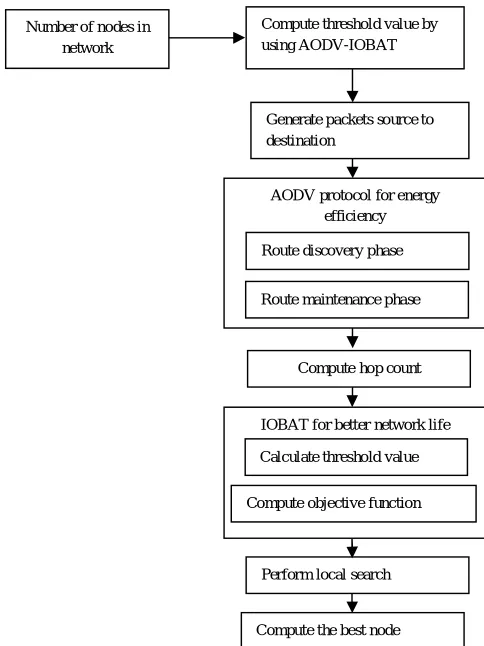
Fig 1 Overall block diagram of the proposed system
A. Network Formation
The proposed methodology includes the MANET environment, where the nodes positioned on the network can communicate via numerous indirect hops. The proposed methodology might be working in any MANETs routing protocols towards implement cooperation between nodes and counter by means of non-cooperative nodes in a MANET environment. In this network, each and every one node might function in loose mode for neighbour monitoring, each and every one links are bidirectional, and transmission ranges of nodes are rather equal, misbehaving nodes are selfish and are not malicious, the MANET network is a multi-hop network, which means the information packets are exchanged among any two nodes and forwarded to other nodes.
B. AODV Protocol
AODV is an on-demand (reactive) routing protocol and has distinct ability are memory overhead, low processing, low network use and better results in high mobility environment [17]. AODV routing algorithm is efficient way intended for building path among the networks. Constantly change in topology of a network, requests is created simply on demand. It works by means of maintain a routing table over time. There are two phases in AODV routing protocol as described below:
C. Route Discovery Phase
The routing table supports during giving data regarding next hop towards destination. It uses a sequence number, which is received route request message (RREQ) to its neighbour node. The RREQ has various fields such as <source_address, source_sequence number, broadcast_id, destination_address, destination_sequence number, hop_count>An intermediate node is able to revise the routing table if it holds an RERQ Packet. For reverse route source and intermediate node receives Route Reply Message (RREP), which update valid route towards destination node. The RREP packet includes various fields are <source_address, detination_address, destination_sequence number, hop_count, energy, lifetime>
Number of nodes in network
Generate packets source to destination
AODV protocol for energy efficiency Compute threshold value by using AODV-IOBAT
Route discovery phase
Route maintenance phase
Compute hop count
IOBAT for better network life
Calculate threshold value
Compute objective function
Perform local search
D. Route Maintenance Phase
It makes use of a Route Error Message (RERR) designed for route failure, link breakage problem in the network. When next hop link breaks, it sends RERR message from starting node of route with the purpose of converse over the broken link by means of the destination node. To extend the energy effectiveness in AODV routing protocol, proposed system measured for energy improvement procedure in AODV routing protocol. This system is functional on AODV routing protocol in route discovery phase. A recvRevrese() function is make use of at definite threshold level towards make sure the energy level of the node. If energy of node is less than the set threshold energy then, it couldn’t assume the design of packet dropping and couldn’t require any link reinstallation. It initiates the job not including any detachment of the nodes. Essentially, it describe upon the function recvRevrese() to go back the previous node. After reaching there, it transmits RREQ message in the direction of discover the new route not including breaking the path. It avoids initiating the path from source node over again which significantly increases its energy. But in the existing AODV routing protocol after drop packet, it over again reinitiates the path from source node which increases energy utilization in AODV. The energy consumption via a node depending on the power utilized for transmitting and receiving packets and the amount of time it spends for with the purpose of task. Energy consumption designed for transmitting and receiving a packet is given in Equation (1), and (2).
(1)
(2)
Where, ETx and ERx indicate the amount of energy consumed by a node. PTx and PRx is transmitting and receiving power of a node.
E. Algorithm
Begin
Generate the network for the input node (n number of nodes) Describe source and destination node
Discover the neighbour node of source node For source to destination
Send route request to neighbour nodes for finding the destination If next node is destination
Then direct path is established
Else Transmit the RREQ to next neighbours Wait for RREP from destination to source Choose the path along with average hop counts Apply energy enrichment process
if (initial energy < threshold value ) {
Receive Reverse() procedure start; }
End
In this method, energy enhancement of AODV reactive routing protocol improves energy of remaining routing protocol. It further increases the energy of residual nodes.
F. IOBAT Algorithm
In this work, the algorithm has been applied on the energy efficient optimization to find an optimum solution. Bat algorithm which is performed depending on the idea of echolocation of bats. For route discovery and route avoidance, bats use sonar echoes which return from the obstruction and are transformed to frequency. They employ time delay between the emission and use with the purpose of delay for navigation. This behaviour of bats utilized to formulate the new bat algorithm. Thus, the optimized parameters are optimized to increase the network performance using best fitness values. To introduce a Bat-inspired routing protocol designed for giving an obstacle free communication path among the source and the destination.
1) Objective function f(x), x = (x1, ..., xd) T
2) Initialize the bat population xi and vi for i = 1 . . . n
4) Initialize pulse rates ri and the loudness Ai
5) while (t < Tmax) // number of iterations
6) Produce new solutions by adjusting frequency, and
7) Updating velocities and locations/solutions
Distance= where x and y are nodes (3)
Throughput = (packet size)/(receive time – send time) (4)
To develop the performance of the network and to reduce the blocking, need to optimize the fitness function using given below equation (5)
Fitness Function 1 d N
) (5)
where, i is the iteration which ranges from 1 to N (total number of nodes), w1, w2, w3 and w4 are the weights supplied to the algorithm,
t is the throughput of the network,
Plr is the normalized packet lost rate in the network, D k i is the distance between node i and k and E is the residual energy of each node in the network. Pdr is packet delivery ratio
8) if(rand(0, 1) > ri)
9) Choose a solution amongst the best nodes
10) Produce a local solution around the best solution
11) end if
12) Generate a new solution by flying randomly
13) if(rand(0, 1) < Ai and f(xi) < f(x))
14) Accept the new solutions
15) Increase ri and reduce Ai
16) end if
17) Rank the bats and find the current best
18) end while
19) Post process results and visualization
For the improvement in optimization values in the above algorithm, a third parameter throughput is also introduced and velocity in the above algorithm is compared to the packet lost rate and position is used to calculate the distance [18]. It will help to improve the network lifetime by reducing and avoiding the link failure node and packet loss. Bes node is elected by using best objective function and optimized network performance is ensured.
IV. SIMULATION SETTINGS
In this section, the performance of the proposed AODV-IOBAT method is evaluated and compared with existing methods such as DSR and PSO. The experiments are conducted using NS-2 simulator. The existing and proposed methods are compared in terms of end to end delay, throughput, energy consumption, packet delivery ratio and network lifetime. The simulation settings are given in Table 1.
Table 1: Simulation Parameters
Parameter values
No. of Nodes 100
Area Size 1100 X 1100 m
Mac 802.11
Radio Range 250m
Simulation Time 60 sec
A. Performance Evaluation
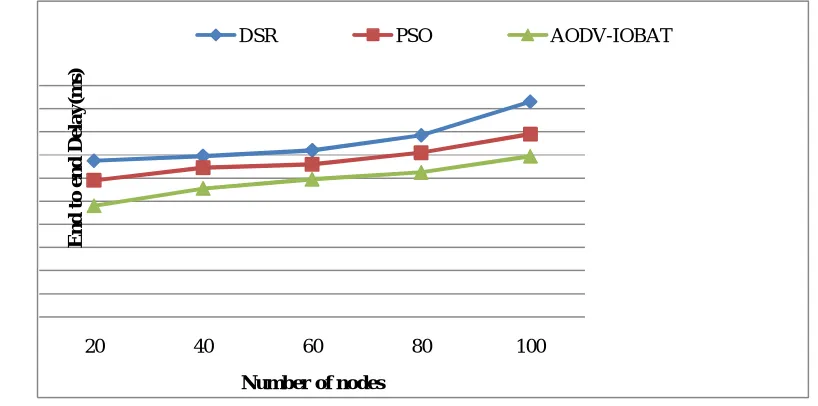
1) End-to-end Delay: The average time taken by a packet to transmit from source to destination across the network is well-known as End to End delay
20 40 60 80 100
E
n
d
t
o
e
n
d
D
el
a
y
(m
s)
Number of nodes
[image:6.595.104.513.153.356.2]DSR PSO AODV-IOBAT
Fig 2 End-to-end delay comparison
Fig 2 shows the comparison of end to end delay performance for proposed AODV-IOBAT and existing PSO and DSR approaches. The nodes are varying from 20 to 100 and end to end delay is plotted for such nodes in milliseconds (ms). From the graph it is clear that the proposed AODV-IOBAT algorithm achieves less end to end delay than the existing PSO and DSR algorithms.
2) Throughput: The rate in which the data packets are successfully transmitted over the network or communication links is defined as throughput. It is measured in bits per second (bit/s or bps). It is also specified by units of information processed over a given time slot.
0 0.1 0.2 0.3 0.4 0.5 0.6 0.7 0.8 0.9 1
20 40 60 80 100
T
hr
o
ug
h
p
ut
Number of nodes
[image:6.595.149.482.505.691.2]DSR PSO AODV-IOBAT
Fig 3 Throughput comparison
B. Energy Consumption
Energy consumption refers to the average energy necessary for transmitting, receiving or forwarding operations of a packet to a node in the network during a period of time
0 5 10 15 20 25 30
20 40 60 80 100
E n er g y c o n su m p ti o n ( J )
Number of nodes
[image:7.595.101.529.153.349.2]DSR PSO AODV-IOBAT
Fig 4 Energy consumption comparison
Fig 4 shows the comparison of energy consumption performance for existing PSO, DSR and proposed AODV-IOBAT schemes. In x axis number of nodes are taken and in y axis energy consumption is taken. From the graph it is clear that the proposed AODV-IOBAT scheme provides better energy consumption than existing methods.
C. Packet Deliver Ratio (PDR)
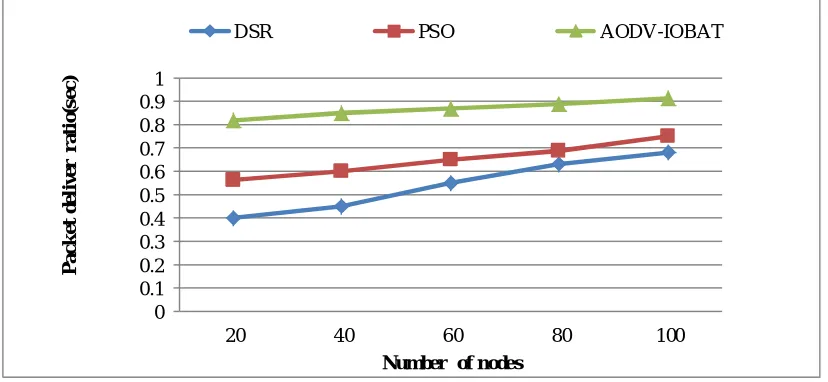
This metric is the ratio of the number of successfully delivered data packets to the sink over the total number of packets generated by all sources. High percentage of the packet delivery ratio increases network reliability and satisfies the QoS.
0 0.1 0.2 0.3 0.4 0.5 0.6 0.7 0.8 0.9 1
20 40 60 80 100
P a c k e t d e li ve r r a ti o (s e c )
Number of nodes
[image:7.595.99.513.468.659.2]DSR PSO AODV-IOBAT
Fig 5 Packet Delivery Ratio Comparison
D. Network Lifetime
0 10 20 30 40 50 60 70 80 90 100
20 40 60 80 100
N
et
w
o
rk
l
if
et
im
e
(s
ec
)
Packet size (bytes)
[image:8.595.99.502.127.341.2]DSR PSO AODV-IOBAT
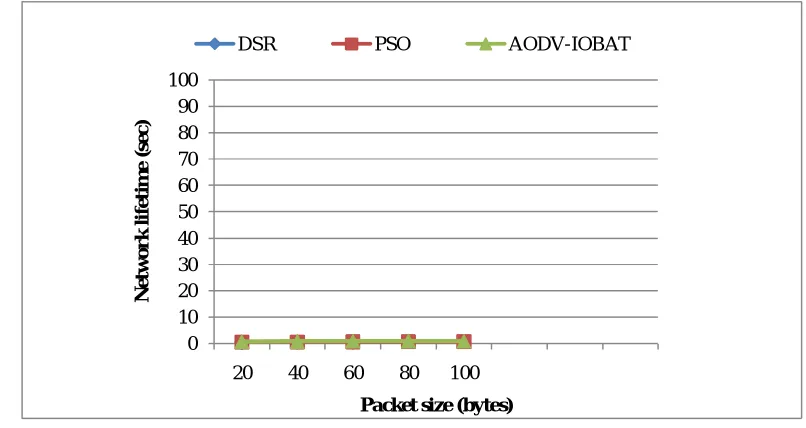
Fig 6 Network lifetime
Fig 6 provides the network lifetime for the given packet size. In x axis, the packet size is taken and in y axis the network lifetime is plotted. The existing system shows lower network performance whereas the proposed system shown higher performance. It is also observed that the proposed system increases the network lifetime by avoiding the repeated usage of nodes when the packet size increases. It proves that the AODV-IOBAT algorithm provides a greater network lifetime compared to the other existing DSR and PSO approaches.
V. CONCLUSION AND FUTURE WORK
This work proposes AODV-IOBAT algorithm for finding best nodes in MANETs to improve energy consumption and network lifetime effectively. Route discovery is done only when a source node does not have a valid path to a destination, where the message has to be sent. AODV uses three kinds of messages during entire routing process viz. RREQ, RREP and RERR. If a node does not have a route to destination then it forwards RREQ to the neighbour nodes adding its own address to the packet. The Route Maintenance takes place, if any node moves or depleted its energy. Route discovery is re-initiated if the source node moves. When the number of nodes increased in the network, the energy efficiency is improved by using this protocol. Also the IOBAT algorithm focused to develop the optimal values for increasing the network lifetime. The result concludes that the proposed AODV-IOBAT algorithm provides higher throughput, packet delivery ratio, network lifetime and lower end to end delay and energy consumption than the existing DSR and PSO approaches. In future work, the hybrid optimized algorithm along with the multipath routing should be enhanced for detecting the attacks over larger network.
REFERENCES
[1] S. Guo and O. Yang, Localized Operations for Distributed Minimum Energy Multicast Algorithm in Mobile Ad Hoc Networks, IEEE Trans. Parallel and Distributed Systems, Feb. 2007, pp. 186-198.
[2] S.CorsonandJ. Macker, “Mobile Adhoc Networking (MANET): Routing Protocol Performance Issues and Evaluation Considerations”, InternetDraft, January, NetworkWorkingGroup,2002.
[3] D. Helen and D. Arivazhagan, “Application, Disadvantages, challenges of Adhoc Network”, Journal of Academic and industrial Research, vol. 2, pp. 2278-5213, Jan.2014.
[4] Bai, Yuxia, Yefa Mai, and Nan Wang. "Performance comparison and evaluation of the proactive and reactive routing protocols for MANETs", Wireless Telecommunications Symposium (WTS), IEEE, 2017.
[5] Liu, Kejun, J., Varshney, P. K., & Balakrishnan, K, "An acknowledgment-based approach for the detection of routing misbehavior in MANETs", IEEE transactions on Mobile Computing 6.5 (2007): 536-550.
[6] Megat F. Zuhairi and David A. Harle, “AODV routing protocol in heterogeneous networks”, ISBN: 978-1-902560-24-3, PGnet, 2010.
[7] E. M. Royer, C. E. Perkins, An Implementation Study of AODV Routing Protocol, IEEE Wireless Communications and Networking Conference (WCNC 2000), 23-28 September 2000, Chicago, pp. 1003-1008
[9] Sur, Chiranjib, and Anupam Shukla. "Adaptive & discrete real bat algorithms for route search optimization of graph based road network." Machine Intelligence and Research Advancement (ICMIRA), 2013 International Conference on. IEEE, 2013.
[10] Kai,A.A. and Jan,H.,R. (2011) “Adaptive Topology Control for MobileAd Hoc Networks” IEEE transaction on parallel and distributed system,Vol. 22 Issue 12, pp. 1960-1963.
[11] Raja ram, A. Dr. and Sugesh, J. (2011),“Power Aware Routing for MANET Using Ondemand Multipath Routing Protocol”. IJCSI International Journal of Computer Science,Vol. 8 Issue 2, pp. 517-522.
[12] Zhang,j.,Zhang,Q.,Li,B.,Luo,X.,Zhu,W. (2006),“Energy-Efficient Routing in Mobile Ad Hoc Networks: Mobility-Assisted Case”IEEE Transaction On Vehicular Technology,Vol. 55 Issue 1, pp. 369-379.
[13] J.-H. Chang and L. Tassiulas: Energy conserving routing in wireless ad-hoc networks: Proc. IEEE INFOCOM, Tel-Aviv, Israel (2000)
[14] P.S.Karadge, Dr.S.V.Sankpal, “A Performance Comparison of Energy Efficient AODV Protocols In Mobile Ad Hoc Networks”, IJARCCE, vol.2, Issue 1, January 2012.
[15] Morteza Maleki, Karthik Dantu, and Massoud Pedram, “Lifetime Prediction Routing in Mobile Ad Hoc Networks”, March 2007.
[16] Kiran M, Reddy, G Ram Mohana 2014, ‘Bat-termite: a novel hybrid bio inspired routing protocol for mobile ad hoc networks’, International Journal of Wireless and Mobile Computing, vol. 7,no. 3, pp. 258-269.
[17] C. Lal, V. Laxmi, and M. S. Gaur, “A node-disjoint multipath routing method based on aodv protocol for manets,” 26th International Conference on Advanced Information Networking and Applications (AINA), IEEE, pp. 399–405, 2012.