Potentiometric Studies on Binary Complex of
L-Aspartic Acid and Ethylenediamine with Essential
Metal Mg (II), Ca (II) and Zn (II) Ions in Low
Dielectric Media
Meti Mengistu Melese
1, Bedasa Abdisa Gonfa
2, Fedlu Kedir Sabir
3, Hadgu Hailekiros Belay
41, 2, 3, 4Department of Applied Chemistry, Adama Science and Technology University, Adama, Oromia, Ethiopia
Abstract: The metal speciation governs both beneficial and toxic interaction with system is important for understanding their distribution mobility, bioavailability, toxicity and for setting environmental quality standards. Speciation studies of toxic metal ion complexes are useful in order to understand the role played by the active site cavities in biological molecules and the bonding behavior of their residues with metal ions. Hence chemical speciation of binary complexes of Mg(II), Ca(II) and Zn(II) with L-Aspartic acid and Ethylenediamine have been studied pH-metrically in various concentrations (0–60%, v/v) of Dimethylformamide-water mixtures maintaining an ionic strength of 0.16 mol L–1 using NaCl as an electrolyte at 310 K to mimic the different species formed in physiological condition. Alkalimetric titrations were carried out in different relative concentrations of metal with L-Aspartic acid and Ethylenediamine. Stability constants of various models of binary complexes were refined with MINIQUAD75. The best-fit chemical models were selected based on statistical parameters and residual analysis. The predominant species were ML, ML2H2, ML2H3 and ML2H4 for Ca (II), Mg (II) and Zn (II). The chemical
speciation, metal bioavailability and transportation were explained based on the distribution diagrams drawn using HYSS HYPERQUAD.
Keywords: Binary Complexes, stability constant, L-Aspartic acid, Ethylenediamine, Low dielectric media, and Potentiometric study
I. INTRODUCTION
L-Aspartic acid (Asp) is a non-essential amino acid. It is primarily used in the body's metabolic processes; it is also key for a variety of other biological processes such as production of immunoglobulin, cell functioning, and the movement of minerals across intestinal linings into blood. Asp has also been used in various clinical applications, showing promise in persons suffering from opiate addiction [1]. Asp is also significant in the removal of excess ammonia and other toxins from the blood stream. It also assists in the proper functioning of carriers for genetic information-RNA and DNA. The conversion of Asp to these amino acids begins with the reduction of Asp to its semi aldehyde [2].
Ethylenediamine (en) is a colorless to yellowish hygroscopic liquid. It is involved in the synthesis of seven membered ring components with β-ketoesters resulting secondary amines and β-enaminoesters [3]. Ethylenediamine plays an important role in the synthesis of Schiff base compounds [4]. N, N-Dimethylformamide (DMF) is an organic compound and a common solvent for chemical reactions that is miscible with water and the majority of organic liquids. It is a polar aprotic solvent with a high boiling point, which facilitates reactions that follow polar mechanisms. It can be hydrolyzed by strong acids and bases, especially at elevated temperatures [5].
Calcium is essential for living organisms. It is one of the most important elements in the diet because it is a structural component of bones, teeth and soft tissues and is essential in many of the body's metabolic processes. Bone itself undergoes continuous remodeling, with constant resorption and deposition of calcium into new bone [6]. Toxicity is manifested by abnormal deposition of calcium in tissues and by elevated blood calcium levels (hypercalcemia). Very high levels of calcium can result in appetite loss, nausea, vomiting, abdominal pain, confusion, seizures and even coma.
neuromuscular functions, endocrine disorders, malabsorption syndromes) and the other is resulting from rare genetic abnormalities of magnesium homeostasis [8].Zinc is an essential metal, necessary for sustaining all life and is thought to protect plants from drought and disease. The role of zinc in these metalloenzymes includes participation in catalytic functions, maintenance of structural stability and regulatory functions [9]. Higher concentrations of zinc in human body suppress copper and iron absorption. The free zinc ions in solution are highly toxic to invertebrate and vertebrate fish. Free zinc ions react with hydro chloric acid of gastric juice to form corrosive zinc chloride, which can cause damage to the stomach lining. In the present study the chemical speciation of L-aspartic acid and ethylenediamine with essential metal ion complexes were reported in the presence of DMF as a co-solvent
II. MATERIALS AND METHODS
A. Chemicals
DMF was used as co-solvent. Aqueous solutions of L aspartic acid (E-Merck, Germany) and ethylenediamine (Qualigen, India) sodium chloride were prepared. Metal solutions of Ca (II), Mg(II) and Zn(II) chlorides ( E- Merck, Germany) were prepared. To increase the solubility of ligand and to suppress the hydrolysis of metal salts, the mineral acid concentration in the above solutions was maintained at 0.05 M. To assess the errors that might have crept into the determination of the concentrations, the data were subjected to analysis of variance of one-way classification (ANOVA) [10]. The strength (concentration) of alkali was determined using the Gran plot method [11].
B. Apparatus
The titrimetric data were obtained with a calibrated ELICO (Model LI-120) pH meter (readability 0.01), which can monitor changes in the H+ ion concentration. The pH meter was calibrated with a 0.05 M potassium hydrogen phthalate solution in the acidic region
and a 0.01 M borax solution in the alkaline region. The glass electrode was equilibrated in a well-stirred DMF water mixture containing an inert electrolyte. All the solutions were carried out in the medium containing varying concentrations of DMF (0-60%, v/v) maintaining an ionic strength of 0.16 M with sodium chloride at 310 K. The effects of variations in the asymmetry potential, liquid junction potential, activity coefficient, sodium ion error and dissolved carbon dioxide on the response of the glass electrode were accounted for in the form of correction factor [12].
C. Procedure
For the determination of stability constants of binary species, initially titrations of strong acid with alkali were carried out at regular intervals to check whether complete equilibration was achieved. Then, the calomel electrode was refilled with DMF-water mixture of equivalent composition as that of the titrand.
1) Alkalimetric Titrations: The pH measurements of metal-ligand binary systems were carried out in aqueous media containing varying compositions of Dimethylformamide in the range of 0-50% (v/v) maintaining an ionic strength of 0.16 mol L-1 with
sodium chloride at 310±0.1 K by using a digital pH meter ELICO (Model LI-120) type readability of 0.01 (0-14). The electrode of the cell was calibrated with 0.05 mol L-1 potassium hydrogen phthalate solution in the acidic region and with 0.01 mol L-1
borax solution. The effect of variations in asymmetry potential, liquid junction potential, activity coefficient, sodium ion error and dissolved carbon dioxide on the response of the glass electrode were accounted in the form of correction factor [13]. Mechanical stirring of the solution was carried out by means of a magnetic stirrer. To verify whether the electrode was equilibrated, a strong acid was titrated with an alkali every day until no appreciable differences were observed between the pH values of two titrations at the corresponding volumes of titrant. A calomel electrode was refilled with DMF-water mixture of the equivalent composition to that of the titrand. Free acid titrations were performed before the metal -ligand titrations to calculate the correction factor. In each of the titrations, the titrand consisted of a mineral acid of approximately 1 mmol in a total volume of 50 mL. In each of the titrations, the titrand consisted of approximately 1.0 mmol mineral acid. Titrations with different metal to ligand ratios (1.0 : 2.5, 1 : 3.75 and 1 : 5.0 in the case of Asp and 1.0 : 5.0, 1 : 7.5 and 1 : 10.0 in the case ethylenediamine were carried out with 0.4 M sodium hydroxide. The correction factor and protonation constants of Asp and en were fixed during the refinement of binary systems.
D. Modeling Strategy
III. RESULTS AND DISCUSSION
A. Selection of Best-fit Model
The final models in DMF-water mixtures for Asp complexes of Ca(II), Mg(II) and Zn(II) contain ML, ML2H2, ML2H3 and ML2H4
similarly ML2, ML2H and ML2H2 were refined for en complexes of Ca(II), Mg(II) and Zn(II) in DMF-water mixtures. The models
containing ML2H2 for Mg(II) -en were rejected because of low (<10%) of species. As the number of species increased, the models
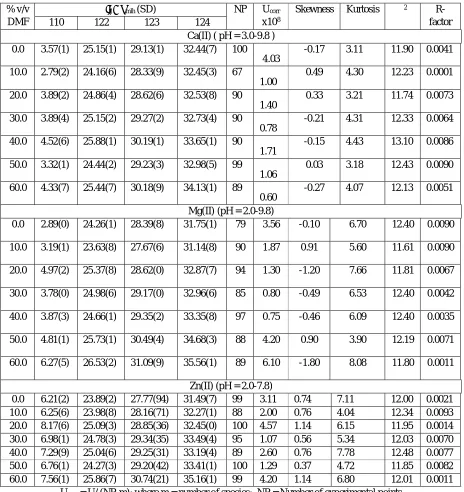
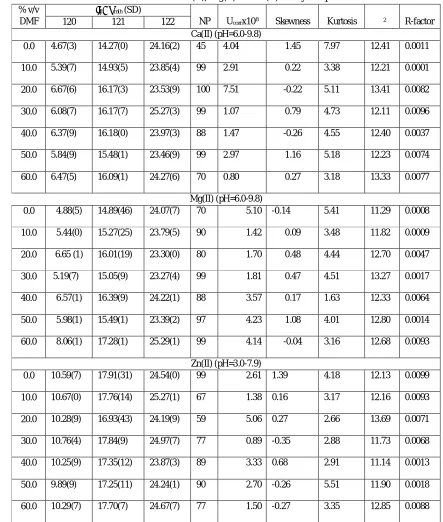
[image:3.595.67.531.255.747.2]gave better statistics denoting better fit. Such exhaustive modeling is performed for all the systems and the final models are given in Tables 1 and 2 for Ca(II), Mg(II) and Zn(II) complexes of Asp and en in DMF-water mixtures. Tables 1 and 2 contain the stoichiometric coefficients and stability constants of the complex species, standard deviations in the stability constants and residual statistics of the best-fit models.
Table 1: Parameters of best fit chemical models of Ca(II), Mg(II), and Zn(II)-Asp in DMF-water mixtures.
% v/v DMF
log βmlh (SD) NP Ucorr
x108
Skewness Kurtosis 2
R-factor
110 122 123 124
Ca(II) ( pH = 3.0-9.8 )
0.0 3.57(1) 25.15(1) 29.13(1) 32.44(7) 100
4.03
-0.17 3.11 11.90 0.0041
10.0 2.79(2) 24.16(6) 28.33(9) 32.45(3) 67
1.00
0.49 4.30 12.23 0.0001
20.0 3.89(2) 24.86(4) 28.62(6) 32.53(8) 90
1.40
0.33 3.21 11.74 0.0073
30.0 3.89(4) 25.15(2) 29.27(2) 32.73(4) 90
0.78
-0.21 4.31 12.33 0.0064
40.0 4.52(6) 25.88(1) 30.19(1) 33.65(1) 90
1.71
-0.15 4.43 13.10 0.0086
50.0 3.32(1) 24.44(2) 29.23(3) 32.98(5) 99
1.06
0.03 3.18 12.43 0.0090
60.0 4.33(7) 25.44(7) 30.18(9) 34.13(1) 89
0.60
-0.27 4.07 12.13 0.0051
Mg(II) (pH = 2.0-9.8)
0.0 2.89(0) 24.26(1) 28.39(8) 31.75(1) 79 3.56 -0.10 6.70 12.40 0.0090
10.0 3.19(1) 23.63(8) 27.67(6) 31.14(8) 90 1.87 0.91 5.60 11.61 0.0090
20.0 4.97(2) 25.37(8) 28.62(0) 32.87(7) 94 1.30 -1.20 7.66 11.81 0.0067
30.0 3.78(0) 24.98(6) 29.17(0) 32.96(6) 85 0.80 -0.49 6.53 12.40 0.0042
40.0 3.87(3) 24.66(1) 29.35(2) 33.35(8) 97 0.75 -0.46 6.09 12.40 0.0035
50.0 4.81(1) 25.73(1) 30.49(4) 34.68(3) 88 4.20 0.90 3.90 12.19 0.0071
60.0 6.27(5) 26.53(2) 31.09(9) 35.56(1) 89 6.10 -1.80 8.08 11.80 0.0011
Zn(II) (pH = 2.0-7.8)
0.0 6.21(2) 23.89(2) 27.77(94) 31.49(7) 99 3.11 0.74 7.11 12.00 0.0021
10.0 6.25(6) 23.98(8) 28.16(71) 32.27(1) 88 2.00 0.76 4.04 12.34 0.0093
20.0 8.17(6) 25.09(3) 28.85(36) 32.45(0) 100 4.57 1.14 6.15 11.95 0.0014
30.0 6.98(1) 24.78(3) 29.34(35) 33.49(4) 95 1.07 0.56 5.34 12.03 0.0070
40.0 7.29(9) 25.04(6) 29.25(31) 33.19(4) 89 2.60 0.76 7.78 12.48 0.0077
50.0 6.76(1) 24.27(3) 29.20(42) 33.41(1) 100 1.29 0.37 4.72 11.85 0.0082
60.0 7.56(1) 25.86(7) 30.74(21) 35.16(1) 99 4.20 1.14 6.80 12.01 0.0011
Table 2: Parameters of best fit chemical models of Ca(II), Mg(II) and Zn(II) binary complexes of en in DMF-water mixtures.
% v/v DMF
log βmlh (SD)
NP Ucorrx108 Skewness Kurtosis 2 R-factor
120 121 122
Ca(II) (pH=6.0-9.8)
0.0 4.67(3) 14.27(0) 24.16(2) 45 4.04 1.45 7.97 12.41 0.0011
10.0 5.39(7) 14.93(5) 23.85(4) 99 2.91 0.22 3.38 12.21 0.0001
20.0 6.67(6) 16.17(3) 23.53(9) 100 7.51 -0.22 5.11 13.41 0.0082
30.0 6.08(7) 16.17(7) 25.27(3) 99 1.07 0.79 4.73 12.11 0.0096
40.0 6.37(9) 16.18(0) 23.97(3) 88 1.47 -0.26 4.55 12.40 0.0037
50.0 5.84(9) 15.48(1) 23.46(9) 99 2.97 1.16 5.18 12.23 0.0074
60.0 6.47(5) 16.09(1) 24.27(6) 70 0.80 0.27 3.18 13.33 0.0077
Mg(II) (pH=6.0-9.8)
0.0 4.88(5) 14.89(46) 24.07(7) 70 5.10 -0.14 5.41 11.29 0.0008
10.0 5.44(0) 15.27(25) 23.79(5) 90 1.42 0.09 3.48 11.82 0.0009
20.0 6.65 (1) 16.01(19) 23.30(0) 80 1.70 0.48 4.44 12.70 0.0047
30.0 5.19(7) 15.05(9) 23.27(4) 99 1.81 0.47 4.51 13.27 0.0017
40.0 6.57(1) 16.39(9) 24.22(1) 88 3.57 0.17 1.63 12.33 0.0064
50.0 5.98(1) 15.49(1) 23.39(2) 97 4.23 1.08 4.01 12.80 0.0014
60.0 8.06(1) 17.28(1) 25.29(1) 99 4.14 -0.04 3.16 12.68 0.0093
Zn(II) (pH=3.0-7.9)
0.0 10.59(7) 17.91(31) 24.54(0) 99 2.61 1.39 4.18 12.13 0.0099
10.0 10.67(0) 17.76(14) 25.27(1) 67 1.38 0.16 3.17 12.16 0.0093
20.0 10.28(9) 16.93(43) 24.19(9) 59 5.06 0.27 2.66 13.69 0.0071
30.0 10.76(4) 17.84(9) 24.97(7) 77 0.89 -0.35 2.88 11.73 0.0068
40.0 10.25(9) 17.35(12) 23.87(3) 89 3.33 0.68 2.91 11.14 0.0013
50.0 9.89(9) 17.25(11) 24.24(1) 90 2.70 -0.26 5.51 11.90 0.0018
60.0 10.29(7) 17.70(7) 24.67(7) 77 1.50 -0.27 3.35 12.85 0.0088
Ucorr = U/ (NP-m); where m = number of species; NP = Number of experimental point.
1) Analysis of Residuals: Gans et al. [16] applied sample standard deviation (SD) in weighted least squares analysis for the calculation of β’s and suggested that any value less than three is satisfactory. Of course, the ideal value of 1 was observed only in a single titration curve (unlike pooled data) inferring that the data have been correctly weighted. The SD and confidence
intervals in β’s are meaningful only when unweighted residuals follow
2 distribution, which measures the possibility ofresiduals forming a part of standard normal distribution with zero mean and unit SD. Higher
2 values than expected are due toappropriate and 3) invoking optimistic estimates of errors in primary data. A perusal of Tables 1 and 2 indicates that the
2values range from 11.14-13.69 for DMF-water mixtures. The values of kurtosis and skewness range from 1.63-8.08 and -1.80-1.45 for DMF-water mixtures, respectively. Deviation of the values of kurtosis and skewness from three and zero, respectively, shows the tendency of these residuals to concentrate more to the left or right of the mean and broadening of the peak. However, the values of Ucorr in all the three mass-balance equations are very low confirming the adequacy of the chemical model to
represent the experimental data.
B. Perturbation In Stability Constants Due To Systematic Errors
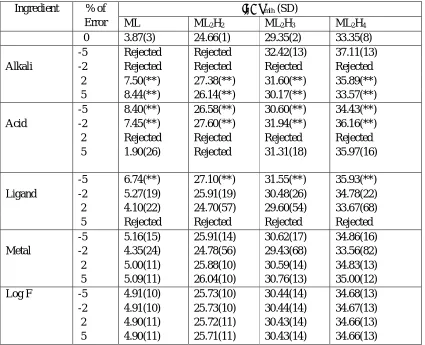
[image:5.595.87.512.376.721.2]The appropriateness of experimental condition were verified by introducing errors deliberately. The module containing different number of species were refined by using computer program MINIQUAD75. The computer programs refine the stability constants by minimizing the random errors in the data. But in the presence of considerable systematic errors, not only the β’s are in errors even some species may be rejected. MINIQUAD75 has no provision to vary the influential parameters. Hence, some representative systems were studied in order to have a cognizance of the effect of errors in concentrations of ingredients on the stability constants of binary metal complexes (Tables 3 and 4).The data show that the order of affecting the magnitudes of stability constant is alkali > acid > ligand > metal. The increased standard deviation in stability constants and even rejection of some species on the introduction of errors confirm the correctness of the proposed models. This type of investigation is significant as the data acquisition was done under varied experimental conditions with different accuracies.
Table 3: Effectof errors in influential parameters on stability constants of Mg (II)-Asp complexes in 40.0% v/v of DMF water mixtures.
**Standard deviation is very high
Ingredient
% of
Error
log β
mlh(SD)
ML
ML
2H
2ML
2H
3ML
2H
40
3.87(3)
24.66(1)
29.35(2)
33.35(8)
Alkali
-5
Rejected
Rejected
32.42(13)
37.11(13)
-2
Rejected
Rejected
Rejected
Rejected
2
7.50(**)
27.38(**)
31.60(**)
35.89(**)
5
8.44(**)
26.14(**)
30.17(**)
33.57(**)
Acid
-5
8.40(**)
26.58(**)
30.60(**)
34.43(**)
-2
7.45(**)
27.60(**)
31.94(**)
36.16(**)
2
Rejected
Rejected
Rejected
Rejected
5
1.90(26)
Rejected
31.31(18)
35.97(16)
Ligand
-5
6.74(**)
27.10(**)
31.55(**)
35.93(**)
-2
5.27(19)
25.91(19)
30.48(26)
34.78(22)
2
4.10(22)
24.70(57)
29.60(54)
33.67(68)
5
Rejected
Rejected
Rejected
Rejected
Metal
Table 4:Effect of errors in influential parameters on stability constants of Ca(II)-en binary complexes in 10.0% v/v of DMF- water mixtures
C. Effect of Solvent on Metal-Ligand Equilibria
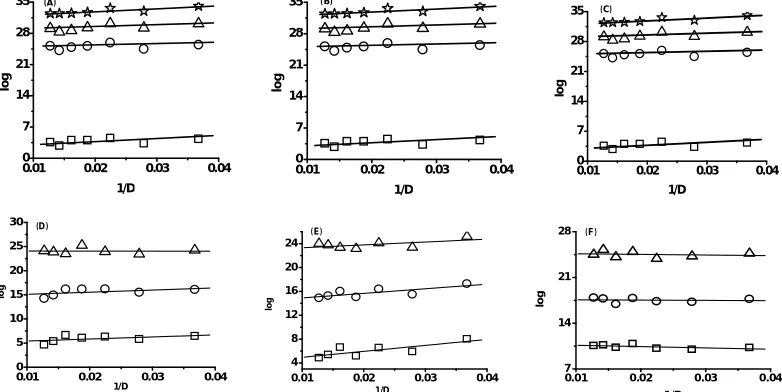
[image:6.595.101.492.490.686.2]Co-solvent influences the equilibria in solution due to change in the dielectric constant (D) of the medium that influences the contribution from electrostatic and non-electrostatic interactions that have a bearing on the magnitude of stability constants. The variation of overall stability constant values or change in free energy with co-solvent content depends upon two factors, viz., electrostatic and non-electrostatic. Born’s [17] classical conditions hold good in accounting for the electrostatic contribution to the free energy change. According to this treatment, the energy of electrostatic interaction is related to dielectric constants. Hence, the log β values should vary linearly as a function of the reciprocal of the dielectric constant (1/D) of the medium. The change in log β values of Ca(II), Mg(II) and Zn(II) complexes of Asp and en with 1/D (Figure 1 ) reveals that, in all the cases the trend is almost linear which indicates that the dielectric constant or long range interactions are responsible for the stability trend in DMF-water mixtures.
Figure 1: Variation of stability constant values of (A-C) Asp and (D-F) en Complexes with reciprocal of dielectric constant (1/D) of DMF-water mixtures; (A and D) Ca(II); (B and E) Mg(II); (C and F) Zn(II); (□) log βML; (◯) log βML2H2; (∆) log βML2H3;(☆)
log βML2H4.
Ingredient % of Error log βmlh(SD)
ML2 ML2H ML2H2
0 5.39(7) 14.93(5) 23.85(4)
Alkali
-5 9.59(57) 17.55(44) 23.66(44)
-2 10.39(34) 17.81(34) 24.58(49)
2 11.34(55) 17.54(45) 25.38(67)
5 11.85(46) Rejected 25.70(58)
Acid
-5 12.5(39) Rejected 26.30(50)
-2 11.57(46) 17.18(**) 25.58(77)
2 10.18(65) 17.68(50) 24.44(40)
5 9.29(33) 17.20(49) Rejected
Ligand
-5 10.36(38) 17.64(29) 23.96(49)
-2 10.63(5) 17.77(8) 24.65(11)
2 11.14(35) 17.84(44) 25.27(37)
5 11.54(47) 17.73(62) 25.61(48)
Metal
-5 10.95(34) 17.77(12) 25.01(17)
-2 10.91(14) 17.82(10) 24.98(17)
2 14.80(20) 17.88(14) 24.96(12)
0.01 0.02 0.03 0.04
0 7 14 21 28 35 l o g 1/D (A)
0.01 0.02 0.03 0.04
0 7 14 21 28 35 l o g 1/D (B)
0.01 0.02 0.03 0.04
0 7 14 21 28 35 l o g 1/D (C)
0.01 0.02 0.03 0.04
0 5 10 15 20 25 30 lo g 1/D (D)
0.01 0.02 0.03 0.04
4 8 12 16 20 24 lo g 1/D (E)
0.01 0.02 0.03 0.04
The trends of stepwise stability constants (log K) of the en binary complexes with the inverse of dielectric constant (1/D) of DMF- water mixtures are shown in (Figure 1). Linear increase in stabilities as seen in Figure 6 A, B and C indicates the dominance of the structure-forming nature of DMF over the complexing ability. The deviations from linearity may be due to some contribution from non-electrostatic forces. Different types of electrostatic and non-electrostatic forces dominate in different ranges of the composition of DMF-water mixtures.
1) L-Aspartic acid complexes: The binary metal complexes refined are ML2H4, ML2H3, ML2H2 and ML for Ca (II), Mg (II) and Zn
(II), in DMF-water mixtures. The formation equilibria of various binary complex species are shown below.
M(II) + 2LH3 ML2H4 + 2H+ ---- 1
M(II) +2LH3 ML2H3 + 3H+ ---- 2
M(II) + 2LH3 ML2H2 + 4H+ ---- 3
ML2H4 ML2H3 + H+ ---- 4
ML2H4 ML2H2 + 2H+ ---- 5
M(II) + 2LH2 ML2H2 + 2H+ ---- 6
M(II) + LH2 ML + 2H+ ---- 7
M(II) + LH ML + H+ ---- 8
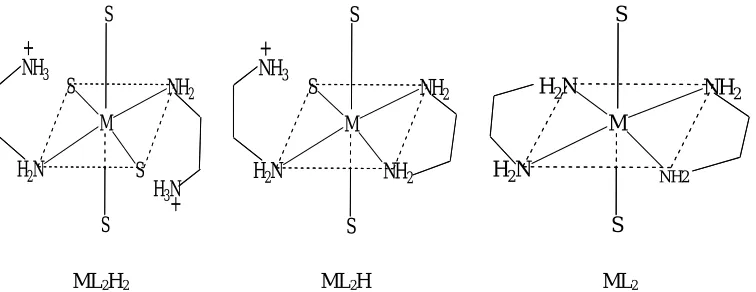
2) Ethylenediamine Complexes: Ethylenediamine has two associable protons. The present investigation reveals the existence of ML2, ML2H, and ML2H2 for Ca (II), Mg (II) and Zn (II). The formation of various binary complex species is shown in the
following equilibriums.
M(II) + 2LH2 ML2H2 + 2 H+ ---- 1
ML(II) +2 LH2 ML2H + 3 H+ ---- 2
ML2H2 ML2H + H+ ----3
M(II) +2 LH2 ML2 + 4 H+ ---- 4
ML2H2 ML2 + 2H+ ---- 5
ML2H ML2 + H+ ---- 6
Some of the typical distributiondiagrams (percentage of species vs. pH) of M(II) - en in varying percentages of DMF-water media. It indicate the binary complexes of Ca(II), Mg(II) and Zn(II). The species ML2, ML2H and ML2H2 are formed in the pH range of
2.8-11.0. According to Equilibria 1, 2 and 4 all the three species of Ca(II), Mg(II) are formed in the pH range 3.4-11.0 and 3.4-10.4, respectively. In case of Zn(II) the complexes formed in the pH range 3.4 to 9.0 as per the equilibria 1, 2, 5 and 6. The concentration of ML2 is very high among the three species in all cases.
D. Distribution Diagrams
Distribution diagrams were obtained from the formation constants in the best fit model with the computer program SCPHD [18]. The species distribution diagrams are shown in Figure 2. They indicate that Asp complexes of Ca(II) Mg(II) and Zn(II) are formed in the pH range 1.8-10.0. At lower pH, ML2H4, ML2H3 and ML2H2 species are formed by the interaction of free metal ion with LH3
and LH2 forms of the ligand (Equilibrium 1 - 3). With increasing pH successive deprotonation of ML2H4 forms ML2H3, ML2H2
(Equilibria 4 and 5) similarly ML and ML2H2 are formed from free metal ion and LH, LH2 and LH3 (Equilibria 6, 7 and 8). Zn(II)
Figure 2: Distribution diagrams of (A) Ca, (B) Mg, (C) Zn(II) with Asp and (D) Ca(II), (E) Mg(II) and (F) Zn(II) with En in aqueous medium. Ratio of Ca(II)(or Mg(II)) and Asp(or En) is1.0:5.0 and that of Zn(II) is 1.0:10.0
E. Structures of Binary Complexes
Although it is not possible to elucidate or confirm the structures of the complexes pH metrically, they can be proposed based on literature reports and chemical knowledge. The plausible structures of the complexes are given in Figures 3 and 4.
Figure 3: Speculative structures of Aspartic acid complexes with Ca(II), Mg(II) and Zn(II), where S is either solvent or water molecules.
H2N S
O S M O S C O C O ML
NH2 S
S N H2 M O O C O C O C O C O S S S S M O O C O C O
H3N
NH3 C O C O OH HO + +
ML2H2
ML2H3
O O S S S N H2 M O O C O C O C O C O O OH H3N
ML2H4
3 6 9 12 0 25 50 75 100 ML 2H4
ML 2H3
ML2H2
ML LH 3 LH 2 LH FM FL % S p e c ie s pH (A)
3 6 9 12 0
25 50 75 100
ML2H4 ML2H3
ML2H2
ML LH3 LH2 LH FL FM % S p e c ie s pH (B)
3 6 9 0 25 50 75 100 ML 2H4 ML2H3
ML 2H2
LH3 LH 2 LH FM % S p e c ie s pH (C)
6 8 10 0
25 50 75 100
ML2H2
ML2H ML2 LH2 LH FL FM % S p e c ie s pH (D)
6 8 10
0 25 50 75 100 LH2 FL LH FM ML 2 ML2H ML
2H2
% S p e c ie s pH (E) 6 9 0 25 50 75 100 FL ML2 ML 2H ML
2H2
LH LH2FM
[image:8.595.116.481.431.720.2]ML2H2 ML2H ML2
Figure 4: Speculative structures of Ethylenediamine complexes with Ca (II), Mg (II) and Zn (II) where S is either solvent or water molecules.
IV. CONCLUSION
Chemical speciation of L-Aspartic Acid and Ethylenediamine with Essential Metal Mg (II), Ca (II) and Zn (II) Ions were investigated in Low Dielectric Media. The following conclusions can be drawn based on the speciation studies performed on these systems. The binary species refined due to the interaction of Asp complexes of Ca (II), Mg (II) and Zn (II) are ML, ML2H2, ML2H3
and ML2H4 in both DMF-water media at physiological pH. For en complexes of Ca (II), Mg (II) and Zn (II), the species ML2, ML2H
and ML2H2 are refined in the DMF-water media. The ingredients that affect the magnitudes of stability constants of metal
complexes were found to be alkali > acid > ligand > metal. The study also gave an insight into the metal ion availability/metal ion transport in bio-fluids which may help in assessing the toxicity of these metal ions if found to be in excess. The binary complexes with higher stability were more amenable for “metal transport” because of their extra stability and the binary complexes with less stability constants make the “metal ion to be available” in biological systems due to their decreased stability.
REFRESNCES
[1] H. Tapiero, G. Mathe, P. Couvreur, K. D. Tew., Biomed Pharmacother, vol. 56, p. 446–457, 2002. [2] P. Paoletti, Pure Appl. Chem., vol. 56, p. 491, 1984.
[3] Hiromichi, F., Kenichi, M., Kita, Y., Ozora, K. and Yuruke, O.,, Org. Lett. , vol. 9, p. 1687, 2007.
[4] Arash, L., Habibi, M. H.. Harrington, R. W., Morteza, M. and William, C., J. Fluorine Chem, vol. 127, p. 769, 2006. [5] R.J. Sengwa., V.Khatari, S.Sankhala, J.Molecular Liquids, vol. 144, pp. 89-96, 2009.
[6] Edwards, L., J. Diss., Univ. of Michigan, 1950.
[7] Basolo, F. and Murmann, R. K., J. Am. Chem. Soc., vol. 74, p. 5243, 1952. [8] Karger, S. and Basel, A. G., Am., J. Nephrol., p. 410, 2000.
[9] Bennett, W. E., J. Am. Chem. Soc, vol. 79, p. 1290, 1957. [10] W. B. Schaap, D. L., J. Am. Chem. Soc, vol. 83, p. 4699, 1960.
[11] W. Kaim, B., in Inorganic Elements in the Chemistry of Life,, Schwederski, Ed., Wiley, Chichester, 1994, p. 187. [12] G. N. Rao, A. Ramakrishna, Proc. Nat. Acad. Sci., India, vol. 75, p. 245, 2005.
[13] P. Gans, a. Sabatini, a.vacca, inorg. Chim. Acta., vol. 18, p. 237–239, 1976. .
[14] M. P. Latha, V. M. Rao, T. S. Rao, G. N. Rao., Bull. Chem. Soc. Ethio, vol. 21, p. 363, 2007. [15] K. V. Lavanya, G. N. Rao, M. Rajesh, M. S., J. Indian Chem. Soc, , vol. 81, p. 384, 2004. [16] Gans, P., Sabatini, A. and Vacca, A., Talanta, vol. 21, p. 53, 1974.
[17] Born, M., Z Phys., vol. 1, p. 45, 1920.
[18] Rao, R. S., Satyanarayana, A. and Krishna, P. V. R., "Proc.Summer Simul. Conf," 1984.
M
S
H
2N
NH
2S
S
S
NH
3+
+
H
3N
M
S
H
2N
NH
2NH
2S
S
NH
3+
M
H
2N
H
2N
NH
2NH2