Consensus Tracking for Multi-Agent Systems with
Nonlinear Dynamics under Fixed Communication
Topologies
Guoguang Wen, Ahmed Rahmani and Yongguang Yu
Abstract—This paper is devoted to the study of consensus tracking problems for multi-agent systems with nonlinear dynamics, in which dynamics of each follower consists of two terms: one is given by an inherent nonlinear dynamics and the other is a simple communication protocol relying only on the position of its neighbors. The consensus reference is taken as a virtual leader who gives only its position information to only its neighbors. In this paper, the consensus tracking problems are respectively considered under fixed undirected and directed communication topologies. It is shown that the consensus tracking can be achieved in finite time under only the position measurements of the followers and the virtual leader. Simulation examples are finally given to demonstrate the effectiveness of the theoretical results.
Index Terms—Nonlinear inherent dynamics, Finite-time con-sensus tracking, Multi-agent system, virtual leader.
I. INTRODUCTION
I
N recent years, consensus problem of multi-agent systems has attracted much attention among researchers in the fields of biology, physics, computer science and control engineering. This is partly due to its broad applications in many areas such as formation control of unmanned air vehicles, design of distributed sensors networks, cooperative control of mobile robots, and so on(see, for example, the survey paper [1] and references therein). For a cooperative multi-agent system, consensus means that each agent updates its state based on local information of its neighbors, such that all agents reach an agreement on certain quantities of interest by negotiating with their neighbors.In the past few years, some theoretical results have been established in [2], [3], [4], [5], [6], [7], [8], [9], [10], [11], to name a few. In [2], Vicsek et al. proposed a discrete-time model to simulate a group of autonomous agents moving in the plane with the same speed but different headings. When the network topology is a connected graph, Adbababie et al. in [3] further studied the linear Vicsek model, and proved that all agents can became a stable state. Lately, the research of consensus problems for multi-agent systems was also extended to the case of directed topology ([4], [5], [6], [7], [8], [9], [10]). In recent literatures, a (virtual) leader-follower approach has been widely used to the consensus problem due to the fact that the state of virtual leader can represent the state of common interest for all other agents. The consensus with a (virtual) leader is usually called consensus tracking which means to design a network distributed control
G. Wen and A. Rahmani are with LAGIS FRE CNRS 3303, Ecole cen-trale de Lille, 59651 Villeneuve d’Ascq, France.(email: [email protected], [email protected] ).
Y. Yu is with Department of Mathematics, Beijing Jiaotong University, Beijing 100044, P.R. China. (email: [email protected]).
policy such that all agents can track the (virtual) leader. In [11], Cao et al. studied a consensus tracking of multi-agent systems for single-integrator dynamics and double-integrator dynamics under fixed and switching undirected topologies. Our objective is to consider the consensus tracking problems for multi-agent systems with nonlinear dynamics, in which dynamics of each follower consists of two terms: one is given by an inherent nonlinear dynamics and the other is a simple communication protocol relying only on the position of its neighbors. On the other hand, the communication can be undirected or directed. Therefore, we consider the consensus tracking problem under fixed undirected topology and fixed directed topology. We show that the consensus tracking can be achieved in finite time under only the position measurements of the followers and the virtual leader.
This paper is organized as follows. Section II gives some preliminaries on algebraic graph theory and formally state of the consensus problem. In sections III and IV, consensus tracking under fixed undirected and directed communication topologies are investigated. In section V, some examples are simulated to verify the theoretical analysis. Finally conclu-sions and future research directions are given in section VI.
II. PRELIMINARIES AND PROBLEM STATEMENT In this section, we first give a brief introduction to the algebraic graph theory, and then state our problem.
A. Algebraic graph theory
The communication topology among agents is represented by a graph G = (V,E,A), with the set of nodes V =
{v1, ..., vn}, the set of edges E ⊆ V × V, and a weighted adjacency matrixA= (aij)n×n. Here, each nodeviinV cor-responds to an agent i, and each edge (vi, vj) ∈ E in a weighted directed graph corresponds to an information link from agent j to agent i, which means that agent i can receive information from agent j. In contrast, pairs of nodes in weighted undirected graph are unordered, where an edge(vj, vi)∈ Edenotes that agentiandjcan receive infor-mation from each other. The weighted adjacency matrixAof a weighted directed graph is defined such that aii = 0 for any vi ∈ V, aij >0 if (vj, vi)∈ E, and aij = 0 otherwise. The weighted adjacency matrix Aof a weighted undirected graph is defined analogously except that aij =aji,∀i6=j, since(vi, vj)∈ E implies (vj, vi)∈ E. We can say vi is a neighbor vertex ofvj, if (vi, vj)∈ E.
The Laplacian matrixL= (lij)n×n of graph Gis defined by lij = −aij for i 6= j, and lii =
Pn
j=1,j6=iaij, i, j ∈
semi-definite. However,Lis not necessarily symmetric for a directed graph.
For simplicity, we denote byIn then×nidentity matrix, and0m×n the m×nzero matrix. Let1n= [1,1, . . . ,1]T ∈ Rn (1 for short, when there is no confusion). λ
min(A)and
λmax(A)are the smallest and the largest eigenvalues of the
matrixA respectively.
Definition 1([7]): A directed path from node vi to vj is a sequence of edges (vi, vj1),(vj1, vj2), ...,(vjl, vj)in a directed graph G with distinct nodesvjk, k= 1, ..., l.
Definition 2([7]): The directed graph G is said to have a directed spanning tree if there is a node (called root node) that can reach all the other nodes following a directed path in graphG.
Lemma 2.1: ([12]): A undirected graphG is connected if
and only if its Laplacian matrixLhas a eigenvalue zero with multiplicity 1 and corresponding eigenvector1,and all other eigenvalues have positive real parts.
Lemma 2.2: ([7]): A directed graph G has a directed
spanning tree if and only if its Laplacian matrix L has a eigenvalue zero with multiplicity 1 and corresponding eigenvector 1, and all other eigenvalues have positive real parts.
Lemma 2.3: ([13]) Kronnecker product⊗has the
follow-ing properties: for matricesA, B, C andDwith appropriate dimensions,
(1) (A+B)⊗C=A⊗C+B⊗C;
(2) (A⊗B)(C⊗D) =AC⊗BD;
(3) (A⊗B)T =AT ⊗BT;
(4) (ξA)⊗B=A⊗(ξB),where ξis a constant.
B. Problem statement
In this paper, we consider a multi-agent system that is made up of one virtual leader (labeled as 0) and n agents (labeled as agent 1 tonand called followers hereafter). Let the graph G represent the communication topology of all followers.
The dynamics of each followeri(i= 1, ..., n)is given by
˙
ξi(t) =f(t, ξi(t)) +ui(t) (1)
where ξi(t) ∈ Rm is the position vector, f(t, ξi(t))∈ Rm is its inherent nonlinear dynamics, and ui(t) is the control input.
The dynamics of the virtual leader0 is given by
˙
ξ0(t) =f(t, ξ0(t)), (2)
where ξ0(t) ∈ Rm and f(t, ξ0(t))∈ Rm are, respectively,
the position states and a nonlinear vector-valued continuous function to describe the dynamics of virtual leader. Suppose that f(t, ξ0(t))6= 0i.e. the velocity of the virtual leader (2)
is time-varying.
The consensus tracking problem of the multi-agent system is to design control inputs ui(t), i={1, ..., n}such that
lim
t→∞kξi(t)−ξ0(t)k2= 0 (3) for anyi and for any arbitrary initial position states.
We suppose that the virtual leader share the same nonlinear inherent dynamics with all followers, and these nonlinear inherent dynamics satisfy a Lipchitz-type condition given by the Definition 3.
Definition 3∀ξ, ζ ∈Rm;∀t≥0, there exists a nonnega-tive constantl such that
kf(t, ξ)−f(t, ζ)k2≤lkξ−ζk2 (4)
Here, Definition 3 is a Lipschitz-type condition, which is satisfied in many well-known systems.
In what follows, the consensus tracking problem under fixed undirected and fixed directed topologies are considered in sections III and IV respectively.
III. CONSENSUS TRACKING UNDER FIXED UNDIRECTED TOPOLOGY
In this section, we consider the fixed undirected topology case. To satisfy the equation (3), we consider the following control input (5) which has been used in [11] to solve consensus problem for single-integrator dynamics case,
ui(t) =−α n
X
j=0
aij(ξi(t)−ξj(t))
−βsgn(
n
X
j=0
aij(ξi(t)−ξj(t)))
(5)
whereαis a nonnegative constant, β is a positive constant,
sgn(·) is the signum function, and aij, i, j = 1, ...n, is the
(i, j)th entry of the adjacency matrixAassociated toG. Note that ai0 >0(i= 1, ..., n) if the virtual leader’s position is
avaulable to followeri, andai0= 0otherwise.
Using (5), (1)can be rewritten as
˙
ξi(t) =f(t, ξi(t))−α n
X
j=0
aij(ξi(t)−ξj(t))
−βsgn(
n
X
j=0
aij(ξi(t)−ξj(t)))
(6)
A. Main result
LetM =L+diag(a10, ..., an0), whereLis the Laplacian
matrix ofG.
Theorem3.1: Suppose that the fixed undirected
graph G is connected and at least one ai0 > 0 .
If α > lλmax(M) λ2
min(M)
, then the system (6) satis-fieskξi(t)−ξ0(t)k2= 0in finite time.
Proof: Letξ˜i(t) =ξi(t)−ξ0(t), i={1, ..., n}. Form (2)
and (6),
˙˜
ξi(t) =−α n
X
j=0
aij(˜ξi(t)−ξ˜j(t))
−βsgn(
n
X
j=0
aij(˜ξi(t)−ξ˜j(t)))
+f(t, ξi(t))−f(t, ξ0(t)),
(7)
Let
˜
ξ(t) = [˜ξ1T(t),ξ˜2T(t), ...,ξ˜nT(t)]T,
F(t,ξ˜(t)) = [(f(t, ξ1(t))−f(t, ξ0(t)))T, ...,(f(t, ξn(t))
− f(t, ξ0(t)))T]T.
Rewrite (7) in the matrix form as
˙˜
ξ(t) =−α(M⊗Im)˜ξ(t)−βsgn((M ⊗Im)˜ξ(t))
where⊗stands for Kronecker product.
Because the fixed undirected graphG is connected and at least one ai0 is positive,M is symmetric positive definite.
Consider the following Lyapunov function candidate
V(t) = 1 2ξ˜
T(t)(M⊗I
m)˜ξ(t). (9)
Tracking the time derivative of V(t) along the trajectory (8) yields
˙
V(t) =1 2ξ˜
T(t)(M⊗I
m) ˙˜ξ(t) +1
2ξ˙˜
T(t)(M⊗I m)˜ξ(t)
=1
2ξ˜
T(t)(M⊗I
m)[−α(M⊗Im)˜ξ(t)
−βsgn((M⊗Im)˜ξ(t)) +F(t,ξ˜(t))]
+1
2[−αξ˜
T(t)(M ⊗I
m)−βsgn(˜ξT(t)(M⊗Im))
+FT(t,ξ˜(t))](M ⊗Im)˜ξ(t)
≤ −αξ˜T(t)(M ⊗I m)2ξ˜(t)
−β
° °
°(M ⊗Im)˜ξ(t)
° ° °
1
+lλmax(M)
° °
°ξ˜(t)
° °
°2
2 ≤ −αλ2min(M)
° °
°ξ˜(t)
° °
°2
2+lλmax(M)
° °
°ξ˜(t)
° °
°2
2
=−(α−lλmax(M)
λ2
min(M)
)λ2
min(M)
° °
°ξ˜(t)
° °
°2
2.
(10)
Note that ifα > lλmax(M) λ2
min(M)
,thenV˙(t)<0.
Next, we prove that V(t) will decrease to zero in finite time. From (10), whenα > lλmax(M)
λ2 min(M)
,V˙(t)will also satisfy that
˙
V(t)≤ −β
° °
°(M ⊗Im)˜ξ(t)
° ° °
1 ≤ −βλmin(M)
° °
°ξ˜(t)
° ° °
2
≤ −β
√
2λmin(M)
p
V(t) p
λmax(M)
.
(11)
From (11),
p
V(t)≤pV(0)− √
2
2 β
λmin(M)
p
λmax(M)
t. (12)
LetpV(0)−√22β√λmin(M) λmax(M)t
∗= 0, then
t∗= q
2˜ξT(0)(M⊗Im)˜ξ(0)pλmax(M)
βλmin(M) . (13)
Therefore, when t > t∗, we have V(t) = 0. The proof is completed.
B. Determination of the control parameters
1) Determination of α: αis chosen such that it satisfies the condition of Theorem 3.1. Indeed, the calculation of the expression lλmax(M)
λ2 min(M)
can be used to selectα.
2) Determination of β: β is chosen according to the bound of time t∗, see (13). Indeed, first choosing the time t∗,β can be determined using the following expression
β = q
2˜ξT(0)(M ⊗I
m)˜ξ(0)
p
λmax(M)
t∗λ
min(M)
.
IV. CONSENSUS TRACKING UNDER DIRECTED FIXED TOPOLOGY
In this section, we consider the consensus tracking for multi-agent systems with nonlinear inherent dynamics under fixed directed topology. We still consider the control input (5).
Since the graph G is a fixed directed graph, generally speaking, the matrixM may be asymmetric.
Let the graph G˜ represent the communication topology of all the followers and the virtual leader. Assume that the virtual leader has no information about its followers, and has independent motion. It implies that if the fixed directed graph G˜ contains a directed spanning tree, then the node corresponding to the virtual leader0 is the root node.
Lemma4.1: Suppose the fixed directed graphG˜contains
a directed spanning tree, then there exists a symmetric positive definite matrixSsuch that the matrixSM+MTSis also symmetric positive definite.
Proof: Consider the following Laplacian matrix ofG,˜
˜
L= ·
M −a0
0T
n 0
¸
, (14)
wherea0= [a10, ..., an0]T.
Since the fixed directed graphG˜ has a directed spanning tree, by Lemma 2.2, L˜ has a simple eigenvalue zero with an associated eigenvector 1, and all other eigenvalues have positive real parts. Note from (14) that, each element in the rown+ 1 is zero, which implies that all eigenvalues of the sub-matrixM are not zero. Moreover, note that each row sum of the matrixL˜is zero. Using the elementary transformation to (14), we can find a matrixP =
·
In 1n
0T
n 1
¸
, such that
PLP˜ −1= ·
M 0n
0T
n 0
¸
. (15)
It implies that all eigenvalues of M are the eigenvalues of L˜ . Hence all eigenvalues of M have positive real parts. Using Theorem 1.2 in [14] , there exists a symmetric positive definite matrixS such thatSM+MTS is also symmetric positive definite. The proof is completed.
A. Main result
Theorem4.2: Suppose that the fixed directed graph G˜
contains a directed spanning tree. Using (5) for (1), ifα >
2lλmax(S)
λmin(SM+MTS), thenkξi(t)−ξ0(t)k2= 0 in finite time.
Proof: Using the same operation as in the proof of Theorem 3.1, we can still obtain the equation (8). Consider the Lyapunov function candidate
V(t) = ˜ξT(t)(S⊗I
m)˜ξ(t). (16)
(8) gives
˙
V(t) =˜ξT(t)(S⊗Im) ˙˜ξ(t) + ˙˜ξT(t)(S⊗Im)˜ξ(t)
=−αξ˜T(t)(S⊗I
m)(M ⊗Im)˜ξ(t)
−βξ˜T(t)(S⊗I
m)sgn((M ⊗Im)˜ξ(t))
+ ˜ξT(t)(S⊗I
m)F(t,ξ˜(t))
−α[(M⊗Im)˜ξ(t)]T(S⊗Im)˜ξ(t)
−βsgn{[(M⊗Im)˜ξ(t)]T}(S⊗Im)˜ξ(t)
+FT(t,ξ˜(t))(S⊗I m)˜ξ(t)
=−αξ˜T(t)[(SM+MTS)⊗I
m)]˜ξ(t)
−2βξ˜T(t)(S⊗I
m)sgn[(M ⊗Im)˜ξ(t)]
+ 2˜ξT(t)(S⊗Im)F(t,ξ˜(t))
≤ −αλmin(SM+MTS)
° °
°ξ˜(t)
° °
°2
2
+ 2lλmax(S)
° °
°ξ˜(t)
° °
°2
2−2βλmin(S)
° °
°ξ˜(t)
° ° °
1
=−(α− 2lλmax(S)
λmin(SM+MTS)
)λmin(SM
+MTS)°°°ξ˜(t)°°°2
2.
(17)
Note that when α > 2lλmax(S) λmin(SM+MTS) ,
˙
V(t)<0 .
Next, we prove that V(t) will decrease to zero in finite time. From (17), when α > 2lλmax(S)
λmin(SM+MTS) ,
˙
V(t) will satisfy that
˙
V(t)≤ −2β
° °
°(S⊗Im)˜ξ(t)
° ° °
1 ≤ −2βλmin(S)
° °
°ξ˜(t)
° ° °
2
≤ −2βλmin(S)
p
V(t) p
λmax(S)
.
(18)
From (18),
p
V(t)≤pV(0)−2βpλmin(S)
λmax(S)
t. (19)
Therefore, when
t > t∗=
q ˜
ξT(0)(S⊗Im)˜ξ(0)pλmax(S)
2βλmin(S) , (20)
we have V(t) = 0, wheret∗ is given by (19). The proof is completed.
B. Determination of the control parameters
1) Determination ofα: Similar to the case in section III.B, α is chosen such that it satisfies the condition of Theorem 4.2. Indeed, the calculation of the expression 2lλmax(S)
λmin(SM+MTS) can be used to selectα.
2) Determination of β: β is chosen according to the bound of time t∗. Indeed, choosing the time t∗, β can be determined using the following expression
β= q
˜
ξT(0)(S⊗I m)˜ξ(0)
p
λmax(S)
2t∗λ
min(S)
.
V. SIMULATIONS
Let us consider a multi-agent system consisting of one virtual leader indexed by 0 and seven followers indexed by 1 to 7, respectively.
For simplicity, we consider that aij = 1 if agent i can receive information from agent j, aij = 0 otherwise, i ∈
{1, ...,7} andj ∈ {0,1, ...,7}.
A. Case of undirected fixed topology
1) Dynamics of agents: The communication topology is given in Fig. 1. Suppose that the dynamics of the followeri (i= 1, ...,7) is described by the equation (21)
˙
ξi(t) = sin(ξi(t))−α n
X
j=0
aij(ξi(t)−ξj(t))
−βsgn(
n
X
j=0
aij(ξi(t)−ξj(t))),
(21)
and their initial x positions and y positions are given by
ξx(0) = [ −3 −2.5 2 −1 2.5 −2 1 ]andξy(0) =
[ 3 2 −1 −2 1.5 1 2 ]respectively.
The dynamics of the virtual leader0 is given by
˙
ξ0(t) = sin(ξ0(t)), (22)
and its initial and desired positions are given in Fig. 2. In addition, there are obstacles between the initial position and desired position of the virtual leader. It is necessary to choose the trajectory of the virtual leader, so that it can reach the desired position by avoiding obstacles ( Fig. 2). Here, the trajectory function of virtual leader is chosen to beξ0(t) =
[t+ sin(t),sin(1 3πt)]T.
2) Determination ofα: The matrix M can be derived from the topology given in Fig.1.
M =
3 −1 −1 0 0 0 0
−1 3 0 −1 −1 0 0
−1 0 3 0 0 −1 −1
0 −1 0 1 0 0 0
0 −1 0 0 1 0 0
0 0 −1 0 0 1 0
0 0 −1 0 0 0 1
.
Using Theorem 3.1, it is easy to obtain that when α > lλmax(M)
λ2 min(M)
= 502.0042, the consensus tracking can be
achieved. Here we chooseα= 510.
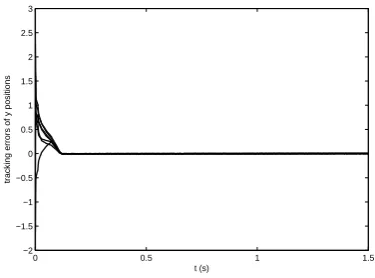
3) Determination ofβ: We aim to design the simulation such that the consensus tracking can be achieved in at most t∗ = 10 s. In order to do that, we have to choose β to be bigger than 28.09, which can be calculated from (13). Let’s takeβ= 29.
Fig. 1. The fixed undirected topology of followers and virtual leader
−4 −2 0 2 4 6 8 10 12 14 16 −2
−1.5 −1 −0.5 0 0.5 1 1.5 2 2.5 3
x (m)
y (m)
obstacle
trajectory of the virtual leader
[image:5.595.113.227.59.149.2]desired position
Fig. 2. Example scenario of obstacle avoidance for all agents
−4 −2 0 2 4 6 8 10 12 14 16 −2
−1.5 −1 −0.5 0 0.5 1 1.5 2 2.5 3
x (m)
y (m)
virtual leader
Fig. 3. Trajectories of the virtual leader and the followers under (21) and (22). The circle denotes the initial position of the virtual leader, while the squares denote the initial positions of the followers.
0 0.5 1 1.5
−3 −2 −1 0 1 2 3
t (s)
tracking errors of x positions
Fig. 4. Position tracking errors ofxpositions under (21) and (22).
0 0.5 1 1.5
−2 −1.5 −1 −0.5 0 0.5 1 1.5 2 2.5 3
t (s)
[image:5.595.329.517.60.199.2]tracking errors of y positions
Fig. 5. Position tracking errors ofypositions under (21) and (22).
B. Case of undirected fixed topology
1) Dynamics of agents: The communication topology is given in Fig. 6. Suppose the dynamics of each follower is described by
˙
ξi(t) = sin(ξi(t) +π
4)−α
X
j∈Ni¯(t)
bij(ξi(t)−ξj(t))
−βsgn( X
j∈Ni¯(t)
bij(ξi(t)−ξj(t))),
(23)
and their initial x positions and y positions are given by
ξx(0) = [ −2.5 −3 −2.8 −4 −2 −1 −3.5 ] and
ξy(0) = [ 0.5 −1.5 1 −0.5 1.5 2 0.8 ]
respec-tively.
The dynamics of the virtual leader is given by
˙
ξ0(t) = sin(ξ0(t) +π
4) (24)
and its initial position is given in Fig. 7.
Our aim is that the virtual leader moves along an ellipse. So the trajectories of the virtual leader is chosen to be ξ0(t) = [−2cos(t), sin(t)]T.
2) Determination of α: Based on the Fig. 6, the matrix M is obtained as follows
M =
2 0 −1 0 0 0 0
−1 2 −1 0 0 0 0
0 −1 1 0 0 0 0
0 −1 0 1 0 0 0
0 −1 0 0 1 0 0
0 0 −1 0 0 1 0
0 0 −1 0 0 0 1
LetSM+MTS=I
n. Then we obtain
S=
0.7227 0.9454 1.6176 0.0714 0.0714 0.0357 0.0357 0.9454 2.0210 3.1134 0.2143 0.2143 0.1071 0.1071 1.6176 3.1134 5.8739 0.1429 0.1429 0.3214 0.3214 0.0714 0.2143 0.1429 0.5000 0 0 0 0.0714 0.2143 0.1429 0 0.5000 0 0 0.0357 0.1071 0.3214 0 0 0.5000 0 0.0357 0.1071 0.3214 0 0 0 0.5000
Using Theorem 4.1, α > 2lλmax(S)
λmin(SM+MTS) = 16.2584. Here we chooseα= 18.
[image:5.595.76.258.205.337.2] [image:5.595.76.261.399.535.2] [image:5.595.74.263.615.750.2]1
0
2
3
[image:6.595.113.226.51.140.2]4
5
6
7
Fig. 6. The fixed directed topology of followers and virtual leader
−4 −3 −2 −1 0 1 2 3 4 −2
−1.5 −1 −0.5 0 0.5 1 1.5 2 2.5 3
x (m)
y (m)
trajectory of the virtual leader
Fig. 7. Trajectories of the virtual leader and the followers under (23) and (24). The circle denotes the initial position of the virtual leader, while the squares denote the initial positions of the followers.
4) Simulation results: Fig.7 shows the trajectories of the virtual leader and the followers. Figs. 8 and 9 show the position tracking errors of x positions and y positions respectively. It is easy to see from Figs. 7, 8 and 9 that the consensus tracking can be achieved in about 0.2 seconds. This value is remarkably less than the desired bound 10 seconds.
VI. CONCLUSIONS AND FUTURE WORKS
In this paper, we consider the consensus tracking for multi-agent systems with nonlinear inherent dynamics under fixed undirected and directed communication topologies. It is shown that the consensus tracking can be achieved in finite time using appropriate control laws. Some simulation examples are finally given to validate the theoretical results.
0 0.1 0.2 0.3 0.4 0.5 0.6 0.7 0.8 0.9 1 −1.5
−1 −0.5 0 0.5 1 1.5
t (s)
tracking errors of x positions
Fig. 8. Position tracking errors ofxpositions under (21) and (22).
0 0.05 0.1 0.15 0.2 0.25 0.3 −1.5
−1 −0.5 0 0.5 1 1.5 2
t(s)
[image:6.595.329.517.61.198.2]tracking errors of y positions
Fig. 9. Position tracking errors ofypositions under (21) and (22).
As further works, we will consider the second-order consensus tracking for multi-agent systems with nonlinear inherent dynamics. On the other hand, since the operation of most multi-agent systems is naturally delayed, the consensus tracking with time delay will be also investigated.
REFERENCES
[1] V. Gazi, and B. Fidan, ”Coordination and control of multi-agent dynamic systems: Models and approaches,” in Proc. of the SAB06 Workshop on Swarm Robotics, ser. Lecture Notes in Computer Science (LNCS) 4433, E. Sahin, W. M. Spears, and A. F. T. Winfield, Eds. Berlin Heidelberg: Springer-Verlag,, 71–102, 2007.
[2] T. Vicsek, A. Cziok, E. B. Jacob, I. Cohen, and O. Shochet, ”Novel type of phase transition in a system of self-driven particles,”Physical Review Letters, 75(6),1226-1229, 1995.
[3] A. Jadbabaie, J. Lin, A. S. and Morse, ”Coordination of groups of mobile autonomous agents using nearest neighbor rules”,IEEE Trans. Autom. Control, vol. 48(6), 985-1001, 2003.
[4] M. Cao, A. S. Morse, and B. D. O. Anderson, ”Reaching a consensus in a dynamically changing environment: a graphical approach,”SIAM Journal on Control and Optimization, 47(2), 575-600, 2008. [5] L. Moreau, ”Stability of multiagent systems with time-dependent
com-munication links,” IEEE Transactions on Automatic Control, 50(2),
169-182, 2005.
[6] R. Olfati-Saber, ”Consensus problems in networks of agents with switching topology and time-delays,”IEEE Transactions on Automatic Control, 49(9),1520-1533, 2004.
[7] W. Ren, and R. W. Beard, ”Consensus seeking in multiagent systems under dynamically changing interaction topologies,” IEEE Transac-tions on Automatic Control, 50(5), 655-661, 2005.
[8] F.Jiang, and L. Wang, ”Finite-time information consensus for multi-agent systems with fixed and switching topologies,”Physica D, 238,
1550-1560, 2009.
[9] W. Yu, G. Chen, and M. Cao, ”Consensus in directed networks of agents with nonlinear dynamics,” IEEE Transactions on Automatic Control. DOI: 10.1109/TAC.2011.2112477, 2010.
[10] M. Cao, and J. Kurths,”Second-order consensus for multiagent systems with directed topologies and nonlinear dynamics,”IEEE Transactions on Systems, Man, and Cybernetics, Part B,40(3), 881-891, 2010. [11] Y. Cao,andW. Ren, ”Distributed coordinated tracking with reduced
interaction via a variable structure approach,”IEEE Transactions on Automatic Control. DOI: 10.1109/TAC.2010.2049517, 2010. [12] F. R. K. Chung, ”Spectral Graph Theory,” American Mathematical
Society,, 1997.
[13] R. A. Horn, and C. R. Johnson,(eds.), ”Matrix Analysis,”Cambridge Univ. Press, 1988.
[image:6.595.76.260.186.323.2] [image:6.595.72.260.617.756.2]