Abstract—The transportation problem of real-life situation is complicated. Optimization target is usually not
unique. We often need to take these optimization objectives of
cost and time into account. This paper proposes and
implements double-objective genetic algorithm based on
MATLAB. The double-objective optimization problem is about
the sale and transportation of a type of connector of China
Information and Electronics Development Inc. Ltd., Hefei. For
the target matrix’s difference on units and quantity degree, the
solution combined manual weight and adaptive weight avoids
the appearance of error on search-behavior unexpectedly to be
too biased to a specific target. By a real instance, we verify that
the algorithm is accurate and reliable, can effectively solve the
large-scale real transportation scheduling problems.
Index Terms—Genetic algorithm, Transportation problem, MATLAB
I. INTRODUCTION
RANSPORTATION problem is a type of NP-hard (non-deterministic polynomial-time hard) problem. For small-scale transport problem, graphic method or table dispatching method does work; but for large-scale transport problem, the result got out by graphic method or table dispatching method is random and blind, we may not find the optimal solution by those methods. In the light of actual conditions, transportation problem can not be usually very simple. In normal conditions, transportation problem has some properties such as large size matrices, multi-objective optimization, objective matrices’ unit and magnitude being inconsistent. In view of these properties, a solution of adaptive weight multi-objective genetic algorithm based on MATLAB is put forward in this paper. The genetic algorithm’s accuracy and reliability are verified by the data from China Information and Electronics Development Inc. Ltd., Hefei and others. We can figure out the optimal solution of these practical problems by the genetic algorithm.
II. PROBLEM DESCRIPTION
A. Practical Problem Faced Is Described Below
China Information and Electronics Development Inc. Ltd., needs to sale and transport a type of connector. Let us figure out the optimal transportation scheme.
Application of Improved Genetic Algorithm in
Solving a Type of Connector Transportation
Problem Based on MATLAB
Cheng Xiangyu, Zhang Yan, An Chunyu
T
Manuscript received November 7, 2011; revised January 13, 2012. Cheng Xiangyu is with the East China Research Institute of Electronic Engineering, Hefei 230088, China (corresponding author to provide phone: 86-138-5698-5318; fax: 86-0551-5391111; e-mail: [email protected]).
Zhang Yan is Anhui Water Conservancy Technical College, Hefei 231603, China (corresponding author to provide phone: 86-0551-5171389; e-mail: [email protected]).
B. Constraint Conditions
Suppliers of the connector include: Guangzhou Winmax Electronic Technology Co. Ltd, Xian Huada Electronic Connector Co. Ltd, Beijing Jingzhe Electronic Technology Co. Ltd, China Aviation Optical-Electrical Technology Co. Ltd, and Shenzhen Connector Technology Co. Ltd. They are represented respectively by the following symbols: S1, S2, S3, S4, and S5.
Quantities of the connector that these companies supply to China Information and Electronics Development Inc. Ltd. are listed in the following table (TABLEI):
The departments for connector’s sale and use include: China Information and Electronics Development Inc. Ltd. headquarters, Beijing liaison offices, Xiamen liaison offices, Chengdu business department, Shenzhen liaison offices and Xinjiang liaison offices. They are represented respectively by the following symbols: D1, D2, D3, D4, and D5.
The departments’ demand quantities of the connector are listed in the following table (TABLEⅡ):
The average transportation cost and time from suppliers to sale departments are listed in the following table (TABLEⅢ):
C. Optimization Target
It needs us to figure out the optimal transportation scheme from suppliers to sale departments. In the scheme, the transportation time and cost in total should meet the minimum value simultaneously.
III. SOLUTION PROCESS
A. Solution Method
The transportation problem is expressed in mathematical language [1] as follows:
5 6
1 1 6
1 5
1
min ,
1, 2
s.t.
,
1, 2,
, 5
,
1, 2,
, 6
0,
,
q q ij ij
i j
ij i j
ij j i
ij
z
c x
q
x
a i
x
b
j
x
i j
It is a multi-objective transportation problem of NP-hard [2]. We may adopt adaptive weight [3] multiple-objective genetic algorithm [4] to solve the optimization problem.
TABLEI
SUPPLY QUANTITIES OF SUPPLIERS
Supplier code S1 S2 S3 S4 S5 Supply quantity
(piece/month) 200 208 120 250 72
TABLEⅡ
DEMAND QUANTITIES OF SALE DEPARTMENTS
Sale department code D1 D2 D3 D4 D5 D6 Demand quantity
(piece/month) 210 220 85 180 65 90
TRANSPORTATION COST AND TIME
Supplier code
Average transportation cost
1 ij
c
(yuan/piece)
Supply quantity
i
a
(piece)S1 S2 S3 S4 S5
10 20 15 25 6 32
11 8 21 7 5 28
9 3 14 16 19 27 10 12 14 15 18 20 12 20 22 16 2 35
200 208 120 250 72
Average transportation time
2 ij
c
(hour/piece)
S1 S2 S3 S4 S5
8.5 6 12 18 4 16 13 11 17 7 16 8 9 3 16 14 19 19.5
6 7 13 9 22 29
9.5 20 19 18 1.5 30 200 208 120 250 72 Demand
quantity
j
b
(piece)
B. Genetic Algorithm Program Flow
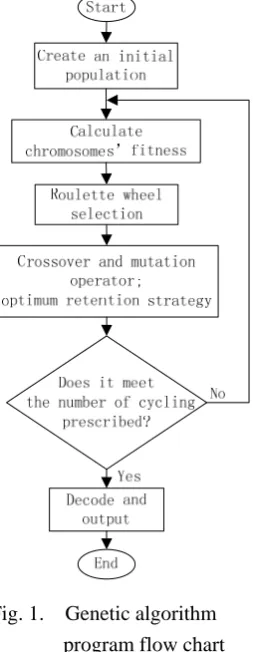
For solving the problem, we adopt a coding method based on prüfer numbers of spanning tree, and design a adaptive weight multiple-objective genetic algorithm program with MATLAB. The main program flow chart is showed as follows:
C. Method Based on Spanning Tree
The genetic algorithm uses a prüfer numbers coding based on spanning tree [5]. It can represent all possible trees. With the genetic algorithm based on spanning tree, we can find out the optimal solutions or the approximate optimal solutions of transportation problem in the total solution space.
Suppliers S1、S2、S3、S4、S5 are defined as elements of the set S ={1,2 ,3,4,5}; sale or use departments D1、D2、D3、D4、D5、D6 are defined as elements of the set D={5+1,5+2,5+3,5+4,5+5, 5+6}={6,7,8,9,10,11}. The transportation problem has 5+6=11 nodes in its spanning tree. It may have 5×6=30 different edges. For a complete graph of p nodes, it may have pp-2 trees of different node label permutations. The node that only connects one edge is called leaf of the tree. Any tree has at least 2 leaves.
Coding Method
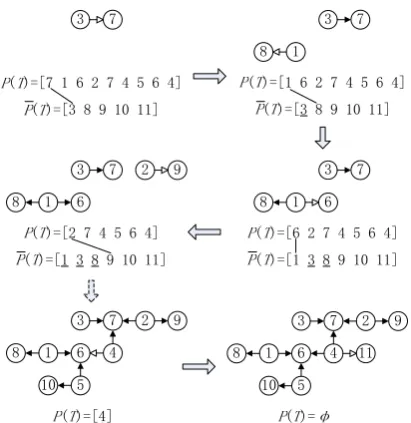
As a coding manner of spanning tree, prüfer numbers can be used to code transportation tree. First record a non-leaf node that directly connects a minimum leaf node, and then remove the minimum leaf node from transportation tree. Do it every time until only two nodes left in the tree to
complete constructing prüfer numbers
P T
( )
gradually. Leaf nodes are marking out with dotted line circles in the below chart. Overall process of constructing prüfer numbers is showed as follows:Decoding Method
First connect the minimum considering node in the set
( )
( )
P T
S
D
P T
to the leftmost number of( )
P T
, and then remove the leftmost number of
P T
( )
. Do it every time to construct transportation tree gradually.In the following chart, the numbers underlined in
P T
( )
are the nodes that have been added to the tree. They belongamong unconsidering nodes. When
P T
( )
, directlyconnect two considering nodes in
P T
( )
to complete constructing transportation tree. The process of converting prüfer numbers into transportation tree is showed as follows: Fig. 1. Genetic algorithmprogram flow chart
3 7 2 9
4 11 6
1 8
5 10
( )=[7]
7 2 9
4 11 6
1 8
5 ( )=[7 1]
7 2 9
4 11 6
1
5 ( )=[7 1 6] ( )=[7 1 6 2 7 4 5 6 4]
4 11 6
10
[image:3.595.95.222.162.489.2]10
[image:3.595.318.539.255.400.2]D. Setting Genetic Algorithm Parameters
The size is set to contain 20 chromosomes in each population. The number of iteration is set to 600 genetic operations. We combine manual weight
1
0.6, 0.4
2w
w
with adaptive
weight
max min
1
(
a q)
, (
1, 2)
q q
w
q
z
z
to form the last weight value.
The regret value calculation of double-objective genetic algorithm in this case adopts formula as follows:
[image:4.595.55.261.61.273.2] [image:4.595.310.548.566.758.2]* , 2 * 1/ 1 min 2 1/ max min 1
( ; , ) ||
||
[
(
) |
| ]
[
|
| ]
p wp p p p q a q q q q
q q
p p p
q
q q q
r z p w
z
z
w w
z
z
z
z
w
z
z
In the formula,
z
q denotes objective value vector ofobjective (q) of a population.
* q
z
denotes ideal point [6] of the objective, it represents the location of the desired objective. We use it to identify the search direction of
genetic algorithm. max q
z
and min qz
denote the maximum number and the maximum number in objective value vector
q
z
.This preference parameter
p
is set to 3. The ability of taking both objectives into account is more power for largep
.The smaller the regret value
r
(
x
)
of the function is, the closer the chromosome is to the solution. Thus methodof converting the regret value to fitness value
eval
(
x
)
isdefined as follows:
max
max min
( )
( )
r
r x
eval x
r
r
. Theparameter
could be used to regulate the probability ofthe roulette wheel selection. When
0
, the roulette probability is directly proportional to chromosome fitnessvalue; When
, the roulette wheel selection willselect chromosomes at complete random. Here, we
set
0.5
.E. Result of Genetic Algorithm
We adopt MATLAB genetic algorithm program to solve the problem. Solution result is as follows:
Genetic algorithm effect figure was depicted.
3 7
( )=[7 1 6 2 7 4 5 6 4]
( )=[3 8 9 10 11]
( )=[1 6 2 7 4 5 6 4]
( )=[3 8 9 10 11]
3 7
1 8
( )=[6 2 7 4 5 6 4]
( )=[1 3 8 9 10 11]
3 7
1
8 6
( )=[2 7 4 5 6 4]
( )=[1 3 8 9 10 11]
3 7
1
8 6
2 9
3 7 2 9
4 6 1 8 5 10 ( )=[4]
( )=[1 2 3 5 6 7 8 9 10 11]
3 7 2 9
4 6 1 8 5 10 ( )=
( )=[1 2 3 4 5 6 7 8 9 10 11] 11
Fig. 3. Process of converting prüfer numbers into transportation tree
Optimal chromosome:
( )
P T
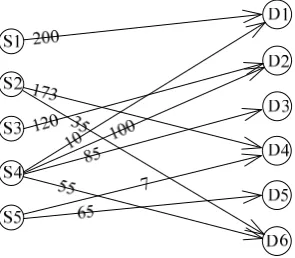
= [6 7 4 4 4 11 5 9 2]Optimal transportation matrix:
200 0 0 0 0 0
0 0 0 173 0 35
GA = 0 120 0 0 0 0
10 100 85 0 0 55
0 0 0 7 65 0
Optimal transportation routing chart (Automatic program generator in MATLAB):
IV. CONCLUSION
Lack of space forbids further concrete details of the adaptive weight multiple-objective genetic algorithm solution here. But all over idea and solution are clearly expressed. The MATLAB genetic algorithm program is designed to solve the practical problems. It provides an effective way of reducing transportation cost and time for China Information and Electronics Development Inc. Ltd. From the result chart and practical application, the company could cut down retrench about RMB 4500 Yuan and save transportation time about 4000 hours at 10 routes every month on average. It avoids the blindness and reduces the difficulty of scheduling decision.
REFERENCES
[1] Rajendra Prasad, V. (Univ of New Brunswick, Canada), Nair, K.P.K. and Aneja, Y.P., “Generalized time-cost trade-off transportation problem”, Journal of the Operational Research Society, v 44, n 12, p 1243-1248, Dec 1993.
[2] Chen, Bin (School of Software, Harbin Institute of Technology, Weihai) and Quan, Guangri, ”NP-hard problems of learning from
examples”, Proceedings - 5th International Conference on Fuzzy Systems and Knowledge Discovery, FSKD 2008, v 2, p 182-186. [3] Othman, Zalinda (Industrial Computing Department, Faculty of
Information Science and Technology, National University of Malaysia (UKM), 43600 Bangi, Selangor, Malaysia), Delavar, Mohammad-Reza Rostamian, Behnam, Sarah and Lessanibahri, Sina, “Adaptive genetic algorithm for fixed-charge transportation problem”, IMECS 2011 - International MultiConference of Engineers and
Computer Scientists 2011, v 1, p 96-101, 2011, IMECS 2011 - International MultiConference of Engineers and Computer Scientists
2011.
[4] Gen, Mitsuo (Ashikaga Inst of Technology, Ashikaga, Japan) and Li, Yin-Zhen, “Spanning tree-based genetic algorithm for bicriteria transportation problem”, Computers and Industrial Engineering, v 35, n 3-4, p 531-534, Dec 1998.
[5] Hajiaghaei-Keshteli, M. (Department of Industrial Engineering and Engineering, Optimization Research Group, University of Tehran, Tehran, Iran), Molla-Alizadeh-Zavardehi, S. and Tavakkoli-Moghaddam, R., “Addressing a nonlinear fixed-charge transportation problem using a spanning tree-based genetic algorithm”, Computers and Industrial Engineering, v 59, n 2, p 259-271, September 2010.
[image:5.595.91.239.246.375.2][6] Mitsuo Gen and Runwei Cheng, “Genetic Algorithms and Engineering Optimization", Wiley-Interscience, 1999-12-28, ISBN: 0471315311, p 258-265.