Multiresolution Techniques and 2D Signal Application
Kyanda S. Kaawaase, Feng Chi
Abstract- Optimal image representation techniques addressing image processing problems are of growing interest in current research, such techniques are often referred to as multiresolution analysis (MRA). This paper puts together such MRA techniques and briefly discusses their applications. It is more aimed at engineers than mathematicians therefore no proofs to mathematical equations, however reference to where such proofs can be found are provided, over 60 current references are cited. It is hoped that this paper will be informative to engineers.
Index terms- multiresolution analysis; wavelet transform; Fourier transform; Short-time Fourier transform, (non) separable transform.
I. INTRODUCTION
Optimal image representation techniques to address image processing problems like enhancement, compression, pattern recognition, edge and feature extraction, are of growing interest in current research [1, 2], such techniques are often referred to as multiresolution analysis (MRA), an idea originated by Burt and Adelson [3-7]. MRA provides simple means to analyze an image at different resolution levels forming a hierarchical framework [6, 8] aimed at solving two difficulties namely; obtaining global minima of a minimization function with many local minima and high computation cost [4]. MRA also allows scale-invariant interpretation of an image so that our interpretation of the scene is not altered when the image scale is changed [9].
History of MRA begins with Joseph Fourier’s theories of frequency (Fourier synthesis) in 1807 [10-12] that have led to the development of many functions to transform signals from spatial domain into phase-space representations that are more suitable for analysis [13].
MRA can be achieved in two ways, namely; (1) the traditional also known as separable and (2) non-separable approach, the former extends one dimension (1D) signal processing algorithms to two dimensions (2D) by equally applying 1D filtering and subsumpling operations in both horizontal and then vertical directions at each scale [2,14] or by use of four matrix convolutions, one for each lowpass/ highpass, horizontal/vertical combination.
Manuscript received December 23rd 2011; revised January 12th 2012.
Kyanda S. Kaawaase is at the College of information and communication Engineering, Harbin Engineering University, P.R. China. (Tel: 008615124506071, fax: 0086-8258911 email: [email protected].)
Feng Chi is with the College of information and communication Engineering, Harbin Engineering University, P.R. China, (email: [email protected] )
The approach avoids geometrical and topological complexity introduced by the second dimension thus making numerical algorithms simple and faster; an example of such a complexity is the causality concept which is not well defined in 2D [3]. The latter approach works different to achieves the same results [15,16], it involves 2D filters and 2D down sampling matrices which are non-factorizable into 1D filters/sampling pairs [16], MRA in this case is computed based on a 2D signal input sample convolved with a single matrix [15] resulting in images more compatible with mammalian vision [17], fewer operations are required and each basis function has square support [18, 19]; geometrical images can best be analyzed with this approach [20] which is a basis for many current applications involving geometric domain and space measurements [21]. However, it is expensive computationally and the associated 2D filterbank design is a challenge [14]. Current research also includes blending of the two approaches [16, 22, 23].
In standard interpretation of MRA, projecting a function
f
on spacesV
i is viewed as successive approximationsto
f
with finer and finer resolution asi
decreases [44]. Asequence of closed subspaces
{ }
V
i i defined in2
( )
L
is a MRA if the following properties are satisfied [3, 24-26],a)
{0}
...
V
1
V
0
V
1...
L
2( ),
b)
iV
i
L
2
c)
iV
i
{0}
d)
f x
V
0
f x
1
V
0e)
f x
V
if
2
x
V
i1Where
and
denote a set of integers and real numbers respectively. Mathematical proofs found in [3, 27].II. FOURIER TRANSFORMS FOR MRA.
Named after a French mathematician Joseph Fourier (1768-1830), the Fourier transform (FT) is the traditional analytical tool for continuous and discrete-time signal [10, 28]. It is a linear combination of sine and cosine waveforms of finite (or infinite) number of frequencies which provide local representation of any signal; such a signal is transformed from time domain to frequency domain. The FT is very useful for many signal application where time resolution is not required, that is to say, the exact time a particular sinusoidal wave occurs in the signal cannot be determined under FT because each of its component (coefficients) depends on the global behavior of the signal even when the function tends to infinity[28,29].
If
g
:
h is a square integrable function, thatis 2 2
2
( )
d
h
( ) | ( )
x
x
( )
x
g
g
g
g
, where2
h
for 2D signals, the FTG x
( )
ofg
is given by2
( )
( )
jxT h Tx| ( ) ,
G x
e
d
Q
g
g
where
x
,
and superscriptT
is conjugate of the first vector andQ
e
2j . The inverse FT for a sufficiently smoothg
is given by
2( )
( )
jxT h Tx|
,
G x e
d x
Q
G x
g
The scalar product in the exponent of the kernel
Tx
makes the FT kernel separable [30]. In discrete case, the 2D FT maps complex valuedMxN
matrix onto complex valuedMxN
matrix and it can be expressed as below;1 1
, ,
0 0
1
M Nny mx
x y m n N M
m n
G
Q
Q
MN
g
and its inverse,
1 1
, ,
0 0
M N
mx ny
m n x y M N
x y
G Q Q
g
.The coexistence of FT and its inverse indicates that under certain conditions, any function can be uniquely represented by FT [31], properties and proof can be found in [30,32].
Although two classes of multiresolution representation are recognized [13], namely; Short-time Fourier transform (STFT) (section III)and wavelet transform, current literature [10,28,33] suggest FT for MRA in which the FT has representation different from STFT concept. Wave-like transform with cosine analyzing function of one period are used in [33] to represent the integral FT while [10] describes direct means to perform time-frequency MRA of signals. The FT is also represented by A-wavelet transform in [28]. All these new representation involve a fully scalable modulated window although not all shifts are possible. Just like the traditional FT,
these modifications have no time resolution hence the adoption of techniques described in next sections.
III. SHORT-TME FOURIER TRANSFROM (STFT).
Introduced by Gabor in 1946 [3,13], STFT also known as time-varying FT [34] or windowed FT is a variation of FT for MRA of non-stationary signals [12]. A signal to be analyzed is split into pieces (frequency components) by a usually compact supported single window function which is translated by a chosen step size to cover the entire time domain while each piece is FT independently [28].
Consider a real and symmetric window
g
( )
t
g
(
t
)
translated by
k
and modulated by the frequency
such that:,
( )
(
)
j t
k
t
t
k e
g
g
Normalizing this translation so that
g
k,
1
for all2
( , )
k
results in the STFT off
L
2
given by:
,
,
,
j t k
k
f
f t
t
k e
dt
g
g
The discrete form with period
N
is given as:
1, 0
2
,
,
[ ] [
]exp
N
k l t
jlt
k l
f
f t
t
k
N
g
g
Where
0
k
N
,
0
l
N
,
k l
,
is calculated with a discrete FT off t
[ ] [
g
t
k
]
[3].The transform depends on the window width in time and frequency, its name is derived from multiplication by
t
k
g
which localizes the Fourier integral in the neighborhood oft
k
[3]. Sufficient accuracy can be attained if proper parameter values are chosen [34], however, the transform lacks decent resolution for both high and low frequencies. Major issues with STFT are computational efficiency and selection of the moving window size [28].IV. WAVELET TRANSFORM FOR MRA.
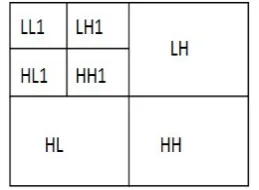
scale than those in the lower subbands [42], such coefficients are stacked on top of each other forming a basic signal decomposition scheme known as pyramid which gives a hierarchical structure [43,66].
The traditional 2D wavelet transform is a separable transform [16], it involves obtaining a general signal representation in terms of simpler, fixed building blocks at different scales and position by convolving the input with a shift (translation in time) and scale (dilations or contractions) of the analyzing wavelet also called “mother” wavelet
y.
[image:3.595.320.538.346.533.2] [image:3.595.71.201.626.721.2]It is difficult to define “wavelet” and equally difficult to write a comprehensive review incorporating all its different properties due to the widely varying classes of wavelet basis functions [37,59], different wavelet families make different trade-offs between how compactly the basis functions are localized in space and smoothness [12], a fully modulated and scalable, sliding window of width dependent on the central scale is used for scale localization in wavelet analysis [11,28,38], a wavelet transform is obtained for every location of this window such that a short window is used at high frequencies while long one is for low frequencies [12,28], the resulting wavelet transform is a collection of time-scaling representations of the signal with varying resolutions [33]. Temporal analysis is accomplished with high frequency wavelet prototype while low frequency version of the same wavelet is for frequency analysis [1,11,12,28,64]. MRA represents a signal in terms of wavelet expansion enabling data operations using only the corresponding wavelet coefficients [12]. Multiresolution with wavelet transform can be viewed as a process of taking one channel’s output signal and putting it through another (or more) pair of analysis filters [15], Wavelet packets require an additional filter pair on each channel [15] for a reason that both approximation and detail coefficients are decomposed at each decomposition level [29]. Multiresolution decomposition is achieved with wavelet transform by taking an input signal
x n
( )
and splitting it into two versions of lower resolution with respect to the input: a lowpass (average) coarser resolution version and a highpass (difference) detailed resolution version. The coarser resolution signal is taken to be input and further split into two as before in a process which can continue for as many levels as desirable only limited by the length of the input signal (image size) [6,15], this process leads to improved hierarchy of resolutions on successive levels of the signal representation [62].Figure 1, shows a two level decomposition structure in wavelet transform, while figure 2 shows the same as applied to Barbara’s image. Multiresolution with wavelet transform conforms to human perception of hearing and vision [6, 4]. The continuous wavelet transform (CWT) is given as:
( , )
( ) (
)
f
W a b
f t
y
at
b dt
where
f t
( )
is the analyzed function,y
( )
t
is the wavelet while(
at
b
)
y
is its shifted and scaled version at timeb
and scalea
.The CWT is not practical for MRA due to the time consuming and complex inverse transform, instead, a discrete version of the wavelet transform is considered for multiresolution representation [65] the DWT of a signal
x n
[ ]
can be given by:1
1
1
[ , ]
[ ]
aL b
f
n b
n
W a b
x n
a
a
g
In the discrete case, the wavelet is replaced with a function
g
as a result of sampling the continuous waveletfunction,
L
is the support size of the basic waveletg.
Wavelet transforms are implemented using filter banks whose relation to wavelets is the recursive convolution of the input vector after shifting and scaling, so the scaling function
( )
t
is determined through recursive application of filter coefficients. The coefficients of scaling function and wavelet function posses all the information about the scaling and wavelet functions respectively [28].The scaling function is defined by:
( )
2
[ ] (2
)
k
t
h k
t
k
and the wavelet function is defined by:
( )
2
[ ] (2
)
k
t
k
t
k
y
g
Figure 1. Two level decomposition with traditional wavelet
transform, L=Lowpass, H=Highpass filter
Figure 2. Two level multiresolution representation of Barbara, energy
[ ]
h k
is a finite set of coefficients which if found, then the lowpass filter can be designed and consequently the highpass filter coefficients are easily found.Although the Discrete Wavelet Transform (DWT) is applied in literature for signal analysis, its application to 2D and higher dimension signals analysis has shortcomings which include: (1) shift sensitivity, a small shift in input signal could causes major variations in energy distribution within coefficients at different scales, such sensitivity is evident in resultant images as Gibbs like artifacts, the DWT followed by its inverse (IDWT) is only shift invariant when all the coefficients are used for IDWT but not if some are left out or quantized[50, 63], (2) poor directional selectivity for diagonal features due to the use of one diagonal subband for multiple frequencies with different orientation [16, 2,37], this mostly affects the optimal representation of natural images which contain a number of smooth regions and edges with random orientations, (3) Redundancy.
Modifications of the traditional wavelet transform have been made to resolve some of these issues, such as, the wavelet transform with no sub-sampling commonly known as algorithme á trouse [50] otherwise known as the redundant discrete wavelet transform or undecimated wavelet transform, and the use of complex wavelet transforms as in the case of Dual Tree complex wavelet transform [37], Duabechies’ complex wavelet transform [63,55]. Also more advanced wavelet transforms have been proposed for MRA, such as directionlets [2,14], wedgeprints[53], bandlets [51,52], ridgelets [54], curvelets [47], these are categorized under nonseparable approaches of MRA [19] while TODFBs [16], contourlet [22] and its critically sampled improvement CRISP-contourlet [23] are combinations of both separable and nonseparable filter banks, these advanced wavelet transforms are hindered by the high computation cost due to critical sampling and sometimes bandwidth limitations.
V. MULTIRESOLUTION FOURIER TRANSFORM (MFT).
MFT is a superset of wavelet transform (section IV) and STFT (section II) combined into a single transform [13,57]. It is a linear transform with an underlying theory that, given an appropriate choice of analysis window and sampling intervals, it is possible to obtain a signal’s Fourier representation which can be computed efficiently without the limitations involved when using fixed scale of window. MFT is able to represent arbitrary compact supported signals in an interference free manner as well as the ability to analyze signals/images over a range of levels with kernels /windowing function of various size in a computationally efficient style compared to other transforms [57].
A coefficient of MFT at level
k
is a function of threeparameters namely; spatial coordinate
( )
k
, frequency co-ordinate
( )
k
and scale
( )
k
, and is presented by[ ( ) ( )]
ˆ ( ( ), ( ), ( ))
( ( )
( )) ( ( ))
j k kn
f
k
k
k
k
k
f
k e
Where
n( ( )
k
( ))
k
is a Finite Prolate Spheroidal
Sequence operating as a windowing function with maximum energy concentration in both spatial and frequency domain [57]. The general structure of MFT is in such that at the lowest level, the entire
N
N
original image representedas
f
( ( ))
k
is covered by a single block in the spatial domain and therefore MFT is a discrete FT of the original image at this level while at the highest level, each of theN
N
blocks covers a single point in the spatial domain so the MFT is the original image itself. Intermediate levels of the MFT are STFTs with windowing functions of different size [57]. Advantages of MFT include;(1) MFT is a hierarchical structure of STFT which is linear in nature and therefore MFT inherits linear properties which are important for signal/image filtering and response prediction operation. (2) Operations in each domain are performed locally at each level of the MFT. (3) MFT also inherits invertibility properties from the STFT hence errors during transformation between domains are reduced.
MFT has been used to segment images based on the analysis of local properties in spatial frequency domain [57].
A shortcoming of MFT is that in its application, the local spectra of MFT are obtained by discrete FT which introduces “wrap around” artifacts in some blocks [57]. MFT has successfully been applied in image analysis where it has proved to be effective and computationally inexpensive [13,45,46].
VI. APPLICATION
This section looks at application of 2D MRA. There are numerous reasons to opt for MRA; first, at coarser resolution, the minimization problem is less ill-posed than at finer resolution and therefore solution obtained at coarser level is close to the true solution at that resolution, interpolating the obtained solution to the next resolution level provides good initial solution that is near the true solution at that level as well, successive repeat of this step to the finest resolution level leads to a solution more likely to be close to the true solution which is the global minimum[4]. Second, multiresolution enables confinement of estimation to a significantly smaller search range at the finest resolution, only the relevant details are processed for a particular task [3] thereby reducing the amount of searches, processing time and complexity.
applicable industrially for example in FBI finger print project [37], biomedical imaging, remote-sensing, surface inspection and face recognition [64,49,60], multiresolution FT has been used for texture analysis in [45]. (3) Image compression standards such as the recent JPEG-2000 [33,41] and MPEG [11]. (4) Image enhancement is another area where MRA has been successfully employed [41]. (5) MRA is largely applied for digital image watermarking in which invisible and robust data hiding/ embedding can only occur in the spatial and frequency domains [11]. (6) MRA has also been extended to more general spaces like graphs, datasets, homogeneous type spaces and other general nonlinear structures where it provides fast computation of functions for efficient compression and denoising [58]. (7) Other areas are; astronomy, acoustics, radar, nuclear engineering, magnetic resonance imaging, human vision, optics, fractals, turbulence, earthquake-prediction, and solving mathematical equations [11,12].
MRA has a shortcoming that it requires much more processing power compared to filtering techniques [41].
VII. DISCUSSION
This section is a brief discussion on techniques in the above sections. As shown above, both Fourier and wavelet transform can effectively be applied for MRA. It is important to note that, individual wavelet functions are localized in time while the basis sinusoidal functions of FT are non-local (and stretch out to infinity) [28]. Wavelet transforms do a better job in approximating single quick changes or sharp spikes in short term signal (unit impulse function) as compared to FT which requires an infinite number of terms as a sum of sinusoids [12,33]. Fourier and wavelet transforms are related in following ways; both transforms can operate on continuous or discrete signals, coefficients in both transforms are calculated by inner-product of the input signal/image and a set of orthonormal basis functions [11,12]. Another relation is that the inverse transform matrix of both the FT and wavelet transform is a transpose of the original signal, and therefore both transforms can be viewed as a rotation in function space to a different domain, this domain consists of sine and cosine basis functions for FT while wavelet transform constitutes more complicated basis functions called “wavelets”. Other differences between the two functions are the type of analysis they can accomplish.
REFERENCES
[1] Anke Meyer-Bäse, “Pattern recognition for medical imaging”, ISBN: 0-12-493290-8, Elsevier, 2004.
[2] V. Velisavljevic´, B. Beferull-Lozano, and M. Vetterli, “Space-frequency quantization for image compression with directionlets,” IEEE Trans. Signal Process., vol. 16, no. 7, pp. 1761–1773, Jul. 2007.
[3] Stephane Mallat, “A Wavelet Tour of Signal Processing” Elsevier, ISBN: 13 978-0-12-374370-1, 2009.
[4] Yao Wang, Jorn Ostermann, Ya Qin Zhang, “Video Processing and Communications” Prentice Hall, ISBN 0-13-017547-1, Pg191, 2002.
[5] P. J. Burt and E. H. Adelson. "A multiresolution spline with application to image mosaics". ACM Trans. on Graphics, 2(4):217–236, 1983.
[6] Sergios Theodoridis and Konstantinos Koutroumbas, Pattern Recognition, Third Edition, ISBN:0-12-369531-7, Elsevier, 2006.
[7] P. J. Burt and E. H. Adelson. "The laplacian pyramid as a compact image code", IEEE Trans. Commun., COM-31:532-540, 1983.
[8] J. Koenderink, "The structure of images" Biological cybernetics. New York: Springer Verlag. 1984.
[9] Stephane G. Mallat, “A theory for multiresolution signal decomposition: The wavelet representation”, IEEE Trans. Pattern Analysis and Machine Intelligence, Vol.11, pp. 674-693, 1989.
[10] Julian U. Anugom and Artyom M. Grigoryan, “Multiresolution signal processing by Fourier Transform time-frequency correlation analysis” IEEE region 5 TPS 2006, san Antonio, TX, 2006
[11] Frederic Truchetet and Olivier Laligant, “Review of industrial applications of wavelet and multiresolution-based signal and image processing”, Journal of Electronic imaging, SPIE and IS&T, 2008. [12] Amara Graps "An Introduction to Wavelets" IEEE computational
Science and Engineering, 1995, vol 2, num. 2, 1995.
[13] R. Wilson, A. D.Calway and E.R.S. Pearson, “A Generalized Wavelet Transform for Fourier analysis: The Multiresolution Fourier Transform and Its Application to Image and Audio Signal Analysis” IEEE Transactions on information theory, vol 38, No.2, 1992.
[14] V. Velisavljevic´, B. Beferull-Lozano, M. Vetterli, and P. L. Dragotti, “Directionlets: Anisotropic multi-directional representation with separable filtering,” IEEE Trans. Image Process., vol. 15, no. 7, pp. 1916–1933, Jul. 2006.
[15] Michael Weeks, "Digital Signal Processing Using MATLAB and Wavelets" Infinity Science Press LLC, ISBN: 0-9778582-0-0, 2007.
[16] Yuichi Tanaka, Masaaki Ikehara, and Truong Q. Nguyen, "Multiresolution Image Representation Using Combined 2-D and 1-D Directional Filter Banks" IEEE transactions on image processing, vol. 18, no. 2, pp. 269-280, February 2009
[17] Manos Papadakis, G. Gogoshin, I.A. Kakadiaris, D.J,Kouri and D.K. Hoffman "Non-separable Radial Frame Multiresolution Analysis in Multidimensions and Isotropic Fast Wavelet Algorithms", SPIE -International Society for Optical Engineering, 5207, 631, 2003.
[18] Yih Jeng, Chuan-Hung Lin, Yi-Wei Li, Chih-Sung Chen, and Hsin-Han Huang "Application of Multiresolution Analysis in Removing Ground-penetrating Radar Noise", Frontiers + Innovation – 2009 CSPG CSEG CWLS Convention.
[19] Ivan W. Selesnick, Richard G. Baraniuk, and Nick G. Kingsbury, "The dual-tree complex wavelet transform" IEEE Signal Processing Magazine Pp 123-151 November 2005.
[20] Arthur L. Cunha and Minh N. Do "Filter Design for Directional Multiresolution Decomposition" proceedings- SPIE The international society for optical engineering, Vol. 5914, pages 59140V, 2005.
[21] Peer-Timo Bremer, Herbert E.,Bernd Hamann, Valerio Pascucci "A Multi-resolution Data Structure for Two-dimensional Morse Functions" VIS Proc. of the 14th IEEE Visualization 2003.
[22] M. N. Do and M. Vetterli, “The contourlet transform: An efficient directional multiresolution image representation,” IEEE Trans. Image Process. vol. 14, no. 12, pp. 2091–2106, Dec. 2005
[23] Y. Lu and M. N. Do, “CRISP-contourlet: A critically sampled directional multiresolution image representation,”Proc. SPIE Wavelet Applications in Signal and Image Processing, pp.655–665, 2003.
[24] Stephane Mallat," Multiresolution approximations and wavelet orthonormal bases of 2
L "Trans. Amer. Math. Soc., 315:69-87, 1989.
[25] Walnut David F., “An introduction to wavelet analysis”, ISBN: 0-8176-3962-4, Birkhauser Bostone, 2002.
[26] Yves Meyer, “Wavelets and operators”, Cambridge Studies in Advanced Math., vol. 37, Cambridge Univ. Press, ISBN 0-521-42000-8, 1992.
[27] David F. Walnut, “An Introduction to Wavelet Analysis”. Birkhauser, ISBN: 0-8176-3962-4, 2002.
[29] Shehrzad Qureshi, "Embedded Image Processing on the TMS320C6000™ DSP Examples in Code Composer Studio™ and MATLAB" Springer +Business Media, ISBN 0-387-25280-0, 2005.
[30] Bernd Jähne, "Digital image processing" 6th Edition, ISBN 3-540-24035-7 Springer Berlin Heidelberg New York, 2005.
[31] Shubing Wang, “Application of Fourier transform to imaging analysis” University of Wisconsin-Madison, dept of statistics, 2007.
[32] Steven T. Karris, "Signals and Systems with MATLAB Applications, Second Edition", Orchard Publications, ISBN 0-9709511-8-3, 2003.
[33] Artyom M. Grigoryan and Serkan Dursun, “Multiresolution of the Fourier transform” IEEE proc. Int. Conference on Acoustics, Speech, and Signal processing 2005,(ICASSP’05), Philadelphia, PA, 2005. [34] W. Chen, N. Kehtarnavaz, and T. W. Spencer, “An efficient recursive
algorithm for time-varying Fourier transform,” IEEE Trans. Signal Process., vol. 41, no. 7, pp. 2488–2490, Jul. 1993.
[35] Ingrid Daubechies, Ten Lectures on Wavelets, SIAM, CBMS-NSF, Philadelphia 1992.
[36] S. Dahlke, K. Koch, M. Werner, P. Maaß, D. Lorenz, S. Schiffler, G. Teschke, H. Thiele, and S. M¨uller, A. St¨ampfli, "Multiscale Approximation", from http://user.hs-nb.de/~teschke/ps/53.pdf, on November 2011.
[37] Karsten Urban, "Wavelet Methods for Elliptic Partial Differential Equations" Oxford University Press, ISBN 9780198526056, 2009. [38] Kyanda Swaib K., Feng Chi "A selective Review on Target Tracking
Algorithms" IEEE proc. ICGIP 2010, pp 24-31, 2010.
[39] Al Bovik, “The Essential Guide to Video Processing” ISBN: 978-0-12-374456-2, Elsevier Inc., 2009
[40] William K. Pratt, “Digital image processing” PIKS Scientific inside 4th ed, Wiley-Interscience, ISBN: 978-0-471-76777-0, Pg284, 2007.
[41] Al Bovik, "Handbook of Image and Video Processing" Pg 232, Academic Press, San Diego, ISBN: 0-12-119790-5, 2000.
[42] C. Valens, "Embedded Zerotree Wavelet EZW encoding" http://citeseerx.ist.psu.edu, 1999.
[43] John Goutsias, Henk J.A.M. Heijmans "Nonlinear multiresolution signal decomposition schemes" IEEE trans. image processing, vol. 9, No.11, November 2000.
[44] Albert Cohen and Ingrid Daubechies, “Non-separable bidimensional wavelet bases” Revista Mathematica Iberoamericana, vol.9, No1, 1993.
[45] Tao-I Hsu , A. D. Calway , R. Wilson, "Texture Analysis using the Multiresolution Fourier Transform" In Scandinavian Conference on Image Analysis, 1993, pp 823-830, 1993.
[46] A.Calway and R.Wilson, “Curve Extraction in images using the Multiresolution Fourier Transform” IEEE proceedings of International Conference on Acoustics, Speech, and Signal processing ICASSP, Albuquerque, NM, 1990.
[47] E. Candès and D. L. Donoho, “Curvelets—A surprisingly effective nonadaptive representation for objects with edges,” in Curves and Surfaces Fitting, A. Cohen, C. Rabut, and L. L. Schumaker, Eds. Nashville, TN: Vanderbilt Univ. Press, 1999.
[48] Rick S. Blum and Zheng Liu, "Multi-sensor image fusion and its applications" Signal processing and communications: 26, Pg 87, ISBN 0-8493-3417-9, Taylor & Francis Group, 2006.
[49] Kourosh Jafari-Khouzani and Hamid Soltanian-Zadeh "Rotation-Invariant Multiresolution Texture Analysis Using Radon and Wavelet Transforms" IEEE Transactions On Image Processing, Vol. 14, No. 6, pp783-795, June 2005
[50] Andrew P. Bradley, "Shift-invariance in the Discrete Wavelet Transform" Proc. 7th Digital Image Computing: Techniques and Applications, Sun C., Talbot H., Ourselin S. and Adriaansen T. (Eds.), 10-12 Dec. 2003, Sydney, pp 29-38, 2003.
[51] E. L. Pennec and S. Mallat, “Sparse geometric image representations with bandelets,” IEEE Trans. Image Process., vol. 14, no. 4, pp. 423– 438, Apr. 2005.
[52] G. Peyré and S.Mallat, “Discrete bandelets with geometric orthogonal filters,” IEEE Int. Conf. Image Processing, Genova, Italy, Sep. 2005
[53] M. Wakin, J. Romberg, H. Choi, and R. Baraniuk, “Wavelet-domain approximation and compression of piecewise smooth images,” IEEE Trans. Image Process., vol. 15, no. 5, pp. 1071–1087, May 2006.
[54] E. Candès and D.L. Donoho, “Ridgelets: A key to higher-dimensional intermittency?” Phil. Trans. Roy. Soc. Lond. A, pp. 2495–2509, 1999.
[55] J. M. Lina, "Complex Daubechies Wavelets: Filters Design and Applications" ISAAC Conference, univ. of Delaware, June 1997. [56] Youcef Chibani & Amrane Houacine "Multiscale versus Multiresolution
Analysis for Multisensor Image Fusion"The European Association for Signal Processing (EURASIP), 1998
[57] Li C.T. and Wilson, R., “Image Segmentation Using Multiresolution Fourier Transform”, Technical report, Department of Computer Science, University of Warwick, 1995
[58] Ronald R. Coifman, Mauro Maggioni, "Diffusion Wavelets" Elsevier Science, 2004.
[59] Bjorn Jawerth and Wim Sweldens, “An Overview of Wavelet Based Multiresolution Analyses” Society for Industrial and Applied Mathematics (SIAM) Philadelphia, PA, USA, Vol. 36 issue 3, 1994. [60] Timo Ojala, Matti Pietikainen, and Topi Maenpaa, "Multiresolution
Gray-Scale and Rotation Invariant Texture Classification with Local Binary Patterns"IEEE transactions on pattern analysis and machine intelligence, vol. 24, no. 7, pp 971-987, July 2002
[61] N. G Kingsbury, “Complex wavelets for shift invariant analysis and filtering of signals”, Journal of applied and computational Harmonic Analysis, vol. 10, no 3, May 2001, pp 234-353.
[62] Jan Jiri, Medical image processing, reconstruction and restoration: concepts and methods, ISBN: 0-8247-5849-8, CRC Press Taylor & Francis Group, 2006.
[63] Ashish Khare and Uma Shanker Tiwary, “Daubechies complex Wavelet transform based moving object tracking”, Proc. IEEE Symposium on Computational Intelligence in Image and Signal (CIISP), 2007.
[64] Vittorio Castelli, Lawrence D. Bergman, "Image Databases: Search and Retrieval of Digital Imagery" pg 324, John Wiley & Sons, ISBN: 0-471-32116-8, 2002
[65] Chaitai Chakrabarti and Mohan Vishwanath “Efficient Realizations of the Discrete and Continuous Wavelet Transforms: from Single Chip Implementations to Mappings on SIMD Array Computers” IEEE Trans. on Signal Processing, vol. 43, pg. 759-771, 1995