Original Article
Effects of rehabilitation training on quality of life, motor
function, and pulmonary function in patients
with chronic obstructive pulmonary
disease in the stable phase
Chunyu Zhang1*, Yin Shao2*, Deqin Ying3
1Nursing Teaching and Research Department, 2Acupuncture Department Second Ward, First Affiliated Hospital,
Heilongjiang University of Chinese Medicine, Harbin, Heilongjiang, China; 3Department of Respiratory Medicine,
The First People’s Hospital of Wanzhou District, Chongqing, China. *Co-first authors.
Received November 27, 2018; Accepted June 5, 2019; Epub August 15, 2019; Published August 30, 2019
Abstract: Objective: The aim of the current study was to investigate the curative effects of erector spinae functional
rehabilitation training on postoperative inflammation of osteoporotic vertebral compressive fractures, as well as the
effects on quality of life, motor function, and pulmonary function, in patients with chronic obstructive pulmonary disease (COPD) in the stable phase. Methods: A total of 80 patients with COPD in the stable phase, hospitalized from January 2017 to October 2017, meeting inclusion criteria, were collected and randomly divided into the re-habilitation treatment group (n=40) and traditional treatment group (n=40). After admission, patients in the tradi-tional treatment group received traditradi-tional treatment, while patients in the rehabilitation treatment group received rehabilitation training based on traditional treatment. All patients were followed up for 6 months after treatment. UK Medical Research Council (MRC) dyspnea scores, forced expiratory volume in 1 second (FEV1), 6-minute
walk-ing distances (6MWD), body mass index, airflow obstruction, dyspnea and exercise capacity index (BODE index) scores, Borg scores, St George’s respiratory questionnaire (SGRQ) scores, Hamilton anxiety scale (HAMA) scores, Hamilton depression scale (HAMD) scores, and body mass index (BMI) were recorded. Expression levels of inflam -matory factors were detected using enzyme-linked immunosorbent assay (ELISA). Correlation levels of motor
func-tion with myodystrophy were explored using Pearson’s correlafunc-tion coefficient analysis. Results: Compared to before treatment, MRC, BODE, Borg, HAMA, HAMD, and SGRQ scores in the rehabilitation treatment group decreased significantly after treatment, with statistical elevation in FEV1, 6MWD, BMI, IL-1, and IL-6 (P<0.05). Compared with
the traditional treatment group, MRC, BODE, Borg, HAMA, HAMD, and SGRQ scores in the rehabilitation treatment group decreased significantly after treatment. Levels of FEV1, 6MWD, BMI, IL-1, and IL-6 were statistically upreg -ulated (P<0.05). Motor function was positively correlated with myodystrophy in patients with COPD. Conclusion: Rehabilitation training is effective for treatment of COPD in the stable phase, improving pulmonary function, motor function, and quality of life. Therefore, it is worthy of clinical popularization and application.
Keywords: Chronic obstructive pulmonary disease, rehabilitation training, pulmonary function, motor function, quality of life
Introduction
Chronic obstructive pulmonary disease (COPD) is a common clinical disease of the respiratory system [1]. Patients often suffer from
continu-ous obstruction of air flow. COPD is featured by
irreversible and continuous obstruction of air
flow, rapid progression of the disease, and a
progressive course, with high morbidity and mortality rates. COPD often causes death, seri-ously impacting patient living and motor abili-ties and leading to a heavy burden on families
with a disease duration of 12.33±4.87 years. The traditional treatment group included 17 males and 23 females, aged of 68.56±4.38 years, with a disease duration of 13.56±3.88 years. There were no differences in gender, age, and course of disease between the two groups (P>0.05), indicating comparability.
Diagnostic criteria
For the current study, the Guidelines for Diag- nosis and Treatment of Chronic Obstructive Pulmonary Disease, formulated by Chronic Ob-
structive Pulmonary Disease Group of
Res-piratory Society, Chinese Medical Association, was taken as diagnostic criteria.
Inclusion criteria: 1) Patients meeting the above diagnosis criteria of COPD in the stable phase; 2) Patients that only received drug treatment recently; 3) Patients that agreed to participate in the study and provided informed consent; and 4) Patients that volunteered to follow the
doctor’s advice and cooperate with treatment.
Exclusion criteria: 1) Patients not meeting the above inclusion criteria; 2) Patients complicat-ed with serious internal mcomplicat-edicine diseases, such as hypertension, diabetes, and heart dis-ease; and 3) Patients with a medical history of severe primary diseases or critical diseases, such as mental disease.
Methods
Research design
Randomized controlled clinical trials were per-formed in the current study.
Random methods
A random number table was generated using Excel software, based on subjects randomly divided into the rehabilitation therapy group
tine drugs, including phlegm-expelling drugs and bronchodilator. Patients with severe cou- ghs appropriately received glucocorticoid ther-apy or immunomodulator therther-apy.
Rehabilitation training methods: In addition to traditional drug therapy, patients in the rehabili-tation therapy group underwent rehabilirehabili-tation
training. Specific methods of rehabilitation
tr-aining are as follows: Upper limbs were trained using a non-resistance hand trolley at a rate of 50 rpm once per day (30 minutes per time). Patients walked for aerobic training of the lower limbs once per day (1 hour per time). Muscular strength of the lower limbs was tested via cir-cuit anti-resistance training once every other day (20 minutes per time). The rehabilitation
therapist pressed the patient’s lower chest wall
or chest back with the palms. The therapist asked the patients to inhale deeply to expand the chest wall against resistance for 20 min-utes per day. Respiratory function retraining was performed via abdominal breathing, mo- uth-shrinking breathing, and assisted
breath-ing. Specific methods of abdominal breathing
are as follows: In a supine position, the patient, with his/her left hand on the chest and right hand on the upper abdomen, inhaled to bulge the abdomen. The patient lifted the right hand with the abdomen bulges, while exhaling to retract the abdomen. The right hand pressed the chest and back slightly hard to help recover
the abdominal muscle. Specific methods of
mouth-shrinking breathing are as follows: The patient inhaled with the nose, then slowly exhaled in a mouth-shrinking and cheek-bulg-ing form. The inspiratory-expiratory time ratio was controlled at 2:4.
Evaluation indexes
expiratory volume in 1 second (FEV1). Patient motor function was evaluated via 6-minute
walking distances (6MWD). Body mass index, airflow obstruction, dyspnea, and exercise
ca-pacity (BODE) indexes were used to assess pro
-gression of the disease. The Borg rating of per -ceived exertion was applied to assess daily liv-ing abilities. Moreover, patient quality of life
was evaluated using the St George’s Respiratory Questionnaire (SGRQ), Hamilton Anxiety Scale (HAMA), and Hamilton depression scale
(HA-MD).
Statistical methods
Statistical Product and Service Solutions (SP- SS) 20.0 software was adopted for statistical analysis. Enumeration data are presented as
mean ± standard deviation. Student’s t-tests were employed for data in line with normal dis-tribution and homogeneity of variance. Cor- rected t-tests were conducted for data in line with normal distribution and heterogeneity of variance. Non-parametric tests were used for data not in line with normal distribution and homogeneity of variance. Rank-sum tests were adopted for ranked data and Chi-square tests were adopted for enumeration data. P<0.05 suggests that differences are statistically sig-
nificant.
Results
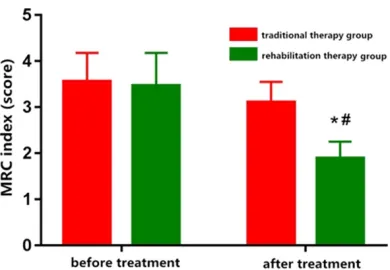
Rehabilitation training reduced MRC dyspnea index
Compared to before treatment, the MRC dys-pnea index of patients in the rehabilitation
ther-apy group was significantly reduced after treat -ment (P<0.05). The MRC dyspnea index in the
rehabilitation therapy group also remarkably declined after treatment, compared with that in the traditional therapy group (P<0.05). Results
suggest that rehabilitation training can signifi -cantly improve symptoms of dyspnea in COPD patients (Figure 1).
Rehabilitation training elevated FEV1
Compared to before treatment, FEV1 levels in the rehabilitation therapy group were notably increased after treatment (P<0.05). FEV1 lev-els in the rehabilitation therapy group were also
significantly increased after treatment, com -pared with levels in the traditional therapy group (P<0.05). Results suggest that
rehabilita-tion training can significantly elevate FEV1 lev -els of COPD patients (Figure 2).
Rehabilitation training increased 6MWD
In the current study, 6MWDs of patients in both groups were markedly increased after treat-ment, compared with levels before treatment (P<0.05). Moreover, 6MWDs in the
rehabilita-tion therapy group were significantly increased
after treatment, compared with those in the traditional therapy group (P<0.05), suggesting that both traditional therapy and rehabilitation
training can significantly improve motor func -tion in COPD patients. The latter, however, is
significantly superior to the former in improving
motor function in COPD patients (Figure 3).
Rehabilitation training results in decline of BODE scores
BODE score of patients in both groups were sig
-nificantly downregulated after treatment. com
-pared with scores before treatment (P<0.05).
[image:3.612.92.287.68.203.2]BODE scores in the rehabilitation therapy group Figure 1. MRC index. Note: *P<0.05 vs. before
[image:3.612.326.520.74.200.2]treat-ment, #P<0.05 vs. traditional therapy group.
Figure 5. Borg scores. Note: *P<0.05 vs. before
treat-ment, #P<0.05 vs. traditional therapy group.
significantly declined after treatment, com -pared with those in the traditional therapy group (P<0.05). Data suggests that rehabilita-tion training can even further improve condi-tions of COPD patients (Figure 4).
Rehabilitation training decreases Borg scores
Borg scores of patients in both groups were
remarkably decreased after treatment, com-pared with scores before treatment (P<0.05).
Also, Borg scores in the rehabilitation therapy group were significantly decreased after treat -ment, compared with scores in the traditional therapy group (P<0.05), indicating that both rehabilitation training can favor the effects of traditional therapy for perceived exertion of COPD patients (Figure 5).
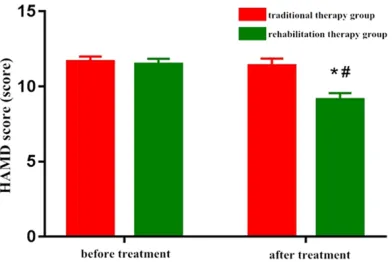
Rehabilitation training lowers HAMA and HAMD scores
Compared with levels before treatment, both
HAMA scores and HAMD scores of patients in the rehabilitation therapy group were signifi -cantly reduced after treatment (P<0.05). Com-
pared with scores in the traditional therapy
group, HAMA scores and HAMD scores in the
rehabilitation therapy group were noticeably reduced after treatment (P<0.05), suggesting
that rehabilitation training can significantly
im-prove depression and anxiety symptoms of COPD patients (Figures 6, 7).
Rehabilitation training reduces SGRQ scores
Compared to before treatment, SGRQ scores of
patients in the rehabilitation therapy group
were significantly reduced after treatment (P< 0.05). Compared with scores in the traditional
therapy group, SGRQ scores in the rehabilita -tion therapy group were also apparently re- duced after treatment (P<0.05). Results
sug-gest that rehabilitation training can significantly
improve the quality of life of COPD patients (Figure 8).
Rehabilitation training raised BMI and inhib-ited inflammatory factor expression
[image:4.612.325.523.73.204.2]BMIs of patients in the rehabilitation therapy group were significantly increased after treat -ment, compared with those before treatment
Figure 3. 6MWD. Note: *P<0.05 vs. before
treat-ment, #P<0.05 vs. traditional therapy group.
Figure 4. BODE scores. Note: *P<0.05 vs. before
[image:4.612.324.523.254.392.2] [image:4.612.91.288.255.386.2](P<0.05). Compared with levels in the
tradition-al therapy group, BMIs in the rehabilitation
therapy group were also statistically increased after treatment (P<0.05). Results suggest that rehabilitation training can remarkably improve myodystrophy in COPD patients (Table 1). IL-1 and IL-6 expression levels of patients in both groups were detected with remarkable decreases after treatment, compared to before
treatment. Differences were statistically signifi -cant (P<0.05). IL-1 and IL-6 expression levels in the rehabilitation therapy group were statisti-cally inhibited after treatment, compared with those in the traditional therapy group (P<0.05), suggesting that rehabilitation training further
suppressed inflammation in COPD patients
based on traditional therapy (Table 1).
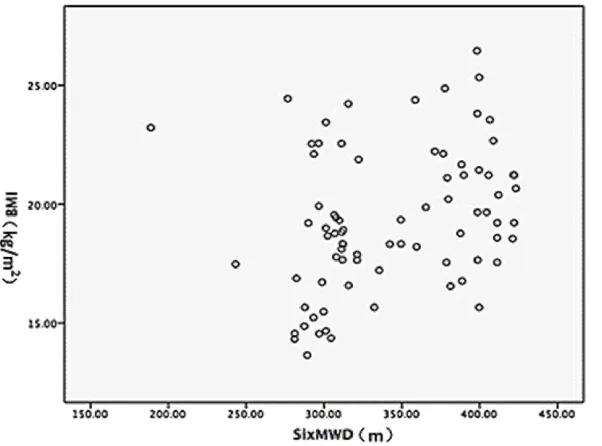
Correlation between motor function and myo-dystrophy
There was a positive correlation between 6M-
WD and BMI (r=0.299), indicating that motor function is associated with myodystrophy of COPD patients (Figure 9).
Discussion
Airway structural remodeling and obstructive emphysema induced by COPD can seriously affect patient lung function, leading to limited activity of daily living and loss of labor ability
[3]. Studies have confirmed [4, 5] that the lung
function limitation of COPD patients cannot be overcome via drug therapy. Lung injuries of COPD patients still progressively exacerbate. In this study, it was found that traditional drug
therapy could indeed improve 6MWD, BODE, and Borg scores of patients with COPD in the
stable phase. Results suggest its efficacy in
ameliorating motor ability, to a certain extent. This also improves conditions and enhances perceived exertion of patients in the treatment
of COPD in the stable phase. However, drug
therapy fails to recover patient lung function and activity levels of daily living and quality of life. Present results are consistent with previ-ous research, indicating that the curative eff- ects of simple drug therapy on COPD in the sta-ble phase are limited. Therefore, the roles of rehabilitation training in improving the lung function of patients with COPD in the stable phase have been increasingly studied. It has been proposed that rehabilitation training, in- cluding training during hospitalization and at home after discharge, is essential for COPD patients. It is extremely important in improving lung function of patients with COPD in the
sta-ble phase [6, 7]. At the same time, many inflam -matory factors produced in COPD, a systemic
inflammatory disease, can lead to respiratory
[image:5.612.92.288.70.201.2]muscular atrophy [8]. Moreover, excessive lung ventilation induced by COPD can further result in abnormalities in the diaphragm and thorax, ultimately affecting patient respiratory function [9, 10]. It is believed currently that the degree of respiratory muscle dysfunction has a high correlation with the condition of COPD patients [11, 12]. Rehabilitation training is effective for COPD patients. It can improve strength and endurance of respiratory muscles, reducing dyspnea and improving motor ability, as well as quality of life levels, of patients [13-15]. In the current study, for treatment of COPD in the sta-ble phase, rehabilitation training effectively ameliorated dyspnea symptoms, improved lung function, and increased motor abilities of pa- tients. At the same time, rehabilitation training
Figure 7. HAMA scores. Note: *P<0.05 vs. before
[image:5.612.323.523.72.217.2]tion and motor function lev-els of COPD patients, incr- easing quality of life. Thus, rehabilitation training has potential value in clinical practice.
Disclosure of conflict of interest
None.
Address correspondence to:
Dr. Deqin Ying, Department of Respiratory Medicine, The Fir-
st People’s Hospital of
Wan-zhou District, 388 Tiancheng East Road, Wanzhou District, Chongqing 404000, China. Tel: +86-15102364628; Fax: effectively improved depression and anxiety
levels, increased perceived exertion, and im- proved the quality of life of patients. In rehabili-tation training, respiratory muscles of patients with COPD in the stable phase are exercised. The abilities of the respiratory muscles are enhanced. Normal physiological functioning of the thorax is maintained. This may be the major reason for improvements in the respiratory function of COPD patients [16-18]. Moreover, motor function of COPD patients will be further boosted due to the improvement of lung func-tion. This is also helpful in regulating patient depression, anxiety, and concern about the
dis-ease. It enhance confidences and increases
the quality of life of patients [19, 20]. According to correlation analyses in this study, it was pro-posed that rehabilitation training may improve myodystrophy through improving the motor function of COPD patients. Results, however, require further investigation.
Conclusion
In conclusion, rehabilitation training plays a fa- cilitating role in the treatment of COPD in the
+86-023-58378627; E-mail: fanghuagong2rti@163. com
References
[1] Melen E, Guerra S, Hallberg J, Jarvis D,
Sta-nojevic S. Linking COPD epidemiology with pe-diatric asthma care; implications for the pa-tient and the physician. Pediatr Allergy Im- munol 2019; [Epub ahead of print].
[2] Arbillaga-Etxarri A, Gimeno-Santos E, Barberan-Garcia A, Balcells E, Benet M, Borrell E, Celorrio
N, Delgado A, Jane C, Marin A, Martin-Cantera C, Monteagudo M, Montella N, Munoz L, Or- tega P, Rodriguez DA, Rodriguez-Roisin R, Simonet P, Toran-Monserrat P, Torrent-Pallicer
J, Vall-Casas P, Vilaro J, Garcia-Aymerich J. Lo-ng-term efficacy and effectiveness of a behav -ioural and community-based exercise interven-tion (Urban Training) to increase physical activ-ity in patients with COPD: a randomised con-trolled trial. Eur Respir J 2018; 52.
[3] Olloquequi J, Jaime S, Parra V, Cornejo-Cordova
E, Valdivia G, Agusti A, Silva OR. Comparative
[image:6.612.91.527.83.138.2]analysis of COPD associated with tobacco sm- oking, biomass smoke exposure or both. Re- spir Res 2018; 19: 13.
[image:6.612.92.393.167.390.2][4] Shady I, Gado OM, Basiony LA, Ibrahim MM,
Affara NK. Anxiety-depressive symptoms in pa-tients with chronic obstructive pulmonary dis-ease (COPD) and impact on outcome. Depress Anxiety 2015; 134: 27-33.
[5] Gardener C, Farquhar M, Butcher HH, Moore C, Ewing G, White P, Howson S, Mahadeva R, Booth S, Burge P. Depression and anxiety: im -pact on service use in patients with advanced
chronic obstructive pulmonary disease. BMJ
Support Palliat Care 2015; 5: 117-121. [6] Xiong XF, Fan LL, Wu HX, Zhu M, Cheng DY.
Effects of tiotropium combined with
theophyl-line on stable COPD patients of group B, D and
its impact on small airway function: a random-ized controlled trial. Adv Ther 2018; 35: 2201-2213.
[7] Cazzola M, Rogliani P. Tiotropium could provide
benefits in the early stage of COPD, but further studies are needed. BMJ Evid Based Med
2018; 23: 183-184.
[8] Siswanto A, Sofia NA, Sumardi, Asdie AH. The influences of latihan pasrah diri on depressive
symptoms and quality of life in chronic obstruc-tive pulmonary disease. Proceedings of The World Congress on Psychosomatic Medicine 2013; 27: 105-105.
[9] LaForce C, Derom E, Bothner U, Kloer IM, Tra-mpisch M, Buhl R. Long-term safety of tiotropi -um/olodaterol Respimat((R)) in patients with moderate-to-very severe COPD and renal im-pairment in the TONADO((R)) studies. Int J Chron Obstruct Pulmon Dis 2018; 13: 1819-1831.
[10] Abrahams R, Moroni-Zentgraf P, Ramsdell J,
Schmidt H, Joseph E, Karpel J. Safety and effi
-cacy of the once-daily anticholinergic BEA2180
compared with tiotropium in patients with COPD. Respir Med 2013; 107: 854-862. [11] Esteban C, Castro-Acosta A, Alvarez-Martinez
CJ, Capelastegui A, Lopez-Campos JL, Pozo-Rodriguez F. Predictors of one-year mortality after hospitalization for an exacerbation of
COPD. BMC Pulm Med 2018; 18: 18.
[12] Wise R, Calverley PM, Dahl R, Dusser D, Met- zdorf N, Müller A, Fowler A, Anzueto A. Safety
and efficacy of tiotropium respimat versus
handihaler in patients naive to treatment with inhaled anticholinergics: apost hocanalysis of the TIOSPIR trial. NPJ Prim Care Respir Med 2015; 25: 15067.
[13] Wadell K, Janaudis Ferreira T, Arne M, Lisspers
K, Ställberg B, Emtner M. Hospital-based pul -monary rehabilitation in patients with COPD in Sweden-a national survey. Respir Med 2013; 107: 1195-1200.
[14] Reijnders T, Schuler M, Wittmann M, Jelusic D, Troosters T, Janssens W, Stenzel NM, Schultz K, von Leupoldt A. The impact of
disease-spe-cific fears on outcome measures of pulmonary
rehabilitation in patients with COPD. Respir Med 2019; 146: 87-95.
[15] Chen JO, Liu JF, Liu YQ, Chen YM, Tu ML, Yu HR,
Lin MC, Lin CC, Liu SF. Effectiveness of a peri-operative pulmonary rehabilitation program following coronary artery bypass graft surgery in patients with and without COPD. Int J Chron Obstruct Pulmon Dis 2018; 13: 1591-1597. [16] Cox M, O’Connor C, Biggs K, Hind D, Bortolami
O, Franklin M, Collins B, Walters S, Wailoo A, Channell J, Albert P, Freeman U, Bourke S, Steiner M, Miles J, O’Brien T, McWilliams D, Schofield T, O’Reilly J, Hughes R. The feasibility
of early pulmonary rehabilitation and activity after COPD exacerbations: external pilot ran-domised controlled trial, qualitative case study
and exploratory economic evaluation. Health
Technol Assess 2018; 22: 1-204.
[17] Sievi NA, Clarenbach CF, Camen G, Rossi VA, Gestel AJ, Kohler M. High prevalence of altered
cardiac repolarization in patients with COPD.
BMC Pulm Med 2014; 14: 55.
[18] Goulart Cda L, Simon JC, Schneiders Pde B, San Martin EA, Cabiddu R, Borghi-Silva A,
Tri-mer R, da Silva AL. Respiratory muscle strength effect on linear and nonlinear heart rate vari-ability parameters in COPD patients. Int J Chron Obstruct Pulmon Dis 2016; 11: 1671-1677.
[19] Make BJ, Yawn BP. Breathing life into COPD
management: ongoing monitoring, pulmonary rehabilitation, and individualized care. Chest 2018; 154: 980-981.
[20] Kusunoki Y, Hattori K, Nakamura T, Motegi T, Ishii T, Furutate R, Genma A, Kida K. Increased