Dependency Graph-to-String Translation
Liangyou Li Andy Way Qun Liu ADAPT Centre, School of Computing
Dublin City University
{liangyouli,away,qliu}@computing.dcu.ie
Abstract
Compared to tree grammars, graph gram-mars have stronger generative capacity over structures. Based on an edge re-placement grammar, in this paper we pro-pose to use a synchronous graph-to-string grammar for statistical machine transla-tion. The graph we use is directly con-verted from a dependency tree by labelling edges. We build our translation model in the log-linear framework with stan-dard features. Large-scale experiments on Chinese–English and German–English tasks show that our model is significantly better than the state-of-the-art hierarchical phrase-based (HPB) model and a recently improved dependency tree-to-string model on BLEU, METEOR and TER scores. Ex-periments also suggest that our model has better capability to perform long-distance reordering and is more suitable for trans-lating long sentences.
1 Introduction
Compared to trees, which have dominated the field of natural language processing (NLP) for decades, graphs are more general for modelling natural lan-guages. The corresponding grammars for recog-nizing and producing graphs are more flexible and powerful than tree grammars. However, because of their high complexity, graph grammars have not been widely used in NLP.
Recently, along with progress on graph-based meaning representation, hyperedge replacement grammars (HRG) (Drewes et al., 1997) have been revisited, explored and used for semantic-based machine translation (Jones et al., 2012). How-ever, the translation process is rather complex and the resources it relies on, namely abstract meaning corpora, are limited as well.
As most available syntactic resources and tools are tree-based, in this paper we propose to con-vert dependency trees, which are usually taken as a kind of shallow semantic representation, to de-pendency graphs by labelling edges. We then use a synchronous version of edge replacement gram-mar (ERG) (Section 2), a special case of HRG, to translate these graphs. The resulting translation model has the same order of magnitude in terms of time complexity with the hierarchical phrase-based model (HPB) (Chiang, 2005) under a certain restriction (Section 3).
Compared to dependency tree-to-string models, using ERG for graph-to-string translation brings some benefits (Section 3). Thanks to the stronger generative capacity of the grammar, our model can naturally translate siblings in a tree struc-ture, which are usually treated as non-syntactic phrases and handled by other techniques (Huck et al., 2014; Xie et al., 2014). Furthermore, com-pared to the known treelet approach (Quirk et al., 2005) and Dep2Str (Xie et al., 2011), our method not only uses treelets but also has a full capacity of reordering.
We define our translation model (Section 4) in the log-linear framework (Och and Ney, 2002). Large-scale experiments (Section 5) on Chinese– English and German–English, two language pairs that have a high degree of syntactic reordering, show that our method significantly improves trans-lation quality over both HPB and Dep2Str, as measured by BLEU (Papineni et al., 2002), TER (Snover et al., 2006) and METEOR (Denkowski and Lavie, 2011). We also find that the rules in our model are more suitable for long-distance re-ordering and translating long sentences.
2 Edge Replacement Grammar
As a special case of HRG, ERG is also a context-free rewriting grammar to recognize and produce graphs. Following HRG, the graph we use in this
Juxing
Chenggong Y
Zai
Nanfei
Juxing
Chenggong Zai
Nanfei Shijiebei
2010 FIFA Juxing
Chenggong X
S
X
Y
Zai
Nanfei
Y
FIFA Shijiebei
1
2010 2010
1
1
[image:2.595.96.504.61.232.2]1
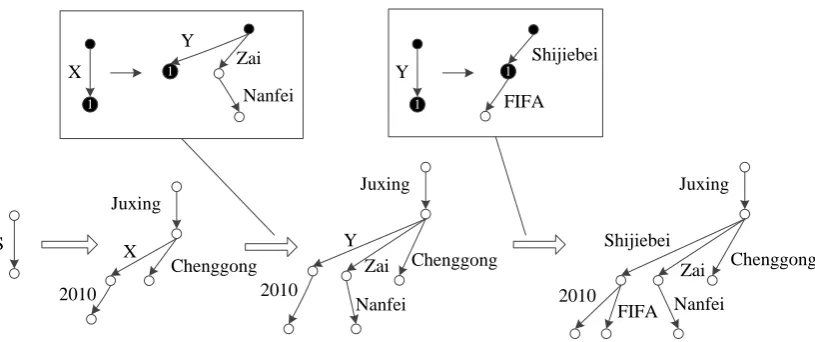
Figure 1: An example of a derivation in an ERG. Dark circles are external nodes.
paper is connected, nodes ordered, acyclic and has edge labels but no node labels (Chiang et al., 2013). We provide some formal definitions on ERG.
Definition 1. Aconnected, edge-labeled, ordered graphis a tupleH =hV, E, φi, where
• V is a finite set of nodes.
• E⊆V2is a finite set of edges.
• φ : E → C assigns a label (drawn fromC) to each edge.
In ERG, the elementary unit is a graph frag-ment, which is also the right-hand side of a pro-duction in the grammar. Its definition is as follows.
Definition 2. A graph fragment is a tuple H = hV, E, φ, Xi, wherehV, E, φiis a graph andX∈ (V ∪V2) is a list of distinct nodes. Following Chiang et al. (2013), we call theseexternal nodes. The external nodes indicate how to integrate a graph into another one during a derivation. Dif-ferent to HRG, ERG limits the number of external nodes to 2 at most to make sure hyperedges do not exist during a derivation. Now we define the ERG.
Definition 3. Anedge replacement grammaris a tuplehN, T, P, Si, where
• N and T are disjoint finite sets of non-terminal symbols and non-terminal symbols, re-spectively.
• P is a finite set of productions of the form A→R, whereA∈NandRis a graph frag-ment, where edge-labels are fromNST.
• S∈N is the start symbol.
Figure 1 shows an example of a derivation in an ERG to produce a graph. Starting from the start symbolS, when a rule (A → R) is applied to an edgee, the edge is replaced by the graph fragment R. Just like in HRG, the ordering of nodesVeine
and external nodesXRinRimplies the mapping
fromVetoXR(Chiang et al., 2013).
3 Graph-to-String Grammar
In SMT, we need a synchronous grammar to si-multaneously parse an input graph and produce translations. The graph we use in this paper is from a dependency structure which is capable of modelling long-distance relations in a sentence.
3.1 The Grammar
Before defining the synchronous grammar, we firstly define a dependency graph which is a spe-cial case of a graph.
Definition 4. A dependency graph is a tuple
hV, E, φ,∆i, wherehV, E, φiis a graph and∆is a restriction: edges are ordered.
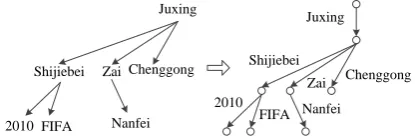
A dependency graph is directly derived from a dependency tree by labeling edges with words, as shown in Figure 2. Although in general graph edges are unordered, in Definition 4 we keep word order by ordering edges, because the word order is an important piece of information for translation.
Similar to the graph fragment, a dependency-graph fragment is defined as below.
Juxing
Chenggong Zai
Nanfei Shijiebei
2010 FIFA Juxing
Chenggong Zai
Nanfei Shijiebei
[image:3.595.77.285.64.132.2]2010 FIFA
Figure 2: An example of deriving a dependency graph from a dependency tree by labelling edges with words.
In this paper, we define a synchronous ERG over dependency graphs as a dependency graph-to-string grammar, which can be used for MT.
Definition 6. A dependency graph-to-string grammar (DGSG) is a tuple hN, T, T0, P, Si,
where
• N is a finite set of non-terminal symbols.
• T andT0are finite sets of terminal symbols.
• S∈N is the start symbol.
• P is a finite set of productions of the form
hA→R, A0 →R0,∼i, whereA, A0 ∈N,R
is a dependency-graph fragment overNST andR0is a string overNST0.∼is a
one-to-one mapping between non-terminal symbols inRandR0.
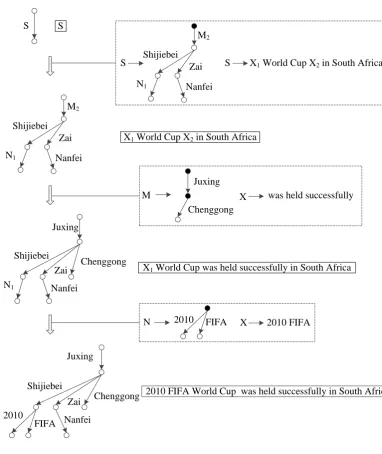
Figure 3 shows a derivation simultaneously pro-ducing a Chinese dependency graph and an En-glish string using a DGSG. Each time a rule is ap-plied, the dependency-graph fragment in the rule replaces an edge in the source graph, and the string in the rule replaces a non-terminal in the target string.
Proposition 1. DGSG has stronger generative ca-pacity over graph-string pairs than both SCFG and synchronous tree substitution grammar (STSG).
Proof. STSG has stronger generative capacity over structures than SCFG (Chiang, 2012).1
Any STSG can easily be converted into a DGSG by labelling edges in tree structures.
1The following STSG generates a trivial example of a
tree-string pair that no SCFG can generate, as SCFG must always have an equal number of non-terminal symbols.
X
|
: X
|
X
|
The following DGSG generates a trivial exam-ple of a graph-string pair, which no STSG can gen-erate, as the left-head side has no head nodes while STSG always requires one to form a tree.
c :
a b
This proof is also verified in Figure 3 where the third rule is used to translate a non-syntactic phrase, which can be a problem for dependency tree-to-string methods. In addition, the second rule translates a treelet and the first rule encodes reordering information inside. All these three aspects are uniformly modeled in our grammar, which makes it more powerful than other methods, such as the treelet approach and the Dep2Str.
3.2 Time Complexity and a Restriction
Given a dependency graph, training and decod-ing time usdecod-ing DGSG depends on the number of dependency-graph fragments. For example, for a graph where the degree of a node isk, the number of all possible fragments starting from the node is O(2k). Therefore, the time complexity would be
exponential if we consider them all.
It is easy to find that the high complexity of DGSG comes from the free combination of edges. That means that a dependency-graph fragment can cover discontinuous words of an input sentence. However, this is not the convention in the field of SMT.
For efficient training and decoding, we add a re-striction to DGSG: each dependency-graph frag-ment covers a continuous span of the source sen-tence. This reduces the complexity from exponen-tial time to cubic time.
3.3 Non-terminal Symbols
In this paper we build a dependency graph-to-string model, so we only use one non-terminal symbolX as in HPB on the target side. However, on the source side we define non-terminal symbols over Part-of-Speech (POS) tags, which can be eas-ily obtained as a by-product of dependency pars-ing.
S S
2010 FIFA World Cup was held successfully in South Africa Juxing
Chenggong Zai
Nanfei Shijiebei
2010 FIFA
X1 World Cup X2 in South Africa
S S
M2
Zai
Nanfei Shijiebei
N1
X1 World Cup X2 in South Africa
M2
Zai
Nanfei Shijiebei
N1
was held successfully X
M
Chenggong Juxing
Juxing
Chenggong Zai
Nanfei Shijiebei
N1
X1 World Cup was held successfully in South Africa
[image:4.595.100.483.138.593.2]N 2010 FIFA X 2010 FIFA
NR_P_AD
Chenggong/AD Zai/P
[image:5.595.80.281.60.134.2]Nanfei/NR Shijiebei/NR
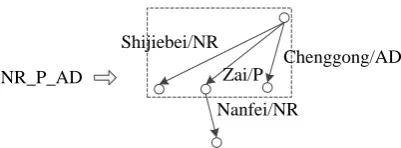
Figure 4: An example inducing a non-terminal symbol (left side) for a dependency-graph frag-ment (right side). Each edge is labeled by a word associated with its POS tag. The head of this frag-ment includes three edges which are in the rectan-gle.
non-terminal symbol forHis defined as the join-ing of POS tags of its head (Li et al., 2012). Figure 4 shows an example.
3.4 Rule Extraction
As well as the restriction defined in Section 3.2 making the grammar much smaller, it also results in a similar way of extracting rules as in HPB. In-spired by HPB, we define the rule set overinitial pairs.
Given a word-aligned dependency graph-string pairP =hG, e,∼i, letGji stand for the sub-graph (it may not be connected) covering words from po-sition ito positionj. Then a rule hGji, eji00i is an
initial pair ofP, iff:
1. Gji is a dependency-graph fragment. That means it is a connected sub-graph and has at most two external nodes, nodes which con-nect with nodes outside or are the root. 2. It is consistent with the word alignment ∼
(Och and Ney, 2004).
The set of rules fromP satisfies the following: 1. IfhGji, eji00iis an initial pair, then
hN(Gji)→Gji, X →eji00i
is a rule, where N(G) defines the non-terminal symbol forG.
2. IfhN(R) → R, X →R0iis a rule ofP and hGji, eji00i is an initial pair such that Gji is a
sub-graph ofRandR0 =r
1eji00r2, then
hN(R)→R\Gi kj , X →r1Xkr2i
is a rule ofP, where\ means replacing Gji inR with an edge labelled withN(Gji) and
kis a unique index for a pair of non-terminal symbols.
As in HPB, in addition to rules extracted from the parallel corpus, we also use glue rules to com-bine fragments and translations when no matched rule can be found.
Furthermore, we can use the same rule extrac-tion algorithm as that in HPB, except that we need to check if a span of a source sentence indicates a dependency-graph fragment, in which case we keep the dependency structure and induce a non-terminal for the fragment.
4 Model and Decoding
We define our model in the log-linear framework over a derivationd, as in Equation (1):
P(d)∝Y
i
φi(d)λi (1)
where φi are features defined on derivations and
λiare feature weights. In our experiments, we use
9 features:
• translation probabilities P(s|t) and P(t|s), where sis the source graph fragment and t is the target string.
• lexical translation probabilitiesPlex(s|t)and
Plex(t|s).
• language modellm(e)over translatione.
• rule penaltyexp(−1).
• word penaltyexp(|e|).
• glue penaltyexp(−1).
• unknown words penalty exp(u(g)), where u(g) is the number of unknown words in a source graphg.
Our decoder is based on the conventional chart parsing CYK algorithm (Kasami, 1965; Younger, 1967; Cocke and Schwartz, 1970). It searches for the best derivation d∗ among all possible
deriva-tionsD, as in Equation (2):
d∗ = argmax
d∈D P(d) (2)
ZH–EN
corpus #sent. #words(ZH) #words(EN)
train 1.5M+ 38M+ ∼45M
dev 878 22,655 26,905
MT04 1,597 43,719 52,705
MT05 1,082 29,880 35,326
DE–EN
corpus #sent. #words(DE) #words(EN)
train 2M+ 52M+ 55M+
dev 3,003 72,661 74,753
WMT12 3,003 72,603 72,988
[image:6.595.71.296.68.231.2]WMT13 3,000 63,412 64,810
Table 1: Chinese–English (ZH–EN) and German– English (DE–EN) corpora. For the English side of dev and test sets, words counts are averaged across all references.
for each fragment, the decoder finds rules to trans-late it. The translation of a large span can be ob-tained by combining translations from its sub-span using rules which have non-terminals. Finally, glue rules are used to make sure that at least one translation is produced.
5 Experiment
We conduct experiments on Chinese–English and German–English translation tasks.
5.1 Datasets
The Chinese–English training corpus is from LDC, including LDC2002E18, LDC2003E07, LDC2003E14, LDC2004T07, the Hansards por-tion of LDC2004T08 and LDC2005T06. NIST 2002 is taken as a development set to tune weights, and NIST 2004 (MT04) and NIST 2005 (MT05) are two test sets to evaluate systems. Table 1 pro-vides a summary of this corpus. The Stanford Chi-nese word segmenter (Chang et al., 2008) is used to segment Chinese sentences. The Stanford de-pendency parser (Chang et al., 2009) parses a Chi-nese sentence into a projective dependency tree which is then converted to a dependency graph in our model.
The German–English training corpus is from WMT 2014, including Europarl V7 and News Commentary. News-test 2011 is taken as a de-velopment set, while News-test 2012 (WMT12) and News-test 2013 (WMT13) are our test sets. Table 1 provides a summary of this corpus. We
use mate-tools2to perform morphological analysis
and parse German sentences (Bohnet, 2010). Then MaltParser3 converts a parse result into a
projec-tive dependency tree (Nivre and Nilsson, 2005).
5.2 Settings
In this paper, we mainly compare our system (DGST) with HPB in Moses (Koehn et al., 2007). We implement our model in Moses and take the same settings as Moses HPB in all experi-ments. In addition, translation results from a re-cently open-source dependency tree-to-string sys-tem, Dep2Str4 (Li et al., 2014), which is
imple-mented in Moses and improves the dependency-based model in Xie et al. (2011), are also reported. All systems use the same sets of features defined in Section 4.
In all experiments, word alignment is performed by GIZA++ (Och and Ney, 2003) with the heuris-tic functiongrow-diag-final-and. We use SRILM (Stolcke, 2002) to train a 5-gram language model on the Xinhua portion of the English Gigaword corpus 5th edition with modified Kneser-Ney dis-counting (Chen and Goodman, 1996). Minimum Error Rate Training (MERT) (Och, 2003) is used to tune weights.
To obtain more reliable results, in each experi-ment, we run MERT three times and report aver-age scores. These scores are calculated by three widely used automatic metrics in case-insensitive mode: BLEU, METEOR and TER.
5.3 Results
Table 2 shows the scores of all three metrics on all systems. Similar to Li et al. (2014), in our experi-ments Dep2Str has on average a comparable result with Moses HPB in terms of BLEU and METEOR scores. However, it obtains a significantly higher (i.e. worse) TER score on the Chinese–English task. This may suggest that translations produced by Dep2Str need more post-editing effort (He et al., 2010).
By contrast, on all test sets, measured by all metrics, our system is significantly better than Moses HPB. On the Chinese–English task, our system achieves an average gain of 1.25 lute, 3.6% relative) BLEU score and 0.55 (abso-lute, 1.7% relative) METEOR score while also
ob-2http://code.google.com/p/mate-tools/
3http://www.maltparser.org/
4http://computing.dcu.ie/˜liangyouli/
Metric System MT04 MT05 WMT12 WMT13ZH–EN DE–EN
BLEU↑ Moses HPB 35.6Dep2Str 35.4 33.833.9 20.220.3 22.722.8
DGST 36.6 35.3 20.7 23.3
METEOR↑ Moses HPB 31.6Dep2Str 31.8 31.931.9 28.628.5 29.729.5∗
DGST 32.1 32.5 28.7 29.8
TER↓ Moses HPB 57.0Dep2Str 58.2∗ 58.359.6∗ 63.263.1 59.559.6
[image:7.595.146.455.61.214.2]DGST 56.1 57.0 62.6 59.0
Table 2: Metric scores for all systems on Chinese–English (ZH–EN) and German–English (DE–EN) cor-pus. Each score is the average score over three MERT runs. Bold figures mean a system is significantly better than Moses HPB atp≤0.01. Moses HPB is significantly better than systems with∗atp≤0.01.
[image:7.595.71.299.281.378.2]Length MT04 MT05 WMT12 WMT13Percentage (0, 10] 7.6% 8.6% 15.0% 19.2% (10, 20] 28.2% 26.0% 31.4% 37.2% (20, 30] 28.2% 26.5% 26.3% 24.5% (30, 40] 20.2% 23.8% 14.4% 12.0% (40,∞) 15.7% 15.2% 12.9% 7.2%
Table 3: Statistics of sentence length on four test sets.
taining a reduction of 1.1 (absolute, 1.91% rela-tive) TER score on average.
On the German–English task, our system achieves an average gain of 0.55 (absolute, 2.56% relative) BLEU score and 0.1 (absolute, 0.35% rel-ative) METEOR score and also obtains a reduction of 0.55 (absolute, 0.89% relative) TER score on average.
5.4 Analysis
As shown in Table 2, compared to Moses HPB and Dep2Str, our system achieves higher transla-tion quality as measured by three automatic met-rics. In this section, we investigate whether de-pendency structures bring benefits as expected on long-distance reordering. Table 3 provides the statistics on sentence length of our four test sets.
In both HPB and our model, the length range of a reordering performed on an input sentence is related to the use of glue grammars which bring two benefits during decoding. When no matched rule is found in the models, glue grammars are ap-plied to make sure a translation is produced. In ad-dition, because of the generalization capability of
rules, which typically are learned under a length limitation, using them on long sentences could cause translation quality to deteriorate. Therefore, when the length of a phrase is greater than a cer-tain value, glue grammars are also applied. There-fore, our experiment of analysis is based on the length limitation that a rule can cover (max. phrase length) during decoding.
We set this max. phrase length to different val-ues, including 10, 20 (default), 30, 40 and 50. Figure 5 gives the BLEU scores on all test sets. We find that on all different values, our system achieves higher BLEU scores than Moses HPB. In addition, when the max. phrase length be-comes larger, Moses HPB shows a declining trend in most cases, especially on the German–English task (WMT12 and WMT13). However, our sys-tem is less sensitive to this value. We hypothesize that this is because rules from dependency graphs have better generalization for translating longer phrases and are more suitable for translating long sentences.
5.5 Case Study
On a manual check, we find that translations pro-duced by our system are more fluent than those of both Moses HPB and Dep2Str. Figure 6 gives an example comparing translations produced by three systems on the Chinese–English task.
Com-35.5 36 36.5
MT04
34 34.5 35
MT05
10 20 30 40 50
20.2 20.4 20.6
WMT12
10 20 30 40 50
22.6 22.8 23 23.2
WMT13
BLEU
Max. Phrase Length
[image:8.595.142.463.61.300.2]Moses HPB DGST
Figure 5: BLEU scores of Moses HPB and DGST (our system) when the length of maximum phrase that a rule can cover during decoding is set to different values.
双方
two sides
欢迎
welcome
伊拉克
Iraqi
临时
interim
管理
governing
委员会
council
关于
about
建立
establish
特别
special
法庭
court
、
,
审判
try
杀人犯
murderer
的
of
决定
decision
。
.
nsubj dobj
punct
Ref: The two sides welcomed the decision by the Iraqi Interim Governing Council to establish a special court to try the murderers.
HPB: the two sides welcomed the interim iraqi authority on establishing a special court, trial of the murderer.
Dep2Str: the two sides welcomed the decision on the Establishment of a special court, justice murderers of the provisional governing council of iraq.
[image:8.595.77.503.358.439.2]DGST: the two sides welcomed the decision of the iraqi interim governing council on the establishment of a special court, justice murderers.
Figure 6: An example of comparing translations produced by three systems on the Chinese–English task. The source sentence is parsed into a dependency structure. Each source word is annotated by a corresponding English word (or phrase).
伊拉克
Iraqi
临时
interim
管理
governing
委员会
council
关于
about
建立
establish
特别
special
法庭
court
、
,
审判
try
杀人犯
murderer
的
of
决定
decision
X 的
of
决定
decision
决定
decision
X 建立
establish X
的
of
伊拉克
Iraqi X
关于
about
建立
establishX
的
of
决定
decision
[image:8.595.124.477.581.708.2]pared to Moses HPB, both Dep2Str and our sys-tem, which rely on dependency structures, are ca-pable of dealing with this. This also suggests that dependency structures are useful for long-distance reordering.
Furthermore, compared to Dep2Str, our system produces a better translation for the ”X 的(of) X” expression, which is not explicitly represented in the dependency structure and thus results in a wrong translation in Dep2Str. After looking into the details of the translation process, we find that our system induces the dependency structure to the ”X 的(of) X” structure by handling both treelets and non-syntactic phrases. Figure 7 shows the pro-cess of this induction.
6 Related Work
Dependency structures have been used in SMT for a few years. Because of its better inter-lingual phrasal cohesion properties (Fox, 2002), it is be-lieved to be beneficial to translation.
Researchers have tried to use dependency struc-tures on both target and source sides. Shen et al. (2010) propose a string-to-dependency model by using dependency fragments of neighbouring words on the target side, which makes the model easier to include a dependency-based language model.
Menezes and Quirk (2005) and Quirk et al. (2005) propose the treelet approach which uses de-pendency structures on the source side. Xiong et al. (2007) extend this approach by allowing gaps in rules. However, their methods need a sepa-rate reordering model to decide the position of translated words (insertion problem). To avoid this problem, Xie et al. (2011) propose to use full head-dependent structures of a dependency tree and build a new dependency-to-string model. However, this model has difficulties in handling non-syntactic phrasal rules and ignores treelets. Meng et al. (2013) and Xie et al. (2014) further augment this model by incorporating constituent phrases and integrating fix/float structures (Shen et al., 2010), respectively, to allow phrasal rules. Li et al. (2014) extend this model by decomposing head-dependent structures into treelets.
Different from these methods, by labelling edges and using the ERG, our model considers the three aspects in a unified way: treelet, reordering and non-syntactic phrase. In addition, the ERG also naturally provides a decision on what kind of
treelets and phrases should be used.
7 Conclusion
In this paper, we present a dependency graph-to-string grammar based on a graph grammar, which we call edge replacement grammar. This gram-mar can simultaneously produce a pair of depen-dency graph and string. With a restriction of us-ing contiguous edges, our translation model built using this grammar can decode an input depen-dency graph, which is directly converted from a dependency tree, in cubic time using the CYK al-gorithm.
Experiments on Chinese–English and German– English tasks show that our model is significantly better than the hierarchical phrase-based model and a recent dependency tree-to-string model (Dep2Str) in Moses. We also find that the rules used in our model are more suitable for long-distance reordering and translating long sentences. Although experiments show significant im-provements over baselines, our model has limita-tions that can be avenues for future work. The re-striction used in this paper reduces the time com-plexity but at the same time reduces the generative capacity of graph grammars. Without allowing hy-peredges or only using at most two external nodes reduces the phrase coverage in our model as well. Acknowledgments
This research has received funding from the Peo-ple Programme (Marie Curie Actions) of the Euro-pean Union’s Framework Programme (FP7/2007-2013) under REA grant agreement no317471. The
ADAPT Centre for Digital Content Technology is funded under the SFI Research Centres Pro-gramme (Grant 13/RC/2106) and is co-funded un-der the European Regional Development Fund. We thank anonymous reviewers for their insight-ful comments and suggestions.
References
Bernd Bohnet. 2010. Very High Accuracy and Fast Dependency Parsing is Not a Contradiction. In Pro-ceedings of the 23rd International Conference on
Computational Linguistics, pages 89–97, Beijing,
China.
Pi-Chuan Chang, Michel Galley, and Christopher D. Manning. 2008. Optimizing Chinese Word Seg-mentation for Machine Translation Performance. In
Machine Translation, pages 224–232, Columbus, Ohio.
Pi-Chuan Chang, Huihsin Tseng, Dan Jurafsky, and Christopher D. Manning. 2009. Discriminative Re-ordering with Chinese Grammatical Relations Fea-tures. InProceedings of the Third Workshop on Syn-tax and Structure in Statistical Translation, pages 51–59, Boulder, Colorado.
Stanley F. Chen and Joshua Goodman. 1996. An Empirical Study of Smoothing Techniques for Lan-guage Modeling. InProceedings of the 34th Annual Meeting on Association for Computational Linguis-tics, ACL ’96, pages 310–318, Santa Cruz, Califor-nia.
David Chiang, Jacob Andreas, Daniel Bauer, Karl Moritz Hermann, Bevan Jones, and Kevin Knight. 2013. Parsing graphs with hyperedge replacement grammars. InProceedings of the 51st Annual Meeting of the Association for
Computa-tional Linguistics (Volume 1: Long Papers), pages
924–932, Sofia, Bulgaria, August.
David Chiang. 2005. A Hierarchical Phrase-based Model for Statistical Machine Translation. In Pro-ceedings of the 43rd Annual Meeting on Association
for Computational Linguistics, pages 263–270, Ann
Arbor, Michigan.
David Chiang. 2012. Grammars for Language and
Genes: Theoretical and Empirical Investigations.
Springer.
John Cocke and Jacob T. Schwartz. 1970. Program-ming Languages and Their Compilers: Preliminary Notes. Technical report, Courant Institute of Math-ematical Sciences, New York University, New York, NY.
Michael Denkowski and Alon Lavie. 2011. Meteor 1.3: Automatic Metric for Reliable Optimization and Evaluation of Machine Translation Systems. In
Proceedings of the Sixth Workshop on Statistical
Machine Translation, WMT ’11, pages 85–91,
Ed-inburgh, Scotland.
Frank Drewes, Hans J¨org Kreowski, and Annegret Ha-bel. 1997. Handbook of graph grammars and com-puting by graph transformation. chapter Hyper-edge Replacement Graph Grammars, pages 95–162. World Scientific Publishing Co., Inc., River Edge, NJ, USA.
Heidi J. Fox. 2002. Phrasal Cohesion and Statis-tical Machine Translation. In Proceedings of the ACL-02 Conference on Empirical Methods in
Nat-ural Language Processing - Volume 10, pages 304–
3111, Philadelphia.
Yifan He, Yanjun Ma, Josef van Genabith, and Andy Way. 2010. Bridging SMT and TM with Translation Recommendation. In Proceedings of the 48th An-nual Meeting of the Association for Computational Linguistics, pages 622–630, Uppsala, Sweden, July.
Matthias Huck, Hieu Hoang, and Philipp Koehn. 2014. Augmenting String-to-Tree and Tree-to-String Translation with Non-Syntactic Phrases. In
Proceedings of the Ninth Workshop on Statistical
Machine Translation, pages 486–498, Baltimore,
Maryland, USA, June.
Bevan Jones, Jacob Andreas, Daniel Bauer, Karl Moritz Hermann, and Kevin Knight. 2012. Semantics-Based Machine Translation with Hyper-edge Replacement Grammars. In COLING 2012, 24th International Conference on Computational Linguistics, Proceedings of the Conference:
Tech-nical Papers, pages 1359–1376, Mumbai, India,
December.
Tadao Kasami. 1965. An Efficient Recognition and Syntax-Analysis Algorithm for Context-Free Lan-guages. Technical report, Air Force Cambridge Re-search Lab, Bedford, MA.
Philipp Koehn, Hieu Hoang, Alexandra Birch, Chris Callison-Burch, Marcello Federico, Nicola Bertoldi, Brooke Cowan, Wade Shen, Christine Moran, Richard Zens, Chris Dyer, Ond‘ej Bojar, Alexandra Constantin, and Evan Herbst. 2007. Moses: Open Source Toolkit for Statistical Machine Translation.
In Proceedings of the 45th Annual Meeting of the
ACL on Interactive Poster and Demonstration
Ses-sions, ACL ’07, pages 177–180, Prague, Czech
Re-public.
Junhui Li, Zhaopeng Tu, Guodong Zhou, and Josef van Genabith. 2012. Head-Driven Hierarchical Phrase-based Translation. InProceedings of the 50th An-nual Meeting of the Association for Computational Linguistics (Volume 2: Short Papers), pages 33–37, Jeju Island, Korea, July.
Liangyou Li, Jun Xie, Andy Way, and Qun Liu. 2014. Transformation and Decomposition for Efficiently Implementing and Improving Dependency-to-String Model In Moses. InProceedings of SSST-8, Eighth Workshop on Syntax, Semantics and Structure in Statistical Translation, October.
Arul Menezes and Chris Quirk. 2005. Dependency Treelet Translation: The Convergence of Statistical and Example-Based Machine-translation? In Pro-ceedings of the Workshop on Example-based
Ma-chine Translation at MT Summit X, September.
Fandong Meng, Jun Xie, Linfeng Song, Yajuan L‘, and Qun Liu. 2013. Translation with Source Con-stituency and Dependency Trees. InProceedings of the 2013 Conference on Empirical Methods in Natu-ral Language Processing, pages 1066–1076, Seattle, Washington, USA, October.
Joakim Nivre and Jens Nilsson. 2005. Pseudo-Projective Dependency Parsing. In Proceedings of the 43rd Annual Meeting on Association for
Com-putational Linguistics, pages 99–106, Ann Arbor,
Franz Josef Och and Hermann Ney. 2002. Discrimina-tive Training and Maximum Entropy Models for Sta-tistical Machine Translation. InProceedings of the 40th Annual Meeting on Association for Computa-tional Linguistics, pages 295–302, Philadelphia, PA, USA.
Franz Josef Och and Hermann Ney. 2003. A System-atic Comparison of Various Statistical Alignment Models. Computational Linguistics, 29(1):19–51, March.
Franz Josef Och and Hermann Ney. 2004. The Align-ment Template Approach to Statistical Machine Translation. Computational Linguistics, 30(4):417– 449, December.
Franz Josef Och. 2003. Minimum Error Rate Training in Statistical Machine Translation. InProceedings of the 41st Annual Meeting on Association for
Com-putational Linguistics - Volume 1, ACL ’03, pages
160–167, Stroudsburg, PA, USA. Association for Computational Linguistics.
Kishore Papineni, Salim Roukos, Todd Ward, and Wei-Jing Zhu. 2002. BLEU: A Method for Automatic Evaluation of Machine Translation. InProceedings of the 40th Annual Meeting on Association for
Com-putational Linguistics, ACL ’02, pages 311–318,
Philadelphia, Pennsylvania.
Chris Quirk, Arul Menezes, and Colin Cherry. 2005. Dependency Treelet Translation: Syntactically In-formed Phrasal SMT. In Proceedings of the 43rd Annual Meeting of the Association for
Computa-tional Linguistics (ACL’05), pages 271–279, Ann
Arbor, Michigan, June.
Libin Shen, Jinxi Xu, and Ralph Weischedel. 2010. String-to-Dependency Statistical Machine Transla-tion. Computational Linguistics, 36(4):649–671, December.
M. Snover, B. Dorr, R. Schwartz, L. Micciulla, and J. Makhoul. 2006. A Study of Translation Edit Rate with Targeted Human Annotation. InProceedings of Association for Machine Translation in the Amer-icas, pages 223–231, Cambridge, Massachusetts, USA, August.
Andreas Stolcke. 2002. SRILM ‘‘ An Extensible Lan-guage Modeling Toolkit. InProceedings of the In-ternational Conference Spoken Language Process-ing, pages 901–904, Denver, CO.
Jun Xie, Haitao Mi, and Qun Liu. 2011. A Novel Dependency-to-string Model for Statistical Machine Translation. In Proceedings of the Conference on Empirical Methods in Natural Language Process-ing, pages 216–226, Edinburgh, United Kingdom. Jun Xie, Jinan Xu, and Qun Liu. 2014. Augment
Dependency-to-String Translation with Fixed and Floating Structures. InProceedings of the 25th In-ternational Conference on Computational Linguis-tics, pages 2217–2226, Dublin, Ireland.
Deyi Xiong, Qun Liu, and Shouxun Lin. 2007. A De-pendency Treelet String Correspondence Model for Statistical Machine Translation. In Proceedings of the Second Workshop on Statistical Machine Trans-lation, pages 40–47, Prague, June.