Closing the Gap:
Domain Adaptation from Explicit to Implicit Discourse Relations
Yangfeng Ji Gongbo Zhang Jacob Eisenstein
School of Interactive Computing Georgia Institute of Technology
{jiyfeng,gzhang64,jacobe}@gatech.edu
Abstract
Many discourse relations are explicitly marked with discourse connectives, and these examples could potentially serve as a plentiful source of training data for recog-nizing implicit discourse relations. How-ever, there are important linguistic differ-ences between explicit and implicit dis-course relations, which limit the accuracy of such an approach. We account for these differences by applying techniques from domain adaptation, treating implic-itly and explicimplic-itly-marked discourse rela-tions as separate domains. The distribu-tion of surface features varies across these two domains, so we apply a marginalized denoising autoencoder to induce a dense, domain-general representation. The label distribution is also domain-specific, so we apply a resampling technique that is simi-lar to instance weighting. In combination with a set of automatically-labeled data, these improvements eliminate more than 80% of the transfer loss incurred by train-ing an implicit discourse relation classifier on explicitly-marked discourse relations.
1 Introduction
Discourse relations reveal the structural orga-nization of text, potentially supporting applica-tions such as summarization (Louis et al., 2010; Yoshida et al., 2014), sentiment analysis (Soma-sundaran et al., 2009), and coherence evaluation (Lin et al., 2011). While some relations are sig-naled explicitly with connectives such as how-ever (Pitler et al., 2008), many more are im-plicit. Expert-annotated datasets of implicit dis-course relations are expensive to produce, so it
would be preferable to use weak supervision, by automatically labeling instances with explicit con-nectives (Marcu and Echihabi, 2003).
However, Sporleder and Lascarides (2008) show that models trained on explicitly marked ex-amples generalize poorly to implicit relation iden-tification. They argued that explicit and implicit examples may be linguistically dissimilar, as writ-ers tend to avoid discourse connectives if the dis-course relation could be inferred from context (Grice, 1975). Similar observations are made by Rutherford and Xue (2015), who attempt to add automatically-labeled instances to improve super-vised classification of implicit discourse relations. In this paper, we approach this problem from the perspective of domain adaptation. Specifically, we argue that the reason that automatically-labeled examples generalize poorly is due to domain mis-match from the explicit relations (sourcedomain) to the implicit relations (targetdomain). We pro-pose to close the gap by using two simple meth-ods from domain adaptation: (1) feature represen-tation learning: mapping the source domain and target domain to a shared latent feature space; (2) resampling: modifying the relation distribution in the explicit relations to match the distribution over implicit relations. Our results on the Penn Dis-course Treebank (Prasad et al., 2008) show that these two methods improve the performance on unsupervised discourse relation identification by more than 8.4% on average F1 score across all
relation types, an 82% reduction on the transfer loss incurred by training on explicitly-marked dis-course relations.
2 Related Work
Marcu and Echihabi (2003) train a classifier for implicit intra-sentence discourse relations from
explicitly-marked examples in the rhetorical struc-ture theory (RST) treebank, where the relations are automatically labeled by their discourse con-nectives: for example, labeling the relation as CONTRAST if the connective is but. However, Sporleder and Lascarides (2008) argue that explic-itly marked relations are too different from im-plicit relations to serve as an adequate supervision signal, obtaining negative results in segmented discourse representation theory (SDRT) relations. More recent work has focused on the Penn Dis-course Treebank (PDTB), using explicitly-marked relations to supplement, rather than replace, a la-beled corpus of implicit relations. For example, Biran and McKeown (2013) collect word pairs from arguments of explicit examples to help the supervised learning on implicit relation identifica-tion. Lan et al. (2013) present a multi-task learning framework, using explicit relation identification as auxiliary tasks to help main task on implicit re-lation identification. Rutherford and Xue (2015) explore several selection heuristics for adding automatically-labeled examples from Gigaword to their system for implicit relation detection, obtain-ing a 2% improvement in Macro-F1. Our work
differs from these previous efforts in that we fo-cus exclusively on training from automatically-labeled explicit instances, rather than supplement-ing a trainsupplement-ing set of manually-labeled implicit ex-amples.
Learning good feature representations (Ben-David et al., 2007) and reducing mismatched la-bel distributions (Joshi et al., 2012) are two main ways to make a domain adaptation task successful. Structural correspondence learning is an early ex-ample of representation learning for domain adap-tation (Blitzer et al., 2006); we build on the more computationally tractable approach of marginal-ized denoising autoencoders (Chen et al., 2012). Instance weighting is an approach for correct-ing label distribution mismatch (Jiang and Zhai, 2007); we apply a simpler approach of resampling the source domain according to an estimate of the target domain label distribution.
3 Domain Adaptation for Implicit Relation Identification
We employ two domain adaptation techniques: learning feature representations, and resampling to match the target label distribution.
3.1 Learning feature representation: Marginalized denoising autoencoders
The goal of feature representation learning is to obtain dense features that capture feature correla-tions between the source and target domains. De-noising autoencoders (Glorot et al., 2011) do this by first “corrupting” the original data,x1, . . . ,xn into x˜1, . . . ,x˜n, either by adding Gaussian noise (in the case of real-valued data) or by randomly ze-roing out features (in the case of binary data). We can then learn a function to reconstruct the origi-nal data, thereby capturing feature correlations and improving resilience to domain shift.
Chen et al. (2012) propose a particularly sim-ple and elegant form of denoising autencoder, by marginalizing over the noising process. Their single-layer marginalized denoising autoencoder (mDA) solves the following problem:
min
W Ex˜i|xi[kxi−Wx˜ik
2] (1)
where the parameter W ∈ Rd×d is a projection matrix. After learning the projection matrix, we use tanh(Wx)as the representation for our rela-tion identificarela-tion task.
Usually, xi ∈ Rdis a sparse vector with more than 105 dimensions. Solving the optimization
problem defined in equation 1 will produce a d×ddense matrix W, and is prohibitively ex-pensive. We employ the trick proposed by Blitzer et al. (2006) to select κ pivot features to be re-constructed. We then split all features into non-overlapping subsets of size ≤ K. Then, a set of projection matrices are learned, so as to transform each feature subset to the pivot feature set. The final projection matrixW is the stack of all pro-jection matrices learned from the feature subsets.
3.2 Handling mismatched label distributions: Resampling with minimal supervision
Temporal Comparison Expansion Contingency 0
0.2 0.4 0.6
Relation distribution
[image:3.595.71.291.61.151.2]Explicit Implicit
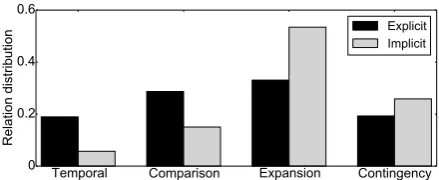
Figure 1: The relation distributions of training ex-amples from the source domain (explicitly-marked relations) and target domain (implicit relations) in the PDTB.
way to obtain performance gains in domain adap-tation (Joshi et al., 2012). Specifically, our goal is to modify the relation distribution in the source domain (explicitly-marked relations) and make it as similar as possible to the target domain (im-plicit relations). Given the label distribution from the target domain, we resample training examples from the source domain with replacement, in or-der to match the label distribution in the target do-main. As this requires the label distribution from the target domain, it is no longer purely unsuper-vised domain adaptation; instead, we call it resam-pling with minimal supervision.
It may also be desirable to ensure that the source and target training instances are similar in terms of their observed features; this is the idea behind theinstance weightingapproach to domain adap-tation (Jiang and Zhai, 2007). Motivated by this idea, we require that sampled instances from the source domain have a cosine similarity of at least τ with at least one target domain instance (Ruther-ford and Xue, 2015).
4 Experiments
Our experiments test the utility of the two do-main adaptation methods, using the Penn Dis-course Treebank (Prasad et al., 2008) and some extra-training data collected from a external re-source.
4.1 Experimental setup
Datasets The test examples are implicit rela-tion instances from secrela-tion 21-22 in the PDTB. For the domain adaptation setting, the training set consists of the explicitly-marked examples ex-tracted from sections 02-20 and 23-24, and the development set consists of the explicit relations from sections 21-22. All relations in the explicit examples are automatically labeled by using the
connective-to-relation mapping from Table 2 in (Prasad et al., 2007), where we only keep the majority relation type for every connective. For each identified connective, we use its annotated arguments in the PDTB. As an upper bound, we also train a supervised discourse relation classi-fier, using the implicit examples in sections 02-20 and 23-24 as the training set, and using sections 00-01 as the development set. Following prior work (Pitler et al., 2009; Park and Cardie, 2012; Biran and McKeown, 2013), we consider the first-level discourse relations in the PDTB — Temporal (TEMP.), Comparison (COMP.), Expansion (EXP.) and Contingency (CONT.). We train binary classi-fiers and reportF1score on each binary
classifica-tion task. Extension of this approach to multi-class classification is important, but since this is not the setting considered in most of the prior research, we leave it for future work.
The true power of learning from automatically labeled examples is that we could leverage much larger datasets than hand-annotated corpora such as the Penn Discourse Treebank. To test this idea, we collected 1,000 news articles from CNN.com as extra training data. Explicitly-marked dis-course relations from this data are automatically extracted by matching the PDTB discourse con-nectives (Prasad et al., 2007). For this data, we also need to extract the arguments of the iden-tified connectives: for every ideniden-tified connec-tive, the sentence following this connective is beled as Arg2 and the preceding sentence is la-beled as Arg1, as suggested by Biran and McKe-own (2013). In a pilot study we found that larger amounts of additional training data yielded no fur-ther improvements, which is consistent with the recent results of Rutherford and Xue (2015).
Relations
Surface Features +Rep. Learning +Resampling TEMP. COMP. EXP. CONT. AverageF1
Implicit→Implicit
1. FULL 24.15 28.87 68.84 43.45 41.32
Explicit [PDTB]→Implicit
2. FULL No No 17.13 20.54 50.55 36.14 31.04
3. FULL No Yes 15.38 23.88 62.04 35.29 34.14
4. FULL Yes No 17.53 22.77 50.85 36.43 31.90
5. FULL Yes Yes 17.05 22.00 63.51 38.23 35.20
6. PIVOT No No 17.33 23.89 53.53 36.22 32.74
7. PIVOT No Yes 17.73 25.39 62.65 36.02 35.44
8. PIVOT Yes No 18.66 25.86 63.37 38.87 36.69
9. PIVOT Yes Yes 19.26 25.74 68.08 41.39 38.62
Explicit [PDTB + CNN]→Implicit
[image:4.595.76.534.76.292.2]10. PIVOT Yes Yes 20.35 26.32 68.92 42.25 39.46
Table 1: Performance of cross-domain learning for implicit discourse relation identification.
0.85; pilot studies found that results are not sensi-tive to the value ofτ across a range of values.
Features All features are motivated by prior work on implicit discourse relation classification: from each training example with two arguments, we extract (1) Lexical features, including word pairs, the first and last words from both argu-ments (Pitler et al., 2009); (2) Syntactic features, including production rules from each argument, and the shared production rules between two argu-ments (Lin et al., 2009); (3) Other features, includ-ing modality, Inquirer tags, Levin verb classes, and argument polarity (Park and Cardie, 2012). We re-implement these features as closely as possible to the cited works, using the Stanford CoreNLP Toolkit to obtain syntactic annotations (Manning et al., 2014).
The FULL feature set for domain adaptation is constructed by collecting all features from the training set, and then removing features that oc-cur fewer than ten times. The PIVOT feature set includes κ high-frequency features from the FULL feature set. To focus on testing the domain adaptation techniques, we use the same FULLand PIVOT set for all four relations, and leave fea-ture set optimization for each relation as a fufea-ture work (Park and Cardie, 2012). To obtain the up-per bound, we employ the same feature categories and frequency threshold to extract features from the in-domain data, hand-annotated implicit dis-course relations. To include the representations
from the marginalized denoising autoencoder for relation identification, we concatenate them with the original surface feature representations of the same examples.
4.2 Experimental results
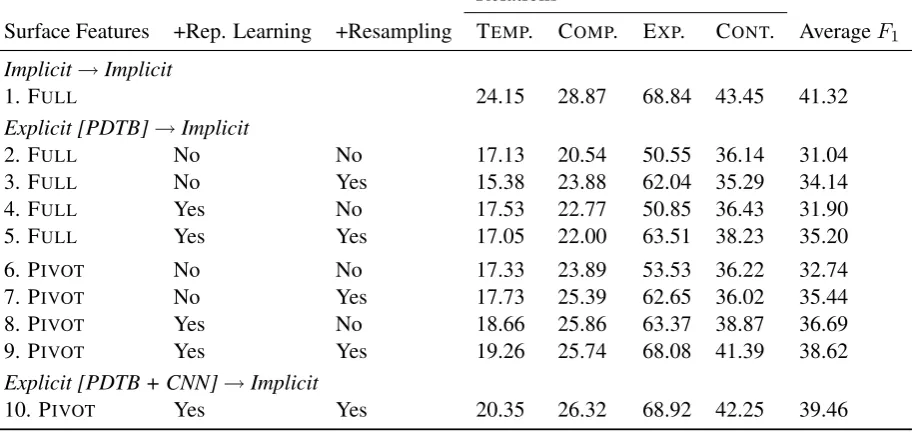
In experiments, we start with surface feature rep-resentations as baselines, then incorporate the two domain adaptation techniques incrementally. As shown in line 2 of Table 1, the performance is poor if directly applying a model trained on the ex-plicit examples with the FULL feature set, which is consistent with the observations of Sporleder and Lascarides (2008): there is a 10.28% abso-lute reduction on average F1 score from the
up-per bound obtained with in-domain suup-pervision (line 1). With mDA, the overall performance in-creases by0.86%(line 4); resampling gives a fur-ther 4.16% improvement mainly because of the performance gain on the EXP. relation (line 5). The resampling method itself (line 3) also gives a better overall performance then mDA (line 4). However, theF1 scores on the TEMP. and CONT.
are even worse than the baseline (line 2).
learning individually, the average F1 increases
from32.74%to35.44%(line 7) and36.69%(line 8) respectively. The combination of these two domain adaptation techniques boosts the average F1 further to 38.62% (line 9). The additional
CNN training data further improves performance to39.46%(line 10). This represents an8.42% im-provement of averageF1 from the original result
(line 2), for more than80%reduction on the trans-fer loss incurred by training on explicit discourse relations.
An additional experiment is to use automatic ar-gument extraction in both the PDTB and the CNN data, which would correspond to more truly un-supervised domain adaptation. (Recall that in the CNN data, we used adjacent sentences as argu-ment spans, while in the PDTB data, we use ex-pert annotations.) When using adjacent sentences as argument spans in both datasets, the average F1 is 38.52% for the combination of
representa-tion learning and resampling. Compared to line 10, this is a0.94% performance drop, indicating the importance of argument identification in the PDTB data. In future work we may consider bet-ter heuristics for argument extraction, such as ob-taining automatically-labeled examples only from those connectors for whom the arguments usu-ally are the adjacent sentences; for example, the connector nonetheless usually connects adjacent spans (e.g.,Bob was hungry. Nonetheless he gave Tina the burger.), while the connectoreven though
may connect two spans that follow the connector in the same sentence (e.g., Even though Bob was hungry, he gave Tina the burger.).
5 Conclusion
We have presented two methods — feature rep-resentation learning and resampling — from do-main adaptation to close the gap of using explicit examples for unsupervised implicit discourse re-lation identification. Experiments on the PDTB show the combination of these two methods elimi-nates more than80%of the transfer loss caused by training on explicit examples, increasing average F1 from31%to 39.5%, against a supervised
up-per bound of41.3%. Future work will explore the combination of this approach with more sophis-ticated techniques for instance selection (Ruther-ford and Xue, 2015) and feature selection (Park and Cardie, 2012; Biran and McKeown, 2013), while also tackling the more difficult problems of
multi-class relation classification and fine-grained level-2 discourse relations.
Acknowledgments This research was supported by a Google Faculty Research Award to the third author. The following members of the Georgia Tech Computational Linguistics Laboratory of-fered feedback throughout the research process: Parminder Bhatia, Naman Goyal, Vinodh Kris-han, Umashanthi PavalanatKris-han, Ana Smith, Yijie Wang, and especially Yi Yang. Thanks to the re-viewers for their constructive and helpful sugges-tions.
References
Shai Ben-David, John Blitzer, Koby Crammer, Fer-nando Pereira, et al. 2007. Analysis of representa-tions for domain adaptation. InNeural Information Processing Systems (NIPS), Vancouver.
Or Biran and Kathleen McKeown. 2013. Agggated word pair features for implicit discourse re-lation disambiguation. InProceedings of the Asso-ciation for Computational Linguistics (ACL), pages 69–73, Sophia, Bulgaria.
John Blitzer, Ryan McDonald, and Fernando Pereira. 2006. Domain adaptation with structural correspon-dence learning. InProceedings of Empirical Meth-ods for Natural Language Processing (EMNLP), pages 120–128.
Minmin Chen, Z. Xu, Killian Weinberger, and Fei Sha. 2012. Marginalized denoising autoencoders for do-main adaptation. InProceedings of the International Conference on Machine Learning (ICML).
Rong-En Fan, Kai-Wei Chang, Cho-Jui Hsieh, Xiang-Rui Wang, and Chih-Jen Lin. 2008. LIBLINEAR: A library for large linear classification. The Journal of Machine Learning Research, 9:1871–1874. Xavier Glorot, Antoine Bordes, and Yoshua Bengio.
2011. Domain adaptation for large-scale sentiment classification: A deep learning approach. In Pro-ceedings of the International Conference on Ma-chine Learning (ICML), Seattle, WA.
H Paul Grice. 1975. Logic and Conversation. In P. Cole and J. L. Morgan, editors,Syntax and Seman-tics Volume 3: Speech Acts, pages 41–58. Academic Press.
Jing Jiang and ChengXiang Zhai. 2007. Instance weighting for domain adaptation in nlp. In Proceed-ings of the Association for Computational Linguis-tics (ACL), Prague.
2012 Joint Conference on Empirical Methods in Natural Language Processing and Computational Natural Language Learning, pages 1302–1312. As-sociation for Computational Linguistics.
Man Lan, Yu Xu, and Zhengyu Niu. 2013. Leveraging Synthetic Discourse Data via Multi-task Learning for Implicit Discourse Relation Recognition. In Pro-ceedings of the Association for Computational Lin-guistics (ACL), pages 476–485, Sophia, Bulgaria.
Ziheng Lin, Min-Yen Kan, and Hwee Tou Ng. 2009. Recognizing implicit discourse relations in the penn discourse treebank. In Proceedings of Empir-ical Methods for Natural Language Processing (EMNLP), pages 343–351, Singapore.
Ziheng Lin, Hwee Tou Ng, and Min-Yen Kan. 2011. Automatically Evaluating Text Coherence Using Discourse Relations. In Proceedings of the Asso-ciation for Computational Linguistics (ACL), pages 997–1006, Portland, OR.
Annie Louis, Aravind Joshi, and Ani Nenkova. 2010. Discourse indicators for content selection in summa-rization. InProceedings of the 11th Annual Meeting of the Special Interest Group on Discourse and Di-alogue, pages 147–156. Association for Computa-tional Linguistics.
Christopher D. Manning, Mihai Surdeanu, John Bauer, Jenny Finkel, Steven J. Bethard, and David Mc-Closky. 2014. The Stanford CoreNLP natural lan-guage processing toolkit. In Proceedings of 52nd Annual Meeting of the Association for Computa-tional Linguistics: System Demonstrations, pages 55–60.
Daniel Marcu and Abdessamad Echihabi. 2003. An unsupervised approach to recognizing discourse re-lations. InProceedings of the Association for Com-putational Linguistics (ACL), pages 368–375.
Joonsuk Park and Claire Cardie. 2012. Improving Implicit Discourse Relation Recognition Through Feature Set Optimization. In Proceedings of the 13th Annual Meeting of the Special Interest Group on Discourse and Dialogue, pages 108–112, Seoul, South Korea, July. Association for Computational Linguistics.
Emily Pitler, Mridhula Raghupathy, Hena Mehta, Ani Nenkova, Alan Lee, and Aravind Joshi. 2008. Eas-ily identifiable discourse relations. InProceedings of the International Conference on Computational Linguistics (COLING), pages 87–90, Manchester, UK.
Emily Pitler, Annie Louis, and Ani Nenkova. 2009. Automatic Sense Prediction for Implicit Discourse Relations in Text. InProceedings of the Association for Computational Linguistics (ACL), Suntec, Sin-gapore.
Rashmi Prasad, Eleni Miltsakaki, Nikhil Dinesh, Alan Lee, Aravind Joshi, Livio Robaldo, and Bonnie L Webber. 2007. The Penn Discourse Treebank 2.0 annotation manual. The PDTB Research Group. Rashmi Prasad, Nikhil Dinesh, Alan Lee, Eleni
Milt-sakaki, Livio Robaldo, Aravind Joshi, and Bonnie Webber. 2008. The Penn Discourse Treebank 2.0. InProceedings of LREC.
Attapol Rutherford and Nianwen Xue. 2015. Improv-ing the Inference of Implicit Discourse Relations via Classifying Explicit Discourse Connectives. In Pro-ceedings of the North American Chapter of the As-sociation for Computational Linguistics (NAACL), pages 799–808, Denver, CO, May–June.
Swapna Somasundaran, Galileo Namata, Janyce Wiebe, and Lise Getoor. 2009. Supervised and unsupervised methods in employing discourse rela-tions for improving opinion polarity classification. In Proceedings of Empirical Methods for Natural Language Processing (EMNLP), Singapore. Caroline Sporleder and Alex Lascarides. 2008. Using
automatically labelled examples to classify rhetori-cal relations: An assessment. Natural Language En-gineering, 14(3):369–416.