Representing Text for Joint Embedding of Text and Knowledge Bases
Kristina ToutanovaMicrosoft Research Redmond, WA, USA
Danqi Chen∗
Computer Science Department Stanford University
Patrick Pantel Microsoft Research Redmond, WA, USA
Hoifung Poon Microsoft Research Redmond, WA, USA
Pallavi Choudhury Microsoft Research Redmond, WA, USA
Michael Gamon Microsoft Research Redmond, WA, USA
Abstract
Models that learn to represent textual and knowledge base relations in the same con-tinuous latent space are able to perform joint inferences among the two kinds of re-lations and obtain high accuracy on knowl-edge base completion (Riedel et al., 2013). In this paper we propose a model that cap-tures the compositional structure of tex-tual relations, and jointly optimizes entity, knowledge base, and textual relation rep-resentations. The proposed model signifi-cantly improves performance over a model that does not share parameters among tex-tual relations with common sub-structure.
1 Introduction
Representing information about real-world enti-ties and their relations in structured knowledge base (KB) form enables numerous applications. Large, collaboratively created knowledge bases have recently become available e.g., Freebase (Bollacker et al., 2008), YAGO (Suchanek et al., 2007), and DBPedia (Auer et al., 2007), but even though they are impressively large, their coverage is far from complete. This has motivated research in automatically deriving new facts to extend a manually built knowledge base, by using infor-mation from the existing knowledge base, textual mentions of entities, and semi-structured data such as tables and web forms (Nickel et al., 2015).
In this paper we build upon the work of Riedel et al. (2013), which jointly learns continuous rep-resentations for knowledge base and textual rela-tions. This common representation in the same vector space can serve as a kind of “universal schema” which admits joint inferences among
∗This research was conducted during the author’s intern-ship at Microsoft Research.
Knowledge Base
Barack Obama
United States Honolulu
Textual Mentions
Barack Obama is the 44th and current President of United States.
Obama was born in the United States
just as he has always said. …
ClueWeb place_of_birth
city_of
nationality
Figure 1:A knowledge base fragment coupled with textual mentions of pairs of entities.
KBs and text. The textual relations represent the relationships between entities expressed in indi-vidual sentences (see Figure 1 for an example). Riedel et al. (2013) represented each textual men-tion of an entity pair by the lexicalized depen-dency path between the two entities (see Figure 2). Each such path is treated as a separate relation in a combined knowledge graph including both KB and textual relations. Following prior work in la-tent feature models for knowledge base comple-tion, every textual relation receives its own contin-uous representation, learned from the pattern of its co-occurrences in the knowledge graph.
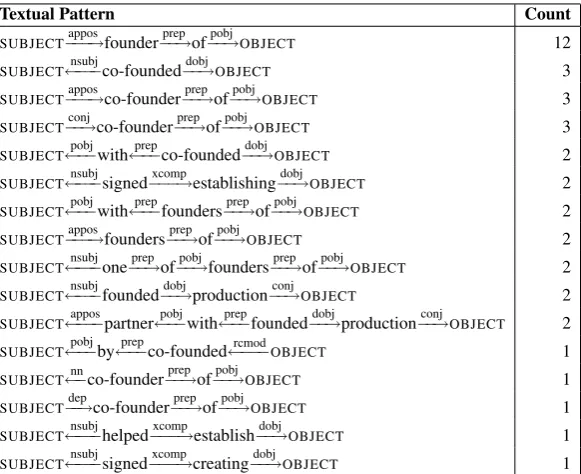
However, largely synonymous textual relations often share common sub-structure, and are com-posed of similar words and dependency arcs. For example, Table 1 shows a collection of dependency paths co-occurring with the
per-son/organizations foundedrelation.
In this paper we model this sub-structure and share parameters among related dependency paths, using a unified loss function learning entity and relation representations to maximize perfor-mance on the knowledge base link prediction task. We evaluate our approach on the FB15k-237 dataset, a knowledge base derived from the
base subset FB15k (Bordes et al., 2013) and filtered to remove highly redundant relations (Toutanova and Chen, 2015). The knowledge base is paired with textual mentions for all entity pairs derived from ClueWeb121 with Freebase entity mention annotations (Gabrilovich et al., 2013).
We show that using a convolutional neural net-work to derive continuous representations for tex-tual relations boosts the overall performance on link prediction, with larger improvement on entity pairs that have textual mentions.
2 Related Work
There has been a growing body of work on learn-ing to predict relations between entities without re-quiring sentence-level annotations of textual men-tions at training time. We group such related work into three groups based on whether KB, text, or both sources of information are used. Addition-ally, we discuss related work in the area of super-vised relation extraction using continuous repre-sentations of text, even though we do not use su-pervision at the level of textual mentions.
Knowledge base completion
Nickel et al. (2015) provide a broad overview of machine learning models for knowledge graphs, including models based on observed graph fea-tures such as the path ranking algorithm (Lao et al., 2011), models based on continuous represen-tations (latent features), and model combinations (Dong et al., 2014). These models predict new facts in a given knowledge base, based on infor-mation from existing entities and relations. From this line of work, most relevant to our study is prior work evaluating continuous representation models on the FB15k dataset. Yang et al. (2015) showed that a simple variant of a bilinear model DISTMULToutperformed TRANSE (Bordes et al.,
2013) and more richly parameterized models on this dataset. We therefore build upon the best per-forming prior model DISTMULTfrom this line of
work, as well as additional models E and F devel-oped in the context of text-augmented knowledge graphs (Riedel et al., 2013), and extend them to in-corporate compositional representations of textual relations.
1http://lemurproject.org/clueweb12/ FACC1/
Relation extraction using distant supervision
A number of works have focused on extracting new instances of relations using information from textual mentions, without sophisticated model-ing of prior knowledge from the knowledge base. Mintz et al. (2009) demonstrated that both surface context and dependency path context were help-ful for the task, but did not model the composi-tional sub-structure of this context. Other work proposed more sophisticated models that reason about sentence-level hidden variables (Riedel et al., 2010; Hoffmann et al., 2011; Surdeanu et al., 2012) or model the noise arising from the incom-pleteness of knowledge bases and text collections (Ritter et al., 2013),inter alia. Our work focuses on representing the compositional structure of sen-tential context for learning joint continuous repre-sentations of text and knowledge bases.
Combining knowledge base and text information
A combination of knowledge base and textual in-formation was first shown to outperform either source alone in the framework of path-ranking al-gorithms in a combined knowledge base and text graph (Lao et al., 2012). To alleviate the spar-sity of textual relations arising in such a com-bined graph, (Gardner et al., 2013; Gardner et al., 2014) showed how to incorporate clusters or con-tinuous representations of textual relations. Note that these vector representations are based on the co-occurrence patterns for the textual relations and not on their compositional structure. Co-occurrence based textual relation representations were also learned in (Neelakantan et al., 2015). Wang et al. (2014a) combined knowledge base and text information by embedding knowledge base entities and the words in their names in the same vector space, but did not model the textual co-occurrences of entity pairs and the expressed tex-tual relations. Weston et al. (2013) combined con-tinuous representations from a knowledge base and textual mentions for prediction of new rela-tions. The two representations were trained inde-pendently of each other and using different loss functions, and were only combined at inference time. Additionally, the employed representations of text were non-compositional.
sources of information. We directly build on the universal schema approach of Riedel et al. (2013) as well as the universal schema extension of the DISTMULT model mentioned previously, to
im-prove the representations of textual relations by capturing their compositional structure. Addition-ally, we evaluate the approach on a dataset that contains rich prior information from the training knowledge base, as well as a wealth of textual in-formation from a large document collection.
Continuous representations for supervised relation extraction
In contrast to the work reviewed so far, work on sentence-level relation extraction using direct su-pervision has focused heavily on representing sen-tence context. Models using hand-crafted fea-tures have evolved for more than a decade, and recently, models using continuous representations have been found to achieve new state-of-the-art performance (Zeng et al., 2014; Gormley et al., 2015). Compared to work on representation learn-ing for sentence-level context, such as this recent work using LSTM models on constituency or de-pendency trees (Tai et al., 2015), our approach us-ing a one-hidden-layer convolutional neural net-work is relatively simple. However, even such a simple approach has been shown to be very com-petitive (Kim, 2014).
3 Models for knowledge base completion
We begin by introducing notation to define the task, largely following the terminology in Nickel et al. (2015). We assume knowledge bases are rep-resented using RDF triples, in the form (subject, predicate,object), where the subject and object are entities and the predicate is the type of relation. For example, the KB fragment shown in Figure 1 is shown as a knowledge graph, where the enti-ties are the nodes, and the relations are shown as directed labeled edges: we see three entities par-ticipating in three relation instances indicated by the edges. For brevity, we will denote triples by
(es, r, eo), whereesandeodenote the subject and object entities, respectively.
The task is, given a training KB consisting of entities with some relations between them, to pre-dict new relations (links) that do not appear in the training KB. More specifically, we will build mod-els that rank candidate entities for given queries
(es, r,?) or(?, r, eo), which ask about the object
Barack Obama is the 44th and currrent President of United States .
nsubj prep pobj
SUBJECT nsubjpresident prep!of obj!OBJECT
1
Figure 2: Textual relation extracted from an entity pair mention.
or subject of a given relation.
This task setting has been used in models for KB completion previously, e.g. (Dong et al., 2014; Gardner et al., 2014), even though it has not been standard in evaluations of distant supervision for relation extraction (Mintz et al., 2009; Riedel et al., 2013). The advantage of this evaluation set-ting is that it enables automatic evaluation without requiring humans to label candidate extractions, while making only a localclosed world assump-tion for the completeness of the knowledge base — i.e., if one objecteofor a certain subject / rela-tion pair(es, r) is present in the knowledge base, it is assumed likely that all other objects(es, r, e0o) will be present. Such an assumption is particularly justified for nearly functional relations.
To incorporate textual information, we follow prior work (Lao et al., 2012; Riedel et al., 2013) and represent both textual and knowledge base re-lations in a single graph of “universal” rere-lations. The textual relations are represented as full lexi-calized dependency paths, as illustrated in Figure 2. An instance of the textual relationSUBJECT←−−−nsubj
president−−→prep of −→obj OBJECTconnecting the entities
BARACKOBAMAandUNITEDSTATES, is added to the knowledge graph based on this sentential occur-rence.
To present the models for knowledge base completion based on such combined knowledge graphs, we first introduce some notation. Let E denote the set of entities in the knowledge graph and letRdenote the set of relation types. We de-note each possible triple asT = (es, r, eo)where
·
r (es, eo)
F:
·
rs es
·
ro eo
+
E:
·
(r es eo
)
DISTMULT:
1
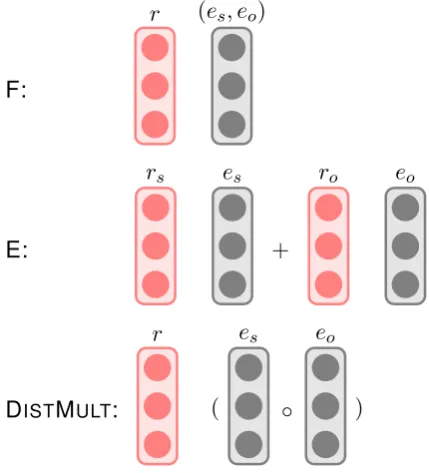
Figure 3: The continuous representations for model F, E and DISTMULT.
their parameters.
3.1 Basic Models
We begin with presenting the three models from prior work that this research builds upon. They all learn latent continuous representations of rela-tions and entities or entity pairs, and score possible triples based on the learned continuous represen-tations. Each of the models can be defined on a knowledge graph containing entities and KB rela-tions only, or on a knowledge graph additionally containing textual relations. We use models F and E from (Riedel et al., 2013) where they were used for a combined KB+text graph, and model DIST
-MULTfrom (Yang et al., 2015), which was
origi-nally used for a knowledge graph containing only KB relations.
As shown in Figure 3, model F learns a K -dimensional latent feature vector for each can-didate entity pair (es, eo), as well as a same-dimensional vector for each relation r, and the scoring function is simply defined as their inner product:f(es, r, eo) =v(r)|v(es, eo). Therefore, different pairs sharing the same entity would not share parameters in this model.
Model E does not have parameters for entity pairs, and instead has parameters for individual entities. It aims to capture the compatibility
be-tween entities and the subject and object posi-tions of relaposi-tions. For each relation type r, the model learns two latent feature vectorsv(rs) and
v(ro)of dimensionK. For each entity (node)ei, the model also learns a latent feature vector of the same dimensionality. The score of a candi-date triple (es, r, eo) is defined as f(es, r, eo) =
v(rs)|v(es) +v(ro)|v(eo). It can be seen that when a subject entity is fixed in a query(es, r,?), the ranking of candidate object entity fillers ac-cording tof does not depend on the subject entity but only on the relation typer.
The third model DISTMULT, is a special form
of a bilinear model like RESCAL (Nickel et al., 2011), where the non-diagonal entries in the rela-tion matrices are assumed to be zero. This model was proposed in Yang et al. (2015) and was shown to outperform prior work on the FB15k dataset. In this model, each entity ei and each relation r is assigned a latent feature vector of dimensionK. The score of a candidate triple(es, r, eo)is defined as f(es, r, eo) = v(r)|(v(es)◦v(eo)), where ◦ denotes the element-wise vector product. In this model, entity pairs which share an entity also share parameters, and the ranking of candidate objects for queries(es, r,?)depends on the subject entity. Denote Ne = |E|, Nr = |R|, and K = di-mension of latent feature vectors, then model E has KNe+ 2KNr parameters and model DIST -MULT has KNe + KNr parameters. Model F
hasKN2
e +KNr parameters, although most en-tity pairs will not co-occur in the knowledge base or text.
In the basic models, knowledge base and textual relations are treated uniformly, and each textual re-lation receives its own latent representation of di-mensionalityK. When textual relations are added to the training knowledge graph, the total number of relations |R| grows substantially (it increases from237to more than2.7million for the dataset in this study), resulting in a substantial increase in the total number of independent parameters.
Note that in all of these models queries about the arguments of knowledge base relations
[image:4.595.76.291.70.307.2]3.2 CONV: Compositional Representations of Textual Relations
In the standard latent feature models discussed above, each textual relation is treated as an atomic unit receiving its own set of latent features. How-ever, many textual relations differ only slightly in the words or dependency arcs used to express the relation. For example, Table 1 shows sev-eral textual patterns that co-occurr with the re-lation person/organizations founded in the train-ing KB. While some dependency paths occur fre-quently, many very closely related ones have been observed only once. The statistical strength of the model could be improved if similar dependency paths have a shared parameterization. We build on work using similar intuitions for other tasks and learn compositional representations of textual re-lations based on their internal structure, so that the derived representations are accurate for the task of predicting knowledge base relations.
We use a convolutional neural network applied to the lexicalized dependency paths treated as a se-quence of words and dependency arcs with direc-tion. Figure 4 depicts the neural network archi-tecture. In the first layer, each word or directed la-beled arc is mapped to a continuous representation using an embedding matrixV. In the hidden layer, every window of three elements is mapped to a hidden vector using position-specific maps W, a bias vectorb, and a tanhactivation function. A max-pooling operation over the sequence is ap-plied to derive the final continuous representation for the dependency path.
The CONV representation of textual relations
can be used to augment any of the three basic mod-els. The difference between a basic model and its CONV-augmented variant is in the
parameteriza-tion of textual menparameteriza-tions. The basic models learn distinct latent feature vectors of dimensionalityK
for all textual relation types, whereas the CONV
models derive the K-dimensional latent feature vectors for textual relation types as the activation at the top layer of the convolutional network in Figure 4, given the corresponding lexicalized de-pendency path as input.
3.3 Training loss function
All basic and CONV-augmented models use the
same training loss function. Our loss function is motivated by the link prediction task and the performance measures used. As previously
men-tioned, the task is to predict the subject or ob-ject entity for given held-out triples (es, r, eo), i.e., to rank all entities with respect to their like-lihood of filling the respective position in the triple2. We would thus like the model to score cor-rect triples(es, r, eo)higher than incorrect triples
(e0, r, e
o)and(es, r, e0)which differ from the cor-rect triple by one entity. Several approaches (Nickel et al., 2015) use a margin-based loss func-tion. We use an approximation to the negative log-likelihood of the correct entity filler instead3. We define the conditional probabilitiesp(eo|es, r)and
p(es|r, eo)for object and subject entities given the relation and the other argument as follows:
p(eo|es, r; Θ) = e
f(es,r,eo;Θ) P
e0∈Neg(es,r,?)ef(es,r,e0;Θ)
Conditional probabilities for subject entities
p(es|eo, r; Θ)are defined analogously. HereΘ de-notes all the parameters of latent features. The denominator is defined using a set of entities that do not fill the object position in any relation triple (es, r,?) in the training knowledge graph. Since the number of such entities is impractically large, we sample negative triples from the full set. We also limit the candidate entities to ones that have types consistent with the position in the relation triple (Chang et al., 2014; Yang et al., 2015), where the types are approximated follow-ing Toutanova and Chen (2015). Additionally, since the task of predicting textual relations is aux-iliary to the main task, we use a weighting factorτ
for the loss on predicting the arguments of textual relations (Toutanova and Chen, 2015).
DenoteT as a set of triples, we define the loss
L(T; Θ)as:
L(T; Θ) = − X (es,r,eo)∈T
logp(eo|es, r; Θ)
− X
(es,r,eo)∈T
logp(es|eo, r; Θ)
Let TKB and Ttext represent the set of knowl-edge base triples and textual relation triples re-spectively. The final training loss function is de-2Our experimental comparison focuses on predicting
ob-ject entities only, but we consider both argument types in the training loss function.
3Note that both margin-based and likelihood-based loss
Textual Pattern Count SUBJECT−−−→apposfounder−−→prepof−−→pobjOBJECT 12
SUBJECT←−−−nsubjco-founded−−→dobj OBJECT 3
SUBJECT−−−→apposco-founder−−→prepof−−→pobjOBJECT 3 SUBJECT−−→conjco-founder−−→prepof−−→pobjOBJECT 3 SUBJECT←−−pobjwith←−−prepco-founded−−→dobjOBJECT 2 SUBJECT←−−−nsubjsigned−−−→xcompestablishing−−→dobjOBJECT 2 SUBJECT←−−pobjwith←−−prepfounders−−→prepof−−→pobjOBJECT 2 SUBJECT−−−→apposfounders−−→prepof−−→pobjOBJECT 2 SUBJECT←−−−nsubjone−−→prepof−−→pobjfounders−−→prepof−−→pobjOBJECT 2 SUBJECT←−−−nsubjfounded−−→dobjproduction−−→conj OBJECT 2 SUBJECT←−−−appospartner←−−pobjwith←−−prepfounded−−→dobjproduction−−→conj OBJECT 2
SUBJECT←−−pobjby←−−prepco-founded←−−−rcmodOBJECT 1
SUBJECT←−nnco-founder−−→prepof−−→pobjOBJECT 1
SUBJECT−−→depco-founder−−→prepof−−→pobjOBJECT 1
SUBJECT←−−−nsubjhelped−−−→xcompestablish−−→dobjOBJECT 1
[image:6.595.156.447.61.298.2]SUBJECT←−−−nsubjsigned−−−→xcompcreating−−→dobjOBJECT 1
Table 1: Textual patterns occurring with entity pairs in aperson/organizations foundedrelationship. The count indicates the number of training set instances that have this KB relation, which co-occur with each textual pattern.
SUBJECT appos! co-founder prep! of pobj! OBJECT
vi=V ei
hi = tanh(W 1vi 1+W0vi+W1vi+1+b) r= max{hi}
Figure 4: The convolutional neural network architecture for representing textual relations.
fined as:
L(TKB; Θ) +τL(Ttext; Θ) +λkΘk2,
whereλis the regularization parameter, and τ is the weighing factor of the textual relations.
The parameters of all models are trained using a batch training algorithm. The gradients of the ba-sic models are straightforward to compute, and the gradients of the convolutional network parameters for the CONV-augmented models are also not hard
to derive using back-propagation.
4 Experiments
Dataset and Evaluation Protocol
We use the FB15k-2374 dataset, which is a sub-set of FB15k (Bordes et al., 2013) that excludes redundant relations and direct training links for held-out triples, with the goal of making the task more realistic (Toutanova and Chen, 2015). The FB15k dataset has been used in multiple stud-ies on knowledge base completion (Wang et al., 2014b; Yang et al., 2015). Textual relations for 4Check the first author’s website for a release of the
dataset.
[image:6.595.102.511.371.541.2]FB15k-237 are extracted from 200 million sen-tences in the ClueWeb12 corpus coupled with Freebase mention annotations (Gabrilovich et al., 2013), and include textual links of all co-occurring entities from the KB set. After pruning5, there are 2.7 million unique textual relations that are added to the knowledge graph. The set of textual rela-tions is larger than the set used in Toutanova and Chen (2015) (25,000 versus 2.7 million), leading to improved performance.
The number of relations and triples in the train-ing, validation and test portions of the data are given in Table 2. The two rows list statistics for the KB and text portions of the data separately. The 2.7 million textual relations occur in 3.9 mil-lion text triples. Almost all entities occur in tex-tual relations (13,937 out of 14,541). The num-bers of triples for textual relations are shown as zero for the validation and test sets because we don’t evaluate on prediction of textual relations (all text triples are used in training). The per-centage of KB triples that have textual relations for their pair of entities is 40.5% for the training, 26.6% for the validation, and 28.1% for the test set. While 26.6% of the validation set triples have textual mentions, the percentage with textual re-lations that have been seen in the training set is 18.4%. Having a mention increases the chance that a random entity pair has a relation from 0.1% to 5.0% — a fifty-fold increase.
Given a set of triples in a set disjoint from a training knowledge graph, we test models on pre-dicting the object of each triple, given the subject and relation type. We rank all entities in the train-ing knowledge base in order of their likelihood of filling the argument position. We report the mean reciprocal rank (MRR) of the correct entity, as well as HITS@10 — the percentage of test triples for which the correct entity is ranked in the top 10. We use filtered measures following the pro-tocol proposed in Bordes et al. (2013) — that is, when we rank entities for a given position, we re-move all other entities that are known to be part of an existing triple in the training, validation, or test set. This avoids penalizing the model for ranking other correct fillers higher than the tested entity.
5The full set of 37 million textual patterns connecting the
entity pairs of interest was pruned based on the count of pat-terns and their tri-grams, and their precision in indicating that entity pairs have KB relations.
Implementation details
We used a value of λ = 1 for the weight of the
L2 penalty for the main results in Table 3, and present some results on the impact ofλat the end of this section. We used batch optimization af-ter initial experiments with AdaGrad showed in-ferior performance. L-BFGS (Liu and Nocedal, 1989) and RProp (Riedmiller and Braun, 1993) were found to converge to similar function values, with RProp converging significantly faster. We thus used RProp for optimization. We initialized the KB+text models from the KB-only models and also from random initial values (sampled from a Gaussian distribution), and stopped optimization when the overall MRR on the validation set de-creased. For each model type, we chose the better of random and KB-only initialization. The word embeddings in the CONVmodels were initialized
using the 50-dimensional vectors from Turian et al. (2010) in the main experiments, with a slight positive impact. The effect of initialization is dis-cussed at the end of the section.
The number of negative examples for each triple was set to 200. Performance improved substan-tially when the number of negative examples was increased and reached a plateau around200. We chose the optimal number of latent feature dimen-sions via a grid search to optimize MRR on the validation set, testing the values 5, 10, 15, 35, 50, 100, 200 and 500. We also performed a grid search over the values of the parameterτ, testing values in the set{0.01,0.1,0.25,0.5,1}. The best dimen-sion for latent feature vectors was10for most KB-only models (not including model F), and5for the two model configurations including F. We used
K = 10for all KB+text models, as higher dimen-sion was also not helpful for them.
Experimental results
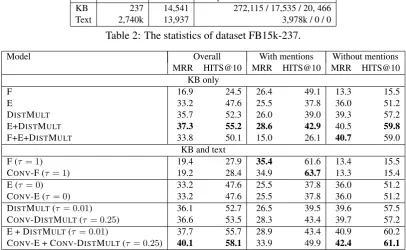
In Table 3 we show the performance of differ-ent models and their combinations6, both when using textual mentions (KB+text), and when us-ing only knowledge base relations (KB only). In the KB+text setting, we evaluate the contribution of the CONV representations of the textual
rela-tions. The upper portion of the Table shows the performance of models that have been trained us-ing knowledge graphs includus-ing only knowledge
6Different models are combined by simply defining a
# Relations # Entities # Triples in Train / Validation / Test KB 237 14,541 272,115 / 17,535 / 20, 466
[image:8.595.95.502.72.322.2]Text 2,740k 13,937 3,978k / 0 / 0
Table 2: The statistics of dataset FB15k-237.
Model Overall With mentions Without mentions
MRR HITS@10 MRR HITS@10 MRR HITS@10 KB only
F 16.9 24.5 26.4 49.1 13.3 15.5
E 33.2 47.6 25.5 37.8 36.0 51.2
DISTMULT 35.7 52.3 26.0 39.0 39.3 57.2
E+DISTMULT 37.3 55.2 28.6 42.9 40.5 59.8
F+E+DISTMULT 33.8 50.1 15.0 26.1 40.7 59.0
KB and text
F (τ= 1) 19.4 27.9 35.4 61.6 13.4 15.5
CONV-F (τ= 1) 19.2 28.4 34.9 63.7 13.3 15.4
E (τ= 0) 33.2 47.6 25.5 37.8 36.0 51.2
CONV-E (τ = 0) 33.2 47.6 25.5 37.8 36.0 51.2
DISTMULT(τ= 0.01) 36.1 52.7 26.5 39.5 39.6 57.5
[image:8.595.96.502.117.322.2]CONV-DISTMULT(τ = 0.25) 36.6 53.5 28.3 43.4 39.7 57.2 E + DISTMULT(τ= 0.01) 37.7 55.7 28.9 43.4 40.9 60.2 CONV-E + CONV-DISTMULT(τ = 0.25) 40.1 58.1 33.9 49.9 42.4 61.1
Table 3: Results on FB15k-237 for KB only and KB+text inference, with basic models versus the pro-posed CONV-augmented models. The values of the hyper-parameter τ (as shown in the Table) were
chosen to maximize MRR on the validation set. The reported numbers were obtained for the test set.
base relations, and are not using any information from textual mentions. The lower portion of the Table shows the performance when textual rela-tions are added to the training knowledge graph and the corresponding training loss function. Note that all models predict based on the learned knowl-edge base relation and entity representations, and the textual relations are only used at training time when they can impact these representations.
The performance of all models is shown as an overall MRR (scaled by 100) and HITS@10, as well as performance on the subset of triples that have textual mentions (column With mentions), and ones that do not (columnWithout mentions). Around 28% of the test triples have mentions and contribute toward the measures in the With men-tionscolumn, and the other 72% of the test triples contribute to theWithout mentionscolumn.
For the KB-only models, we see the perfor-mance of each individual model F, E, and DIST
-MULT. Model F was the best performing single
model from (Riedel et al., 2013), but it does not perform well when textual mentions are not used. In our implementation of model F, we created en-tity pair parameters only for enen-tity pairs that co-occur in the text data (Riedel et al. (2013) also trained pairwise vectors for co-occuring entities
only, but all of the training and test tuples in their study were co-occurring)7. Without textual in-formation, model F is performing essentially ran-domly, because entity pairs in the test sets do not occur in training set relations (by construction of the dataset). Model E is able to do surprisingly well, given that it is making predictions for each object position of a relation without considering the given subject of the relation. DISTMULT is
the best performing single model. Unlike model F, it is able to share parameters among entity pairs with common subject or object entities, and, un-like model E, it captures some dependencies be-tween the subject and object entities of a relation. The combination of models E+DISTMULT
im-proves performance, but combining model F with the other two is not helpful.
The lower portion of Table 3 shows results when textual relations are added to the training knowl-edge graph. The basic models treat the textual re-lations as atomic and learn a separate latent feature vector for each textual relation. The CONV-
mod-els use the compositional representations of tex-7Learning entity pair parameters for all entity pairs would
tual relations learned using the convolutional neu-ral network architecture shown in Figure 4. We show the performance of each individual model and its corresponding variant with a CONV
pa-rameterization. For each model, we also show the optimal value of τ, the weight of the textual re-lations loss. Model F is able to benefit from tex-tual relations and its performance increases by2.5
points in MRR, with the gain in performance be-ing particularly large on test triples with textual mentions. Model F is essentially limiting its space of considered argument fillers to ones that have co-occurred with the given subject entity. This gives it an advantage on test triples with textual mentions, but model F still does relatively very poorly over-all when taking into account the much more nu-merous test triples without textual mentions. The CONV parameterization performs slightly worse
in MRR, but slightly better in HITS@10, com-pared to the atomic parameterization. For model E and its CONVvariant, we see that text does not
help as its performance using text is the same as that when not using text and the optimal weight of the text is zero. Model DISTMULT benefits
from text, and its convolutional text variant CONV
-DISTMULToutperforms the basic model, with the
gain being larger on test triples with mentions. The best model overall, as in the KB-only case, is E+DISTMULT. The basic model
bene-fits from text slightly and the model with compo-sitional representations of textual patterns CONV
-E+CONV-DISTMULT, improves the performance
further, by 2.4 MRR overall, and by 5 MRR on triples with textual mentions. It is interesting that the text and the compositional representations helped most for this combined model. One hy-pothesis is that model E, which provides a prior over relation arguments, is needed in combination with DISTMULT to prevent the prediction of
un-likely arguments based on noisy inference from textual patterns and their individual words and de-pendency links.
Hyperparameter Sensitivity
To gain insight into the sensitivity of the model to hyper-parameters and initialization, we report on experiments starting with the best model CONV
-E + CONV-DISTMULTfrom Table 3 and varying
one parameter at a time. This model has weight of the textual relations loss τ = 0.25, weight of theL2penaltyλ= 1, convolution window size of
three, and is initialized randomly for the entity and KB relation vectors, and from pre-trained embed-dings for word vectors (Turian et al., 2010). The overall MRR of the model is 40.4 on the validation set (test results are shown in the Table).
When the weight ofτis changed to 1 (i.e., equal contribution of textual and KB relations), the over-all MRR goes down to 39.6 from 40.4, indicat-ing the usefulness of weightindicat-ing the two kinds of relations non-uniformly. When λ is reduced to
0.04, MRR is 40.0 and when λ is increased to
25, MRR goes down to 38.9. This indicates the
L2 penalty hyper-parameter has a large impact on performance. When we initialize the word embed-dings randomly instead of using pre-trained word vectors, performance drops only slightly to 40.3. If we initialize from a model trained using KB-only information, performance goes down sub-stantially to 38.7. This indicates that initialization is important and there is a small gain from using pre-trained word embeddings. There was a drop in performance to MRR40.2 when using a win-dow size of one for the convolutional architecture in Figure 4, and an increase to40.6when using a window size of five.
5 Conclusion and Future Work
Here we explored an alternative representation of textual relations for latent feature models that learn to represent knowledge base and textual re-lations in the same vector space. We showed that given the large degree of sharing of sub-structure in the textual relations, it was beneficial to com-pose their continuous representations out of the representations of their component words and de-pendency arc links. We applied a convolutional neural network model and trained it jointly with a model mapping entities and knowledge base rela-tions to the same vector space, obtaining substan-tial improvements over an approach that treats the textual relations as atomic units having indepen-dent parameterization.
Acknowledgements
References
S¨oren Auer, Christian Bizer, Georgi Kobilarov, Jens Lehmann, Richard Cyganiak, and Zachary Ives. 2007. Dbpedia: A nucleus for a web of open data. Springer.
Kurt Bollacker, Colin Evans, Praveen Paritosh, Tim Sturge, and Jamie Taylor. 2008. Freebase: a col-laboratively created graph database for structuring human knowledge. InProceedings of the 2008 ACM SIGMOD international conference on Management of data, pages 1247–1250. ACM.
Antoine Bordes, Nicolas Usunier, Alberto Garcia-Duran, Jason Weston, and Oksana Yakhnenko. 2013. Translating embeddings for modeling multi-relational data. InAdvances in Neural Information Processing Systems (NIPS).
Kai-Wei Chang, Wen-tau Yih, Bishan Yang, and Christopher Meek. 2014. Typed tensor decompo-sition of knowledge bases for relation extraction. In Empirical Methods in Natural Language Processing (EMNLP).
Xin Dong, Evgeniy Gabrilovich, Geremy Heitz, Wilko Horn, Ni Lao, Kevin Murphy, Thomas Strohmann, Shaohua Sun, and Wei Zhang. 2014. Knowledge vault: A web-scale approach to probabilistic knowl-edge fusion. InInternational Conference on Knowl-edge Discovery and Data Mining (KDD).
Evgeniy Gabrilovich, Michael Ringgaard, and Amar-nag Subramanya. 2013. FACC1: Freebase anno-tation of ClueWeb corpora, Version 1 (release date 2013-06-26, format version 1, correction level 0).
Matt Gardner, Partha Pratim Talukdar, Bryan Kisiel, and Tom Mitchell. 2013. Improving learning and inference in a large knowledge-base using latent syntactic cues. In Empirical Methods in Natural Language Processing (EMNLP).
Matt Gardner, Partha Talukdar, Jayant Krishnamurthy, and Tom Mitchell. 2014. Incorporating vector space similarity in random walk inference over knowledge bases. InEmpirical Methods in Natural Language Processing (EMNLP).
Matthew R Gormley, Mo Yu, and Mark Dredze. 2015. Improved relation extraction with feature-rich compositional embedding models. arXiv preprint arXiv:1505.02419.
Raphael Hoffmann, Congle Zhang, Xiao Ling, Luke Zettlemoyer, and Daniel S. Weld. 2011. Knowledge-based weak supervision for information extraction of overlapping relations. In Association for Computational Linguistics (ACL).
Yoon Kim. 2014. Convolutional neural
net-works for sentence classification. arXiv preprint arXiv:1408.5882.
Ni Lao, Tom Mitchell, and William W Cohen. 2011. Random walk inference and learning in a large scale knowledge base. InEmpirical Methods in Natural Language Processing (EMNLP).
Ni Lao, Amarnag Subramanya, Fernando Pereira, and
William W Cohen. 2012. Reading the web
with learned syntactic-semantic inference rules. In Empirical Methods in Natural Language Process-ing and Computational Natural Language LearnProcess-ing (EMNLP/CoNLL).
Dong C Liu and Jorge Nocedal. 1989. On the limited memory bfgs method for large scale optimization. Mathematical programming, 45(1-3):503–528.
Mike Mintz, Steven Bills, Rion Snow, and Daniel Ju-rafsky. 2009. Distant supervision for relation ex-traction without labeled data. In Association for Computational Linguistics and International Joint Conference on Natural Language Processing (ACL-IJCNLP).
Arvind Neelakantan, Benjamin Roth, and Andrew Mc-Callum. 2015. Compositional vector space models for knowledge base completion. InACL.
Maximilian Nickel, Volker Tresp, and Hans-Peter Kriegel. 2011. A three-way model for collective learning on multi-relational data. InProceedings of the 28th international conference on machine learn-ing (ICML-11), pages 809–816.
Maximilian Nickel, Kevin Murphy, Volker Tresp, and Evgeniy Gabrilovich. 2015. A review of re-lational machine learning for knowledge graphs: From multi-relational link prediction to automated knowledge graph construction. arXiv preprint arXiv:1503.00759.
Sebastian Riedel, Limin Yao, and Andrew McCal-lum. 2010. Modeling relations and their men-tions without labeled text. InMachine Learning and Knowledge Discovery in Databases, pages 148–163. Springer.
Sebastian Riedel, Limin Yao, Benjamin M. Marlin, and Andrew McCallum. 2013. Relation extraction with matrix factorization and universal schemas. In North American Chapter of the Association for Computational Linguistics: Human Language Tech-nologies (NAACL-HLT).
Martin Riedmiller and Heinrich Braun. 1993. A direct adaptive method for faster backpropagation learn-ing: The rprop algorithm. In Neural Networks, 1993., IEEE International Conference on, pages 586–591. IEEE.
Fabian M Suchanek, Gjergji Kasneci, and Gerhard Weikum. 2007. Yago: a core of semantic knowl-edge. InProceedings of the 16th international con-ference on World Wide Web, pages 697–706. ACM. Mihai Surdeanu, Julie Tibshirani, Ramesh
Nallap-ati, and Christopher D. Manning. 2012. Multi-instance multi-label learning for relation extraction. InEmpirical Methods in Natural Language Process-ing and Computational Natural Language LearnProcess-ing (EMNLP/CoNLL).
Kai Sheng Tai, Richard Socher, and Christopher D Manning. 2015. Improved semantic representa-tions from tree-structured long short-term memory networks. arXiv preprint arXiv:1503.00075. Kristina Toutanova and Danqi Chen. 2015. Observed
versus latent features for knowledge base and text inference. InProceedings of the 3rd Workshop on Continuous Vector Space Models and their Compo-sitionality, pages 57–66. Association for Computa-tional Linguistics.
Joseph Turian, Lev Ratinov, and Yoshua Bengio. 2010. Word representations: a simple and general method for semi-supervised learning. InProceedings of the 48th annual meeting of the association for compu-tational linguistics, pages 384–394. Association for Computational Linguistics.
Zhen Wang, Jianwen Zhang, Jianlin Feng, and Zheng Chen. 2014a. Knowledge graph and text jointly em-bedding. InProceedings of the 2014 Conference on Empirical Methods in Natural Language Processing (EMNLP). Association for Computational Linguis-tics, pages 1591–1601.
Zhen Wang, Jianwen Zhang, Jianlin Feng, and Zheng Chen. 2014b. Knowledge graph embedding by translating on hyperplanes. In Proceedings of the Twenty-Eighth AAAI Conference on Artificial Intel-ligence, pages 1112–1119.
Jason Weston, Antoine Bordes, Oksana Yakhnenko, and Nicolas Usunier. 2013. Connecting language and knowledge bases with embedding models for re-lation extraction. InEmpirical Methods in Natural Language Processing (EMNLP).
Bishan Yang, Wen-tau Yih, Xiaodong He, Jianfeng Gao, and Li Deng. 2015. Embedding entities and relations for learning and inference in knowledge bases. In International Conference on Learning Representations (ICLR).