i
Combining Hand-crafted Rules and Unsupervised Learning
in
Constraint-based Morphological Disambiguation
Kemal Oflazer and GSkhan Tfir
Department of Computer Engineering and Information Science
Bilkent University, Bilkent, Ankara, TR-06533, TURKEY
{ko, tur}~cs, bilkent, edu. tr
A b s t r a c t
1
I n t r o d u c t i o n
This paper presents a constraint-based morphological disambiguation approach that is applicable languages with complex morphology-specifically agglutinative lan- guages with productive inflectional and derivational morphological phenomena. In certain respects, our approach has been motivated by Brill's recent work (Brill, 1995b), but with the observation that his transformational approach is not directly applicable to languages like Turkish. Our system combines corpus independent hand- crafted constraint rules, constraint rules that are learned via unsupervised learn- ing from a training corpus, and additional statistical information from the corpus to
be morphologically disambiguated. The
hand-crafted rules are linguistically moti- vated and tuned to improve precision with-
out sacrificing recall. The unsupervised
learning process produces two sets of rules:
(i) choose rules which choose morpholog-
ical parses of a lexical item satisfying con- straint effectively discarding other parses,
and (ii) delete rules, which delete parses
satisfying a constraint. Our approach also uses a novel approach to unknown word processing by employing a secondary mor- phological processor which recovers any rel- evant inflectional and derivational informa- tion from a lexieal item whose root is un- known. With this approach, well below
1% of the tokens remains as unknown in
the texts we have experimented with. Our results indicate that by combining these hand-crafted, statistical and learned infor- mation sources, we can attain a recall of 96 to 97% with a corresponding precision of 93 to 94%, and ambiguity of 1.02 to 1.03 parses per token.
Automatic morphological disambiguation is a very crucial component in higher level analysis of natural language text corpora. Morphological disambigua- tion facilitates parsing, essentially by performing a certain amount of ambiguity resolution using rela- tively cheaper methods (e.g., Gfing6rdii and Oflazer (1995)). There has been a large number of studies in tagging and morphological disambiguation using various techniques. Part-of-speech tagging systems have used either a statistical approach where a large corpora has been used to train a probabilistic model which then has been used to tag new text, assign- ing the most likely tag for a given word in a given context (e.g., Church (1988), Cutting et al. (1992), DeRose (1988)). Another approach is the rule-based or constraint-based approach, recently most promi- nently exemplified by the Constraint G r a m m a r work (Karlsson et al., 1995; Voutilainen, 1995b; Vouti- lainen et al., 1992; Voutilainen and Tapanainen, 1993), where a large number of hand-crafted linguis- tic constraints are used to eliminate impossible tags or morphological parses for a given word in a given context. Brill (1992; 1994; 1995a) has presented a transformation-based learning approach, which in- duces rules from tagged corpora. Recently he has extended this work so that learning can proceed in an unsupervised manner using an untagged cor- pus (Brill, 1995b). Levinger et al. (1995) have re- cently reported on an approach that learns morpho- lexical probabilities from untagged corpus and have the used the resulting information in morphological disambiguation in Hebrew.
In contrast to languages like English, for which there is a very small number of possible word forms with a given root word, and a small number of tags associated with a given lexical form, languages like Turkish or Finnish with very productive agglutina- tive morphology where it is possible to produce thou- sands of forms (or even millions (Hankamer, 1989)) for a given root word, pose a challenging problem for morphological disambiguation. In English, for
example, a word such as make or set can be verb
or a noun. In Turkish, even though there are ambi- guities of such sort, the agglutinative nature of the language usually helps resolution of such ambiguities due to restrictions on lnorphotactics. On the other hand, this very nature introduces another kind of ambiguity, where a lexical form can be morpholog- ically interpreted in m a n y ways, some with totally unrelated roots and morphological features, as will be exemplified in the next section.
Our previous approach to tagging and morpho- logical disambiguation for Turkish text had em- ployed a constraint-based approach (Oflazer and Kuru6z, 1994) along the general lines of similar pre- vious work for English (Karlsson et al., 1995; Vouti- lainen et al., 1992; Voutilainen and Tapanainen, 1993). Although the results obtained there were rea- sonable, the fact t h a t all constraint rules were hand crafted, posed a rather serious i m p e d i m e n t to the generality and i m p r o v e m e n t of the system.
In this paper we present a constraint-based mor- phological disambiguation approach that uses unsu- pervised learning component to discover some of the constraints it uses in conjunction with hand-crafted rules. It is specifically applicable to languages with productive inflectional and derivational morpholog- ical processes, such as Turkish, where morpholog- ical a m b i g u i t y has a rather different nature than t h a t found in languages like English. Our approach starts with a set of corpus-independent hand-crafted rules t h a t reduce morphological ambiguity (hence improve precision) without sacrificing recall. It then uses an untagged training corpus in which all lexical items have been a n n o t a t e d with all possible morpho- logical analyses, incrementally proposing and eval- uating additional (possibly corpus dependent) con- straints for disambiguation of morphological parses using the constraints imposed by unambiguous con- texts. These rules choose or delete parses with spec- ified features. In certain respects, our approach has been m o t i v a t e d by Brill's recent work (Brill, 1995b), but with the observation t h a t his transformational approach is not directly applicable to languages like Turkish, where tags associated with forms are not predictable in advance.
In the following sections, we present an overview of the morphological disambiguation problem, high-
lighted with examples from Turkish. We then
present the details of our approach and results. We finally conclude after a discussion and evaluation of our results.
2 T a g g i n g a n d M o r p h o l o g i c a l D i s a m b i g u a t i o n
In almost all languages, words are usually ambigu- ous in their parts-of-speech or other lexical features, and m a y represent lexical items of different syntac- tic categories, or morphological structures depend- ing on the syntactic and semantic context. Part-of-
speech (POS) tagging involves assigning every word its proper part-of-speech based upon the context the word appears in. In English, for e x a m p l e a word
such as set can be a verb in certain contexts (e.g.,
He set the table for dinner) and a noun in some oth-
ers (e.g., We are now facing a whole s e t of problems).
In Turkish, there are ambiguities of the sort
above. However, the agglutinative nature of the
language usually helps resolution of such ambigui- ties due to the restrictions on morphotactics. On the other hand, this very nature introduces another kind of ambiguity, where a whole lexical f o r m can be morphologically interpreted in m a n y ways not pre- dictable in advance. For instance, our full-scale mor- phological analyzer for Turkish returns the following
set of parses for the word oysa: 1,2
1. [[CAT CONN] [ROOT oysa]] (on the other hand)
2. [[CAT NOUN] [ROOT oy] [AGR 3SG]
[POSS NONE] [CASE NOM]
[c0Nv VERB NONE] [TAM1COND] [AGR 3SG]] (if it is a vote)
3. [[CAT PRONOUN] [ROOT o] [TYPE DEMONS] [AGR 3SG] [POSS NONE]
[CASE NOM] [CONV VERB NONE] [TAM1COND][AGR 3SG]] (if it is)
4. [[CAT PRONOUN] [ROOT o] [TYPE PERSONAL] [AGR 3SG] [POSS NONE] [CASE NOM] [CONV VERB NONE] [TAM1COND] [AGR 3SG]]
(if s/he is)
s. [[CAT VERB] [ROOT oy] [SENSE POS]
[TAM1 DES] [AGR 3SG]] (wish s/he would carve)
On the other hand, the f o r m oya gives rise to the following parses:
1. [[CAT NOUN] [ROOT oya] [AGR 3SG]
[POSS NONE] [CASE NOM]] (lace) 2. [[CAT NOUN] [ROOT oy] [AGR 3SG]
[POSS NONE] [CASE DAT]] (to the vote) 3. [[CAT VERB] [ROOT oy] [SENSE POS]
[TAM1 OPT] [AGR 3SG]] (let him carve)
and the form oyun gives rise to the following parses:
iOutput of the morphological anaJyzer is edited for clarity, and English glosses have been given.
2Glosses are given as linear feature value sequences
corresponding to the morphemes (which are not shown). The feature names are as follows: CAT-major category, TYPE-minor category, R00T-main root form, AGR -number and person agreement, POSS- possessive agreement, CASE
I
I. [[CAT NOUN] [ROOT oyun] [AGR 3SG] [POSS NONE] [CASE NOM]] (game)
2. [[CAT NOUN] [ROOT oy] [AGR 3SG]
[POSS NONE] [CASE GEN]] (of the vote) 3. [[CAT NOUN] [ROOT oy] [AGR 3SG]
[POSS 2SG] [CASE NOM]] (your vote)
4. [[CAT VERB] [ROOT oy] [SENSE POS] [TAM1 IMP] [AGR 2PL]] (carve it!)
O n the other hand, the local syntactic context m a y help reduce some of the ambiguity above, as
in: 3
sen-in o y - u n ..
PRON(you)+GEN NOUN(vote)+POSS-2SG
your vote
o y - u n reng-i ..
NOUN(vote)+GEN NOUN(color)+POSS-3SG
(NOUN-GEN NOUN-POSS form)
color of the vote
o y u n reng-i ..
NOUN(game) NOUN(color)+POSS-3SG
game color
(NOUN NOUN-POSS form)
using some very basic noun phrase agreement con- straints in Turkish. Obviously in other similar cases, it m a y be possible to resolve the ambiguity com- pletely.
There are also numerous other examples of word forms where productive derivational processes come into play: 4
geldiGimdeki (at the time I came)
[[CAT VERB] [ROOT gel] [SENSE POS] (basic form)
[CONV NOUN DIE] [AGR 3SG]
[POSS iSG] [CASE LOC] (participle form) [CONV ADJ REL]]
(final adjectivalization by the relative (ki) suffix)
Here, the original root is verbal but the final part- of-speech is adjectival. In general, the ambiguities of the forms t h a t come before such a form in text can be resolved with respect to its original (or intermediate) parts-of-speech (and inflectional features), while the ambiguities of the forms t h a t follow can be resolved based on its final part-of-speech.
T h e m a i n intent of our system is to achieve a mor-
phological ambiguity reduction in the text by choos-
ing for a given ambiguous token, a subset of its
ZWith a slightly different but nevertheless common glossing convention.
4Upper cases in morphological output indicates one of the non-ASCII special Turkish characters: e.g., G denotes ~, U denotes /i, etc.
parses which are not disallowed by the syntactic con- text it appears in. It is certainly possible t h a t a given token m a y have multiple correct parses, usually with the same inflectional features or with inflectional fea- tures not ruled out by the syntactic context. These can only be disambiguated usually on semantic or discourse constraint grounds. 5
We consider a token fully disambiguated if it has
only one morphological parse remaining after auto- matic disambiguation. We consider as token as cor- rectly disambiguated, if one of the parses remain-
ing for t h a t token is the correct intended parse. 6
We evaluate the resulting disambiguated text by a number of metrics defined as follows (Voutilainen, 1995a):
# P a r s e s A m b i g u i t y -
# T o k e n s
Recall = # T o k e n s C o r r e c t l y D i s a m b i g u a t c d # T o k e n s
~ T o k c n s C o r r e c t l y D i s a m b i g u a t e d P r e c i s i o n =
~ P a r s e s
In the ideal case where each token is uniquely and correctly disambiguated with the correct parse, both recall and precision will be 1.0. On the other hand, a text where each token is a n n o t a t e d with all possible parses, 7 the recall will be 1.0 but the precision will be low. The goal is to have both recall and precision as high as possible.
3 C o n s t r a i n t - b a s e d M o r p h o l o g i c a l D i s a m b i g u a t i o n
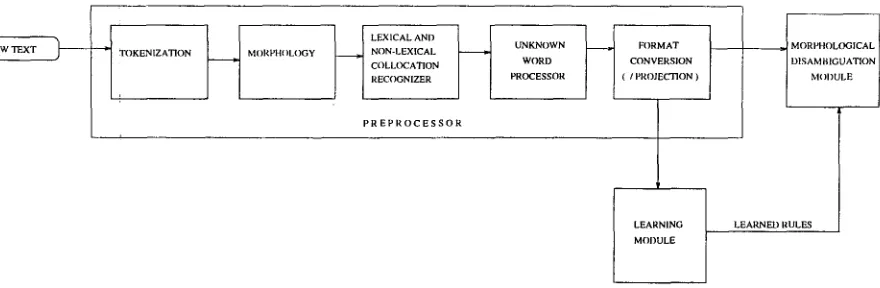
This section outlines our approach to constraint- based morphological disambiguation incorporating unsupervised learning component. Our system with the structure presented in Figure 1 has three m a i n components:
1. the preprocessor,
2. the learning module, and
3. the morphological disambiguation module. Preprocessing is c o m m o n to b o t h the learning and
the morphological disambiguation modules. T h e
module takes as input to the system raw Turkish text and preprocesses it in a m a n n e r to be described shortly.
If the text is to be used for training, the learning module then
1. applies an initial set of linguistically m o t i v a t e d hand-crafted constraint rules to choose a n d / o r delete certain parses, and
5For instance the third and fourth parses for oysa
above.
6It is certainly possible that, a parse that is deleted may also be a valid parse in that context.
rAssuming no unknown words.
2. uses an unsupervised learning procedure to in- duce some additional (an possibly corpus de- pendent) rules to choose and delete some parses. Morphological disambiguation of previously un- seen text proceeds as follows:
1. The hand-crafted rules are applied first.
2. Certain parses are deleted using context statis- tics on the corpus to be tagged.
3. Rules learned to choose and delete parses are then applied.
3.1 T h e P r e p r o c e s s o r
The preprocessing module takes as input a Turk- ish text, segments it into sentences using various heuristics about punctuation, tokenizes and runs it through a wide-coverage high-performance morpho- logical analyzer developed using two-level morphol- ogy tools by Xerox (Karttunen, 1993). This module also performs a number of additional functions:
• it groups
lexicalized collocations
such as id-iomatic forms, semantically coalesced forms such as proper noun groups, certain numeric forms, etc.
• it groups any
compound verb formations
whichare formed by a lexically adjacent, direct or oblique object, and a verb, which for the pur- poses of syntactic analysis, may be considered as single lexical item: e.g.,
saygz durmak
(to pay respect),kafay~ yemek
(literally t0eat the head
- to get mentally deranged), etc.• it groups
non-lexicalized collocations:
Turkishabounds with various non-lexicalized colloca- tions where the sentential role of the colloca- tion has (almost) nothing to do with the parts- of-speech of the individual forms involved. Al- most all of these collocations involve duplica- tions, and have forms like w + x w + y where w is the duplicated string comprising the root and certain sequence of suffixes and x and y are possibly different (or empty) sequences of other suffixes.
The following is a list of multi-word constructs for Turkish that we handle in our preproces- sor. This list is not meant to be comprehensive, and new construct specifications can easily be added. It is conceivable that such a function- ality can be used in almost any language. (See Oflazer and Kuru6z (1994) and KuruSz (1994) for details of all other forms for Turkish.)
1. duplicated optative and 3SG verbal forms functioning as manner adverb. An example
is
ko~a ko~a,
where each lexical item has themorphological parse
[[CAT VERB] [ROOT koS] [SENSE POS] [TAM1 0PT] [AGR3SG]]
The preprocessor recognizes this and gen- erates the feature sequence:
2.
[[CAT VERB] [ROOT koS] [SENSE POS] [TAM1 OPT] [AGR 3SG]
[CONV ADVERB DUPi] [TYPE MANNER]]
aorist verbal forms with root duplications and sense negation, functioning as tem- poral adverbs. For instance for the n o n -
lexicalized collocation
yapar yapmaz,
whereitems have the parses
[[CAT VERB] [ROOT yap] [SENSE P0S] [TAM1 AORIST ] [AGR 3SG]]
[[CAT VERB] [ROOT yap] [SENSE BEG] [TAM1 AORIST ] [AGR 3SG]]
respectively, the preprocessor generates the feature sequence
[[CAT VERB] [ROOT koS] [SENSE POS] [TAM1 AORIST] [AGR 3SG]
[CONV ADVERB DUP-AOR] [TYPE TEMP]] 3. duplicated verbal and derived adverbial
forms with the same verbal root acting as temporal adverbs, e.g.,
gitti gideli,
4. emphatic adjectival forms involving dupli-
cation and question clitic, e.g.,
g71zel mi
g~zel
(beautiful question-clitic beautiful-very beautiful)
5. adjective or noun duplications that act as manner adverbs, e.g.,
hzzh hzzh, evev,
This module recognizes all such forms and coa- lesces them into new feature structures reflect- ing the final structure along with any inflec- tional information.
• The preprocessor then converts each parse into a hierarchical feature structure so that the in- flectional feature of the form with the last cat- egory conversion (if any) are at the top level.
Thus in the example above for
geldi~imdeki,
thefollowing feature structure is generated:
[[CAT VERB] [ROOT g e l ] [SENSE POS] [CONV NOUN DIK] [AGR 3SG]
[P0SS ISG] [CASE LOC] [CONV ADJ REL]]
"CAT ADJ
"CAT AGR POSS CASE
N O U N 3 S G i S G
L O C
S T E M
C A T V E R B ' S T E M [ R O O T gel
[ . S E N S E P O S S U F F I X D I K
S U F F I X ~ E L
• Finally, each such feature structure is then
pro-
jected
on a subset of its features. The featuresselected are
TOKEN IZATION MORPHOLOGY NON-LEXICAL UNKNOWN FORMAT COLLOCATION WORD CONVERSION RECOGNIZER PROCESSOR ( / PRO/ECTION )
P R E P R O C E S S O R
M O R P H O L O G I C A L
DISAM BIGUATION MODULE
LEARNING LEARNED RULES MOI)ULE
Figure h T h e structure of the constraint-based morphological disambiguation system.
-- roots and certain relevant features such as subcategorization requirements for closed classes of words such as connectives, post- positions, etc.
T h e set of features selected for each part-of- speech category is determined by a t e m p l a t e and hence is controllable, permitting experi- m e n t a t i o n with differing levels of information. The information selected for stems are deter- mined by the category of the stem itself recur- sively.
Under certain circumstances where a token has two or more parses t h a t agree in the selected features, those parses will be represented by a single projected parse, hence the number of parses in the (projected) training corpus m a y be smaller t h a n the number of parses in the origi- nal corpus. For example, the feature structure above is projected into a feature structure such
a s :
- C A T A D J
[image:5.612.80.520.72.216.2][OAT NOUN
]]
| A G R 3 S G
|POSS 1SG
STEM /CASE LOC
/STEM [ C A T VERB
[SUFFIX DIK SUFFIX REL
3.2 U n k n o w n W o r d s
Although the coverage of our morphological analyzer for Turkish (Oflazer, 1993), with about 30,000 root words and a b o u t 35,000 proper names, is very sat- isfactory, it is inevitable t h a t there will be forms in the corpora being processed t h a t are not recog- nized by the morphological analyzer. These are al- m o s t always foreign proper names, words adapted into the language and not in the lexicon, or very obscure technical words. These are nevertheless in- flected (using Turkish word formation paradigms)
with inflectional features demanded by the syntactic context and sometimes even go through derivational processes. For improved disambiguation, one has to at least recover any morphological features even if the root word is unknown. To deal with this, we have made the assumption t h a t all unknown words have nominal roots, and built a second morphologi- cal analyzer whose (nominal) root lexicon recognizes S + where S is the Turkish surface alphabet (in the two-level morphology sense), but then tries to in- terpret an arbitrary postfix of the unknown word as a sequence of Turkish suffixes subject to all mor- phographemic constraints. For instance when a form such as t a l k s h o w u m u n is entered, this second ana- lyzer hypothesizes the following analyses:
I. [[CAT NOUN] [ROOT talkshowumun] [AGR 3SG] [POSS NONE] [CASE NOM]]
2. [[CAT NOUN] [ROOT talkshowumu] [AGR 3SG] [POSS 2SG] [CASE NOM]]
3. [[CAT NOUN] [ROOT talksho~um] [AGR 3SG] [POSS NONE] [CASE GEN]]
4. [[CAT NOUN] [ROOT talkshowum]
[AGR 3SG] [POSS 2SG] [CASE NOM]]
5. [[CAT NOUN] [ROOT talksho~u] [AGR 3SG] [POSS 1SG] [CASE GENII
6. [[CAT NOUN] [ROOT talkshow]
[AGR 3SG] [POSS ISG] [CASE GEN]]
which are then processed just like any other during disambiguation.S
This however is not a sufficient solution for some very obscure situations where for the foreign word is written using its, say, English orthography, while suffixation goes on according to its English pronun- ciation, which m a y m a k e some constraints like vowel
8Incidentally, the correct analysis is the 6 th, meaning
o.[ my talk show. The 5 th one has the same morphological
features except for the root.
harmony inapplicable on the graphemic representa- tion, though harmony is in effect in the pronuncia- tion. For instance one sees the form C a r t e r ' a where the last vowel in C a r t e r is pronounced so that it harmonizes with a in Turkish, while the e in the surface form does not harmonize with a. We are nevertheless rather satisfied with our solution as in
our experiments we have noted that well below 1%
of the forms remain as unknown and these are usu- ally item markers in formatted or itemized lists, or obscure foreign acronyms.
3.3 C o n s t r a i n t R u l e s
The system uses rules of the sort
if LC and RC then choose PARSE or
if LC and RC then d e l e t e PARSE
where LC and RC are feature constraints on unam- biguous left and right contexts of a given token, and PARSE is a feature constraint on the parse(s) that is (are) chosen (or deleted) in that context if they are subsumed by that constraint. Currently the left and right contexts can be at most 2 tokens, hence we look at a window of at most 5 tokens of which one is ambiguous. We refer to the unambiguous tokens in the context as l l c (left-left context) l c (left con- text), r c (right context) and r r c (right-right con- text). Depending on the amount of unambiguous tokens in a context, our rules can have one of the following context structures, listed in order of de- creasing specificity:
i. l l c , I c . . . . r c , r r c
2. llc, ic ....
r c , r r c
3. ic rc
4. lc
r c
To illustrate the flavor of our rules we can give the following examples. The first example chooses parses with case feature ablative, preceding an un- ambiguous postposition which subcategorizes for an ablative nominal form.
[llc: [] ,Ic: [] ,
c h o o s e : [case : abl] ,
rc: [[cat : p o s t p , s u b c a t :abl]] ,rrc: []]
A second example rule is
[llc : [ [ c a t : a d j , type : d e t e r m i n e r ] ] ,
ic: [[cat :adj ,stem: [cat :noun]]] , c h o o s e : [cat :adj] ,
r c : [ [ c a t : n o u n , p o s s : ' N O N E ' ] ] , r r c : [ ] ] .
which selects and adjective parse following a deter- miner, adjective sequence, and before a noun with- out a possessive marker.
Another sample rule is:
[llc: [] ,Ic: [ [agr: '2SG' , c a s e : g e n ] ] , c h o o s e : [cat :noun,poss: '2SG'] ,
rc: [3 ,rrc: []3
which chooses a nominal form with a possessive
marker 2SG following a pronoun with 2SG agree- m e n t and genitive case, enforcing the simplest form of n o u n - n o u n form noun phrase constraints.
O u r system uses two hand-crafted sets of rules, in combination with the rules that are learned by
unsupervised learning:
1. We use an initial set of hand-crafted choose
rules to speed-up the learning process by cre-
ating disambiguated contexts over which statis-
tics can be collected. These rules (examples
of which are given above) are independent of the corpus that is to be tagged, and are lin- guistically motivated. They enforce some very common feature patterns especially where word order is rather strict as in N P ' s or P P ' s . 9 The motivation behind these rules is that they should improve precision without sacrificing re-
call. These are rules which impose very tight
constraints so as not to make any recall errors. Our experience is that after processing with these rules, the recall is above 99% while pre- cision improves by about 20 percentage points. Another important feature of these rules is that they are applied even if the contexts are also
ambiguous, as the constraints are tight. T h a t
is, if each token in a sequence of, say, three am- biguous tokens have a parse matching one of the context constraints (in the proper order), then all of them are simultaneously disambiguated. In hand crafting these rules, we have used our experience from an earlier tagger (Oflazer and
Kuruhz, 1994). Currently we use 288 hand-
crafted choose rules.
2. We also use a set of hand-crafted heuristic delete
rules to get rid of any very low probability
parses. For instance, in Turkish, postpositions have rather strict contextual constraints and if there are tokens remaining with multiple parses one of which is a postposition reading, we delete that reading. Our experience is that these rules improve precision by about 10 to 12 additional percentage points with negligible impact on re- call. Currently we use 43 hand-crafted delete rules.
3.4
Learning Choose
R u l e sGiven a training corpus, with tokens annotated with possible parses (projected over selected features), we
first apply the hand-crafted rules. Learning then
goes on as a number of iterations over the training corpus. We proceed with the following schema which is an adaptation of Brill's formulation (Brill, 1995b):
1. We generate a table, called
incontext,
of all possible unambiguous contexts which contain a token with an unambiguous (projected) parse, along with a count of how many times this parse occurs unambiguously in exactly the samecontext in the corpus. We refer to an en-
try in table with a context C and parse P as
incontext(C, P).
2. We also generate a table, called
count,
of all unambiguous parses in the corpus along with a count of how many times this parse occurs in the corpus. We refer to an entry in this table with a given parse P, ascount(P).
3. We then start going over the corpus token by token generating contexts as we go.
4. For each unambiguous context encountered,
C = (LC, RC) 1° around an
ambiguous
token wwith parses P1,. • • Pk, and for each parse Pi, we generate a candidate rule of the sort
if LC and RC then c h o o s e
Pi
5. Every such candidate rule is then scored in the following fashion:
(a) We compute
Pma~ = argmaxpj (j#i) count(Pj)"
incontext( C, Pj ).
(b) The score of the candidate rule is then com- puted as:
Scorei
= incontext(C,
P i ) - count(Pmax)"count(P~)
incontext( C, Pmaz)
6. We order all candidate rules generated during one pass over the corpus, along two dimensions:
(a) we group candidate rules by
context speci-
ficity
(given by the order in Section 3.3),(b) in each group, we order rules by descending score.
We maintain score thresholds associated with each context specificity group: the threshold of a less specific group being higher than that of a more specific group. We then choose the top scoring rule from any group whose score equals or exceeds the threshold associated with that group. The reasoning is that we prefer more specific a n d / o r high scoring rules: high scor- ing rules are applicable, in general, in more places; while more specific rules have stricter constraints and more accurate morphological parse selections, We have noted that choosing the highest scoring rule at every step m a y some- times make premature commitments which can not be undone later.
1°Either of LC or RC may be empty.
7. The selected rules are then applied in the matching contexts and ambiguity in those con- texts is reduced. During this application the following are also performed:
(a) if the application results in an unambigu- ous parse in the context of the applied rule, we increment the count associated with this
parse in table
count.
We also update theincontext
table for the same context, andother contexts which contains the disam- biguated parse.
(b) we also generate any new unambiguous contexts that this newly disambiguated to- ken may give rise to, and add it to the
incontext
table along with count 1.Note that for efficiency reasons, rule candidates are not generated repeatedly during each pass over the corpus, but rather once at the begin- ning, and then when selected rules are applied to very specific portions of the corpus.
8. If there are no rules in any group that exceed its threshold, group thresholds are reduced by multiplying by a damping constant d (0 < d < 1) and iterations are continued.
9. If the threshold for the most specific context falls below a given lower limit, the learning pro- cess is terminated.
Some of the rules that have been generated by this learning process are given below:
1. Disambiguate around a coordinating conjunc- tion:
[ l l c : [] , i c : [] ,
c h o o s e : [cat : n o u n , a g r : 3 S G , c a s e : n o m ] , r c : [ [cat : c o n n , r o o t : re] ] ,
r r c : [ [cat : noun, a g r : 3SG, p o s s : NONE] ] ]
2. Choose participle form adjectival over a nomi- nal reading:
[ l l c : [ ] , I c : [ ] ,
c h o o s e : [cat : a d j , s u f f i x : y a h ] ,
r c : [ [ c a t : n o u n , a g r : 3 S G , p o s s : N O N E ] ] ,
r r c : [ [ c a t : n o u n , a g r : 3 S G , p o s s : 3 S G ] ] ] .
3. Choose a nominal reading (over an adjectival) if a three token compound noun agreement can be established with the next two tokens:
[ l l c : [] , l c : [] ,
choose : [cat :noun,agr: 3SG ,case :nom], rc : [ [cat :noun, agr : 3SG,poss : 3SG] ] , r r c : [ [cat : noun, agr : 3SG,poss : 3SG] ] ]
3.4.1 C o n t e x t s i n d u c e d b y m o r p h o l o g i c a l d e r i v a t i o n
The procedure outlined in the previous section has to be modified slightly in the case when the unam- biguous token in the r c position is a morphologi- cally derived form. For such cases one has to take into consideration additional pieces of information.
We will motivate this using a simple example from Turkish. Consider the example fragment:
... bir masa+dlr.
... a t a b l e + i s ... is a t a b l e
where the first token has the morphological parses:
I. [[CAT ADJ] [ROOT bir] [TYPE CARDINAL]] (one)
2. [[CAT ADJ] [ROOT bir] [TYPE DETERMINER]] (a)
3. [[CAT ADVERB] [ROOT bir]] (only/merely)
and the second form has the unambiguous morpho- logical parse:
1. [[CAT NOUN] [ROOT masa] [AGR 3SG] [POSS NONE]
[CASE NOM] [CONV VERB NONE]
[TAM1PRES] [AGR 3SG]] (is table)
which in hierarchical formcorresponds to the ~ a t u r e
VERB PRES 3SG
ROOT masa
STEM 3SG
I POSS NONE
LCASE NOM
SUFFIX NONE
In the syntactic context this fragment is interpreted
a s
structure:
"C AT TAM1
%GR
VP
NP +dlr
D E T NOUN
I
I
bir masa
where the determiner is attached to the noun and the whole phrase is then taken as a VP although the verbal marker is on the second lexical item. If, in this case, the token b i t is considered to neighbor a token whose top level inflectional features indicate it is a verb, it is likely that b i t will be chosen as an adverb as it precedes a verb, whereas the correct parse is the determiner reading.
In such a case where the right context of an am- biguous token is a derived form, one has to con- sider as the right context, both the top level features of final form, and the s t e m from which it was de- rived. During the set-up of the i n c o n t e x t table, such a context is entered twice: once with the top level
feature constraints of the immediate unambiguous right-context, and once with the feature constraints of the stem. The unambiguous token in the right context is also entered to the c o u n t table once with its top level feature structure and once with the fea- ture structure of the stem.
When generating candidate choose or delete rules, for contexts where r c is a derived form and r r c is empty, we actually generate two candidates rules for each ambiguous token in that context:
1. if llc, ic and rc then c h o o s e / d e l e t e P i . 2. if llc, Ic and s t e m ( r e ) then c h o o s e / d e l e t e
P~.
These candidate rules are then evaluated as de- scribed above. In general all derivations in a lexical form have to be considered though we have noted that considering one level gives satisfactory results.
3.4.2 Ignoring Features
Some morphological features are only meaningful or relevant for disambiguation only when they ap- pear to the left or to the right of the token to be disambiguated. For instance, in the case of Turkish, the CASE feature of a nominal form is only useful in the immediate left context, while the POSS (the pos- sessive agreement marker) is useful only in the right context. If these features along with their possible values are included in context positions where they are not relevant, they "split" scores and hence cause the selection of some other irrelevant rule. Using the m a x i m that union gives strength, we create contexts so that features not relevant to a context position are not included, thereby treating context that differ in these features as same. 11
3.5 Learning D e l e t e R u l e s
For choosing delete rules we have experimented with
two approaches. One obvious approach is to use
the formulation described above for learning choose rules, but instead of generating choose rules, pick the parses that score (significantly) worse than and generate delete rules for such parses. We have imple- mented this approach and found t h a t it is not very desirable due to two reasons:
1. it generates far too m a n y delete rules, and
2. it impacts recall seriously without a correspond- ing increase in precision.
The second approach that we have used is consid- erably simpler. We first reprocess the training cor- pus but this time use a second set of projection tem- plates, and apply initial rules, learned choose rules and heuristic delete rules. Then for every unambigu- ous context C = (LC, RC), with either an immediate left, or an immediate right components or both (so
the contexts used here are the last 3 in Section 3.3), a s c o r e
incontext( C, Pi )
count ( Pi )
for each parse Pi of the (still) a m b i g u o u s token, is c o m p u t e d . Then, delete rules of the sort
if LC a n d RC then d e l e t e
Pi
are generated for all parses with a score below a cer- tain fraction (0.2 in our experiments) of the highest scoring parse. In this process, our m a i n goal is to remove any seriously i m p r o b a b l e parses which m a y s o m e h o w survive all the previous choose and delete constraints applied so far. Using a second set of tem- plates which are m o r e specific t h a n the t e m p l a t e s used during the learning of the choose rules, we in- t r o d u c e features we were originally projected out. O u r experience has been t h a t less strict contexts (e.g., just a l c or r c ) generate very useful delete rules, which basically weed o u t w h a t can (almost) never h a p p e n as it is certainly not very feasible to f o r m u l a t e h a n d - c r a f t e d rules t h a t specify w h a t se- quences of features are n o t possible.
Some of the interesting delete rules learned here are:
1. Delete the first of two consecutive verb parses:
[ l l c : [] , l c : [] ,
d e l e t e : [ c a t : v e r b ] ,
r e : [ [ c a t : v e r b ] ] , r r c : []]
2. Delete accusative case m a r k e d n o u n parse be- fore a p o s t p o s i t i o n t h a t subcategorizes for a n o m i n a t i v e noun:
[ l l c : [] ,Ic: [] ,
d e l e t e : [ c a t : n o u n , a g r : 3 S G , p o s s : N O N E , c a s e : a c c ] ,
r c : [ [ c a t : p o s t p , s u b c a t : nora] ] , r r c : [] ] .
3. Delete the accusative case m a r k e d parse with- out a n y possessive marking, if the previous f o r m has genitive case m a r k i n g (signaling a g e n i t i v e - possessive N P construction):
[ l l c : [] ,
l c : [ [ c a t : noun, agr : 3SG,poss : NONE, case : gen] ] , d e l e t e : [ c a t :noun, a g r : 3SG ,poss : NONE, case : a c e ] ,
r e : [] , r r c : [ ] ] .
3.6 U s i n g c o n t e x t s t a t i s t i c s t o d e l e t e p a r s e s
After a p p l y i n g h a n d - c r a f t e d rules to a text to be dis- a m b i g u a t e d we arrive at a state where a m b i g u i t y is a b o u t 1.10 to 1.15 parses per token (down from 1.70 to 1.80 parses per token) w i t h o u t any serious loss on recall. This state allows statistics to be collected over u n a m b i g u o u s contexts. To remove additional parses which never a p p e a r in any u n a m b i g u o u s con- text we use the scoring described above for choosing delete rules, to discard parses on the current text based on context s t a t i s t i c s } 2 We make three passes
12Please note that delete rules learned may be applied to future texts to be disambiguated, while this step is
over the current text, scoring parses in u n a m b i g u - ous contexts of the f o r m used in g e n e r a t i n g delete rules, and discarding parses whose score is below a certain fraction of the m a x i m u m scoring parse, on the fly. T h e only difference with the scoring used for delete rules, is t h a t the score of a parse
Pi
here is a weighted s u m of the q u a n t i t yincontext(C, Pi)
count( Pi )
evaluated for three contexts in the case b o t h the l c and r c are u n a m b i g u o u s /
3 . 7 S t e p s i n D i s a m b l g u a t i n g a T e x t
Given a new text a n n o t a t e d with all m o r p h o l o g i c a l parses (this time the parses are not projected), we proceed with the following steps for d i s a m b i g u a t i o n :
1. T h e initial h a n d - c r a f t e d choose rules are applied first. These rules always constrain top level in- flectional features, and hence, any stems fromn derivational processes are n o t considered unless explicitly indicated in the c o n s t r a i n t itself.
2. T h e h a n d - c r a f t e d delete clean-up rules are ap- plied.
3. C o n t e x t statistics described in the preceding section are used to discard further parses.
4. T h e choose rules t h a t have been l e a r n e d ear- lier, are then repeatedly applied to u n a m b i g u - ous contexts, until no m o r e a m b i g u i t y reduc- tion is possible. D u r i n g the application of these rules, if the i m m e d i a t e right context of a token is a derived form, then the s t e m of the right context is also checked against the constraint imposed by the rule. So if the rule right context constraint subsumes the t o p level feature struc- ture or the stem feature structure, then the rule succeeds and is applied if all other constraints are also satisfied.
5. Finally, the delete rules t h a t have been learned are applied repeatedly to u n a m b i g u o u s con- texts, until no m o r e a m b i g u i t y r e d u c t i o n is pos- sible.
4
Experimental
R e s u l t sWe have applied our learning s y s t e m to two Turk- ish texts. Some statistics on these texts are given in Table 1. T h e first text labeled A R K is a short text on near eastern archaeology. T h e second text f r o m which f r a g m e n t s whose labels start with C are derived, is a book on early 20 ~h history of Turkish Republic.
In Table 1, the tokens considered are t h a t are gen- erated after m o r p h o l o g i c a l analysis, u n k n o w n word processing and any lexical coalescing is done. T h e
applied to the current text on which disambiguation is performed.
T e x t
ARK
C 2 4 0 0 C 2 7 0
S e n t e n c e s
492 2 , 4 0 7 270
T o k e n s
0 1
7 , 9 2 8 0.15% 4 9 . 3 4 % 3 9 , 8 0 0 0.03% 5 0 . 5 6 %
5212 0.02% 5 0 . 6 3 %
D i s t r i b u t i o n o f M o r p h o l o g i c a l P a r s e s
2 3 4 > 4
3 0 . 9 3 % 9.19% 8 . 4 6 % 1.93%
2 8 . 6 6 % 1 0 . 1 2 % 8 . 1 6 % 2 . 4 7 % 3 0 . 6 8 % 8 . 6 2 % 8 . 3 6 & 1 . 6 9 %
Table 1: Statistics on Texts
words that are unknown are those that could not even be processed by the unknown noun proces- sor. Whenever an unknown word had more than one parse it was counted under the appropriate group.
We learned rules from A R K itself, and on the first 500, 1000, and 2000 sentence portions of C2400. C270 which was from the remaining 400 sentences of C2400 was set aside for testing. Gold standard dis- ambiguated versions for ARK, C270 were prepared manually to evaluate the automatically tagged ver- sions.
Our results are summarized in the following set of tables. Tables 2 and 3 give the ambiguity, re- call and precision initially, after hand-crafted rules are applied, and after the contextual statistics are used to remove parses - all applications being cu- mulative. The rows labeled BASE give the initial state of the text to be tagged. The rows labeled I N I T I A L C H O O S E give the state after hand-crafted choose rules are applied, while the rows labeled INI- T I A L D E L E T E give the state after the hand-crafted choose and delete rules are applied. The rows la- beled C O N T E X T STATISTICS give the state after the rules are applied and context statistics are used (as described earlier) to remove additional parses.
D i s a m b i g u a t i o n A m b i g u i t y Recall P r e .
Stage ( ~ ) ( ~ )
B A S E 1.828 100.OO 54.69
I N I T I A L C H O O S E 1.339 99.28 74.13
I N I T I A L D E L E T E 1.110 99.08 88.91
C O N T E X T S T A T I S T I C S 1.032 97.38 94.35
Table 2: Average parses, recall and precision for text A R K
D i s a m b i g u a t i o n Stage
A m b i g u i t y
B A S E 1.719
I N I T I A L C H O O S E 1.353
I N I T I A L D E L E T E 1.130
C O N T E X T S T A T I S T I C S 1.038
R e c a l l P r e .
(%) (%)
1 0 0 . 0 0 5 8 . 1 8 9 9 . 1 6 7 3 . 2 7 9 8 . 7 3 8 7 . 2 4
96.70 93.15
Table 3: Average parses, recall and precision for text C270
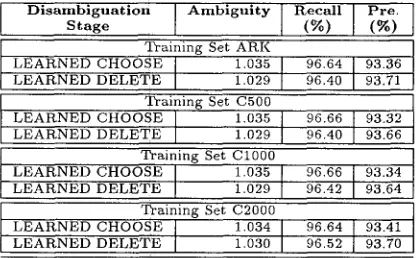
Tables 5 and 6 present the results of further dis- ambiguation of ARK, and C270 using rules learned from training texts C500, C1000, C2000 and ARK. These rules are applied after the last stage in the ta-
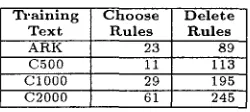
bles above. 13 The number of rules learned are given in Table 4.14
T r a i n i n g C h o o s e D e l e t e
Text Rules Rules
A R K 23 8 9
C 5 0 0 ii 1 1 3
C 1 0 0 0 29 195
C 2 0 0 0 61 245
Table 4: Number of choose and delete rules learned from training texts.
D i s a m b i g u a t i o n A m b i g u i t y R e c a l l P r e .
Stage ( % ) (°Z~)
T r a i n i n g Set A R K
I
I
L E A R N E D D E L E T E 1.027 97.20 94.63
T r a i n i n g Set C5O0
L E A R N E D D E L E T E 1.028 97.30 94.61
T r a i n i n g Set C 1 0 0 0
I
I
L E A R N E D D E L E T E 1.026 97.18 94.68
T r a i n i n g Set C 2 0 0 0
L E A R N E D C H O O S E 1.028 I 97.24 I 94.60
L E A R N E D D E L E T E 1.025 9 7 . 1 3 9 4 . 7 1
Table 5: Average parses, recall and precision for text A R K after applying learned rules.
Table 7 gives some additional statistical results at the sentence level, for each of the test texts. The columns labeled U A / C and A / C give the number and percentage of the sentences that are correctly disambiguated with one parse per token, and with more than one parse for at least one token, respec- tively. The columns labeled 1, 2, 3, and >3 denote the number and percentage of sentences that have 1, 2, 3, and >3 tokens, with all remaining parses incorrect. It can be seen that well 60% of the sen- tences are correctly morphologically disambiguated with very small number of ambiguous parses remain- ing.
13Please note for ARK, in the first two rows, the train- ing and the test texts are the same.
[image:10.612.150.477.74.133.2] [image:10.612.370.495.211.267.2] [image:10.612.328.537.333.463.2] [image:10.612.81.301.462.514.2] [image:10.612.65.300.573.628.2]Text ARK
C270
S e n t e n c e s
T o t a l U A / C [ A / C C ( U A / C + A / C ) I 2 3 >3 494 220 (44.53%) 97 (19.6,I%) 317 (64.17%) 133 (26.92%) 41 (8.30%) 3 (0.61%) 0 (0.00%) 270 116 (42.96%) 50 (18.52%) 166 (61.48%) 55 (20.37%,) 27 (10.00%) 17 (6.30%) 5 (1.85%)
Table 7: Disambiguation results at the sentence level using rules learned from C2000.
D i s a m b i g u a t i o n S t a g e A m b i g u i t y [ R e c a l l (%) P r e . ] ( ~ )
Training Set ARK LEARNED CHOOSE 1.035 LEARNED DELETE 1.029
~ a i n i n g S e t LEARNED CHOOSE LEARNED DELETE
96.64 93.36 96.40 93.71
C500 I
1.035 96.66 93.32 1.029 96.40 93.66 Training Set C1000
LEARNED CHOOSE 1.035 LEARNED DELETE 1.029 Training Set C20O0 LEARNED CHOOSE 1.034 LEARNED DELETE 1.030
9 6 . 6 6 9 3 . 3 4
96.42 9 3 . 6 4 9 6 . 6 4 ] 93.41 96.52 93.70
Table 6: Average parses, recall and precision for text 270 after applying learned rules.
4.1 D i s c u s s i o n o f R e s u l t s
We can make a number of observations from our experience: Hand-crafted rules go a long way in im- proving precision substantially, but in a language like Turkish, one has to code rules that allow no, or only carefully controlled derivations, otherwise lots of things go massively wrong. Thus we have used very tight and conservative rules in hand-crafting. Although the additional impact of choose and rules that are induced by the unsupervised learning is not substantiM, this is to be expected as the stage at which they are used is when all the "easy" work has been done and the more notorious cases re- main. An important class of rules we explicitly have avoided hand crafting are rules for disambiguating around coordinating conjunctions. We have noted that while learning choose rules, the system zeroes in rather quickly on these contexts and comes up with rather successful rules for conjunctions. Simi- larly, the delete rules find some interesting situations which would be virtually impossible to enumerate. Although it is easy to formulate what things can go together in a context, it is rather impossible to for- mulate what things can not go together.
We have also attempted to learn rules directly without applying any hand-crafted rules, but this has resulted in a failure with the learning process getting stuck fairly early. This is mainly due to the lack of sufficient unambiguous contexts to bootstrap the whole disambiguation process.
From analysis of our results we have noted that trying to choose one correct parse for every token is rather ambitious (at least for Turkish). There are a number of reasons for this:
There are genuine ambiguities. The word o is either a personal or a demonstrative pronoun (in addition to being a determiner). One simply can not choose among the first two using any amount of contextual information.
A given word may be interpreted in more than one way but with the same inflectional features, or with features not inconsistent with the syn- tactic context. This usually happens when the root of one of the forms is a proper prefix of the root of the other one. One would need se- rious amounts of semantic, or statistical root word and word form preference information for resolving these. For instance, in
koyun sfirfisfi
koyun sfirfi+sfi
sheep herd+POSS-3SG
(sheep herd)
koy+un siirfi+sfi
bay+GEN herd+POSS-3SG
(?? bay's herd)
both noun phrases are syntactically possible, though the second one is obviously nonsense. It is not clear how one would disambiguate this using just contextual or syntactic information. Another similar example is:
kurmaya yardlm etti
kur+ma+ya yardlm et+ti
construct+INF+DAT help make+PAST
helped construct (something)
kurmay+a yard~m et+ti
milit ary-officer+DAT help make+PAST
helped the military-officer
where again with have a similar problem. It may be possible to resolve this one using sub- categorization constraints on the object of the verb kur assuming it is in the very near preced- ing context, but this m a y be very unlikely as Turkish allows arbitrary adjuncts between the object and the verb.
Turkish allows sentences to consist of a number of sentences separated by commas. Hence locat- ing a verb in the middle of a sentence is rather difficult, as certain verbal forms also have an adjectival reading, and punctuation is not very helpful as commas have many other uses.
The distance between two constituents (of, say, a noun phrase) that have to agree in vari- ous morphosyntactic features m a y be arbitrar-
[image:11.612.61.521.71.111.2] [image:11.612.66.275.154.283.2]ily long and this causes occasional mislnatches, especially if the right nominal constituent has a surface plural marker which causes a 4-way
ambiguity, as in
masalam.
masalarI
I. [[CAT NOUN] [ROOT masa] [AGR 3PL] [POSS NONE] [CASE ACC]]
(tables accusative)
2. [[CAT NOUN] [ROOT masa] [AGR 3PL] [POSS 3SG] [CASE NOM]]
(his tables)
3. [[CAT NOUN] [ROOT masa] [POSS 3PL] [CASE NON]] (their tables)
[AGR 3PL]
4. [[CAT NOUN] [ROOT masa] [AGR 3SG] [POSS 3PL] [CASE NOM]]
(their table)
Choosing a m o n g the last three is rather prob- lematic if the corresponding genitive form to force agreement with is outside the context.
A m o n g these problems, the most crucial is the second one which we believe can be solved to a great extent by using root word preference statistics and word form preference statistics. We are currently working on obtaining such statistics.
5
C o n c l u s i o n s
This paper has presented a rule-based morphologi- cal disambiguation approach which combines a set of hand-crafted constraint rules and learns additional rules to choose and delete parses, from untagged text in an unsupervised manner. We have extended the rule learning and application schemes so t h a t the i m p a c t of various morphological p h e n o m e n a and fea- tures are selectively taken into account. We have ap- plied our approach to the morphological disambigua- tion of Turkish, a free-constituent order language, with agglutinative morphology, exhibiting produc- tive inflectional and derivational processes. We have also incorporated a rather sophisticated unknown form processor which extracts any relevant inflec- tional or derivational markers even if the root word is unknown.
Our results indicate t h a t by combining these hand-crafted, statistical and learned information sources, we can attain a recall of 96 to 97% with a corresponding precision of 93 to 94% and ambigu- ity of 1.02 to 1.03 parses per token, on test texts, however the i m p a c t of the rules t h a t are learned is not significant as hand-crafted rules do most of the easy work at the initial stages.
6
Acknowledgments
We would like to thank Xerox Advanced D o c u m e n t Systems, and Lauri K a r t t u n e n of Xerox Pare and of Rank Xerox Research Centre (Grenoble) for pro- viding us with the two-level transducer development software on which the morphological and unknown word recognizer were implemented. This research has been supported in part by a N A T O Science for Stability G r a n t T U - L A N G U A G E .
R e f e r e n c e s
Eric Brill. 1992. A simple-rule based part-of-speech
tagger. In
Proceedings of the Third Conference
on Applied Natural Language Processing,
Trento,Italy.
Eric Brill. 1994. Some advances in rule-based p a r t of
speech tagging. In
Proceedings of the Twelfth Na-
tional Conference on Articial Intelligence (AAAI-
9~),
Seattle, Washinton.Eric Brill. 1995a. T r a n s f o r m a t i o n - b a s e d error- driven learning and natural language processing:
A case study in part-of-speech tagging.
Computa-
tional Linguistics,
21(4):543-566, D e c e m b e r .Eric Brill. 1995b. Unsupervised learning of dis-
ambiguation rules for part of speech tagging. In
Proceedings of the Third Workshop on Very Large
Corpora,
Cambridge, MA, June.Kenneth W. Church. 1988. A stochastic p a r t s pro- g r a m and a noun phrase parser for unrestricted
text. In
Proceedings of the Second Conference
on Applied Natural Language Processing,
Austin,Texas.
Doug Cutting, Julian Kupiec, J a n Pedersen, and Penelope Sibun. 1992. A practical part-of-speech
tagger. In
Proceedings of the Third Conference
on Applied Natural Language Processing,
Trento,Italy.
Steven J. DeRose. 1988. G r a m m a t i c a l category dis-
a m b i g u a t i o n by statistical optimization.
Compu-
tational Linguistics,
14(1):31-39.Zelal GiingSrdii and K e m a l Oflazer. 1995. Pars-
ing Turkish using the Lexical-Functional G r a m -
m a r formalism.
Machine Translation,
11(4):293-319.
Jorge Hankamer. 1989. Morphological parsing and
the lexicon. In W. Marslen-Wilson, editor,
Lexical
Representation and Process.
M I T Press.Fred Karlsson, Atro Voutilainen, J u h a HeikkilS,
and Arto Anttila. 1995.
Constraint Grammar-A
Language-Independent System for Parsing Unre-
stricted Text.
Mouton de Gruyter.Lauri Karttunen. 1993. Finite-state lexicon com-