1256
Tensorized Self-Attention:
Efficiently Modeling Pairwise and Global Dependencies Together
Tao Shen1, Tianyi Zhou2, Guodong Long1, Jing Jiang1, Chengqi Zhang1
1 Centre for Artificial Intelligence, School of Software, University of Technology Sydney 2Paul G. Allen School of Computer Science & Engineering, University of Washington
[email protected],[email protected],
{guodong.long,jing.jiang,chengqi.zhang}@uts.edu.au
Abstract
Neural networks equipped with self-attention have parallelizable computation, light-weight structure, and the ability to capture both long-range and local dependencies. Further, their expressive power and performance can be boosted by using a vector to measure pair-wise dependency, but this requires to expand the alignment matrix to a tensor, which results in memory and computation bottlenecks. In this paper, we propose a novel attention mech-anism called “Multi-mask Tensorized Self-Attention” (MTSA), which is as fast and as memory-efficient as a CNN, but significantly outperforms previous CNN-/RNN-/attention-based models. MTSA 1) captures both pair-wise (token2token) and global (source2token) dependencies by a novel compatibility func-tion composed of dot-product and additive attentions, 2) uses a tensor to represent the feature-wise alignment scores for better ex-pressive power but only requires paralleliz-able matrix multiplications, and 3) combines multi-head with multi-dimensional attentions, and applies a distinct positional mask to each head (subspace), so the memory and compu-tation can be distributed to multiple heads, each with sequential information encoded in-dependently. The experiments show that a CNN/RNN-free model based on MTSA achieves state-of-the-art or competitive perfor-mance on nine NLP benchmarks with com-pelling memory- and time-efficiency.
1 Introduction
Recurrent neural network (RNN) and convolu-tional neural network (CNN) have been broadly used as context fusion modules for natural language processing (NLP) tasks. Recently, RNN/CNN in conjunction with an attention mech-anism has been proven to be effective for con-textual feature modeling in a wide range of NLP tasks, including sentiment classification (Li
et al.,2018), machine translation (Bahdanau et al.,
2015), reading comprehension (Seo et al., 2017;
Yu et al.,2018), etc. More recently, self-attention mechanisms have been developed for context fu-sion and syntactic dependency modeling with the advantage of fewer parameters, more paralleliz-able computation, and better empirical perfor-mance (Hu et al.,2017;Vaswani et al.,2017;Shen et al.,2018a). In addition, neural networks based solely on self-attention mechanisms have achieved state-of-the-art quality on many NLP tasks, e.g., machine translation (Vaswani et al., 2017), sen-tence embedding (Shen et al.,2018a) and semantic role labeling (Tan et al.,2017).
Self-attention mechanisms can be categorized into two classes according to the type of depen-dency each aims to model. The first category is to-ken2tokenself-attention (Hu et al.,2017;Vaswani et al.,2017;Shen et al.,2018a) that captures syn-tactic dependency between every two tokens in a sequence. An efficient dot-product compatibil-ity function is usually deployed to measure this pairwise dependency (Vaswani et al., 2017). In contrast, additive compatibility function captures the dependency by multi-layer perceptron (MLP), and can usually achieve better performance (Britz et al., 2017). Its expressive power can be fur-ther improved if expanded to multiple dimensions (Shen et al.,2018a). This multi-dim self-attention empirically surpasses dot-product one, but suffers from expensive computation and memory, which grow linearly with the number of features and quadratically with the sequence length. Hence, it is not scalable to long sequences in practice.
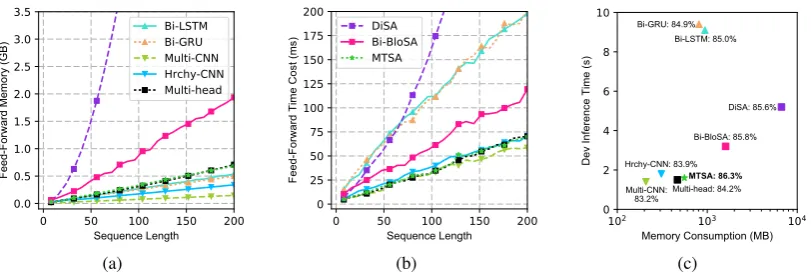
(a) (b) (c)
Figure 1: (a) Memory consumption and (b) time costvs. sequence length on synthetic data; (c) memory load (x-axis), inference time on dev set (y-axis) and test accuracy on the SNLI dataset.
with the sequence length. Hence, it is empiri-cally efficient in terms of memory and computa-tion even if expanded to multiple dimensions, i.e., using a vector of feature-wise scores instead of a scalar for the global dependency. But, it is hard to reach state-of-the-art performance on NLP tasks due to the lack of pairwise and local dependencies.
In this paper, we propose a novel atten-tion mechanism called multi-mask tensorized self-attention (MTSA), for context fusion. In MTSA, 1) the pairwise dependency is captured by an efficient dot-product based token2token self-attention, while the global dependency is modeled by a feature-wise multi-dim source2token self-attention, so they can work jointly to encode rich contextual features; 2) self-attention alignment scores are tensorized for more expressive power in that each pair of tokens has one score for each fea-ture, but no tensor computation is required other than simple and efficient matrix multiplications when implemented; 3) the tensors above are com-puted in multiple subspaces (i.e., in a multi-head fashion) rather than in the original input space, so the required memory and computation can be dis-tributed to multiple subspaces; and 4) a distinct positional mask is applied to each head in order to encode rich structural information such as the sequential order and relative position of tokens.
In the experiments, we build CNN/RNN-free neural networks based on MTSA for sentence em-bedding and sequence tagging tasks, including natural language inference, semantic role label-ing, sentiment analysis, question-type classifica-tion, machine translaclassifica-tion, etc. The results demon-strate that MTSA achieves state-of-the-art or com-petitive performance on nine benchmark datasets. To summarize the comparison of MTSA with
re-cently popular models, we show the memory con-sumption and time cost vs. sequence length re-spectively in Figure1(a)and1(b)on synthetic data (batch size of 64 and feature channels of 300). On the SNLI (Bowman et al.,2015), a public dataset for language inference, as shown in Figure 1(c), MTSA achieves the best result but is as fast and as memory-efficient as the CNNs (all baselines and the benchmark are detailed in Section4).
Notations: 1) lowercase denotes a vector; 2) bold lowercase denotes a sequence of vectors (stored as a matrix); and 3) uppercase denotes a matrix or tensor.
2 Background
2.1 Attention Mechanism
Given an input sequence of token embeddings or memory slots x = [x1, . . . , xn] ∈ Rde×n, and a vector representation of a query q ∈ Rdq, at-tention mechanism (Bahdanau et al., 2015; Lu-ong et al.,2015) computes an alignment score be-tween each tokenxiandqby a compatibility func-tion f(xi, q), which aims to measure the depen-dency/relevance betweenxiandq, or the attention ofqtoxi, w.r.t. a given task. The scores are trans-formed into probabilities through asoftmax func-tion. These probabilities are then used as weights to sum all the tokens and generate a contextual em-bedding forq, i.e.,
p(z|x, q) = softmax(a), a= [f(xi, q)]ni=1,
s= n
X
i=1
p(z=i|x, q)·xi=Ei∼p(z|x,q)[xi], (1)
[image:2.595.100.506.64.204.2]attention probabilities, which is derived from ap-plyingsoftmaxfunction toa. And,s∈Rdeis the output vector for the queryq.
There are two major types of compatibility functions, leading to the two most frequently used attention mechanisms. The first one is dot-product or multiplicative compatibility function (Eq.(2)), which composes dot-product attention mecha-nism (Luong et al.,2015) using cosine similarity to model the dependencies. The other one is ad-ditive or multi-layer perceptron (MLP) compati-bility function (Eq.(3)) that results inadditive at-tentionmechanism (Bahdanau et al.,2015) using MLP to model the dependencies.
f(xi, q) =hW(d1)xi, W(d2)qi, (2)
f(xi, q) =wTσa(W(a)[xi;q] +b(a)) +b, (3)
whereW(d1) ∈Rdi×de, W(d2) ∈
Rdi×dq, W(a)∈ Rda×(de+dq), w ∈ Rda are learnable parameters,
h·,·idenotes inner-product. Empirically, networks with additive attention usually outperform those with dot-product attention, but require more com-putation time and memory (Britz et al.,2017).
Multi-dim attention mechanism (Shen et al.,
2018a) expands the alignment score in previous attention mechanisms to a vector for feature-wise scores, each computed on a feature dimension. It has greater capacity to model complex dependen-cies, and can handle context variation and poly-semy problems harassing many NLP tasks. In particular, it replaces vector wT ∈ R1×da in
additive compatibility function (Eq.(3)) with a matrix W ∈ Rde×da, and thus produces d
e
scores to describe the attention ofqtoxi.
2.2 Self-Attention Mechanism
Self-attention mechanism is a special case of at-tention mechanisms, where the query q stems from the input sequence itself. Self-attention mechanisms can be classified into token2token or source2token self-attention mechanism according to the type of dependency each aims to model.
A) Token2token self-attention mechanism (Vaswani et al., 2017; Shen et al., 2018a) aims at producing a context-aware representation for each token in light of its syntactic dependen-cies on other tokens from the same sequence. Two examples of token2token self-attention are 1) scaled dot-product self-attention which com-poses the multi-head self-attention (Vaswani et al.,
2017), and 2) masked self-attention used in direc-tional self-attention (Shen et al.,2018a).
A.1)Scaled dot-product attentionmechanism (Vaswani et al., 2017) in general form has three arguments: query tokens q ∈ Rdi×m, key to-kens k ∈ Rdi×n and value tokens v ∈
Rdh×n associated with the key tokens. It uses a scaled dot-product function to model the relationship be-tween each query and key, and finally outputs a sequences= [s1, . . . , sm]∈Rdh×msuch that
s= sdpAttn(q,k,v),vsoftmax(q Tk
p
dq )T (4)
A special case of this mechanism is that the three input arguments are derived from the same source, i.e.,q/k/v = fq/k/v(x), which can be referred to as a token2token self-attention, namely scaled dot-product self-attention. As formulti-head atten-tion mechanism, the input is projected into mul-tiple subspaces, then parameter-untied scaled dot-product attention is applied to the embeddings in each subspace. The results for multiple subspaces are concatenated to form the final outputs, i.e.,
s=W(o)[H1;. . .;Hh], (5)
whereHc= sdpAttn(Wcqq, Wckk, Wcvv).
A.2) Masked self-attention mechanism (Shen et al., 2018a) uses multi-dim compatibility func-tion to model the dependency between every two tokens in a sequence, and uses positional mask to encode sequential information. It overcomes in-herent problem appearing in self-attention com-pared to RNNs on the lack of sequential informa-tion. Its compatibility function is defined as
f(xi, xj) =c·tanh{(W(m)[xi;xj]+b(m))/c}+Mi,j (6) where c is a constant scalar, W(m) ∈ Rde×2de is learnable weight matrix, andM is a positional mask with each entry Mi,j ∈ {−∞,0}. When
Mi,j = −∞, applying softmax function to the alignment scores results in a zero attention prob-ability, which cuts off the attention of xj to xi. Hence, masked self-attention with an asymmetric mask, whereMij 6= Mji, can encode sequential or other structural information (Shen et al.,2018a;
Im and Cho, 2017). To this end, two positional masks have been proposed to encode the forward and backward order information respectively, i.e.,
Mi,jf w=
0, i < j
−∞,otherwise M bw i,j=
0, i > j
Furthermore, directional self-attention (DiSA) (Shen et al.,2018a) concatenates the features pro-duced by masked self-attention mechanisms with the forward and backward positional masks (i.e.,
Mf w, Mbw), leading to context-ware representa-tions with bi-directional information encoded.
B) Source2token self-attention mechanism (Liu et al., 2016; Lin et al., 2017; Shen et al.,
2018a) is designed for sentence embedding or se-quence compression, which is based on the im-portance of each tokenxi to the entire source se-quence x for a specific task. Specifically, it re-moves the query q from the compatibility func-tionf(xi, q)when computing the alignment score. For example, the compatibility function of addi-tive source2token self-attention mechanism is to simply removeqfrom Eq.(3).
3 Proposed Models
In this section, we firstly elaborate on tensorized self-attention (TSA) in Section 3.1, which cap-tures both pairwise and global dependencies by combining the two types of self-attention mech-anisms introduced in Section 2.2. Then, we ex-tend TSA to multi-mask tensorized self-attention (MTSA) in Section3.2by applying different posi-tional masks to TSA in multiple subspaces (multi-head fashion). Lastly, in Section3.3, we present an efficient computation scheme for MTSA with-out any high-rank tensor computation involved even if tensorized alignment scores are used.
[image:4.595.73.292.530.636.2]3.1 Tensorized Self-Attention (TSA)
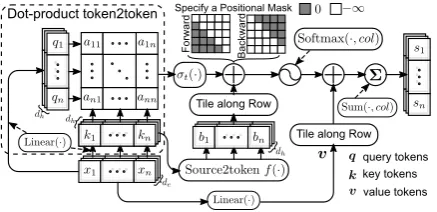
Figure 2: Tensorized self-attention (TSA) Mechanism.
Tensorized self-attention (TSA), whose struc-ture is illustrated in Figure 2, is a neural mech-anism that can be trained to model both pair-wise and global dependencies, while any previ-ous self-attention mechanism only focuses on one type of dependencies. TSA models both types by combining the aforementioned token2token
and source2token self-attention mechanisms. This generates ann×n×dhtensor containing the align-ment scores between every two tokens on each feature dimension. These scores are then nor-malized and transformed into probability weights, which are used to sum all dependent tokens and then generate the contextual embedding for each input token. We will demonstrate later in Section
3.3that only matrix rather than tensor operation is required when executing the procedures above.
To facilitate the elaboration of proposed mod-els and keep the consistent notation with prior at-tention mechanisms, TSA first projects the input embeddings x into three spaces to represent the query, key and value tokens, respectively.
q=W(t1)x, k=W(t2)x, and v=W(t3)x, (7)
where W(t1), W(t2) ∈
Rdi×de and W(t3) ∈ Rdh×de are learnable weights for projections.
TSA then integrates two kinds of compatibil-ity functions from two self-attention mechanisms respectively. Firstly, the scaled dot-product self-attention is used to capture dependency between every two tokens. Dot-product operations are fast, and sufficient to model thepairwise dependency
in most tasks. Its compatibility function is
ft(ki, qj) =hki, qji/
p
di, ∀i, j ∈[n], (8)
where h·,·i is inner-product operation. Then, a multi-dim source2token self-attention mechanism is used to estimate the contribution of each to-ken to the given task on each feature dimension. It aims at capturing the importance of each to-ken to the entire input sequence w.r.t. the task, i.e., the global dependency. The multi-dim ex-tension only linearly increases the memory and computation of source2token self-attention by a multiplicative factor dh, but is essentially helpful to improve expressive capability in line with prior works (Shen et al.,2018a). Its compatibility func-tion is
fs(ki) =W(s2)σm(W(s1)ki+b(s1)) +b(s2), (9)
where ∀i ∈ [n], W(s1) ∈ Rda×di, W(s2) ∈
Rdh×da are the learnable weights, and σm(·) is an activation function. The compatibility func-tion used in TSA broadcasts the scalar alignment scoreft(k
fs(ki)∈Rdh computed by the source2token self-attention. In addition, the positional masks from masked self-attention (in Section2.2) are also in-tegrated to encode sequential and structural infor-mation. These yield following compatibility func-tion of TSA.
ftsa(ki, qj)
l= (10)
σt ft(ki, qj)
+σs([fs(ki)]l) +Mi,j,
where∀i, j ∈ [n], ∀l ∈ [dh]. σt(·) andσt(·)are two scale functions. They control the way to com-bine two kinds of scores and their weights.
For each query token qj, a softmax function is applied to the alignment scores[ftsa(ki, qj)]ni=1
on each feature dimension, resulting in a categori-cal distribution over all value tokens[vi]ni=1based on corresponding key tokens[ki]ni=1. The
proba-bility of tokenqjattending tovion thelthfeature dimension (i.e.,zl=i) is
p(zl=i|k,qj),[pji]l ,
e[ftsa(ki,qj)]l
Pn
g=1e[f
tsa(kg,qj)] l
,(11)
where, ∀i, j ∈ [n], ∀l ∈ [dh]. TSA outputs a contextual embedding for each input token on ev-ery feature dimension as the weighted sum of all the value token embeddings on that dimension, where the weights are provided by the probabili-ties in Eq.(11). It is the expectation of sampling a value token embeddings on each feature dimen-sion according to the feature-wise probability dis-tribution, i.e.,
s,[sj]nj=1, where (12)
sj ,
h
Ei∼p(zl|k,qj)([vi]l)
idh
l=1= Xn
i=1p
j i ·vi
3.2 Multi-Mask Tensorized Self-Attention (MTSA) Mechanism
Rather than computing attention in the original input space, multi-head attention (Vaswani et al.,
2017) projects the input sequence to multiple sub-spaces, applies attention to the projected embed-ding in each subspace, and concatenates their outputs at last. The computations associated with multiple heads can be completed in paral-lel. By using adequate heads, each with a low-dimensional subspace (i.e., the representation di-mension for each head is updated bydh ←dh/h wherehis the number of head), it reduces param-eters and memory/computation cost and increases
diversity of the attention. In addition, to encode different kinds of sequential or structural informa-tion, multiple different positional masks (e.g., for-ward, backward and multi-length window) can be further applied to the multiple heads.
The memory-/time-efficiency and expressive power of TSA can be improved by using the com-bination of the multi-head and multi-mask tech-niques introduced above. By writing TSA mech-anism as a function TSA(x, M) with input se-quence x ∈ Rde×n and a positional mask M ∈ Rn×n, and the output given by Eq.(12), multi-mask tensorized self-attention (MTSA) produces
s=W(o)[H1;. . .;Hh], (13) whereHc= TSAc(x, Mc),
where W(o) ∈ Rh·dh×h·dh, h is the num-ber of heads, TSAc denotes the cth parameter-independent TSA block that produces a dh-dim representation in thecthsubspace,Mcrepresents the positional mask applied to attention in thecth
subspace, [·;. . .;·] denotes a vertical concatena-tion operaconcatena-tion, and s ∈ Rh·dh×n is the output of MTSA. In our experiments, we apply forward mask to half of the heads and apply backward mask to the other half to encode bi-directional or-der information of the input sequence.
3.3 Computation-Optimized MTSA
Algorithm 1Multi-Mask Tensorized Self-Attention
Input:input sequencex∈Rde×n, head numberh,
subspace dimensiondh, positional masks{Mc}h c=1, and
weights/biases:
{Wc(t1), W
(t2)
c ∈Rdi×de, Wc(t3)∈Rdh×de, W(s1)
c ∈
Rda×di, Wc(s2)∈Rdh×da,andb(cs1), b(cs2)}hc=1, andW(o) Output:contextual embeddingss= [s1,. . ., sn]∈Rh·dh×n
1: for allc= 1, . . . , hdo .Computingh-head in parallel 2: qc, kc,vc←Wc(t1)x, Wc(t2)x, Wc(t3)x
3: Rc←(k
c
)Tqc
√
dh . n×ntoken2token attention scores 4: Sc←Wc(s2)σm(W
(s1)
c kc+b
(s1)
c )+b
(s2)
c
. dh×nscores of source2token attention 5: ER
c ←exp(σt(Rc))·exp(Mc)
.Applying maskMcto token2token weights 6: EcS←exp(σs(Sc)); EcX←vc·EcS
.Applying source2token weightsESc tovc 7: Hc←EcXEcR/EcSEcR .Applying masked
token2token weightsER
c and normalizing 8: end for
9: Returns←W(o)[H
1;. . .;Hh]
.Vertical concatenation of the outputs from allhheads
scores and probabilities as n×n× dh tensors. In accordance with multi-dim self-attention (Shen et al.,2018a), this makes TSA more expressively powerful and improves the final performance for sequence modeling, but terribly leads to memory explosion and computational bottleneck on long sequences with large n and dh. Fortunately, in MTSA, it is possible to significantly reduce the de-mand on computations to matrix-only operations by exploring the computational structure.
A memory-optimized and highly-parallelizable computation scheme for MTSA is given in Al-gorithm 1. For each head, the score matrices of token2token and source2token are computed in steps3and4respectively. Then, we combine to-ken2token scores with the positional mask to form a new mask in step 5, and compute the dh ×n output embedding with the weighs from the multi-dim source2token self-attention in step6. Finally, in step7, we apply the new mask from step 5 to the weighted embedding from step6and complete the normalization. This procedure generates the exactly same output as Eq.(13)but no any tensor operation is incurred.
4 Experiments
We compare MTSA with commonly-used context fusion baselines on several NLP tasks1. When ad-dressing a sentence embedding problem, a multi-dim source2token self-attention is applied on the top of context fusion module to produce the se-quence embedding. Codes are implemented in Python with Tensorflow and executed on a single NVIDIA GTX 1080Ti graphics card. In addition, data for both time cost and memory consumption are collected under Tensorflow-1.7 with CUDA9 and cuDNN7.
The context fusion baselines include 1) Bi-LSTM(Graves et al.,2013): 600D bi-directional LSTM consisting of 300D forward plus 300D backward LSTMs, 2) Bi-GRU (Chung et al.,
2014): 600D bi-directional GRU,3) Multi-CNN
(Kim, 2014): three CNNs with 200D kernels to model 3/4/5-grams respectively, 4) Hrchy-CNN
(Gehring et al.,2017): 3-layer 300D stacked CNN with kernel size 5, gated linear units (Dauphin et al., 2016) and residual connections (He et al.,
2016), 5) Multi-head (Vaswani et al., 2017): 600D multi-head self-attention with 8 heads
(75-1Codes for Experiments are released at https://
github.com/taoshen58/mtsa.
dim subspace per head) and positional embed-ding used by Vaswani et al. (2017), 6) DiSA
(Shen et al., 2018a): 600D directional self-attention mechanism consisting of 300D forward and 300D backward masked self-attentions, and
7) Bi-BloSA (Shen et al., 2018c): 600D bi-directional block self-attention with intra-/inter-block self-attention, aiming to reduce the time and space complexities of multi-dim self-attention by using hierarchical structure.
4.1 Natural Language Inference
Natural language inference (NLI) aims at specu-lating on the relationship between a premise and a corresponding hypothesis, where the relationship could beentailment,neutral orcontradiction. In experiments, we first compare MTSA with other baselines on the Stanford Natural Language Infer-ence (Bowman et al.,2015) (SNLI) dataset.
Following the method of applying sentence-encoding model to NLI given by Bowman et al. (2016), two parameter-tied sentence-encoding models are used to generate embeddings for premise and hypothesis, resulting insp andsh
respectively. The concatenation ofsp,sh,sp−sh
andspshrepresenting the relationship is passed into a 3-way neural classifier for final prediction.
The experimental results of the models from the official leaderboard, baselines, and MTSA are shown in Table 1. MTSA achieves state-of-the-art performance with less time and memory cost. Compared to the methods from the leaderboard, MTSA outperforms RNN-based encoders (e.g., Residual stacked enc.), RNN+attention encoders (e.g., Deep Gated Attn.) and even parsing trees based encoders (e.g., Gumbel TreeLSTM enc.) by a large margin. Compared to the two competitive self-attention networks with complicated and ex-pensive training computations, MTSA trained in end-to-end manner achieves the same state-of-the-art performance by using much fewer parameters and less computational time.
self-Model |θ| Time/Epoch Inf. Time Memory Train Acc. Test Acc.
300D SPINN-PI encoders (Bowman et al.,2016) 3.7m 89.2 83.2
600D Bi-LSTM encoders (Liu et al.,2016) 2.0m 86.4 83.3
600D Bi-LSTM enc.+intra-attn (Liu et al.,2016) 2.8m 84.5 84.2 600D Deep Gated Attn. (Chen et al.,2017) 11.6m 90.5 85.5 600D Gumbel TreeLSTM enc. (Choi et al.,2018) 10.0m 93.1 86.0 600D Residual stacked enc. (Nie and Bansal,2017) 29.0m 91.0 86.0 300D Reinforced SAN (Shen et al.,2018b) 3.1m 404s 92.6 86.3 Distance-based SAN (Im and Cho,2017) 4.7m 416s 89.6 86.3
Bi-LSTM (Graves et al.,2013) 2.9m 854s 9.1s 942MB 90.4 85.0 Bi-GRU (Chung et al.,2014) 2.5m 850s 9.4s 810MB 91.9 84.9
Multi-CNN (Kim,2014) 1.4m 137s 1.4s 208MB 89.3 83.2
Hrchy-CNN (Gehring et al.,2017) 3.4m 195s 1.8s 309MB 91.3 83.9 Multi-head (Vaswani et al.,2017) 2.0m 179s 1.5s 466MB 89.6 84.2 DiSA (Shen et al.,2018a) 2.3m 390s 5.2s 6682MB 91.1 85.6 Bi-BloSA (Shen et al.,2018c) 4.1m 303s 3.2s 1600MB 91.6 85.8
[image:7.595.90.518.65.254.2]MTSA 2.9m 180s 1.6s 558MB 91.8 86.3
Table 1: Experimental results for different methods with comparative parameter number on SNLI.|θ|: the number of parameters (excluding word embedding part); Time/Epoch: averaged training time per epoch with batch size 128; Inf. Time: averaged dev inference time with batch size 128; Memory: memory load on synthetic data of sequence length 64 and batch size 64 with back-propagation considered; Train Acc. and Test Acc.: the accuracies on training/test sets. All state-of-the-art methods in leaderboard are listed in Table1&2up to Sep. 2018.
Model SNLI MultiNLI
Dev Test Match Mismatch
BiLSTM w/ Shortcuta – 86.0 74.6 73.6 BiLSTM w/ Gen-Poolingb – 86.6 73.8 74.0
HBMPc – 86.6 73.7 73.0
Transfer + Multi-Head 86.9 86.6 76.3 75.7 Transfer + MTSA 87.2 86.9 76.7 76.4
Table 2: Experimental results on sentence-encoding
based SNLI and MultiNLI benchmark tasks. “ Trans-fer” denotes pretrained language model on large cor-pus for transfer learning, which detailed by Radford et al. (2018). References: a(Nie and Bansal, 2017), b(Chen et al.,2018),c(Talman et al.,2018).
attention (DiSA and Bi-BloSA), MTSA uses much less memory and time but even produces much better prediction quality.
In addition, to further improve the state-of-the-art performance, in contrast to training from scratch, a language model built on the Transformer (Vaswani et al., 2017) unsupervisedly pretrained on large English corpus (detailed by Radford et al.(2018)) is transfered for the baseline and pro-posed models for sentence-encoding based NLI tasks. As shown in Table2, MTSA integrated with pretrained language model can achieve new state-of-the-art accuracy on both SNLI and Multi-Genre Natural Language Inference (MultiNLI) (Williams et al., 2017)2 among all sentence-encoding
mod-2All test results are Evaluated on Kaggle official
Model |θ| Inf. Time Test Acc.
MTSA 2.9m 1.6 86.3
MTSA w/o fw&bw masks 2.9m 1.6 85.3 (-1.0) MTSA w/o token2token 2.5m 1.5 85.8 (-0.5) MTSA w/o source2token 2.5m 1.4 84.9 (-1.4) MTSA w/o proposed modules 1.8m 1.1 84.3 (-2.0)
Table 3: An ablation study of MTSA on SNLI.
els.
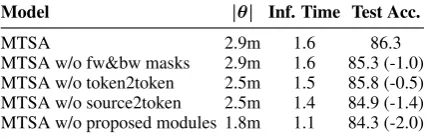
An ablation study of MTSA is shown in Table3
to verify the capability of its each part in context fusion. The results show that token2token ing pairwise dependency), source2token (model-ing global dependency), and positional masks (en-coding sequential information) all contribute im-portant information to sequence modeling, and the contributions are complementary.
4.2 Semantic Role Labeling
To verify the capability of MTSA in generating context-aware representation of each token, we compare it with baselines on semantic role la-beling (SRL) task, which aims to tag each token from an input sequence with a label for its seman-tic role. Parseman-ticularly, given a sentence, the goal of SRL is to identify the arguments of each tar-get verb into semantic roles, which can benefit many downstream NLP tasks. SRL has two steps:
[image:7.595.310.524.347.416.2]Models Training Development WSJ Test Brown Test
Time P R F1 Comp. P R F1 Comp. P R F1 Comp.
T¨ackstr¨om et al.(2015) 81.2 76.2 78.6 54.4 82.3 77.6 79.9 56.0 74.3 68.6 71.3 39.8 Zhou and Xu(2015) 79.7 79.4 79.6 - 82.9 82.8 82.8 - 70.7 68.2 69.4 -He et al.(2017) 81.6 81.6 81.6 62.3 83.1 83.0 83.1 64.3 72.8 71.4 72.1 44.8 He et al.(2018) - - - 83.9 - - - 73.7 -Strubell et al.(2018) - - - - 84.7 84.2 84.5 - 73.9 72.4 73.1
-Bi-LSTM (Graves et al.,2013) 72h 81.8 83.4 82.6 63.3 83.0 84.0 83.5 64.6 72.3 72.8 72.5 46.8 Multi-CNN (Kim,2014) 19h 75.2 79.6 77.3 53.6 77.3 80.9 79.0 55.5 68.3 70.3 69.3 41.9 Multi-head∗(Tan et al.,2017) 20h 82.6 83.6 83.1 65.2 84.5 85.2 84.8 66.4 73.5 74.6 74.1 48.4
MTSA 20h 82.8 84.4 83.6 65.4 84.2 85.3 84.8 67.0 74.3 74.6 74.5 49.1
Table 4: Experimental Results of SRL for single models on CoNLL-05 with gold predicates.∗Multi-head baseline is equivalent to the model inTan et al.(2017). For fair comparisons, first, we use the hyper-parameters provided by Tan et al. (2017) instead of tuning them; second, all listed models are independent of external linguistics information, e.g., PoS, dependency parsing.
Model CR MPQA SUBJ TREC SST-5
cBoWa 79.9 86.4 91.3 87.3 / Skip-thoughtb 81.3 87.5 93.6 92.2 /
DCNNc / / / 93.0 48.5
SRUd 84.8(1.3)89.7(1.1)93.4(0.8)93.9(0.6) / CNNsd 82.2(.2) 88.8(1.2)92.9(0.7)93.2(0.5) /
Bi-LSTM 84.6(1.6)90.2(0.9)94.7(0.7)94.4(0.3)49.9(0.8) Multi-head 82.6(1.9)89.8(1.2)94.0(0.8)93.4(0.4)48.2(0.6) DiSA 84.8(2.0)90.1(0.4)94.2(0.6)94.2(0.1)51.0(0.7) Bi-BloSA 84.8(0.9)90.4(0.8)94.5(0.5)94.8(0.2)50.6(0.5)
MTSA 84.9(2.4)90.5(0.6)94.5(0.6)95.3(0.3)51.3(0.7)
Table 5: Experimental results on five sentence clas-sification benchmarks. References: a(Mikolov et al., 2013), b(Kiros et al., 2015), c(Kalchbrenner et al., 2014),d(Lei and Zhang,2017).
1) assigning either a semantic argument or non-argument to a given predicate and 2) labeling a specific semantic role for the identified argument. We follow the experimental setup in Tan et al.(2017), where the SRL task is treated as a BIO tagging problem. Tan et al.(2017) designed a deep attentive neural net by stacking multi-head self-attention, named as deepatt, to perform con-text fusion, whose output is then passed to a neu-ral classifier to make the final decision. The re-sults achieved by previous methods, baselines, and MTSA are shown in Table4, which demonstrates that MTSA achieves new state-of-the-art perfor-mance on the CoNLL-05 dataset by costing sim-ilar training time as CNN and multi-head self-attention baselines.
4.3 Sentence Classifications
The goal of sentence classification is to predict the correct label for a sentence in various scenarios.
We evaluate the models on five sentence classifi-cation benchmarks for different NLP tasks, which include1) CR(Hu and Liu,2004): customer re-views of various products to predict whether the review is positive or negative,2) MPQA (Wiebe et al., 2005): an opinion polarity detection sub-task of the MPQA dataset, 3) SUBJ (Pang and Lee, 2004): subjectivity dataset where a label in-dicates whether a sentence is subjective or objec-tive,4) TREC(Li and Roth,2002): question-type classification dataset which classifies the question sentences into six classes,5) SST-5(Socher et al.,
2013): the Stanford Sentiment Treebank dataset with five sentiment labels. The reported accuracies for CR, MPQA, and SUBJ are the mean of 10-fold cross validation. The accuracies for TREC are the mean of five runs on the dev set, and the accuracies for SST-5 are the mean of five runs on the test set. All standard deviations are shown in parentheses.
The prediction accuracies achieved on these five benchmarks are shown in Table 5. MTSA achieves the best prediction accuracy on CR, MPQA, TREC and SST-5 benchmarks with better time efficiency and a lower memory load.
4.4 Machine Translation
Model Multi-head (Transformer) MTSA
Param# 61.38M 61.58M
Setup1 23.64 24.09
p-value:0.001 (6 runs)
Setup2 26.98 27.21
p-value:0.080 (3 runs)
Table 6: Results for the Transformer with either multi-head self-attention or proposed MTSA. The reported BLEU values for Setup 1 and 2 are the mean of 5 and 3 runs respectively.
For Setup1, we use default hyperparameter set oftransformer base single gpu provided by offi-cial implementation with1×P100 , batch size of 2048 and training step of 250K, and report BLEU value for the last checkpoint. For Setup2, we use the hyperparameter set of transformer base with the modification of 1) using 4× instead of 8×P100, 2) increasing batch size from 4096 to 6144 per GPU, and 3) using training step of 133K. As shown in Table6, with small p-value for both training setup 1 and 2, the encoder with MTSA significantly outperforms that with multi-head self-attention, which demonstrates that multi-dim based MTSA modeling both pairwise and global dependencies is more expressive than dot-product based multi-head self-attention. Although the re-sults do not improve state-of-the-art BLEU value of machine translation task, the purpose of this experiment to verify the effectiveness of MTSA in contrast to dot-product based multi-head self-attention is accomplished.
5 Conclusion
In conclusion, MTSA is highly parallelizable with more expressive power since it efficiently cap-tures the pairwise dependency at token level, but delicately models the global dependency at fea-ture level, and distributes computations to mul-tiple heads, each equipped with a distinct posi-tional mask. These lead to a sweet spot of the trade-off between performance and efficiency, and make MTSA as memory-efficient as CNN and scalable to long sequences but outperform pre-vious (and even multi-dim) self-attention mecha-nisms in terms of prediction quality. The exper-iments conducted on nine NLP tasks verify that the MTSA can reach state-of-the-art performance with appealing efficiency.
Acknowledgments
This research was funded by the Australian Gov-ernment through the Australian Research Coun-cil (ARC) under grants 1) LP160100630 partner-ship with Australia Government Department of Health and 2) LP150100671 partnership with Aus-tralia Research Alliance for Children and Youth (ARACY) and Global Business College Australia (GBCA). We also acknowledge the support of NVIDIA Corporation and MakeMagic Australia with the donation of GPUs.
References
Dzmitry Bahdanau, Kyunghyun Cho, and Yoshua Ben-gio. 2015. Neural machine translation by jointly learning to align and translate. InICLR.
Samuel R Bowman, Gabor Angeli, Christopher Potts, and Christopher D Manning. 2015. A large anno-tated corpus for learning natural language inference. InEMNLP.
Samuel R Bowman, Jon Gauthier, Abhinav Ras-togi, Raghav Gupta, Christopher D Manning, and Christopher Potts. 2016. A fast unified model for parsing and sentence understanding. InACL.
Denny Britz, Anna Goldie, Thang Luong, and Quoc Le. 2017. Massive exploration of neural ma-chine translation architectures. arXiv preprint arXiv:1703.03906.
Qian Chen, Zhen-Hua Ling, and Xiaodan Zhu. 2018. Enhancing sentence embedding with generalized pooling. arXiv preprint arXiv:1806.09828.
Qian Chen, Xiaodan Zhu, Zhen-Hua Ling, Si Wei, Hui Jiang, and Diana Inkpen. 2017. Recurrent neural network-based sentence encoder with gated atten-tion for natural language inference. In RepEval@ EMNLP.
Jihun Choi, Kang Min Yoo, and Sang goo Lee. 2018. Learning to compose task-specific tree structures. In
AAAI.
Junyoung Chung, Caglar Gulcehre, KyungHyun Cho, and Yoshua Bengio. 2014. Empirical evaluation of gated recurrent neural networks on sequence model-ing. InNIPS.
Yann N Dauphin, Angela Fan, Michael Auli, and David Grangier. 2016. Language modeling with gated convolutional networks. arXiv preprint arXiv:1612.08083.
Alex Graves, Navdeep Jaitly, and Abdel-rahman Mo-hamed. 2013. Hybrid speech recognition with deep bidirectional lstm. InAutomatic Speech Recognition and Understanding (ASRU), 2013 IEEE Workshop on, pages 273–278. IEEE.
Kaiming He, Xiangyu Zhang, Shaoqing Ren, and Jian Sun. 2016. Deep residual learning for image recog-nition. InCVPR.
Luheng He, Kenton Lee, Omer Levy, and Luke Zettle-moyer. 2018. Jointly predicting predicates and argu-ments in neural semantic role labeling. InACL.
Luheng He, Kenton Lee, Mike Lewis, and Luke Zettle-moyer. 2017. Deep semantic role labeling: What works and what?s next. InACL.
Minghao Hu, Yuxing Peng, and Xipeng Qiu. 2017. Re-inforced mnemonic reader for machine comprehen-sion.CoRR, abs/1705.02798.
Minqing Hu and Bing Liu. 2004. Mining and summa-rizing customer reviews. InSIGKDD.
Jinbae Im and Sungzoon Cho. 2017. Distance-based self-attention network for natural language infer-ence. arXiv preprint arXiv:1712.02047.
Nal Kalchbrenner, Edward Grefenstette, and Phil Blunsom. 2014. A convolutional neural net-work for modelling sentences. arXiv preprint arXiv:1404.2188.
Yoon Kim. 2014. Convolutional neural networks for sentence classification. InEMNLP.
Ryan Kiros, Yukun Zhu, Ruslan R Salakhutdinov, Richard Zemel, Raquel Urtasun, Antonio Torralba, and Sanja Fidler. 2015. Skip-thought vectors. In
NIPS.
Tao Lei and Yu Zhang. 2017. Training rnns as fast as cnns. arXiv preprint arXiv:1709.02755.
Xin Li and Dan Roth. 2002. Learning question classi-fiers. InACL.
Zheng Li, Ying Wei, Yu Zhang, and Qiang Yang. 2018. Hierarchical attention transfer network for cross-domain sentiment classification. In Thirty-Second AAAI Conference on Artificial Intelligence.
Zhouhan Lin, Minwei Feng, Cicero Nogueira dos San-tos, Mo Yu, Bing Xiang, Bowen Zhou, and Yoshua Bengio. 2017. A structured self-attentive sentence embedding. InICLR.
Yang Liu, Chengjie Sun, Lei Lin, and Xiaolong Wang. 2016. Learning natural language inference using bidirectional lstm model and inner-attention. arXiv preprint arXiv:1605.09090.
Minh-Thang Luong, Hieu Pham, and Christopher D Manning. 2015. Effective approaches to attention-based neural machine translation. InEMNLP.
Tomas Mikolov, Kai Chen, Greg Corrado, and Jef-frey Dean. 2013. Efficient estimation of word representations in vector space. arXiv preprint arXiv:1301.3781.
Yixin Nie and Mohit Bansal. 2017. Shortcut-stacked sentence encoders for multi-domain infer-ence. arXiv preprint arXiv:1708.02312.
Bo Pang and Lillian Lee. 2004. A sentimental educa-tion: Sentiment analysis using subjectivity summa-rization based on minimum cuts. InACL.
Alec Radford, Karthik Narasimhan, Tim Salimans, and Ilya Sutskever. 2018. Improving language under-standing by generative pre-training. OpenAI Re-search.
Minjoon Seo, Aniruddha Kembhavi, Ali Farhadi, and Hannaneh Hajishirzi. 2017. Bidirectional attention flow for machine comprehension. InICLR.
Tao Shen, Tianyi Zhou, Guodong Long, Jing Jiang, Shirui Pan, and Chengqi Zhang. 2018a. Disan: Di-rectional self-attention network for rnn/cnn-free lan-guage understanding. InAAAI.
Tao Shen, Tianyi Zhou, Guodong Long, Jing Jiang, Sen Wang, and Chengqi Zhang. 2018b. Reinforced self-attention network: a hybrid of hard and soft attention for sequence modeling. arXiv preprint arXiv:1801.10296.
Tao Shen, Tianyi Zhou, Guodong Long, Jing Jiang, and Chengqi Zhang. 2018c. Bi-directional block self-attention for fast and memory-efficient sequence modeling. InICLR.
Richard Socher, Alex Perelygin, Jean Y Wu, Jason Chuang, Christopher D Manning, Andrew Y Ng, Christopher Potts, et al. 2013. Recursive deep mod-els for semantic compositionality over a sentiment treebank. InEMNLP.
Emma Strubell, Patrick Verga, Daniel Andor, David Weiss, and Andrew McCallum. 2018. Linguistically-informed self-attention for semantic role labeling. arXiv preprint arXiv:1804.08199.
Oscar T¨ackstr¨om, Kuzman Ganchev, and Dipanjan Das. 2015. Efficient inference and structured learn-ing for semantic role labellearn-ing. Transactions of the Association for Computational Linguistics, 3:29–41.
Aarne Talman, Anssi Yli-Jyra, and Jorg Tiedemann. 2018. Natural language inference with hierarchi-cal bilstm max pooling architecture. arXiv preprint arXiv:1808.08762.
Ashish Vaswani, Shazeer, Noam, Niki Parmar, Jakob Uszkoreit, Llion Jones, Aidan N. Gomez, Lukasz Kaiser, and Illia Polosukhin. 2017. Attention is all you need. InNIPS.
Janyce Wiebe, Theresa Wilson, and Claire Cardie. 2005. Annotating expressions of opinions and emo-tions in language. Language resources and evalua-tion, 39(2):165–210.
Adina Williams, Nikita Nangia, and Samuel R Bow-man. 2017. A broad-coverage challenge corpus for sentence understanding through inference. arXiv preprint arXiv:1704.05426.
Adams Wei Yu, David Dohan, Minh-Thang Luong, Rui Zhao, Kai Chen, Mohammad Norouzi, and Quoc V Le. 2018. Qanet: Combining local convolution with global self-attention for reading comprehension. In
ICLR.