1
Entity Recognition at First Sight:
Improving NER with Eye Movement Information
Nora Hollenstein ETH Zurich
Ce Zhang ETH Zurich
Abstract
Previous research shows that eye-tracking data contains information about the lexical and syn-tactic properties of text, which can be used to improve natural language processing models. In this work, we leverage eye movement fea-tures from three corpora with recorded gaze information to augment a state-of-the-art neu-ral model for named entity recognition (NER) with gaze embeddings. These corpora were manually annotated with named entity labels. Moreover, we show how gaze features, gen-eralized on word type level, eliminate the need for recorded eye-tracking data at test time. The gaze-augmented models for NER using token-level and type-token-level features outperform the baselines. We present the benefits of eye-tracking features by evaluating the NER mod-els on both individual datasets as well as in cross-domain settings.
1 Introduction
The field of natural language processing includes studies of tasks of different granularity and depths of semantics: from lower level tasks such as tokenization and part-of-speech tagging up to higher level tasks of information extraction such as named entity recognition, relation extraction, and semantic role labeling (Collobert et al.,2011). As NLP systems become increasingly prevalent in society, how to take advantage of information passively collected from human readers, e.g. eye movement signals, is becoming more interesting to researchers. Previous research in this area has shown promising results: Eye-tracking data has been used to improve tasks such as part-of-speech tagging (Barrett et al., 2016), sentiment analysis (Mishra et al.,2017), prediction of multiword ex-pressions (Rohanian et al., 2017), and word em-bedding evaluation (Søgaard,2016).
However, most of these studies focus on either relatively lower-level tasks (e.g. part-of-speech tagging and multiword expressions) or relatively
global properties in the text (e.g. sentiment analy-sis). In this paper, we test a hypothesis on a differ-ent level:Can eye movement signals also help im-prove higher-level semantic tasks such as extract-ing information from text?
The answer to this question is not obvious. On one hand, the quality improvement attributed to eye movement signals on lower-level tasks implies that such signals do contain linguistic information. On the other hand, it is not clear whether these sig-nals can also provide significant improvement for tasks dealing with higher-level semantics. More-over, even if eye movement patterns contain sig-nals related to higher-level tasks, as implied by a recent psycholinguistic study (Tokunaga et al., 2017), noisy as these signals are, it is not straight-forward whether they would help, if not hurt, the quality of the models.
In this paper, we provide the first study of the impact of gaze features to automatic named entity recognition from text. We test the hypothesis that eye-tracking data is beneficial for entity recogni-tion in a state-of-the-art neural named entity tag-ger augmented with embedding layers of gaze fea-tures. Our contributions in the current work can be summarized as follows:
1. First, we manually annotate three eye-tracking corpora with named entity labels to train a neural NER system with gaze features. This collection of corpora facilitates future research in related topics. The annotations are publicly available.
2. Beyond that, we present a neural architecture for NER, which in addition to textual infor-mation, incorporates embedding layers to en-code eye movement information.
makes the use of eye-tracking data in NLP applications more feasible since recorded eye-tracking data for each token in context is not required anymore at prediction time. Moreover, type-aggregated features appear to be particularly useful for cross-domain sys-tems.
Our hypotheses are evaluated not only on the available eye-tracking corpora, but also on an ex-ternal benchmark dataset, for which gaze informa-tion does not exist.
2 Related Work
The benefits of eye movement data for machine learning have been assessed in various domains, including NLP and computer vision. Eye-trackers provide millisecond-accurate records on where humans look when they are reading, and they are becoming cheaper and more easily available by the day (San Agustin et al.,2009;Sewell and Ko-mogortsev,2010). Although eye-tracking data is still being recorded in controlled experiment en-vironments, this will likely change in the near fu-ture. Recent approaches have shown substantial improvements in recording gaze data while read-ing by usread-ing cameras of mobile devices (G´omez-Poveda and Gaudioso, 2016; Papoutsaki et al., 2016). Hence, eye-tracking data will probably be more accessible and available in much larger vol-umes in due time, which will facilitate the creation of sizable datasets enormously.
Tokunaga et al. (2017) recently analyzed eye-tracking signals during the annotation of named entities to find effective features for NER. Their work proves that humans take into account a broad context to identify named entities, includ-ing predicate-argument structure. This further strengthens our intuition to use eye movement in-formation to improve existing NER systems. And going even a step further, it opens the possibil-ity for real-time entpossibil-ity annotation based on the reader’s eye movements.
The benefit of eye movement data is backed up by extensive psycholinguistic studies. For exam-ple, when humans read a text they do not focus on every single word. The number of fixations and the fixation duration on a word depends on a num-ber of linguistic factors (Clifton et al.,2007; Dem-berg and Keller, 2008). First, readers are more likely to fixate on open-class words that are not
predictable from context (Rayner, 1998). Read-ing patterns are a reliable indicator of syntacti-cal categories (Barrett and Søgaard,2015a). Sec-ond, word frequency and word familiarity influ-ence how long readers look at a word. The fre-quency effect was first noted by Rayner (1977) and has been reported in various studies since, e.g. Just and Carpenter(1980) andCop et al. (2017). Moreover, although two words may have the same frequency value, they may differ in familiarity (es-pecially for infrequent words). Effects of word fa-miliarity on fixation time have also been demon-strated in a number of recent studies (Juhasz and Rayner,2003;Williams and Morris,2004). Addi-tionally, the positive effect of fixation information in various NLP tasks has recently been shown by Barrett et al. (2018), where an attention mecha-nism is trained on fixation duration.
State-of-the-art NER Non-linear neural net-works with distributed word representations as in-put have become increasingly successful for any sequence labeling task in NLP (Huang et al., 2015; Chiu and Nichols, 2016; Ma and Hovy, 2016). The same applies to named entity recog-nition: State-of-the-art systems are combinations of neural networks such as LSTMs or CNNs and conditional random fields (CRFs) (Strauss et al., 2016). Lample et al. (2016) developed such a neural architecture for NER, which we employ in this work and enhance with eye movement fea-tures. Their model successfully combines word-level and character-word-level embeddings, which we augment with embedding layers for eye-tracking features.
3 Eye-tracking corpora
For our experiments, we resort to three eye-tracking data resources: the Dundee corpus (Kennedy et al., 2003), the GECO corpus (Cop et al., 2017) and the ZuCo corpus (Hollenstein et al., 2018). For the purpose of information ex-traction, it is important that the readers process longer fragments of text, i.e. complete sentences instead of single words, which is the case in all three datasets.
Dundee GECO ZuCo Total
domain(s) news articles literature movie reviews,
Wikipedia articles
-number of sentences 2367 5424 700 8491
mean sentence length 24.75 12.65 22.12 19.84
number of words 58598 68606 15237 142441
unique word types 9131 5283 4408 13937
mean word length 4.29 3.76 4.44 4.16
fixation duration (ms) 202 214 226 214
[image:3.595.117.484.62.200.2]gaze duration (ms) 237 232 265 244.7
Table 1: Descriptive statistics of the eye-tracking corpora, including domain, size and mean fixation and gaze duration per token.
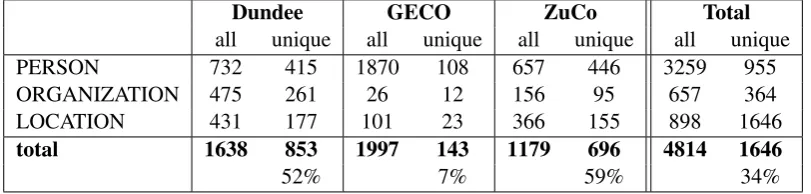
Dundee GECO ZuCo Total
all unique all unique all unique all unique
PERSON 732 415 1870 108 657 446 3259 955
ORGANIZATION 475 261 26 12 156 95 657 364
LOCATION 431 177 101 23 366 155 898 1646
total 1638 853 1997 143 1179 696 4814 1646
52% 7% 59% 34%
Table 2: Number and distribution of named entity annotations in all three eye-tracking corpora.
milliseconds) and gaze duration (the average du-ration of all fixations on a word)).
Dundee Corpus The gaze data of the Dundee corpus (Kennedy et al.,2003) was recorded with aDr. Bouis Oculometer Eyetracker. The English section of this corpus comprises 58,598 tokens in 2,367 sentences. It contains eye movement infor-mation of ten native English speakers as they read the same 20 newspaper articles fromThe Indepen-dent. The text was presented to the readers on a screen five lines at a time. This data has been widely used in psycholinguistic research to ana-lyze the reading behavior of subjects while read-ing sentences in context under relatively naturalis-tic conditions.
GECO Corpus The Ghent Eye-Tracking Cor-pus (Cop et al., 2017) is a more recent dataset, which was created for the analysis of eye move-ments of monolingual and bilingual subjects dur-ing readdur-ing. The data was recorded with an Eye-Link 1000 system. The text was presented one paragraph at a time. The subjects read the entire novel The Mysterious Affair at Styles by Agatha Christie(1920) containing 68,606 tokens in 5,424 sentences. We use only the monolingual data recorded from the 14 native English speakers for this work to maintain consistency across corpora.
ZuCo Corpus The Zurich Cognitive Language Processing Corpus (Hollenstein et al., 2018) is a combined eye-tracking and EEG dataset. The gaze data was also recorded with anEyeLink 1000 system. The full corpus contains 1,100 English sentences read by 12 adult native speakers. The sentences were presented at the same position on the screen one at a time. For the present work, we only use the eye movement data of the first two reading tasks of this corpus (700 sentences, 15,237 tokens), since these tasks encouraged natural reading. The reading material included sentences from movie reviews from the Stanford Sentiment Treebank (Socher et al.,2013) and the Wikipedia dataset byCulotta et al.(2006).
For the purposes of this work, all datasets were manually annotated with named entity labels for three categories: PERSON, OR-GANIZATION and LOCATION. The annota-tions are available athttps://github.com/
DS3Lab/ner-at-first-sight.
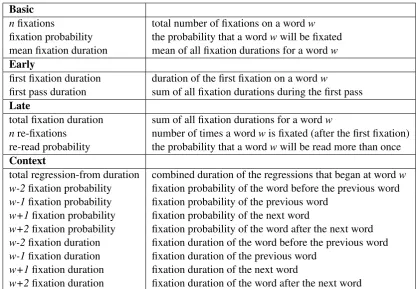
[image:3.595.97.503.246.343.2]inter-Basic
nfixations total number of fixations on a wordw fixation probability the probability that a wordwwill be fixated mean fixation duration mean of all fixation durations for a wordw Early
first fixation duration duration of the first fixation on a wordw
first pass duration sum of all fixation durations during the first pass
Late
total fixation duration sum of all fixation durations for a wordw
nre-fixations number of times a wordwis fixated (after the first fixation) re-read probability the probability that a wordwwill be read more than once
Context
total regression-from duration combined duration of the regressions that began at wordw w-2fixation probability fixation probability of the word before the previous word w-1fixation probability fixation probability of the previous word
w+1fixation probability fixation probability of the next word
w+2fixation probability fixation probability of the word after the next word w-2fixation duration fixation duration of the word before the previous word w-1fixation duration fixation duration of the previous word
w+1fixation duration fixation duration of the next word
[image:4.595.89.509.60.349.2]w+2fixation duration fixation duration of the word after the next word
Table 3: Gaze features extracted from the Dundee, GECO and ZuCo corpora.
annotator reliability analysis on 10,000 tokens (511 sentences) sampled from all three datasets yielded an agreement of 83.5% on the entity labels (κ= 0.68).
Table2shows the number of annotated entities in each dataset. The distribution of entities be-tween the corpora is highly unbalanced: Dundee and ZuCo, the datasets containing more hetero-geneous texts and thus, have a higher ratio of unique entity occurrences, versus GECO, a homo-geneous corpus consisting of a single novel, where the named entities are very repetitive.
4 Eye-tracking features
The gaze data of all three corpora was recorded for multiple readers by conducting experiments in a controlled environment using specialized equip-ment. It is important to consider that, while we extract the same features for all corpora, there are certainly practical aspects that differ across the datasets. The following factors are expected to in-fluence reading: experiment procedures; text pre-sentation; recording hardware, software and qual-ity; sampling rates; initial calibration and filtering, as well ashuman factorssuch as head movements and lack of attention. Therefore, separate normal-ization for each dataset should better preserve the
signal within each corpus and for the same reason the type-aggregation was computed on the normal-ized feature values. This is especially relevant for the type-aggregated features and the cross-corpus experiments described below.
In order to add gaze information to the neu-ral network, we have selected as many features as available from those present in all three cor-pora. Previous research shows benefits in com-bining multiple eye-tracking features of different stages of the human reading process (Barrett et al., 2016;Tokunaga et al.,2017).
The features extracted follow closely on Bar-rett et al. (2016). As described above, psycho-linguistic research has shown how fixation dura-tion and probability differ between word classes and syntactic comprehension processes. Thus, the features focus on representing these nuances as broadly as possible, covering the complete reading time of a word at different stages. Table3shows the eye movement features incorporated into the experiments. We split the 17 features into 4 dis-tinct groups (analogous to Barrett et al. (2016)), which define the different stages of the reading process:
fixations on a word or the probability that a word will be fixated (namely, the number of subjects who fixated the word divided by the total number of subjects).
2. EARLYgaze measures capture lexical access and early syntactic processing and are based on the first time a word is fixated.
3. LATEmeasures reflect the late syntactic pro-cessing and general disambiguation. These features are significant for words which were fixated more than once.
4. CONTEXT features capture the gaze mea-sures of the surrounding tokens. These features consider the fixation probability and duration up to two tokens to the left and right of the current token. Additionally, regressions starting at the current word are also considered to be meaningful for the syntactic processing of full sentences.
The eye movement measurements were aver-aged over all native-speaking readers of each dataset to obtain more robust estimates. The small size of eye-tracking datasets often limits the po-tential for training data-intensive algorithms and causes overfitting in benchmark evaluation (Xu et al.,2015). It also leads to sparse samples of gaze measurements. Hence, given the limited num-ber of observations available, we normalize the data by splitting the feature values into quantiles to avoid sparsity issues. The best results were achieved with 24 bins. This normalization is con-ducted separately for each corpus.
Moreover, special care had to be taken regard-ing tokenization, since the recorded eye-trackregard-ing data considers only whitespace separation. For ex-ample, the string John’s would constitute a sin-gle token for eye-tracking feature extraction, but would be split intoJohnand’sfor NER, with the former token holding the label PERSON and the latter no label at all. Our strategy to address this issue was to assign the same values of the gaze features of the originating token to split tokens.
4.1 Type aggregation
Barrett and Søgaard (2015b) showed that type-level aggregation of gaze features results in larger improvements for part-of-speech tagging. Follow-ing their line of work, we also conducted
exper-iments with type aggregation for NER. This im-plies that the eye-tracking feature values were av-eraged for each word type over all occurrences in the training data. For instance, the sum of the fea-tures of allnoccurrences of the token “island” are averaged over the number of occurrences n. As a result, for each corpus as well as for the ag-gregated corpora, a lexicon of lower-cased word types with their averaged eye-tracking feature val-ues was compiled. Thus, as input for the network, either the type-level aggregates for each individ-ual corpus can be used or the values from the com-bined lexicon, which increases the number of word types with known gaze feature values.
The goal of type aggregation is twofold. First, it eliminates the requirement of eye-tracking fea-tures when applying the models at test time, since the larger the lexicon, the more tokens in the unseen data receive type-aggregated eye-tracking feature values. For those tokens not in the lexi-con, we assign a placeholder for unknown feature values. Second, type-aggregated features can be used on any dataset and show that improvements can be achieved with aggregated gaze data without requiring large quantities of recorded data.
5 Model
The experiments in this work were executed us-ing an enhanced version of the system presented by Lample et al. (2016). This hybrid approach is based on bidirectional LSTMs and conditional random fields and relies mainly on two sources of information: character-level and word-level repre-sentations.
For the experiments, the originally proposed values for all parameters were maintained. Specif-ically, the bidirectional LSTMs for character-based embeddings are trained on the corpus at hand with dimensions set to 25. The lookup ta-ble tor the word embeddings was initialized with the pre-trained GloVe vectors of 100 dimensions (Pennington et al., 2014). The model uses a sin-gle layer for the forward and backward LSTMs. All models were trained with a dropout rate at 0.5. Moreover, all digits were replaced with zeros.
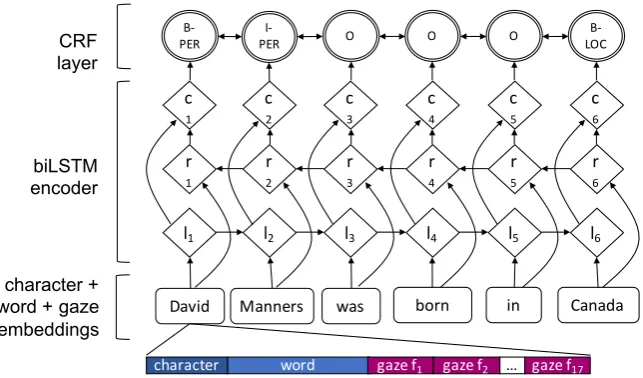
The original model1was modified to include the gaze features as additional embedding layers to the network. The character-level representation, i.e. the output of a bidirectional LSTM, is con-catenated with the word-level representation from
l1
Manners Canada
David was born in
r
1
c
1
l2
r
2
c
2
l3
r
3
c
3
l4
r
4
c
4
l5
r
5
c
5
l6
r
6
c
6
B-LOC O
O O
I-PER
B-PER CRF
layer
biLSTM encoder
character + word + gaze embeddings
word
[image:6.595.144.466.61.250.2]character gaze f1 gaze f2 … gaze f17
Figure 1: Main architecture of the network. Character and word embeddings concatenated with gaze features are given to a bidirectional LSTM.li represents the wordiand its left context,ri represents the wordiand its right
context. Concatenating these two vectors yields a representation of the wordiin its context,ci.
a word lookup table. In the augmented model with eye-tracking information, the embedding for each discrete gaze feature is also concatenated to the input. The dimension of the gaze feature embed-dings is equal to the number of quantiles. This ar-chitecture is shown in Figure1. Word length and word frequency are known to correlate and interact with gaze features (Tomanek et al., 2010), which is why we selected a base model that allows us to combine the eye-tracking features with word- and character-level information.
6 Results
Our main finding is that our models enhanced with gaze features consistently outperform the base-line. As our baseline, we trained and evaluated the original models with the neural architecture and parameters proposed by Lample et al.(2016) on the GECO, Dundee, and ZuCo corpora and com-pared it to the models that were enriched with eye-tracking measures. The best improvements on F1 -score over the baseline models are significant un-der one-sided t-tests (p<0.05).
All models were trained with 10-fold cross val-idation (80% training set, 10% development set, 10% test set) and early stopping was performed after 20 epochs of no improvement on the devel-opment set to reduce training time.
First, the performance on the individual datasets is tested, together with the performance of one combined dataset consisting of all three corpora (consisting of 142,441 tokens). In addition, we
evaluate the effects of the type-aggregated features using individual type lexicons for each datasets, and combining the three type lexicons of each cor-pus. Finally, we experiment with cross-corpus sce-narios to evaluate the potential of eye-tracking fea-tures in NER for domain adaptation. Both settings were also tested on an external corpus without eye-tracking features, namely the CoNLL-2003 dataset (Sang and De Meulder,2003).
6.1 Individual dataset evaluation
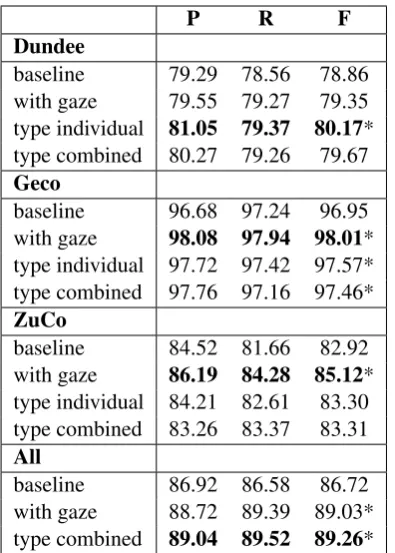
First, we analyzed how augmenting the named en-tity recognition system with eye-tracking features affects the results on the individual datasets. Ta-ble4shows the improvements achieved by adding all 17 gaze features to the neural architecture, and training models on all three corpora, and on the combined dataset containing all sentences from the Dundee, GECO and ZuCo corpora. Notice-ably, adding token-level gaze features improves the results on all datasets individually and com-bined, even on the GECO corpus, which yields a high baseline due to the homogeneity of the con-tained named entities (see Table2).
fea-P R F Dundee
baseline 79.29 78.56 78.86 with gaze 79.55 79.27 79.35 type individual 81.05 79.37 80.17* type combined 80.27 79.26 79.67
Geco
baseline 96.68 97.24 96.95 with gaze 98.08 97.94 98.01* type individual 97.72 97.42 97.57* type combined 97.76 97.16 97.46*
ZuCo
baseline 84.52 81.66 82.92 with gaze 86.19 84.28 85.12* type individual 84.21 82.61 83.30 type combined 83.26 83.37 83.31
All
[image:7.595.84.282.60.337.2]baseline 86.92 86.58 86.72 with gaze 88.72 89.39 89.03* type combined 89.04 89.52 89.26*
Table 4: Precision (P), recall (R) and F1-score (F) for
all models trained on individual datasets (best results in bold; * indicates statistically significant improve-ments on F1-score). With gazeare models trained on
the original eye-tracking features on token-level, type individualare the models trained on type-aggregated gaze features of this corpus only, whiletype combined
are the models trained with type-aggregated features computed on all datasets.
ture levels varies between datasets, but both the original token-level features as well as the indi-vidual and combined type-level features achieve improvements over the baselines of all datasets.
To sum up, the largest improvement with eye-tracking features is achieved when combining all corpora into one larger dataset, where an addi-tional 4% is gained in F1-score by using type-aggregated features. Evidently, a larger mixed-domain dataset benefits from the type aggrega-tion, while the original token-level gaze features achieve the best results on the individual datasets. Moreover, the additional gain when training on all datasets is due to the higher signal-to-noise ratio of type-aggregated features from multiple datasets.
Evaluation on CoNLL-2003 Going on step fur-ther, we evaluate the type-aggregated gaze fea-tures on an external corpus with no eye move-ment information available. The CoNLL-2003 corpus (Sang and De Meulder, 2003) has been
CoNLL-2003 P R F
baseline 93.89 94.16 94.03 type combined 94.38 94.32 94.35*
Table 5: Precision (P), recall (R) and F1-score (F) for
using type-aggregated gaze features on the CoNLL-2003 dataset (* marks statistically significant improve-ment).
widely used as a benchmark dataset for NER in different shared tasks. The English part of this corpus consists of Reuters news stories and con-tains 302,811 tokens in 22,137 sentences. We use this dataset as an additional corpus without gaze information. Only the type-aggregated features (based on the combined eye-tracking corpora) are added to each word. Merely 76% of the tokens in the CoNLL-2003 corpus also appear in the eye-tracking corpora described above and thus receive type-aggregated feature values. The rest of the to-kens without aggregated gaze information avail-able receive a placeholder for the unknown feature values.
Note that to avoid overfitting we do not train on the official train/test split of the CoNLL-2003 dataset, but perform 10-fold cross validation. Ap-plying the same experiment setting, we train the augmented NER model with gaze features on the CoNLL-2003 data and compare it to a baseline model without any eye-tracking features. We achieve a minor, but nonetheless significant im-provement (shown in Table 5), which strongly supports the generalizability effect of the type-aggregated features on unseen data.
6.2 Cross-dataset evaluation
In a second evaluation scenario, we test the poten-tial of eye-tracking features for NER across cor-pora. The goal is to leverage eye-tracking features for domain adaptation. To show the robustness of our approach across domains, we train the models with token-level and type-level features on 100% of corpus A and a development set of 20% of cor-pus B and test on the remaining 80% of the corcor-pus B, alternating only the development and the test set for each fold.
[image:7.595.320.516.62.104.2]Dundee GECO ZuCo
P R F P R F P R F
baseline 74.20 70.71 72.40 75.36 75.62 75.44
Dundee token 75.68 71.54 73.55* 78.85 74.51 77.02 type 76.44 77.09 76.75* 78.33 76.49 77.35
baseline 58.91 34.91 43.80 68.88 42.49 52.38
GECO token 59.61 35.62 44.53 69.18 44.22 53.81
type 58.39 35.99 44.44 67.69 42.36 52.01
[image:8.595.74.526.61.213.2]baseline 65.85 54.01 59.34 83.00 78.11 80.48 ZuCo token 72.62 50.76 59.70 82.92 75.35 78.91 type 69.21 53.05 59.95 83.68 74.57 78.85
Table 6: Cross-corpus results: Precision (P), recall (R) and F1-score (F) for all models trained on one dataset and
tested on another (rows = training dataset; columns = test dataset; best results in bold; * indicates statistically significant improvements). The baseline models are trained without eye-tracking features, tokenmodels on the original eye-tracking features, andtype are the models trained with type-aggregated features computed on all datasets.
and tested on the GECO corpus. Presumably, this is due to the combination of the small training data size of the ZuCo corpus and the homogeneity of the named entities in the GECO corpus.
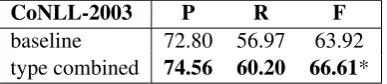
CoNLL-2003 P R F
[image:8.595.307.535.303.466.2]baseline 72.80 56.97 63.92 type combined 74.56 60.20 66.61*
Table 7: Precision (P), recall (R) and F1-score (F) for
using type-aggregated gaze features trained on all three eye-tracking datasets and tested on the CoNLL-2003 dataset (* marks statistically significant improvement).
Evaluation on CoNLL-2003 Analogous to the individual dataset evaluation, we also test the po-tential of eye-tracking features in a cross-dataset scenario on an external benchmark dataset. Again, we use the CoNLL-2003 corpus for this purpose. We train a model on the Dundee, GECOandZuCo corpora using type-aggregated eye-tracking fea-tures and test this model on the ConLL-2003 data. Table7shows that compared to a baseline without gaze features, the results improve by 3% F1-score. These results underpin our hypothesis of the pos-sibility of generalizing eye-tracking features on word type level, such that no recorded gaze data is required at test time.
7 Discussion
[image:8.595.86.280.370.412.2]The models evaluated in the previous section show that eye-tracking data contain valuable semantic information that can be leveraged effectively by NER systems. While the individual datasets are
Figure 2: Results per class for the models trained on all gaze datasets combined.
still limited in size, the largest improvement is ob-served in the models making use ofall the avail-able data.
At a closer look, the model leveraging gaze data yield a considerably higher increase in recall when comparing to the baselines. In addition, a class-wise analysis shows that the entity type benefiting the most from the gaze features over all models is ORGANIZATION, which is the most difficult class to predict. Figure2 illustrates this with the results per class of the models trained on all three gaze corpora jointly.
under-standable that in this scenario the original gaze features and the gaze features aggregated only on the individual datasets result in better mod-els. However, when evaluating the NER models in a cross-corpus scenario, the type-aggregated fea-tures lead to significant improvements.
Type aggregation evidently reduces the fine-grained nuances contained in eye-tracking infor-mation and eliminates the possibility of disam-biguation between homographic tokens. Never-theless, this type of disambiguation is not crucial for named entities, which mainly consist of proper nouns and the same entities tend to appear in the same context. Especially noteworthy is the gain in the models tested on the CoNLL-2003 bench-mark corpus, which shows that aggregated eye-tracking features from other datasets can be ap-plied to any unseen sentence and show improve-ments, even though more than 20% of the tokens have unknown gaze feature values. While the high number of unknown values is certainly a limitation of our approach, it shows at once the possibility of not requiring original gaze features at prediction time. Thus, the trained NER models can be ap-plied robustly on unseen data.
8 Conclusion
We presented the first study of augmenting a NER system with eye-tracking information. Our results highlight the benefits of leveraging cognitive cues such as eye movements to improve entity recogni-tion models. The manually annotated named en-tity labels for the three eye-tracking corpora are freely available. We augmented a neural NER ar-chitecture with gaze features. Experiments were performed using a wide range of features relevant to the human reading process and the results show significant improvements over the baseline for all corpora individually.
In addition, the type-aggregated gaze features are effective in cross-domain settings, even on an external benchmark corpus. The results of these type-aggregated features are a step towards lever-aging eye-tracking data for information extrac-tion at training time, without requiring real-time recorded eye-tracking data at prediction time.
References
Maria Barrett, Joachim Bingel, Nora Hollenstein, Marek Rei, and Anders Søgaard. 2018. Sequence classification with human attention. InProceedings
of the 22nd Conference on Computational Natural Language Learning, pages 302–312.
Maria Barrett, Joachim Bingel, Frank Keller, and An-ders Søgaard. 2016. Weakly supervised part-of-speech tagging using eye-tracking data. In Pro-ceedings of the 54th Annual Meeting of the Associa-tion for ComputaAssocia-tional Linguistics, volume 2, pages 579–584.
Maria Barrett and Anders Søgaard. 2015a. Reading be-havior predicts syntactic categories. InProceedings of the 19th Conference on Computational Natural Language Learning, pages 345–349.
Maria Barrett and Anders Søgaard. 2015b. Using read-ing behavior to predict grammatical functions. In
Proceedings of the Sixth Workshop on Cognitive As-pects of Computational Language Learning, pages 1–5.
Jason PC Chiu and Eric Nichols. 2016. Named entity recognition with bidirectional LSTM-CNNs. Trans-actions of the Association for Computational Lin-guistics, 4:357–370.
Agatha Christie. 1920. The Mysterious Affair at Styles. Retrieved from Project Gutenberg,
www.gutenberg.org.
Charles Clifton, Adrian Staub, and Keith Rayner. 2007. Eye movements in reading words and sentences. In
Eye Movements, pages 341–371. Elsevier.
Ronan Collobert, Jason Weston, L´eon Bottou, Michael Karlen, Koray Kavukcuoglu, and Pavel Kuksa. 2011. Natural language processing (almost) from scratch. Journal of Machine Learning Research, 12(Aug):2493–2537.
Uschi Cop, Nicolas Dirix, Denis Drieghe, and Wouter Duyck. 2017. Presenting GECO: An eyetracking corpus of monolingual and bilingual sentence read-ing.Behavior research methods, 49(2):602–615.
Aron Culotta, Andrew McCallum, and Jonathan Betz. 2006. Integrating probabilistic extraction models and data mining to discover relations and patterns in text. InProceedings of the Human Language Tech-nology Conference of the North American Chap-ter of the Association of Computational Linguistics, pages 296–303.
Vera Demberg and Frank Keller. 2008. Data from eye-tracking corpora as evidence for theories of syntactic processing complexity. Cognition, 109(2):193–210.
Jose G´omez-Poveda and Elena Gaudioso. 2016. Evalu-ation of temporal stability of eye tracking algorithms using webcams. Expert Systems with Applications, 64:69–83.
Zhiheng Huang, Wei Xu, and Kai Yu. 2015. Bidi-rectional LSTM-CRF models for sequence tagging.
arXiv preprint arXiv:1508.01991.
Barbara J Juhasz and Keith Rayner. 2003. Investigating the effects of a set of intercorrelated variables on eye fixation durations in reading. Journal of Experimen-tal Psychology: Learning, Memory, and Cognition, 29(6):1312.
Marcel A Just and Patricia A Carpenter. 1980. A theory of reading: From eye fixations to comprehension.
Psychological review, 87(4):329.
Alan Kennedy, Robin Hill, and Jo¨el Pynte. 2003. The Dundee corpus. In Proceedings of the 12th Euro-pean Conference on Eye Movement.
Guillaume Lample, Miguel Ballesteros, Sandeep Sub-ramanian, Kazuya Kawakami, and Chris Dyer. 2016. Neural architectures for named entity recognition.
Proceedings of the 2016 Conference of the North American Chapter of the Association for Computa-tional Linguistics: Human Language Technologies, pages 260–270.
Linguistic Data Consortium. 2005. ACE (Automatic Content Extraction) English annotation guidelines for entities. Version, 5(6):2005–08.
Xuezhe Ma and Eduard Hovy. 2016. End-to-end sequence labeling via bi-directional LSTM-CNNs-CRF. Proceedings of the 54th Annual Meeting of the Association for Computational Linguistics, 1:1064– 1074.
Abhijit Mishra, Diptesh Kanojia, Seema Nagar, Kuntal Dey, and Pushpak Bhattacharyya. 2017. Leveraging cognitive features for sentiment analysis. Proceed-ings of The 20th Conference on Computational Nat-ural Language Learning, pages 156–166.
Alexandra Papoutsaki, Patsorn Sangkloy, James Laskey, Nediyana Daskalova, Jeff Huang, and James Hays. 2016. WebGazer: Scalable webcam eye tracking using user interactions. InProceedings of the Twenty-Fifth International Joint Conference on Artificial Intelligence-IJCAI 2016.
Jeffrey Pennington, Richard Socher, and Christo-pher D. Manning. 2014. Glove: Global vectors for word representation. In Proceedings of the 2014 Conference on Empirical Methods in Natural Lan-guage Processing, pages 1532–1543.
Keith Rayner. 1977. Visual attention in reading: Eye movements reflect cognitive processes. Memory & Cognition, 5(4):443–448.
Keith Rayner. 1998. Eye movements in reading and information processing: 20 years of research. Psy-chological bulletin, 124(3):372.
Omid Rohanian, Shiva Taslimipoor, Victoria Yaneva, and Le An Ha. 2017. Using gaze data to predict
multiword expressions. In Proceedings of the In-ternational Conference Recent Advances in Natural Language Processing, pages 601–609.
Javier San Agustin, Henrik Skovsgaard, John Paulin Hansen, and Dan Witzner Hansen. 2009. Low-cost gaze interaction: ready to deliver the promises. In
CHI’09 Extended Abstracts on Human Factors in Computing Systems, pages 4453–4458.
Erik F Sang and Fien De Meulder. 2003. Introduc-tion to the CoNLL-2003 shared task: Language-independent named entity recognition. In Proceed-ings of the 7th Conference on Natural Language Learning, volume 4, pages 142–147.
Weston Sewell and Oleg Komogortsev. 2010. Real-time eye gaze tracking with an unmodified commod-ity webcam employing a neural network. InCHI’10 Extended Abstracts on Human Factors in Comput-ing Systems, pages 3739–3744.
Richard Socher, Alex Perelygin, Jean Wu, Jason Chuang, Christopher D Manning, Andrew Ng, and Christopher Potts. 2013. Recursive deep models for semantic compositionality over a sentiment tree-bank. In Proceedings of the 2013 Conference on Empirical Methods in Natural Language Process-ing, pages 1631–1642.
Anders Søgaard. 2016. Evaluating word embeddings with fMRI and eye-tracking. InProceedings of the 1st Workshop on Evaluating Vector-Space Represen-tations for NLP, pages 116–121.
Benjamin Strauss, Bethany Toma, Alan Ritter, Marie-Catherine de Marneffe, and Wei Xu. 2016. Results of the wnut16 named entity recognition shared task. InProceedings of the 2nd Workshop on Noisy User-generated Text (WNUT), pages 138–144.
Takenobu Tokunaga, Hitoshi Nishikawa, and Tomoya Iwakura. 2017. An eye-tracking study of named entity annotation. Proceedings of the International Conference Recent Advances in Natural Language Processing, pages 758–764.
Katrin Tomanek, Udo Hahn, Steffen Lohmann, and J¨urgen Ziegler. 2010. A cognitive cost model of an-notations based on eye-tracking data. In Proceed-ings of the 48th Annual Meeting of the Association for Computational Linguistics, pages 1158–1167.
Rihana Williams and Robin Morris. 2004. Eye move-ments, word familiarity, and vocabulary acquisition.
European Journal of Cognitive Psychology, 16(1-2):312–339.