gation because these results were inconsis-tent. Hence, in this study, we conducted a meta-analysis through searching studies from PubMed, Medline and CNKI to assess the effi -cacy and safety of sildenafil treatment com -pared with other agents in men with PE.
Material and method
Literature search
The study search strategy was conducted according to the handbook of the Cochrane col-laboration, and an electronic searching was performed using PubMed, EMBASE, Medline, Science Direct/Elsevier, CNKI, and the Coch- rane Library. The studies of these databases were published between January 1980 and March 2016. The following keywords (both alone and in combination) were used in the search: “premature ejaculation”, “sildenafil” and “PDE5 inhibitors”.
Inclusion criteria Introduction
PE is defined as persistent ejaculation with minimal sexual stimulation before or soon after penetration, in which the individual has mini-mal voluntary control over [1]. PE has become one of the most common diseases in urology and estimated prevalence is more than 21%, and perhaps 75% of men at some point in their lives are affected [1, 2]. Quality of life and social interaction in men with PE suffered a serious impact, as well as low satisfaction with sexual intercourse [3-5].
At present, psychotherapy and behavior train-ing therapy have poor patient adherence rates with PE [6, 7]. Pharmaceutical therapy is still recommended as the first priority for the con -sistent treatment of PE [8]. Agents such as selective serum reuptake inhibitor substances (SSRIs), local anesthetics and phosphodiester-ase type 5 (PDE5) inhibitors have been devel-oped specifically for the treatment of PE and are widely used in many countries. 13 studies have investigated the therapeutic role of
silde-Original Article
The clinical efficacy and safety of sildenafil in
premature ejaculate: a meta-analysis
Qingjian Wu1*, Fan Yang2*, Zhenqiang Fang1, Jiang Zhao1, Hu Xiaoyan1, Longkun Li1
1Department of Urology, Second Affiliated Hospital, Third Military Medical University, Chongqing 400037, China; 2Central of Medical Experiment & Technique, Second Affiliated Hospital, Third Military Medical University,
Chongqing 400037, China. *Equal contributors.
Received June 28, 2016; Accepted September 5, 2016; Epub January 15, 2017; Published January 30, 2017
Abstract:This study aims to assess the efficacy and safety of sildenafil therapy compared with other agents in
patients with premature ejaculation (PE) but without erectile dysfunction (ED). Systematically literature search was performed using PubMed, EMBASE, Medline, Science Direct/Elsevier, CNKI, and the Cochrane Library. The mean
difference (MD) or relative risk (RR) and 95% confidence intervals (CI) were used to assess the efficacy and safety of sildenafil treatment compared with other agents in men with PE. 13 studies, including 506 cases and 506 controls, were identified. The results suggested that when compared with other agents, sildenafil had a better effect on intra -vaginal ejaculation latency time (IELT) (MD: 1.56, 95% CI: 1.23-1.90), number of coitus per week (MD: 0.78, 95% CI: 0.72-0.84) and overall coitus satisfaction rate (RR: 1.32, 95% CI: 1.17-1.48), However, a higher but acceptable
rate of adverse events was found in the patients treated with sildenafil (RR: 2.13, 95% CI: 1.28-3.53). The present study shows that sildenafil was more effective in prolonging IELT, increasing the number of coitus per week and
increasing the overall coitus satisfaction rate with an acceptable rate of side effects than other treatment agents.
case-control or RCT study design; 2. Patients in the studies were aged more than 18 years, with a history of lifelong PE but without ED, who met the PE definition of international society for sexual medicine (ISSM) or Diagnostic and Statistical Manual of Mental Disorders (DSW-IV), and had a stable, monogamous, heterosex-ual relationship with a duration was more than 6 months; 3. The study compared the efficacy and safety of two therapeutic methods (silde-nafil and other agents); 4. The study had avail -able data that could be extracted from the article or obtained by calculation.
Study selection
The literatures searched from data base were screened by two independent reviewers. When the relevancy of the study was uncertain, a subsequent full-text assessment was conduct-ed. Review articles, case reports, comments, meeting abstracts and editorials were exclud-ed. Because the data included in this study were retrieved from the literature, ethical approval from an ethics committees was not needed.
Data extraction and quality assessments
The extraction data included the following: the last name of the first author, publication year, study population, mean ages of participants, study design features, number of cases and controls, study interventions and the efficacy and safety outcomes.
ing 95% CIs were used to measure the efficacy and safety of sildenafil treatment compared with other agents in men with PE. Homogeneity tests were performed with the use of Q statis- tic and the I2 statistic. When the P value was less than 0.05, it was considered statistically significant.
Results
[image:2.612.92.375.73.271.2]Study selection process and study character-istics
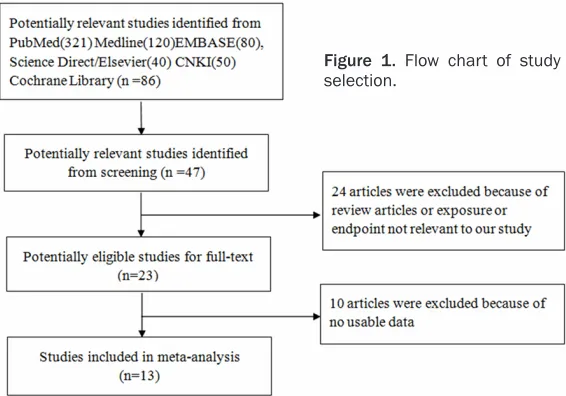
Figure 1 presents a flow chart showing the study selection process. Initially, we identified potential studies from PubMed, EMBASE, Medline, Science Direct/Elsevier, CNKI, and the Cochrane Library. After screening the abstracts or titles, most of them were excluded because they were letters and reviews or the exposure and endpoint were not linked to our study. After that, 13 studies [9-21], including 506 cases and 506 controls, were identified.
Table 1 depicts the study characteristics of the included studies. They were published from 2002 to 2014. Of these studies, eight were conducted in the Chinese population [10, 11, 15, 17-21]. The remaining five studies were conducted in the Italian, Australian, Turkish, Iranian and Egyptian populations. The end-points of our study included intravaginal ejacu-lation latency time, number of coitus per week, overall coitus satisfaction rate and adverse events.
Figure 1. Flow chart of study selection.
Based on the standard crite-ria (randomization, blinding, and failure to follow-up and using the scoring system developed by Jadad et al. [22], the quality of included studies was evaluated.
Statistical analysis
Table 1. The characteristics of the included studies
Study (Year) Population Sample Size (n)case/control Rang of age Treatment case/control Endpoints Quality grade
Salonia et al. (2002) Italian 40/40 19-47 Sildenafil + paroxetine/paroxetine IELT, numbers of coitus per week, adverse events 2 Tang et al. (2004) Chinese 30/30 29-46 Sildenafil + behavior/behavior IELT, numbers of coitus per week, adverse events 2 Zhang et al. (2005) Chinese 36/36 18-42 Sildenafil + sertralin/sertralin IELT, numbers of coitus per week, adverse events, coitus
satisfaction rate 2
McMahon et al. (2005) Australian 73/71 18-65 Sildenafil/placebo IELT, adverse events 3 Atan et al. (2006) Turkish 20/20 20-52 Sildenafil/placebo Adverse events, coitus satisfaction rate 2 Li et al. (2006) Chinese 35/35 N Sildenafil + seroxat/seroxat IELT, numbers of coitus per week, coitus satisfaction rate 2 Li et al. (2007) Chinese 34/34 18-52 Trazodone hydrochloride + sildenafil + behavior/trazodone
hydro-chloride + behavior
IELT, coitus satisfaction rate 2
Hou et al. (2008) Chinese 30/30 25-50 Sildenafil + sertralin/sertraline IELT 2
Hosseini et al. (2007) Iranian 43/48 21-43 Sildenafil/fluoxetine Adverse events, coitus satisfaction rate 2 Wang et al. (2007) Chinese 60/60 -- Sildenafil/paroxetine IELT, numbers of coitus per week, adverse events 2 Jiang et al. (2011) Chinese 40/40 21-47 Sildenafil + lidocaine/lidocaine Coitus satisfaction rate 2
Gameel et al. (2013) Egyptian 30/27 26-39 Sildenafil/placebo IELT 3
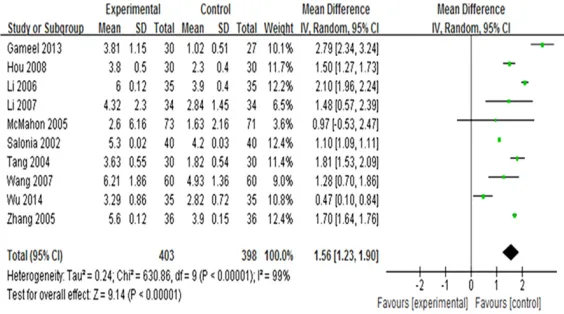
Figure 2. The IELT comparison between sildenafil and other agents.
Figure 3. The number of coitus per week comparison between sildenafil and
other agents.
Meta-analysis results
Intravaginal ejaculation lat-ency time (IELT): Ten studies reported the differences in IELT between sildenafil and other treatment agents. Of these studies, only one study showed there was no differ-ence [12], and the other five studies found a significant dif -ference. The pooled results showed that there was a sig-nificant difference in IELT between the two therapeutic methods (MD: 1.56, 95% CI: 1.23-1.90), however, a strong evidence of heterogeneity among these studies was found (I2=99%, P<0.05). The results are presented in
Figure 2.
Number of coitus per week:
Four studies were included to assess whether there was any difference in the number of coitus per week between these two therapeutic meth-ods, and all of them showed an increase in the number of coitus per week after treat-ment with sildenafil. Pooled analysis showed that the number of coitus per week in the patients with sildenafil treatment was higher than that in the men treated with other agents (MD: 0.78, 95% CI: 0.72-0.84). Little evidence of heterogeneity was found (I2=61%, P=0.05). The results are presented in Figure 3.
[image:4.612.95.374.477.670.2]Overall coitus satisfaction rate: Seven studies reported coitus satisfaction rate at the end of treatment. Compared with other agents, sildenafil treatment significantly increa-sed the coitus satisfaction rate, the RR (95% CI) was 1.32 (1.17-1.48). The results are shown in Figure 4.
Figure 4. The coitus satisfaction rate comparison between sildenafil and
Adverse events: All included studies presented the adverse events data. The most common adverse events included headache, flushing, dyspepsia, abnormal vision and nausea. Based on a random-effects model, compared with other agents, sildenafil had a higher adverse reaction rate, the combined RR (95% CI was 2.13 (1.28-3.53). Figure 5 presents the results of the adverse events comparison between sildenafil and other agents.
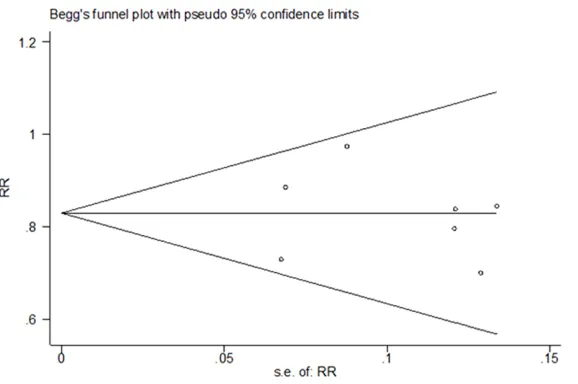
Publication bias: The adverse reaction rate was assessed for publication bias. Begg’s test and Egg’s test showed low evidence of publication bias found among the included studies using STATA 12.0 (P=0.897). The results of the publi-cation bias assessment is presented in Figure 6.
rior urethral pressure changes of the nervous system played important roles in the ejacula-tion process [24]. Lately, neuroendocrine fac-tors have gradually become the focus of stud-ies on PE etiology.
[image:5.612.97.375.74.212.2]The therapeutic methods of PE are varied, including the replacement of previously admin-istered psychosexual cognitive behavioral ther-apy with an integrated treatment approach, topical agents, SSRIs, PDE5 inhibitors and acupuncture [8]. Behavioral therapy has been shown to be minimally effective because the results are not durable and patients have low compliance [24]. Several topical therapies have also been used, including severance-secret cream, lignocaine spray, lidocaine-prilocaine cream and lidocaine-prilocaine spray. The most prominent side effects are penile numbness
Figure 5. The adverse events comparison between sildenafil and other
agents.
Figure 6. Funnel plot of publication bias.
Discussion
[image:5.612.93.382.263.455.2]-and local symptoms of irritation, burning, -and delayed ejaculation [6]. However, these topical therapies have lower coitus satisfaction rates for patients and their partners.
Recently, several studies have reported that PDE5 inhibitors, as a first line oral pharmaco -therapy for ED, have efficacy for alleviating PE [26]. Sildenafil, a selective inhibitor of cyc-lic guanosine monophosphate (cGMP)-specific phosphodiesterase type 5, has typically been chosen to treat patients with PE [27]. Some studies have evaluated the efficacy and safety of sildenafil for the management of PE. 13 stud -ies were retrieved for this review after search-ing online databases. These studies met quali-ty criteria regarding patient selection, outcome measurement specification, and appropriate -ness of follow-up. However, the effect of this drug in these studies was controversial; it may be associated with the existence of several methodological flaws which significantly affect -ed the results of our study. Most importantly, the absence of widely accepted and unique definitions created a bias for the investigation of the sildenafil treatment outcomes. In this study, we found that sildenafil was more effec -tive than other treatments in prolonging IELT, increasing the number of coitus per week and increasing the overall coitus satisfaction rate, with acceptable side effects.
The mechanisms of sildenafil in the treatment of PE are unclear. However, the potential mech-anisms are related to the NO-cGMP pathway. Cyclic guanosine monophosphate (cGMP) is generated by cytoplasmic soluble guanylatecy-clases, and the phosphodiesterase type 5 (PDE5) enzyme is highly specific for hydrolysis of cGMP. First, sildenafil, a PDE5 inhibitor, alle -viates sympathetic tone and inhibits smooth muscle dilation of the vas deferens and semi-nal vesicles to delay ejaculation through incre- asing NO generation [28]. Second, sildenafil induces peripheral nerves to produce a status of alganesthesia, which helps to reduce the sensitivity of the penis in some patients with premature ejaculation [29]. Third, the latent period of ejaculation is affected by the duration of the erection. Sildenafil prolongs the duration of erection, and the longer the duration of erec-tion, the longer the latent period of ejaculation [30, 31].
This study has some limitations that should be considered. First, in our review, all of the includ-ed studies did not report the results of long-term follow-ups. Hence, it was difficult to deter -mine the long-term curative effects and adverse reactions to sildenafil. Second, there was no unified standard of diagnosis and treatment and no uniform standard for classifying the severity of PE. Third, this study included both RCTs and observation studies. The clinical evi-dence was influenced by the observation stud -ies. Fourth, strong evidence of heterogeneity in some of our results was found. The patients of the included studies were from different loca-tions, had different basic characteristics and were of different pathological types. Fifth, the sample size of our study was still small, and more well-design RCTs studies should address these issues.
Although there were many limitations, our study has some important significance. This study was the first meta-analysis to estimate the effi -cacy and safety of sildenafil treatment com -pared with other agents in patients with PE but without erectile dysfunction (ED). Although indi-vidual studies had insufficient statistical power, 8 eligible studies, including a large sample size, were included in our meta-analysis, which greatly enhanced the statistical power and pro-vided more reliable results. However, the most important finding was that we found a longer IELT, higher frequencies of coitus per week and an increase in the overall coitus satisfaction rate from the patients with sildenafil treatment than the patients with other treatment agents, and no severe complications were observed. These results provide important clinical signifi -cance for the patients with PE.
Conclusions
Our study found that sildenafil was more effec -tive compared with other treatments in pro-longing of IELT, increasing the frequency of coitus per week, and increasing the overall coitus satisfaction rate with acceptable rates of side effects. More well-design RCTs with long-term follow-up studies are warranted. Acknowledgements
Disclosure of conflict of interest None.
Address correspondence to: Longkun Li, Depart-
ment of Urology, Second Affiliated Hospital, Third
Military Medical University, Chongqing 400037,
China. Tel: +8623 6875 5623; Fax: +8623 6875 5623; Cell: +8613983615565; E-mail: lilongk@hot -mail.com
References
[1] Abdel-Hamid IA, E Naggar EA, E Gilany AH. Assessment of as needed use of pharmaco-therapy and the pause-squeeze technique in premature ejaculation. Int J Impot Res 2001; 13: 41-5.
[2] Shamloul R, el-Nashaar A. Chronic prostatitis in premature ejaculation: a cohort study in 153 men. J Sex Med 2006; 3: 150-4.
[3] Jannini EA, Lenzi A. Epidemiology of premature ejaculation. Curr Opin Urol 2005; 15: 399-403.
[4] McMahon CG. Treatment of premature ejacu-lation with sertraline HCl: a single-blind place-bo controlled crossover study. J Urol 1998; 159: 1935-8.
[5] Symonds T, Roblin D, Hart K, Althof S. How does premature ejaculation impact a man’s life? J Sex Marital Ther 2003; 29: 361-70. [6] Rowland D, Cooper S. Practical tips for sexual
counseling and psychotherapy in premature ejaculation. J Sex Med 2011; 8: 342-52. [7] Jern P. Evaluation of a behavioral treatment
intervention for premature ejaculation using a handheld stimulating device. J Sex Marital Ther 2014; 40: 358-66.
[8] Waldinger MD, Zwinderman AH, Schweitzer DH, Olivier B. Relevance of methodological
de-sign for the interpretation of efficacy of drug
treatment of premature ejaculation: A system-atic review and meta-analysis. Int J Impot Res 2004; 16: 369-81.
[9] Salonia A, Maga T, Colombo R, Scattoni V, Briganti A. A prospective studycomparing
paro-xetine alone versus paroparo-xetine plus sildenafil
in patients with premature ejaculation. J Urol 2002; 168: 2486-9.
[10] Tang W, Ma L, Zhao L, Liu Y, Chen Z. Clinical
efficacy of Viagra with behavior therapy against
premature ejaculation. Zhonghua Nan Ke Xue 2004; 10: 366-370.
[11] Zhang XS, Wang YX, Huang XY, Leng J, Li Z.
Comparison between sildenafil plus sertraline
and sertraline alone in the treatment of pre-mature ejaculation. Zhonghua Nan Ke Xue 2005; 11: 520-525.
[12] McMahon CG, Stuckey BG, Andersen M, Purvis
K, Koppiker N. Efficacy of sildenafil citrate
(Viagra) in men with premature ejaculation. J Sex Med 2005; 2: 368-75.
[13] Atan A, Basar MM, Tuncel A, Ferhat M, Agras K,
Tekdogan U. Comparison of efficacy of silde
-nafil-only, sildenafil plus topical EMLA cream,
and topical EMLA-cream-only in treatment of premature ejaculation. Urology 2006; 67: 388-91.
[14] Hosseini MM, Yarmohammadi H. Effect of
fluoxetine alone and in combination with silde
-nafil in patients with premature ejaculation.
Urol Int 2007; 79: 28-32.
[15] Wang WF, Wang Y, Minhas S, Ralph DJ.
Can sildenafil treat primary premature ejacula -tion? A prospective clinical study. Int J Urol 2007; 14: 331-5.
[16] Gameel TA, Tawfik AM, Abou-Farha MO,
Bastawisy MG, El-Bendary MA. On-demand
use of tramadol, sildenafil, paroxetine and lo -cal anaesthetics for the management of pre-mature ejaculation: A Randomized placebo-controlled clinical trial. Arab J Urol 2013; 11:392-7.
[17] Li HJ, Shi M, Zhang ZL. Clinical Management of Premature Ejaculation in Male. Shenzhen Journal of Integrated Traditional Chinese and Western Medicine 2006; 16: 89-91.
[18] Li FP. Clinical efficacy of trazodone hydrochlo
-ride with sildenafil against premature ejacula -tion. J Clin Urol 2007; 22: 812-813.
[19] Hou KB, Li Z, Yan SW, Zhou M, Ping P, Gong DM, Wang YX. The effect of sertraline
hydro-chloride combined with sildenafil in the treat -ment of patients with premature ejaculation. Reproduction & Contraception 2008; 28: 665-7.
[20] Jiang J, Peng GF, Xu QY, JIa C, Yang BH. Compound lidocaine cream combined with
small dose of sildenafil in the treatment of
premature ejaculation. Jilin Medical Journal 2011; 32: 1765.
[21] Wu ZX, Zhang XQ, Zhang YL, Wang RF, Han ZH, Chen AP, Zhang Z. Curative effect of small dose
of oral silaenafil combined with psychological
therapy in the treatment of premature ejacula-tion. The Chinese Journal of Human Sexuality 2014; 23: 8-10.
[22] Jadad AR, Moore RA, Carroll D, Jenkinson C, Reynolds DJ. Assessing the quality of reports of randomized clinical trials: is blinding neces-sary? Control Clin Trials 1996; 17: 1-12. [23] Bar-Or D, Salottolo KM, Orlando A, Winkler JV.
A randomized doubleblind, placebo-controlled
multicenter study to evaluate the efficacy and
safety of two doses of the tramadol orally disin-tegrating tablet for the treatment of premature ejaculation within less than 2 minutes. Eur Urol 2012; 61: 736-43.
[25] Chen J, Mabjeesh NJ, Matzkin H, Greenstein A.
Efficacy of sildenafil as adjuvant therapy to se -lective serotonin reuptake inhibitor in alleviat-ing premature ejaculation. Urology 2003; 61: 197-200.
[26] Aversa A, Pili M, Francomano D, Bruzziches R, Spera E, La Pera G, Spera G. Effects of
varde-nafil administration on intravaginal ejaculatory
latency time in men with lifelong premature ejaculation. Int J Impot Res 2009; 21: 221-7. [27] Sato Y, Christ GJ, Horita H, Adachi H, Suzuki N,
Tsukamoto T. The effects of alterations in nitric oxide levels in the paraventricular nucleus on
copulatory behavior and reflexive erections in
male rats. J Urol 1999; 162: 2182-5.
[28] Hull EM, Lumley LA, Matuszewich L, Domin- guez J, Moses J, Lorrain DS. The roles of nitric oxide in sexual function of male rats. Neuro- pharmacology 1994; 33: 1499-504.
[29] Jain NK, Patil CS, Singh A, Kulkarni SK. Sil-
denafil-induced peripheral analgesia and acti -vation of the nitric oxide-cyclic GMP pathway. Brain Res 2001; 909: 170-8.
[30] Carson CC, Burnett AL, Levine LA, Nehra A. The
efficacy of sildenafil citrate (Viagra) in clinical
populations: an update. Urology 2002; 60: 12-27.