Proceedings of NAACL-HLT 2019, pages 166–177 166
Topic-Guided Variational Autoencoders for Text Generation
Wenlin Wang1, Zhe Gan2, Hongteng Xu1,3, Ruiyi Zhang1, Guoyin Wang1,
Dinghan Shen1,Changyou Chen4,Lawrence Carin1
1Duke University, 2Microsoft Dynamics 365 AI Research,
3Infinia ML, Inc, 4University at Buffalo
{wenlin.wang, ruiyi.zhang, gw60, ds448, lcarin}@duke.edu [email protected], [email protected]
Abstract
We propose a topic-guided variational au-toencoder (TGVAE) model for text
genera-tion. Distinct from existing variational
au-toencoder (VAE) based approaches, which as-sume a simple Gaussian prior for the latent code, our model specifies the prior as a Gaus-sian mixture model (GMM) parametrized by
a neural topic module. Each mixture
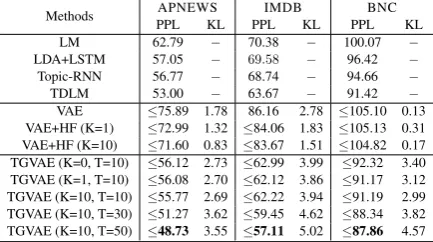
com-ponent corresponds to a latent topic, which provides guidance to generate sentences un-der the topic. The neural topic module and the VAE-based neural sequence module in our model are learned jointly. In particular, a se-quence of invertible Householder transforma-tions is applied to endow the approximate pos-terior of the latent code with high flexibility during model inference. Experimental results show that our TGVAE outperforms alterna-tive approaches on both unconditional and con-ditional text generation, which can generate semantically-meaningful sentences with vari-ous topics.
1 Introduction
Text generation plays an important role in vari-ous natural language processing (NLP)
applica-tions, such as machine translation (Cho et al.,2014;
Sutskever et al., 2014), dialogue generation (Li
et al.,2017a), and text summarization (Nallapati
et al.,2016;Rush et al.,2015). As a competitive
solution to this task, the variational autoencoder
(VAE) (Kingma and Welling,2013;Rezende et al.,
2014) has been widely used in text-generation
sys-tems (Bowman et al.,2015;Hu et al.,2017;Serban
et al., 2017). In particular, VAE defines a
gen-erative model that propagates latent codes drawn from a simple prior through a decoder to mani-fest data samples. The generative model is further augmented with an inference network, that feeds observed data samples through an encoder to yield a distribution on the corresponding latent codes.
Compared with other potential methods, e.g.,
those based on generative adversarial networks
(GANs) (Yu et al.,2017;Guo et al.,2017;Zhang
et al.,2017b,2018;Chen et al.,2018), VAE is of
particular interest when one desires not only text generation, but also the capacity to infer meaning-ful latent codes from text. Ideally, semantically-meaningful latent codes can provide high-level guidance while generating sentences. For exam-ple, when generating text, the vocabulary could potentially be narrowed down if the input latent code corresponds to a certain topic (e.g., the word “military” is unlikely to appear in a sports-related
document).
However, in practice this desirable property is not fully achieved by existing VAE-based text gen-erative models, because of the following two chal-lenges. First, the sentences in documents may as-sociate with different semantic information (e.g., topic, sentiment, etc.) while the latent codes of ex-isting VAE-based text generative models often em-ploy a simple Gaussian prior, which cannot indicate the semantic structure among sentences and may re-duce the generative power of the decoder. Although some variants of VAE try to impose some
struc-ture on the latent codes (Jiang et al.,2016;
Dilok-thanakul et al.,2016), they are often designed with
pre-defined parameter settings without incorporat-ing semantic meanincorporat-ings into the latent codes, which may lead to over-regularization (Dilokthanakul
et al.,2016).
The second issue associated with VAE-based text generation is “posterior collapse,” first
iden-tified in Bowman et al. (2015). With a strong