A n E f f i c i e n t D i s t r i b u t i o n o f L a b o r in a T w o S t a g e R o b u s t
I n t e r p r e t a t i o n P r o c e s s
C a r o l y n P e n s t e i n Ros6
Carnegie Mellon University
Baker Hall 135F
Pittsburgh, PA 15213
[email protected]
A l o n Lavie
Carnegie Mellon University
Center for Machine Translation
Pittsburgh, PA 15213
alavie~cs.cmu.edu
A b s t r a c t
Although Minimum Distance Parsing (MDP) offers a theoretically attractive so- lution to the problem of e x t r a g r a m m a t - icality, it is often computationally infea- sible in large scale practical applications. In this paper we present an alternative ap- proach where the labor is distributed be- tween a more restrictive partial parser and a repair module. T h o u g h two stage ap- proaches have grown in popularity in re- cent years because of their efficiency, they have done so at the cost of requiring hand coded repair heuristics (Ehrlich and Han- rieder, 1996; Danieli and Gerbino, 1995). In contrast, our two stage approach does not require any hand coded knowledge sources dedicated to repair, thus making it possible to achieve a similar run time advantage over M D P without losing the quality of domain independence.
1
I n t r o d u c t i o n
The correct interpretation of spontaneous spoken language poses challenges that continue to fall out- side of the reach of state-of-the-art technology. The first essential task of a natural language interface is to m a p the user's utterance onto some meaning rep- resentation which can then be used for further pro- cessing. T h e three biggest challenges that continue to stand in the way of accomplishing even this most basic task are extragrammaticality, ambiguity, and speech recognition errors. In this paper we address the issue of how to handle the problem of extra- grammaticality efficiently, where extragrammatical- ity is defined as any deviation of an input string from the coverage of a given system's parsing grammar. We demonstrate the superiority of our approach by comparing performance between it and a set of alter- native approaches in terms of parse time and parse quality over the same previously unseen test corpus. T h e approach presented in this paper is the c o m -
pletely automatic portion of the ROSE 1 approach. ROSE, RObustness with Structural Evolution, re- pairs e x t r a g r a m m a t i c a l input in two phases. T h e first phase, Repair Hypothesis Formation, is re- sponsible for assembling a set of hypotheses a b o u t the meaning of the ungrammatical utterance. This phase is itself divided into two stages, Partial Pars- ing and Combination. A restricted version of Lavie's GLR* parser (Lavie, 1995; Lavie and T o m i t a , 1993) is used to obtain an analysis of islands of the speaker's sentence in cases where it is not possible to obtain an analysis for the entire sentence. In the Combination stage, the fragments from the partial parse are assembled into a set of alternative meaning representation hypotheses. A genetic programming approach is used to search for different ways to com- bine the fragments in order to avoid requiring any hand-crafted repair rules. In ROSE's second phase, Interaction with the User, the system generates a set of queries, negotiating with the speaker in order to narrow down to a single best meaning representa- tion hypothesis. In this paper, only the Hypothesis Formation phase is described and evaluated. Since repairs beyond those made possible by the partial parser are performed during the Combination stage, we refer to the implementation of the Combination stage as the repair module. T h o u g h a set of hypothe- ses are produced by during the C o m b i n a t i o n stage, in the evaluation presented in this paper, only the re- pair hypothesis scored by the repair m o d u l e as best is returned.
The ROSE approach was developed in the con- text of the JANUS large-scale multi-lingual machine translation system (Lavie et al., 1996; Woszcyna et al., 1993; Woszcyna et al., 1994). Currently, the JANUS system deals with the scheduling d o m a i n where two speakers a t t e m p t to schedule a meeting together over the phone. T h e system is composed of four language independent and d o m a i n indepen- dent modules including speech-recognition, parsing, discourse processing, and generation. T h e repair module described in this paper is similarly language
independent and domain independent, requiring no hand-coded knowledge dedicated to repair. T h e evaluations described in this paper were conducted using a g r a m m a r with approximately 1000 rules and a lexicon with approximately 1000 lexical items.
2 A l t e r n a t i v e A v e n u e s T o w a r d s R o b u s t n e s s
There are a wide range of different approaches to handling the problem of extragrammaticality, but which way is best? Three basic avenues exist whereby the coverage of a natural language under- standing system can be expanded: further develop- ment of the parsing grammar, addition of flexibil- ity to the parsing algorithm, or addition of a post- processing repair stage after the parsing stage.
It is always possible to add additional rules to a parsing g r a m m a r in order to expand the coverage, but this approach is both time intensive in terms of development and ultimately computationally expen- sive at run time since large, cumbersome grammars generate excessive amounts of ambiguity. Adding flexibility to the parsing algorithm is preferable in some respects, particularly in that it reduces the g r a m m a r development burden. However, it lends it- self to the same weakness in terms of computational expense. In the extreme case, in a Minimum Dis- tance Parser (MDP) (Lehman, 1989; Hipp, 1992), any ungrammatical sentence can be mapped onto a sentence inside of the coverage of the g r a m m a r through a series of insertions, deletions, and in some cases substitutions or transpositions.
The more flexibility, the better the coverage in theory, but in realistic large scale systems this ap- proach becomes computationally intractable. Cur- rent efforts towards robust interpretation have fo- cused on less powerful partial parsers (Abney, 1996; Nord, 1996; Srinivas et al., 1996; Federici, Mon- temagni, and Pirrelli, 1996) and repair approaches where the labor is distributed between two or more stages (Ehrlich and Hanrieder, 1996; Danieli and Gerbino, 1995). T h e purpose of the second stage is to assemble the pieces of the partial parse pro- duced in the first stage. In this paper we present a two stage approach composed of a partial parser followed by a completely automatic repair module.
Though two stage approaches have grown in popularity in recent years because of their effi- ciency, they have done so at the cost of requiring hand coded repair heuristics (Ehrlich and Hanrieder, 1996; Danieli and Gerbino, 1995). In contrast, the ROSE approach does not require any hand coded knowledge sources dedicated to repair, thus making it possible to achieve the benefits of repair without losing the quality of domain independence.
In this paper, we compare the performance of the two stage ROSE approach with MDP. A parameter- ized version of Lavie's GLR* parser (Lavie, 1995)
is used which has been extended to perform a lim- ited version of MDP in which insertions and dele- tions are possible, but not transpositions or substi- tutions. We refer to this parameterized M D P parser as LR MDP. We run LR MDP over the same test corpus in different settings, demonstrating the flex- ibility/quality/parse time trade off. With this we demonstrate that the two stage ROSE approach, coupling the restricted version of the GLR* parser with a post-processing repair stage, achieves better translation quality far more efficiently than any flex- ibility setting of LR MDP over the same corpus.
3 M D P v e r s u s T w o
Stage
I n t e r p r e t a t i o nEfforts towards solving the problem of extragram- maticality have primarily been in the direction of building flexible parsers. In principle, Minimum Dis- tance Parsers (Lehman, 1989; Hipp, 1992) have the greatest flexibility. They fit an e x t r a g r a m m a t i c a l sentence to the parsing g r a m m a r through a series of insertions, deletions, and transpositions. Since any string can be mapped onto any other string through a series of insertions, deletions, and transpositions, this approach makes it possible to repair any sen- tence. The underlying assumption behind the M D P approach is that the analysis of the string that de- viates the least from the input string is most likely to be the best analysis. Thus, Minimum Distance Parsing appears to be a reasonable approach.
In practice, however, Minimum Distance Parsing has only been used successfully in very small and limited domains. Lehman's core g r a m m a r , described in (Lehman, 1989), has on the order of 300 rules, and all of the inputs to her system can be assumed to be commands to a calendar program. Hipp's Cir- cuit Fix-It Shop system, described in (Hipp, 1992), has a vocabulary of only 125 words and a g r a m m a r size of only 500 rules. Flexible parsing algorithms introduce a great deal of extra ambiguity. This in turn m a y deem certain approaches impractical for systems of realistic scale. Therefore, an i m p o r t a n t question one must ask is whether the M D P approach can scale up to a larger system a n d / o r domain.
An example of a more restrictive parsing algo- r i t h m is Lavie's GLR* skipping parser described in (Lavie, 1995). GLR* is a parsing system based on T o m i t a ' s Generalized LR parsing algorithm which was designed to be robust to two particular types of extra-grammaticality: noise in the input, and lim- ited g r a m m a r coverage. GLR* a t t e m p t s to overcome these forms of extra-grammaticality by ignoring the unparsable words and fragments and conducting a search for the maximal subset of the original input that is covered by the grammar.
analysis of the largest grammatical subset of the ut- terance. Partial analyses for skipped portions of the utterance can also be returned by the parser. Thus, whereas MDP considers insertions and transposi- tions in addition to deletions, GLR* only considers deletions. GLR* can be viewed as a restricted form of MDP applied to an efficient non-robust general parsing method. GLR* can, in most cases, achieve most of the robustness of the more general MDP approach while maintaining feasibility, due to effi- ciency properties of the G L R approach and an effec- tive well:guided search. In the evaluation presented in this paper, GLR* has been restricted to skip only initial segments so that the partial analyses returned are always for contiguous portions of the sentence.
Because GLR* was designed as an enhancement to the widely used standard G L R context-free pars- ing algorithm, grammars, lexicons and other tools developed for the standard G L R parser can be used without modification. GLR* uses the standard SLR(0) parsing tables which are compiled in advance from the grammar. It inherits the benefits of G L R in terms of ease of g r a m m a r development, and, to a large extent, efficiency properties of the parser it- self. In the case t h a t an input sentence is completely grammatical, GLR* will normally return the exact same parse as the G L R parser.
The weakness of this and other partial parsing ap- proaches (Abney, 1996; Nord, 1996; Srinivas et al., 1996; Federici, Montemagni, and Pirrelli, 1996) is that part of the original meaning of the utterance may be thrown away with the portion(s) of the ut- terance that are skipped if only the analysis for the largest subset is returned, or part of the analysis will be missing if the parser only a t t e m p t s to build a partial parse. These less powerful algorithms trade coverage for speed. T h e idea is to introduce enough flexibility to gain an acceptable level of coverage at an acceptable computational expense.
The goal behind the two stage approach (Ehrlich and Hanrieder, 1996; Danieli and Gerbino, 1995) is to increase the coverage possible at a reasonable computational cost by introducing a post-processing repair stage, which constructs a complete mean- ing representation out of the fragments of a partial parse. Since the input to the second stage is a collec- tion of partial parses, the additional flexibility that is introduced at this second stage can be channeled just to the part of the analysis t h a t the parser does not have enough knowledge to handle straightfor- wardly. This is unlike the M D P approach, where the full amount of flexibility is unnecessarily applied to every part of the analysis, even in completely gram- matical sentences. Therefore, this two stage process is a more efficient distribution of labor since the first stage is highly constrained by the g r a m m a r and the results of this first stage are then used to constrain the search in the second stage. Additionally, in cases where the limited flexibility parser is sufficient, the
second stage can be entirely bypassed, yielding an even greater savings in time.
4 T h e T w o S t a g e I n t e r p r e t a t i o n P r o c e s s
T h e main goal of the two stage ROSE approach is to achieve the ability to robustly interpret spontaneous natural language efficiently in a system at least as large and complex as the JANUS multi-lingual ma- chine translation system, which provides the context for this work. In this section we describe the divi- sion of labor between the Partial Parsing stage and the Combination stage in the ROSE approach.
4.1 T h e P a r t i a l
Parsing Stage
S e n t e n c e : That wipes out my mornings.
Partial Analyses:
C h u n k l : that
((ROOT THAT)
(TYPE P R O N O U N )
( F R A M E *THAT))
C h u n k 2 : out
((TYPE NEGATIVE) (DEGREE NORMAL) (FRAME *RESPOND))
C h u n k 3 : my
((ROOT I)
(TYPE PERSON-POSS) (FRAME *I))
C h u n k 4 : mornings
((TIME-OF-DAY MORNING) (NUMBER PLURAL) (FRAME *SIMPLE-TIME) (SIMPLE-UNIT-NAME TOD))
Figure 1: Parse Example
allow time expressions to be modified by possessive pronouns. So "my mornings" also does not parse. Although the g r a m m a r recognizes "out" as a way of expressing a rejection, as in "Tuesdays are out," it does not allow the time being rejected to follow the "out". However, although the parser was not able to obtain a complete parse for this sentence, it was able to extract four chunks.
The chunks are feature structures in which the parser encodes the meaning of portions of the user's sentence. This frame based meaning representation is called an interlingua because it is language inde- pendent. It is defined by an interlingua specification, which serves as the primary symbolic knowledge source used during the Combination stage. Each frame encodes a concept in the domain. The set of frames in the meaning representation are arranged into subsets that are assigned a particular type. Each frame is associated with a set of slots. The slots represent relationships between feature struc- tures. Each slot is associated with a type which determines the set of possible frames which can be fillers of that slot. T h o u g h this meaning representa- tion specification is knowledge that must be encoded by hand, it is knowledge that can be used by all as- pects of the system, not only the repair module as is the case with repair rules. Arguably, any well designed system would have such a specification to describe its meaning representation.
T h e four chunks extracted by the parser each en- code a different part of the meaning of the sentence " T h a t wipes out my mornings." The first chunk rep- resents the meaning of "that". T h e second one rep- resents the meaning of "out". Since "out" is gener- ally a way of rejecting a meeting time in this domain, the associated feature structure represents the con- cept of a response that is a rejection. Since "wipes" does not match anything in the grammar, this token is left without any representation among the frag- ments returned by the parser. The last two chunks represent the meaning of "my" and "mornings" re- spectively.
T h e disadvantage of this skipping parser over the MDP approach is that it does not have the abil- ity to perform some necessary repairs that the more complicated approach can make. In this case, for example, it is unable to determine how these pieces fit together into one coherent parse. T h e goal of the Combination stage is to overcome this limitation ef- ficiently. Thus, the second stage of the interpreta- tion process is responsible for making the remaining types of repairs. More flexibility can be introduced in the second stage efficiently since the search space has already been reduced with the addition of the knowledge obtained from the partial parse.
4.2 T h e C o m b i n a t i o n S t a g e
T h e purpose of the Combination stage is to make the remainder of the types of repairs that could in
principle be done with a minimum distance parser using insertions, deletions, and transpositions, but that cannot be performed with the skipping parser. The Combination stage takes as input the partial analyses returned by the skipping parser. These chunks are combined into a set of best repair hy- potheses. T h e hypotheses built during this combina- tion process specify how to build meaning represen- tations out of the partial analyses produced by the parser that are meant to represent the meaning of the speaker's whole sentence, rather than just parts. Since the meaning representation is compositional, a single, more complete meaning representation can be built by assembling the meaning representations for the parts of the sentence.
Ideal Repair Hypothesis:
(MY-COMB
((FRAME *RESPOND) (DEGREE NORMAL)
(TYPE NEGATIVE)) ; argl
((TIME-OF-DAY MORNING) (NUMBER PLURAL) (FRAME *SIMPLE-TIME)
(SIMPLE-UNIT-NAME TOD)) ; arg2
WHEN) ; slot
;insert arg2 into argl in slot
Ideal S t r u c t u r e :
((FRAME *RESPOND) (DEGREE NORMAL) (TYPE NEGATIVE)
(WHEN ((FRAME *SIMPLE-TIME) (TIME-OF-DAY MORNING) (NUMBER PLURAL)
(SIMPLE-UNIT-NAME TOD))))
Gloss: Mornings are out.
Figure 2: Combination Example
can fit together in order to create a structure that is legal in this frame based meaning representation.
Both t h e skipping parsing algorithm and the ge- netic programming combination algorithm are com- pletely domain independent. Therefore, the ROSE approach maintains the positive quality of domain independence that the m i n i m u m distance parsing approach has while avoiding some of the computa- tional expense.
5
T h e G e n e t i c P r o g r a m m i n g
C o m b i n a t i o n P r o c e s s I n - D e p t h
Recovery from parser failure is a natural applica- tion for genetic programming (Koza, 1992; Koza, 1994). One can easily conceptualize the process of constructing a meaning representation hypothesis as the execution of a computer program that assembles the set of chunks returned from the parser. This program would specify the operations required for building larger chunks out of smaller chunks and then even larger ones from those. Because the pro- grams generated by the genetic search are hierar- chical, they naturally represent the compositional nature of the repair process.
5.1 Constructing Alternative Hypotheses
See Figure 2 for an example repair hypotheses. I4Y-COMB is a simple function that a t t e m p t s to insert the second feature structure into some slot in the first feature structure. It selects a slot, if a suitable one can be found, and then instantiates the third parameter to this slot. In this case, the WHEN slot is selected. So the feature structure corresponding to "mornings" is inserted into the WHEN slot in t h e feature structure corresponding to "out". T h e re- sult is a feature structure indicating that "Mornings are out." T h o u g h this is not an exact representa- tion of the speaker's meaning, it is the best t h a t can be done with the available feature structures ~. No- tice that since the expression "wipes out" is foreign to the parsing grammar, and no similar expression is associated with the same meaning in it, the MDP ap- proach would also not be able to do better than this since it can only insert and delete in order to fit the current sentence to the rules in its parsing grammar. Additionally, since the time expression follows "out" rather than preceding it as the g r a m m a r expects, only MDP with transpositions in addition to inser- tions and deletions would be able to arrive at the
2Note that part of the expression "wipes out" matches a rule in the grammar that happens to have a similar meaning since "out" can be used as a rejection as in "Tuesday is out." If the expression had been "out of sight", which is positive, both the ROSE approach and MDP would construct the opposite meaning from the intended meaning. Problems like this can only be dealt with through interaction with the user to confirm that repaired meanings reflect the speaker's true intention.
same result. Note that the feature structures corre- sponding to
"my"
and "that" are not included in this hypothesis. The job of the Combination Mechanism is both to determine which fragments to include as well as how to combine the selected ones.In the genetic programming approach, a popula- tion of programs are evolved that specify how to build complete meaning representations from the chunks returned from the parser. A complete mean- ing representation is one that is meant to represent the meaning of the speaker's whole utterance, rather than just part. Partial solutions are evolved through the genetic search specifying how to build parts of the full meaning representation. Because in the same population there can be programs that specify how to build different parts of the meaning representa- tion, different parts of the full solution are evolved in parallel, making it possible to evolve a complete solution quickly.
Hypothesisl:
(MY-COMB
( M Y - C O M B
((FRAME *RESPOND))
((FRAME *SIMPLE-TIME)
(TIME-OF-DAY M O R N I N G )
( N U M B E R PLURAL)
(SIMPLE-UNIT-NAME TOD))
W H E N )
((FRAME *THAT)
(ROOT THAT) (TYPE PRONOUN))
W H E N )
R e s u l t l : Mornings and that are out.
((FRAME *RESPOND) (DEGREE NORMAL) (TYPE NEGATIVE) (WHEN (*MULTIPLE*
((FRAME *SIMPLE-TIME) (TIME-OF-DAY MORNING) (NUMBER PLURAL)
(SIMPLE-UNIT-NAME TOD)) ((FRAME *THAT)
(ROOT THAT) (TYPE PRONOUN)))))
Figure 3: Alternative Repair Hypothesis 1
H y p o t h e s i s 2 :
(MY-COMB
((TIME-OF-DAY MORNING) (NUMBER PLURAL) (FRAME *SIMPLE-TIME) (SIMPLE-UNIT-NAME TOD)) ((FRAME *RESPOND)
(DEGREE NORMAL) (TYPE NEGATIVE))
??)
R e s u l t 2 : Mornings.
((FRAME *SIMPLE-TIME) (TIME-OF-DAY MORNING) (NUMBER PLURAL)
(SIMPLE-UNIT-NAME TOD))
Figure 4: A l t e r n a t i v e R e p a i r H y p o t h e s i s 2
3, corresponds to the interpretation, "Mornings and t h a t are out." T h e problem with this hypothesis is t h a t it includes the chunk " t h a t " , which in this case should be left out.
In the second hypothesis, displayed in Figure 4, the repair module a t t e m p t s to insert the rejection chunk into the t i m e expression chunk, the opposite of the ideal order. No slot could be found in the t i m e expression chunk in which to insert the rejec- tion expression chunk. In this case, the slot remains uninstantiated and the largest chunk, in this case the t i m e expression chunk, is returned. This hy- potheses produces a feature structure t h a t is indeed a portion of the correct structure, though not the complete structure.
5.2 A p p l y i n g t h e G e n e t i c P r o g r a m m i n g P a r a d i g m t o R e p a i r
T h e r e are five steps involved in applying the genetic p r o g r a m m i n g p a r a d i g m to a particular problem: de- termining a set of terminals, determining a set of functions, determining a fitness measure, determin- ing the p a r a m e t e r s and variables to control the run, and determining the m e t h o d for deciding when to stop the evolution process. T h e first two constrain the range of repairs t h a t the Repair process is capa- ble of making. T h e fitness measure determines how alternative repair hypotheses are ranked, and thus whether it is possible t h a t the search will converge on the correct hypothesis rather t h a n on a s u b - o p t i m a l c o m p e t i n g hypothesis. The last two factors deter- mine how quickly it will converge and how long it is given to converge.
T h e set of terminals for this p r o b l e m is m o s t nat- urally a chunk from the parser. Each operation in- volved in the repair process takes chunks as input
and returns an a u g m e n t e d chunk as o u t p u t . The single operator, called my-comb, takes two chunks as input. It inserts the second chunk into a slot in the first chunk. If it is not possible to insert the sec- ond chunk into the first one, it a t t e m p t s to merge them. If this too is not possible, the largest chunk is returned.
T h e fitness measure is trained from repair exam- ples from a separate corpus and is discussed in more detail below. T h e p a r a m e t e r s for the run, such as the size of the population of p r o g r a m s on each gener- ation, are determined experimentally f r o m the train- ing corpus.
5.3 T r a i n i n g a F i t n e s s F u n c t i o n
T h e purpose of the trained fitness function is to rank the repair hypotheses t h a t are produced in each gen- eration. Since survival of the fittest is the key to the evolutionary process, the d e t e r m i n a t i o n of which hy- potheses are more fit is absolutely crucial. Since the purpose of the repair module is to evolve a hypoth- esis t h a t generates the ideal meaning representation structure, hypotheses t h a t produce m e a n i n g repre- sentation structures closer to the ideal representa- tion should be ranked as better t h a n others t h a t pro- duce structures t h a t are more different. Of course, the repair module does not have access to t h a t ideal structure while it is searching for the best combina- tion of chunks. So a fitness function is trained t h a t must estimate how close the result of a particular repair hypothesis is to the ideal structure by consid- ering secondary evidence.
T h e first step in training a fitness function is to decide which pieces of information to m a k e available to the fitness function for it to use in m a k i n g its de- cision. T h e fitness function, once it is trained, com- bines these pieces of information into a single score t h a t can be used for ranking the hypotheses. In the current version of the ranking function, three pieces of information are given: the n u m b e r of operations in the repair hypothesis, the n u m b e r of frames and atomic slot fillers in the resulting meaning represen- tation structure, and the average of the statistical scores for the set of repairs t h a t were made. T h e statistical score of a repair corresponds to the mu- tual information between a slot and the type of filler t h a t was inserted into it. This statistical information is trained on a training corpus of m e a n i n g represen- tation structures.
the quality of the decisions t h a t were m a d e in formu- lating the hypothesis, such as the decision of which slot in one structure to insert another structure into. The fitness function t h a t combines these three pieces of information is trained over a training cor- pus of sentences t h a n need repair coupled with ideal meaning representation structures. T h e purpose of the training process is to learn a function t h a t can m a k e wise decisions a b o u t the trade offs between these three different factors. Sometimes these three factors m a k e conflicting predictions a b o u t which hy- potheses are better. For example, a structure with a large n u m b e r of frames t h a t was constructed by m a k i n g a lot of statistically unlikely decisions m a y be less good t h a n a smaller structure m a d e with de- cisions t h a t were m o r e likely to be correct. T h e factor t h a t only considers the completeness of the solution would predict t h a t the hypothesis produc- ing the larger structure is better. On the other hand, the factor considering only the statistical predictions would choose the other hypothesis. Neither factor will be correct in all circumstances. Simple repair hypotheses tend to be better in general, b u t this goal can conflict with the goal of having a large re- sulting structure. T h e goal of the training process is to learn a function t h a t can m a k e these trade-offs successfully.
T h e trained fitness function combines the three given numerical scores using addition, subtraction, multiplication, and division. It is trained using a genetic p r o g r a m m i n g technique. A successful fit- ness function ranks hypotheses the s a m e way as an ideal fitness function t h a t can c o m p a r e the result- ing structures with the ideal one. Before a fitness function can be trained, there m u s t first be training data. A p p r o p r i a t e training d a t a for the fitness func- tion is a set of ranked lists of scores, e.g., the three scores mentioned above. Each set of three scores cor- responds to the repair hypothesis it was extracted from. These sets of scores in the training examples are ranked the way the ideal fitness function would rank the associated hypotheses. T h e purpose of the training process is to find a function t h a t combines the three scores into a single score such t h a t when the set of single scores are sorted, the ordering is the s a m e as in the training example. Correctly sorting the sets of scores is equivalent to ranking the hy- potheses themselves. Therefore, a function t h a t can successfully sort the scores in the training examples will be correspondingly good at ranking repair hy- potheses.
6 A C o m p a r a t i v e A n a l y s i s i n a L a r g e S c a l e P r a c t i c a l S e t t i n g
In order to c o m p a r e the two stage repair approach with the single stage M D P approach in a practi- cal, large-scale scenario, we conducted a c o m p a r a - tive evaluation. As mentioned above, we m a k e use
of a version of Lavie's G L R * parser (Lavie, 1995) extended to be able to p e r f o r m b o t h skipping and inserting which we refer to as LR MDP. This makes it possible to c o m p a r e the two stage ROSE approach to M D P keeping all other factors constant.
T h e parser uses a semantic g r a m m a r with approx- imately 1000 rules which m a p s the input sentence onto an interlingua representation (ILT) which rep- resents the meaning of the sentence in a language- independent manner. This I L T is then passed to a generation c o m p o n e n t which generates a sentence in the target language which is then graded by a h u m a n judge as Bad, Partial, Okay, or Perfect in t e r m s of translation quality. P a r t i a l indicates t h a t the result c o m m u n i c a t e d p a r t of the content of the original sentence while not containing any incorrect information. Okay indicates t h a t the generated sen- tence c o m m u n i c a t e d all of the relevant i n f o r m a t i o n in the original sentence but not in the ideal way. Per- fect indicates b o t h t h a t the result c o m m u n i c a t e d the relevant information and t h a t it did so in a s m o o t h , high quality m a n n e r . T h e corpus used in this evalu- ation contains 500 sentences from a corpus of spon- taneous scheduling dialogues collected in English.
In a previous experiment we determined t h a t the two stage approach performs a b o u t two orders of m a g n i t u d e faster t h a n L R MDP. For the purpose of the evaluation presented in this p a p e r we tested the effect of imposing a m a x i m u m deviation p e n a l t y on the m i n i m u m distance parser in order to deter- mine how much flexibility could be allowed before the c o m p u t a t i o n a l cost would become unreasonable. A full, unconstrained i m p l e m e n t a t i o n of M D P can find an analysis for any sentence using a c o m b i n a t i o n of insertions, deletions, and transpositions. How- ever, in order to m a k e it viable to test the M D P approach in a system as large as the one which pro- vides the context for this work, we m a k e use of a more restricted version of MDP. While the full M D P algorithm allows insertions, deletions, and transpo- sitions, our more constrained version of M D P allows only insertions and deletions. Although this still al- lows the M D P parser to repair any sentence, in some cases the result will not be as complete as it would have been with the unconstrained version of M D P or with the two stage repair process. Additionally, with a lexicon on the order of 1000 lexical items, it is not practical to do insertions on the level of the lexical items themselves. Instead, we allow only non-terminals to be inserted. An insertion p e n a l t y equivalent to the m i n i m u m n u m b e r of words it would take to generate a given non-terminal is assigned to a parse for each inserted non-terminal.
In order to test the effect of imposing a m a x i m u m deviation penalty, we used a p a r a m e t e r i z e d version of LR MDP, where the deviation p e n a l t y of a parse is the total n u m b e r of words skipped plus the parse's associated insertion penalty as described above.
CD
.E
F- .c
8 2
Q .
2500
2000
1500
1000
5 0 0
i
/ l I I / I / / / l l
]
: 1
!
: /
/
~ /
/
i i
MDP1 MDP3 - ~ - - MDP5 -m-- GLR* w/Restarts ..x ... GLR* w/Restarts + Repair -~-.-
f
i
2
5 10 15 20
Sentence Length
Figure 5: P a r s e T i m e s f o r A l t e r n a t i v e S t r a t e g i e s
NIL Bad Partial Okay Perfect
M D P 1 21.4% 3.4% 3.4% 18.4% 53.4%
M D P 3 16.2% 4.2% 5.0% 19.6% 55.0%
M D P 5 8.4% 8.2% 6.0% 21.0% 56.4%
G L R * with Restarts 9.2% 6.4% 12.8% 19.4% 52.2% G L R * with Restarts + Repair 0.4% 9.6% 11.8% 23.4% 54.8%
Figure 6: Translation Quality of Alternative Strategies
are far from exhaustive. Substitutions and transpo- sitions are not allowed in this version of the parser, nor is it possible to set a separate m a x i m u m penalty for skipping and for inserting. Additionally, inser- tions and deletions are weighted equally, where some researchers have weighted t h e m differently (Hipp, 1992). These and other possibilities are left for fu- ture inquiry.
7 E v a l u a t i o n
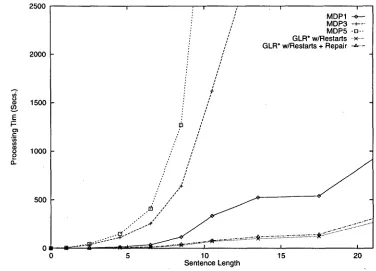
T h e LR M D P parser was run over the corpus at three different flexibility settings. T h e first setting, M D P 1, is M i n i m u m Distance Parsing with m a x - i m u m deviation p e n a l t y of 1. Similarly, M D P 3 and M D P 5 are M D P with m a x i m u m devaition penalty of 3 and 5 respectively. We also ran the version of G L R * where only initial segments can be skipped which we refer to as G L R * w i t h R e s t a r t s . Thus, while the parser can restart from each word in the sentence, analyses produced are always for con- tiguous segments of the sentence. We ran G L R *
w i t h R e s t a r t s both with and w i t h o u t repair. T i m - ings for all five of these iterations over the corpus are displayed in Figure 5. Notice t h a t G L R * w i t h R e s t a r t s is significantly faster t h a n even M D P 1. And since the repair stage is run only for sentences t h a t the repair module determines need repair, and since the repair process takes only seconds on aver- age to run, no significant difference in t i m e can be seen in this graph between the case with repair and the case without repair.
[image:8.612.112.488.72.343.2]w i t h R e s t a r t s without repair. Though these re- sults display certain trends in the performance of these alternative approaches, the differences in gen- eral are very small. For example, the difference in number of acceptable translations between M D P 5 and G L R * w i t h r e s t a r t s + r e p a i r is only about 1%. The largest difference between the two is that G L R * w i t h r e s t a r t s + r e p a i r has about 7% more sentences with translation quality of Partial or bet- ter, indicating that G L R * w i t h r e s t a r t s + r e p a i r produces analyses that are useful for furthering the conversation between the two speakers using the sys- tem 7% more often than M D P 5.
While we have no doubt that increasingly more flexible versions of MDP would perform better than M D P 5, we have already demonstrated that even M D P 5 is impractical in terms of its run-time per- formance. Thus we conclude that the two stage ROSE approach, even with a very limited flexibil- ity parser, is a superior choice. We believe that by increasing the flexibility of the parser to include very limited skipping in addition to restarts would in- crease the performance of this two stage approach without incurring a significant increase in run time performance. Determining exactly how much skip- ping is ideal is a direction for future research.
8 C o n c l u s i o n s
In this paper we addressed the issue of how to ef- ficiently handle the problem of extragrammaticality in a large-scale spontaneous spoken language sys- tem. We argue that even though Minimum Dis- tance Parsing offers a theoretically attractive so- lution to the problem of extragrammaticality, it is computationally infeasible in large scale practical applications. Our analysis demonstrates that the ROSE approach, consisting of a skipping parser with limited flexibility coupled with a completely auto= matic post-processing repair module, performs sig- nificantly faster than even a version of MDP limited only to skipping and inserting and constrained to a maximum deviation penalty of 5, while producing analyses of superior quality.
R e f e r e n c e s
Abney, S. 1996. Partial parsing via finite-state cas- cades. In Proceedings of the Eight European Sum- mer School In Logic, Language and Information, Prague, Czech Republic.
Danieli, M. and E. Gerbino. 1995. Metrics for eval- uating dialogue strategies in a spoken language system. In Working Notes of the A A A I Spring Symposium on Empirical Methods in Discourse Interpretation and Generation.
Ehrlich, U. and G. Hanrieder. 1996. Robust speech parsing. In Proceedings of the Eight European
Summer School In Logic, Language and Informa- tion, Prague, Czech Republic.
Federici, S., S. Montemagni, and V. Pirrelli. 1996. Shallow parsing and text chunking: a view on un- derspecification in syntax. In Proceedings of the Eight European Summer School In Logic, Lan- guage and Information, Prague, Czech Republic.
Hipp, D. R. 1992. Design and Development of Spo- ken Natural-Language Dialog Parsing Systems.
Ph.D. thesis, Dept. of Computer Science, Duke University.
Koza, J. 1992. Genetic Programming: On the Pro- gramming of Computers by Means of Natural Se-
lection. MIT Press.
Koza, J. 1994. Genetic Programming II. MIT Press.
Lavie, A. 1995. A Grammar Based Robust Parser
For Spontaneous Speech. Ph.D. thesis, School of
Computer Science, Carnegie Mellon University.
Lavie, A., D. Gates, M. Gavalda, L. Mayfield, and A. Waibel L. Levin. 1996. Multi-lingual transla- tion of spontaneously spoken language in a limited domain. In Proceedings of COLING 96, Kopen- hagen.
Lavie, A. and M. Tomita. 1993. GLR* - an efficient noise-skipping parsing algorithm for context free grammars. In Proceedings of the Third Interna- tional Workshop on Parsing Technologies.
Lehman, J. F. 1 9 8 9 . Adaptive Parsing: Self-
Extending Natural Language Interfaces. Ph.D.
thesis, School of Computer Science, Carnegie Mel- lon University. CMU-CS-89-191.
Nord, G. Van. 1996. Robist parsing with the head- corner parser. In Proceedings of the Eight Euro- penn Summer School In Logic, Language and In- formation, Prague, Czech Republic.
Srinivas, B., C. Doran, B. Hockey, and A. Joshi. 1996. An approach to robust partial parsing and evaluation metrics. In Proceedings of the Eight European Summer School In Logic, Language and Information, Prague, Czech Republic.
Woszcyna, M., N. Aoki-Waibel, F. D. Buo, N. Coc- caro, K. Horiguchi, T. Kemp, A. Lavie, A. Mc- Nair, T. Polzin, I. Rogina, C. P. Ros@, T. Schultz, B. Suhm, M. Tomita, and A. Waibel. 1994. JANUS 93: Towards spontaneous speech transla- tion. In Proceedings of the International Confer- ence on Acoustics, Speech, and Signal Processing.