Proceedings of the 2019 Conference on Empirical Methods in Natural Language Processing and the 9th International Joint Conference on Natural Language Processing, pages 5077–5089,
5077
Read, Attend and Comment: A Deep Architecture for Automatic News
Comment Generation
Ze Yang†, Can Xu♦, Wei Wu♦, Zhoujun Li†∗
†State Key Lab of Software Development Environment, Beihang University, Beijing, China
♦Microsoft Corporation, Beijing, China
{tobey, lizj}@buaa.edu.cn{wuwei, caxu}@microsoft.com
Abstract
Automatic news comment generation is a new testbed for techniques of natural language gen-eration. In this paper, we propose a “read-attend-comment” procedure for news com-ment generation and formalize the procedure with a reading network and a generation net-work. The reading network comprehends a news article and distills some important points from it, then the generation network creates a comment by attending to the extracted discrete points and the news title. We optimize the model in an end-to-end manner by maximiz-ing a variational lower bound of the true objec-tive using the back-propagation algorithm. Ex-perimental results on two datasets indicate that our model can significantly outperform exist-ing methods in terms of both automatic evalu-ation and human judgment.
1 Introduction
In this work, we study the problem of automatic news comment generation, which is a less ex-plored task in the literature of natural language generation (Gatt and Krahmer, 2018). We are aware that numerous uses of these techniques can pose ethical issues and that best practices will be necessary for guiding applications. In particular, we note that people expect comments on news to be made by people. Thus, there is a risk that peo-ple and organizations could use these techniques at scale to feign comments coming from people for purposes of political manipulation or persuasion. In our intended target use, we explicitly disclose the generated comments on news as being formu-lated automatically by an entertaining and engag-ing chatbot (Shum et al.,2018). Also, we under-stand that the behaviors of deployed systems may need to be monitored and guided with methods, including post-processing techniques (van Aken
∗
Corresponding Author
Title: FIFA rankings: France number one, Croatia and England soar, Germany and Argentina plummet
Body (truncated):World Cup glory has propelled France to the top of FIFA’s latest world rankings, with the impact of Russia 2018 felt for better or worse among a number of football’s heavyweight nations.
These are the first set of rankings released under FIFA’s new formula that ”relies on adding/subtracting points won or lost for a game to/from the previous point totals rather than averaging game points over a given time period”. FIFA world rankings: 1.France 2.Belgium 3. Brazil 4. Croatia 5. Uruguay 6. England 7. Portugal 8. Switzer-land 9. Spain 10. Denmark
Comment A:If it’s heavily based on the 2018 WC, hence England leaping up the rankings, how are Brazil at 3? Comment B:England above Spain, Portugal and Ger-many. Interesting.
Table 1: A news example from Yahoo!
et al.,2018). While there are risks with this kind of AI research, we believe that developing and demonstrating such techniques is important for understanding valuable and potentially troubling applications of the technology.
oversimplify the problem of news comment gen-eration and are far from how people behave on news websites. In practice, people read a news article, draw attention to some points in the arti-cle, and then present their comments along with the points they are interested in. Table1illustrates news commenting with an example from Yahoo! News.1 The article is about the new FIFA rank-ing, and we pick two comments among the many to explain how people behave in the comment sec-tion. First, both commenters have gone through the entire article, as their comments are built upon the details in the body. Second, the article gives many details about the new ranking, but both com-menters only comment on a few points. Third, the two commenters pay their attention to differ-ent places of the article: the first one notices that the ranking is based on the result of the new world cup, and feels curious about the position of Brazil; while the second one just feels excited about the new position of England. The example indicates a “read-attend-comment” behavior of humans and sheds light on how to construct a model.
We propose a reading network and a generation network that generate a comment from the entire news article. The reading network simulates how people digest a news article, and acts as an encoder of the article. The generation network then simu-lates how people comment the article after reading it, and acts as a decoder of the comment. Specifi-cally, from the bottom to the top, the reading net-work consists of a representation layer, a fusion layer, and a prediction layer. The first layer repre-sents the title of the news with a recurrent neural network with gated recurrent units (RNN-GRUs) (Cho et al., 2014) and represents the body of the news through self-attention which can model long-term dependency among words. The second layer forms a representation of the entire news article by fusing the information of the title into the repre-sentation of the body with an attention mechanism and a gate mechanism. The attention mechanism selects useful information in the title, and the gate mechanism further controls how much such infor-mation flows into the representation of the article. Finally, the third layer is built on top of the pre-vious two layers and employs a multi-label clas-sifier and a pointer network (Vinyals et al.,2015) to predict a bunch of salient spans (e.g., words,
1https://www.yahoo.com/news/
fifa-rankings-france-number-one-112047790. html
phrases, and sentences, etc.) from the article. With the reading network, our model comprehends the news article and boils it down to some key points (i.e., the salient spans). The generation network is an RNN language model that generates a com-ment word by word through an attention mecha-nism (Bahdanau et al.,2015) on the selected spans and the news title. In training, since salient spans are not explicitly available, we treat them as a la-tent variable, and jointly learn the two networks from article-comment pairs by optimizing a lower bound of the true objective through a Monte Carlo sampling method. Thus, training errors in com-ment prediction can be back-propagated to span selection and used to supervise news reading com-prehension.
We conduct experiments on two large scale datasets. One is a Chinese dataset published re-cently in (Qin et al., 2018), and the other one is an English dataset built by crawling news articles and comments from Yahoo! News. Evaluation re-sults on the two datasets indicate that our model can significantly outperform existing methods on both automatic metrics and human judgment.
Our contributions are three-folds: (1) proposal of “read-attend-comment” procedure for news comment generation with a reading network and a generation network; (2) joint optimization of the two networks with an end-to-end learning ap-proach; and (3) empirical verification of the effec-tiveness of the proposed model on two datasets.
2 Related Work
News comment generation is a sub-task of nat-ural language generation (NLG). Among various NLG tasks, the task studied in this paper is most related to summarization (Rush et al.,2015; Nal-lapati et al., 2016; See et al., 2017) and product review generation (Tang et al.,2016;Dong et al.,
a gated attention neural network model to gener-ate news comments from news titles. The model is further improved by a generative adversarial net.
Qin et al.(2018) publish a dataset with results of some basic models. Different from all the exist-ing methods, we attempt to comprehend the entire news articles before generation and perform end-to-end learning that can jointly optimize the com-prehension model and the generation model.
Our model is partially inspired by the re-cent success of machine reading comprehension (MRC), whose prosperity can be attributed to an increase of publicly available large scale annotated datasets, such as SQuAD (Rajpurkar et al., 2016,
2018) and MS Marco (Nguyen et al., 2016) etc. A great number of models have been proposed to tackle the MRC challenges, including BiDAF (Seo et al.,2016), r-net (Wang et al.,2017), DCN (Xiong et al.,2016), Document Reader (Chen and Bordes,2017), QANet (Yu et al.,2018), and s-net (Tan et al., 2018) etc. Our work can be viewed as an application of MRC to a new NLG task. The task aims to generate a comment for a news article, which is different from existing MRC tasks whose goal is to answer a question. Our learning method is also different from those in the MRC works.
3 Approach
3.1 Problem Formalization
Suppose we have a datasetD={(Ti, Bi, Ci)}Ni=1, where thei-th triple(Ti, Bi, Ci)consists of a news title Ti, a news body Bi, and a comment Ci. Our goal is to estimate a probability distribution
P(C|T, B) from D, and thus, given a new arti-cle (T, B) with T the news title andB the news body, we can generate a comment C following
P(C|T, B).
3.2 Model Overview
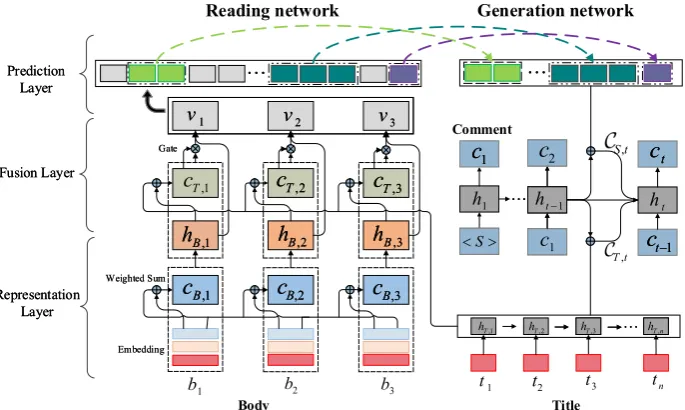
Figure1illustrates the architecture of our model. In a nutshell, the model consists of a reading work and a generation network. The reading net-work first represents a news title and a news body separately in a representation layer, then forms a representation of the entire article by fusing the title into the body through a fusion layer, and fi-nally distills some salient spans from the article by a prediction layer. The salient spans and the news title are then fed to the generation network to syn-thesize a comment. With the two networks, we can factorize the generation probabilityP(C|T, B)as
P(S|T, B)·P(C|S, T), whereS = (s1, . . . , sw) refers to a set of spans inB,P(S|T, B)represents the reading network, andP(C|S, T)refers to the generation network.
3.3 Reading Network
In the representation layer, let T = (t1, . . . , tn) be a news title with tj the j-th word, and B =
(b1, . . . , bm)be the associated news body withbk thek-th word, we first look up an embedding ta-ble and represent tj and bk as eT ,j ∈ Rd1 and
eB,k ∈ Rd1 respectively, where eT,j and eB,k are randomly initialized, and jointly learned with other parameters. Different from the title, the body is long and consists of multiple sentences. Hence, to emphasize positional information of words in the body, we further expand eB,k with
oB,k and sB,k, where oB,k, sB,k ∈ Rd2 are
po-sitional embeddings with the former indexing the position of bk in its sentence and the latter indi-cating the position of the sentence in the entire body. The representation of bk is then given by
ˆ
eB,k = MLP([eB,k;oB,k;sB,k]), where ˆeB,k ∈
Rd1, MLP(·) refers to a multi-layer perceptron
with two layers, and [·;·;·]means the concatena-tion of the three arguments.
Starting fromET = (eT ,1, . . . , eT ,n)andEB =
(ˆeB,1, . . . ,eˆB,m) as initial representations of T and B respectively, the reading network then transforms T into a sequence of hidden vectors
HT = (hT ,1, . . . , hT ,n) with a recurrent neu-ral network with gated recurrent units (RNN-GRUs) (Cho et al., 2014). In the meanwhile,
B is transformed to HB = (hB,1, . . . , hB,m) with the k-th entry hB,k ∈ Rd1 defined as
MLP([ˆeB,k;cB,k]) (two layers) and cB,k is an attention-pooling vector calculated by a scaled dot-product attention (Vaswani et al., 2017) de-noted asdot-att(EB,eˆB,k):
cB,k=Pmj=1αk,jeˆB,j,
αk,j=exp(sk,j)/Pml=1exp(sk,l),
sk,j= (ˆe > B,keˆB,j)/
√
d1.
(1)
In Equation (1), a word is represented via all words in the body weighted by their similarity. By this means, we try to capture the dependency among words in long distance.
The fusion layer takes HT and HB as inputs, and producesV = (v1, . . . , vm)as new represen-tation of the entire news article by fusingHT into
1
t t2
,2 T h ,1 T h , T t , S t 1 h SS t h ,3 T hT,3
h hhT nT n,,
3
t tn
Body
Reading network Generation network
Title 1 c1 c 1 t
ct−1 c− t ct c 1 t h− 1 c1 c 2 c2 c 1 t h− 1 c 2 c Comment 1 b ,1 B
cB,1 c
,1
B hB,1 h
2
b
,2
B
cB,2 c
,2
B hB,2 h
3
b
,3
B
cB,3 c
,3
B hB,3 h
,1
T
c ccTT,2,2 ccTT,3,3
1 v1
[image:4.595.129.472.63.268.2]v vv22 vv33 Prediction Layer Embedding Gate Representation Layer Fusion Layer Weighted Sum Prediction Layer Embedding Gate Representation Layer Fusion Layer Weighted Sum
Figure 1: Architecture of our model. The black solid arrows represent differentiable operations and the dashed arrows are non-differentiable operations which represent distilling points from news body.
attend to HT and form a representation cT ,k = dot-att(HT, hB,k), wheredot-att(HT, hB,k)is pa-rameterized as Equation (1). With this step, we aim to recognize useful information in the title. Then we combinecT,kandhB,kasvk∈Rd1 with
a gate gk which balances the impact of cT,k and
hB,k and filters noise fromcT ,k.vkis defined by:
vk=hB,k+gkcT ,k,
gk=σ(Wg[hB,k;cT ,k]),
(2)
The top layer of the reading network extracts a bunch of salient spans based on V. Let S = ((a1, e1), . . . ,(aw, ew)) denote the salient spans, whereai andei refer to the start position and the end position of thei-th span respectively, we pro-pose detecting the spans with a multi-label classi-fier and a pointer network. Specifically, we for-malize the recognition of(a1, . . . , aw)as a multi-label classification problem with V as an input andL = (l1, . . . , lm) as an output, where ∀k ∈
{1, . . . , m},lk = 1means that thek-th word is a start position of a span, otherwise lk = 0. Here, we assume that(a1, . . . , aw)are independent with each other, then the multi-label classifier can be defined asmbinary classifiers with thek-th clas-sifier given by
ˆ
yk=softmax(MLPk(vk)), (3)
where MLPk(·) refers to a two-layer MLP, and
ˆ
yk ∈ R2 is a probability distribution with the
first entry asP(lk = 0)and the second entry as
P(lk = 1). The advantage of the approach is that
it allows us to efficiently and flexibly detect a vari-able number of spans from a varivari-able-length news article, as there is no dependency among the m
classifiers, and they can be calculated in parallel. Givenak, the end positionekis recognized via a probability distribution(αak,1, . . . , αak,m) which is defined by a pointer network:
αak,j=exp(sak,j)/ Pm
l=1exp(sak,l),
sak,j =V
>
tanh(Wvvj+Whhak,1),
hak,1=GRU(h0,[c0;vak]),
(4)
whereh0 =att(V, r)is an attention-pooling vec-tor based on parameterr:
h0 =Pmj=1βj·vj,
βj=exp(βj0)/ Pm
l=1exp(β 0 l),
βj0 =V >
1 tanh(Wv,1vj+Wh,1r),
(5)
c0 =att(V, h0)is defined in a similar way withr replaced byh0.
Let us denote(a1, . . . , aw)asstartandP(li =
1)aspi, thenP(S|T, B)can be formulated as
P(S|T, B) =
w Y
k=1
[pak·αak,ek] Y
i /∈start,1≤i≤m
[1−pi]. (6)
article and thus hard to tune, or we can only pick a fixed number of spans for any articles by ranking the probabilities. Neither of them is favorable.
3.4 Generation Network
With S = ((a1, e1), . . . ,(aw, ew)) the salient spans, V = (v1, . . . , vm) the representation of the news article, and HT the represen-tation of the news title given by the three layers of the reading network respectively, we define a representation of S as HS = (va1, va1+1, . . . , ve1, . . . , vaw, vaw+1, . . . , vew). The generation network takes HT and HS as inputs and decodes a comment word by word via attending to bothHT andHS. At stept, the hidden state isht =GRU(ht−1,[eC,t−1;CT,t−1;CS,t−1]),
ht ∈ Rd1. eC,t−1 is the embedding of the word generated at step t-1, CT,t−1 = att(HT, ht−1) and CS,t−1 = att(HS, ht−1) are context vectors that represent attention on the title and the spans respectively. att(·,·)is defined as Equation (5).
With ht, we calculate CT ,t and CS,t via
att(HT, ht)andatt(HS, ht)respectively and ob-tain a probability distribution over vocabulary by Pt = softmax(V[ht;CT,t;CS,t] + b). Let
C = (c1, . . . , co) be a comment where ∀k ∈
{1, . . . , o},ck is the index of the k-th word ofC in vocabulary, thenP(C|S, T)is defined as
P(C|S, T) =P(c1|S, T) o Y
t=2
P(ct|c1, . . . , ct−1, S, T)
=P1(c1) o Y
t=2
Pt(ct),
where Pt(ct) refers to the ct-th entry of Pt. In decoding, we define the initial state h0 as an attention-pooling vector over the concatenation of
HT andHS given byatt([HT;HS], q). qis a pa-rameter learned from training data.
3.5 Learning Method
We aim to learnP(S|T, B) andP(C|S, T) from
D = {(Ti, Bi, Ci)}Ni=1, but S is not explicitly available, which is a common case in practice. To address the problem, we treatS as a latent vari-able, and consider the following objective:
J =
N X
i=1
logP(Ci|Ti, Bi)
=
N X
i=1
log X
Si∈S
P(Si|Ti, Bi)P(Ci|Si, Ti
,
(7)
whereS refers to the space of sets of spans, and
Si is a set of salient spans for(Ti, Bi). Objective
J is difficult to optimize, as logarithm is outside the summation. Hence, we turn to maximizing a lower bound of ObjectiveJ which is defined as:
L=
N X
i=1 X
Si∈S
P(Si|Ti, Bi) logP(Ci|Si, Ti)<J (8)
Let Θ denote all parameters of our model and ∂Li
∂Θ denote the gradient of L on an example
(Ti, Bi, Ci), then ∂∂LΘi is given by
X
Si∈S
P(Si|Ti, Bi)
h∂logP(Ci|Si, Ti)
∂Θ +
logP(Ci|Si, Ti)
∂logP(Si|Ti, Bi)
∂Θ
i
.
(9)
To calculate the gradient, we have to enumerate all possibleSis for(Ti, Bi), which is intractable. Thus, we employ a Monte Carlo sampling method to approximate∂Li
∂Θ. Suppose that there areJ sam-ples, then the approximation of ∂Li
∂Θ is given by
1
J
J X
n=1
h∂logP(Ci|Si,n, Ti)
∂Θ +
logP(Ci|Si,n, Ti)
∂logP(Si,n|Ti, Bi)
∂Θ
i
,
(10)
where∀n,Si,nis sampled by first drawing a group of start positions according to Equation (3), and then picking the corresponding end positions by Equations (4)-(5). Although the Monte Carlo es-timator is unbiased, it typically suffers from high variance. To reduce variance, we subtract base-lines fromlogP(Ci|Si,n, Ti). Inspired by (Mnih
and Gregor, 2014), we introduce an observation-dependent baselineBψ(Ti, Ci)to capture the sys-tematic difference in news-comment pairs during training. Besides, we also exploit a global baseline
Bto further control the variance of the estimator. The approximation of ∂Li
∂Θ is then re-written as
1
J
J X
n=1
h∂logP(Ci|Si,n, Ti)
∂Θ +
logP(Ci|Si,n, Ti)
− Bψ(Ti, Ci)− B
∂logP(Si,n|Ti, Bi)
∂Θ
i
.
(11)
of the GRUs and the MLP are estimated via
min(Ti,Bi)∈mini-batch,1≤n≤J[logP(Ci|Si,n, Ti) −
Bψ(Ti, Ci)− B]2.
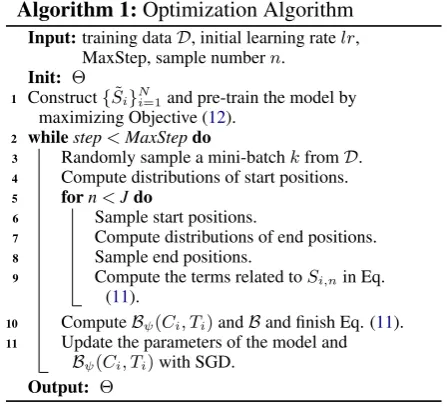
The learning algorithm is summarized in Algo-rithm 1. To speed up convergence, we initialize our model through pre-training the reading net-work and the generation netnet-work. Specifically,
∀(Ti, Bi, Ci) ∈ D, we construct an artificial span set S˜i, and learn the parameters of the two net-works by maximizing the following objective:
N X
i=1
logP( ˜Si|Ti, Bi) + logP(Ci|Ti,S˜i) (12)
˜
Si is established in two steps: first, we collect all associated comments for(Ti, Bi), extract n-grams (1≤n≤6) from the comments, and recognize an n-gram inBias a salient span if it exactly matches with one of the n-grams of the comments. Second, we breakBias sentences and calculate a matching score for a sentence and an associated comment. Each sentence corresponds to a group of match-ing scores, and if any one of them exceeds 0.4, we recognize the sentence as a salient span. The matching model is pre-trained with {Ti, Ci}Ni=1 withCias a positive example and a randomly sam-pled comment from other news as a negative ex-ample. In the model,TiandCiare first processed by GRUs separately, and then the last hidden states of the GRUs are fed to a three-layer MLP to cal-culate a score.
Algorithm 1:Optimization Algorithm Input:training dataD, initial learning ratelr,
MaxStep, sample numbern. Init: Θ
1 Construct{S˜i}Ni=1and pre-train the model by
maximizing Objective (12).
2 whilestep<MaxStepdo
3 Randomly sample a mini-batchkfromD. 4 Compute distributions of start positions. 5 forn<Jdo
6 Sample start positions.
7 Compute distributions of end positions. 8 Sample end positions.
9 Compute the terms related toSi,nin Eq.
(11).
10 ComputeBψ(Ci, Ti)andBand finish Eq. (11). 11 Update the parameters of the model and
Bψ(Ci, Ti)with SGD.
Output: Θ
4 Experiments
We test our model on two large-scale news com-menting datasets.
Train Dev Test
Tencent # News 191,502 5,000 1,610 Avg. # Cmts per News 27 27 27
[image:6.595.69.293.490.693.2]Yahoo # News 152,355 5,000 3,160 Avg. # Cmts per News 20.6 20.5 20.5
Table 2: Statistics of the two datasets.
4.1 Experimental Setup
The first dataset is a Chinese dataset built from Tencent News (news.qq.com) and published re-cently in (Qin et al.,2018). Each data point con-tains a news article which is made up of a ti-tle and a body, a group of comments, and some side information including upvotes and categories. Each test comment is labeled by two annotators according to a 5-scale labeling criteria presented in Table 3. All text in the data is tokenized by a Chinese word segmenter Jieba (https:
//github.com/fxsjy/jieba). The
aver-age lengths of news titles, news bodies, and com-ments are15words, 554words and17words re-spectively. In addition to the Chinese data, we also build another dataset by crawling news ar-ticles and the associated comments from Yahoo! News. Besides upvotes and categories, side in-formation in Yahoo data also includes paragraph marks, WIKI-entities, downvotes, abusevotes, and sentiment tagged by Yahoo!. Text in the data is to-kenized by Stanford CoreNLP pipline (Manning et al., 2014). As pre-processing, we filter out news articles shorter than 30 words in the body and comments shorter than 10 words or longer than 100words. Then, we remove news articles with less than5comments. If the number of com-ments of an article exceeds30, we only keep top
30comments with the most upvotes. On average, news titles, news bodies, and comments contain
12 words, 578 words and 32 words respectively. More information about Yahoo data can be found in AppendixA. After the pre-processing, we ran-domly sample a training set, a validation set, and a test set from the remaining data, and make sure that there is no overlap among the three sets. Ta-ble2summarizes the statistics of the two datasets. Note that we only utilize news titles, news bod-ies and comments to learn a generation model in this work, but both datasets allow modeling news comment generation with side information, which could be our future work.
Score Criteria
5 Rich in content; attractive; deep insights; new yet relevant viewpoints
4 Highly relevant with meaningful ideas 3 Less relevant; applied to other articles 2 Fluent/grammatical; irrelevant
1 Hard to read; Broken language; Only emoji
Table 3: Human judgment criteria
performance of different models with both au-tomatic metrics and human judgment. In terms of automatic evaluation, we employ BLEU ( Pap-ineni et al.,2002), METEOR (Banerjee and Lavie,
2005), ROUGE (Lin, 2004), and CIDEr ( Vedan-tam et al.,2015) as metrics on both data. Besides these metrics, Qin et al. (2018) propose human score weighted metrics including BLEU, W-METEOR, W-ROUGE and W-CIDEr. These met-rics, however, requires human judgment on each comment in the test set. Thus, we only involve re-sults w.r.t. these metrics in Tencent data. AsQin et al. (2018) do not publish their code for metric calculation, we employ a popular NLG evaluation project available at https://github.com/
Maluuba/nlg-eval, and modify the scripts
with the scores provided in the data according to the formulas in (Qin et al., 2018) to calculate all the metrics. In human evaluation, for each dataset, we randomly sample500articles from the test data and recruit three native speakers to judge the qual-ity of the comments given by different models. For every article, comments from all models are pooled, randomly shuffled, and presented to the annotators. Each comment is judged by the three annotators under the criteria in Table3.
4.2 Baselines
The following models are selected as baselines: Basic models: the retrieval models and the gen-eration models used in (Qin et al., 2018) includ-ing (1) IR-T and IR-TC: both models retrieve a set of candidate articles with associated comments by cosine of TF-IDF vectors. Then the comments are ranked by a convolutional neural network (CNN) and the top position is returned. The difference is that IR-T only utilizes titles, while IR-TC lever-ages both titles and news bodies; (2) Seq2seq: the basic sequence-to-sequence model (Sutskever et al., 2014) that generates a comment from a ti-tle; and (3) Att and Att-TC: sequence-to-sequence with attention (Bahdanau et al.,2015) in which the input is either a title (Att) or a concatenation of
a title and a body (Att-TC). In Seq2seq, Att, and Att-TC, top 1 comment from beam search (beam size=5) is returned.
GANN: the gated attention neural network pro-posed in (Zheng et al.,2018). The model is further improved by a generative adversarial net.
We denote our model as “DeepCom” standing for “deep commenter”, as it is featured by a deep reading-commenting architecture. All baselines are implemented according to the details in the re-lated papers and tuned on the validation sets.
4.3 Implementation Details
For each dataset, we form a vocabulary with the top 30k frequent words in the entire data. We pad or truncate news titles, news bodies, and com-ments to make them in lengths of30,600, and50
respectively. The dimension of word embedding and the size of hidden states of GRU in all mod-els are set as256. In our model, we setd1 as256 andd2(i.e., dimension of the position embedding in the reading network) as128. The size of hidden layers in all MLPs is 512. The number of sam-ples in Monte Carlo sampling is1. In pre-training, we initialize our model with a Gaussian distribu-tionN(0,0.01)and optimize Objective (12) using AdaGrad (Duchi et al.,2011) with an initial learn-ing rate0.15and an initial accumulator value0.1. Then, we optimizeLusing stochastic gradient de-scent with a learning rate0.01. In decoding, top1
comment from beam search with a size of5is se-lected for evaluation. In IR-T and IR-TC, we use three types of filters with window sizes1, 3, and
5in the CNN based matching model. The number of each type of filters is128.
4.4 Evaluation Results
Dataset Models METEOR W-METEOR Rouge L W-Rouge L CIDEr W-CIDEr BLEU-1 W-BLEU-1 Human Kappa
Tencent
IR-T 0.107 0.086 0.254 0.217 0.018 0.014 0.495 0.470 2.43 0.64
IR-TC 0.127 0.101 0.266 0.225 0.056 0.044 0.474 0.436 2.57 0.71
Seq2seq 0.064 0.047 0.196 0.150 0.011 0.008 0.374 0.320 1.68 0.83
Att 0.080 0.058 0.246 0.186 0.010 0.007 0.481 0.453 1.81 0.79
Att-TC 0.114 0.082 0.299 0.223 0.023 0.017 0.602 0.551 2.26 0.69
GANN 0.097 0.075 0.282 0.222 0.010 0.008 0.312 0.278 2.06 0.73
DeepCom 0.181 0.138 0.317 0.250 0.029 0.023 0.721 0.656 3.58 0.65
Yahoo
IR-T 0.114 - 0.214 - 0.014 - 0.472 - 2.71 0.67
IR-TC 0.117 - 0.219 - 0.017 - 0.483 - 2.86 0.61
Seq2seq 0.061 - 0.203 - 0.011 - 0.365 - 2.26 0.68
Att 0.075 - 0.217 - 0.017 - 0.462 - 2.29 0.78
Att-TC 0.089 - 0.246 - 0.022 - 0.515 - 2.74 0.63
GANN 0.079 - 0.228 - 0.019 - 0.496 - 2.52 0.64
[image:8.595.74.523.63.219.2]DeepCom 0.107 - 0.263 - 0.024 - 0.665 - 3.35 0.68
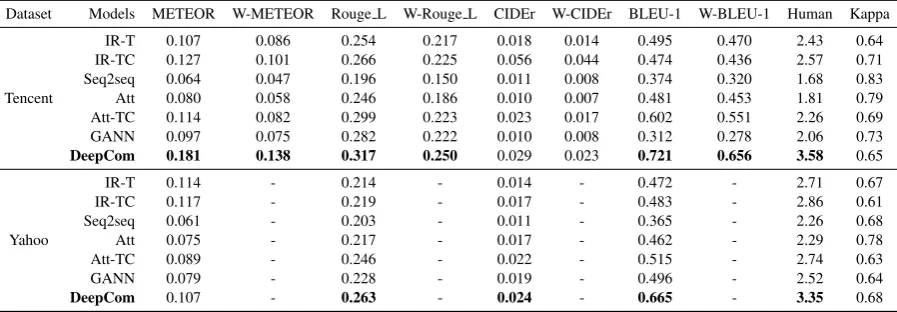
Table 4: Evaluation results on automatic metrics and human judgment. Human evaluation results are calculated by combining labels from the three judges. “Kappa” means Fleiss’ kappa. Numbers in bold mean that improvement over the best baseline is statistically significant.
Dataset Metrics No Reading No Prediction No Sampling Full Model
Tencent
METEOR 0.096 0.171 0.171 0.181 W-METEOR 0.072 0.129 0.131 0.138 Rouge L 0.282 0.307 0.303 0.317 W-Rouge L 0.219 0.241 0.239 0.250 CIDEr 0.012 0.024 0.026 0.029 W-CIDEr 0.009 0.019 0.021 0.023 BLEU-1 0.426 0.674 0.667 0.721 W-BLEU-1 0.388 0.614 0.607 0.656
Yahoo
METEOR 0.081 0.092 0.102 0.107 Rouge L 0.232 0.245 0.244 0.263 CIDEr 0.017 0.023 0.020 0.024 BLEU-1 0.490 0.531 0.609 0.665
Table 5: Model ablation results
than0.6, indicating substantial agreement among the annotators. Although built in a complicated structure, GANN does not bring much improve-ment over other baseline methods, which demon-strates that only using news titles is not enough in comment generation. IR-TC and Att-TC repre-sent the best retrieval model and the best genera-tion model among the baselines on both datasets, implying that news bodies, even used in a simple way, can provide useful information to comment generation.
4.5 Discussions
Ablation study: We compare the full model of DeepCom with the following variants: (1) No Reading: the entire reading network is replaced by a TF-IDF based keyword extractor, and top40
keywords (tuned on validation sets) are fed to the generation network; (2) No Prediction: the pre-diction layer of the reading network is removed, and thus the entireVis used in the generation net-work; and (3) No Sampling: we directly use the model pre-trained by maximizing Objective (12). Table 5 reports the results on automatic metrics.
We can see that all variants suffer from perfor-mance drop and No Reading is the worst among the three variants. Thus, we can conclude that (1) span prediction cannot be simply replaced by TF-IDF based keyword extraction, as the former is based on a deep comprehension of news articles and calibrated in the end-to-end learning process; (2) even with sophisticated representations, one cannot directly feed the entire article to the gen-eration network, as comment gengen-eration is vulner-able to the noise in the article; and (3) pre-training is useful, but optimizing the lower bound of the true objective is still beneficial.
To further understand why DeepCom is supe-rior to its variants, we calculate BLEU-1 (denoted as BLEUspan) with the predicted spans and the
ground truth comments in the test sets of the two data, and compare it with a baseline BLEU-1 (de-noted as BLEUbase) which is calculated with the
entire news articles and the ground truth com-ments. On Tencent data, BLEUspanand BLEUbase
are0.31and0.17respectively, and the two num-bers on Yahoo data are0.29and0.16respectively. This means that by extracting salient spans from news articles, we can filter out redundant infor-mation while keeping the points that people like to comment on, which explains why DeepCom is better than No Prediction. When comparing Deep-Come with No Sampling, we find that spans in DeepCom are longer than those in No Sampling. In the test set of Tencent data, the average lengths of salient spans with and without sampling are
informa-1 2 3 4 5
Tencent
IR-TC 0.3% 55.2% 33.3% 9.50% 1.7% Att-TC 19.3% 49.5% 18.5% 11.7% 1.0% DeepCom 1.5% 3.3% 32.0% 61.9% 1.3%
Yahoo
[image:9.595.73.289.63.134.2]IR-TC 1.3% 53.0% 14.7% 20.3% 10.7% Att-TC 20.3% 22.3% 22.6% 32.1% 2.7% DeepCom 1.7% 17.6% 33.3% 39.4% 8.0%
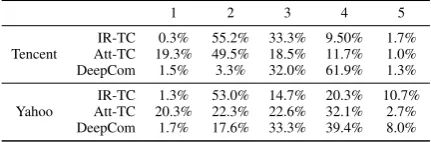
Table 6: Human score distributions
tion rather than a few single words or bi-grams in comment generation, which demonstrates the ad-vantage of our learning method.
Analysis of human annotations: We check the distributions of human labels for DeepCom, Att-TC, and IR-TC to get insights on the problems these models suffer from. Table6 shows the re-sults. Most of the bad comments from IR-TC are labeled as “2”, meaning that although IR-TC can give attractive comments with rich and deep con-tent, its comments are easy to diverge from the news articles and thus be judged as “irrelevant”. In terms of Att-TC, there are much more com-ments judged as “1” than the other two models, indicating that Att-TC often generates ill-formed sentences. This is because a news article and a comment are highly asymmetric in terms of both syntax and semantics, and thus the generation pro-cess cannot be simply modeled with an encoder-decoder structure. Bad cases from DeepCom con-centrate on “3”, reminding us that we need to fur-ther enrich the content of comments and improve their relevance in the future.
Case Study: Finally, to further understand our model, we visualize the predicted salient spans and the generated comment using a test example from Tencent dataset in Table 7. Due to space limitation, we truncate the body and only show three of the selected spans in the truncated body. The full article with the full set of spans and an-other test example from Yahoo! News dataset are shown in Appendix B. In spite of this, we can see that the model finds some interesting points after “reading” the article and synthesizes a com-ment along one of the spans (i.e. “Chinese Pal-adin 3”). More interestingly, the model extends the content of the article in the comment with “Luo Jin”, who is Tiffany Tang’s partner but is not talked about in the article. On the other hand, comments given by the baseline methods are either too gen-eral (Att-TC, the best generation baseline), or to-tally irrelevant with the article (IR-TC, the best
re-Title: 唐嫣为什么不演清宫剧?(Why Tiffany Tang never plays a role in a drama set in Qing dynasty?)
Body (truncated): 众多的 戏剧影 视作品 让
唐嫣获得不少人气,众多活动的多变造型
树立其在大众心中百变小天后的形象。... 如果 说唐嫣最美的造型是《仙剑奇侠传三》中的紫萱, 那最丑的造型应该就是这个了吧!...
(... The numerous television series and movies Tiffany Tang acted in have made her very popular, and her varied modelling in many activities has set her an image of ”the queen of reinvention” in the hearts of the public. ... If her most beautiful role is Zi Xuan in “Chinese Paladin 3”, then the most ugly one should be this! ... )
DeepCom: 唐嫣罗晋的演技真的很好,特别喜欢她 演《仙剑奇侠传》。我觉得这部剧挺好看。(Tiffany Tang and Luo Jin are really good actors. I especially like her role in “Chinese Paladin 3”. I think the TV drama is worth watching.)
[image:9.595.309.527.80.324.2]Att-TC:我也是醉了(I have nothing to comment.) IR-TC: 星爷和谁开撕过嘛, 都是别人去撕星 爷!(Stephen Chow never fights with others. It is others that fight with Stephen Chow!)
Table 7: A Case from Tencent News dataset. The con-tents in the red box represent salient spans predicted by the reading network. The content in the blue box is a generated entity which is included in the salient spans.
trieval baseline). The example demonstrates that our model can generate relevant and informative comments through analyzing and understanding news articles.
5 Conclusions
We propose automatic news comment generation with a reading network and a generation network. Experimental results on two datasets indicate that the proposed model can significantly outperform baseline methods in terms of both automatic eval-uation and human evaleval-uation. On applications, we are motivated to extend the capabilities of a pop-ular chatbot. We are aware of potential ethical is-sues with application of these methods to gener-ate news commentary that is taken as human. We hope to stimulate discussion about best practices and controls on these methods around responsible uses of the technology.
Acknowledgment
References
Betty van Aken, Julian Risch, Ralf Krestel, and Alexander L¨oser. 2018. Challenges for toxic com-ment classification: An in-depth error analysis.
arXiv preprint arXiv:1809.07572.
Dzmitry Bahdanau, Kyunghyun Cho, and Yoshua Ben-gio. 2015. Neural machine translation by jointly learning to align and translate. InInternational Con-ference on Learning Representations.
Satanjeev Banerjee and Alon Lavie. 2005. Meteor: An automatic metric for mt evaluation with im-proved correlation with human judgments. In Pro-ceedings of the ACL Workshop on Intrinsic and Ex-trinsic Evaluation Measures for Machine Transla-tion and/or SummarizaTransla-tion, pages 65–72. Associa-tion for ComputaAssocia-tional Linguistics.
Danqi Chen and Antoine Bordes. 2017. Reading wikipedia to answer open-domain questions. In Pro-ceedings of the 55th Annual Meeting of the Associa-tion for ComputaAssocia-tional Linguistics (Volume 1: Long Papers), pages 1870–1879.
Kyunghyun Cho, Bart van Merri¨enboer, Dzmitry Bah-danau, and Yoshua Bengio. 2014. On the proper-ties of neural machine translation: Encoder–decoder approaches. Proceedings of SSST-8, Eighth Work-shop on Syntax, Semantics and Structure in Statisti-cal Translation, pages 103–111.
Li Dong, Shaohan Huang, Furu Wei, Mirella Lapata, Ming Zhou, and Ke Xu. 2017. Learning to generate product reviews from attributes. InProceedings of the 15th Conference of the European Chapter of the Association for Computational Linguistics: Volume 1, Long Papers, pages 623–632.
John Duchi, Elad Hazan, and Yoram Singer. 2011.
Adaptive subgradient methods for online learning and stochastic optimization. J. Mach. Learn. Res., 12:2121–2159.
Albert Gatt and Emiel Krahmer. 2018. Survey of the state of the art in natural language generation: Core tasks, applications and evaluation. Journal of Artifi-cial Intelligence Research, 61:65–170.
Chin-Yew Lin. 2004. Rouge: A package for auto-matic evaluation of summaries.Text Summarization Branches Out.
Christopher D. Manning, Mihai Surdeanu, John Bauer, Jenny Finkel, Steven J. Bethard, and David Mc-Closky. 2014. The Stanford CoreNLP natural lan-guage processing toolkit. InAssociation for Compu-tational Linguistics (ACL) System Demonstrations, pages 55–60.
Andriy Mnih and Karol Gregor. 2014. Neural vari-ational inference and learning in belief networks. InProceedings of the 31st International Conference on International Conference on Machine Learn-ing - Volume 32, ICML’14, pages II–1791–II–1799. JMLR.org.
Ramesh Nallapati, Bowen Zhou, Cicero dos Santos, C¸ a glar Gulc¸ehre, and Bing Xiang. 2016. Abstrac-tive text summarization using sequence-to-sequence rnns and beyond. pages 280–290.
Tri Nguyen, Mir Rosenberg, Jianfeng Gao, and Li Deng. 2016. Ms marco: A human generated machine reading comprehension dataset. arXiv preprint arXiv:1611.09268.
Kishore Papineni, Salim Roukos, Todd Ward, and Wei-Jing Zhu. 2002. Bleu: a method for automatic eval-uation of machine translation. InProceedings of the 40th Annual Meeting of the Association for Compu-tational Linguistics, pages 311–318.
Lianhui Qin, Lemao Liu, Wei Bi, Yan Wang, Xiaojiang Liu, Zhiting Hu, Hai Zhao, and Shuming Shi. 2018. Automatic article commenting: the task and dataset.
arXiv preprint arXiv:1805.03668.
Pranav Rajpurkar, Robin Jia, and Percy Liang. 2018. Know what you don’t know: Unanswerable ques-tions for squad.arXiv preprint arXiv:1806.03822.
Pranav Rajpurkar, Jian Zhang, Konstantin Lopyrev, and Percy Liang. 2016.SQuAD: 100,000+ questions for machine comprehension of text. InProceedings of the 2016 Conference on Empirical Methods in Nat-ural Language Processing, pages 2383–2392.
Alexander M Rush, Chopra, and Jason Weston. 2015.
A neural attention model for abstractive sentence summarization. In Proceedings of the 2015 Con-ference on Empirical Methods in Natural Language Processing, pages 379–389.
Abigail See, Peter J Liu, and Christopher D Manning. 2017.Get to the point: Summarization with pointer-generator networks. InProceedings of the 55th An-nual Meeting of the Association for Computational Linguistics (Volume 1: Long Papers), pages 1073– 1083.
Minjoon Seo, Aniruddha Kembhavi, Ali Farhadi, and Hannaneh Hajishirzi. 2016. Bidirectional attention flow for machine comprehension. arXiv preprint arXiv:1611.01603.
Heung-Yeung Shum, Xiaodong He, and Di Li. 2018.
From eliza to xiaoice: Challenges and opportunities with social chatbots. Frontiers of Information Tech-nology & Electronic Engineering, 19(1):10–26.
Ilya Sutskever, Oriol Vinyals, and Quoc V. Le. 2014.
Sequence to sequence learning with neural net-works. In Proceedings of the 27th International Conference on Neural Information Processing Sys-tems - Volume 2, NIPS’14, pages 3104–3112, Cam-bridge, MA, USA. MIT Press.
Jian Tang, Yifan Yang, Sam Carton, Ming Zhang, and Qiaozhu Mei. 2016. Context-aware natural lan-guage generation with recurrent neural networks.
arXiv preprint arXiv:1611.09900.
Ashish Vaswani, Noam Shazeer, Niki Parmar, Jakob Uszkoreit, Llion Jones, Aidan N Gomez, Ł ukasz Kaiser, and Illia Polosukhin. 2017. Attention is all you need. In I. Guyon, U. V. Luxburg, S. Bengio, H. Wallach, R. Fergus, S. Vishwanathan, and R. Gar-nett, editors, Advances in Neural Information Pro-cessing Systems 30, pages 5998–6008. Curran As-sociates, Inc.
Ramakrishna Vedantam, C Lawrence Zitnick, and Devi Parikh. 2015. Cider: Consensus-based image de-scription evaluation. In The IEEE Conference on Computer Vision and Pattern Recognition (CVPR), pages 4566–4575.
Oriol Vinyals, Meire Fortunato, and Navdeep Jaitly. 2015. Pointer networks. In C. Cortes, N. D. Lawrence, D. D. Lee, M. Sugiyama, and R. Garnett, editors,Advances in Neural Information Processing Systems 28, pages 2692–2700. Curran Associates, Inc.
Wenhui Wang, Nan Yang, Furu Wei, Baobao Chang, and Ming Zhou. 2017. Gated self-matching net-works for reading comprehension and question an-swering. InProceedings of the 55th Annual Meet-ing of the Association for Computational LMeet-inguistics (Volume 1: Long Papers), volume 1, pages 189–198.
Caiming Xiong, Victor Zhong, and Richard Socher. 2016. Dynamic coattention networks for question answering. arXiv preprint arXiv:1611.01604.
Adams Wei Yu, Rui Dohan, Kai Chen, Mohammad Norouzi, and Quoc V Le. 2018. Qanet: Combining local convolution with global self-attention for read-ing comprehension. InInternational Conference on Learning Representations.
Hai-Tao Zheng, Wei Wang, Wang Chen, and Arun Ku-mar Sangaiah. 2018. Automatic generation of news comments based on gated attention neural networks.
A Yahoo! News Dataset
More information about the Yahoo dataset is shown in Table8. The side information associated with news including:
• Paragraph. After pre-processing, we retain the paragraph structure of news articles.
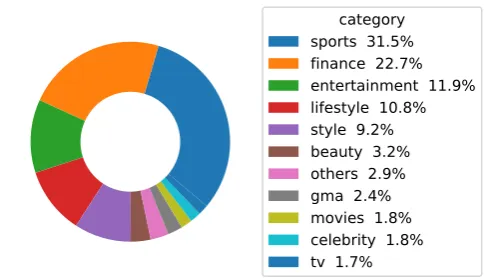
• Category. There are 31 news categories and the distribution is shown in Figure2.
• Wiki-Entities. The Wikipedia entities mentioned in the news articles are extracted.
• Vote. Each comment has upvote, downvote and abusevote information from news readers.
• Sentiment. Each comment is annotated with POSITIVE, NEGATIVE or NEUTRAL by Yahoo!.
Train Dev Test
Tencent
# News 191,502 5,000 1,610
Avg. # Comments per News 27 27 27
Avg. #Upvotes per Comment 5.9 4.9 3.4
Yahoo
# News 152,355 5,000 3,160 Avg. # Comments per News 20.6 20.5 20.5 Avg. #Upvotes per Comment 31.4 30.2 32.0
Avg. #DownVotes per Comment 4.8 4.8 4.9
[image:12.595.163.434.222.336.2]Avg. #AbuseVotes per Comment 0.05 0.05 0.05
Table 8: Statistics of the two datasets.
category
sports 31.5%
finance 22.7%
entertainment 11.9%
lifestyle 10.8%
style 9.2%
beauty 3.2%
others 2.9%
gma 2.4%
movies 1.8%
celebrity 1.8%
tv 1.7%
Figure 2: The category distribution of Yahoo! News dataset.
B Case Study
[image:12.595.178.425.384.524.2]Title:唐嫣为什么不演清宫剧?(Why Tiffany Tang never plays a role in a drama set in Qing dynasty?)
Body: 众 多 的 戏 剧 影 视 作 品 让 唐 嫣 博 获 得 不 少 人 气 , 众 多 活 动 的 多 变 造 型
树 立 其 在大众心中“百变小天后”的 形 象 。 商 业 活 动 高 贵 优 雅 、 媒 体 活 动 清 新 脱
俗,唐嫣每走到一处总能获得交口称赞和镁光灯的钟爱。唐嫣身材高挑、笑容甜美,精致的脸庞,时尚的
装扮,有着“九头身美女”之称。如果说唐嫣最美的造型是《仙剑奇侠传三》中的紫萱,那最丑的造型应 该 就 是 这 个 了 吧 ! 无 论 是 发 型 还 是 脸 都 无 法 直 视 啊 ! 《 仙 剑 奇 侠 传 三 》
时 候 应 该 算 是 唐 嫣 的 颜 值 巅 峰 期 了 吧 ! 而 穿 上 宫 廷 服 装 的 唐 嫣 , 真
的不好看,宛如一个智障少女. . . .这一段清宫戏,是唐嫣在电视剧《乱世佳人》的造型,但这
部 戏 简 直 是唐嫣不堪回首的过去啊!这个民国时期的造型也不好看!终 于 明 白 为 什
么唐嫣从来不演清宫剧了!如果不用假刘海,就算脸在小,她的额头还是很大!对此,大家怎么看?
(The numerous television series and movies Tiffany Tang acted in have made her very popular, and her varied modelling in many activities has set her an image of ”the queen of reinvention” in the hearts of the public. Her el-egant and unique nature showed in commercial events and media events brings her a lot of praise and spotlight.
Tiffany Tang is tall, slim, has sweet smile and a beautiful face, and is always dressed in fashion. Thus, she is called “9-heads tall” girl by her fans. If her most beautiful role is Zi Xuan in “Chinese Paladin 3”, then the most ugly one should be this! Both hair-style and makeup look terrible. She is most alluring at the time of “Chinese Paladin 3”. When she dressed up with a costume in Qing Dynasty, however, she looks really bad, like an idiot. This is how Tiffany Tang looks like in a TV series “A Beauty in Troubled Times”, but this might be her forgettable moment. Her costume in Republic of China looks terrible too. I finally know why Tiffany Tang never plays a role in a drama set in Qing dynasty. If she does not use fake bangs, even her face is small, her forehead looks too big! What do you think?)
DeepCom: 唐嫣罗晋的演技真的很好,特别喜欢她演《仙剑奇侠传》。我觉得这部剧挺好看。(Tiffany Tang and Luo Jin are really good actors. I especially like her role in Chinese Paladin 3. I think the TV drama is worth watching.)
Att-TC:我也是醉了(I have nothing to comment.)
[image:13.595.83.519.81.394.2]IR-TC:星爷和谁开撕过嘛,都是别人去撕星爷!(Stephen Chow never fights with others. It is others that fight with Stephen Chow!)
Table 9: A case from Tencent News dataset.
Title:NBA notebook : Rockets targeting Anthony after losing Mbah a Moute
Body: The Houston Rockets are now determined to sign forward Carmelo Anthony after forward Luc Mbah a Moute joined the Los Angeles Clippers on a one-year, $4.3 million deal on Monday, according to an ESPN report.
An-thony is currently a member of the Oklahoma City Thunder, but the two sides are reportedly working on parting ways, whether through a trade, a buyout or waiving via the stretch provision. Anthony is likely to become a free agent even if he is traded, as his new team would likely waive him. Multiple reports on Sunday said rockets guard Chris Paul wants Anthony, a good friend of his, to join the rockets, while Anthony is also believed to have interest in joining Lebron James with the Los Angeles Lakers. The Miami Heat are also reportedly interested in adding
An-thony. Mbah a Moute spent the 2015-16 and 2016-17 seasons with the Clippers before joining the Rockets last season. The 31-year-old averaged 7.5 points , 3.0 rebounds and 1.2 steals in 25.6 minutes per game across 61 games (15 starts) in Houston. – The Cleveland cavaliers are looking to deal 37-year-old guard Kyle Korver and transition to a younger lineup, according to Terry Pluto of the Cleveland Plain Dealer. . . . Korver’s contract has $ 15.1 million remaining over the next two seasons, although only $ 3.4 million of his 2019-20 salary is guaranteed. He could prove to be a good option for a team looking for better perimeter shooting to compete for a league title. . . . – It ’s unclear whether Joakim Noah will remain with the New York Knicks moving forward, but the center said he hopes to say in the big apple, in a video published by TMZ. “I love New York,” Noah said, “I don’t know what’s going to happen , but Coach Fiz is cool, man.” . . .
DeepCom:the rockets are going to have a lot of fun in this series . Att-TC:i think he is going to be a contender
IR-TC:the kings have a great future if cousins is n’t the team ’s leader . but if continues to be propped up as the guy , then the kings will only have a good future along with the bottom half of the west . cousins just is n’t enough of a leadership guy who will go through 3 more coaches before he finds a decent match not just for himself , but the team .
[image:13.595.83.513.449.678.2]