Proceedings of the 2019 Conference on Empirical Methods in Natural Language Processing
1834
Unsupervised Context Rewriting for Open Domain Conversation
Kun Zhou1∗, Kai Zhang2, Yu Wu3, Shujie Liu3,andJingsong Yu1 1School of Software and Microelectronics, Peking University
2AI and Research Microsoft, Beijing, China
3Microsoft Research, Beijing, China
{kaizh,Wu.Yu,shujliu}@microsoft.com [email protected]
Abstract
Context modeling has a pivotal role in open domain conversation. Existing works either use heuristic methods or jointly learn con-text modeling and response generation with an encoder-decoder framework. This paper proposes an explicit context rewriting method, which rewrites the last utterance by consid-ering context history. We leverage pseudo-parallel data and elaborate a context rewrit-ing network, which is built upon the Copy-Net with the reinforcement learning method. The rewritten utterance is beneficial to candi-date retrieval, explainable context modeling, as well as enabling to employ a single-turn
framework to the multi-turn scenario. The
empirical results show that our model outper-forms baselines in terms of the rewriting qual-ity, the multi-turn response generation, and the end-to-end retrieval-based chatbots.
1 Introduction
Recent years have witnessed remarkable progress in open domain conversation (non-task oriented dialogue system) (Ji et al.,2014;Li et al.,2016a) due to the easy-accessible conversational data and the development of deep learning techniques (Bahdanau et al.,2014). One of the most difficult problems for open domain conversation is how to model the conversation context.
A conversation context is composed of multi-ple utterances, which raises some challenges not existing in the sentence modeling, including: 1) topic transition; 2) plenty of coreferences (he, him, she, it, they); and 3) long term dependency. To tackle these problems, existing works either re-fine the context by appending keywords to the last turn utterance (Yan et al.,2016), or learn a vector representation with neural networks (Serban et al.,
∗This work was done when the first author was an intern
at Microsoft XiaoIce.
Response: I think coffee is so bitter. Context Rewrite Model
Response Generation/Retrieval Model Context: I hate drinking coffee.
Last Utterance: Why? It`s tasty.
[image:1.595.310.524.221.334.2]Rewritten-Utterance: Why hate drinking coffee? It`s tasty.
Figure 1: An Example of Context Rewriting.
2017b). However, these methods have drawbacks, for instance, correct keywords cannot be selected by heuristics rules, and a fix-length vector is not able to handle a long context.
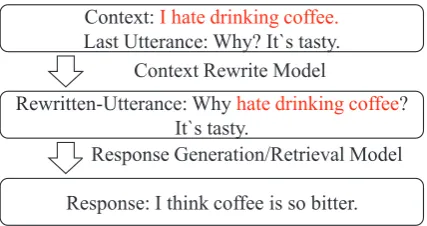
We propose a context rewriting method, which explicitly rewrites the last utterance by consider-ing the contextual information. Our goal is to gen-erate a self-contained utterance, which neither has coreferences nor depends on other utterances in history. By this means, we change the input of chatbots from an entire conversation session to a rewritten sentence, which significantly reduces the difficulty of response generation/selection since the rewritten sentence is shorter and does not has redundant information. Figure1gives an example to further illustrate our idea.
The last utterance contains the word “it” which refers to the coffee in context. Moreover, “Why?” is an elliptical interrogative sentence, which is a shorter form of “Why hate drinking coffee?”. We rewrite the context and yield a self-contained utter-ance “Why hate drinking coffee? It’s tasty.” Com-pared to previous methods, our method enjoys the following advantages: 1) The rewriting pro-cess is friendly to the retrieval stage of retrieval-based chatbots. Retrieval-retrieval-based chatbots consists of two components: candidate retrieval and can-didate reranking. Traditional works (Yan et al.,
retrieval stage, which regards the entire context or context rewritten with heuristic rules as queries so noise is likely to be introduced; 2) It makes a step toward explainable and controllable context mod-eling, because the explicit context rewriting results are easy to debug and analyze. 3) Rewritten results enable us to employ a single-turn framework to solve the multi-turn conversation task. The single-turn conversation technology is more mature than the multi-turn conversation technology, which is able to achieve higher responding accuracy.
To this end, we propose a context rewriting network (CRN) to integrate the key information of the context and the original last utterance to build a rewritten one, so as to improve the an-swer performance. Our CRN model is a sequence-to-sequence network (Ilya Sutskever, 2014) with a bidirectional based encoder, and a GRU-based decoder enhanced with the CopyNet (Gu et al.,2016), which helps the CRN to directly copy words from the context. Due to the absence of the real written last utterance, unsupervised methods are used with two training stages, a pre-training stage with pseudo rewritten data, and a fine-tuning stage using reinforcement learning (RL) (Sutton et al.,1998) to maximize the reward of the final answer. Without the pre-training part, RL is un-stable and slow to converge, since the randomly initialized CRN model cannot generate reason-able rewritten last utterance. On the other hand, only the pre-training part is not enough, since the pseudo data may contain errors and noise, which restricts the performance of our CRN.
We evaluate our method with four tasks, includ-ing the rewritinclud-ing quality, the multi-turn response generation, the multi-turn response selection, and the end-to-end retrieval-based chatbots. Empiri-cal results show that the outputs of our method are closer to human references than baselines. Be-sides, the rewriting process is beneficial to the end-to-end retrieval-based chatbots and the multi-turn response generation, and it shows slightly positive effect on the response selection.
2 Related Work
Recently, data-driven approaches for chatbots (Ritter et al., 2011;Ji et al., 2014) has achieved promising results. Existing work along this line includes retrieval-based methods (Hu et al.,2014;
Ji et al.,2014;Wang et al.,2015;Yan et al.,2016;
Zhou et al.,2016) and generation-based methods
(Shang et al., 2015; Serban et al., 2016;Vinyals and Le,2015;Li et al.,2016a,b;Xing et al.,2017;
Serban et al.,2017a).
Early research into retrieval-based chatbots (Wang et al., 2013; Hu et al.,2014;Wang et al.,
2015) only considers the last utterances and ig-nores previous ones, which is also called Short Text Conversation (STC). Recently, several stud-ies (Lowe et al., 2015; Yan et al., 2016; Wu et al., 2017, 2018b) have investigated multi-turn response selection, and obtained better results in a comparison with STC. A common practice for multi-turn retrieval-based chatbots first retrieve candidates from a large index with a heuristic con-text rewriting method. For example, (Wu et al.,
2017) and (Yan et al., 2016) refine the last utter-ance by appending keywords in history, and re-trieve candidates with the refined utterance. Then, response selection methods are applied to measure the relevance between history and candidates.
A number of studies about generation-based chatbots have considered multi-turn response gen-eration.Sordoni et al.(2015) is the pioneer of this type of research, it encodes history information into a vector and feeds to the decoder.Shang et al.
(2015) propose three types of attention to utilize the context information. In addition,Serban et al.
(2016) propose a Hierarchical Recurrent Encoder-Decoder model (HRED), which employs a hier-archical structure to represent the context. After that, latent variables (Serban et al.,2017b) and hi-erarchical attention mechanism (Xing et al.,2018) have been introduced to modify the architecture of HRED. Compared to previous work, the original-ity of this study is that it proposes a principle way instead of heuristic rules for context rewriting, and it does not depend on parallel data.
3 Model
Given a dialogue data set D = {(U, r)z}Nz=1, whereU = {u0,· · · , un} represents a sequence of utterances and r is a response candidate. We denote the last utterance as q = un for sim-plicity, which is especially important to pro-duce the response, and other utterances as c = {u0,· · ·, un−1}. The goal of our paper is to
Decoder: Generate rewritten-utterance
Encoder: Last Utterance Representation Encoder: Context Representation
Why hate drinking coffee ? It`s tasty . <end>
Context vector
Last utterance
vector
Fusion hidden state Copy
mode
Predict mode
…
Vocabulary words
…
Context words
Pℎ = ℎ + (ℎ )
Context vector
Last utterance
vector
Why ? It`s tasty .
Attention read from last utterance
I hate drinking coffee .
Attention read from context
[image:3.595.117.482.60.240.2]Decoder Step
Figure 2: The Detail of CRN
multi-turn response generation and selection tasks. To rewrite the last utterance q with the help of contextc, we propose a context rewriting net-work (CRN), which is a popularly used sequence-to-sequence network, equipped with a CopyNet to copy words from the original context c (Sec-tion 3.1). Without the real paired data (pairs of the original and rewritten last utterance), our CRN model is firstly pre-trained with the pseudo data, generated by inserting extracted keywords from context into the original last utteranceq (Section
3.2). To let the final response to influence the rewriting process, reinforcement learning is lever-aged to further enhance our CRN model, using the rewards from the response generation and selec-tion tasks respectively (Secselec-tion3.3).
3.1 Context Rewriting Network
As shown in Figure 2, our context rewriting net-work (CRN) follows the sequence to sequence framework, consisting of three parts: one encoder to learn the context (c) representation, another en-coder to learn the last utterance (q) representation, and a decoder to generate the rewritten utterance
q∗. Attention is also used to focus on different
words in the last utteranceqand the contextc, and the copy mechanism is introduced to copy impor-tant words from the contextc.
3.1.1 Encoder
To encode the context c and the last utterance
q, bidirectional GRU is leveraged to take both the left and right words in the sentence into con-sideration, by concatenating the hidden states of two GRU networks in positive time direction and negative time direction. With the bidirectional GRU, the last utteranceq is encoding intoHQ =
[hq1, . . . , hqnq], and the contextcis encoding into
HC = [hc1, . . . , hcnc].
3.1.2 Decoder
The GRU network is also leveraged as decoder to generate the rewritten utteranceq∗, in which the attention mechanism is used to extract useful in-formation from the contextcand the last utterance
q, and the copy mechanism is leveraged to directly copy words from the context c into q∗. At each time stept, we fuse the information fromc,qand last hidden statestto generate the input vectorzt of GRU as following
zt=WfT[st; nq
i=1
αqihqi; nc
i=1
αcihci] +b (1)
where [;] is the concatenation operation. Wf and
b are trainable parameters, st is the last hidden state of decoder GRU in stept,αq andαc are the weights of the words inq andc respectively, de-rived by the attention mechanism as following
αi = nexp(ei)
j=1exp(ej)
(2)
ei =hiWast (3)
where hi is the encoder hidden state of the ith word inqorc,Wais the trainable parameter.
The copy mechanism is used to predict the next target word according to the probability of
p(yt|st, HQ, HC), which is computed as
p(yt|st, HQ, HC) =ppr(yt|zt)·pm(pr|zt)
+pco(yt|zt)·pm(co|zt) (4) whereyt is thet−th word in response, prand
costand for the predict-mode and the copy-mode,
im-plemented by two MLP (multi layer perceptron) classifiers, respectively. Andpm(·|·)indicates the probability to choose the two modes, which is a MLP (multi layer perceptron) classifier with soft-max as the activation function:
pm(pr|zt) = e
ψpr(yt,HQ,HC)
eψpr(yt,HQ,HC)+eψco(yt,HQ,HC)
(5) whereψpr(·),ψco(·)are score functions for choos-ing the predict-mode and copy-mode with differ-ent parameters.
3.2 Pre-training with Pseudo Data
Instead of directly leverage RL to optimize our model CRN, which could be unstable and slow to converge, we pre-train our model CRN with pseudo-parallel data. Cross-entropy is selected as the training loss to maximize the log-likelihood of the pseudo rewritten utterance.
LMLE =−1
N
n
i=1
log(p(yt|st, HQ, HC)) (6)
The main challenge for the pre-training stage is how to generate good pseudo data, which can inte-grate suitable keywords from context and the orig-inal last utterance to form a better one to generate a good response. Given the contextc, we extract keywords wc∗1:n using pointwise mutual informa-tion (PMI) (in Secinforma-tion3.2.1). With the extracted keywords wc∗1:n, language model is leveraged to find suitable positions to insert them into the orig-inal last utterance to generate rewritten candidates
s∗, which will be re-ranked leveraging the
infor-mation from following process (the response gen-eration/selection) to get final pseudo rewritten ut-teranceQ∗ (in Section3.2.2). In the following of this section, we will introduce our pseudo data cre-ation method in detail.
3.2.1 Key Words Extraction
To penalize common and low frequent words, and prefers the “mutually informative” words, PMI is used to extract the keywords in the context c. Given a context word wc, and a word wr in re-sponse r, it is the divides the prior distribution
pc(wc) by the posterior distribution p(wc|wr) as shown as:
PMI(wc, wr) =−logp(pwc(wc)
c|wr) (7) In order to select the keywords which contribute to the response, and are suitable to be shown in
the last utterance, we also calculate PMI(wc, wq) between the context word wc and any word wq in the last utterance. The final contribution score
PMI(wc, q, r) for the context wordwc to the last
utteranceqand the responseris calculated as
norm(PMI(wc, q)) +norm(PMI(wc, r)) (8)
where norm(·) is the min-max normalization among all words inc, and PMI(wc, q)(similar for PMI(wc, r)) is calculated as
PMI(wc, q) =
wq∈q
PMI(wc, wq). (9)
The keywordsw∗cwith top-20%contribution score
PMI(wc, q, r)againstrandqare selected to insert
into the last utteranceq.1
3.2.2 Pseudo Data Generation
Together with the extract candidate keyword, the words nearby are also extracted to form a continu-ous span to introduce more information, of which, at most 2 words before and after are considered. For one keyword, there are at mostC31 ∗C31 = 9 span candidates. We apply a multi-layer RNN lan-guage model to insert the extracted key phrase to a suitable position in the last utterance. Top-3 gen-erated sentences with high language model scores are selected as the rewritten candidatess∗.
With the information from the response, a re-rank model is used to select the best one from the candidatess∗. For end-to-end generation task, the quality of candidates is measured with the cross-entropy of a single-turn attention based encoder-decoder modelMs2s, hoping that the good rewrit-ten utterance can help to generate the proper re-sponse. For the end-to-end response selection task, the quality of the candidates is measured by the rank loss of a single-turn response selection modelMir, hoping that the good one can distin-guish the positive and negative responses.
LMs2s(r|s∗) =−
1
n
n
i=1
logp(r1, . . . , rn|s∗)
(10)
LMir(po, ne, s∗) =Mir(po, s∗)−Mir(ne, s∗) (11) In equation10,ri is thei−thword in response. In equation11pois the positive response, andne are the negative one.
1
3.3 Fine-Tuning with Reinforcement Learning
Since the generated pseudo data inevitably con-tains errors and noise, which limits the perfor-mance of the pre-trained model, we leverage the reinforcement learning method to build the di-rect connection between the context rewrite model CRN and different tasks. We first generate rewrit-ten utterance candidates qr with our pre-trained model, and calculate the rewardR(qr)which will be maximized to optimize the network parame-ters of our CRN. Due to the discrete choices of words in sequential generation, the policy gradi-ent is used to calculate the gradigradi-ent.
∇θJ(θ) =E[R· ∇log(P(yt|x))] (12) For reinforcement learning in sequential genera-tion task, instability is a serious problem. Simi-lar to other works (Wu et al.,2018a), we combine MLE training objective with RL objective as
Lcom=L∗rl+λLMLE (13)
whereλis a harmonic weight.
By directly maximizing the reward from end tasks (response generation and selection), we hope that our CRN can correct the errors in the pseudo data and generate better rewritten last utterance. Two different rewards are used to fine-tune our CRN for the tasks of response generation and se-lection respectively. We will introduce them in de-tail in the following.
3.3.1 End-to-end response generation reward
Similar as we do in Section3.2.2, for end-to-end response generation task, we use the cross-entropy loss of a single-turn attention based encoder-decoder model Ms2s to evaluate the quality of rewritten last utteranceqras
Rg(r, q∗, qr) =LMs2s(r|q∗)−LMs2s(r|qr) (14) where LMs2s is defined in Equation 10, r is the response candidate, qr is the generated candidate of our CRN, andq∗is the pseudo rewritten candi-date as introduced in Section3.2.2. Ifqrcan bring more useful information from context, it will get lower cross-entropy to generaterthan the original pseudo rewritten oneq∗.
3.3.2 End-to-end response selection reward
For end-to-end response selection task, we use a single-turn response selected modelMirto evalu-ate the quality of the generevalu-ated candidevalu-ateqrby the
rank loss, it is calculated as
Rir(po, ne, q∗, qr) =LMir(po, ne, qr)
−LMir(po, ne, q∗) (15)
where LMir is defined in Equation 11, qr is the generated candidate of our model, and q∗ is the pseudo candidate as introduced in Section 3.2.2. Similar to Equation14, ifqr can bring more use-ful information, it will do better to distinguish the negative and positive responses.
4 Experiment
We conduct four experiments to validate the ef-fectiveness of our model, including the rewriting quality, the multi-turn response generation, the multi-turn response selection, and the end-to-end retrieval-based chatbots.
We crawl human-human context-response pairs from Douban Group which is a popular forum in China and remove duplicated pairs and utterances longer than 30 words. We create pseudo rewritten context as described in Section3.1. Because most of the responses are only relevant with the last two turn utterances, following Li et al. (2016c), we remove the utterances beyond the last two turns. We finally split 6,844,393 (ci, qi, qi∗, ri) quadru-plets for training2, 1000 for validation and 1074 for testing, and the last utterance in test set are selected by human and they all require rewriting to enhance information3. In the data set, the ratio between rewritten last utterance and un-rewritten4 the last utterance is1.426 : 1. The average length of context ci, last utterance qi, response ri, and rewritten last utteranceqi∗are 12.69, 11.90, 15.15 and 14.27 respectively.
We pre-train the CRN with the pseudo-parallel data until it coverages, then we use the reinforce-ment learning technique described in Section 3.3
to fine-tune the CRN. The specific details of the model hyper-parameters and optimization algo-rithms can be found in theSupplementary.
4.1 Rewriting Quality Evaluation
The detail of the training process is the same as Section 4.2.1. We evaluate the rewriting quality by calculating the BLEU-4 score (Papineni et al.,
2The data in the training set do not overlap with the test
data of the four tasks. 3
Our human-annotated test set is available athttps:// github.com/love1life/chat
4
BLEU-4
Last Utterance 34.2
Last Utterance + Context 37.1 Last Utterance + Keyword 49.8
CRN 50.9
[image:6.595.104.258.64.141.2]CRN + RL 54.2
Table 1: The result of rewriting quality.
2002), a sequence order sensitive metric, between the system outputs and human references. Such references are rewritten by a native speaker who considers the information in context. It is required that the rewritten last utterance is self-contained.
We compare our models CRN with three base-lines. Firstly, we report the BLEU-4 scores of the origin last utterance and the combination of the last utterance and context. Additionally, follow-ingWu et al.(2017), we append five keywords to the last utterance, where the keywords are selected from the context by TF-IDF weighting, which is named by Last Utterance + Keyword. The IDF score is computed on the entire training corpus.
Table 1 shows the experiment result, which indicates that our rewriting method outperforms heuristic methods. Moreover, a 54.2 BLEU-4 score means that the rewritten sentences are very similar to the human references. CRN-RL has a higher score than CRN-Pre-train on BLEU-4, it proves reinforcement learning promotes our model effectively.
4.2 Multi-turn Response Generation
Section4.1demonstrates the outputs of our model are more similar to the human rewritten refer-ences. In this part, we will show the influence of the context rewriting for response generation.
We use the same test data in Section4.1to eval-uate our model in the multi-turn response gener-ation task. The multi-turn response genergener-ation is defined as, given an entire context consisting of multiple utterances, a model should generate in-formative, relevant, and fluent responses. We com-pare against the following previous works:
S2SA:We adopt the well-known Seq2Seq with attention (Bahdanau et al.,2014) model to gener-ate responses by feeding the last utterances q as source sentences.
HRED: Serban et al. (2016) propose using a hierarchical encoder-decoder model to handle the multi-turn response generation problem, where each utterance and the entire session are repre-sented by different networks.
Dynamic, Static: Zhang et al. (2018) pro-pose two state-of-the-art hierarchical recurrent at-tention networks for response generation. The dynamic model dynamically weights utterances in the decoding process, while the static model weights utterances before the decoding process.
4.2.1 Implementation Details
Given a context c and last utterance q, we first rewrite them with the CRN. Then the rewritten last utteranceq is fed to a single-turn generation model. The details of the model can be found in Supplementary and we set the same sizes of hidden states and embedding in all models. We regard two adjacent utterances in our training data to construct the training dataset (5,591,794 utterance-response pairs) for the single-turn gen-eration model. We do not use the rewritten con-text as the input in the training phase, since we would like to guarantee the gain only comes from the rewriting mechanism at the inference stage.
4.2.2 Evaluation Metrics
We regard the human response as the ground truth, and use the following metrics:
Word overlap based metrics: We report BLEU score (Papineni et al.,2002) between model outputs and human references.
Embedding based metrics: As BLEU is not correlated with the human annotation perfectly, following (Liu et al., 2016), we employ embed-ding based metrics, Embedembed-ding Average (Aver-age), Embedding Extrema (Extrema), and Embed-ding Greedy (Greedy) to evaluate results. The word2vec is trained on the training data set, whose dimension is200.
Diversity: We evaluate the response diversity based on the ratios of distinct unigrams and bi-grams in generated responses, denoted as Distinct-1 and Distinct-2 (Li et al.,2016a).
BLEU-1 BLEU-2 BLEU-3 Average Extrema Greedy Distinct-1 Distinct-2
S2SA 5.72 2.80 1.37 11.14 8.58 13.15 25.55 58.89
HRED 10.10 5.53 2.75 27.45 21.71 27.43 15.22 32.19
Dynamic 7.05 3.54 1.75 17.77 14.20 18.94 6.22 15.08
Static 9.31 5.01 2.77 21.32 17.36 22.49 6.59 17.31
CRN 13.26 8.43 4.64 32.31 26.97 33.59 31.48 67.02
CRN + RL 13.63 8.69 4.88 33.14 27.49 34.68 31.42 65.10
Table 2: Automatic evaluation results.
3 2 1 0 -1 avg
S2SA 14.48% 48.56% 31.01% 5.48% 0.46% 1.72
HRED 13.28% 16.90% 65.00% 3.99% 0.46% 1.40
CRN+S2SA 37.05% 31.01% 25.07% 6.04% 0.46% 1.99
CRN+S2SA+RL 42.43% 29.25% 15.04% 12.63% 0.46% 2.02
Table 3: The distribution of human evaluation in response generation model.
4.2.3 Evaluation Results
Table2presents the automatic evaluation results, showing that our models outperform baselines on relevance and diversity. Table 3 gives the hu-man annotation results, which also demonstrates the superiority of our models. Our models sig-nificantly improve response diversity, mainly be-cause the rewritten sentence contains rich informa-tion that is capable of guiding the model to gener-ate a specific output. After reinforcement learn-ing our model promotes on BLEU and embeddlearn-ing metrics, it is because reinforcement learning can build the connection between the utterance-rewrite model with the response generation model for ex-ploring better rewritten-utterance. But our model drops a little on the diversity metrics after rein-forcement learning, this owes to the fact that the reward is biased to relevance rather than diver-sity. The similar phenomenon can be observed in the comparison of HRED and S2SA, which means that although relevance can increase by consid-ering context information, general responses be-come more frequently concurrently.
Table3presents the distribution of score in hu-man evaluation, we can observe that most of the responses generated by HRED and S2SA get 1 or 2 in human evaluation, while most of the re-sponses generated by our model can get 2 or 3. It proves that our model can reduce noisy from context and construct an informative utterance to generate high-quality response. However, after re-inforcement learning our model gets more 0 and 3 score, that is because after reinforcement learning, our model becomes unstable and prefers to extract more words from context. The score of one can-didate will increase or decrease a lot if useful
key-words or wrong keykey-words are inserted into the last utterance, respectively. In fact, more utterances are rewritten better after reinforcement learning so the average evaluation score improves.
4.3 Multi-turn Response Selection
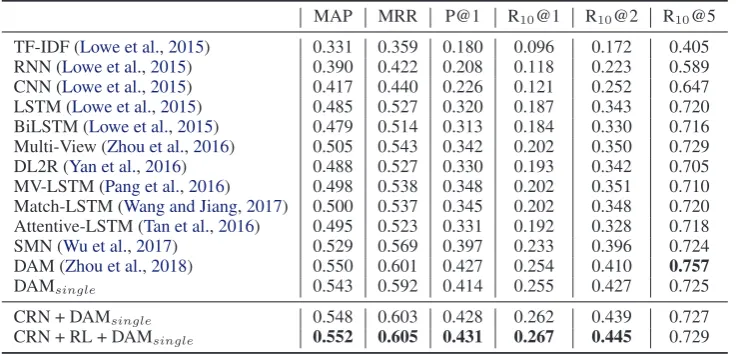
We also evaluate the multi-turn response selec-tion task of retrieval-based chatbots, which aims to select proper responses from a candidate pool by considering the context. We use the Douban Conversation Corpus released byWu et al.(2017), which is created by crawling a popular Chinese fo-rum, the Douban Group5, covering various top-ics. Its training set contains 0.5 million conver-sational sessions, and the validation set contains 50,000 sessions. The negative instances in both sets are randomly sampling with a 1:1 positive-negative ratio. The test set contains 1000 conver-sation contexts, and each context has 10 response candidates with human annotations.
We split the last utterance from each context in the training data, and forms 0.5 million of(q, r) pairs. Subsequently, we train a single-turn Deep Attention Matching Network (Zhou et al., 2018) consuming the pair as an input, which is denoted as DAMsingle. The DAMsinglemodel is treated as a rank model in Section3.2.2and a reward func-tion in Secfunc-tion3.3.2. In the testing stage, we use the CRN and the DAMsingleto assign a score for each candidate. Notably, the original DAM takes a context-response pair as an input, which is set as a baseline method. The parameters of the DAM is the same as its original paper.
MAP MRR P@1 R10@1 R10@2 R10@5
TF-IDF (Lowe et al.,2015) 0.331 0.359 0.180 0.096 0.172 0.405
RNN (Lowe et al.,2015) 0.390 0.422 0.208 0.118 0.223 0.589
CNN (Lowe et al.,2015) 0.417 0.440 0.226 0.121 0.252 0.647
LSTM (Lowe et al.,2015) 0.485 0.527 0.320 0.187 0.343 0.720
BiLSTM (Lowe et al.,2015) 0.479 0.514 0.313 0.184 0.330 0.716
Multi-View (Zhou et al.,2016) 0.505 0.543 0.342 0.202 0.350 0.729
DL2R (Yan et al.,2016) 0.488 0.527 0.330 0.193 0.342 0.705
MV-LSTM (Pang et al.,2016) 0.498 0.538 0.348 0.202 0.351 0.710
Match-LSTM (Wang and Jiang,2017) 0.500 0.537 0.345 0.202 0.348 0.720
Attentive-LSTM (Tan et al.,2016) 0.495 0.523 0.331 0.192 0.328 0.718
SMN (Wu et al.,2017) 0.529 0.569 0.397 0.233 0.396 0.724
DAM (Zhou et al.,2018) 0.550 0.601 0.427 0.254 0.410 0.757
DAMsingle 0.543 0.592 0.414 0.255 0.427 0.725
CRN + DAMsingle 0.548 0.603 0.428 0.262 0.439 0.727
[image:8.595.116.487.63.240.2]CRN + RL + DAMsingle 0.552 0.605 0.431 0.267 0.445 0.729
Table 4: Evaluation results on multi-turn response selection. The numbers of baselines are copied from (Zhou
et al.,2018)
Win Loss Tie
CRN vs baseline 51.3% 29.7% 19.0%
CRN + RL vs baseline 35.7% 21.8% 42.5%
Table 5: The result of end-to-end response selection subjective evaluation.
4.3.1 Evaluation Results
Table 4 shows the response selection perfor-mances of different methods. We can see that our model achieves a comparable performance with state-of-the-art DAM model, but only consuming a rewritten utterance rather than the whole context. This indicates that our model is able to recognize important content in context and generate a self-contained sentence. This argument is also verified by 1 point promotion compared with DAMsingle which only uses the last utterance as an input. Ad-ditionally, DAMsingle just underperforms DAM 1 point, meaning that the last utterance is very im-portant for response selection. It supports our as-sumption that the last utterance is important which is a good prototype for context rewriting.
4.4 End-to-End Multi-turn Response Selection
In practice, a retrieval-based chatbot first retrieves a number of response candidates from an in-dex, then re-ranks the candidates with the afore-mentioned response selection methods. Previous works pay little attention to the retrieval stage, which just appends some keywords to the last ut-terance to collect candidates (Wu et al.,2017).
Because our model is able to rewrite context and generate a self-contained sentence. We ex-pect it could retrieve better candidates at the first step, benefiting to the end-to-end performance.
Since it is hard to evaluate the retrieval-stage, we evaluate the end-to-end response selection perfor-mance. Specifically, we first rewrite the contexts in the test set with CRN, and then retrieve 10 candidates with the rewritten context from the in-dex6. DAMsingle is employed to compute rele-vance scores with the rewritten utterance and the candidates. The candidate with the top score is se-lected as the final response. The baseline model appends keywords from context to the last utter-ance for retrieval and use the original DAM with all context as the input to select final response.
We recruit three annotators to do a side-by-side evaluation, and the model outputs are shuffled be-fore human evaluation. The majority of the three judgments are selected as a result. If both outputs are hard to distinguish, we choose Tie as the result.
4.4.1 Evaluation Results
We list the side-by-side evaluation results in Ta-ble 5. Human annotators prefer the outputs of our model. On account of the reranking modules are comparable, we can infer that the gain comes from the better retrieval candidates. However, re-inforcement learning does not have a positive ef-fect on this task. We find our reinforced model becomes more conservative, it tends to generate shorter rewritten utterance than our pre-training model. That may be beneficial for response re-rank, but if wrong keywords or noise words are extracted from context. It will reduce the qual-ity of retrieved candidates, leading to an undesired end-to-end result.
6
Context 我十九号昆明飞厦门I will fly from Kunming to 上了豆瓣更无聊 你5点半下班?
Xiamen in 19th
Douban is so boring Do you go off duty in 5:30?
Last Utterance 我也想去I want to go, too 好像是这样Yes 的 是Yes, I am in bus now的呀,坐上班车了都
Rewritten-Utterance 昆明飞厦门我也想去 豆瓣好像是这样的 是班的?呀,坐上班车了都下
I want to fly from Kunming to Xiamen, too
Yes, Douban is. Yes, I am now in bus off
duty?
Rewritten-Utterance+RL 我也想去厦门 好像是这样的豆瓣更无聊 班是车了的呀5都点半下班,坐上
I want to go to Xiamen, too Yes, Douban is so boring Yes, go off duty in 5:30, I am now in bus
S2SA 那Let‘s go就出发吧 你是双子You are Gemini 55:30点半
HRED 我也是 是啊 好吧
Me too Yes Okay
Our Model 昆明大理丽Kunming, Dali, Lijiang江 豆瓣Douban can ruin whole life.毁一生 下Do you go off?班了吗
[image:9.595.80.518.62.317.2]Our Model+RL 厦门Welcome to Xiamen欢迎你 无聊I‘m bored to death到爆 我也是坐I am taking the bus, too班车
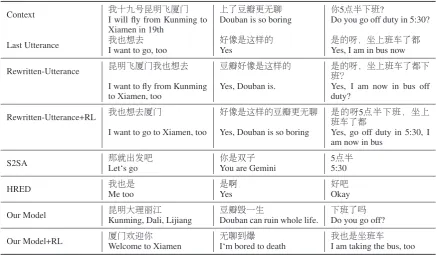
Table 6: The examples of end-to-end response generation.
4.5 Case Study
We list the generated examples of our models and baseline models for End-to-end Generation Chat-bot and Retrieval ChatChat-bot. Because the submis-sion space is quite limited, we put the case study of Retrieval Chatbot in the Supplementary Mate-rial.
4.5.1 End-to-end Generation Chatbots Table 6 presents the generated examples of our models and baselines, our model can extract the keywords from the context which is help-ful to generate an informative response, but the HRED model often generates safe responses like
“Metoo” or “Y es”. It is because the input
infor-mation from context and last utterance contain so much noise, some of the context words are use-less for the last utterance to generate responses. Our model can extract important keywords from noisy context and insert them into the last utter-ance, it is not only easy to control and explain in a chat-bot system, but also transmit useful in-formation directly to last utterance. The input of S2SA model is the last utterance, so it can gen-erate diverse response due to less noise, but its relevancy with context is low. Our model suc-ceeds fusing advantage from both models and get a significant promotion. Comparing the gener-ated responses by our pre-training model and rein-forced model, the rewritten-utterance inferred by
our pre-training model may be more informative, but the final generated response may be unrelated to context and last utterance. It is because rein-forcement learning can build the connection be-tween the utterance-rewrite model with response generation model for exploring better rewritten-utterance. A better rewritten-utterance should be helpful to generate a context-related response, Too much information inserted will add noise and too little will be useless.
5 Conclusion
This paper investigates context modeling in open domain conversation. It proposes an unsupervised context rewriting model, which benefits to candi-date retrieval and controllable conversation. Em-pirical results show that the rewriting contexts are similar to human references, and the rewriting pro-cess is able to improve the performance of multi-turn response selection, multi-multi-turn response gen-eration, and end-to-end retrieval chatbots.
Acknowledgement
[image:9.595.81.516.63.317.2]References
Dzmitry Bahdanau, Kyunghyun Cho, and Yoshua
Bengio. 2014. Neural machine translation by
jointly learning to align and translate. CoRR,
abs/1409.0473.
Jiatao Gu, Zhengdong Lu, Hang Li, and Victor O. K.
Li. 2016. Incorporating copying mechanism in
sequence-to-sequence learning. In Proceedings of
the 54th Annual Meeting of the Association for Computational Linguistics, ACL 2016, August 7-12, 2016, Berlin, Germany, Volume 1: Long Papers.
Baotian Hu, Zhengdong Lu, Hang Li, and Qingcai Chen. 2014. Convolutional neural network archi-tectures for matching natural language sentences. InAdvances in Neural Information Processing
Sys-tems, pages 2042–2050.
Quoc V. Le Ilya Sutskever, Oriol Vinyals. 2014. Se-quence to seSe-quence learning with neural networks.
InNips, pages 3104–3112.
Zongcheng Ji, Zhengdong Lu, and Hang Li. 2014. An information retrieval approach to short text
conver-sation. ArXiv, abs/1408.6988.
Jiwei Li, Michel Galley, Chris Brockett, Jianfeng Gao, and Bill Dolan. 2016a. A diversity-promoting ob-jective function for neural conversation models. In
NAACL HLT 2016, The 2016 Conference of the North American Chapter of the Association for Computational Linguistics: Human Language Tech-nologies, San Diego California, USA, June 12-17,
2016, pages 110–119.
Jiwei Li, Michel Galley, Chris Brockett, Georgios P. Spithourakis, Jianfeng Gao, and William B. Dolan. 2016b. A persona-based neural conversation model. InProceedings of the 54th Annual Meeting of the As-sociation for Computational Linguistics, ACL 2016, August 7-12, 2016, Berlin, Germany, Volume 1: Long Papers.
Jiwei Li, Will Monroe, Alan Ritter, Dan Jurafsky, Michel Galley, and Jianfeng Gao. 2016c. Deep
rein-forcement learning for dialogue generation. In
Pro-ceedings of the 2016 Conference on Empirical Meth-ods in Natural Language Processing, EMNLP 2016, Austin, Texas, USA, November 1-4, 2016, pages 1192–1202.
Chia-Wei Liu, Ryan Lowe, Iulian Serban, Michael Noseworthy, Laurent Charlin, and Joelle Pineau.
2016. How NOT to evaluate your dialogue
sys-tem: An empirical study of unsupervised evaluation
metrics for dialogue response generation. In
Pro-ceedings of the 2016 Conference on Empirical Meth-ods in Natural Language Processing, EMNLP 2016, Austin, Texas, USA, November 1-4, 2016, pages 2122–2132.
Ryan Lowe, Nissan Pow, Iulian Serban, and Joelle Pineau. 2015. The ubuntu dialogue corpus: A large
dataset for research in unstructured multi-turn
dia-logue systems. InProceedings of the SIGDIAL 2015
Conference, The 16th Annual Meeting of the Spe-cial Interest Group on Discourse and Dialogue, 2-4 September 2015, Prague, Czech Republic, pages 285–294.
Liang Pang, Yanyan Lan, Jiafeng Guo, Jun Xu,
Shengxian Wan, and Xueqi Cheng. 2016. Text
matching as image recognition. InProceedings of
the thirtieth AAAI Conference on Artificial Intelli-gence, pages 2793–2799.
Kishore Papineni, Salim Roukos, Todd Ward, and Wei-Jing Zhu. 2002. Bleu: a method for automatic
eval-uation of machine translation. InACL, pages 311–
318. Association for Computational Linguistics.
Alan Ritter, Colin Cherry, and William B Dolan. 2011. Data-driven response generation in social media. In
Proceedings of the Conference on Empirical Meth-ods in Natural Language Processing, pages 583– 593. Association for Computational Linguistics.
Iulian Vlad Serban, Tim Klinger, Gerald Tesauro, Kar-tik Talamadupula, Bowen Zhou, Yoshua Bengio,
and Aaron C. Courville. 2017a. Multiresolution
recurrent neural networks: An application to
dia-logue response generation. In Proceedings of the
Thirty-First AAAI Conference on Artificial Intelli-gence, February 4-9, 2017, San Francisco, Califor-nia, USA., pages 3288–3294.
Iulian Vlad Serban, Alessandro Sordoni, Yoshua Ben-gio, Aaron C. Courville, and Joelle Pineau. 2016. Building end-to-end dialogue systems using
gener-ative hierarchical neural network models. In
Pro-ceedings of the Thirtieth AAAI Conference on Arti-ficial Intelligence, February 12-17, 2016, Phoenix, Arizona, USA., pages 3776–3784.
Iulian Vlad Serban, Alessandro Sordoni, Ryan Lowe, Laurent Charlin, Joelle Pineau, Aaron C Courville, and Yoshua Bengio. 2017b. A hierarchical latent variable encoder-decoder model for generating
di-alogues. InAAAI, pages 3295–3301.
Lifeng Shang, Zhengdong Lu, and Hang Li. 2015. Neural responding machine for short-text
conversa-tion. InACL 2015, July 26-31, 2015, Beijing, China,
Volume 1: Long Papers, pages 1577–1586.
Alessandro Sordoni, Michel Galley, Michael Auli, Chris Brockett, Yangfeng Ji, Margaret Mitchell, Jian-Yun Nie, Jianfeng Gao, and Bill Dolan. 2015. A neural network approach to context-sensitive
gen-eration of conversational responses. InNAACL HLT
2015, The 2015 Conference of the North American Chapter of the Association for Computational Lin-guistics: Human Language Technologies, Denver, Colorado, USA, May 31 - June 5, 2015, pages 196– 205.
Richard S Sutton, Andrew G Barto, et al. 1998.
Ming Tan, C´ıcero Nogueira dos Santos, Bing Xiang, and Bowen Zhou. 2016. Improved representation
learning for question answer matching. In
Proceed-ings of the 54th Annual Meeting of the Association for Computational Linguistics, ACL 2016, August 7-12, 2016, Berlin, Germany, Volume 1: Long Papers.
Oriol Vinyals and Quoc V. Le. 2015. A neural
conver-sational model. CoRR, abs/1506.05869.
Hao Wang, Zhengdong Lu, Hang Li, and Enhong Chen. 2013. A dataset for research on short-text
conversations. InProceedings of the 2013
Confer-ence on Empirical Methods in Natural Language Processing, EMNLP 2013, 18-21 October 2013, Grand Hyatt Seattle, Seattle, Washington, USA, A meeting of SIGDAT, a Special Interest Group of the
ACL, pages 935–945.
Mingxuan Wang, Zhengdong Lu, Hang Li, and Qun Liu. 2015. Syntax-based deep matching of short
texts. InTwenty-Fourth International Joint
Confer-ence on Artificial IntelligConfer-ence.
Shuohang Wang and Jing Jiang. 2017. Machine com-prehension using match-lstm and answer pointer.
ICLR.
Lijun Wu, Fei Tian, Tao Qin, Jianhuang Lai, and Tie-Yan Liu. 2018a. A study of reinforcement learning
for neural machine translation. In Proceedings of
the 2018 Conference on Empirical Methods in Nat-ural Language Processing, EMNLP 2018, Brussels, Belgium, November 2-4, 2018.
Yu Wu, Furu Wei, Shaohan Huang, Yunli Wang, Zhou-jun Li, and Ming Zhou. 2018b. Response generation
by context-aware prototype editing. InAAAI.
Yu Wu, Wei Wu, Chen Xing, Ming Zhou, and
Zhou-jun Li. 2017. Sequential matching network: A
new architecture for multi-turn response selection
in retrieval-based chatbots. In Proceedings of the
55th Annual Meeting of the Association for Compu-tational Linguistics, ACL 2017, Vancouver, Canada, July 30 - August 4, Volume 1: Long Papers, pages 496–505.
Chen Xing, Wei Wu, Yu Wu, Jie Liu, Yalou Huang, Ming Zhou, and Wei-Ying Ma. 2017. Topic aware
neural response generation. InProceedings of the
Thirty-First AAAI Conference on Artificial Intelli-gence, February 4-9, 2017, San Francisco, Califor-nia, USA., pages 3351–3357.
Chen Xing, Yu Wu, Wei Wu, Yalou Huang, and Ming Zhou. 2018. Hierarchical recurrent attention
net-work for response generation. InProceedings of the
Thirty-Second AAAI Conference on Artificial Intelli-gence, (AAAI-18), the 30th innovative Applications of Artificial Intelligence (IAAI-18), and the 8th AAAI Symposium on Educational Advances in Artificial Intelligence (EAAI-18), New Orleans, Louisiana, USA, February 2-7, 2018, pages 5610–5617.
Rui Yan, Yiping Song, and Hua Wu. 2016. Learning to respond with deep neural networks for
retrieval-based human-computer conversation system. In
Proceedings of the 39th International ACM SIGIR conference on Research and Development in Infor-mation Retrieval, SIGIR 2016, Pisa, Italy, July 17-21, 2016, pages 55–64.
Wei-Nan Zhang, Yiming Cuiy, Yifa Wang, Qingfu Zhu, Lingzhi Li, Lianqiang Zhouz, and Ting Liu. 2018. Context-sensitive generation of open-domain
con-versational responses. In COLING, pages 2437–
2447.
Xiangyang Zhou, Daxiang Dong, Hua Wu, Shiqi Zhao, Dianhai Yu, Hao Tian, Xuan Liu, and Rui Yan.
2016. Multi-view response selection for
human-computer conversation. InProceedings of the 2016
Conference on Empirical Methods in Natural Lan-guage Processing, EMNLP 2016, Austin, Texas, USA, November 1-4, 2016, pages 372–381.
Xiangyang Zhou, Lu Li, Daxiang Dong, Yi Liu, Ying Chen, Wayne Xin Zhao, Dianhai Yu, and Hua Wu.
2018. Multi-turn response selection for chatbots
with deep attention matching network. In