Proceedings of the 2019 Conference on Empirical Methods in Natural Language Processing 3121
Mixture Content Selection for Diverse Sequence Generation
Jaemin Cho1∗ Minjoon Seo2,3 Hannaneh Hajishirzi1,3
Allen Institute for AI1 Clova AI, NAVER2 University of Washington3
[email protected] {minjoon,hannaneh}@cs.washington.edu
Abstract
Generating diverse sequences is important in many NLP applications such as question generation or summarization that exhibit se-mantically one-to-many relationships between source and the target sequences. We present a method to explicitly separate diversification from generation using a general plug-and-play module (called SELECTOR) that wraps around and guides an existing encoder-decoder model. The diversification stage uses a mixture of experts to sample different binary masks on the source sequence for diverse content se-lection. The generation stage uses a stan-dard encoder-decoder model given each se-lected content from the source sequence. Due to the non-differentiable nature of discrete sampling and the lack of ground truth la-bels for binary mask, we leverage a proxy for ground-truth mask and adopt stochastic hard-EM for training. In question genera-tion (SQuAD) and abstractive summarizagenera-tion (CNN-DM), our method demonstrates signifi-cant improvements in accuracy, diversity and training efficiency, including state-of-the-art top-1 accuracy in both datasets, 6% gain in top-5 accuracy, and 3.7 times faster training over a state-of-the-art model. Our code is pub-licly available athttps://github.com/ clovaai/FocusSeq2Seq.
1 Introduction
Generating target sequences given a source se-quence has applications in a wide range of prob-lems in NLP with different types of relationships between the source and target sequences. For in-stance, paraphrasing or machine translation ex-hibit a one-to-one relationship because the source and the target should carry the same meaning. On the other hand, summarization or question gen-eration exhibit one-to-many relationships because
∗
Most work done during internship at Clova AI.
Source Passage: in december 1878 , tesla left graz and severed all relations with his family to hide the fact that he dropped out of school .
Target: what did tesla do in december 1878?
Focus 1: in december 1878 ,teslaleft graz and severed all relations with his family to hide the fact that he dropped out of school.
(Ours)⇒what did tesla do?
Focus 2: indecember 1878 , teslaleft graz and severed all relations with his family to hide the fact that he dropped out of school.
(Ours)⇒what did tesla do in december 1878?
Focus 3: in december 1878 ,teslaleft graz and severed all relations with his family tohidethe fact that hedropped
out ofschool.
(Ours) ⇒ what did tesla do to hide he dropped out of school?
Figure 1: Sample questions produced by our method from given passage-answer pair (answer is underlined). Our method generates diverse questions, by selecting different tokens to focus (colored) in contrast to 3-mixture decoder (Shen et al., 2019) that generates 3 identical questions: “what did tesla do to hide the fact that he dropped out of school?”.
a single source often results in diverse target
se-quences with different semantics. Fig. 1 shows
different questions that can be generated from a given passage.
Encoder-decoder models (Cho et al.,2014) are
widely used for sequence generation, most no-tably in machine translation where neural models are now often almost as good as human
transla-tors in some language pairs. However, a
stan-dard encoder-decoder often shows a poor perfor-mance when it attempts to produce multiple, di-verse outputs. Most recent methods for didi-verse se-quence generation leverage diversifying decoding
steps through alternative search algorithms (Fan
et al.,2018;Vijayakumar et al.,2018) or mixture
of decoders (He et al., 2018; Shen et al., 2019).
step, while a more focused selection of the source sequence can lead to diversifying the semantics of the generated target sequences.
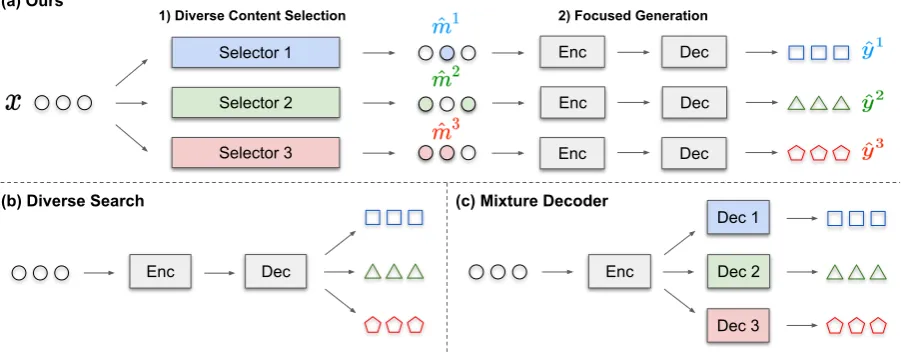
In this paper, we present a method for diverse generation that separates diversification and gen-eration stages. The diversification stage leverages content selection to map the source to multiple sequences, where each mapping is modeled by
focusing on different tokens in the source
(one-to-many mapping). The generation stage uses
a standard encoder-decoder model to generate a target sequence given each selected content from the source (one-to-one mapping). We present a
generic module called SELECTORthat is
special-ized for diversification. This module can be used as a plug-and-play to an arbitrary encoder-decoder model for generation without architecture change.
The SELECTORmodule leverages a mixture of
experts (Jacobs et al.,1991;Eigen et al.,2014) to
identify diverse key contents to focus on during generation. Each mixture samples a sequential la-tent variable modeled as a binary mask on every source sequence token. Then an encoder-decoder model generates multiple target sequences given these binary masks along with the original source tokens. Due to the non-differentiable nature of discrete sampling, we adopt stochastic hard-EM
for training SELECTOR. To mitigate the lack of
ground truth annotation for the mask (content se-lection), we use the overlap between the source and target sequences as a simple proxy for the ground-truth mask.
We experiment on question generation and ab-stractive summarization tasks and show that our method achieves the best trade-off between ac-curacy and diversity over previous models on
SQuAD (Rajpurkar et al., 2016) and CNN-DM
(Hermann et al.,2015;Nallapati et al.,2016;See et al., 2017) datasets. In particular, compared
to the recently-introduced mixture decoder (Shen
et al.,2019) that also aims to diversify outputs by creating multiple decoders, our modular method not only demonstrates better accuracy and diver-sity, but also trains 3.7 times faster.
2 Related Work
Diverse Search Algorithms Beam search, the most commonly used search algorithm for decod-ing, is known to produce samples that are short, contain repetitive phrases, and share majority of
their tokens. Hence several methods are
intro-duced to diversify search algorithms for decoding.
Graves(2013);Chorowski and Jaitly(2017) tune temperature hyperparameter in softmax function.
Vijayakumar et al. (2018); Li et al. (2016b) pe-nalize similar samples during beam search in
or-der to obtain diverse set of samples. Cho (2016)
adds random noise to RNN decoder hidden states.
Fan et al. (2018) sample tokens from top-k to-kens at each decoding step. Our method is or-thogonal to these search-based strategies, in that
they diversifydecodingwhile our method
diversi-fies which content to be focused duringencoding.
Moreover, our empirical results show diversifica-tion with stochastic sampling hurts accuracy sig-nificantly.
Deep Mixture of Experts Several methods
adopt a deep mixture of experts (MoE) (Jacobs
et al., 1991; Eigen et al., 2014) to diversify
de-coding steps. Yang et al. (2018) introduce soft
mixture of softmax on top of the output layer of
RNN language model. He et al. (2018); Shen
et al. (2019) introduce mixture of decoders with uniform mixing coefficient to improve diversity in machine translation. Among these, the closest to
ours is the mixture decoder (Shen et al., 2019)
that also adopts hard-EM for training, where a minimum-loss predictor is assigned to each data point, which is also known as multiple choice
learning (Guzman-Rivera et al., 2012;Lee et al.,
2016). WhileShen et al.(2019) makes RNN
de-coder as a MoE, we make SELECTORas a MoE
to diversify content selection and let the encoder-decoder models one-to-one generation. As shown in our empirical results, our method achieves a better accuracy-diversity trade-off while reducing training time significantly.
Variational Autoencoders Variational
Autoen-coders (VAE) (Kingma and Welling, 2013) are
used for diverse generation in several tasks, such
as language modeling (Bowman et al.,2016),
ma-chine translation (Zhang et al., 2016; Su et al.,
2018;Deng et al., 2018; Shankar and Sarawagi,
2019), and conversation modeling (Serban et al.,
2017; Wen et al., 2017; Zhao et al., 2017; Park et al., 2018; Wen and Luong, 2018; Gu et al.,
2019). These methods sample diverse latent
vari-ables from an approximate posterior distribution, but often suffer from a posterior collapse where
the sampled latent variables are ignored (Bowman
(a) Ours
(b) Diverse Search
1) Diverse Content Selection 2) Focused Generation
(c) Mixture Decoder
Dec 1
Dec 2 Enc
Dec 3 Dec
Enc
Dec Enc
Dec Enc
Dec Enc
Selector 1
Selector 2
[image:3.595.75.526.68.245.2]Selector 3
Figure 2: Overview of diverse sequence-to-sequence generation methods. (a) refers to our two-stage approach described throughout Section. 3, (b) refers to search-based methods (Vijayakumar et al.,2018;Li et al.,2016b; Fan et al.,2018), and (c) refers to mixture decoders (Shen et al.,2019;He et al.,2018).
Dieng et al.,2018;Xu and Durrett,2018;He et al.,
2019;Razavi et al.,2019). This is also observed
in our initial experiments andShen et al. (2019),
where MoE-based methods significantly outper-forms VAE-based methods because of the poste-rior collapse. Moreover, we observe that sampling mixtures makes training more stable compared to stochastic sampling of latent variables. Further-more, our latent structure as a sequence of binary variables is different from most VAEs which use a fixed-size continuous latent variable. This gives a finer-grained control and interpretability on where to focus, especially when source sequence is long.
Diversity-Promoting Regularization Adding regularization to objective functions is used to
diversify generation. Li et al. (2016a) introduce
a term maximizing mutual information between
source and target sentences. Chorowski and
Jaitly (2017); Kalyan et al. (2018) introduce
terms enforcing knowledge transfer among
similar annotations. Our work is orthogonal to these methods and can potentially benefit from adding these regularization terms to our objective function.
Content Selection in NLP Selecting important parts of the context has been an important step in
NLP applications (Reiter and Dale, 2000). Most
recently, Ke et al.(2018); Min et al.(2018)
con-duct soft-/ hard-selection of key parts from source
passages for question answering. Zhou et al.
(2017b) use soft gating on the source document
encoder for abstractive summarization. Li et al.
(2018) guide abstractive summarization models
with off-the-shelf keyword extractors. The most
relevant work to ours are Subramanian et al.
(2018) andGehrmann et al.(2018). Subramanian
et al.(2018) use a pointer network (Vinyals et al.,
2015) for extracting key phrases for question
gen-eration andGehrmann et al.(2018) use content
se-lector to limit copying probability for abstractive summarization. The main purpose of these ap-proaches is to enhance accuracy, while our method uses diverse content selection to enhance both ac-curacy and diversity (refer to our empirical re-sults). Additionally, our method allows models to learn how to utilize information from the selected
content, whereasGehrmann et al.(2018) manually
limit the copying mechanism on non-selected con-tents.
3 Method
In this paper, we focus on sequence generation tasks such as question generation and summariza-tion that have one-to-many relasummariza-tionship. More
for-mally, given a source sequencex= (x1. . . xS)∈
X, our goal is to model a conditional multimodal
distribution for the target sequencep(y|x)that
as-signs high values onp(y1|x). . . p(yK|x) forK
valid mappings x → y1. . . x → yK. For
in-stance, Fig. 1 illustratesK = 3 different valid
questions generated for a given passage.
For learning a multimodal distribution, it is not
appropriate to use a generic encoder-decoder (Cho
This can lead to a suboptimal mapping that is in the middle of the targets but not near any of them. As a solution, we propose to (1) introduce a
la-tent variable calledfocusthat factorizes the
distri-bution into two stages, select andgenerate
(Sec-tion 3.1), and (2) independently train the
factor-ized distributions (Section3.2).
3.1 Select and Generate
In order to factorize the multimodal distribution
into the two stages (selectandgenerate), we
intro-duce a latent variable calledfocus. The intuition
is that in theselectstage we sample several
mean-ingful focus, each of which indicates which part
of the source sequence should be considered
im-portant. Then in thegeneratestage, each sampled
focus biases the generation process towards being conditioned on the focused content.
Formally, we model focus with a sequence of
binary variable, each of which corresponds to
each token in the input sequence, i.e. m =
{m1. . . mS} ∈ {0,1}S. The intuition is that
mt = 1indicates t-th source token xt should be
focusedduring sequence generation. For instance,
in Fig.1, colored tokens (green, red, or blue) show
that different tokens are focused (i.e. values are 1) for different focus samples (out of 3). We first use
the latent variablemto factorizep(y|x),
p(y|x) =Em∼pφ(m|x)[pθ(y|m,x)] (1)
wherepφ(m|x)isselectorandpθ(y|x,m)is
gen-erator. The factorization separates focus selection from generation so that modeling multimodality
(diverse outputs) can be solely handled in the
se-lect stage and generate stage can solely
concen-trate on the generation task itself. We now de-scribe each component in more details.
Selector In order to directly control the
diver-sity of the SELECTOR’s outputs, we model it as a
hard mixture of experts (hard-MoE) (Jacobs et al.,
1991;Eigen et al.,2014), where each expert spe-cializes in focusing on different parts of the source
sequences. In Fig. 1 and 2, focus produced by
each SELECTORexpert is colored differently. We
introduce a multinomial latent variable z ∈ Z,
where Z = {1. . . K}, and let each focus m be
assigned to one of K experts with uniform prior
p(z|x) = K1. With this mixture setting,p(m|x)is
recovered as follows.
p(m|x) =Ez∼p(z|x)[pφ(m|x, z)]
= 1
K 1...K
X
z
pφ(m|x, z)
(2)
We model SELECTOR with a single-layer
Bi-directional Gated Recurrent Unit (Bi-GRU) (Cho
et al.,2014) followed by two fully-connected lay-ers and a Sigmoid activation. We feed (current
hidden stateht, first and last hidden stateh1,hS,
and expert embedding ez) to a fully-connected
layers (FC). Expert embedding ez is unique for
each expert and is trained from a random initial-ization. From our initial experiments, we found this parallel focus inference to be more effective
than auto-regressive pointing mechanism (Vinyals
et al.,2015;Subramanian et al.,2018). The
distri-bution of the focus conditioned on the inputxand
the expert idzis the Bernoulli distribution of the
resulting values,
(h1. . .hS) =Bi-GRU(x)
ozt =σ(FC([ht;h1;hS;ez]))
pφ(mt|x, z) =Bernoulli(ozt)
(3)
To prevent low quality experts fromdying
dur-ing traindur-ing, we let experts share all parameters,
except for the individual expert embeddingez. We
also reuse the word embedding of the generator in
the word embedding of SELECTORto promote
co-operative knowledge sharing between SELECTOR
and generator. With these parameter sharing
tech-niques, adding a mixture of SELECTORexperts
in-creases only a slight amount of parameters (GRU,
FC, andez) to sequence-to-sequence models.
Generator For maximum diversity, we sample
one focus from each SELECTORexpert to
approx-imatepφ(m|x). For a deterministic behavior, we
thresholdozt with a hyperparameterth instead of
sampling from the Bernoulli distribution. This
gives us a list of focus m1. . .mK coming from
K experts. Each focusmz = (mz1. . . mzS) is
en-coded as embeddings and concatenated with the
input embeddings of the source sequence x =
(x1. . . xS). An off-the-shelf generation function such as encoder-decoder can be used for modeling
p(y|m,x), as long as it accepts a stream of input
embeddings. We use an identical generation
func-tion withKdifferent focus samples to produceK
Algorithm 1:Training
(N: Dataset size, K: Number of mixtures)
Data: D={(x(i),y(i),mguide (i))}N i=1
1 fori∈ {1. . . N}do
/* Selector pφ(m|x, z) E-step */
2 forz∈ {1. . . K}do
3 L(selecti)z =−logpφ(mguide(i)|x(i), z)
4 end
5 zbest(i) = argmin z
L(selecti)z
/* Selector pφ(m|x, z) M-step */
6 φzbest(i) =φzbest(i)−α∇φ zbest(i)L
(i)zbest(i)
select
/* Generator pθ(y|x,m) Update */
7 L(i)gen=−logpθ(y(i)|x(i),mguide (i))
8 θ=θ−α∇θL(geni)
9 end
3.2 Training
Marginalizing the Bernoulli distribution in Eq. 3
by enumerating all possible focus is intractable
since the cardinality of focus space2S grows
ex-ponentially with source sequence length S.
Pol-icy gradient (Williams, 1992; Yu et al., 2017)
or Gumbel-softmax (Jang et al.,2017;Maddison
et al.,2017) are often used to propagate gradients through a stochastic process, but we empirically found that these do not work well. We instead cre-atefocus guideand use it to independently and
di-rectly train the SELECTORand the generator.
For-mally, a focus guidemguide = (mguide1 . . . mguideS )
is a simple proxy of whether a source token is
fo-cused during generation. We sett-th focus guide
mguidet to 1 if t-th source token xt is focused in
target sequencey and0 otherwise. During
train-ing, mguide acts as a target for SELECTOR and is a given input for generator (teacher forcing).
Dur-ing inference,mˆ is sampled from SELECTORand
fed to the generator.
In question generation, we set mguidet to 1 if
there is a target question token which shares the
same word stem with passage tokenxt. Then we
set mguidet to 0 if xt is a stop word or is inside the answer phrase. In abstractive summarization, we generate focus guide using copy target
gener-ation by Gehrmann et al.(2018), where they set
source document token xt is copied if it is part
of the longest possible subsequence that overlaps with the target summary.
Alg. 1 describes the overall training process,
which first uses stochastic hard-EM (Neal and
Hinton,1998;Lee et al.,2016) for training the SE
-LECTORand then the canonical MLE for training the generator.
E-step (line 2-5 in Alg. 1) we sample fo-cus from all experts and compute their losses
−logpφ(mguide|x, z). Then we choose an expert
zbestwith minimum loss.
zbest= argmin z
−logpφ(mguide|x, z) (4)
M-step (line 6 in Alg. 1) we only update the
parameters of the chosen expertzbest.
Training Generator (line 7-8 in Alg. 1)
The generator is independently trained using conventional teacher forcing, which minimizes
−logpθ(y|x,mguide).
4 Experimental Setup
We describe our experimental setup for question
generation (Section 4.1) and abstractive
summa-rization (Section4.2). For both tasks, we use an
off-the-shelf, task-specific encoder-decoder-based
model for the generator and show how adding SE
-LECTORcan help to diversify the output of an ar-bitrary generator. To evaluate the contribution of SELECTOR we additionally compare our method with previous diversity-promoting methods as the
baseline (Section4.3).
4.1 Question Generation
Question generation is the task of generating a question from a passage-answer pair. Answers are
given as a span in the passage (See Fig.1).
Dataset We conduct experiments on SQuAD
(Rajpurkar et al.,2016) and use the same dataset
split of Zhou et al. (2017a), resulting in 86,635,
8,965, and 8,964 source-target pairs for training, validation, and test, respectively. Both source pas-sages and target questions are single sentences. The average length of source passage and target question are 32 and 11 tokens.
Generator We use NQG++ (Zhou et al.,2017a) as the generator, which is an RNN-based encoder-decoder architecture with copying mechanism (Gulcehre et al.,2016).
4.2 Abstractive Summarization
Dataset We conduct experiments on the
non-anonymized version of CNN-DM dataset (
Her-mann et al.,2015;Nallapati et al.,2016;See et al.,
2017), whose training, validation, test splits have
size of 287,113, 13,368, and 11,490 source-target
pairs, respectively. The average length of the
source documents and target summaries are 386
and 55 tokens. Following See et al. (2017), we
truncate source and target sentences to 400 and 100 tokens during training.
Generator We use Pointer Generator (PG) (See et al., 2017) as the generator for summarization, which also leverages RNN-based encoder-decoder architecture and copying mechanism, and uses coverage loss to avoid repetitive phrases.
4.3 Baselines
For each task, we compare our method with other techniques which promote diversity at the decod-ing step. In particular, we compare with recent di-verse search algorithms including Truncated
Sam-pling (Fan et al., 2018), Diverse Beam Search
(Vijayakumar et al.,2018), and Mixture Decoder (Shen et al., 2019). We implement these meth-ods with NQG++ and PG. For each method, we generate K = (3 and 5) hypotheses from each
source sequence. For search-based baselines (Fan
et al., 2018;Vijayakumar et al., 2018), we select the top-k candidates after generation. For
mix-ture models (Shen et al.(2019) and ours), we
con-duct greedy decoding from each mixture for fair comparison with search-based methods in terms of speed/memory usage.
Beam Search This baseline keepsK hypotheses with highest log-probability scores at each decod-ing step.
Diverse Beam Search This baseline adds a di-versity promoting term to log-probability when
scoring hypotheses in beam search, Following
Vi-jayakumar et al.(2018), we use hamming diversity
and diversity strengthλ= 0.5.
Truncated Sampling This baseline randomly samples words from top-10 candidates of the
dis-tribution at the decoding step (Fan et al.,2018).
Mixture DecoderThis baseline constructs a hard-MoE of K decoders with uniform mixing
coeffi-cient (referred as hMup inShen et al.(2019)) and
conducts parallel greedy decoding. All decoders share all parameters but use different embeddings for start-of-sequence token.
Mixture Selector (Ours) We construct a
hard-MoE of K SELECTORs with uniform mixing
co-efficient that infers K different focus from source sequence. Guided by K focus, generator conducts parallel greedy decoding.
4.4 Metrics: Accuracy and Diversity
We use metrics introduced by previous works (Ott et al., 2018; Vijayakumar et al., 2018; Zhu et al., 2018) to evaluate the diversity promoting
approaches. These metrics are extensions over
BLEU-4 (Papineni et al.,2002) and ROUGE-2F1
-score (Lin,2004) and aim to evaluate the trade-off
between accuracy and diversity.
Top-1 metric (⇑) This measures the Top-1 accu-racy among the generated K-best hypotheses. The accuracy is measured using a corpus-level metric, i.e., BLEU-4 or ROUGE-2.
Oracle metric (⇑) This measures the quality of the target distribution coverage among the Top-K
generated target sequences (Ott et al., 2018;
Vi-jayakumar et al.,2018). Given an optimal ranking method (oracle), this metric measures the upper bound of Top-1 accuracy by comparing the best hypothesis with the target. Concretely, we
gen-erate hypotheses {yˆ1. . .yˆK} from each source
x and keep the hypothesis yˆbest that achieves
the best sentence-level metric with the target y.
Then we calculate a corpus-level metric with the
greedily-selected hypotheses {yˆ(i),best}N
i=1 and
references{y(i)}N i=1.
Pairwise metric (⇓) Referred as self- (Zhu et al., 2018) or pairwise- (Ott et al., 2018) met-ric, this measures the within-distribution similar-ity. This metric computes the average of sentence-level metrics between all pairwise combinations
of hypotheses {yˆ1. . .yˆK} generated from each
source sequencex. Low pairwise metric indicates
high diversity between generated hypotheses.
4.5 Human Evaluation Setup
We ask Amazon Mechanical Turkers (AMT) to compare our method with the baselines. For each method, we generate three questions / summaries from 100 passages sampled from SQuAD / CNN-DM test set. For every pair of methods, annota-tors are instructed to pick a set of questions /
sum-maries that are more diverse. To evaluate
out of 3 questions / summaries with highest log-probability from each method. They are instructed to select a question / summary that is more coher-ent with the source passage / documcoher-ent. Each an-notator is asked to choose either a better method (resulting in “win” or “lose”) or “tie” if their qual-ity is indistinguishable. Diversqual-ity and accuracy evaluations are conducted separately, and every
pair of methods are presented to 10 annotators1.
4.6 Implementation details
For all experiments, we tie the weights (Press and
Wolf, 2017) of the encoder embedding, the
de-coder embedding, and the dede-coder output layers. This significantly reduces the number of parame-ters and training time until convergence. We train up to 20 epochs and select the checkpoint with the
best oracle metric. We use Adam (Kingma and
Ba,2015) optimizer with learning rate 0.001 and
momentum parmetersβ1 = 0.9andβ2 = 0.999.
Minibatch size is 64 and 32 for question gener-ation and abstractive summarizgener-ation. All models
are implemented in PyTorch (Paszke et al.,2017)
and trained on single Tesla P40 GPU, based on NAVER Smart Machine Learning (NSML)
plat-form (Kim et al.,2018a).
Question Generation Following Zhou et al.
(2017a), we use 256-dim hidden states for each di-rection of Bi-GRU encoder, 512-dim hidden states for GRU decoder, 300-dim word embedding
ini-tialized from GloVe (Pennington et al., 2014),
vocabulary of 20,000 most frequent words, 16-dim embeddings for three linguistic features (POS, NER and word case) respectively.
Abstractive Summarization Following See
et al. (2017), we use 256-dim hidden states for each direction of Bi-LSTM encoder and LSTM decoder, 128-dim word embedding trained from scratch, and vocabulary of 50,000 most frequent
words. Following See et al. (2017), we train
our model to generate concatenation of target summaries and split it with periods.
SELECTOR The GRU has the same size as the generator encoder, and the dimension of expert
embeddingezis 300 for NQG++, and 128 for PG.
From simple grid search over [0.1, 0.5], we obtain
focus binarization thresholdth 0.15. The size of
focus embedding for the generator is 16.
1We conducted 12 human evaluations in total: 2 tasks x 3
baselines x 2 criteria. See Table3aand3b.
Method BLEU-4 Oracle Pairwise
(Top-1 ) (Top-K) (Self-sim)
NQG++ 13.27 -
-Search-based Methods
3-Beam 13.590 16.848 67.277
5-Beam 13.526 18.809 74.674
3-D. Beam 13.696 16.989 68.018
5-D. Beam 13.379 18.298 74.795
3-T. Sampling 11.890 15.447 37.372
5-T. Sampling 11.530 17.651 45.990 Mixture of Experts + Greedy Decoding
3-M. Decoder 14.720 19.324 51.360
5-M. Decoder 15.166 21.965 58.727
3-M. SELECTOR(Ours) 15.874 20.437 47.493 5-M. SELECTOR(Ours) 15.672 22.451 59.815
Focus Guide during Test Time
5-Beam + Focus Guide 24.580
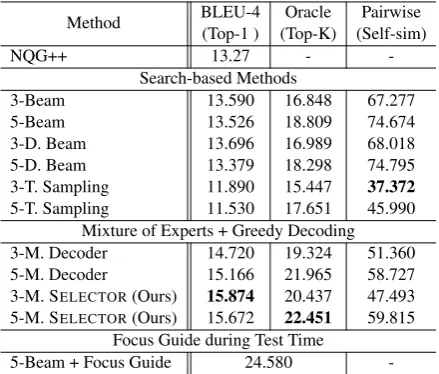
-Table 1:Question generation results:Comparison of diverse generation methods on SQuAD. The score of NQG++ (top row) is fromZhou et al.(2017a), and the rest are from our experiments using NQG++ as a gen-erator. Method prefixes are the numbers of generated questions for each passage-answer pair. Best scores are bolded.
5 Results
Diversity vs. Accuracy Trade-off Tables1and
2 compare our method with different
diversity-promoting techniques in question generation and abstractive summarization. The tables show that
our mixture SELECTOR method outperforms all
baselines in Top-1 and oracle metrics and achieves the best trade-off between diversity and accuracy. Moreover, both mixture models are superior to all search-based methods in the trade-off between di-versity and accuracy. Standard and diverse beam search methods score low both in terms of ac-curacy and diversity. Truncated sampling shows the lowest self-similarity (high diversity), but it achieves the lowest score on Top-1 accuracy. No-tably, our method scores state-of-the-art BLEU-4 in question generation on SQuAD and ROUGE comparable to state-of-the-art methods in
abstrac-tive summarization in CNN-DM (See also Table4
for state-of-the-art results in CNN-DM).
Diversity vs. Number of Mixtures Here we
compare the effect of number of mixtures in our SELECTOR and Mixture Decoder (Shen et al.,
2019). Tables 1 and2 show that pairwise
simi-larity increases (diversity⇓) when the number of
mixtures increases for Mixture Decoder. While we
observe a similar trend for SELECTORin the
[image:7.595.307.527.62.249.2]Method ROUGE-2 Oracle Pairwise (Top-1) (Top-K) (Self-sim)
PG 17.28 -
-Search-based Methods
3-Beam 16.533 18.509 85.598
5-Beam 16.634 19.442 84.765
3-D. Beam 16.667 18.722 85.496 5-D. Beam 16.632 19.659 84.043 3-T. Sampling 12.914 17.068 17.306 5-T. Sampling 13.049 19.161 16.720
Mixture of Experts + Greedy Decoding 3-M. Decoder 15.854 21.214 43.168 5-M. Decoder 16.104 21.801 67.196 3-M. SELECTOR(Ours) 17.930 21.316 51.092 5-M. SELECTOR(Ours) 18.309 22.511 47.280
Focus Guide during Test Time
5-Beam + Focus Guide 42.757
-Table 2: Summarization results: Comparison of di-verse generation methods on CNN-DM. The score of PG (top row) is fromSee et al.(2017), and the rest are from our experiments using PG as a generator. Method prefixes are the numbers of generated summaries for each document. Best scores are bolded.
effect in the summarization task i.e., pairwise
sim-ilarity decreases (diversity⇑) for SELECTOR.
The abstractive summarization task on CNN-DM has a target distribution with more modal-ities than question generation task on SQuAD, which is more difficult to model. We speculate that
our SELECTORimproves accuracy by focusing on
more modes of the output distribution (diversity
⇑), whereas Mixture Decoder tries to improve the
accuracy by concentrating on fewer modalities of
the output distribution (diversity⇓).
Upper Bound Performance The bottom rows
of Tables 1 and 2 show the upper bound
perfor-mance of SELECTOR by feeding focus guide to
generator during test time. In particular, we as-sume that the mask is the ground truth overlap be-tween input and target sequences at test time. The gap between the oracle metric (top-k accuracy) and the upper bound is very small for question generation. This indicates that the top-k masks for question generation include the ground truth mask. Future work involves improving the content selec-tion stage for the summarizaselec-tion task.
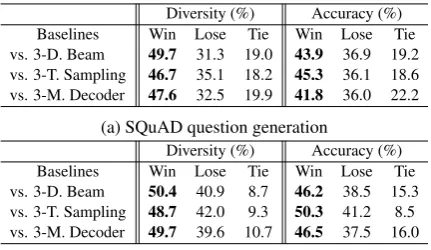
Human Evaluation Table 3a and 3b show the human evaluation in two tasks of questions gen-eration and summarization, comparing sequences
generated by SELECTOR with the
diversity-promoting baselines: Diverse Beam, Truncated Sampling and Mixture Decoder. The table shows that our method significantly outperforms all three
Diversity (%) Accuracy (%) Baselines Win Lose Tie Win Lose Tie vs. 3-D. Beam 49.7 31.3 19.0 43.9 36.9 19.2 vs. 3-T. Sampling 46.7 35.1 18.2 45.3 36.1 18.6 vs. 3-M. Decoder 47.6 32.5 19.9 41.8 36.0 22.2
(a) SQuAD question generation
Diversity (%) Accuracy (%) Baselines Win Lose Tie Win Lose Tie vs. 3-D. Beam 50.4 40.9 8.7 46.2 38.5 15.3 vs. 3-T. Sampling 48.7 42.0 9.3 50.3 41.2 8.5 vs. 3-M. Decoder 49.7 39.6 10.7 46.5 37.5 16.0
[image:8.595.309.525.61.186.2](b) CNN-DM abstractive summarization
Table 3: Human evaluation results
baselines in terms of both diversity and accuracy with statistical significance.
Comparison with State-of-the-art Table 4
compares the performance of SELECTOR with
the state-of-the-art bottom-up content selection ofGehrmann et al.(2018) in abstractive
summa-rization. SELECTOR passes focus embeddings at
the decoding step, whereas the bottom-up selec-tion method only uses the masked words for the
copy mechanism. We setK, the number of
mix-tures of SELECTOR, to 1 to directly compare it
with the previous work (Bottom-Up (Gehrmann
et al., 2018)). We observe that SELECTOR not only outperforms Bottom-Up in every metric, but also achieves a new state-of-the-art ROUGE-1 and ROUGE-L on CNN-DM. Moreover, our method scores state-of-the-art BLEU-4 in question
gener-ation on SQuAD (Table1).
Method R-1 R-2 R-L
PG (See et al.,2017) 39.53 17.28 36.38 Bottom-Up (Gehrmann et al.,2018) 41.22 18.68 38.34 DCA (Celikyilmaz et al.,2018) 41.69 19.47 37.92 SELECTOR& 10-Beam PG (Ours) 41.72 18.74 38.79
Table 4: Comparison of single-expert selector with state-of-the-art abstractive summarization methods on CNN-DM. R stands for ROUGE (Lin,2004)
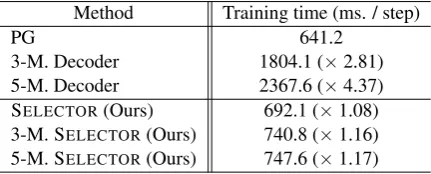
Efficient Training Table 5 shows that SELEC
-TORtrains up to 3.7 times faster than mixture
de-coder (Shen et al.,2019). Training time of mixture
decoder linearly increases with the number of
de-coders, while parallel focus inference of SELEC
-TORmakes additional training time negligible.
Qualitative Analysis To analyze how the gen-erator uses the selected content, we visualize
at-tention heatmap of NQG++ in Fig.3for question
formed in november1990 by the equalmerger of skytelevisionand britishsatellitebroadcasting, bskybbecame the uk 's largest digitalsubscriptiontelevisioncompany .
who was the merger of sky television and british satellite broadcasting ?
formed in november1990 by the equal merger of sky televisionand britishsatellitebroadcasting, bskybbecame the uk 's largestdigitalsubscriptiontelevisioncompany .
what teamwon theuk ?
formed in november1990 by the equal merger of sky televisionand britishsatellitebroadcasting, bskybbecamethe uk 's largestdigitalsubscriptiontelevisioncompany . who
became the uk 's largestdigital subscription television company ?
0.0 0.2 0.4 0.6 0.8
0.00 0.08 0.16 0.24 0.32 0.40
[image:9.595.73.525.63.255.2]0.0 0.2 0.4 0.6 0.8
Figure 3: Attention heatmap of NQG++ decoder with three different focus by SELECTOR. This shows focus can guide generator to generate different sequences. Passage tokens are colored when corresponding focus is 1.
Method Training time (ms. / step)
PG 641.2
3-M. Decoder 1804.1 (×2.81)
5-M. Decoder 2367.6 (×4.37)
SELECTOR(Ours) 692.1 (×1.08) 3-M. SELECTOR(Ours) 740.8 (×1.16) 5-M. SELECTOR(Ours) 747.6 (×1.17)
Table 5: Training time: Comparison of training time on CNN-DM. See4.6for implementation details.
mechanisms depending on three different focuses
inferred by different SELECTORexperts.
6 Conclusion
We introduce a novel diverse sequence generation method via proposing a content selection module, SELECTOR. Built upon mixture of experts and
hard-EM training, SELECTOR identifies different
key parts on source sequence to guide generator to output a diverse set of sequences.
SELECTOR is a generic plug-and-play module
that can be added to an existing encoder-decoder model to enforce diversity with a negligible addi-tional computaaddi-tional cost. We empirically demon-strate that our method improves both accuracy and diversity and reduces training time signifi-cantly compared to baselines in question genera-tion and abstractive summarizagenera-tion. Future work
involves incorporating SELECTOR for other
gen-eration tasks such as diverse image captioning.
Acknowledgment
This research was supported by Allen Distin-guished Investigator Award, the Office of Naval Research under the MURI grant N00014-18-1-2670, Samsung GRO, and gifts from Allen Insti-tute for AI and Google. We also thank the mem-bers of Clova AI, UW NLP, and the anonymous reviewers for their insightful comments.
References
Samuel R. Bowman, Luke Vilnis, Oriol Vinyals, An-drew M. Dai, Rafal Jozefowicz, and Samy Ben-gio. 2016. Generating Sentences from a Continuous Space. InCoNLL.
Asli Celikyilmaz, Antoine Bosselut, Xiaodong He, and Yejin Choi. 2018. Deep Communicating Agents for Abstractive Summarization. InNAACL.
Kyunghyun Cho. 2016. Noisy Parallel Approxi-mate Decoding for Conditional Recurrent Language Model.
Kyunghyun Cho, Bart van Merrienboer, Caglar Gul-cehre, Dzmitry Bahdanau, Fethi Bougares, Hol-ger Schwenk, and Yoshua Bengio. 2014. Learn-ing Phrase Representations usLearn-ing RNN Encoder-Decoder for Statistical Machine Translation. In EMNLP.
Jan Chorowski and Navdeep Jaitly. 2017.Towards bet-ter decoding and language model integration in se-quence to sese-quence models. InINTERSPEECH.
[image:9.595.72.288.317.404.2]Adji B Dieng, Yoon Kim, Alexander M Rush, and David M Blei. 2018. Avoiding Latent Variable Col-lapse with Generative Skip Models. InICML Work-shop.
David Eigen, Marc’Aurelio Ranzato, and Ilya Sutskever. 2014. Learning Factored Represen-tations in a Deep Mixture of Experts. In ICLR Workshop.
Angela Fan, Mike Lewis, and Yann Dauphin. 2018. Hi-erarchical Neural Story Generation. InACL.
Sebastian Gehrmann, Yuntian Deng, and Alexander M Rush. 2018. Bottom-Up Abstractive Summariza-tion. InEMNLP.
Alex Graves. 2013. Generating Sequences With Re-current Neural Networks.
Xiaodong Gu, Kyunghyun Cho, Jung-woo Ha, and Sunghun Kim. 2019. DialogWAE : Multimodal Response Generation with Conditional Wasserstein Auto-Encoder. InICLR.
Caglar Gulcehre, Sungjin Ahn, Ramesh Nallapati, Bowen Zhou, and Yoshua Bengio. 2016. Pointing the Unknown Words. InACL.
Abner Guzman-Rivera, Dhruv Batra, and Pushmeet Kohli. 2012. Multiple Choice Learning: Learning to Produce Multiple Structured Outputs. InNIPS.
Junxian He, Daniel Spokoyny, Graham Neubig, and Taylor Berg-Kirkpatrick. 2019. Lagging Inference Networks and Posterior Collapse in Variational Au-toencoders. InICLR.
Xuanli He, Gholamreza Haffari, and Mohammad Norouzi. 2018. Sequence to Sequence Mixture Model for Diverse Machine Translation. InCoNLL.
Karl Moritz Hermann, Tom´aˇs Koˇcisk´y, Edward Grefenstette, Lasse Espeholt, Will Kay, Mustafa Su-leyman, and Phil Blunsom. 2015. Teaching Ma-chines to Read and Comprehend. InNIPS.
Robert Jacobs, Michael Jordan, Steven J. Nowlan, and Geoffrey E. Hinton. 1991. Adaptive Mixtures of Lo-cal Experts.Neural Computation, 3(1):78–87.
Eric Jang, Shixiang Gu, and Ben Poole. 2017. Cat-egorical Reparameterization with Gumbel-Softmax. InICLR.
Ashwin Kalyan, Stefan Lee, Anitha Kannan, and Dhruv Batra. 2018. Learn from Your Neighbor: Learning Multi-modal Mappings from Sparse An-notations. InICML.
Nan Rosemary Ke, Konrad Zolna, Alessandro Sor-doni, Zhouhan Lin, Adam Trischler, Yoshua Ben-gio, Joelle Pineau, Laurent Charlin, and Chris Pal. 2018. Focused Hierarchical RNNs for Conditional Sequence Processing. InICML.
Hanjoo Kim, Minkyu Kim, Dongjoo Seo, Jinwoong Kim, Heungseok Park, Soeun Park, Hyunwoo Jo, KyungHyun Kim, Youngil Yang, Youngkwan Kim, Nako Sung, and Jung-Woo Ha. 2018a. NSML: Meet the MLaaS platform with a real-world case study.
Yoon Kim, Sam Wiseman, Andrew C. Miller, David Sontag, and Alexander M. Rush. 2018b. Semi-Amortized Variational Autoencoders. InICML.
Diederik P. Kingma and Jimmy Ba. 2015. Adam: A Method for Stochastic Optimization. InICLR.
Diederik P Kingma and Max Welling. 2013. Auto-Encoding Variational Bayes. InNIPS.
Stefan Lee, Senthil Purushwalkam, Michael Cogswell, Viresh Ranjan, David Crandall, and Dhruv Batra. 2016. Stochastic Multiple Choice Learning for Training Diverse Deep Ensembles. InNIPS.
Chenliang Li, Weiran Xu, Si Li, and Sheng Gao. 2018. Guiding Generation for Abstractive Text Summa-rization based on Key Information Guide Network. InNAACL.
Jiwei Li, Michel Galley, Chris Brockett, Jianfeng Gao, and William B. Dolan. 2016a. A Diversity-Promoting Objective Function for Neural Conversa-tion Models. InNAACL.
Jiwei Li, Will Monroe, and Dan Jurafsky. 2016b. A Simple, Fast Diverse Decoding Algorithm for Neu-ral Generation.
Chin-Yew Lin. 2004. ROUGE: A Package for Auto-matic Evaluation of Summaries. InACL Workshop.
Chris J. Maddison, Andriy Mnih, and Yee Whye Teh. 2017.The Concrete Distribution: A Continuous Re-laxation of Discrete Random Variables. InICLR.
Sewon Min, Victor Zhong, Richard Socher, and Caim-ing Xiong. 2018. Efficient and Robust Question An-swering from Minimal Context over Documents. In ACL.
Ramesh Nallapati, Bowen Zhou, Cicero dos Santos, Caglar Gulcehre, and Bing Xiang. 2016. Ab-stractive Text Summarization using Sequence-to-sequence RNNs and Beyond. InCoNLL.
Radford M. Neal and Geoffrey E. Hinton. 1998. A View of the EM Algorithm that Justifies Incremen-tal, Sparse, and other Variants. In Learning in Graphical Models, pages 355–368.
Myle Ott, Michael Auli, David Grangier, and Marc’Aurelio Ranzato. 2018. Analyzing Uncer-tainty in Neural Machine Translation. InICML.
Yookoon Park, Jaemin Cho, and Gunhee Kim. 2018. A Hierarchical Latent Structure for Variational Con-versation Modeling. InNAACL.
Adam Paszke, Sam Gross, Soumith Chintala, Gregory Chana, Edward Yang, Zachary DeVito, Zeming Lin, Alban Desmaison, Luca Antiga, and Adam Lerer. 2017. Automatic differentiation in PyTorch. In NIPS Workshop.
Jeffrey Pennington, Richard Socher, and Christopher Manning. 2014. Glove: Global Vectors for Word Representation. InEMNLP.
Ofir Press and Lior Wolf. 2017. Using the Output Em-bedding to Improve Language Models. InEACL.
Pranav Rajpurkar, Jian Zhang, Konstantin Lopyrev, and Percy Liang. 2016. SQuAD: 100,000+ Questions for Machine Comprehension of Text. InEMNLP.
Ali Razavi, Aaron van den Oord, Ben Poole, and Oriol Vinyals. 2019. Preventing Posterior Collapse with δ-VAEs. InICLR.
Ehud Reiter and Robert Dale. 2000. Building Natural Language Generation Systems.
Abigail See, Peter J. Liu, and Christopher D. Man-ning. 2017. Get To The Point: Summarization with Pointer-Generator Networks. InACL.
Iulian Vlad Serban, Alessandro Sordoni, Ryan Lowe, Laurent Charlin, Joelle Pineau, Aaron Courville, and Yoshua Bengio. 2017. A Hierarchical Latent Vari-able Encoder-Decoder Model for Generating Dia-logues. InAAAI.
Shiv Shankar and Sunita Sarawagi. 2019.Posterior At-tention Models for Sequence to Sequence Learning. InICLR.
Tianxiao Shen, Myle Ott, Michael Auli, and Marc’Aurelio Ranzato. 2019. Mixture Models for Diverse Machine Translation: Tricks of the Trade. InICML.
Jinsong Su, Shan Wu, Deyi Xiong, Yaojie Lu, Xianpei Han, and Biao Zhang. 2018. Variational Recurrent Neural Machine Translation. InAAAI.
Sandeep Subramanian, Tong Wang, Xingdi Yuan, Saizheng Zhang, Yoshua Bengio, and Adam Trischler. 2018. Neural Models for Key Phrase Ex-traction and Question Generation. In ACL Work-shop.
Ashwin K Vijayakumar, Michael Cogswell, Ram-prasath Ramprasaath R Selvaraju, Qing Sun, Ste-fan Lee, David Crandall, and Dhruv Batra. 2018. Diverse Beam Search for Improved Description of Complex Scenes. InAAAI.
Oriol Vinyals, Meire Fortunato, and Navdeep Jaitly. 2015.Pointer Networks. InNIPS.
Tsung-hsien Wen and Minh-thang Luong. 2018.Latent Topic Conversational Models.
Tsung Hsien Wen, Yishu Miao, Phil Blunsom, and Steve Young. 2017.Latent Intention Dialogue Mod-els. InICML.
Ronald J. Williams. 1992. Simple statistical gradient-following algorithms for connectionist reinforce-ment learning.Machine Learning, 8(3):229–256.
Jiacheng Xu and Greg Durrett. 2018. Spherical La-tent Spaces for Stable Variational Autoencoders. In EMNLP.
Zhilin Yang, Zihang Dai, Ruslan Salakhutdinov, and William W. Cohen. 2018. Breaking the Softmax Bottleneck: A High-Rank RNN Language Model. InICLR.
Lantao Yu, Weinan Zhang, Jun Wang, and Yong Yu. 2017. SeqGAN: Sequence Generative Adversarial Nets with Policy Gradient. InAAAI.
Biao Zhang, Deyi Xiong, Jinsong Su, Hong Duan, and Min Zhang. 2016. Variational Neural Machine Translation. InEMNLP.
Tiancheng Zhao, Ran Zhao, and Maxine Eskenazi. 2017. Learning Discourse-level Diversity for Neu-ral Dialog Models using Conditional Variational Au-toencoders. InACL.
Qingyu Zhou, Nan Yang, Furu Wei, Chuanqi Tan, Hangbo Bao, and Ming Zhou. 2017a. Neural Ques-tion GeneraQues-tion from Text: A Preliminary Study. In NLPCC.
Qingyu Zhou, Nan Yang, Furu Wei, and Ming Zhou. 2017b. Selective Encoding for Abstractive Sentence Summarization. InACL.