Proceedings of the 2019 Conference on Empirical Methods in Natural Language Processing and the 9th International Joint Conference on Natural Language Processing, pages 2578–2589,
2578
Quick and (not so) Dirty: Unsupervised Selection of Justification
Sentences for Multi-hop Question Answering
Vikas Yadav, Steven Bethard, Mihai Surdeanu
University of Arizona, Tucson, AZ, USA
{vikasy, bethard, msurdeanu}@email.arizona.edu
Abstract
We propose an unsupervised strategy for the selection of justification sentences for multi-hop question answering (QA) that (a) maxi-mizes the relevance of the selected sentences, (b) minimizes the overlap between the selected facts, and (c) maximizes the coverage of both question and answer. This unsupervised sen-tence selection method can be coupled with any supervised QA approach. We show that the sentences selected by our method im-prove the performance of a state-of-the-art supervised QA model on two multi-hop QA datasets: AI2’s Reasoning Challenge (ARC) and Multi-Sentence Reading Comprehension (MultiRC). We obtain new state-of-the-art per-formance on both datasets among approaches that do not use external resources for training the QA system: 56.82% F1 on ARC (41.24% on Challenge and 64.49% on Easy) and 26.1% EM0 on MultiRC. Our justification sentences have higher quality than the justifications se-lected by a strong information retrieval base-line, e.g., by 5.4% F1 in MultiRC. We also show that our unsupervised selection of justifi-cation sentences is more stable across domains than a state-of-the-art supervised sentence se-lection method.
1 Introduction
Interpretable machine learning (ML) models, where the end user can understand how a deci-sion was reached, are a critical requirement for the wide adoption of ML solutions in many fields
such as healthcare, finance, and law (Samek et al.,
2017; Alvarez-Melis and Jaakkola, 2017; Arras et al.,2017;Gilpin et al.,2018;Biran and Cotton,
2017)
For complex natural language processing (NLP) such as question answering (QA), human readable explanations of the inference process have been
proposed as a way to interpret QA models (Zhou
et al.,2018).
To which organ system do the esophagus, liver, pancreas, small intestine, and colon belong?
(A) reproductive system (B) excretory system (C)digestive system(D) endocrine system
ROCC-selected justification sentences:
1. vertebratedigestive systemhas oral cavity, teeth and pharynx,esophagusand stomach,small intestine, pan-creas, liverand the large intestine
2. digestive systemconsists liver, stomach, large intestine, small intestine, colon, rectum and anus
BM25-selected justification sentences:
1. theirdigestive systemconsists of a stomach,liver, pan-creas,small intestine, and a large intestine
2. theliver pancreasand gallbladder are the solid organ of thedigestive system
Figure 1:A multiple-choice question from the ARC dataset with the correct answer in bold, followed by justification sen-tences selected by our approach (ROCC) vs. sensen-tences se-lected by a strong IR baseline (BM25). ROCC justification sentences fully cover the five key terms in the question (shown in italic), whereas BM25 misses two:esophagusandcolon. Further, the second BM25 sentence is largely redundant with the first, not covering other query terms.
Recently, multiple datasets have been proposed
for multi-hop QA, in which questions can only
be answered when considering information from
multiple sentences and/or documents (Clark et al.,
2018; Khashabi et al., 2018a;Yang et al., 2018;
Welbl et al.,2018;Mihaylov et al.,2018;Bauer et al.,2018;Dunn et al.,2017;Dhingra et al.,2017;
Lai et al.,2017;Rajpurkar et al.,2018;Sun et al.,
2019). The task of selecting justification sentences
is complex for multi-hop QA, because of the ad-ditional knowledge aggregation requirement (ex-amples of such questions and answers are shown
in Figures1and2). Although various neural QA
methods have achieved high performance on some
of these datasets (Sun et al., 2018;Trivedi et al.,
2019;Tymoshenko et al.,2017;Seo et al.,2016;
In this work we propose an unsupervised
al-gorithm for the selection of multi-hop
justifica-tions fromunstructuredknowledge bases (KB).
Un-like other supervised selection methods (Dehghani
et al.,2019;Bao et al.,2016;Lin et al.,2018;Wang et al.,2018b,a;Tran and Niedere´ee,2018;Trivedi et al., 2019), our approach does not require any training data for justification selection. Unlike ap-proaches that rely on structured KBs, which are
ex-pensive to create, (Khashabi et al.,2016;Khot et al.,
2017;Zhang et al.,2018;Khashabi et al.,2018b;
Cui et al.,2017;Bao et al.,2016), our method op-erates over KBs of only unstructured texts. We demonstrate that our approach has a bigger impact on downstream QA approaches that use these justi-fication sentences as additional signal than a strong baseline that relies on information retrieval (IR). In particular, the contributions of this work are:
(1) We propose an unsupervised, non-parametric
strategy for the selection of justification sentences for multi-hop question answering (QA) that (a)
maximizes the Relevance of the selected
sen-tences; (b) minimizes the lexicalOverlap between
the selected facts; and (c) maximizes the lexical
Coverage of both question and answer. We call
our approach ROCC. ROCC operates by first
cre-ating nk justification sets from the top n
sen-tences selected by the BM25 information retrieval
model (Robertson et al., 2009), where k ranges
from 2 ton, and then ranking them all by a
for-mula that combines the three criteria above. The set with the top score becomes the set of justifi-cations output by ROCC for a given question and
candidate answer. As shown in Figure1, the
justifi-cation sentences selected by ROCC perform more meaningful knowledge aggregation than a strong IR baseline (BM25), which does not account for overlap (or complementarity) and coverage.
(2) ROCC can be coupled with any supervised QA
approach that can use the selected justification sen-tences as additional signal. To demonstrate its ef-fectiveness, we combine ROCC with a
state-of-the-art QA method that relies on BERT (Devlin et al.,
2018) to classify correct answers, using the text of
the question, the answer, and (now) the justification sentences as input. On the Multi-Sentence Reading
Comprehension (MultiRC) dataset (Khashabi et al.,
2018a), we achieved a gain of 8.3% EM0 with ROCC justifications when compared to the case where the complete comprehension passage was provided to the BERT classifier. On AI2’s
Reason-ing Challenge (ARC) dataset (Clark et al.,2018),
the QA approach enhanced with ROCC justifica-tions outperforms the QA method without justifi-cations by 9.15% accuracy, and the approach that uses top sentences provided by BM25 by 2.88%. Further, we show that the justification sentences se-lected by ROCC are considerably more correct on their own than justifications selected by BM25 (e.g., the justification score in MultiRC was increased by 11.58% when compared to the best performing BM25 justifications), which indicates that the in-terpretability of the overall QA system was also increased.
(3) Lastly, our analysis indicates that ROCC is
more stable across the different domains in the MultiRC dataset than a supervised strategy for the selection of justification sentences that relies on a dedicated BERT-based classifier, with a difference of over 10% F1 score in some configurations.
The ROCC system and the codes for
generat-ing all the analysis are provided here - https:
//github.com/vikas95/AutoROCC.
2 Related Work
The body of QA work that addresses the selec-tion of justificaselec-tion sentences can be classified into roughly four categories: (a) supervised approaches that require training data to learn how to select justification sentences (i.e., questions and answers coupled with correct justifications); (b) methods that treat justifications as latent variables and learn jointly how to answer questions and how to select justifications from questions and answers alone; (c) approaches that rely on information retrieval to se-lect justification sentences; and, lastly, (d) methods that do not use justification sentences at all.
In the first category, previous works
(e.g., (Trivedi et al., 2019)) have used
entail-ment resources including labeled trained datasets
such as SNLI (Bowman et al.,2015) and MultiNLI
(Williams et al., 2017) to train components for selecting justification sentences for QA. Other works have explicitly focused on training sentence
selection components for QA models (Min et al.,
2018; Lin et al., 2018; Wang et al., 2019). In datasets where gold justification sentences are not provided, researchers have trained such compo-nents by retrieving justifications from structured
KBs (Cui et al., 2017; Bao et al., 2016; Zhang
with denoising components (Wang et al., 2019). While these works offer exciting directions, they all rely on training data for justifications, which is expensive to generate and may not be available in real-world use cases.
The second group of methods tend to rely on
reinforcement learning (Choi et al.,2017;Lai et al.,
2018;Geva and Berant,2018) or PageRank ( Sur-deanu et al.,2008) to learn how to select justifica-tion sentences without explicit training data. Other works have used end-to-end (mostly RNNs with attention mechanisms) QA architectures for learn-ing to pay more attention on better justification
sentences (Min et al.,2018;Seo et al.,2016;Yu
et al., 2014;Gravina et al., 2018). While these approaches do not require annotated justifications, they need large amounts of question/answer pairs during training so they can discover the latent jus-tifications. In contrast to these two directions, our approach requires no training data at all for the justification selection process.
The third category of methods utilize IR tech-niques to retrieve justifications from both
unstruc-tured (Yadav et al.,2019) and structured (Khashabi
et al.,2016) KBs. Our approach is closer in spirit to this direction, but it is adjusted to account for more intentional knowledge aggregation. As we show in
Section4, this is important for both the quality of
the justification sentences and the performance of the downstream QA system.
The last group of QA approaches learn how to classify answers without any justification
sen-tences (Mihaylov et al., 2018; Sun et al., 2018;
Devlin et al.,2018). While this has been shown to obtain good performance for answer classification, we do not focus on it in this work because these methods cannot easily explain their inference.
Note that some of the works discussed here trans-fer knowledge from external datasets into the QA
task they address (Chung et al.,2017;Sun et al.,
2018;Pan et al.,2019;Min et al.,2017;Qiu et al.,
2018;Chen et al.,2017). In this work, we focus solely on the resources provided in the task itself because such compatible external resources may not be available in real-world applications of QA.
3 Approach
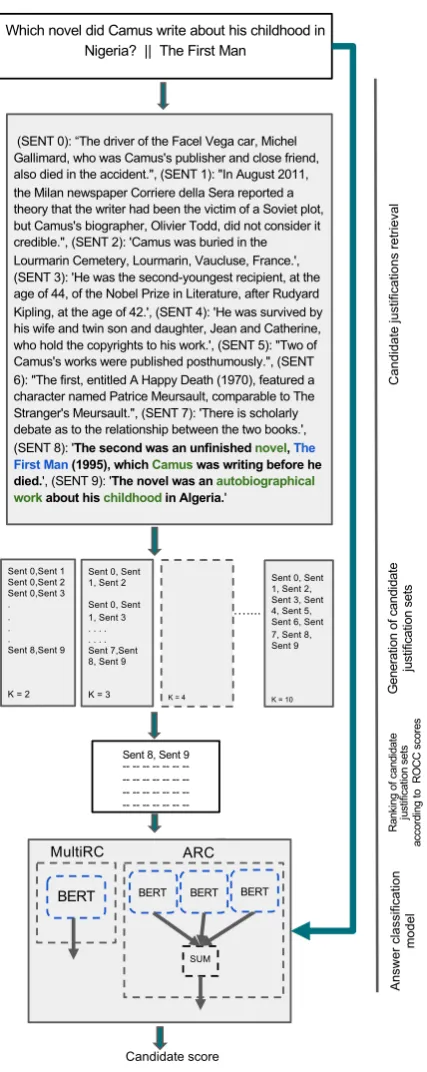
ROCC, coupled with a QA system, operates in the
following steps (illustrated in Figure2):
(1) Retrieval of candidate justification sen-tences: For datasets that rely on huge supporting
KBs (e.g., ARC), we retrieve the topnsentences1
from this KB using an IR query that concatenates the question and the candidate answer, similar to
Clark et al.(2018); Yadav et al.(2019). We im-plemented this using the BM25 IR model with the
default parameters in Lucene2. For reading
com-prehension datasets where the question is associ-ated with a text passage (e.g., MultiRC), all the sentences in this passage become candidates.
(2) Generation of candidate justification sets: Since its focus is on knowledge aggregation, ROCC
ranks sets of justification sentences (see below)
rather than individual sentences. In this step we
create candidate justification sets by generating nk
groups of sentences from the previousnsentences,
using multiple values ofk.
(3) Ranking of candidate justification sets: For every candidate justification set, we calculate its
ROCC score (see Section3.1), which estimates the
likelihood that this group of justifications explains the given answer. We then rank the justification sets in descending order of ROCC score, and choose the top set as the group of justifications that is the output of ROCC for the given question and answer. In MultiRC, we rearrange the justification sentences according to their original indexes in the given passage to bring coherence in the selected sequence of sentences.
(4) Answer classification: ROCC can be coupled with any supervised QA component for answer classification. In this work, we feed in the question, answer, and justification texts into a
state-of-the-art classifier that relies on BERT (see Section3.2).
Because the justification sentences in the reading comprehension use case (e.g., MultiRC) come from the same passage and their sequence is likely to be coherent, we concatenate them into a single pas-sage, and use a single BERT instance for classifica-tion. This approach is shown on the left side of the
answer classification component in Figure2. On
the other hand, the justification sentences retrieved from an external KB (e.g., ARC) may not form a coherent passage when aggregated. For this reason, in the ARC use case, we classify each justifica-tion sentence separately (together with the quesjustifica-tion and candidate answer), and then average all these scores to produce a single score for the candidate answer (right-hand side of the figure).
1
Which novel did Camus write about his childhood in Nigeria? || The First Man
(SENT 0): “The driver of the Facel Vega car, Michel Gallimard, who was Camus's publisher and close friend, also died in the accident.", (SENT 1): "In August 2011, the Milan newspaper Corriere della Sera reported a theory that the writer had been the victim of a Soviet plot, but Camus's biographer, Olivier Todd, did not consider it credible.", (SENT 2): 'Camus was buried in the Lourmarin Cemetery, Lourmarin, Vaucluse, France.', (SENT 3): 'He was the second-youngest recipient, at the age of 44, of the Nobel Prize in Literature, after Rudyard Kipling, at the age of 42.', (SENT 4): 'He was survived by his wife and twin son and daughter, Jean and Catherine, who hold the copyrights to his work.', (SENT 5): "Two of Camus's works were published posthumously.", (SENT 6): "The first, entitled A Happy Death (1970), featured a character named Patrice Meursault, comparable to The Stranger's Meursault.", (SENT 7): 'There is scholarly debate as to the relationship between the two books.', (SENT 8): 'The second was an unfinished novel, The First Man(1995), which Camuswas writing before he died.', (SENT 9): 'The novel was an autobiographical workabout his childhoodin Algeria.'
Sent 0,Sent 1 Sent 0,Sent 2 Sent 0,Sent 3 . . . . Sent 8,Sent 9
K = 2
Sent 0, Sent 1, Sent 2
Sent 0, Sent 1, Sent 3 . . . . . . . . Sent 7,Sent 8, Sent 9
K = 3
Sent 0, Sent 1, Sent 2, Sent 3, Sent 4, Sent 5, Sent 6, Sent 7, Sent 8, Sent 9
K = 10
Ca nd id at e ju st ifi ca tio ns r et rie va l
K = 4
….... Ge ne ra tio n of c an di da te ju st ific at io n se ts
Sent 8, Sent 9 --Ra nk in g of ca nd id at e jus tif ic at ion se ts ac cor di ng to R O C C s cor es Candidate score BERT SUM BERT BERT ….. BERT MultiRC ARC An sw er cl assi fica tio n m odel
Figure 2: An example of the ROCC process for a ques-tion from the MultiRC dataset. Here, ROCC correctly extracts the two justification sentences necessary to ex-plain the correct answer.
3.1 Ranking of Candidate Justification Sets
Each set of justifications is ranked based on its
ROCC score, which: (a) maximizes theRelevance
of the selected sentences; (b) minimizes the lexical
Overlap between the selected facts; and (c)
max-imizes the lexicalCoverage of both question and
answer (Cques, Cans). The overall score for a given
justification setPiis calculated as:
S(Pi) =
R +O(Pi)
·(+C(A))·(+C(Q)) (1)
To avoid zeros, we add a small constant ( = 1
here) to each component that can have a value of 0.3
We detail the components of this formula below.
Relevance (R) We use the Lucene
implementa-tion4 of the BM25 IR model (Robertson et al.,
2009) to estimate the relevance of each
justifica-tion sentence to a given quesjustifica-tion and candidate answer. In particular, we form a query that concate-nates the question and candidate answer, and use as underlying document collection (necessary to com-pute document statistics such as inverse document frequencies (IDF)) either: sentences in the entire KB (for ARC), or all sentences in the correspond-ing passage in the case of readcorrespond-ing comprehension (MultiRC). The arithmetic mean of BM25 scores over all sentences in a given justification set gives
the value ofRfor the entire set.
Overlap (O) To ensure diversity and complemen-tarity between justification sentences, we compute the overlap between all sentence pairs in a given group. Thus, minimizing this score reduces redun-dancy and encourages the aggregated sentences to
addressdifferentparts of the question and answer:
O(S) = X
si∈S X
sj∈S−si
|t(si)∩t(sj)|
max(|t(si)|,|t(sj)|)
|S|
2
(2)
whereSis the given set of justification sentences;
si is theith sentence inS; andt(si) denotes the
set of unique terms in sentencesi. Note that we
divide by |S2|to normalize across different sizes
of justification sets.
Coverage (C) Complementing the overlap score, this component measures the lexical coverage of the question and the answer texts by the given set
of justificationsS. This coverage is weighted by
the IDF of question and answer terms. Thus, max-imizing this value encourages the justifications to address more of the meaningful content mentioned
3Our R score relies on BM25, which is larger than 0 on the topnsentences.
4https://lucene.apache.org/core/7_
in the question (X=Q) and the answer (X=A):
Ct(X) =
[
si∈S
t(X)∩t(si) (3)
C(X) =
P|Ct(X)|
t=1 IDF[Ct(X)[t]]
|t(X)| (4)
where t(X) denotes the unique terms inX, and
Ct(X)represents the set of all unique terms inX
that are present in any of the sentences of the given
justification set. C(X) gives the IDF weighted
average ofCt(X)terms.
3.2 Answer Classification
As indicated earlier, we propose two flavors for the answer classification component: if the sentences in a justification group come from the same pas-sage and, thus, are likely to be coherent, they are concatenated into a single text before classification, and handled by a single answer classifier. If the sen-tences come from different texts, they are handled by separate instances of the answer classifier. In the latter case, all scores are averaged to produce a sin-gle score for a candidate answer. In all situations
we used BERT (Devlin et al., 2018) for answer
classification. In particular, we employed BERT as a binary classifier operating over two texts. The first text consists of the concatenated question and answer, and the second text consists of the justifi-cation text. The classifier operates over the hidden states of the two texts, i.e., the state corresponding
to the[CLS]token (Devlin et al.,2018).5
We observed empirically that pre-training the
BERT classifier on all n sentences retrieved by
BM25, and then fine tuning on the ROCC justifi-cations improves performance on all datasets we experimented with. This resembles the transfer
learning discussed byHoward and Ruder(2018),
where the source domain would be the BM25 sen-tences, and the target domain the ROCC justifica-tions. However, one important distinction is that, in our case, all this knowledge comes solely from the resources provided within each dataset, and is retrieved using unsupervised method (BM25). We conjecture that this helped mainly because the pre-training step exposed BERT to more data which, even if imperfect, is topically related to the corre-sponding question and answer.
5We used the following hyper parameters with BERT Large: learning rate of 1e-5, maximum sequence length of 128, batch size = 16, number of epochs = 6.
Question + answer text Justification set
Animal cells obtain energy 1) obtain water and nutrient by by||absorbing nutrients absorbing them directly into
plant cell
2) the animal obtain nourish-ment by absorbing nutrient released by symbiotic bacteria
Table 1: Example of a justification set in ARC which was scored by annotator with a precision of12because the first jus-tification sentence is not relevant, and a coverage of12 because the link betweennourishmentandenergyis not covered.
4 Empirical Evaluation
We evaluated ROCC coupled with the proposed QA approach on two QA datasets. We use the standard train/development/test partitions for each dataset, as well as the standard evaluation measures:
accuracy for ARC (Clark et al., 2018), and F1m
(macro-F1 score), F1a(micro-F1 score), and EM0
(exact match) for MultiRC (Khashabi et al.,2018a).
Multi-sentence reading comprehension (MultiRC): this is a reading comprehen-sion dataset implemented as multiple-choice QA (Khashabi et al., 2018a). Each question is accompanied by a supporting passage, which contains the correct answer. We use all sentences from such paragraphs as candidate justifications for the corresponding questions.
AI2’s Reasoning Challenge (ARC): this is a multiple-choice question dataset, containing ques-tions from science exams from grade 3 to grade 9 (Clark et al.,2018). The dataset is split in two partitions: Easy and Challenge, where the latter partition contains the more difficult questions that require reasoning. Most of the questions have 4
an-swer choices, with<1% of all the questions having
either 3 or 5 answer choices. Importantly, ARC in-cludes a supporting KB of 14.3M unstructured text passages. We use BM25 over this entire KB to re-trieve candidate justification sentences for ROCC.
4.1 Justification Results
To demonstrate that ROCC has the capacity to se-lect better justification sentences, we also report the quality of the extracted justification sentences. For MultiRC, we report precision/recall/F1 justification scores, computed against the gold justification
sen-tences provided by the dataset.6 For ARC, where
gold justifications are not provided, we used an
# External Supervised Method F1m F1a EM0 Justification
resource? selection of P R F1
justifications?
DEVELOPMENT DATASET
Baselines
0 No No Predict 1 (Khashabi et al.,2018a) 61.0 59.9 0.8 – 1 No No IR(paragraphs) (Khashabi et al.,2018a) 64.3 60.0 1.4 – 2 No No SurfaceLR (Khashabi et al.,2018a) 66.5 63.2 11.8 – 3 No No Entailment baseline (Trivedi et al.,2019) 51.3 50.4 – –
Previous work
4 Yes Yes EERDP L+ FTWang et al.(2019) 70.5 67.8 13.3 – 5 Yes Yes Multee (GloVe) (Trivedi et al.,2019) 71.3 68.3 17.9 – 6 No Yes Multee (ELMo) (Trivedi et al.,2019) 70.3 67.3 22.8 – 7 Yes Yes Multee (ELMo) (Trivedi et al.,2019) 73.0 69.6 22.8 –
8 No Yes RS (Sun et al.,2018) 69.7 67.9 16.9 –
9 Yes Yes RS (Sun et al.,2018) 73.1? 70.5? 21.8 –
BERT + IR baselines
10 No No BERT + entire passage 65.7 62.7 17.0 17.4 100.0 29.6 11 No No BERT + BM25 (k= 1sentence) 66.2 62.8 17.9 61.0 27.1 37.5 12 No No BERT + BM25 (k= 2sentences) 68.1 64.8 21.0 51.6 45.6 48.4 13 No No BERT + BM25 (k= 3sentences) 69.1 65.7 21.6 42.6 56.1 48.4 14 No No BERT + BM25 (k= 4sentences) 70.05 66.7 22.3 36.9 64.6 47.0 15 No No BERT + BM25 (k= 5sentences) 71.2 67.7 23.4 32.7 71.1 44.8
BERT + parametric ROCC
16 No No BERT + ROCC (k= 2sentences) 69.8 66.8 22.7 54.7 48.5 51.4 17 No No BERT + ROCC (k= 3sentences) 72.7 69.7 25.2 48.0 63.5 54.7 18 No No BERT + ROCC (k= 4sentences) 72.2 69.0 25.0 40.6 71.0 51.6 19 No No BERT + ROCC (k= 5sentences) 71.6 68.7 22.7 35.0 76.5 48.1
BERT + non-parametric ROCC
20 No No BERT + AutoROCC (k∈ {2,3,4}) 72.0 69.0 21.9 48.9 66.5 56.3 21 No No BERT + AutoROCC (k∈ {2,3,4,5}) 72.0 68.8 23.5 48.3 67.7 56.4 22 No No BERT + AutoROCC (k∈ {2,3,4,5,6}) 72.1 69.2 25.3 48.2 68.2 56.4
23 No No BERT + BM25 (kfrom best AutoROCC) 71.1 67.4 23.1 43.8 61.2 51.0 24 No No BERT + AutoROCC (k∈ {2,3,4,5,6}, pre-trained) 72.9 69.6 24.7 48.2 68.2 56.4
Ceiling systems with gold justifications
25 Yes Yes EERgt+ FT (Wang et al.,2019) 72.3 70.1 19.2
-26 No Yes BERT + Gold knowledge 79.1 75.4 37.6 100.0 100.0 100.0
27 - - Human 86.4 83.8 56.6 –
TEST DATASET
[image:6.595.79.519.56.491.2]28 No No SurfaceLR (Khashabi et al.,2018a) 66.9 63.5 12.8 29 Yes Yes Multee (ELMo) (Trivedi et al.,2019) 73.8 70.4 24.5 – 30 No No BERT + AutoROCC (k∈ {2,3,4,5,6}, pre-trained) 73.8 70.6 26.1
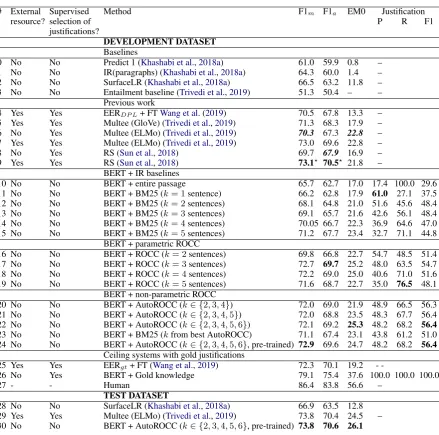
Table 2:Performance on the MultiRC dataset, under various configurations.kindicates the size(s) of the sets of justification sentences. In parametric ROCC,kis a hyper parameter; in AutoROCC,kis selected automatically. The pre-trained ROCC configurations pre-train BERT on the entire passage corresponding to the question, before fine tuning it on the ROCC sentences. Bold values with?indicate state-of-the-art results that used external labeled resources or other supervised methods for the selection of justification sentences. Italicized bold values show state-of-the-art results from experiments that do not use any external labeled resources.
external annotator to annotate the justifications for a random stratified sample of 70 questions, with 10 questions selected from each grade (3 – 9).The annotator reported two scores: precision, and cov-erage. Precision was defined as the fraction of justi-fication sentences that are relevant for the inference necessary to connect the corresponding question and candidate answer. Coverage was defined as 1 if the justification set completely covers the inference
process for the given question and answer,1/2if
the set of justifications partially addresses the in-ference, and 0 if the justification set is completely
irrelevant. Table1illustrates these scores with an
actual output from ARC.
4.2 Question answering results
# External Supervised Method Challenge Easy All Justification
resources selection of P, Coverage
used? justifications?
Baselines
0 No No AI2 IR Solver (Clark et al.,2018) 59.99 23.98 >0
1 No No Sanity Check (Yadav et al.,2018) 58.36 26.56 >0
2 Yes No Tuple-Inf (Clark et al.,2018) 60.71 23.83 >0
3 Yes No DGEM (Clark et al.,2018) 58.97 27.11 >0
Previous work
4 Yes – Bi-LSTM max-out (Mihaylov et al.,2018) 33.87 34.26 = 0
8 No No AHE (Yadav et al.,2019) 33.28 63.22 53.31 9 No – Reading Strategies (Sun et al.,2018) 35.40 63.10 53.94 = 0
10 Yes – Reading Strategies (Sun et al.,2018) 42.30? 68.90? 60.19? = 0
BERT + IR baselines
11 No – BERT 35.11 52.75 46.94
12 No No BERT + BM25 (k= 1sentence) 33.87 56.23 48.85 13 No No BERT + BM25 (k= 2sentences) 38.65 60.50 53.29 14 No No BERT + BM25 (k= 3sentences) 41.04 63.19 55.89 15 No No BERT + BM25 (k= 4sentences) 37.9 63.49 53.90 16 No No BERT + BM25 (k= 5sentences) 38.01 61.28 53.60
BERT + parametric ROCC
17 No No BERT + ROCC (k= 2sentences) 36.65 60.59 52.69 18 No No BERT + ROCC (k= 3sentences) 39.29 62.97 55.16 19 No No BERT + ROCC (k= 4sentences) 40.39 61.13 54.29 20 No No BERT + ROCC (k= 5sentences) 40.62 59.96 53.58
BERT + non-parametric ROCC
[image:7.595.77.520.60.357.2]21 No No BERT + AutoROCC (k∈ {2,3, ...20}) 40.73 63.64 56.09 48.04, 62.50 22 No No BERT + BM25 (kfrom best AutoROCC) 39.24 61.01 53.83 42.55, 55.88 23 No No BERT + AutoROCC (k∈ {2,3, ...20}, pre-trained) 41.24 64.49 56.82 48.04, 62.50
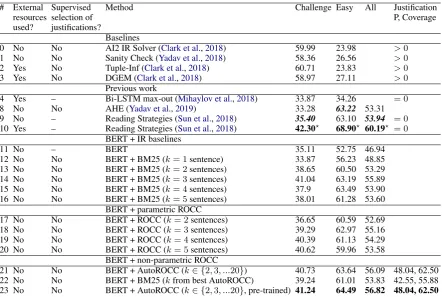
Table 3: Performance on the ARC dataset, under various configurations. Notations are the same as in Table2.
BM25 baseline has an additional hyper parameter:
the number of sentences to be considered (k).
Table 2 reports comprehensive results on
MultiRC, including both overall QA performance,
measured using F1m, F1a, and EM0, as well as
justification quality, measured using standard preci-sion (P), recall (R), and F1. Note that the bulk of the results are reported on the development partition. The last row in the table reports results on the test partition, computed using the official submission portal which can be accessed only once per model (including its variants). To understand ROCC’s be-havior, the table includes both the parametric form of ROCC, where the size of the justification sets
(k) is manually tuned as well as the non-parametric
ROCC, where k is automatically selected in the
third step of the ROCC algorithm (see Figure2) by
sorting across all sizes of justification sets together,
instead of sorting within each value ofk. Table3
lists equivalent results on ARC.
We draw several observations from these tables:
(1) Despite its simplicity, ROCC combined with
the BERT classifier obtains new state-of-the-art per-formance on both MultiRC and ARC for the class of approaches that do not use external resources to either train the justification sentence selection or the answer classifier. For example, ROCC
outper-forms the previous best result in MultiRC by 2.5 EM0 points on the development partition (row 24 vs. row 6), and 1.6 EM0 points on test (row 30 vs. row 29). In ARC, ROCC outperforms the previous best approach by 5.8% accuracy on the Challenge partition, and 2.9% overall (row 23 vs. row 9).
(2) On both datasets, the non-parametric form of
ROCC (AutoROCC) slightly outperforms the para-metric variant. Importantly, it always achieves higher justification scores compared to the paramet-ric ROCC. In MultiRC, AutoROCC outperforms our baseline of BERT + entire passage (row 10 vs 22) by 8.3% EM0, indicating that AutoROCC can filter out irrelevant content. In ARC, AutoROCC outperforms the baseline with no justification sen-tences by 9.1% (row 21 vs row 11), demonstrating that ROCC aggregates useful knowledge.
(3) The results of the parametric forms of ROCC
(rows 16 – 19 in Table 2 and rows 17 – 20 in
Table 3) indicate that performance continues to
increase until k = 4 in MultiRC and k = 3in
ARC. This indicates that: (a) knowledge aggrega-tion is beneficial for these tasks; (b) ROCC can robustly handle non-trivial cases of aggregation
with larger values ofk; and (c) similar to other QA
train/test Science Fiction News Wiki wikiMovie Society, All
textbook articles Summaries Law and
Justice
AutoROCC 54.57 53.88 54.32 60.49 57.10 61.06 56.44
BERT+All passages 55.15 55.46 68.77 65.14 57.39 58.79 60.90
BERT+Science textbook 55.67 41.01 51.45 50.06 54.96 48.84 50.79
BERT+Fiction 45.16 57.60 63.05 63.13 59.98 50.94 58.31
BERT+News 44.11 50.77 68.82 65.45 57.01 58.30 59.30
[image:8.595.77.525.62.186.2]GPT-2 (Wang et al.,2019) - - - 60.7
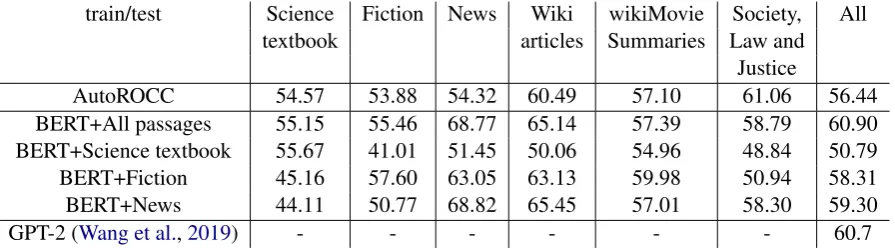
Table 4: Domain robustness of the non-parametric ROCC vs. a supervised sentence selection model, evaluated on the gold justification sentences from MultiRC. Each column represents a section of the MultiRC development set. Each row after AutoROCC represents a justification sentence selection component trained only on the specified section of MultiRC (these sections are listed in descending order of the number of passages in the training data).
decreases for large values of k, suggesting that
knowledge aggregation remains an open research challenge.
(4) The justification scores in both datasets are
con-siderably higher than the equivalent configuration that uses BM25 instead of ROCC (i.e., row 24 vs.
row 23 in Table2, and row 23 vs. row 22 in
Ta-ble3). This confirms that thejointscoring of sets
of justifications that ROCC performs is better than the individual ranking of justification sentences per-formed by standard IR models such as BM25.
4.3 Domain Robustness Analysis
To understand ROCC’s domain robustness, we compared it against a supervised BERT-based clas-sifier for the selection of justification sentences, as
well as against GPT-2 (Wang et al.,2019). For this
experiment, we used MultiRC, where gold justifi-cations are provided. We used this data to train a classifier for the selection of justification sentences on various domain-specific sections of MultiRC.
The results of this experiment are shown in Table4.
Unsurprisingly, training and testing in the same do-main (e.g., Fiction) leads to the best performance on sentence selection. However, ROCC is more stable across domains than the supervised sentence selection component, with a difference of over 10 F1 points in some configurations. This suggests that ROCC is a better solution for real-world use cases where the distribution of the test data may be very different from the training data.
Compared to BERT, the unsupervised Auto-ROCC achieves almost the same or better perfor-mance in the majority of the domains except Wiki articles and News. We conjecture this happens be-cause the BERT language model was trained on a large text corpus that comes from these two
do-# Ablations ARC MultiRC MultiRC
EM0 Justification
F1
0 Full AutoROCC 56.09 25.29 56.44
1 – IDF 54.11 24.65 54.19
2 –C(A) 54.90 21.82 52.93
3 –C(Q) 54.66 23.61 52.09
4 – O 55.88 24.03 55.97
[image:8.595.309.525.253.373.2]5 R? 53.90 23.40 44.81
Table 5: Ablation study, removing different compo-nents of ROCC. The scores are reported on the ARC test set and MultiRC dev set. R? denotes the best ap-proach that relies just on theRscore. The hyper param-eterkin R?, was tuned on the development partition of the respective dataset.
mains. However, importantly, AutoROCC is more robust across domains that are different from these two, since it is an unsupervised approach that is not tuned for any specific domain.
The ARC dataset does not provide justification sentences, so we instead ask how well our question-answering models do on a related inference task,
the SciTail entailment dataset (Khot et al.,2018).
We trained three QA classifiers on the ARC dataset: BERT with no justification, BERT with BM25
(k= 4) justifications, and BERT with AutoROCC
justifications. We tested these on SciTail, and achieved 64.49%, 69.70%, and 73.46% accuracy, respectively, indicating that AutoROCC’s knowl-edge aggregation is a valid proxy for entailment.
4.4 Ablation Analysis
Table5shows an ablation of the different
compo-nents of ROCC. Row 0 reports the score from the full AutoROCC model. In row 1, we remove IDF
Question type Precision Recall F-1 score
True/False/Yes/No 54.1 68.9 60.6
Verbatim 49.7 71.2 58.5
[image:9.595.75.289.61.117.2]Non-verbatim 47.3 68.7 56.0
Table 6: Justification selection performance of Auto-ROCC on different types of questions, in the MultiRC development dataset.
of both question and answer text. In row 2, 3 and 4, we remove the coverage of answer, coverage of question, and overlap from the ROCC formula (see
eq. (1)) respectively. In all the cases, we found
small drops in both performance and justification scores across both the datasets, with the removal of
eitherC(A)orC(Q)having the largest impact.
4.5 Error Analysis
We analyzed ROCC’s justification selection per-formance on three different types of questions in MultiRC: True/False/Yes/No, Verbatim, and
Non-verbatim (Khashabi et al.,2018b). As shown in
Table6, AutoROCC achieves higher recall scores
on Verbatim questions, where the answer text is likely to appear within the given justification pas-sage, and worse recall on question types where such overlap does not exist, e.g., Non-verbatim and
True/False. This suggests that the C(A)
compo-nent of ROCC is important for the extraction of meaningful justifications.
4.6 Alignment ROCC
To understand the dependence between ROCC and exact lexical match, we compare the justification selection performance of ROCC when its score components are computed based on lexical match (the approach used throughout the paper up to this
point) vs. the semantic alignment match ofYadav
et al.(2018). The latter approach relaxes the re-quirement for lexical match, i.e., two tokens are considered to be matched when the cosine
similar-ity of their embedding vectors is larger than0.95.7
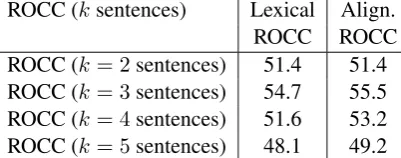
As shown in Table7, the alignment-based ROCC
indeed performs better than the ROCC that relies on lexical match. However, the improvements are not large, e.g., the maximum improvement is 1.6%
(whenk= 4), which indicates that ROCC is robust
to a certain extent to lexical variation.
7This threshold was tuned on the MultiRC development set. We used 100-dimensional GloVe embeddings for this experiment, which performed similarly to larger embedding vectors (300), but allowed for faster experiments.
ROCC (ksentences) Lexical Align.
ROCC ROCC
ROCC (k= 2sentences) 51.4 51.4
ROCC (k= 3sentences) 54.7 55.5
ROCC (k= 4sentences) 51.6 53.2
ROCC (k= 5sentences) 48.1 49.2
Table 7: Justification selection performance of the ROCC configuration that uses lexical match (BM25) to retrieve candidate justifications (Lexical ROCC), com-pared against a ROCC variant that uses the semantic alignment approach ofYadav et al.(2018) to retrieve candidates (Align. ROCC). This experiment used the MultiRC development dataset.
5 Conclusion
We introduced ROCC, a simple unsupervised ap-proach for selecting justification sentences for ques-tion answering, which balances relevance, overlap of selected sentences, and coverage of the ques-tion and answer. We coupled this method with a state-of-the-art BERT-based supervised question answering system, and achieved a new state-of-the-art on the MultiRC and ARC datasets among approaches that do not use external resources dur-ing traindur-ing. We showed that ROCC-based QA approaches are more robust across domains, and generalize better to other related tasks like entail-ment. In the future, we envision that ROCC scores can be used as distant supervision signal to train supervised justification selection methods.
Acknowledgments
This work was supported by the Defense Ad-vanced Research Projects Agency (DARPA) un-der the World Modelers program, grant number W911NF1810014, and by the National Science Foundation (NSF) under grant IIS-1815948.
Mihai Surdeanu declares a financial interest in lum.ai. This interest has been properly disclosed to the University of Arizona Institutional Review Committee and is managed in accordance with its conflict of interest policies.
References
David Alvarez-Melis and Tommi S Jaakkola. 2017. A causal framework for explaining the predictions of black-box sequence-to-sequence models. arXiv preprint arXiv:1707.01943.
[image:9.595.315.516.64.143.2]” what is relevant in a text document?”: An in-terpretable machine learning approach. PloS one, 12(8):e0181142.
Seohyun Back, Seunghak Yu, Sathish Reddy Indurthi, Jihie Kim, and Jaegul Choo. 2018. Memoreader: Large-scale reading comprehension through neural memory controller. InProceedings of the 2018 Con-ference on Empirical Methods in Natural Language Processing, pages 2131–2140.
Junwei Bao, Nan Duan, Zhao Yan, Ming Zhou, and Tiejun Zhao. 2016. Constraint-based question an-swering with knowledge graph. In Proceedings of COLING 2016, the 26th International Conference on Computational Linguistics: Technical Papers, pages 2503–2514.
Lisa Bauer, Yicheng Wang, and Mohit Bansal. 2018. Commonsense for generative multi-hop question an-swering tasks.arXiv preprint arXiv:1809.06309.
Or Biran and Courtenay Cotton. 2017. Explanation and justification in machine learning: A survey. In
IJCAI-17 workshop on explainable AI (XAI), vol-ume 8.
Samuel R Bowman, Gabor Angeli, Christopher Potts, and Christopher D Manning. 2015. A large anno-tated corpus for learning natural language inference.
arXiv preprint arXiv:1508.05326.
Danqi Chen, Adam Fisch, Jason Weston, and An-toine Bordes. 2017. Reading wikipedia to an-swer open-domain questions. arXiv preprint arXiv:1704.00051.
Jifan Chen and Greg Durrett. 2019. Understand-ing dataset design choices for multi-hop reasonUnderstand-ing.
arXiv preprint arXiv:1904.12106.
Eunsol Choi, Daniel Hewlett, Jakob Uszkoreit, Illia Polosukhin, Alexandre Lacoste, and Jonathan Be-rant. 2017. Coarse-to-fine question answering for long documents. InProceedings of the 55th Annual Meeting of the Association for Computational Lin-guistics (Volume 1: Long Papers), pages 209–220.
Yu-An Chung, Hung-Yi Lee, and James Glass. 2017. Supervised and unsupervised transfer learning for question answering. arXiv preprint arXiv:1711.05345.
Peter Clark, Isaac Cowhey, Oren Etzioni, Tushar Khot, Ashish Sabharwal, Carissa Schoenick, and Oyvind Tafjord. 2018. Think you have solved question an-swering? try arc, the ai2 reasoning challenge. arXiv preprint arXiv:1803.05457.
Wanyun Cui, Yanghua Xiao, Haixun Wang, Yangqiu Song, Seung-won Hwang, and Wei Wang. 2017. Kbqa: learning question answering over qa corpora and knowledge bases. Proceedings of the VLDB En-dowment, 10(5):565–576.
Nicola De Cao, Wilker Aziz, and Ivan Titov. 2018. Question answering by reasoning across documents with graph convolutional networks. arXiv preprint arXiv:1808.09920.
Mostafa Dehghani, Hosein Azarbonyad, Jaap Kamps, and Maarten de Rijke. 2019. Learning to transform, combine, and reason in open-domain question an-swering. InProceedings of the Twelfth ACM Inter-national Conference on Web Search and Data Min-ing, pages 681–689. ACM.
Jacob Devlin, Ming-Wei Chang, Kenton Lee, and Kristina Toutanova. 2018. Bert: Pre-training of deep bidirectional transformers for language understand-ing.arXiv preprint arXiv:1810.04805.
Bhuwan Dhingra, Kathryn Mazaitis, and William W Cohen. 2017. Quasar: Datasets for question an-swering by search and reading. arXiv preprint arXiv:1707.03904.
Matthew Dunn, Levent Sagun, Mike Higgins, V Ugur Guney, Volkan Cirik, and Kyunghyun Cho. 2017. Searchqa: A new q&a dataset augmented with context from a search engine. arXiv preprint arXiv:1704.05179.
Mor Geva and Jonathan Berant. 2018. Learning to search in long documents using document structure.
arXiv preprint arXiv:1806.03529.
Leilani H Gilpin, David Bau, Ben Z Yuan, Ayesha Ba-jwa, Michael Specter, and Lalana Kagal. 2018. Ex-plaining explanations: An overview of interpretabil-ity of machine learning. In 2018 IEEE 5th Inter-national Conference on Data Science and Advanced Analytics (DSAA), pages 80–89. IEEE.
Alessio Gravina, Federico Rossetto, Silvia Severini, and Giuseppe Attardi. 2018. Cross attention for selection-based question answering. In 2nd Work-shop on Natural Language for Artificial Intelligence. Aachen: R. Piskac.
Yanchao Hao, Yuanzhe Zhang, Kang Liu, Shizhu He, Zhanyi Liu, Hua Wu, and Jun Zhao. 2017. An end-to-end model for question answering over knowl-edge base with cross-attention combining global knowledge. InProceedings of the 55th Annual Meet-ing of the Association for Computational LMeet-inguistics (Volume 1: Long Papers), pages 221–231.
Jeremy Howard and Sebastian Ruder. 2018. Univer-sal language model fine-tuning for text classification.
arXiv preprint arXiv:1801.06146.
Daniel Khashabi, Tushar Khot, Ashish Sabhar-wal, Peter Clark, Oren Etzioni, and Dan Roth. 2016. Question answering via integer programming over semi-structured knowledge. arXiv preprint arXiv:1604.06076.
Daniel Khashabi, Tushar Khot, Ashish Sabharwal, and Dan Roth. 2018b. Question answering as global rea-soning over semantic abstractions. InThirty-Second AAAI Conference on Artificial Intelligence.
Tushar Khot, Ashish Sabharwal, and Peter Clark. 2017. Answering complex questions using open informa-tion extracinforma-tion. arXiv preprint arXiv:1704.05572.
Tushar Khot, Ashish Sabharwal, and Peter Clark. 2018. Scitail: A textual entailment dataset from science question answering. InThirty-Second AAAI Confer-ence on Artificial IntelligConfer-ence.
Guokun Lai, Qizhe Xie, Hanxiao Liu, Yiming Yang, and Eduard Hovy. 2017. Race: Large-scale reading comprehension dataset from examinations. arXiv preprint arXiv:1704.04683.
Tuan Manh Lai, Trung Bui, and Sheng Li. 2018. A review on deep learning techniques applied to an-swer selection. In Proceedings of the 27th Inter-national Conference on Computational Linguistics, pages 2132–2144.
Yankai Lin, Haozhe Ji, Zhiyuan Liu, and Maosong Sun. 2018. Denoising distantly supervised open-domain question answering. InProceedings of the 56th An-nual Meeting of the Association for Computational Linguistics (Volume 1: Long Papers), pages 1736– 1745.
Todor Mihaylov, Peter Clark, Tushar Khot, and Ashish Sabharwal. 2018. Can a suit of armor conduct elec-tricity? a new dataset for open book question answer-ing. arXiv preprint arXiv:1809.02789.
Sewon Min, Minjoon Seo, and Hannaneh Hajishirzi. 2017. Question answering through transfer learn-ing from large fine-grained supervision data. arXiv preprint arXiv:1702.02171.
Sewon Min, Victor Zhong, Richard Socher, and Caim-ing Xiong. 2018. Efficient and robust question answering from minimal context over documents.
arXiv preprint arXiv:1805.08092.
Xiaoman Pan, Kai Sun, Dian Yu, Heng Ji, and Dong Yu. 2019. Improving question answering with external knowledge. arXiv preprint arXiv:1902.00993.
Minghui Qiu, Liu Yang, Feng Ji, Weipeng Zhao, Wei Zhou, Jun Huang, Haiqing Chen, W Bruce Croft, and Wei Lin. 2018. Transfer learning for context-aware question matching in information-seeking conversations in e-commerce. arXiv preprint arXiv:1806.05434.
Pranav Rajpurkar, Robin Jia, and Percy Liang. 2018. Know what you don’t know: Unanswerable ques-tions for squad.arXiv preprint arXiv:1806.03822.
Stephen Robertson, Hugo Zaragoza, et al. 2009. The probabilistic relevance framework: Bm25 and be-yond.Foundations and TrendsR in Information Re-trieval, 3(4):333–389.
Wojciech Samek, Thomas Wiegand, and Klaus-Robert M¨uller. 2017. Explainable artificial intelligence: Understanding, visualizing and interpreting deep learning models.arXiv preprint arXiv:1708.08296.
Minjoon Seo, Aniruddha Kembhavi, Ali Farhadi, and Hannaneh Hajishirzi. 2016. Bidirectional attention flow for machine comprehension. arXiv preprint arXiv:1611.01603.
Robert Speer, Joshua Chin, and Catherine Havasi. 2017. Conceptnet 5.5: An open multilingual graph of gen-eral knowledge. InAAAI, pages 4444–4451.
Kai Sun, Dian Yu, Jianshu Chen, Dong Yu, Yejin Choi, and Claire Cardie. 2019. Dream: A challenge dataset and models for dialogue-based reading com-prehension. arXiv preprint arXiv:1902.00164.
Kai Sun, Dian Yu, Dong Yu, and Claire Cardie. 2018. Improving machine reading comprehension with general reading strategies. arXiv preprint arXiv:1810.13441.
Mihai Surdeanu, Massimiliano Ciaramita, and Hugo Zaragoza. 2008. Learning to rank answers on large online qa collections. In Proceedings of ACL-08: HLT, pages 719–727.
Nam Khanh Tran and Claudia Niedere´ee. 2018. Mul-tihop attention networks for question answer match-ing. InThe 41st International ACM SIGIR Confer-ence on Research & Development in Information Re-trieval, pages 325–334. ACM.
Harsh Trivedi, Heeyoung Kwon, Tushar Khot, Ashish Sabharwal, and Niranjan Balasubramanian. 2019. Repurposing entailment for multi-hop question an-swering tasks.arXiv preprint arXiv:1904.09380.
Kateryna Tymoshenko, Daniele Bonadiman, and Alessandro Moschitti. 2017. Ranking kernels for structures and embeddings: A hybrid preference and classification model. InEMNLP.
Hai Wang, Dian Yu, Kai Sun, Jianshu Chen, Dong Yu, Dan Roth, and David McAllester. 2019. Evidence sentence extraction for machine reading comprehen-sion.arXiv preprint arXiv:1902.08852.
Shuohang Wang and Jing Jiang. 2016. A compare-aggregate model for matching text sequences. arXiv preprint arXiv:1611.01747.
Yizhong Wang, Kai Liu, Jing Liu, Wei He, Yajuan Lyu, Hua Wu, Sujian Li, and Haifeng Wang. 2018b. Multi-passage machine reading comprehension with cross-passage answer verification. arXiv preprint arXiv:1805.02220.
Johannes Welbl, Pontus Stenetorp, and Sebastian Riedel. 2018. Constructing datasets for multi-hop reading comprehension across documents. Transac-tions of the Association of Computational Linguis-tics, 6:287–302.
Adina Williams, Nikita Nangia, and Samuel R Bow-man. 2017. A broad-coverage challenge corpus for sentence understanding through inference. arXiv preprint arXiv:1704.05426.
Vikas Yadav, Steven Bethard, and Mihai Surdeanu. 2019. Alignment over heterogeneous embeddings for question answering. InProceedings of the 2019 Conference of the North American Chapter of the Association for Computational Linguistics: Human Language Technologies, (Long Papers), Minneapo-lis, USA. Association for Computational Linguis-tics.
Vikas Yadav, Rebecca Sharp, and Mihai Surdeanu. 2018. Sanity check: A strong alignment and infor-mation retrieval baseline for question answering. In
The 41st International ACM SIGIR Conference on Research & Development in Information Retrieval, pages 1217–1220. ACM.
Zhilin Yang, Peng Qi, Saizheng Zhang, Yoshua Ben-gio, William W Cohen, Ruslan Salakhutdinov, and Christopher D Manning. 2018. Hotpotqa: A dataset for diverse, explainable multi-hop question answer-ing. arXiv preprint arXiv:1809.09600.
Lei Yu, Karl Moritz Hermann, Phil Blunsom, and Stephen Pulman. 2014. Deep learning for answer sentence selection. arXiv preprint arXiv:1412.1632.
Yuanzhe Zhang, Shizhu He, Kang Liu, and Jun Zhao. 2016. A joint model for question answering over multiple knowledge bases. InThirtieth AAAI Con-ference on Artificial Intelligence.
Yuyu Zhang, Hanjun Dai, Kamil Toraman, and Le Song. 2018. Kgˆ2: Learning to reason science exam questions with contextual knowledge graph embeddings. CoRR, abs/1805.12393.