Proceedings of the 2019 Conference on Empirical Methods in Natural Language Processing
1941
Variational Hierarchical User-based Conversation Model
JinYeong Bak
School of Computing KAIST
Alice Oh
School of Computing KAIST
Abstract
Generating appropriate conversation re-sponses requires careful modeling of the utterances and speakers together. Some recent approaches to response generation model both the utterances and the speakers, but these approaches tend to generate responses that are overly tailored to the speakers. To overcome this limitation, we propose a new model with a stochastic variable designed to capture the speaker information and deliver it to the conversational context. An important part of this model is the network of speakers in which each speaker is connected to one or more conversational partner, and this network is then used to model the speakers better. To test whether our model generates more appropriate conversation responses, we build a new conversation corpus containing approximately 27,000 speakers and 770,000 conversations. With this corpus, we run experiments of generating conversational responses and compare our model with other state-of-the-art models. By automatic evaluation metrics and human evaluation, we show that our model outperforms other models in generating appropriate responses. An additional advantage of our model is that it generates better responses for various new user scenarios, for example when one of the speakers is a known user in our corpus but the partner is a new user. For replicability, we make available all our code and data1.
1 Introduction
In conversation response generation, modeling the speakers in addition to the utterances is important for generating appropriate responses. Knowing in-formation about a speaker, such as her linguistic style or personal information can help predict her response, and knowing more about both speakers
1
https://github.com/NoSyu/VHUCM
from their previous conversations can help pdict the contents of their conversation. Some re-cent work models the speakers in addition to the utterances (Li et al.,2016b;Olabiyi et al.,2018), but these models tend to overly emphasize the speaker such that they generate very similar re-sponses even when the previous utterances are dif-ferent. Another difficult and under-tackled prob-lem in conversation response generation is the cold start problem, when the training data do not con-tain one or both of the speakers. It then becomes very difficult to predict the appropriate responses. In this paper, we propose Variational Hierar-chical User-based Conversation Model (VHUCM) which has a stochastic variable conditioned on the speakers and affects the context. We generate the stochastic variable from a prior distribution whose parameters are given by feed-forward neural net-works. The inputs of the neural networks are two speakers that are represented as vector embed-dings. Then, we use an RNN to infer the conversa-tional context from the utterances and the stochas-tic variable. During training, we sample the vari-able from the variational distribution whose inputs are the speakers and utterances and minimize the difference between the distributions. The stochas-tic variable models the speakers to a more appro-priate degree than the previous models because it is generated from the learned distribution. With VHUCM, we devise a simple solution to the cold start problem by initializing the embeddings of the new speakers by combining the embeddings of their conversation partners. This is based on the assumption that two speakers are close in the em-bedding space when they have conversations be-cause people try to minimize the social difference among themselves when they have conversations
(Linell et al.,1991).
speakers interconnected in a social network. This corpus contains naturally-occurring conversations over a long period, each conversation having more than just everyday greetings. More details about the corpus can be found in Section3.
We evaluate VHUCM with this new corpus, and in comparison with other conversation models, the responses generated by VHUCM score the high-est using automatic evaluation metrics as well as human evaluation. We show two additional advan-tages of VHUCM: 1) it can generate personalized responses based on the user and conversation part-ner, and 2) VHUCM with user embeddings can solve the new user cold start problem.
Our contributions in this paper include the fol-lowing. First, we collect a large and longitudinal conversation corpus from Twitter (Sec3). Second, we present VHUCM, a new conversation model which captures the speaker information more ef-fectively and leverages the network of the speak-ers for better speaker embedding (Sec 4). Third, we conduct the response generation experiments with VHUCM and other models and show that VHUCM outperforms the others (Sec5). Last, we show how to approach the new user problem with VHUCM and speaker embedding (Sec6).
2 Related Work
Dialogue response generation has been exten-sively studied (Ratnaparkhi, 2002; Ritter et al.,
2011), and recently, neural network models, es-pecially sequence-to-sequence models have been widely used (Sordoni et al., 2015; Serban et al.,
2017;Park et al.,2018;Du et al.,2018;Gu et al.,
2019). One limitation of basic seq2seq models is that they only generate responses to the immedi-ately preceding utterances, whereas people usu-ally respond to the entire dialogue consisting of multiple previous utterances. To overcome this limitation, Hierarchical recurrent encoder-decoder (HRED) (Sordoni et al., 2015) builds one more RNN that models the dependency over the ut-terances in the conversation. VHUCM also con-structs the hierarchical RNN structure to under-stand the previous utterances.
Recently, latent variable models based on Conditional Variational Auto-Encoder (CVAE)
(Kingma et al., 2014) or Generative Adversarial
Network (GAN) (Goodfellow et al., 2014) show the better performance for generating response
(Serban et al., 2017; Xu et al., 2017; Li et al.,
Users Dyads Conv’s Utterances
27,152 107,611 770,739 6,109,469
Table 1: Basic statistics of Twitter conversations corpus
2017a; Park et al., 2018). We adopt CVAE to
VHUCM and compare the performance with GAN based model (Gu et al.,2019).
Modeling of speakers in the conversation model has been studied (Li et al., 2016b; Xing and
Fern´andez, 2018). They incorporate the speakers
to generate the responses, but Li et al. (2016b) only considers a short context of the conversation.
Olabiyi et al.(2018) overcomes this, but the user
information is still in the utterance level. This ap-proach tends to generate the same response for the same speaker even when the given utterances are different. This is because it gives too much impor-tance to the speaker rather than the content of the previous utterances. VHUCM differs from these models in that it uses a global stochastic variable which is conditioned on the speakers and affects the context.
3 Twitter Conversation Corpus
In this section, we describe our new Twitter con-versations corpus. We first explain how we build the corpus, then we compare it with other conver-sation corpora.
3.1 Definition and Basic Statistics
We define a Twitter conversation as a chain of tweets where two users are consecutively replying to each other’s tweets using the Twitter reply but-ton. Unlike other research using Twitter conversa-tion corpora (Bak et al., 2014;Li et al., 2016b), we increase the minimum number of the tweets in a conversation from three to five because in many cases, the first few utterances are greetings such as “How are you”. To model the users in-depth, we keep conversations only from dyads with ten or more conversations and users with three or more conversational partners.
3.2 Other Conversation Corpora
Our corpus has two major differences from exist-ing conversation corpora. First major difference is that our corpus consists of open-domain naturally-occurring conversations. The widely-used Cor-nell movie corpus (Danescu-Niculescu-Mizil and Lee, 2011) and TV series transcripts (Li et al.,
2016b) are made up conversations written by the
script writers. The Ubuntu dialog corpus (Lowe
et al., 2015) consists of naturally-occurring
con-versations, but the topics are limited to a spe-cific computer OS.Mazare et al.(2018) creates a corpus perhaps closest to open-domain naturally-occurring conversations, but Reddit comments are in the form of discussions, rather than personal ca-sual conversations.
Another property of our corpus is that it is large and longitudinal. It contains ten or more conversa-tions by the same two users, over several months, and the corpus contains hundreds of thousands of such dyads and their conversations. Existing Twit-ter conversation corpora (Ritter et al., 2011; Li
et al.,2016b) consist of short conversations, with
about three turns in each conversation. The Dai-lyDialog corpus (Li et al., 2017b) contains daily conversations from English learners, but the cor-pus size is relatively small, and it does not have a user indicator to identify the speakers.Zhang et al.
(2018) builds a dialogue corpus for personalized responses, but the corpus is generated by crowd workers in a controlled setting, and the corpus is relatively small.
4 Variational Hierarchical User-based Conversation Model
𝐳𝐳conv
𝒖𝒖𝑛𝑛𝑎𝑎 𝒖𝒖𝑛𝑛𝑏𝑏
𝐱𝐱𝑡𝑡−1
𝐡𝐡𝑡𝑡𝑐𝑐𝑐𝑐𝑡𝑡
𝐳𝐳tutt
𝐱𝐱𝑡𝑡
𝒔𝒔𝑡𝑡
𝐡𝐡𝑡𝑡+1𝑐𝑐𝑐𝑐𝑡𝑡
… …
𝐡𝐡𝑡𝑡−1𝑒𝑒𝑛𝑛𝑐𝑐 𝐡𝐡𝑡𝑡𝑑𝑑𝑒𝑒𝑐𝑐
𝐱𝐱𝑡𝑡
𝐡𝐡𝑡𝑡𝑒𝑒𝑛𝑛𝑐𝑐
𝐳𝐳t+1utt
𝐱𝐱𝑡𝑡+1
𝒔𝒔𝑡𝑡+1
[image:3.595.81.275.534.681.2]𝐡𝐡𝑡𝑡+1𝑑𝑑𝑒𝑒𝑐𝑐
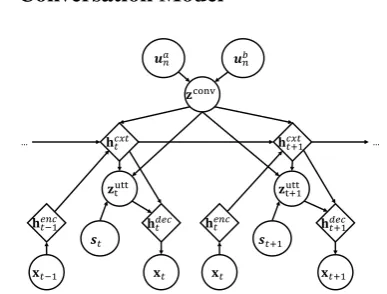
Figure 1: Graphical representation of VHUCM. The global context of the conversationzconvis inferred by the speakers of the conversation.
This section describes our model, the Vari-ational Hierarchical User-based Conversation
Model (VHUCM) which explicitly models the speakers as well as the input utterances. VHUCM is based on the Variational Hierarchical Conversa-tion RNN (VHCR) (Park et al.,2018), but in gen-erating the conversation level latent variablezconv
and the uttrerance level latent variablezuttt , we
in-corporate the user embedding. We further propose to initialize the user embedding from the conver-sation network described in section4.3.
4.1 Notations
We have N conversations in the data
{c1,c2, . . . ,cN}, where the n-th
conversa-tion has Mn utterances by two users u a n and ubn. The t-th utterance in the conversation has word sequence xnt and speaker indicator snt.
Hence, cn = {(xn1, sn1), . . . ,(xnMn, snMn)} andsnt ∈{uan, u
b
n}wheret∈{1, . . . , Mn}.
4.2 VHUCM
The structure of VHUCM is similar to the VHCR, which has three RNNs (encoder RNNfθenc,
con-text RNN fθcxt, and decoder RNNfθdec) and two latent random variables (zuttt andzconv).
Given previoust−1utterances2, VHUCM gen-erates the word sequence of the next utterancext
as follows:
henct−1=fθenc(xt−1)
hcxtt =f cxt θ (h
cxt t−1,h
enc t−1,z
conv
).
We use the embeddings of the two users in the con-versationhuserua andhuser
ub to create dyad-specific
contextzconvas follows:
pθ(z conv
∣huserua ,huser
ub )=N(z∣µ
d ,σdI)
µd=MLPθ(huserua ,huser
ub ) σd=Softplus(MLPθ(h
user ua ,huser
ub )). We also use the user embeddings to understand the users’ words as follows:
pθ(z utt t ∣x<t,z
conv
,huserst )=N(z∣µt,σtI)
µt=MLPθ(h cxt t ,z
conv
,huserst )
σt=Softplus(MLPθ(h cxt t ,z
conv
,huserst )).
To decode the words from the context, we use the decoder RNN with context-related variables.
pθ(xt∣x<t,z utt t ,z
conv
)=fθdec(htcxt,zuttt ,zconv)
For the inference ofzconv, we adopt the idea of VHCR that uses a bi-directional GRUfconvwhere
2
the input is the encoder RNN outputs.
qφ(z conv
∣c,huserua ,huser
ub )=N(z∣µ′
d ,σ′dI)
hconv=fconv(henc1 , . . . ,hencN )
µ′d=MLPφ(h conv
,huserua ,huser
ub )
σ′d=Softplus(MLPφ(hconv,huserua ,huser
ub ))
To inferzuttt , we build the additional networks:
qφ(z utt t ∣c,z
conv)
=N(z∣µ′t,σt′I)
µ′t=MLPφ(xt,h cxt t ,z
conv
,huserst )
σt′ =Softplus(MLPφ(xt,h cxt t ,z
conv
,huserst )).
The loss function of VHUCM is the ELBO loss and the auxiliary loss. The ELBO loss is the com-bination of the reconstruction loss, and the KL di-vergence betweenpθandqφwith KL cost
anneal-ing (Bowman et al.,2016). We also add the bag-of-word loss (Zhao et al.,2017) as the auxiliary loss to avoid the vanishing latent variable problem.
4.3 VHUCM-PUE
We leverage the fact that people connected in a so-cial network can be modeled with the node2vec al-gorithm (Grover and Leskovec,2016), where the nodes are users, and two nodes are connected if they have conversations. We can use the number of conversations as the weight of the edge. We extend the original VHUCM with these pre-trained user embeddings based on the conversation network, and we can call this VHUCM-PUE (VHUCM with Pre-trained User Embeddings). This approach is similar to soc2seq (Bhatia et al.,2017) which em-beds the users more elaborately using comments and likes but is a much simpler conversational model based on the encoder-decoder.
5 Experiment 1 - Response Quality
This section describes the experiments and results of VHUCM and VHUCM-PUE compared to other state-of-the-art response generation models. We compare the models using various automatic eval-uation metrics in section5.2and with human eval-uation in section5.3. Section5.4presents a qual-itative analysis of the generated responses, in par-ticular how the responses can be personalized.
5.1 Experiment Setup
DataWe use the corpus described in section3for this experiment. We split the data as 80/10/10 for training/validation/test, because VHUCM learns
the user information from the conversation, we split the conversations of each dyad in chronolog-ical order and merge each part into overall train-ing, validation and test sets. We further investigate cases of new users that are not in the training data but appear in the test data in section6.
Comparison models We compare VHUCM
and VHUCM-PUE with the following models:
• HRED(Sordoni et al.,2015): A hierarchical
structure of RNNs for encoder, decoder, and context.
• VHRED(Serban et al., 2017): A variational autoencoder model that adds latent variables
zuttt to the HRED.
• VHCR(Park et al., 2018): A variational
au-toencoder model that adds the latent variable
zconvto the VHRED.
• SpeakAddr (Li et al., 2016b): A persona seq2seq model. We choose the Speaker-Addressee model as this outperforms the Speaker model.
• DialogWAE (Gu et al., 2019): A condi-tional Wasserstein autoencoder model that uses GAN for training. We use DialogWAE-GMP which outperforms DialogWAE by us-ing the Gaussian mixture prior.
5.2 Quantitative Analysis
Model Perp Model Perp
HRED 72.6 SpeakAddr 85.5
VHRED 71.2 DialogWAE 81.0
VHCR 71.1 VHUCM 65.3
[image:4.595.320.515.492.571.2]VHUCM-PUE 62.7
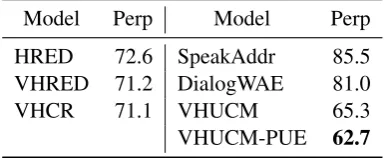
Table 2: Perplexity per word of the generated re-sponses. VHUCM-PUE outperforms all other methods.
MetricsTo quantitatively compare the response generation performance of VHUCM-PUE with other models, we use various automatic metrics used in (Park et al.,2018;Du et al.,2018;Olabiyi
et al.,2018;Gu et al.,2019).
We first compute the perplexity per word of each model using the reconstruction errors of the test data. For variational models, we calculate the values by importance sampling. As shown in Table
Model BLEU Embedding ROUGE-L Distinct Len
Avg Ext Gre Rec Prec F dist-1 dist-2
HRED 0.090 0.577 0.364 0.357 0.064 0.162 0.066 0.019 0.072 9.4
VHRED 0.120 0.596 0.368 0.377 0.072 0.161 0.072 0.016 0.063 11.4
VHCR 0.137 0.599 0.371 0.381 0.076 0.169 0.075 0.020 0.076 12.3
SpeakAddr 0.037 0.567 0.384 0.337 0.052 0.218 0.055 0.016 0.031 4.8
DialogWAE 0.127 0.586 0.345 0.369 0.079 0.132 0.080 0.012 0.104 11.5
VHUCM 0.120 0.633 0.373 0.394 0.075 0.154 0.079 0.030 0.108 10.1
VHUCM-PUE 0.161 0.643 0.376 0.400 0.082 0.162 0.087 0.034 0.123 10.6
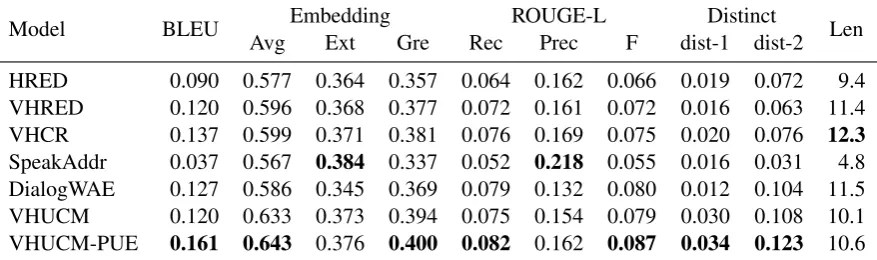
Table 3: Comparison of various models using BLEU, Embedding, and ROUGE-L scores, which measure the quality of the generated responses with respect to the ground truth. Embedding Avg, Ext, and Gre are average, extrema and greedy matching by embedding based metrics, respectively. ROUGE-L is ROUGE score using the longest common subsequence. Distinct unigram (dist-1) and bigram (dist-2) measure the degree of diversity among responses. Len is the average length of the generated response. VHUCM-PUE outperforms the other methods for most of the metrics.
We then compute the following metrics, with the results in Table3:
• BLEU (Papineni et al., 2002): We
com-pute the sentence-level BLEU score with the smoothing seven technique (Chen and
Cherry,2014).
• Embedding based metrics(Liu et al., 2016): We use three types of the embedding based metrics,Embedding average,Embedding ex-trema, andEmbedding greedy matching. We use pre-trained Google news word embed-ding (Mikolov et al., 2013) to measure the embedding metrics to avoid dependency be-tween the training data for dialogue response generation and embedding.
• ROUGE-L (Lin, 2004): We report three types of ROUGE-L score, ROUGE-L Rec, ROUGE-L Prec, andROUGE-L Fscore.
• Distinct(Li et al.,2016a): We usedist-1and dist-2that refer to the diversity of generated responses.
• Average length: We examine the average length of the generated responses to show its diversity.
Results As shown in Table 3, VHUCM-PUE outperforms the other methods on most metrics. SpeakAddr generally shows the lowest perfor-mance, reflecting that this model does not ex-plicitly model the conversation context. ROUGE-L Prec on SpeakAddr shows higher values than
the others because it generates shorter responses on average. VHCR performs better than HRED and VHRED and performs similarly to Dialog-WAE. VHUCM outperforms VHCR, confirming the effectiveness of the user embeddings. Finally, VHUCM-PUE outperforms all other methods for most of the metrics, showing the effectiveness of the conversation network in initializing the user embeddings.
5.3 Human Evaluation
Wins Losses Ties
[image:5.595.80.519.65.195.2]vs SpeakAddr 40.7±3.0 34.9±3.0 24.4±2.4 vs VHCR 45.5±2.7 40.4±2.8 14.1±2.1 vs DialogWAE 52.5±2.9 34.5±2.8 13.0±2.1
Table 4: Human evaluation of the appropriateness of the generated response. We ask MTurkers to pick a more appropriate response from two candidates gen-erated by different models. Five annotators answered each task. We compute the mean preferences with a 90% confidence interval. VHUCM-PUE outperforms the baselines.
ap-propriate. One of the candidates is from VHUCM-PUE, and the other is from one of the baselines (SpeakAddr, VHCR, and DialogWAE). The anno-tators can use the answer ‘Tie’ if they cannot read-ily select an answer. For each task, we take five an-notations and compute the mean preference with a 90%confidence interval. Table 4shows the re-sults, in which VHUCM-PUE competes with three baselines and outperforms all of them.
Table 5 shows an example of the generated responses from SpeakAddr, VHCR, DialogWAE, and VHUCM-PUE for the same three-turn con-text. Overall, VHUCM-PUE generates more ap-propriate responses given the context. SpeakAddr makes general responses without the context. VHCR and DialogWAE create more context re-lated responses than SpeakAddr. But, VHUCM-PUE generates more sophisticated responses than other baselines.
5.4 Personalized Responses
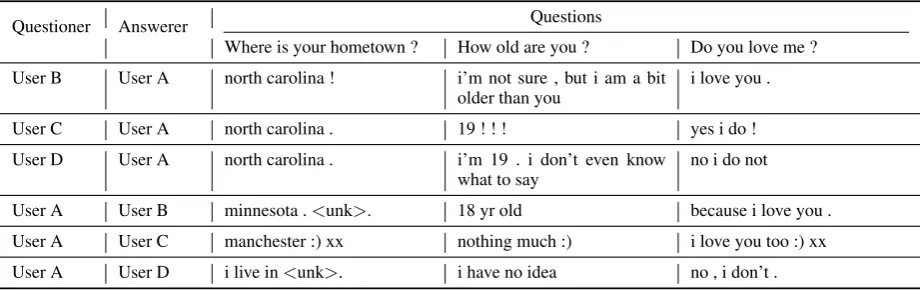
We test for consistent responses of personal infor-mation, such as age when the user is fixed. We de-vise personal information questions and generate the responses between the dyads. Table 6 shows examples of these questions and responses.
For the question, the answers of “where is your hometown?” from A are identical even when the questioners differ, because A reveals the home-town in the training data. VHUCM-PUE can an-swer the user-specific context with learned user vector. In the opposite cases when the questioner is A, the responses are based on the answerer.
The answers of A to the question about age are entirely consistent with the experience question. Moreover, the answer of A for question from B is interesting. From the other answers, we know that age of A is 19, and B’s age is 18. The answer to the question is correct even it does not generate the exact age number.
To see the relationship between a dyad, we cre-ate the third question that asks about the partner, “Do you love me?”. The generated responses show that they match the same feeling on each other. For example, the generated response of A & B and A & C dyads are agreed with the question, ‘I love you’. The response of A & D dyad are also matched, but negation of the question. We find the reason that A & B and A & C dyads use emotional words and emoticons. But, A & D dyad have ques-tion and answers about the computer-related
top-ics perfunctorily. It shows that VHUCM-PUE can learn the relationship of dyads from their conver-sation word patterns.
Another interesting outcome is that all re-sponses of C contain ‘:)’ and ‘xx’ words. User C usually uses the words at the end of the tweets in the training data. It also shows that VHUCM-PUE can learn the word preferences of users.
6 Experiment 2 - New Users and Dyads
In this section, we investigate the new user prob-lem when generating responses. We simulate var-ious scenarios of new dyads and new users, and show how VHUCM-PUE incorporates the net-work information to perform better even for an un-known user.
6.1 Experiment Setup
A
B C D E
H
G I
F
1 3
2
4
3
1
1 1
1 1 1
1 1
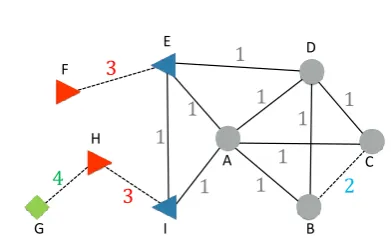
Figure 2: Example of a conversation network. Nodes are users, and a edge between two nodes forms a line if they have conversations. To create the new users and dyads in the test time, we randomly select dyads and remove all conversations between them in the training data (the dashed line in the figure). F, G, and H are new users, B-C dyad is new dyad since they are not in the training data.
[image:6.595.314.510.312.431.2]Context SpeakAddr VHCR DialogWAE VHUCM-PUE
nice ! atl a few months ago and al-ready back again :) how could you not be .. im so excited for the both of them .→whose getting married
? ?→snarky and suzi . got engaged
back in dec
i know , i know ! ! !
hey ah ha ha , i have to do a
lot of time to get to see what happens .
what about u
call me when your at the station , i shall be with→am waiting at
sta-tion 2 caramel macchiato and 2 pain aux raisin in hand ! ! ! x→whoop
whoop , , , starting to feel sick
i know , i know ! !
no . i don’t even know what to do , but i don’t think so . :(
i know what the hell is , but the is .
:( oh .
how was your exam ? x→think it
was okay actually :) x→thats good
then :) x
you ! :d :d :d :d :d :d
:d i miss you too <3<3<3
hahah ! ! ! im so sorry to tell you when I get home or something lol
[image:7.595.72.534.281.426.2]you are still the best person who’s there ? x
Table 5: Examples of generated responses from SpeakAddr, VHCR, DialogWAE, and VHUCM-PUE. The→ means a changes of turn in the context.
Questioner Answerer Questions
Where is your hometown ? How old are you ? Do you love me ?
User B User A north carolina ! i’m not sure , but i am a bit
older than you
i love you .
User C User A north carolina . 19 ! ! ! yes i do !
User D User A north carolina . i’m 19 . i don’t even know
what to say
no i do not
User A User B minnesota .<unk>. 18 yr old because i love you .
User A User C manchester :) xx nothing much :) i love you too :) xx
User A User D i live in<unk>. i have no idea no , i don’t .
Table 6: Responses to users’ personal information questions from VHUCM-PUE. The questioner asks each ques-tion to the answerer, and VHUCM-PUE generates the answerers’ responses. The ‘<unk>’ token is an unknown word. VHUCM-PUE generates personalized responses of users.
1. Known Dyad: Conversations of the dyad exist in the training and validation data. Examples include A-B, A-D, and E-I.
2. Known Users: There are no conversations of the dyad in the training and validation data, but the two users’ conversations with other users exist in the training data. An example is B-C.
3. Known Partner: Similar toKnown Users, ex-cept there are no conversations of one of the speakers (“new user”) in the training data. But the other partner (“known partner”) has conversations with other users in the train-ing corpus, so the model can see the partner’s conversations during training. Examples are F-E and H-I where F and H are new users, and E and I are known partners.
4. New Users: Both users do not have any
con-versations in the training and validation data. They are new users. An example is G.
For this experiment, we create a small but dense conversation network from our corpus. As in sec-tion 3, we filter out dyads with fewer than ten conversations, but here we filter users who have fewer than five conversation friends. The number of users is 2,187, the number of dyads is 3,833, and the number of conversations is 84,295. We randomly select20%of the dyads and remove all conversations of the dyads in the training and val-idation data. We conduct the experiment six times with different random seeds.
6.2 New User Embedding
Dyads NonDyads
VHUCM 2.449±0.004 2.453±0.001
VHUCM-PUE 2.879±0.003 5.444±0.001
Table 7: Distance between users in the user embed-ding spaces from VHUCM or VHUCM-PUE. We make two groups of user pairs; pairs who have conversations (Dyads), and pairs who do not have any conversations
(NonDyads). We compute the mean value of the
Eu-clidean distance between each pair in the groups with a 90%confidence interval. VHUCM-PUE distinguishes the two groups significantly better than VHUCM.
(Linell et al.,1991). We investigate how VHUCM
and VHUCM-PUE learn this assumption well. We make two groups of user pairs whether they have conversations or not. Dyads are user pairs who have conversations, andNonDyads are user pairs who do not. And, we compute the Euclidean dis-tance of user embedding between each pair in a group.
Table 7 shows the results. The two groups are statistically significantly different in VHUCM-PUE user embedding, but not in VHUCM. This re-sult shows that VHUCM-PUE learns the assump-tion better than VHUCM, and this is one reason why VHUCM-PUE outperforms VHUCM.
Accordingly, we can set the vector of a new user to be near the conversation partner. Formally, we compute the average of the conversation partners of the new user and add some random noise to the new user embedding. For example, F is the new user and E is the known partner in Figure2. We utilize the embedding of F from conversation part-ner E as follows:
huserF = ∑ i∈friends of F
huseri +
∼Uniform(umin, umax)
where umin and umax are min and max values
over each dimension of the trained user vectors, and the friends of F = {E}. We incorporate this method in VHUCM-PUE for new users in the Known Partnerscenario.
In the New Userscase, we cannot get the user information during the test. So, we set their em-beddings as random values. For example, G is a new user in the New Users, thus we set the user embedding values from the uniform distri-bution over the trained user embedding space as huserG ∼ Uniform(umin, umax). We incorporate
this method in VHUCM for all new users and
VHUCM-PUE for users who are in theNew Users.
6.3 Results and Discussion
Figure3shows the response quality test results for all cases. VHUCM and VHUCM-PUE outperform VHCR in theKnown Dyadcase which is the same situation in section 5. In the Known Users case, VHUCM and VHUCM-PUE performs better than VHCR. Although the conversations of the dyad are not in the training data, VHUCM can learn the users from conversations with other partners, and this helps to infer the responses between them.
In theKnown Partnercase, VHUCM-PUE out-performs VHUCM and VHCR. To see the reason of this improvement, we investigate the difference of user embeddings between the models. We run VHUCM-PUE with full data which are not re-moved the conversations in the training data. Fig-ure4ashows the two-dimensional plot of the user embedding by projecting t-SNE (Maaten and Hin-ton,2008). The new user (▶) and known partner (◀) pairs are closed each other. But the closeness between the dyad is not observed in VHUCM with removed data since it creates the new user embed-ding randomly (Fig4b). The new user and known partner dyads are closed in VHUCM-PUE which applies the method in section6.2 to new users in the space (Fig 4c). This results show the reason why VHUCM-PUE has a better performance in Known Partnercase.
Finally, New Users shows an overlap with re-gard to the performances of all models. No in-formation about new users exists in the training data and test data; hence VHUCM-PUE is forced to initialize the new users randomly, similarly to VHUCM.
7 Conclusion
Known
Dyad KnownUsers PartnerKnown UsersNew 0.10
0.12 0.14 0.16 0.18 0.20 0.22 0.24
VHCR VHUCM VHUCM-PUE
(a) BLEU
Known
Dyad KnownUsers PartnerKnown UsersNew 0.50
0.52 0.54 0.56 0.58 0.60 0.62
0.64 VHCR VHUCM VHUCM-PUE
(b) Embedding Avg
Known
Dyad KnownUsers PartnerKnown UsersNew 0.050
0.055 0.060 0.065 0.070 0.075 0.080 0.085
VHCR VHUCM VHUCM-PUE
[image:9.595.84.521.64.178.2](c) ROUGE-L F
Figure 3: Response quality test on four cases of new users and dyads. The range of the vertical error bar is one standard error of the metric values among the experimental trials. VHUCM-PUE outperforms the other models in cases involving new user with a known user whose conversations are in the training data (Known Partnercase).
(a) VHUCM-PUE with full data (b) VHUCM with removed data (c) VHUCM-PUE with removed data
Figure 4: Plots of two-dimensions projection of trained user vectors by each model and data by t-SNE. Four types of users: Known Users (●) who are in theKnown Dyad andKnown Users cases, New Users (▶) and Known Partners (◀) who are in theKnown Partner case, and New Users (◆) who are in theNew Userscase. (a) The conversation partners (▶and◀) are closed in the embedding space. (b) Many new users (▶and◆) are not well distributed. (c) The conversation partners (▶and◀) are well paired as similar as (a).
Acknowledgments
We would like to thank the anonymous review-ers for helpful questions and comments. This work was supported by IITP grant funded by the Korea government (MSIT) (No.2017-0-01779, XAI).
References
JinYeong Bak, Chin-Yew Lin, and Alice Oh. 2014.
Self-disclosure topic model for classifying and an-alyzing twitter conversations. InProceedings of the
EMNLP.
Parminder Bhatia, Marsal Gavald`a, and Arash Einol-ghozati. 2017. soc2seq: Social embedding meets conversation model.arXiv preprint.
Samuel R. Bowman, Luke Vilnis, Oriol Vinyals, An-drew Dai, Rafal Jozefowicz, and Samy Bengio. 2016. Generating sentences from a continuous space. InProceedings of the CoNLL.
Boxing Chen and Colin Cherry. 2014. A systematic comparison of smoothing techniques for sentence-level bleu. InProceedings of the WMT.
Cristian Danescu-Niculescu-Mizil and Lillian Lee. 2011. Chameleons in imagined conversations: A
new approach to understanding coordination of lin-guistic style in dialogs. In Proceedings of the
CMCL.
Jiachen Du, Wenjie Li, Yulan He, Ruifeng Xu, Lidong Bing, and Xuan Wang. 2018. Variational autoregres-sive decoder for neural response generation. In
Pro-ceedings of the EMNLP.
Ian Goodfellow, Jean Pouget-Abadie, Mehdi Mirza, Bing Xu, David Warde-Farley, Sherjil Ozair, Aaron Courville, and Yoshua Bengio. 2014. Generative ad-versarial nets. InProceedings of the NIPS.
Aditya Grover and Jure Leskovec. 2016. node2vec: Scalable feature learning for networks. In
Proceed-ings of the SIGKDD.
Xiaodong Gu, Kyunghyun Cho, Jung-Woo Ha, and Sunghun Kim. 2019. DialogWAE: Multimodal response generation with conditional wasserstein auto-encoder. InProceedings of the ICLR.
Durk P Kingma, Shakir Mohamed, Danilo Jimenez Rezende, and Max Welling. 2014.
Semi-supervised learning with deep generative models. InProceedings of the NIPS.
[image:9.595.81.519.234.348.2]ob-jective function for neural conversation models. In
Proceedings of the NAACL.
Jiwei Li, Michel Galley, Chris Brockett, Georgios Sp-ithourakis, Jianfeng Gao, and Bill Dolan. 2016b. A persona-based neural conversation model. In Pro-ceedings of the ACL.
Jiwei Li, Will Monroe, Tianlin Shi, S´ebastien Jean, Alan Ritter, and Dan Jurafsky. 2017a. Adversarial learning for neural dialogue generation. In Proceed-ings of the EMNLP.
Yanran Li, Hui Su, Xiaoyu Shen, Wenjie Li, Ziqiang Cao, and Shuzi Niu. 2017b. Dailydialog: A man-ually labelled multi-turn dialogue dataset. In Pro-ceedings of the IJCNLP.
Chin-Yew Lin. 2004. ROUGE: A package for auto-matic evaluation of summaries. InText Summariza-tion Branches Out.
Per Linell, Antony Manstead, et al. 1991. Contexts of Accommodation: Developments in Applied Sociolin-guistics. Cambridge University Press.
Chia-Wei Liu, Ryan Lowe, Iulian Serban, Mike Nose-worthy, Laurent Charlin, and Joelle Pineau. 2016.
How not to evaluate your dialogue system: An em-pirical study of unsupervised evaluation metrics for dialogue response generation. InProceedings of the
EMNLP.
Ryan Lowe, Nissan Pow, Iulian Serban, and Joelle Pineau. 2015. The ubuntu dialogue corpus: A large dataset for research in unstructured multi-turn dia-logue systems. InProceedings of the SIGDIAL.
Laurens van der Maaten and Geoffrey Hinton. 2008. Visualizing data using t-sne. Journal of Machine Learning Research.
Pierre-Emmanuel Mazare, Samuel Humeau, Martin Raison, and Antoine Bordes. 2018. Training mil-lions of personalized dialogue agents. In Proceed-ings of the EMNLP.
Tomas Mikolov, Ilya Sutskever, Kai Chen, Greg S Cor-rado, and Jeff Dean. 2013. Distributed representa-tions of words and phrases and their compositional-ity. InProceedings of the NIPS.
O. O. Olabiyi, A. Khazane, and E. T. Mueller. 2018. A persona-based multi-turn conversation model in an adversarial learning framework. InProceedings of
the ICMLA.
Kishore Papineni, Salim Roukos, Todd Ward, and Wei-Jing Zhu. 2002. Bleu: a method for automatic eval-uation of machine translation. InProceedings of the ACL.
Yookoon Park, Jaemin Cho, and Gunhee Kim. 2018. A hierarchical latent structure for variational conversa-tion modeling. InProceedings of the NAACL.
Adwait Ratnaparkhi. 2002. Trainable approaches to surface natural language generation and their appli-cation to conversational dialog systems. Computer Speech & Language.
Alan Ritter, Colin Cherry, and William B. Dolan. 2011.
Data-driven response generation in social media. In
Proceedings of the EMNLP.
Iulian Vlad Serban, Alessandro Sordoni, Ryan Lowe, Laurent Charlin, Joelle Pineau, Aaron C Courville, and Yoshua Bengio. 2017. A hierarchical latent variable encoder-decoder model for generating di-alogues. InProceedings of the AAAI.
Alessandro Sordoni, Yoshua Bengio, Hossein Vahabi, Christina Lioma, Jakob Grue Simonsen, and Jian-Yun Nie. 2015. A hierarchical recurrent encoder-decoder for generative context-aware query sugges-tion. InProceedings of the CIKM.
Yujie Xing and Raquel Fern´andez. 2018. Automatic evaluation of neural personality-based chatbots. In
Proceedings of the INLG.
Zhen Xu, Bingquan Liu, Baoxun Wang, Chengjie SUN, Xiaolong Wang, Zhuoran Wang, and Chao Qi. 2017. Neural response generation via gan with an approximate embedding layer. InProceedings of the
EMNLP.
Saizheng Zhang, Emily Dinan, Jack Urbanek, Arthur Szlam, Douwe Kiela, and Jason Weston. 2018. Per-sonalizing dialogue agents: I have a dog, do you have pets too? InProceedings of the ACL.