Proceedings of the 2019 Conference on Empirical Methods in Natural Language Processing and the 9th International Joint Conference on Natural Language Processing, pages 4547–4557,
4547
GECOR: An End-to-End Generative Ellipsis and Co-reference Resolution
Model for Task-Oriented Dialogue
Jun Quan‡∗, Deyi Xiong‡†, Bonnie Webber§and Changjian Hu¶
‡School of Computer Science and Technology, Soochow University, Suzhou, China §University of Edinburgh, Edinburgh, UK
¶Lenovo Research AI Lab, Beijing, China
[email protected], [email protected], [email protected], [email protected]
Abstract
Ellipsis and co-reference are common and ubiquitous especially in multi-turn dialogues. In this paper, we treat the resolution of el-lipsis and co-reference in dialogue as a prob-lem of generating omitted or referred expres-sions from the dialogue context. We there-fore propose a unified end-to-end Generative Ellipsis and CO-reference Resolution model (GECOR) in the context of dialogue. The model can generate a new pragmatically com-plete user utterance by alternating the gen-eration and copy mode for each user utter-ance. A multi-task learning framework is fur-ther proposed to integrate the GECOR into an end-to-end task-oriented dialogue. In or-der to train both the GECOR and the multi-task learning framework, we manually con-struct a new dataset on the basis of the pub-lic dataset CamRest676 with both ellipsis and co-reference annotation. On this dataset, in-trinsic evaluations on the resolution of ellip-sis and co-reference show that the GECOR model significantly outperforms the sequence-to-sequence (seq2seq) baseline model in terms of EM, BLEU and F1while extrinsic
evalua-tions on the downstream dialogue task demon-strate that our multi-task learning framework with GECOR achieves a higher success rate of task completion than TSCP, a state-of-the-art end-to-end task-oriented dialogue model (Lei et al.,2018).
1 Introduction
Due to the rhetorical principle of saving words and avoiding repetitions, ellipsis and co-reference oc-cur frequently in multi-turn dialogues leaving ut-terances paragmatically incomplete if they are sep-arate from context. Humans can easily understand utterances with anaphorically referenced or absent
∗
Work performed during an internship at Lenovo Re-search AI Lab.
†
Corresponding author
information (e.g.,Q2andQ3in Table1) based on
the dialogue context while dialogue systems often fail to understand such utterances correctly, which may result in false or incoherent responses.
If user utterances can be automatically supple-mented with information that is left out or substi-tuted by anaphora according to the dialogue con-text as humans do (e.g.,Q2: I want cheap Italian
restaurants. Q3: Yes, I would like the phone num-ber please.), dialogue models may understand user requests correctly and would not generate wrong responses caused by ellipsis and co-reference phe-nomena. Especially in task-oriented dialogue sys-tems, explicitly providing such information to the models can effectively improve the success rate of task completion.
In order to achieve this goal, we propose an end-to-end generative ellipsis and co-reference res-olution model (GECOR) for task-oriented dia-logue in this paper. The essential idea behind GECOR is that we treat the resolution of ellip-sis and co-reference in user utterances as a gen-eration task: transforming a user utterance with ellipsis or anaphora into a new utterance where the left-out or referred expressions are automat-ically generated from the dialogue context. We refer to the new utterance as the complete ver-sion of the original utterance. We use an end-to-end sequence-to-sequence model with two coders for this transformation task, where one en-coder reads the user utterance and the other the di-alogue context and the decoder generates the com-plete utterance. Since most omitted expressions or antecedents can be found in the dialogue con-text, we resort to the attention and copy mecha-nism to detect such fragments in previous context and copy them into the generated complete utter-ance.
learning framework. The entire model contains two encoders (one for user utterance and the other for the dialogue context) and three decoders: one decoder for predicting dialogue states, the second decoder for generating complete user utterances and the third decoder for generating system re-sponses. The three decoders are jointly trained.
In order to train GECOR with the task-oriented dialogue model, we manually annotate the public task-oriented dialogue dataset CamRest676 with omitted expressions and substitute anaphora in the dataset with corresponding antecedents. The new dataset can be used either to train a stand-alone ellipsis or co-reference resolution model or to jointly train a task-oriented dialogue model equipped with the ellipsis / co-reference resolution model.
We conduct a series of experiments and analy-ses, demonstrating that the proposed method can significantly outperform a strong baseline model. Our contributions are threefold:
• We propose an end-to-end generative resolu-tion model that attempts to solve the ellipsis and co-reference reolution in a single unified framework, significantly different from pre-vious end-to-end co-reference resolution net-work with two phases of detection and candi-date ranking.
• To the best of our knowledge, this is the first attempt to combine the task of ellipsis and co-reference resolution with the multi-turn task-oriented dialogue. The success rate of task completion is significantly improved with the assistance of the ellipsis and co-reference res-olution.
• We construct a new dataset based on Cam-Rest676 for ellipsis and co-reference resolu-tion in the context of task-oriented dialogue.1
2 Related Work
Ellipsis recovery: The earliest work on ellip-sis as far as we know is the PUNDIT system (Palmer et al.,1986) which discusses the commu-nication between the syntactic, semantic and prag-matic modules that is necessary for making im-plicit linguistic information exim-plicit. Dalrymple et al. (1991) and Shieber et al. (1996) establish
1The new dataset and the code of our proposed
sys-tem are available athttps://multinlp.github.io/ GECOR/
a set of linguistic theories in the ellipsis recov-ery of English verb phrases. Nielsen (2003) first proposes an end-to-end computable system to per-form English verb phrase ellipsis recovery on the original input text.Liu et al.(2016) propose to de-compose the resolution of the verb phrase ellipsis into three sub-tasks: target detection, antecedent head resolution, and antecedent boundary detec-tion.
Co-reference resolution: Co-reference resolu-tion is mainly concerned with two sub-tasks, re-ferring expressions (i.e., mentions) detection, and entity candidate ranking. Uryupina and Mos-chitti(2013) propose a rule-based approach for co-reference detection which employs parse tree fea-tures with an SVM model. Peng et al.(2015) im-prove the performance of mention detection by ap-plying a binary classififier on their feature set. In recent years, applying deep neural networks to the co-reference resolution has gained great success.
Clark and Manning (2016) apply reinforcement learning on mention-ranking co-reference resolu-tion. Lee et al. (2017) introduce the first end-to-end co-reference resolution model. Lee et al.
(2018) present a high-order co-reference resolu-tion model with coarse-to-fine inference.
Ellipsis and co-reference resolution in QA and Dialogue: The methods mentioned above do not generalize well to dialogues because they nor-mally require a large amount of well-annotated contextual data with syntactic norms and candi-date antecedents. In recent years, a few studies try to solve ellipsis / co-reference resolution tailored for dialogue or QA tasks.Kumar and Joshi(2016) train a semantic sequence model to learn semantic patterns and a syntactic sequence model to learn linguistic patterns to tackle with the non-sentential (incomplete) questions in a question answering system.Zheng et al.(2018) builds a seq2seq neu-ral network model for short texts to identify and recover ellipsis. However, these methods are still limited to short texts or one-shot dialogues. Our work is the first attempt to provide both solution and dataset for ellipsis and co-reference resolution in multi-turn dialogues.
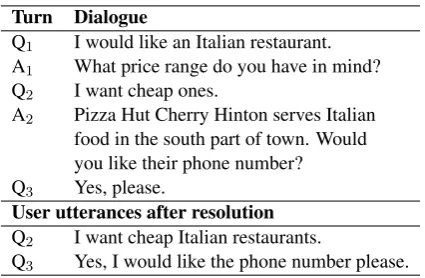
Turn Dialogue
Q1 I would like an Italian restaurant.
A1 What price range do you have in mind?
Q2 I want cheap ones.
A2 Pizza Hut Cherry Hinton serves Italian
food in the south part of town. Would you like their phone number? Q3 Yes, please.
User utterances after resolution Q2 I want cheap Italian restaurants.
[image:3.595.74.287.60.199.2]Q3 Yes, I would like the phone number please.
Table 1: Examples of ellipsis and co-reference resolu-tion
2018; Jin et al., 2018). Our work is an innova-tive combination of ellipsis and co-reference reso-lution and the end-to-end task-oriented dialogue.
3 The GECOR Model
In this section, we reformulate the ellipsis and co-reference resolution task in the context of multi-turn dialogue and detail the proposed GECOR model.
3.1 Ellipsis and Co-Reference Resolution Reformulation
Our task is to reconstruct a pragmatically complete utterance from a user utterance where the ellip-sis and/or co-reference phenomena are present ac-cording to the dialogue context. Table1provides examples of reconstructed utterances in which the omitted information is recovered or the anaphor is substituted with referred expressions.
We attempt to solve the resolution of ellipsis and co-reference in a unified framework because in essence both ellipsis and co-reference can be understood from contextual clues. We consider these two problems in multi-turn dialogue and re-formulate the resolution of them as a generation problem: generating the omitted or referred ex-pressions. In this way, the modeling of ellipsis and co-reference is in line with response generation in dialogue modeling.
Unlike previous methods that combine detec-tion and ranking models, our generadetec-tion-based for-mulation is not constrained by the syntactic forms of ellipsis or co-reference in sentences. They can be either words (e.g., noun, verb) or phrases or even clauses. Furthermore, the formulation does not need to provide a set of candidate antecedents to be resolved. Previous studies usually need to
traverse the text when there are multiple ellipsis or anaphora to be resolved, which leads to a high computational complexity.
In this reformulation, we assume that the dia-logue context is composed of all utterances from the beginning of the dialogue to the current user utterance. Both the context and the user utterance in question are input to the GECOR model to gen-erate the complete version of the user utterance.
3.2 Model Structure
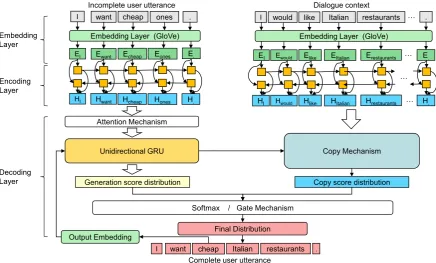
The GECOR model is shown in Figure 1. The model essentially contains an embedding module, a user utterance encoder, a dialogue context en-coder and a deen-coder with either copy (Gu et al.,
2016) or gated copy mechanism (modified from
See et al.(2017)). Both the generation probability over the entire vocabulary and the copy probability over all words from the dialogue context are taken into account for predicting the complete user ut-terance.
Embedding Layer In GECOR, we first tok-enize the input user utterance and the dialogue context. We then use GloVe (Pennington et al.,
2014) (the pre-trained 50-dimensional word vec-tors) in the embedding layer to obtain word em-beddings. LetU={u1, ..., um}, C={c1, ..., cn}
be representations of the tokenized utterance and context sequence.
Utterance and Context Encoder We use a single-layer bidirectional GRU to construct both encoders. The forward and backward hidden states over the input embeddings from the embed-ding layer are concatenated to form the hidden states of the two encoders.
DecoderThe decoder is a single-layer unidirec-tional GRU. In the decoder, the attention distribu-tionatis calculated as inBahdanau et al.(2015):
eti =vTtanh(Whhi+Wsst−1+battn) (1)
at=sof tmax(et) (2)
wherev, Wh, Ws andbattn are learnable
param-eters, hi is the hidden state for word ui from
the sequence produced by the utterance encoder. The attention distribution at is used to produce a weighted sum of the encoder hidden states, known as the context vectorh∗t:
h∗t =X i
atihi (3)
It is fed into the single-layer unidirectional GRU together with the previous decoder statestand the
Figure 1: The end-to-end generative model for ellipsis and co-reference resolution (GECOR).
word to obtain the decoder statest. The updated st−1 is then concatenated with the context vector
h∗t to produce the generation probability distribu-tion over the vocabularyVas follows:
Pg(yt) = 1
Ze
ψg(yt), y
t∈V (4)
ψg(yt=vi) =viT(Wghh∗t+Wgsst+bg)(5)
st=GRU([yt−1;h∗t], st−1) (6)
whereWhg,Wsgandbgare learnable parameters and
viis the one-hot indicator vector for wordvi ∈V. ψg is the score function for the generation-mode
and Z is the normalization term shared by the generation-mode and copy-mode.
Copy Network The copy network (Gu et al.,
2016) is used to calculate the probabilities for words copied from the dialogue context. These words are parts of the omitted or referred expres-sions to be predicted. We build the copy network on the top of the context encoder. The probability for copying each word from the dialogue context is computed as follows:
Pc(yt) = 1
Z
|C|
X
i:ci=yt
eψc(ci), y
t∈C (7)
ψc(yt=ci) =σ(Wchci +bc)st (8)
where Wc andbc are learnable parameters, hci is
the output for wordci from the context encoder,
and σ is a non-linear activation function. ψc is
the score function for the copy-mode andZ is the normalization term shared by equation (4) and (7). Both probabilities from the two modes con-tribute to the final probability distribution over the extended vocabulary (the vocabulary plus the words from the dialogue context) which is calcu-lated as follows:
P(yt) =Pg(yt) +Pc(yt), yt∈V∪C (9)
which is used to predict the final output word.
Gated CopyAn alternative to the copy network is the gated copy mechanism that use a gate to reg-ulate the contributions of the generation and copy mode to the final prediction. The gatepgenis
cal-culated as follows:
pgen=σ(Whh∗t+Wsst+Wyyt−1+bt)(10)
P(yt) =pgenPg(yt)+(1−pgen)Pc(yt)(11)
whereWh, Ws,Wy andbt are learnable
parame-ters andσis the sigmoid function.
Training The standard cross-entropy loss is adopted as the loss function to train the GECOR model.
4 Task-Oriented Dialogue with GECOR
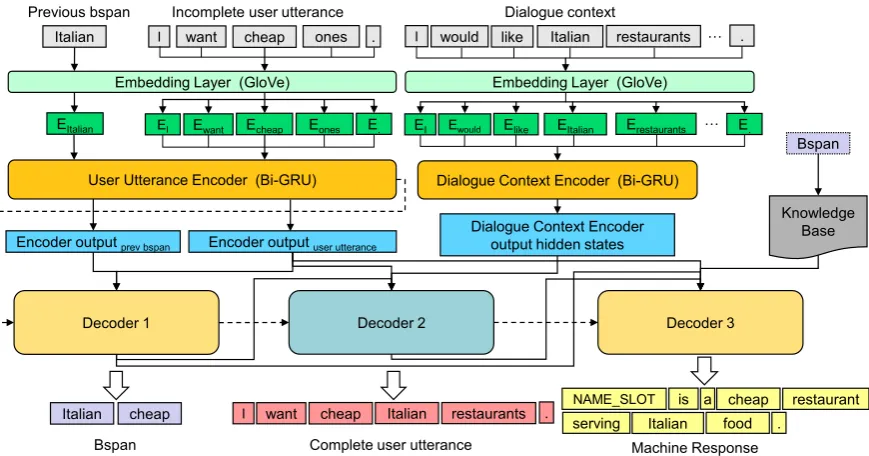
Figure 2: The architecture of the end-to-end task-oriented dialogue enhanced with the GECOR model. Decoder 1: BSpan decoder. Decoder 2: completed user utterance decoder. Decoder 3: machine response decoder.
byLei et al.(2018) in a multi-task learning frame-work, which is shown in Figure2. The GECOR-equipped TSCP model contains the embedding layer, the utterance and context encoders, and three decoders: decoder 1 for generating belief spans (BSpan) defined in (Lei et al.,2018) which are text spans for tracking dialogue states (e.g.,
hinfiItalian, cheaph/infi;hreqiphoneh/reqi), decoder 2 for complete user utterances and decoder 3 for machine responses. The embedding layer and encoders are the same as described in section3.
BSpan DecoderUnlikeLei et al.(2018), we do not concatenate current user utterance with previ-ously generated machine response. At each turn of dialogue, the user utterance and the previous BSpan (the dialogue states updated to the previ-ous turn) are used as the inputs to the user utter-ance encoder. The outputs of this encoder are then fed into the BSpan decoder for predicting the new BSpan for the current turn and a cross-entropy loss L1 is calculated. The user utterance encoder
hid-den states, the last hidhid-den state and the output of the BSpan decoder are input into the other two de-coders.
Complete User Utterance DecoderThe basic structure of this decoder is the same as the decoder described in the last section.We pass the last hid-den state of the BSpan decoder to the initial state of this decoder. In addition to the inputs from the user utterance encoder and the dialogue context
encoder, we also input the output of the BSpan decoder into this decoder. The generation proba-bilityPgt, copy probabilityPtc1for copying tokens in BSpan, and copy probability Ptc2 for copying words in the dialogue context are calculated with a shared normalization term and combined for the final probability computation:
Pt=Ptg+Ptc1+Ptc2 (12)
Pt is then used to decode the words in the
com-plete user utterance. For this decoder, the second cross-entropy lossL2is calculated.
Machine Response DecoderSimilar to the pre-vious two decoders, the machine response decoder is also a single-layer unidirectional GRU, the ini-tial state of which is set to the last hidden state of the complete user utterance decoder. In this de-coder, we compute three context vectors for each decoder state st. The first context vector h∗t1 is
calculated over the user utterance encoder hid-den states while the other two context vectorsh∗t2, h∗t3 are calculated over the BSpan decoder hidden states and the complete user utterance decoder hid-den states, respectively. The concatenation ofst, h∗t1,h∗t2,h∗t3and the Knowledge Base (KB) match-ing vectorKt(a one-hot representation of the
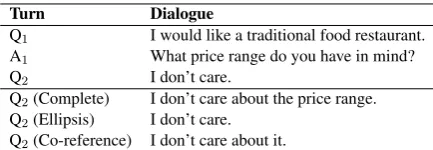
gener-Turn Dialogue
Q1 I would like a traditional food restaurant.
A1 What price range do you have in mind?
Q2 I don’t care.
Q2(Complete) I don’t care about the price range. Q2(Ellipsis) I don’t care.
[image:6.595.74.291.61.136.2]Q2(Co-reference) I don’t care about it.
Table 2: An example of the ellipsis / co-reference an-notation
ation probability distribution over the vocabulary. Similar to the complete user utterance decoder, we also use the copy mechanism in the machine re-sponse decoder. The third cross-entropy lossL3is
then calculated.
TrainingThe final loss for the multi-task learn-ing framework is estimated as follows:
L=L1+L2+L3 (13)
We learn parameters to minimize the final loss.
5 Data Annotation for Ellipsis and Co-Reference Rosultion in Dialogue Since there are no publicly available labeled data for the resolution of ellipsis and co-reference in di-alogue, we manually annotate such a new dataset based on the public dataset CamRest676 (Wen et al.,2016a,b) from the restaurant domain.
Annotation SpecificationAnnotation cases for user utterances can be summarized into the follow-ing three conventions:
• As shown in Table2, if a user utterance con-tains an ellipsis or anaphor, we manually re-solve the ambiguity of ellipsis or anaphor and supplement the user utterance with a correct expression by checking the dialogue context. In doing so, we create a pragmatically com-pleteversion for the utterance. If the utter-ance only contains an ellipsis and the ellipsis can be replaced with an anaphor, we create a co-reference version for it. Similarly, if the utterance only contains an anaphor and the anaphor can be omitted, we create an ellip-sisversion for the utterance.
• If the user utterance itself is pragmatically complete, without any ellipsis or anaphora, we create an anaphor and ellipsis version for it if such a creation is appropriate.
• If the utterance itself is complete and it is not suitable to create an ellipsis or anaphor ver-sion, we just do nothing.
With the annotation convention described above, for each user utterance in the dataset, we can la-bel it as l ∈ {ellipsis, co-reference, complete}
or create two other versions for it if appropriate. Please notice that these labels are used only for dataset statistics or for designing experiments, not for training our models.
Dataset statistics The CamRest676 dataset contains 676 dialogues, with 2,744 user utter-ances. After annotation, 1,174 ellipsis versions and 1,209co-reference versions are created from the 2,744 user utterances. 1,331 incomplete utter-ances are created that they are an eitherellipsisor co-reference version. 1,413 of the 2,744 user ut-terances are complete and not amenable to change. No new versions are created from these 1,413 ut-terances.
Dataset Split for Experiments We split the new dataset into a training set (accounting for 80%) and validation set (accounting for 20%) which can be used for the stand-alone ellipsis/co-reference resolution task and the multi-task learn-ing of both the ellipsis/co-reference resolution and end-to-end task-oriented dialogue.
6 Experiments
In this section we conducted experiments on the new dataset to examine the generative ellipsis/co-reference resolution model and its integration into the end-to-end task-oriented dialogue.
6.1 Evaluation Metrics
As far as we know, there is no end-to-end gen-erative ellipsis and co-reference resolution model applied to multi-turn dialogues. Therefore there are no off-the-shelf metrics tailored to this eval-uation. Since we deal with two tasks: the task of ellipsis/co-reference resolution (resolution task for short) and the task-oriented dialogue with in-tegrated ellipsis/co-reference resolution (hereafter dialogue task), we use two sets of evaluation met-rics. For the resolution task, we use the exact match rate (EM) that measures whether the gen-erated utterances exatly match the gold utterances. BLEU (Papineni et al., 2002) and F1 score (a
balance between word-level precision and recall) are also used for the resolution task to evaluate the quality of generated utterances at the n-gram and word level. We use the success F1 which is
de-fined as the F1 score of requested slots correctly
comple-Data Model Resolution Task
EM(%) EM 1(%) EM 2(%) BLEU(%) F1(%) Prec.(%) Rec.(%) Reso.F1(%)
Ellipsis
Baseline 49.99 68.88 27.31 73.26 90.89 92.14 89.67 44.47
GECOR 1 67.56 92.07 37.18 83.69 96.25 98.28 94.30 70.48
GECOR 2 67.75 91.38 38.46 82.94 96.58 98.48 94.76 70.85
Co-reference
Baseline 55.64 76.03 33.60 78.12 92.58 93.28 91.89 44.24
GECOR 1 71.35 91.67 47.68 85.89 96.49 98.19 94.86 64.93
GECOR 2 71.18 93.80 44.92 85.93 97.09 98.46 95.76 71.26
Mixed
Baseline 50.38 70.89 28.57 74.11 90.93 91.72 90.15 44.10
GECOR 1 68.52 92.03 42.04 83.91 95.88 98.12 93.74 66.06
[image:7.595.74.517.60.183.2]GECOR 2 66.22 91.64 37.45 82.98 96.47 98.41 94.60 66.16
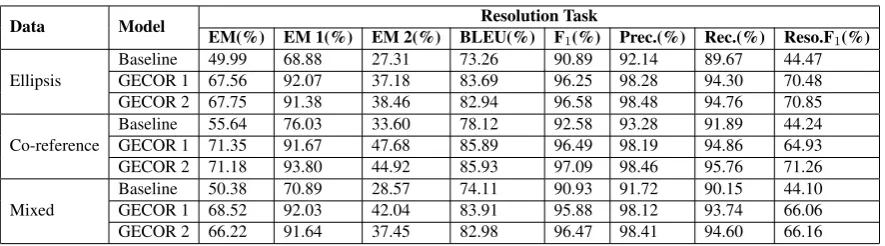
Table 3: Results of the resolution task on the dataset. GECOR 1/2: the GECOR model with the copy/gated copy mechanism. EM 1 and EM 2 respectively indicate the situation that the input utterance is complete or incomplete while EM is the comprehensive evaluation of the two situations. Reso.F1: Resolution F1
tion rate for the dialogue task, similar toLei et al.
(2018).
6.2 Parameter Settings
For all our models, both the size of hidden states and word embeddings were set to 50. The vocabu-lary size|V|was set to 800 and the batch size was set to 32. We trained our models via the Adam optimizer (Kingma and Ba,2015), with a learning rate of 0.003 and a decay parameter of 0.5. Early stopping and dropout were used to prevent overfit-ting, and the dropout rate was set to 0.5.
6.3 Baselines and Comparisons
For the resolution task, we compared our GECOR model with the baseline model proposed byZheng et al. (2018) which is a seq2seq neural network model that identifies and recovers ellipsis for short texts.
For the dialogue task, we compared our multi-task learning framework with the baseline model TSCP proposed by Lei et al. (2018) which is a seq2seq model enhanced with reinforcement learning. We ran the source code2 on our dataset to get the baseline results for comparison.
For the resolution task, we also performed a comparison study to examine the impacts of the gate mechanism incorporated into the copy net-work on the GECOR model and on the multi-task learning dialogue model.
6.4 The GECOR Model
Our generative resolution model was trained on three types of data: the ellipsis data where only ellipsis version utterances from the annotated dataset were used, the co-reference data where
2https://github.com/WING-NUS/sequicity
only co-reference version utterances from the an-notated dataset were used, and the mixed data where we randomly selected a version for each user utterance from {ellipsis, co-reference, com-plete}. In the mixed data, 633 turns are with ellip-sis user utterances, 698 turns are with co-reference user utterances, and the rest are with complete user utterances. The experimental results of the GECOR and baseline model (Zheng et al.,2018) on the three different datasets are shown in Table
3.
Overall results From the third column of the table, we find that the GECOR model with the copy mechanism (GECOR 1) improves the exact match rate (EM) by more than 17 points on the ellipsis version data, more than 15 points on the co-reference data, and more than 18 points on the mixed data. We further define a metric we term asResolution F1that is an F1score calculated by
comparing machine-generated words with ground truth words for only the ellipsis / co-reference part of user utterances. The GECOR model achieves consistent and significant improvements over the baseline in terms of BLEU, F1and Resolution F1
in addition to the EM metric . The major differ-ence between the GECOR and the baseline is that the former tries to copy words from the dialogue context. The improvements, especially the im-provements on the ellipsis resolution (higher than those on the co-reference resolution) indicate that the copy mechanism is crucial for the recovery of ellipsis and co-reference.
Effect of the two copy mechanisms Compar-ing the GECOR 1 against the GECOR 2 (with the gated copy mechanism), we can find that the gating between copy and generation is helpful in terms of the word-level quality (F1 and
Data Model Resolution Task Dialogue Task
EM(%) BLEU(%) F1(%) Prec.(%) Rec.(%) Succ.F1(%) Prec.(%) Rec.(%)
Complete TSCP - - - 86.30 89.60 83.23
Ellipsis TSCP - - - 84.56 87.25 82.02
Our Model 60.83 78.89 95.64 97.79 93.58 85.33 88.69 82.21 Co-reference TSCP - - - 82.17 88.91 76.38 Our Model 68.56 83.98 96.61 98.09 95.18 86.00 90.46 81.95
Mixed TSCP - - - 83.25 86.91 79.89
[image:8.595.72.526.61.165.2]Our Model 66.47 83.63 96.26 98.16 94.44 85.97 87.98 84.05
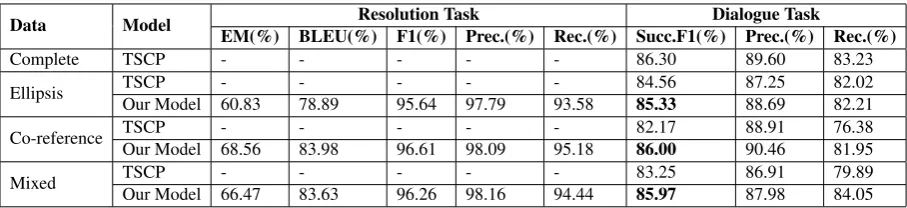
Table 4: Results of the multi-task learning model. This table is split into two parts: performance of resolution for the integrated GECOR on the left side and performance of dialogue task on the right side.
or sequence-based metrics (i.e., BLEU and EM). Therefore, we only integrate the GECOR model with the copy mechanism into the dialogue sys-tem.
Incomplete vs. complete utterances In multi-turn dialogues, user utterances may be incomplete or complete. A robust resolution model needs to be able to accurately identify whether the input ut-terance is complete or not. The model needs to keep it unchanged when it is complete and to pre-dict the corresponding complete version when it is incomplete. For these cases, we tested our mod-els and made statistical analysis on the three ver-sions of data as shown in column 3, 4 and 5 of Table3(EM, EM 1, EM 2). We can find that the GECOR model beats the baseline model in all re-spects. However, the GECOR model needs fur-ther improvement when the input utterances are incomplete, compared with its good performance on complete utterances.
Analysis on GECOR results for complete ut-terances We then analyzed the experimental re-sults of the GECOR 1 on the mixed data in detail. When the input user utterances are complete, the GECOR model can amazingly generate 92.03% utterances that exactly match the input utterances. Only 7.97% do not match perfectly. Most un-matched cases, as we found, are with: (1) missed words(e.g., User: Can I get a Korean restaurant in the town centre? GECOR: Can I get a Ko-rean restaurant in the town?)(2) Repetition(e.g., User: OK, thank you. That is all for today then. GECOR:OK, thank you. That is all for today for today then.)
Analysis on GECOR results for incomplete utterances For incomplete input user utterances, GECOR can generate 42.04% exactly matched cases. Among the 57.96% cases that do not ex-actly match ground truth utterances, only 6.3% are not complete, which still contains unresolved
el-lipsis or co-reference, while 93.7% of these cases are complete with GECOR-generated words that do not match ground truth words. An in-depth analysis on these show that they can be clustered into 4 classes. (1) Paraphrases. We found that the majority of the unmatched complete utterances generated by GECOR are actually paraphrases to the ground truth complete utterances (e.g., User: Any will be fine. GECOR: Any food type will be fine. Reference: Any type of restaurant will be fine.). This is also confirmed by the high scores of the word-level evaluation metrics in Table 3.
(2) Partial resolution. When a pronoun refers to more than one items, GECOR sometimes gener-ate a partial resolution for the pronoun (e.g., User: I do not care about them. GECOR:I do not care about the price range. Reference: I do not care about the price range or location.).(3) Minor er-rors. In a few cases, the resolution part is correct while there are some errors elsewhere. (e.g., User: How about Chinese food? Prediction: How about international food on the south side of town? Ref-erence:How about Chinese food on the south side of town?) (4) Repetition. Some cases contain re-peatedly generated words.
We think that although not exactly matched, paraphrased complete utterances generated by GECOR are acceptable. These utterances are helpful for the downstream dialogue task. For other errors, such as partial resolution or repeti-tion, it may be necessary to enhance the attention or copy mechanism further in GECOR.
6.5 The Multi-Task Learning Model
We further conducted experiments to extrinsically evaluate the GECOR model in task-oriented dia-logue with the success F1 metric. This is also to
base-line TSCP model on the ellipsis, co-reference and mixed dataset, we also trained it on the dataset with only complete user utterances. This is to ex-amine the ability of the baseline model in using correct contextual information presented in user utterances. The experimental results are shown in Table4.
Overall results In comparison to the baseline, we can see that our model improves the success F1 score by nearly 4 points on the co-reference
dataset, which is close to the score obtained by the baseline trained with the complete user utterances. On the mixed and ellipsis dataset, our model also achieves 2.7 points and 0.8 points of success F1
score improvements, respectively.
Resolution performance of the integrated GECOR We also provide the performance of the integrated GECOR on the resolution task in Table
4. The performance is slightly lower than when the GECOR is trained independently as a stand-alone system. This suggests that the GECOR is able to perform well when integrated into a di-alogue system. The overall results demonstrate that the proposed multi-task learning framework for the end-to-end dialogue is able to improve the task completion rate by incorporating an auxiliary ellipsis/co-reference resolution task.
Since the BSpan decoder is also used in the baseline system to capture contextual informa-tion and track dialogue states, we believe that our multi-task learning model with the integrated GECOR will play a more important role in end-to-end dialgoue models that do not use state track-ing modules, e.g., neural open-domain conversa-tion models (Vinyals and Le,2015;Li et al.,2016).
7 Conclusion and Future Work
In this paper, we have extensively investigated the ellipsis and co-reference resolution in the context of multi-turn task-oriented dialogues. We have presented the GECOR, a unified end-to-end gener-ative model for both ellipsis and co-reference reso-lution in multi-turn dialogues. A multi-task learn-ing framework is further proposed to integrate the GECOR into the end-to-end task-oriented di-alogue. In order to train and test the proposed model and framework, we manually created a new dataset with annotated ellipsis and co-reference in-formation based on the publicly available Cam-Rest676 dataset. Experiments on the resolution task show that the GECOR is able to significantly
improve the performance in terms of the exact match rate, BLEU and word-level F1 score.
Ex-periments on the dialogue task demonstrate that the task completion rate of the task-oriented di-alogue system is significantly improved with the aid of ellipsis and co-reference resolution.
Our work could be extended to end-to-end open-domain multi-turn dialogue. We will fur-ther improve our model by incorporating syntac-tic and location information. We would also like to adapt the proposed methods to document-level neural machine translation in the future.
Acknowledgments
The present research was supported by the Na-tional Natural Science Foundation of China (Grant No.61861130364) and the Royal Society (Lon-don) (NAF\R1\180122). We would like to thank the anonymous reviewers for their insightful com-ments.
References
Dzmitry Bahdanau, Kyunghyun Cho, and Yoshua Ben-gio. 2015. Neural machine translation by jointly learning to align and translate. Proceedings of the 3rd International Conference on Learning Repre-sentations (ICLR 2015).
Kevin Clark and Christopher D Manning. 2016. Deep reinforcement learning for mention-ranking corefer-ence models. Proceedings of the 2016 Conference on Empirical Methods in Natural Language Pro-cessing, pages 2256–2262.
Mary Dalrymple, Stuart M Shieber, and Fernando CN Pereira. 1991. Ellipsis and higher-order unification. Linguistics and philosophy, 14(4):399–452.
Mihail Eric and Christopher D Manning. 2017a. A copy-augmented sequence-to-sequence architecture gives good performance on task-oriented dialogue. Proceedings of the 15th Conference of the European Chapter of the Association for Computational Lin-guistics: Volume 2, Short Papers,, pages 468–473.
Mihail Eric and Christopher D Manning. 2017b. Key-value retrieval networks for task-oriented dialogue. Proceedings of the SIGDIAL 2017 Conference, pages 37–49.
Jiatao Gu, Zhengdong Lu, Hang Li, and Victor OK Li. 2016. Incorporating copying mechanism in sequence-to-sequence learning. Proceedings of the 54th Annual Meeting of the Association for Compu-tational Linguistics, pages 1631–1640.
Yin. 2018. Explicit state tracking with semi-supervisionfor neural dialogue generation. In Pro-ceedings of the 27th ACM International Conference on Information and Knowledge Management, pages 1403–1412. ACM.
Diederik P Kingma and Jimmy Ba. 2015. Adam: A method for stochastic optimization. Proceedings of the 3rd International Conference on Learning Rep-resentations (ICLR 2015).
Vineet Kumar and Sachindra Joshi. 2016. Non-sentential question resolution using sequence to se-quence learning. InProceedings of COLING 2016, the 26th International Conference on Computational Linguistics: Technical Papers, pages 2022–2031.
Kenton Lee, Luheng He, Mike Lewis, and Luke Zettle-moyer. 2017. End-to-end neural coreference resolu-tion. Proceedings of the 2017 Conference on Em-pirical Methods in Natural Language Processing, pages 188–197.
Kenton Lee, Luheng He, and Luke Zettlemoyer. 2018. Higher-order coreference resolution with coarse-to-fine inference. Proceedings of NAACL-HLT 2018, pages 687–692.
Wenqiang Lei, Xisen Jin, Min-Yen Kan, Zhaochun Ren, Xiangnan He, and Dawei Yin. 2018. Sequic-ity: Simplifying task-oriented dialogue systems with single sequence-to-sequence architectures. In Pro-ceedings of the 56th Annual Meeting of the Associa-tion for ComputaAssocia-tional Linguistics (Volume 1: Long Papers), pages 1437–1447.
Jiwei Li, Will Monroe, Alan Ritter, Michel Galley, Jianfeng Gao, and Dan Jurafsky. 2016. Deep re-inforcement learning for dialogue generation. Pro-ceedings of the 2016 Conference on Empirical Meth-ods in Natural Language Processing, pages 1192– 1202.
Zhengzhong Liu, Edgar Gonz`alez Pellicer, and Daniel Gillick. 2016. Exploring the steps of verb phrase ellipsis. InProceedings of the Workshop on Coref-erence Resolution Beyond OntoNotes (CORBON 2016), pages 32–40.
Leif Arda Nielsen. 2003. A corpus-based study of verb phrase ellipsis. In Proceedings of the 6th Annual cluk Research Colloquium, pages 109–115.
Martha S. Palmer, Deborah A. Dahl, Rebecca J. Schiff-man, Lynette HirschSchiff-man, Marcia Linebarger, and John Dowding. 1986. Recovering implicit informa-tion. In Proceedings of the Workshop on Strategic Computing Natural Language, HLT ’86, pages 96– 113, Stroudsburg, PA, USA. Association for Com-putational Linguistics.
Kishore Papineni, Salim Roukos, Todd Ward, and Wei-Jing Zhu. 2002. Bleu: a method for automatic eval-uation of machine translation. In Proceedings of the 40th annual meeting on association for compu-tational linguistics, pages 311–318. Association for Computational Linguistics.
Haoruo Peng, Kai-Wei Chang, and Dan Roth. 2015. A joint framework for coreference resolution and men-tion head detecmen-tion. In Proceedings of the Nine-teenth Conference on Computational Natural Lan-guage Learning, pages 12–21.
Jeffrey Pennington, Richard Socher, and Christopher Manning. 2014. Glove: Global vectors for word representation. InProceedings of the 2014 confer-ence on empirical methods in natural language pro-cessing (EMNLP), pages 1532–1543.
Alexander I Rudnicky, Eric Thayer, Paul Constan-tinides, Chris Tchou, R Shern, Kevin Lenzo, Wei Xu, and Alice Oh. 1999. Creating natural dialogs in the carnegie mellon communicator system. In Sixth European Conference on Speech Communica-tion and Technology.
Abigail See, Peter J. Liu, and Christopher D. Manning. 2017. Get to the point: Summarization with pointer-generator networks. InProceedings of the 55th An-nual Meeting of the Association for Computational Linguistics (Volume 1: Long Papers), pages 1073– 1083, Vancouver, Canada. Association for Compu-tational Linguistics.
Stuart M Shieber, Fernando CN Pereira, and Mary Dal-rymple. 1996. Interactions of scope and ellipsis. Linguistics and philosophy, 19(5):527–552.
Olga Uryupina and Alessandro Moschitti. 2013. Mul-tilingual mention detection for coreference resolu-tion. InProceedings of the Sixth International Joint Conference on Natural Language Processing, pages 100–108.
Oriol Vinyals and Quoc Le. 2015. A neural conversa-tional model.Proceedings of the International Con-ference on Machine Learning, Deep Learning Work-shop (2015).
Tsung-Hsien Wen, Milica Gasic, Nikola Mrkˇsi´c, Lina M Rojas Barahona, Pei-Hao Su, Stefan Ultes, David Vandyke, and Steve Young. 2016a. Conditional gen-eration and snapshot learning in neural dialogue sys-tems. In Proceedings of the 2016 Conference on Empirical Methods in Natural Language Process-ing, pages 2153–2162.
Tsung-Hsien Wen, David Vandyke, Nikola Mrksic, Milica Gasic, Lina M Rojas-Barahona, Pei-Hao Su, Stefan Ultes, and Steve Young. 2016b. A network-based end-to-end trainable task-oriented dialogue system. In Proceedings of the 15th Conference of the European Chapter of the Association for Com-putational Linguistics, pages 438–449.
Jie Zheng, Fang Kong, and Guodong Zhou. 2018. Se-quence to seSe-quence model to ellipsis recovery for chinese short text. Journal of Chinese Information Processing, 32(12):92–99.
conversational interface for weather information. IEEE Transactions on speech and audio processing, 8(1):85–96.