Proceedings of the 2019 Conference on Empirical Methods in Natural Language Processing 2273
Topic-Guided Coherence Modeling for Sentence Ordering by
Preserving Global and Local Information
Byungkook Oh, Seungmin Seo, Cheolheon Shin, Eunju Jo, Kyong-Ho Lee Department of Computer Science, Yonsei University
Seoul, South Korea
{bkoh, smseo, chshin, ejjo}@icl.yonsei.ac.kr [email protected]
Abstract
We propose a noveltopic-guided coherence modeling (TGCM)for sentence ordering. Our attention based pointer decoder directly utilize sentence vectors in a permutation-invariant manner, without being compressed into a sin-gle fixed-length vector as the paragraph repre-sentation. Thus, TGCM can improve global dependencies among sentences and preserve relatively informative paragraph-level seman-tics. Moreover, to predict the next sentence, we capture topic-enhanced sentence-pair in-teractions between the current predicted sen-tence and each next-sensen-tence candidate. With the coherent topical context matching, we promote local dependencies that help iden-tify the tight semantic connections for sen-tence ordering. The experimental results show that TGCM outperforms state-of-the-art mod-els from various perspectives.
1 Introduction
Modeling the coherence among sentences to com-pute their gold order is one of the fundamen-tal tasks in Natural Language Processing (NLP) with many applications such as document model-ing (Narayan et al., 2018a), extractive document summarization (Jadhav and Rajan,2018;Nallapati et al.,2017), question answering (Yu et al.,2018; Liu et al., 2017), conversational analysis (Zeng et al.,2018), automated text generation (Guo et al., 2018), and image captioning (Anderson et al., 2018). The coherence helps readers to improve reading comprehension and better understand the intent of a document. Sentence ordering is a set-to-sequence problem, which aims to identify the correct order of a sentence set. To do this, various studies on sentence ordering typically combine the coherent features extracted from sentences.
In recent years, most of the traditional ap-proaches to sentence ordering are designed based
on a pairwise strategy (Chen et al.,2016;Agrawal et al., 2016; Li and Jurafsky, 2016). The sen-tence pair ordering (SPO) models determine the relative order within a sentence pair via neural networks based semantic matching, which com-putes the relevance between the two sentence vec-tors. However, such models cause combinatorial optimization problems because search algorithms (e.g., beam search) are necessary to find the most optimal permutation. Since the SPO models only focus on the sentence-pair interactions (i.e.,local dependency), they have trouble in capturing the interactions among three or more input sentences (i.e.,global dependency) in an entire paragraph.
More recently, state-of-the-art models aim to put randomly sorted sentences into a coherent paragraph with the correct order so that the whole sentences have the highest coherence probabil-ity (Vinyals et al.,2015a;Gong et al., 2016; Lo-geswaran et al.,2018;Cui et al.,2018). Unlike the SPO models, these models can perform the sen-tence set ordering (SSO) task for an entire para-graph based on the pointer network (Vinyals et al., 2015b). Hierarchical RNN networks consisting of sentence and paragraph encoders take unordered sentences as input. They build a paragraph-level vector representation, which represents a semantic summary of the input sentences. Then, a pointer network based decoder fetches the paragraph vec-tor and iteratively outputs sentences in the correct order. At this time, since the output sentences are taken from the input sentences, this can solve the combinatorial optimization problems, which the SPO models suffer from. Also, the SSO models can capture the global dependency among input sentences via the paragraph vector.
Despite the successes of the SSO models, there still exist severe limitations as shown in Figure 1.
SSO task only utilize the last hidden state at the end of paragraph encoders. The encoder always pushes sentence information into a single fixed-length paragraph vector, no matter how many sentences are in the paragraph. Thus, they may struggle with the bottleneck problem where im-portant information between the encoder and the decoder is shrunk. Especially, the more the number of sentences, the more difficult to pre-serve theglobal informationof the paragraph.
• [L2]The attention layer repeatedly decides the next sentence from sentence-pair interactions between the current predicted sentence and each paragraph-independent candidate {si}51. Thus,
they do not elaborately utilize the context of previously predicted sentences{s1, s2, s3} and
the context of s4 conditioned on the context
of the paragraph (i.e., the shuffled sentences
{s2, s4, s5, s1, s3}), where the coherent
con-texts indicate thelocal information that helps determine the tights3-s4interactions.
To address the above limitations, this paper pro-poses a novelTopic-GuidedCoherenceModeling (TGCM) for sentence ordering by capturing lo-cal and global dependencies among sentences. Specifically, TGCM is composed of two major components: topic-sensitive sentence encoder and attentive pointer decoder.
To complement the structural limitations of ex-isting RNN-based pointer decoders, which se-quentially decode one paragraph vector, our tentive pointer decoder relies entirely on the at-tention mechanism (Vaswani et al.,2017) without any recurrent units or convolutions. Since our de-coder directly receives the set of sentence vectors regardless of their input order via attention, our encoder is free from the constraint that all sen-tences must be compressed into a single fixed-length vector as a paragraph representation. As a result, the preservation ofglobal information im-proves the global dependencies among sentences and provides a relatively informative paragraph-level semantics, which can deal with the bottle-neck problem. Moreover, TGCM can better pre-serve the fine-grained word/sentence-level seman-tics from the encoder to the decoder.
Instead of paragraph-independent next-sentence candidates, the topic-sensitive sentence encoder enriches each candidate sentence with its topical context conditioned on the paragraph context via
؟ࢷ
paragraph vector shuffled
sentences ሼݏଶǡ ݏସǡ ݏହǡ ݏଵǡ ݏଷሽ
ݏଵ ݏଶ ݏଷ
ݏଵ ݏଶ ݏଷ ݏସ
Content-Based Attention Layer
ݏସ ݏହ
[image:2.595.306.527.64.146.2]՜
Figure 1: Pointer decoder for sentence ordering. Based on the paragraph vector encoded from the shuffled sen-tences, the attention layer selects the next sentences4 followings3 from sentence-pair interactions between the previously predicteds3and each candidate{si}51.
topic modeling based on Latent Dirichlet Alloca-tion (LDA) (Blei et al.,2003). For each position of the decoder, TGCM also incorporates the topical context flow of previously predicted sentence se-quence into the current predicted sentence. It then predicts the next sentence from topic-enhanced sentence-pair interactions with the coherent top-ical context as local information. Consequently, the preservation of local information promotes the local dependencies between the current pre-dicted sentence and each next-sentence candidate, resulting in identifying the strongest semantic con-nection for ordering a shuffled paragraph.
2 Related Work
The key idea of sentence modeling is to embed each sentence into continuous vector spaces by combining word vectors with recurrent neural net-works (RNNs) (Mikolov et al., 2010) to capture long-term dependencies between words and con-volution neural networks (CNNs) (Kim,2014) to capture important local invariance context.
Sentence Pair Modeling: To identify the re-lationship between given two sentences, sentence pair modeling learns a semantic matching func-tion based on neural networks, which extracts their task-specific features. As a famous example, question answering measures relevance between question-answer pairs with a matching function and ranks candidate answer sentences (Severyn and Moschitti, 2016;Liu and Huang,2016). Re-cent models further measure the semantic simi-larity elaborately by using multi-attention mech-anism (Tan et al., 2018; Tay et al., 2018) and a word-level similarity matrix (Pang et al., 2016; Shen et al.,2017).
sen-tence pair independently. After pairwisely scor-ing, they use a beam search algorithm to find an optimal order for input sentences. Agrawal et al. (2016) develop a pairwise scoring model to or-ganize unordered image-caption pairs. However, such models have the combinatorial optimization problem of finding the most optimal permutation. Moreover, they cannot capture the paragraph-level contextual information, which indicates the global dependency of an entire paragraph.
Sentence Set Modeling: To solve the above is-sues, the pointer network (Vinyals et al., 2015b) is proposed based on the sequence-to-sequence model (Sutskever et al., 2014). The pointer net-work consists of encoding input tokens to a sum-mary vector, decoding next token vectors itera-tively via content-based attention over input to-ken vectors, and producing the output toto-ken se-quence from the output token vectors. Inspired by the pointer network, state-of-the-art SSO mod-els (Vinyals et al., 2015a;Gong et al.,2016; Lo-geswaran et al.,2018) usually employ hierarchical RNN-based encoders to produce a paragraph vec-tor from unordered sentences. Then, the pointer network based decoders predict the correct sen-tence sequence. However, the paragraph vector depends on the permutation of input sentences.
To address the issue, ATTOrderNet (Cui et al., 2018) employs self-attention at the encoder to cap-ture global dependencies regardless of an input sentence order. However, similar to traditional models, they also compress sentence vectors into a single fixed-length vector via average pooling. While Our TGCM is also permutation-agnostic to input sentences, we feed the sentence vector set directly into the attentive pointer decoder and cap-ture the coherent topical context in sentence-pair interactions via topic modeling. Thus, unlike AT-TOrderNet, TGCM can simultaneously improve both local and global dependencies.
Topic-Aware Sentence Modeling: The com-monly used topic model is based on LDA, which extracts the latent topic vectors (i.e., topic distri-butions) of words, sentences, and paragraphs from a training corpus. Given sentences in a paragraph, their topic latent vectors help in capturing global topical context for the paragraph and local top-ical context for each sentence. Therefore, topic modeling is used in various research fields requir-ing sentence modelrequir-ing (Narayan et al.,2018b; Di-eng et al., 2016;Gong et al., 2018). LTMF (Jin
et al.,2018) is a context-aware recommender sys-tem, which combines LSTMs and topic modeling before applying matrix factorization. They extract the global context information related to words in a user review via topic distributions.
3 The Proposed Model
In this section, we present TGCM as a novel topic-guided coherence modeling for SSO. TGCM can address the above-mentioned limitations[L1] and[L2] simultaneously. We first build a topic-distribution generating function via topic
mod-eling. Then, we describe two major
compo-nents: topic-sensitive sentence encoder and at-tentive pointer decoder. The encoder leverages the topic distributions of a paragraph and its sen-tences. Then, the decoder directly utilizes them in a permutation-agnostic manner and determines the correct order of randomly sorted sentences.
3.1 Problem Definition
The primary goal of sentence set ordering is to put an unordered set of sentences into a coherent paragraph in the correct order. Specifically, given a paragraphp, the correct sentence sequence and its order are denoted bySp = [s1, s2, ..., s|p|]and Op = [os1, os2, ..., os|p|], respectively, where |p| denotes the number of sentences inp.
Given a shuffled sentence sequence, our TGCM outputs a sentence sequenceSˆpwhose order is de-noted byOˆp. The objective of coherence model-ing is to make the coherence probability for the predicted orderOˆp approximate to the coherence probability for the correct orderOpas follows:
P(Op|p)≈P( ˆOp|p), (1)
where P(Op|p) and P( ˆOp|p) denote the coher-ence probabilities forOpandOˆp, respectively.
3.2 Topic Latent Vectors
training corpus LDA-based topic modeling per-corpus topic distributions
… ܜௗൌtopicDistribution(݀ܿ)
(unseen document)
[image:4.595.310.524.58.317.2](݀௧hidden topics) ݀ܿ
Figure 2: Topic modeling on a corpus as preprocessing of TGCM. topicDistribution(·) returns LDA-based features, a topic latent vectortdocof a given document.
To do this, we utilize LDA (Blei et al., 2003), which is the most simple and popular algorithm for topic modeling. The topic latent vectors of sentences and paragraphs indicate the sentence-level (local) and the paragraph-sentence-level (global) topi-cal context via hidden topics, respectively.
3.3 Topic-Sensitive Sentence Encoder
Attention-Based bi-LSTM Layer. We leverage an extended version of LSTMs (Hochreiter and Schmidhuber, 1997) as our base model in Figure 3, which overcomes the gradient vanishing of ex-isting RNNs. Particularly, attention-based bidirec-tional LSTMs (Att-BLSTMs) (Zhou et al.,2016) are mostly used in sentence modeling.
In this layer, we aim to produce the sentence vector s from a given sentence sconsisting of a word sequence [w1, w2, ..., wn]. Each word wi is encoded into a word embedding wi ∈ Rdw. Att-BLSTMs consist of two sub-networks with forward and backward LSTMs, which take the word embeddings[w1,w2, ...,wn]and output se-quences of forward and backward hidden states
[−→h1,
− →
h2, ...,
− →
hn] and [
←−
h1,
←−
h2, ...,
←−
hn], respec-tively as follows:
− →
ht=
−−−−→
LST M(Mt,
− →
ht−1),
←−
ht=
←−−−−
LST M(Mt,
←−
ht+1),
(2)
whereMtis a set of learnable parameters. Then, we combine the forward and backward hidden states by an element-wise sum as follows:
hi = [
− →
hi⊕
←−
hi]. (3)
Thus, the hidden state vectors[h1,h2, ...,hn]∈ Rdw×n are obtained from previous LSTM layers and fed into an attention layer as follows:
α=sof tmax(mT1tanh([h1,h2, ...,hn])),
s= [h1,h2, ...,hn]αT,
(4)
…
sentence ݏଶ sentence ݏȁȁ sentence ݏଵ
…
shuffled paragraph (sentence sequence) ܛଵ Attention-Based bi-LSTM Word Embedding ܜ
ൌ ሼݏଶǡ ݏǡ ǥ ǡ ݏଵሽ
ݏא ሼݏଶǡ ݏǡ ǥ ǡ ݏଵሽ
ܜ௦
ܛଶ ܛଵ Attention-Based bi-LSTM Word Embedding ܛȁȁ Attention-Based bi-LSTM Word Embedding ܛଵ
ܛଶ ܛȁȁ
topicDistribution(·) … … … … ݏଶ ݏȁȁ ݏଵ … …
૦ࢉઝ߾ ɼԻɼ ࢇ ࢽѦЕ Ѷߞ ɼѧ۽ࢇ
ࣚࡸ … … element-wise multiplication input …
؟ࢷ
Linear Linear Linear
topic-sensitive sentence vectors
(permutation-agnostic)
ܜ۪ܜଶ ܜ۪ܜ௦ȁȁ ܜ۪ܜ௦భ
[image:4.595.120.242.64.180.2]ݏȁȁ
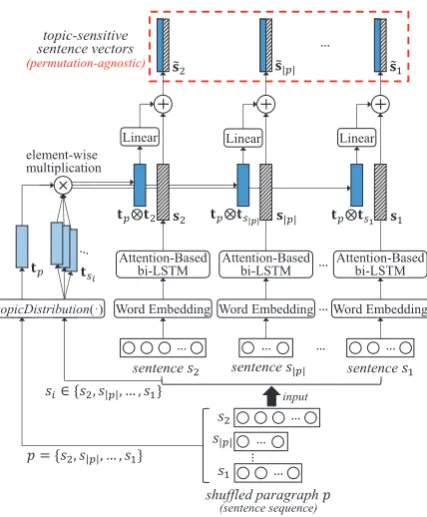
Figure 3: Architecture of topic-sensitive sentence en-coder. The encoder takes a shuffled paragraph con-sisting of{s2, s|p|, ..., s1}and outputs{˜s2,˜s|p|, ...,˜s1} from their vectors and topic latent vectors of the para-graph and sentences. The outputs are directly utilized in a decoder without being compressed into a vector.
where m1 ∈ Rdw and α ∈ Rn denote a weight vector and resulting attention weights, respec-tively. s ∈ Rdw is the final sentence vector of s, which is computed by a weighted sum between the hidden state vectors and the attention weights.
Topic-Sensitive Sentence Vectors. As shown in Figure 3, our topic-sensitive sentence encoder takes a shuffled paragraphp as input, which con-sists of unordered sentences {si}
|p|
1 . We create
sentence vectors si for all sentences si with the attention-based bi-LSTMs. In addition, topic la-tent vectorstp ∈Rdt andtsi ∈R
dt are generated
by topicDistribution(·) for p and si, where dt denotes the number of latent topics.
During the encoding of TGCM, we multiplytsi andtpfor each sentencesito weight the coherent latent topics that appear simultaneously in both the sentence and the paragraph. The topic latent vec-tortsi captures how topical a sentencesi is in it-self (local context), whereas the topic latent vector
topical relevance to the paragraph as follows:
(tp⊗tsi)∈R dt; s
i ∈ {s1, s2, ..., s|p|}, (5)
where the operation ⊗indicates an element-wise multiplication. To combinetp⊗tsi with the sen-tence vectorssi, we apply two linear transforma-tions with a ReLU activation to eachtp⊗tsi sep-arately. Then, the transformed vectors are added with the corresponding sentence vectors as fol-lows:
˜
si=max(0,(tp⊗tsi) |W
1+b1)W2+b2+si, (6)
where˜si ∈Rdwdenotes a topic-sensitive sentence vector. Thus, the global topical context relating to the local topical context of each sentence is in-corporated into the corresponding sentence vector. This helps our pointer decoder for next-sentence predictions to guide the semantic connection be-tween a predicted sentence and its next sentence by considering coherent topical context flow.
3.4 Attentive Pointer Decoder
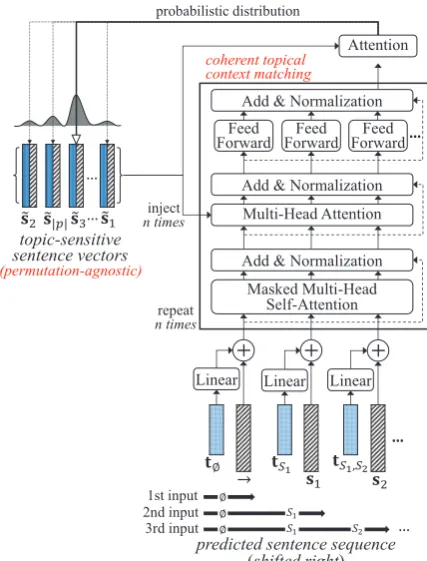
As shown in Figure 4, we build the attentive pointer decoder based on the decoder of Trans-former (Zhou et al., 2016) and the pointer net-work (Narayan et al., 2018b). The pointer net-work determines next token vectors iteratively via content-based attention over input token vectors. For coherent topical context matching, our de-coder is mainly composed of a stack ofnattention modules relying entirely on attention which have been attracted as a promising technique in many sequence-based tasks (Bahdanau et al.,2014).
Existing SSO models utilized RNN-based de-coders cannot pass encoded sentence vectors be-cause their decoders sequentially decode one para-graph vector. Attention mechanisms allow each sentence in a different position to link other sen-tences regardless of the order and number of in-put sentences. Thus, our attention based pointer decoder directly utilize the topic-sensitive sen-tence vectors{˜s2,˜s|p|,˜s3, ...,˜s1}in a
permutation-agnostic manner (global information). This allows our model to avoid bottleneck problems which dilute word/sentence semantics between encoder and decoder and fully utilize the semantics for sen-tence ordering.
Moreover, Our attentive pointer decoder can capture topic-enhanced sentence-pair interactions between the current predicted sentence and
topic-sensitive sentence vectors
…
…
predicted sentence sequence
(shifted right)
Masked Multi-Head Self-Attention Add & Normalization
repeat
n times
Feed Forward
Multi-Head Attention Add & Normalization
inject
n times
… Feed
Forward ForwardFeed
probabilistic distribution
Attention
1st input
(permutation-agnostic)
coherent topical context matching
ܛଶ ܛȁȁܛଷ ܛଵ
2nd input 3rd input
؟ࢷ
ܛଶ
ܛଵ
Linear Linear Linear
՜
Add & Normalization
…
ܜ ܜௌభ ܜௌభǡௌమ
ܵଵ
ܵଶ
ܵଵ
[image:5.595.309.523.61.342.2]…
Figure 4: Architecture of attentive pointer decoder. The decoder fetches permutation-agnostic topic-sensitive sentence vectors{˜s2,˜s|p|,˜s3, ...,˜s1}from the encoder. For coherent topical context modeling, at the 3rd step, a stack of n attention modules position-wisely takes
{→,s1,s2} and newly created topic latent vectors
{t∅,ts1,ts1,s2}, wheret∅denotes a zero vector. The
topic vectors are generated by incrementally including previously predicted{s1, s2}, The attention layer out-puts a probabilistic distribution over encoder outout-puts
{˜s2,˜s|p|,˜s3, ...,˜s1}and select the next sentences3.
encoder outputs {˜s2,˜s|p|,˜s3, ...,˜s1}) as
next-sentence candidates. With the coherent topical context (local information) matching, we promote local dependencies for identifying the tight seman-tic connections for sentence ordering.
Coherent Topical Context Matching. Our at-tentive pointer decoder employs a stack of atten-tion modules identical with the decoder of Trans-former (Zhou et al., 2016) for the coherent topi-cal context matching. Given queryQ ∈ Rn×dm, key K ∈ Rn×dm, and value V ∈
Rn×dm, the attention mechanism computes the output matrix
Outatt ∈ Rn×dm obtained from the value matrix
Vwith an attention weightαas follows:
α=sof tmax(QK
|
√
dk
), Outatt=αV, (7)
the case when all query, key, and value matrices are the same. Masked attention, a variant of at-tention, masks out all positions after the current position by arbitrarily setting a large value (−∞) in the softmax function.
Firstly, for the coherent topical context match-ing, we position-wisely feed previously predicted sentence vectors and their newly created topic latent vectors to the masked multi-head self-attention sub-layer. In that, each topic latent vector is generated by topicDistribution(·) with pre-dicted sentences in all positions before the current position. Thus, we incorporate the topical context flow of the previously predicted sentence sequence into the corresponding predicted sentence vector.
After a residual connection (He et al.,2016) and layer normalization (Lei Ba et al., 2016), the re-sulting vectors are injected as the query matrix
Q into the multi-head attention sub-layer. The sub-layer also takes permutation-agnostic topic-sensitive sentence vectors obtained from our en-coder as the key and value matrices K and V. We follow Transformer for the remaining coherent topical context matching process, including multi-head attention strategy. As a result, with the mul-tiple attention modules, TGCM draws global de-pendencies among sentences by attending over the topic-sensitive sentence vectors repeatedly.
Probabilistic Distribution for Ordering. At the ith step, the attention module of the decoder takes previously predicted sentences {s˜1, ...,˜si−1} and
˜
s0 for the token ”→” as inputs. After repeating
the attention module ntimes, we then utilize the dw-dimensional output vectorci−1 corresponding
to the (i−1)th decoder position. As shown in Figure 4, at the 3rd step, the output vector(c3)of
the 3rd position is fed into the final attention layer as like in conventional pointer decoders.
In the final attention layer, for the output vector
ci of the attention modules, TGCM produces an output distribution over topic-sensitive sentence vectors{˜s1,˜s2, ...,˜s|p|}obtained from encoder via content-based attention as follows:
uji =v|atanh(Wa
˜
sj
ci
), (1< j <|p|),
P(ˆoi|oˆ<i,˜s1,s˜2, ...,˜s|p|) =sof tmax(ui), (8)
where ˆoi denotes the order of the ith position. Wa ∈ Rd×2d v|a ∈ Rd denote the weight ma-trix and vector, respectively, which are shared in all positions. Thus, we can select the correct next
Train Valid Test #Voca.
[image:6.595.309.524.62.126.2]NIPS abstract 2,248 (5.91) 409 (5.95) 402 (5.86) 16,721 ANN abstract 8,569 (4.83) 962 (4.84) 2626 (4.97) 34,485 NSF abstract 96,070 (8.68) 10,185 (8.73) 21580 (8.63) 334,090 arXiv abstract 884,912 (5.38) 110,614 (5.39) 110,615 (5.37) 64,557 SIND 40,155 (5) 4,990 (5) 5,055 (5) 30,861
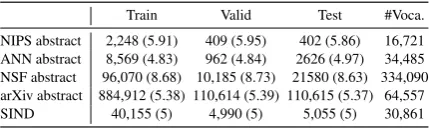
Table 1: The number of paragraphs, average sentences (in parentheses), and vocabulary size of 5 datasets.
sentencesithat yields the highest probability from the output distribution.
Finally, the selected sentence vector si is fed into the decoder along with previously selected sentences {s1,s2, ...,si−1} and newly created
topic latent vectors{t∅,ts1,ts1,s2, ...,ts1,...,si}as inputs at the(i+ 1)th step.
Training.For each correct sentence sequence, we sample 5 shuffled sentence sequences at training phase. Following the typical sentence ordering models, we train parameters of our model to max-imize the coherence probability by minimizing the loss function as follows.
L=− 1
|D|logP( ˆOp|p,Θ) +
λ
2||Θ||
2 2, (9)
whereΘandλdenote a set of trainable parameters and a regularization parameter, respectively.
4 Experimental Setup
The parameters of TGCM were tuned by the RM-SProp1 optimizer, which adaptively adjusts the learning rate for each parameter and resolves the problem of Adagrad (Duchi et al.,2011) where the learning rate radically decreases or increases.
All experiments were implemented in Python using TensorFlow (Abadi et al.,2016), which sup-ports the GPU-accelerated deep learning. We also utilized Natural Language Toolkit2 (NLTK) (Loper and Bird,2002) for sentence tokenization and data preprocessing, and Gensim3 for LDA-based topic modeling. The word embeddings were initialized with pre-trained GloVe vectors of di-mension dw = 200, trained by GloVe ( Penning-ton et al.,2014). We trained our LDA-based topic model for each dataset with its training, valid, and test corpora.
1
http://www.cs.toronto.edu/˜tijmen/ csc321/slides/lecture_slides_lec6.pdf
2
https://www.nltk.org/
4.1 Datasets
We first conducted our experiments on commonly used 4 abstract datasets: NIPS, ANN (Wang et al., 2018), NSF, and arXiv (Chen et al.,2016), which contain abstracts of research papers. The abstracts datasets collected from NIPS papers, ACL Anthol-ogy Network (AAN) corpus, NSF Research Award abstract, and arXiv website, respectively. Ab-stracts have the logical consistency of high qual-ity, which helps coherence modeling for sentence ordering. We further considered the Sequential Image Narrative Dataset (SIND) (Huang et al., 2016), which consists of personal multimodal sto-ries consisting of five sentences per story. We did not utilize accident and earthquake datasets (Barzilay and Lapata,2008) because the datasets are too small and do not provide the validation set. Following the setup in (Logeswaran et al.,2018), we split undivided datasets for training, validation, and test. Table 1 shows the details of the 5 datasets used in our experiments.
4.2 Evaluation Metrics
Following the evaluation metrics widely used in previous SPO and SSO models, we adopted three metrics to assess sentence ordering performance: Kendall’s tau, perfect match ratio, and positional accuracy.
Kendall’s tau (τ): Kendall’s tau (Lapata, 2003, 2006) measures the ordinal association between two sequences to automatically evaluate coher-ence modeling as follows:
τ = 1
|D|
X
i∈|D|
2×inversions(Opi,Oˆpi)
|pi|(|pi| −1)/2
, (10)
where|D|and|pi|denote the total number of para-graphs in a test datasetDand the number of sen-tences in a paragraphpi, respectively. The func-tion inversions(Opi,Oˆpi) returns the number of sentence-pair interchanges for reconstructing the correct order Opi from the predicted order Oˆpi. The value ranges from -1 to 1. A higher value indicates better performance. The evaluation met-ric closely correlates with user ratings and reading times, which are related with the readability.
Perfect Match Ratio (PMR in %): The perfect match ratio is the ratio of exactly matching orders across all predicted paragraphs as follows:
PMR= 1
|D|
X
i∈|D|
I(Opi = ˆOpi), (11)
where I(Opi = ˆOpi) denotes the indicator func-tion, which returns 1 if the correct sentence order Opiand the predicted sentence orderOˆpiare iden-tical and 0 otherwise.
Positional Accuracy(PAcc in %): The positional accuracy is defined as the ratio of the matched sentence-level absolute positions between the pre-dicted and correct orders as follows:
PAcc= 1
|D|
X
i∈|D| X
j∈|pi|
I(osj = ˆosj) (12)
where osj denotes the absolute position of sen-tencesj in the correct sequenceSj. Likewise,oˆsj denotes the absolute position of sentencesjin the predicted sequenceSˆj. I(osj = ˆosj) denotes the indicator function equal to 1 ifosj = ˆosj and 0 otherwise.
4.3 Hyperparameters
For LDA-based topic modeling, we decided its hy-perparametersβanddtwith a grid search on each dataset. Following Griffiths and Steyvers(2004), we kept α = 0.1andβ = 50/dt constantly and obtained the best results withdt= 300for all ab-stract datasets anddt= 200for SIND. We initially configureddw = 200with the Glove vectors and updated the word vectors during training. For our attentive pointer decoder, we followed the same hyperparameters in Transformer and used a learn-ing rate of 0.01. Other parameters were initialized randomly based onHe et al.(2015).
5 Experimental Results
NIPS abstract ANN abstract NSF abstract arXiv abstract SIND
τ PMR PAcc τ PMR PAcc τ PMR PAcc τ PMR PAcc τ PMR PAcc
Random Model 0 7.53 15.59 0 8.07 19.36 0 5.42 9.46 0 8.07 14.11 0 6.05 9.32
Pairwise Model 0.47 19.72 26.63 0.58 21.54 41.82 0.25 13.56 15.51 0.66 33.43 50.79 0.32 10.43 30.75 Seq2seq 0.27 14.39 21.18 0.40 18.09 36.62 0.10 11.63 13.68 0.52 29.43 45.67 0.21 8.64 26.18 RNN Decoder 0.67 23.31 48.22 0.66 21.31 52.06 0.48 14.87 25.79 0.66 35.53 48.31 0.38 10.68 31.53 V-LSTM+PtrNet 0.72 27.87 51.55 0.73 29.79 58.06 0.51 18.53 28.33 0.72 41.74 55.90 0.45 13.44 35.26 CNN+PtrNet 0.66 26.79 48.64 0.69 26.65 58.21 0.52 16.73 33.22 0.71 39.28 52.92 0.48 12.32 35.52 LSTM+PtrNet 0.67 28.20 50.87 0.69 30.41 58.20 0.52 19.53 32.45 0.72 40.44 54.31 0.48 12.34 34.45 ATTOrderNet 0.72 29.87 56.09 0.73 32.11 63.24 0.55 21.35 37.72 0.73 42.19 56.11 0.49 14.01 36.24
TGCM-S 0.72 29.02 57.67 0.74 34.14- 64.65 0.53 21.09 39.15 0.73 42.51 55.16 0.51 14.41 36.75
[image:8.595.96.269.248.356.2]TGCM 0.75 31.44 59.43 0.75 36.69 65.16 0.55 22.35 42.67 0.75 44.28 58.31 0.53 15.18 38.71
Table 2: Performance of neural networks based models on the sentence ordering task. Best results are in boldface.
arXiv SIND
Head Tail Head Tail
Random Model 23.06 23.16 22.78 22.56 Pairwise Model 84.85 62.37 - -CNN+PtrNet 89.43 65.36 73.53 53.26 LSTM+PtrNet 90.47 66.49 74.66 53.30 ATTOrderNet 91.00 68.08 76.00 54.42
TGCM-S 91.15 67.93 77.34 54.64
TGCM 92.46 69.45 78.98 56.24
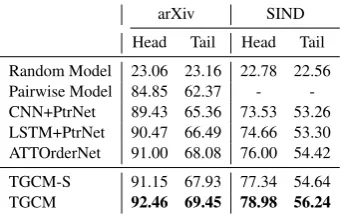
Table 3: Performance of predicting the correct head and tail sentences on arXiv and SIND. The results are directly taken from (Cui et al.,2018).
We could infer the topic latent vectors of new doc-uments at the test phases.
Given a shuffled sentence sequence, the main goal is to find the most coherent sentence se-quence. The coherence probability of a predicted sentence sequence is approximated to the coher-ence probability of a correct sentcoher-ence sequcoher-ence. In Table 2-3, the several values of some models are directly taken from (Cui et al., 2018), while we implemented the rest of models using their pub-lic code with the same experimental setup. Some methods do not release their implemented codes and so were implemented. In the case of the lat-est model ATTOderNet, we only utilized the high-performance model among three versions.
We discuss the reason for our highest perfor-mance among previous models by classifying the factors affecting performance into four categories: sentence set modeling, topic latent vectors, permu-tation invariance, and attention at decoder.
5.1 Impact of Sentence Set Modeling
This is related to the global dependencies of an entire paragraph. We observed that the perfor-mances of the random model and the pairwise
model (Chen et al., 2016) were the worst. The pairwise model only learns the relative order from sentence-pair interactions. Since the two models do not consider all sentences at a time, they can-not leverage paragraph-level information. In other words, they cannot capture the global dependen-cies that help sentence ordering.
5.2 Impact of Topic Latent Vectors
Furthermore, we evaluated the variant version of TGCM, referred to TGCM-S, where the encoder of TGCM-S do not combine topic latent vectors and original sentence vectors. Also, the decoder of TGCM-S do not take newly created topic la-tent vectors. This allows us to explore whether the topic latent vectors actually help the sentence ordering task. Since TGCM-S cannot perform coherent topical context matching, TGCM-S do not elaborately capture the local dependencies, which help to identify tight semantic connections between the current predicted sentence and each next-sentence candidate.
As shown in the Tables 2-3, full TGCM outper-formed TGCM-S which employs only attention-based bi-LSTMs without topic modeling. Al-though TGCM-S do not utilize topical context features at encoder and decoder (such as tp and
ts), TGCM-S also employs the transformer-based attentive pointer decoder. Thus, we found that topic modeling additionally contributes to model-ing sentences through global topical context relat-ing to local topical context of each sentence, re-sulting in improving the sentence ordering perfor-mance.
5.3 Impact of Permutaion Invariance
The conventional models typically adopt hierar-chical RNN-based encoders, which combine sen-tence vectors sequentially and generate paragraph-level representation as a vector. Since they are de-pendent on the permutation of the input sentences, their paragraph-level representations are not reli-able.
On the other hand, self-attention-based AT-TOrderNet (encoder side) and attention-based our TGCM/TGCM-S (decoder side) use a set of sen-tence representations in a permutation-invariant manner rather than a single vector to represent a paragraph. Thus, these models can capture global dependencies regardless of the order of input sen-tences. The outputs of their encoder are more in-formative and reliable for improving the sentence ordering performance.
5.4 Impact of Attention at Decoder
This is related to solving the bottleneck problem by enhancing the expressiveness of the decoder’s input and capturing the global and local dependen-cies among input sentences simultaneously.
Table 2-3 show that ATTOrderNet and TGCM, which utilize an attention mechanism, perform much better than all the other models. With an encoder employing self-attention mechanism, AT-TOrderNet can capture some global dependencies with the reliable paragraph-level representation re-gardless of their input order. However, since AT-TOrderNet also compresses sentence vectors into a single fixed-length paragraph vector via an aver-age pooling layer, the word/sentence-level seman-tics from the encoder to the decoder are diluted.
In contrast to ATTOrderNet, TGCM feeds the sentence vectors directly into a decoder without compressing them into a single vector. Then, the attention mechanism allows our decoder to receive and utilize the sentence vectors, regardless of the order and number of sentences. As a result, since our TGCM could elaborately capture both local and global dependencies simultaneously, TGCM showed the best sentence ordering performance among all comparative models on all datasets.
6 Conclusions
We propose TGCM which better preserves lo-cal and global information for sentence ordering. Our attentive pointer decoder fully utilizes the se-mantics of sentence vectors without being com-pressed into a paragraph vector. Our sentence
encoder produces topic-sensitive sentence vectors via topic modeling. With the coherent topical con-text matching between the current predicted sen-tence and each next-sensen-tence candidate, we pro-mote local dependencies that help identify the tight semantic connections. The empirical results on sentence ordering demonstrate that TGCM out-performs state-of-the-art models.
Acknowledgments
This work was supported by the National Re-search Foundation of Korea(NRF) grant funded by the Korea government(MSIP; Ministry of Science, ICT & Future Planning) (No. NRF-2019R1A2B5B01070555).
References
Mart´ın Abadi, Paul Barham, Jianmin Chen, Zhifeng Chen, Andy Davis, Jeffrey Dean, Matthieu Devin, Sanjay Ghemawat, Geoffrey Irving, Michael Isard, et al. 2016. Tensorflow: A system for large-scale machine learning. In 12th USENIX Symposium on Operating Systems Design and Implementation, pages 265–283.
Harsh Agrawal, Arjun Chandrasekaran, Dhruv Batra, Devi Parikh, and Mohit Bansal. 2016. Sort story: Sorting jumbled images and captions into stories.
arXiv preprint arXiv:1606.07493.
Peter Anderson, Xiaodong He, Chris Buehler, Damien Teney, Mark Johnson, Stephen Gould, and Lei Zhang. 2018. Bottom-up and top-down attention for image captioning and visual question answering. In
Proceedings of the IEEE Conference on Computer Vision and Pattern Recognition, pages 6077–6086.
Dzmitry Bahdanau, Kyunghyun Cho, and Yoshua Ben-gio. 2014. Neural machine translation by jointly learning to align and translate. arXiv preprint arXiv:1409.0473.
Regina Barzilay and Mirella Lapata. 2008. Modeling local coherence: An entity-based approach. Compu-tational Linguistics, 34(1):1–34.
David M Blei, Andrew Y Ng, and Michael I Jordan. 2003. Latent dirichlet allocation. Journal of ma-chine Learning research, 3(Jan):993–1022.
Xinchi Chen, Xipeng Qiu, and Xuanjing Huang. 2016. Neural sentence ordering. arXiv preprint arXiv:1607.06952.
Adji B Dieng, Chong Wang, Jianfeng Gao, and John Paisley. 2016. Topicrnn: A recurrent neural net-work with long-range semantic dependency. arXiv preprint arXiv:1611.01702.
J. Duchi, E. Hazan, and Y. Singer. 2011. Adaptive sub-gradient methods for online learning and stochas-tic optimization. Journal of Machine Learning Re-search, 12:2121–2159.
Hongyu Gong, Tarek Sakakini, Suma Bhat, and Jinjun Xiong. 2018. Document similarity for texts of vary-ing lengths via hidden topics. InProceedings of the 56th Annual Meeting of the Association for Compu-tational Linguistics (Volume 1: Long Papers), vol-ume 1, pages 2341–2351.
Jingjing Gong, Xinchi Chen, Xipeng Qiu, and Xu-anjing Huang. 2016. End-to-end neural sentence ordering using pointer network. arXiv preprint arXiv:1611.04953.
Thomas L Griffiths and Mark Steyvers. 2004. Find-ing scientific topics. Proceedings of the National academy of Sciences, 101(suppl 1):5228–5235.
Jiaxian Guo, Sidi Lu, Han Cai, Weinan Zhang, Yong Yu, and Jun Wang. 2018. Long text generation via adversarial training with leaked information. In
Thirty-Second AAAI Conference on Artificial Intelli-gence.
K. He, X. Zhang, S. Ren, and J. Sun. 2015. Delving deep into rectifiers: Surpassing human-level perfor-mance on imagenet classification. InICCV, pages 1026–1034.
Kaiming He, Xiangyu Zhang, Shaoqing Ren, and Jian Sun. 2016. Deep residual learning for image recog-nition. In Proceedings of the IEEE conference on computer vision and pattern recognition, pages 770– 778.
Sepp Hochreiter and J¨urgen Schmidhuber. 1997. Long short-term memory. Neural computation, 9(8):1735–1780.
Ting-Hao Kenneth Huang, Francis Ferraro, Nasrin Mostafazadeh, Ishan Misra, Aishwarya Agrawal, Ja-cob Devlin, Ross Girshick, Xiaodong He, Pushmeet Kohli, Dhruv Batra, et al. 2016. Visual storytelling. InProceedings of the 2016 Conference of the North American Chapter of the Association for Computa-tional Linguistics: Human Language Technologies, pages 1233–1239.
Aishwarya Jadhav and Vaibhav Rajan. 2018. Extrac-tive summarization with swap-net: Sentences and words from alternating pointer networks. In Pro-ceedings of the 56th Annual Meeting of the Associa-tion for ComputaAssocia-tional Linguistics (Volume 1: Long Papers), volume 1, pages 142–151.
Mingmin Jin, Xin Luo, Huiling Zhu, and Hankz Han-kui Zhuo. 2018. Combining deep learning and topic modeling for review understanding in context-aware
recommendation. InProceedings of the 2018 Con-ference of the North American Chapter of the Asso-ciation for Computational Linguistics: Human Lan-guage Technologies, Volume 1 (Long Papers), vol-ume 1, pages 1605–1614.
Yoon Kim. 2014. Convolutional neural net-works for sentence classification. arXiv preprint arXiv:1408.5882.
Mirella Lapata. 2003. Probabilistic text structuring: Experiments with sentence ordering. In Proceed-ings of the 41st Annual Meeting on Association for Computational Linguistics-Volume 1, pages 545– 552. Association for Computational Linguistics.
Mirella Lapata. 2006. Automatic evaluation of infor-mation ordering: Kendall’s tau. Computational Lin-guistics, 32(4):471–484.
Jimmy Lei Ba, Jamie Ryan Kiros, and Geoffrey E Hin-ton. 2016. Layer normalization. arXiv preprint arXiv:1607.06450.
Jiwei Li and Dan Jurafsky. 2016. Neural net models for open-domain discourse coherence. arXiv preprint arXiv:1606.01545.
Biao Liu and Minlie Huang. 2016. A sentence inter-action network for modeling dependence between sentences. InProceedings of the 54th Annual Meet-ing of the Association for Computational LMeet-inguistics (Volume 1: Long Papers), volume 1, pages 558–567.
Xiaodong Liu, Yelong Shen, Kevin Duh, and Jian-feng Gao. 2017. Stochastic answer networks for machine reading comprehension. arXiv preprint arXiv:1712.03556.
Lajanugen Logeswaran, Honglak Lee, and Dragomir Radev. 2018. Sentence ordering and coherence modeling using recurrent neural networks. In
Thirty-Second AAAI Conference on Artificial Intel-ligence.
Edward Loper and Steven Bird. 2002. Nltk: the natural language toolkit. arXiv preprint cs/0205028.
Tom´aˇs Mikolov, Martin Karafi´at, Luk´aˇs Burget, Jan ˇ
Cernock`y, and Sanjeev Khudanpur. 2010. Recurrent neural network based language model. InEleventh annual conference of the international speech com-munication association.
Ramesh Nallapati, Feifei Zhai, and Bowen Zhou. 2017. Summarunner: A recurrent neural network based se-quence model for extractive summarization of docu-ments. InThirty-First AAAI Conference on Artificial Intelligence.
Shashi Narayan, Shay B Cohen, and Mirella Lap-ata. 2018b. Don’t give me the details, just the summary! topic-aware convolutional neural net-works for extreme summarization. arXiv preprint arXiv:1808.08745.
Liang Pang, Yanyan Lan, Jiafeng Guo, Jun Xu, Shengxian Wan, and Xueqi Cheng. 2016. Text matching as image recognition. InThirtieth AAAI Conference on Artificial Intelligence.
J. Pennington, R. Socher, and C. Manning. 2014. Glove: Global vectors for word representation. In
EMNLP, pages 1532–1543.
Aliaksei Severyn and Alessandro Moschitti. 2016. Modeling relational information in question-answer pairs with convolutional neural networks. arXiv preprint arXiv:1604.01178.
Gehui Shen, Yunlun Yang, and Zhi-Hong Deng. 2017. Inter-weighted alignment network for sentence pair modeling. InProceedings of the 2017 Conference on Empirical Methods in Natural Language Pro-cessing, pages 1179–1189.
Ilya Sutskever, Oriol Vinyals, and Quoc V Le. 2014. Sequence to sequence learning with neural net-works. InAdvances in neural information process-ing systems, pages 3104–3112.
Chuanqi Tan, Furu Wei, Wenhui Wang, Weifeng Lv, and Ming Zhou. 2018. Multiway attention networks for modeling sentence pairs. InIJCAI, pages 4411– 4417.
Yi Tay, Luu Anh Tuan, and Siu Cheung Hui. 2018. Multi-cast attention networks for retrieval-based question answering and response prediction. arXiv preprint arXiv:1806.00778.
Ashish Vaswani, Noam Shazeer, Niki Parmar, Jakob Uszkoreit, Llion Jones, Aidan N Gomez, Łukasz Kaiser, and Illia Polosukhin. 2017. Attention is all you need. InAdvances in Neural Information Pro-cessing Systems, pages 5998–6008.
Oriol Vinyals, Samy Bengio, and Manjunath Kudlur. 2015a. Order matters: Sequence to sequence for sets. arXiv preprint arXiv:1511.06391.
Oriol Vinyals, Meire Fortunato, and Navdeep Jaitly. 2015b. Pointer networks. In Advances in Neural Information Processing Systems, pages 2692–2700.
Qingyun Wang, Zhihao Zhou, Lifu Huang, Spencer Whitehead, Boliang Zhang, Heng Ji, and Kevin Knight. 2018. Paper abstract writing through edit-ing mechanism.arXiv preprint arXiv:1805.06064.
Adams Wei Yu, David Dohan, Minh-Thang Luong, Rui Zhao, Kai Chen, Mohammad Norouzi, and Quoc V Le. 2018. Qanet: Combining local convolution with global self-attention for reading comprehen-sion.arXiv preprint arXiv:1804.09541.
Xingshan Zeng, Jing Li, Lu Wang, Nicholas Beauchamp, Sarah Shugars, and Kam-Fai Wong. 2018. Microblog conversation recommendation via joint modeling of topics and discourse. In Proceed-ings of the 2018 Conference of the North American Chapter of the Association for Computational Lin-guistics: Human Language Technologies, Volume 1 (Long Papers), volume 1, pages 375–385.