Determining Optimal Plan of Fabric Cutting with
the Multiple Criteria Programming Methods
Tunjo Perić and Zoran Babić, Member, IAENG
Abstract: In this paper authors indicate, by means of a concrete example, that it is possible to apply the method of multiple criteria integer linear programming method in dealing with the problem of determining an optimal plan for fabric cutting optimization. The procedure involves the following stages: 1) Selection of the criteria for optimization of fabric cutting, 2) Setting the problem of determining an optimal plan of fabric cutting, 3) Setting the model of multiple criteria, linear integer programming in finding solution to a given problem (4) The solutions are obtained applying the method of satisfactory goals.
Index Terms: fabric cutting, integer programming, multiple criteria programming.
I. INTRODUCTION
Fabric cutting represents a very complex area of work which is present in many industrial branches, for example in wood and timber industry, textile industry, paper industry, leather industry, metal-working industry etc.
By fabric cutting basic fabric is transformed into desired forms, and the result of cutting is a cut-out and the waste of basic material. Fabric cutting should provide the required number of cut-outs, high productivity of work, simplicity of machine work, as well as the safety in the process of work. Industrial fabric cutting presupposes the existence of a plan of cutting. The plan of cutting implies a set of cutting schemes which determine the way certain units of material should be cut out, in order to obtain the requested number of cut-outs. The selection of cutting schemes might be empiric and formally mathematical.
The applicability of certain cutting schemes depends on the character of the material, cutting means, as well as technical and organizational principles. Rational selection of cutting schemes is the one which enables the application of the existing technology, organization of work, materials at disposal and cutting means. In addition, each of the cutting schemes needs to be technologically achievable. The task of fabric cutting consists of a demand for certain assortment of cut-outs and the best possible usage of basic fabric, means of work and labor with the respect for given technological constraints.
Manuscript received December 12, 2007.
Tunjo Perić was with the Faculty of Economics Dubrovnik, University of Split, Republic of Croatia. He is now with the Bakery Sunce, 10437 Bestovje, Rakitje, Rakitska cesta 98, Republic of Croatia. Phone: ++385913370620; fax: ++38513370630; e-mail: [email protected].
Zoran Babić is with the Faculty of Economics, University of Split, 21000 Split, Matice hrvatske 31, Republic of Croatia. E-mail: [email protected].
Accordingly, fabric cutting is a very serious and responsible phase of work in many industrial branches, and thus involves the engagement of broad circle of specialists. Since in the process of production direct fabric appears, in terms of costs it is important to observe its course, as in this way cost rate and the price of finished product can be influenced.
In this work we proceed from the following hypothesis: In the process of industrial fabric cutting disposable means and labor are not being used in a rational way, and therefore companies do not achieve optimal business results.
The aim of this work is to: (1) point to the fact that determining plan of fabric cutting for a certain period is essentially a multiple criteria problem, (2) develop the multiple criteria linear programming model by means of which the plan of fabric cutting would be optimized, (3) apply the appropriate method of multiple criteria, linear and integer programming in finding a solution to determine optimal plan of fabric cutting in a concrete company.
II. MULTIPLE CRITERIA PROGRAMMING MODELFOR DETERMININGTHE OPTIMAL PLANOF FABRIC
CUTTING
In the process of selecting the criteria for optimization of the plan of fabric cutting it is necessary to have in mind the following: 1
- fabric cutting, according to different variants, gives different amounts of waste,
- the time (costs) of fabric cutting is different according to different variants.
It would be ideal if the fabric was cut out according to variants which give a minimal waste, and if the time of fabric cutting (also the costs) were minimal. Accordingly, the following criteria should be considered in the process of optimizing the plan of fabric cutting:
1. the cut-out as a result of fabric cutting, in square meter terms,
2. the time of fabric cutting in minutes, or costs of cutting in currency units.
The construction of multiple criteria programming (MCP) model is possible by two-dimensional fabric cutting of even
1
cutting properties (compactness and thickness) on the whole surface, and in the case of fabric of regular geometrical shape (circle, rectangle, square, etc...).
In the process of determining the optimal plan of fabric cutting using MCP methods, it is necessary to begin with the following:
1. the criteria for optimization of fabric cutting are given, 2. the variants of fabric cutting are familiar,
3. the quantity of fabric for cutting is limited, 4. the need for quantity of certain cut-outs is given. Let us introduce the following signs:
- bl = need for object type l (l=1,L, )m ,
- ailα = quantity of objects of type l contained in i variant
of cutting, completed on fabric of dimension α (i=1,L,n; α =1,L,r; l=1,L,m),
- xiα = quantity of fabric of dimension α, which is to be cut out according to i variant(i=1,L,n; 1,α = L, )r ,
- Qα = disposable quantity of fabric of dimension α (α =1,L, )r ,
- oiα =fabric waste of dimension α, according to i variant
(i=1,L,n; 1,α = L, )r ,
- hiα =the time necessary for machine work for fabric
cutting of dimension α, according to i variant (i=1,L,n; 1, , )r
α = L .
On the basis of the above, the MCP model for fabric cutting has got the following form:
1 1 1 1
(min) ,
n r n r
i i i i
i i
f o xα α h xα α
α α
− = = = =
⎡ ⎤
= ⎢ ⎥
⎢ ⎥
⎣
∑∑
∑∑
⎦s. t. (1)
1 1 n r
il i l i
aα αx b
α
= =
≥
∑∑
(l=1,L, )m1 n
i i
xα Qα
= ≤
∑
(α =1,L, )r0
i
xα ≥ (i=1,L,m; 1,α = L, )r .
The setting of such a model is conditioned by the knowledge of object placement variants. Cutting variants are generated by computation, whereby it is usually understood that the appropriate arrangement variant is the one which provides that the fabric waste is smaller than the smallest object of the arrangement. However, even though the problem is relatively slight (cutting as many as 10 different elements of two to three kinds of fabric),2 in this
way a great number of cutting variants are generated. All the obtained fabric cutting variants should be examined
from the view of technological possibilities of cutting, and for technologically possible variants, cutting machine work hours should be determined. This would be a tedious task. However, even if we examine all these variants, we would form an oversized model by introducing the «appropriate» variants into the model, which might make the problem too complex to solve. Therefore it is proposed to condense the model regarding the number of the variants, by finding all the variants of substitution and its inclusion into the basic model (a unit or more object units of smaller dimensions could be received from one object of arrangement).
Our suggestion is to condense the number of variants by adding the limitation to the program for cutting variants generating, according to which the variant is satisfying only if the entire uncovered surface (waste) is smaller than a certain percentage of the entire surface of the dimensions of the cut fabric. The appropriate percentage would be reached in the interaction with the computer. At that point only the best variants remain, which should be examined from the view of technological possibilities of cutting, as well as from the view of the necessary work hours of cutting machines for each variant. Technologically appropriate variants and the variants which do not demand an overwork of cutting machines are being integrated into the MCP model. By solving the given model in the interaction with the decision makerthe most suitable plan for cutting fabric would be reached.
By solving the model above, different methods of multiple criteria integer linear programming can be applied [4].
III. CASE STUDY
In this section we set the problem of determining an optimal plan of cutting material in a concrete company. It is necessary here, on the basis of a defined plan of production for a certain period of time, to determine an optimal amount of certain cutting schemes for the production of the needed amount of cut-outs. Nineteen different, technically executable, variants for cutting chipboard are chosen, of dimensions: 4880 x 2050 mm (Dimension 1) and 2750 x 1850 mm (Dimension 2) for the production of 10 different cut-outs. Regarding chipboard of dimensions 4880 x 2050 mm, 9 different cutting variants are chosen, and regarding chipboard of dimensions 2750 x 1850 mm, 10 different cutting variants are chosen. The company has got 1500 chipboards of dimension 1 and 800 chipboards of dimension 2 at its disposal.
Acceptable variants of cutting of 10 different objects from two chipboards of different dimensions, necessary amounts of certain cut–outs, waste by variants in square meters, as well as necessary work hours of cutting machine in «normal» conditions expressed in seconds, are shown in the following table:3
3
Table 3. Problem data
Board 1: 4880 x 2050 mm / Variants Ord.
num-ber
Dimensions of
objects in mm 1 2 3 4 5 6 7 8 9
1 2206 x 570 - - - - 4 4 - - -
2 838 x 562 - 10 5 - - - - - -
3 838 x 520 - - 10 - - - - - -
4 1652 x 418 2 4 2 - - 4 11 11 -
5 436 x 418 - - - 2 1 2 - - 44
6 838 x 76 - - - 28 4 20
7 424 x 562 - - - 22 - 6 - - -
8 424 x 520 36 8 6 - 3 - - - -
9 424 x 76 3 - - - - 55 4
10 2206 x 410 - - - 4 4 - - - -
Waste in m2x 10-3 589 768 588 779 513 418 625 380 619
Time of production in
seconds 240 130 135 160 65 90 280 360 250
Continuation of Table 3.
Board 2: 2750 x 1850 mm / Variant Ord.
number 10 11 12 13 14 15 16 17 18 19
Necess. amount 1 1 1 1 1 - - 3 1 - - 2400
2 - - - - 8 2 - - 7 3 1200
3 1 19 - - - 1 1 - - - 1200
4 - - 3 3 - 4 - 3 - 3 2400
5 - - - 3 3 2 - 7 5 6 2400
6 - - - - 6 2 2 - - - 1200
7 - - - 4 - - - - 2 - 1200
8 2 - 7 - 1 - 2 1 - - 4800
9 - - - 4 - 2 1 - - 8 1200 10 3 - - - - 2400 Waste in
2
m x 10-3 188 367 215 132 170 339 227 450 403 252
Time of
prod. in sec. 45 115 70 100 120 100 60 90 90 120
From the previous table it can be noticed that it is necessary to minimize the function of waste and the function of work hours of the cutting machine.
Let xi,α= be the amount of fabric of dimension α, which is to be cut according to i - variant (i=1,L,19), (α =1, 2).
Then, the multiple criteria integer linear programming model for solving the concrete problem of determining an optimal plan of cutting fabric is as follows:
a) Criteria functions Waste:
1 1,1 2,1 3,1 4,1
5,1 6,1 7,1 8,1
9,1 10,2 11,2 12,2
13,2 14,2 15,2 16,2
17,2 1
(min) 0.589 0.768 0.588 0.779 0.513 0.418 0.625 0.380 0.619 0.188 0.367 0.215 0.132 0.170 0.339 0.227 0.450 0.403
f x x x x
x x x x
x x x x
x x x x
x x
= + + + +
+ + + + + +
+ + + + + +
+ + + + + +
+ + 8,2+0.252x19,2,
Time of production:
2 1,1 2,1 3,1 4,1
5,1 6,1 7,1 8,1 9,1
10,2 11,2 12,2 13,2 14,2
15,2 16,2 17,2 18,2 19,2
(min) 240 130 135 160
65 90 280 360 250
45 115 70 100 120
100 60 90 90 120 .
f x x x x
x x x x x
x x x x x
x x x x x
= + + + +
+ + + + + +
+ + + + + +
+ + + + +
b) Constraints
Necessary elements – (1) to (10):
(1) 5,1 6,1 10,2 11,2 12,2 13,2
16,2 17,2
4 4
3 2400,
x x x x x x
x x
+ + + + + +
+ + ≥
(2) 2,1 3,1 14,2 15,2 18,2
19,2
10 5 8 2 7
3 1200,
x x x x x
x
+ + + + +
+ ≥
(4)
1,1 2,1 3,1 6,1 7,1
8,1 12,2 13,2 15,2 17,2
19,2
2 4 2 4 11
11 3 3 4 3
3 2400,
x x x x x
x x x x x
x
+ + + + +
+ + + + + +
+ ≥
(5)
4,1 5,1 6,1 9,1 13,2
14,2 15,2 17,2 18,2
19,2
2 2 44 3
3 2 7 5
6 2400,
x x x x x
x x x x
x
+ + + + +
+ + + + +
+ ≥
(6) 7,1 8,1 9,1 14,2 15,2
16,2
28 4 20 6 2
2 1200,
x x x x x
x
+ + + + +
+ ≥
(7) 22x4,1+6x6,1+4x13,2+2x18,2≥1200,
(8) 1,1 2,1 3,1 5,1 10,2 12,2
14,2 16,2 17,2
36 8 6 3 2 7
2 4800,
x x x x x x
x x x
+ + + + + +
+ + + ≥
(9) 1,1 8,1 9,1 13,2 15,2 16,2
19,2
3 55 4 4 2
8 1200,
x x x x x x
x
+ + + + + +
+ ≥
(10) 4x4,1+4x5,1+3x10,2≥2400,
Fabric provision - (11) to (12):
(11) 1,1 2,1 3,1 4,1 5,1 6,1 7,1
8,1 9,1 800,
x x x x x x x
x x
+ + + + + + +
+ + ≤
(12) 10,2 11,2 12,2 13,2 14,2 15,2
16,2 17,2 18,2 19,2 1500,
x x x x x x
x x x x
+ + + + + +
+ + + ≤
(13)x1,1,L,x9,1;x10,2,L,x19,2≥0.
IV. SOLVINGTHE MODELOF DETERMININGAN OPTIMAL PLANOF FABRIC CUTTING
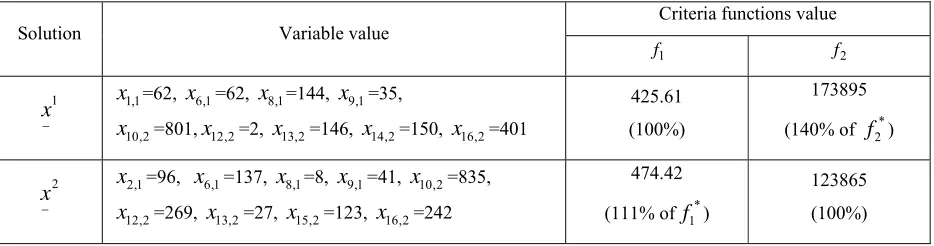
[image:4.612.73.540.337.460.2]The model from the previous chapter was first solved by using the linear integer programming, minimizing each of the two criteria functions on the given set ofconstraints. The following solutions are obtained:
Table 4. Optimal and marginal solutions of criteria functions
Criteria functions value
Solution Variable value
1
f f2
1
x
−
1,1
x
=62,x
6,1=62,x
8,1=144,x
9,1=35,10,2
x
=801,x
12,2=2,x
13,2=146,x
14,2=150,x
16,2=401425.61 (100%)
173895
(140% of
f
2*)2
x
−
2,1
x
=96,x
6,1=137,x
8,1=8,x
9,1=41,x
10,2=835,12,2
x
=269,x
13,2=27,x
15,2=123,x
16,2=242474.42
(111% of
f
1*)123865 (100%)
From the table 4 it can be noticed that by minimizing the function f1 the received minimal value for that function is considerably different from the value of that function when function f2 is minimized. The implication is the lack of
application of the linear integer programming in determining an optimal plan of fabric cutting, as well as the necessity of application of the multiple criteria integer
linear programming (MCILP) methods. Namely, if the
MCILP methods are not being used, the selection of the plan of fabric cutting is reduced to one of the marginal solutions. By solving the given model using the MCILP methods, the solution that would give more acceptable values to the criteria functions would be received.
A. Solving the Optimization Model of the Plan of Fabric Cutting by the Method of Satisfactory Goals
By application of the Method of Satisfactory Goals the following model is solved:
(min) fLS( )x −
s.t. (2) ( ) 0
i
g x
− ≤ , i=1,L,m
( ) q
j j
f x L
− ≤ , j=1,L,k; j≠LS
whereby fLS( )x
− is the criteria function with which the decision maker is the least satisfied, and q
j
L
(j=1,L,k),j≠LS are the values of remained criteria functions are determined by an analyst in step q ( q *
j j
L < f ).
In our example we defined:
1( ) LS( )
f x f x
− = − , and
2( ) 199930
f x
The following solution is obtained:
Table 5. Optimal solution
Criteria functions value Solution
Variable value
1
f f2
1 x
− 1,1
41
x = ;x6,1=1;x8,1=55;x9,1=34;x10,2=800;x11,2 =154;
12,2 154
x = ;x13,2=28;x14,2 =116;x15,2=135; x16,2 =265
444.47 (104 % of f1*)
199930 (126 % of f2*)
Since the decision makerwanted to decrease the value of function f2, we solved the following model:
(min) f x1( )−
s.t. (3)
x X
−∈
2( ) 169730
f x
− ≤
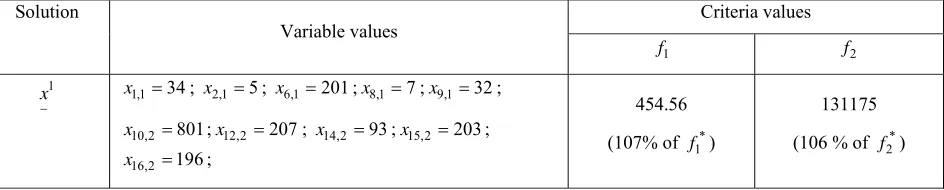
The following solution is obtained:
Table 6. Optimal (preferred) solution
Criteria values Solution
Variable values
1
f f2
1 x
− 1,1
34
x = ; x2,1=5; x6,1=201;x8,1=7;x9,1=32;
10,2 801
x = ;x12,2 =207; x14,2 =93;x15,2 =203;
16,2 196
x = ;
454.56
(107% of * 1 f )
131175
(106 % of * 2 f )
The decision maker accepted the presented solution, since from his point of view it provides acceptable values of criteria function.
V. CONCLUSION
On the basis of the previously outlined, we come to conclusion that the application of the method of integer MCP in solving problems of determining the optimal plan of fabric cutting represents a «necessity», which is a result of the fact that in a given problem there is a multiplicity of conflicting goals, thus the optimization of criteria function that suits one goal leads to insufficient actualization of another goal. This adversely affects actualization of total business results of a company.
Developed model of multiple criteria integer decision making creates an opportunity for optimization of business in industrial companies dealing with fabric cutting.
REFERENCES
[1] D. ABEL, Programmable Controllers, Instruments & Control System,
1974, p.49 – 54.
[2] C. BERG, Getting the most from your PC, 1978.
[3] B. BOJANIĆ i M. BOJANIĆ, „Generiranje varijanti krojenja materijala pomoću elektroničkog računala“, Praksa, Beograd, No. 9, 1979, str. 28-35.
[4] V. CHANKONG and Y. Y. HAIMES, Multiobjective Decision Making: Theory and Methodology, North Holland, New York, 1983. [5] D. L. HWANG and A. S. M. MASUD, Multiple Objective Decision Making: Methods and Applications, Springer – Verlag, New York, 1979.
[6] P. C. FISHBURN, „Lexicographic Orders, Utilities and Decision Rules: a Survey“, Management Science,Vol. 20, No. 11, 1974, pp.1442-1471.
[7] Panel Cutting Optimization Software - Plus 2D for Woodworking . Avaliable: http://www.nirvanatec.com/panel_optimization_wood.
[image:5.612.74.546.307.402.2]