A U T O M A T I C
S E M A N T I C CLASSIFICATION O F V E R B S F R O M T H E I R
SYNTACTIC CONTEXTS: AN IMPLEMENTED CLASSIFIER FOR STATIVITY
M i c h a e l R. B r e n t M I T AI L a b 545 T e c h n o l o g y S q u a r e C a m b r i d g e , M a s s a c h u s e t t s 02139
m i c h a e l @ a i . m i t . e d u
A b s t r a c t
This paper discusses an implemented program that automatically classifies verbs into those that ~ describe only states of the world, such as to know, and those that describe events, such as to
look. It works by exploiting the con, straint between the syntactic environ- ments in which a verb can occur and its meaning. The only input is on-line text. This demonstrates an important new technique for the automatic gener- ation of lexical databases.
1 I n t r o d u c t i o n
Young children and natural language process- ing programs face a common problem: everyone else knows a lot more about words. Children, it is hypothesized, catch up by observing the linguis- tic and non-linguistic contexts in which words are used. This paper focuses on the value and acces- sibility of the linguistic context. It argues t h a t linguistic context by itself can provide useful cues about verb meaning to an artificial learner. This is demonstrated by a program that exploits two par- ticular cues from the linguistic context to classify verbs automatically into those whose sole sense is one describing a state, and those that have a sense describing an event. 1 The approach described here accounts for a certain degree of noise in the input due both to mis-apprehension of input sentences and to their occasional real.formation. This work shows that the two cues are available and are re- liable given the statistical methods applied.
Language users, whether natural or artificial, need detailed semantic and syntactic classifica- tions of words. Ultimately, any artificial language IThe i n p u t s e n t e n c e s are t h o s e compiled in the Lan- caster/Oslo/Bergen (LOB) Corpus, a balanced corpus o f o n e million words of British English. The LOB con- sists primarily of edited prose.
user must be able to add new words to its lexicon, if only to accommodate the many neologisms i t will encounter. And our lexicographic needs grow with our understanding of language. A number of current approaches to satisfying the lexical re- quirements for artificial devices do not involve un- supervised learning from examples. Boguraev and Briscoe (1987)discusses interpreting the informa- tion published in on-line dictionaries, while Zernik a/~d Dyer (1987) discuss tutored learning in a con. trolled environment. But any method that re- quires explicit human intervention - - be it that of lexicographers, knowledge engineers, or "tutors" - - will lag behind both the growth of vocabu- lary and the growth of linguistics, and even with the lag their maintenance will be expensive. By contrast, dictionaries constructed by automated learners from real sentences will not lag behind vocabulary growth; examples of current language use are free and nearly infinite. These observa- tions have led ~everal researchers, including Hindle (1990) and Smadja and McKeown (1990), to begin investigating automatic acquisition of semantics. Hindle and Smadja and McKeown rely purely on the ability of one particular word to statistically predict the occurrence of another in a particular position. In contrast, the approach described here is targeted at particular semantic classes that are revealed by specific linguistic constructions. 2 T h e Q u e s t i o n s
This section discusses work on two linguis- tic cues that reveal the availability of non-stative senses for verbs. This work attempts to determine the difficulty of using the cues to classify verbs: into those describing states and those describing events. To that end, it focuses on two questions:
J
more useful the technique will be.)
2. Assuming minimal syntactic power, how re- liable are our two cues in real t e x t , which is subject to performance limitations? Are there learning strategies under which their re- liability is adequate?
Section 2.1 describes syntactic constructions stud- ied and demonstrates their relation to the stative semantic class. Sections 2.2 answers questions 1 in the affirmative. Section 2.4 answers question 2 in the affirmative, discusses the statistical m e t h o d used for noise reduction, and demonstrates the program t h a t learns the state-event distinction. 2.1 l ' t e v e a H n g C o n s t r u c t i o n s
T h e differences between verbs describing states (statives) and those describing events (non- statives) has been studied by linguists at least since Lakoff (1965). (For a more precise seman- tic characterization of stativ¢s see Dowty, 1979.) Classic examples of stative verbs are know,
believe,
desire, and love. A number of syntactic tests have been proposed to distinguish between statives and non-statives (again see Dowry, 1979). For exam- ple, stative verbs are anomalous when used in the progressive aspect and when 'modified by rate ad- verbs such as quickly and slowly:(1) a. * Jon is knowing calculus b. * Jon knows calculus quickly Perception verbs like see a n d hear share with st~- rives a strong resistance to the progressive aspect, but not to rate adverbs:
(2) a. * Jon is seeing the car b. OK Jon quickly saw the car
Agentive verbs describing a t t e m p t s to gain per- ceptions, like look and listen, do not share either property:
(3) a. OK Jon is looking at a car
b. OK Jon quickly looked at his watch T h e classification program relies primarily on the progressive cue, but uses evidence from the rate adverb cue when it is available.
2.2 S y n t a c t i c R e q u i r e m e n t s f o r C u e D e t e c t i o n
Consider first how much syntactic analysis is needed to detect the progressive and rate adverb constructions. Initially, suppose t h a t the availabil- ity of a non-stative sense is aii intrinsic property of a verb not affected by its syntactic context. 2 To detect progressives one need only parse a trivial part of the auxiliary system, which is known to 2This is not true in general, as shown by the f&ct that think that.., is stative while think about.., is not.
be finite-state. Detecting the rate aclverb cue re- quires determining what the adverb modifies, and that can be trickier. For example, adverbs may appear after the direct object, (4a), and this must not be confused with the case where they appear after the subject of an embedded clause, (4b).
(4) a. ,Ion fixed the robot quickly
b. ,Ion knew his hostess rapidly lost inter- eat in such things
Using simple, finite-state machinery one would be forced to deal with (4b) by recognizing the po- sition of the adverb as ambiguous and rejecting the example. Or one could deploy more sophist i - cated s y n t a x to try determining the boundaries of embedded sentences. But even the best syntactic parser will fail on truly ambiguous cases like the following:
(5) a. Jon fixed the robot t h a t had spoken slowly
b. Jon believed the robot that had spoken slowly
T h e d a t a on rate adverbs were collected using the parsing approach, which required a substantial a m o u n t of machinery, b u t a finite-state approach might do almost as well. (See Brent and Berwick, 1991, for automatic iexical acquisition using sim- ple finite-state parsing.)
2.3 D a t a o n C u e s f r o m t h e C o r p u s
( p r l n t - h l s t o g r e n h$?S : w a x - i n d e x 200 : s c a l e tOO0) NIL
I
I
I
I
I
I
i
I
I
I
I
I
I
I
[
I-[T -I I
O.O 0 . 0 | 0 . 0 2 III.OS 0 . 8 4 O.IIS 0°06 O.OT (I.O0 II.O* 0 . 1 I I . | | 0 . 1 2 | . 1 3 0 . 1 4 O. IS 0. l £ II.I]P I I . l O 0 . 1 9 0 . 2
I
~ic L/so Liatener f
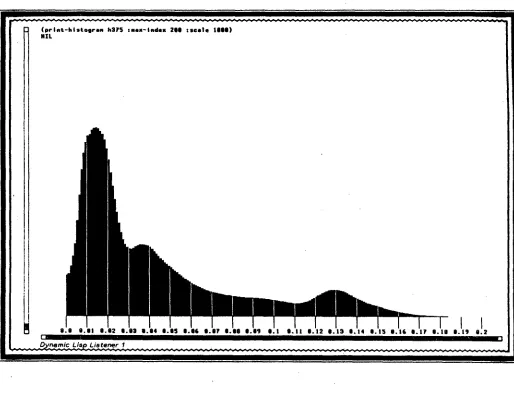
Figure 1: A h i s t o g r a m c o n s t r u c t e d b y s m n m i n g t h e p r o b a b i l i t y d i s t r i b u t i o n s o f t r u e f r e q u e n c y in t h e p r o g r e s s i v e o v e r e a c h o f t h e 38 m o s t c o m m o n v e r b s i n t h e c o r p u s
stative verbs fall in the first population, to the left of the slight discontinuity at 1.35% of occurrence in the progressive.
2,4 T h e C l a s s i f i c a t i o n P r o g r a m
1 implemented a program t h a t a t t e m p t s to classify verbs into those with event senses, and those whose only meaning describes a state rather than an event. It does this by first detecting oc- currences of the progressive and rate adverb con- structions in the LOB corpus, and then computing confidence intervals on the true frequency of occur- rence of each verb in an arbitrarily large corpus of the same composition. T h e p r o g r a m classifies
the verbs according to bounds, which are for the m o m e n t supplied by the researcher, on the confi- dence intervals. For example, on the run shown in Figure 2, the program classifies verbs which oc- cur at least .1% of the time either in the progres- sive or modified by a rate adverb, as having an event (non-stative) sense. T h e classifier acts on
.1% bound only if the sample-size is large enough to guarantee the bound with 95% confidence. Ac- curacy in ascribing non-stative senses according with this technique is excellent - - no purely sta. t i r e verbs are ntis-classified as having non-stative senses. In fact, t h i s result is not very sensitive to raising the m i n i m u m progressive frequency from .1% to as high as .6% or .7%, since most verbs with non-stative senses yield observed frequencies of at least two or three percent.
[image:3.596.52.566.64.460.2]( © l a s s i r y - s t a t l v e - n o n - s t a t l v e : n a x - p r o o r - f o r - s t a t l v e .OlOS ~ n l n - r l t e - f o r - n o n - s t a t l v e .OOI
: n l n - p r o o r - f o r - n o n - s t a t l v e . 0 0 | ) LRCKS-NRN-STRTIVE-SERSE:
KHOU SEER LIKE RELIEVE URHT OERRIN HERR HERR REOUIRE UNDEGSTRHO RCGEE HRS-UOH-STRTIVE-SEHSE:
UEflR URZT 00 T R L K SROU SO £ T R Y TRY VISIT LISTEN LIE SIT PREPRRE FRIL SEEK HONOEG F I G H T UORK STOOY B(GZH ORIVE URTCH OERL OCT EHJOY SETTLE SflILE PLRY OZE LIVE HUH HOVE 8TRRO HOPPER HOLK CRERTE PROVE
CRUSE OR(OK DROP LOOK CRRRY FRCE RTTEND EXPECT F R L L (HO OEVELOP OFFER ERT URIT[ OEO0 CLOSE RECOil( P OIHT OORU RETURN RISE BUILD CHRHCE DIN COnE LERRN PUBLISH PICK RSSOCIRTE GET PRODUCE REPLY PRY LERO ZRTRODUC[ COflPLETE REFUGE SRV( NOTICE P U L L OVOID RECEIVE SERVE PDES£RT STOP OPEN ENTER SET SPEHO ~IGH
FORGET HOTE RGSURE PLRCE IHCRERSE OCCUR COHPRRE COHSIOER SUGGEST COVER DISCOVER S E L L THINK OEGOGO RFF~ CT KEEP HOLO FOLLOU PUT HEET RCCEPT 8EHO HELP REVERL BOISG ORIGE OPPERR PGOVIO[ TONE GEH£HOEO SPEEK FINISH TURN DSK RERCH LET T E L L R R K [ F E L L RHSUER FIND LERV[ RCHIEVE F E E L CRLL 6HON USE (XPLRIN GIVE OGTRIN OECIOE DRY SEE
IHOETEGHIRATE:
THROU REFER BRSE CHOOSE CRrCH ORRIVE KRRRGE SUPPORT EXIST BELONG OHISE BERD REEO CUT IHTEHO IRRCIUE C LRIH FQRfl BUY HE STRTE gILL RPPLY REISQVE RERLISE HOPE RRINTRIN JOIN HEHTIGN FILL OOnI! OEPEHO REPORT
OLLOU flROOY ESTRRLISR IHOICRTE LRY LOOSE SPERK SUPPOSE REDUCE REPRESENT LOVE ZHUOLUE COHTRIH OO0 STORY 8R IHCLUOE COHCERH COHTIHU[ OE$CRIBE
HIL
Oynarnic Lisp Listener f
Figure 2: O n e r u n o f t h e s t a t i v e / n o n - s t a t i v e c l a s s i f i c a t i o n p r o g r a m o n v e r b s o c c u r r i n g a t l e a s t 100 t i m e s in t h e L O B c o r p u s
tives are also quite good, although more sensitive to the precise bounds than were the results for identifying non-statives. If the u p p e r bound on progressive frequency is set at 1.35%, as in Fig- ure 2, then eleven verbs are identified as purely stative, of the 204 distinct verbs occurring at least 100 times each in the corpus. T w o of these, hear and agree, have relatively rare non-stative senses, meaning to imagine one hears ("I am hearing a ringing in my ears") and to communicate agree- ment ("Rachel was already agreeing when Jon in- t e r r u p t e d her with yet another tirade"). If the up- per bound on progressive frequency is tightened to 1.20% then hear and agree drop into the "indeter- minate" category of verbs that pass neither test. So, too, do three pure statives, mean, require, and understand.
It is worth noting the importance of using some sort of noise reduction technique, such as the confidence intervals used here. T h e r e are two sources of noise in the linguistic input. First
speakers do u t t e r anomalous sentences. For ex. ample, the stative verb mean occurred one time out of 450 in the progressive. T h e sentence, "It's a stroke, t h a t was what he was meaning" is clearly anomalous. T h e second source of noise is failure of the learner to detect the cue accurately. T h e accuracy of our automatic cue detection detection is described in the following section.
2.5 A c c u r a c y o f C u e D e t e c t i o n
Section 2.2 discussed how much structure must be imposed on sentences if the progressive and rate-adverb constructions are to be detected. Sec- tion 2.3 showed t h a t the progressive and rate- adverb constructions are indeed reliable cues for the availability of a non-stative sense. This sec- tion discusses tile accuracy with which these cues can be detected.
[image:4.596.36.549.63.416.2]selected at random from among the most com- monly occurring verbs. This check revealed only one sentence that did not truly describe a progres- sive event. That sentence is shown in (6a).
(6) a. go: What that means in this case is go. ing back to the war years...
b. see: The task was solely to see h o w s p e e d i l y it could be m e t . . .
c. compare: ...the purchasing power of the
underdeveloped countries in the com- monwealth will rise s l o w l y c o m p a r e d with that of Europe.
It is not clear how to automatically determine that (6a) does not describe an event of going in progress. Rate adverbs are infrequent enough that it was possible to verify manually all 281 cases the program found. In four of those cases the rate ad- verb actually modified a verb other than the one that the program chose. Three of these four cases had the structure of (6b), where a wh- relative is not recognized as signaling the beginning of a new clause. This reflects an oversight in the gram- mar that should be easily correctable. The one re- maining case of a mis-attributed rate adverb, (6c), would again require some work, and perhaps sub- stantial syntactic knowledge, to correct. The rate of false positives in cue detection, then can be esti- mated at about one serious hazard in 300 for both "t'~sts.
3 C o n c l u s i o n s
This work demonstrates a promising ap- proach to automatic semantic classification of verbs based only on their immediate linguistic con- texts. Some sort of statistical smoothing is essen- tial to avoid being permanently mislead by anoma- lous and misunderstood utterances, and this work demonstrated the sufficiency of an-approach based on binomial confidence-intervals. These meth- ods, in combination with pure collocational meth- ods like those of [Hindle, 1990] and [Smadja and McKeown, 1990], may eventually yield substan- tial progress toward automatic acquisition of word meaning, or some aspects thereof, by language us- ing devices.
The initial results described here suggest many more experiments, some of which are al- ready u~nderway (see Brent and Berwick, 1991). These include attempting to take into account the ability of local syntactic context to influence a verb's meaning as well as to reveal it. For exam- ple, think that is stative while think about and think
of are not. Separating these two senses automati- cally could add substantial power to our classifier. Next, there are many more linguistic cues to verb meaning to be detected and exploited. For exam- ple, the ability to take both adirect object and a
propositional complement, as in "tell him that he's a fool", reveal verbs of communication. While the progressive cue is not available in Romance lan- guages, the ability to take a direct object and a propositional complement seems to be diagnostic of communication verbs in Romance as well as in English. It would be valuable to demonstrate cues like this on non-English text. It would also be valuable to apply these techniques to a greater va- riety of input sentences, including transcriptions of mother's speech to their children. Finally, sub- stantially larger corpora should be used in order to enlarge the number of verbs classified. All of these planned extensions serve the goal of auto- matically classifying thousands of verbs by dozens of different syntactic criteria, and thereby yielding a valuable, adaptable lexicon for natural language processing and artificial intelligence.
R e f e r e n c e s
[Boguraev and Briscoe, 1987] B. Boguraev and T. Briscoe. Large Lexicons for Natural Lan- guage Processing: Utilising the Grammar Cod- ing System of LDOCE. Comp. Ling., 13(3), 1987.
[Brent and Berwick, 1991] M. Brent and R. Berwick. Automatic Acquisition of Subcate- gorization Frames From Free Text Corpora. In
Proceedings of the 4th Darpa Speech and Natu-
ral Language Workshop. Defense Advanced Re-
search Projects Agency, Arlington, VA, USA, 1991.
[Dowty, 1979] D. Dowty. Word Meaning and
Montague Grammar. Synthese Language Li-
brary. D. Reidel, Boston, 1979.
[Hindle, 1990] D. Hindle. Noun cla-qsification from predicate argument structures. In Proceedings
of the ~Sth Annual Meeting of the ACL, pages
268-275. ACL, 1990.
[Lakoff, 1965] G. Lakoff. On the Nature of Syntac.
tic Irregularity. PhD thesis, Indiana University,
1965. Published by Holt, Rinhard, and Winston
as Irregularity in Syntax, 1970.
[Smadja and McKeown, 1990]
F. Smadja and K. McKeown. Automatically extracting and representing collocations for lan- guage generation. In ~8th Annual Meeting of
the Association for Comp. Ling., pages 252-259.
ACL, 1990.
[Zernik and DYer, 1987] U. Zernik and M. Dyer. The self-extending phrasal lexicon. Comp.