Unsupervised Pretraining for Sequence to Sequence Learning
Prajit Ramachandran and Peter J. Liu and Quoc V. Le
Google Brain
{prajit, peterjliu, qvl}@google.com
Abstract
This work presents a general unsuper-vised learning method to improve the ac-curacy of sequence to sequence (seq2seq) models. In our method, the weights of the encoder and decoder of a seq2seq model are initialized with the pretrained weights of two language models and then fine-tuned with labeled data. We ap-ply this method to challenging bench-marks in machine translation and abstrac-tive summarization and find that it sig-nificantly improves the subsequent super-vised models. Our main result is that pretraining improves the generalization of seq2seq models. We achieve state-of-the-art results on the WMT English→German task, surpassing a range of methods us-ing both phrase-based machine transla-tion and neural machine translatransla-tion. Our method achieves a significant improve-ment of 1.3 BLEU from the previous best models on both WMT’14 and WMT’15 English→German. We also conduct hu-man evaluations on abstractive summa-rization and find that our method outper-forms a purely supervised learning base-line in a statistically significant manner. 1 Introduction
Sequence to sequence (seq2seq) models (Sutskever et al., 2014; Cho et al., 2014; Kalchbrenner and Blunsom, 2013; Allen, 1987; ˜Neco and Forcada,1997) are extremely effective on a variety of tasks that require a mapping between a variable-length input sequence to a variable-length output sequence. The main weakness of sequence to sequence models, and deep networks in general, lies in the fact that they
can easily overfit when the amount of supervised training data is small.
In this work, we propose a simple and effec-tive technique for using unsupervised pretraining to improve seq2seq models. Our proposal is to initialize both encoder and decoder networks with pretrained weights of two language models. These pretrained weights are then fine-tuned with the la-beled corpus. During the fine-tuning phase, we jointly train the seq2seq objective with the lan-guage modeling objectives to prevent overfitting.
We benchmark this method on machine trans-lation for English→German and abstractive sum-marization on CNN and Daily Mail articles. Our main result is that a seq2seq model, with pre-training, exceeds the strongest possible baseline in both neural machine translation and phrase-based machine translation. Our model obtains an improvement of 1.3 BLEU from the previ-ous best models on both WMT’14 and WMT’15 English→German. On human evaluations for ab-stractive summarization, we find that our model outperforms a purely supervised baseline, both in terms of correctness and in avoiding unwanted repetition.
We also perform ablation studies to understand the behaviors of the pretraining method. Our study confirms that among many other possible choices of using a language model in seq2seq with atten-tion, the above proposal works best. Our study also shows that, for translation, the main gains come from the improved generalization due to the pretrained features. For summarization, pretrain-ing the encoder gives large improvements, sug-gesting that the gains come from the improved op-timization of the encoder that has been unrolled for hundreds of timesteps. On both tasks, our pro-posed method always improves generalization on the test sets.
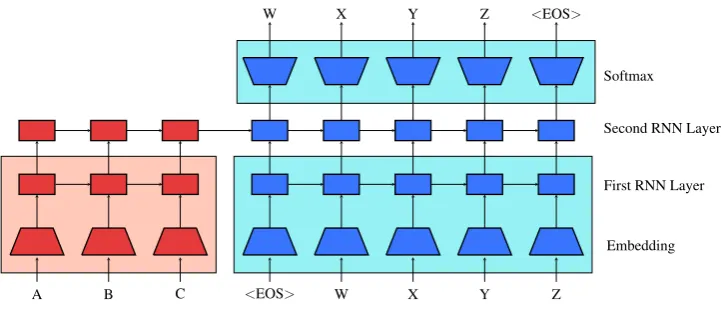
A B C <EOS> W X Y Z W X Y Z <EOS>
Embedding First RNN Layer Softmax
[image:2.595.118.479.63.218.2]Second RNN Layer
Figure 1: Pretrained sequence to sequence model. The red parameters are the encoder and the blue parameters are the decoder. All parameters in a shaded box are pretrained, either from the source side (light red) or target side (light blue) language model. Otherwise, they are randomly initialized.
2 Methods
In the following section, we will describe our basic unsupervised pretraining procedure for sequence to sequence learning and how to modify sequence to sequence learning to effectively make use of the pretrained weights. We then show several exten-sions to improve the basic model.
2.1 Basic Procedure
Given an input sequence x1, x2, ..., xm and an
output sequence yn, yn−1, ..., y1, the objective of sequence to sequence learning is to maximize the likelihood p(yn, yn−1, ..., y1|x1, x2, ..., xm).
Common sequence to sequence learn-ing methods decompose this objective as p(yn, yn−1, ..., y1|x1, x2, ..., xm) =
Qn
t=1p(yt|yt−1, ..., y1;x1, x2, ..., xm).
In sequence to sequence learning, an RNN en-coder is used to represent x1, ..., xm as a hidden
vector, which is given to an RNN decoder to pro-duce the output sequence. Our method is based on the observation that without the encoder, the decoder essentially acts like a language model on
y’s. Similarly, the encoder with an additional out-put layer also acts like a language model. Thus it is natural to use trained languages models to ini-tialize the encoder and decoder.
Therefore, the basic procedure of our approach is to pretrain both the seq2seq encoder and de-coder networks with language models, which can be trained on large amounts of unlabeled text data. This can be seen in Figure 1, where the parame-ters in the shaded boxes are pretrained. In the fol-lowing we will describe the method in detail using
machine translation as an example application. First, two monolingual datasets are collected, one for the source side language, and one for the target side language. A language model (LM) is trained on each dataset independently, giving an LM trained on the source side corpus and an LM trained on the target side corpus.
After two language models are trained, a multi-layer seq2seq modelM is constructed. The em-bedding and first LSTM layers of the encoder and decoder are initialized with the pretrained weights. To be even more efficient, the softmax of the de-coder is initialized with the softmax of the pre-trained target side LM.
2.2 Monolingual language modeling losses
After the seq2seq modelM is initialized with the two LMs, it is fine-tuned with a labeled dataset. However, this procedure may lead tocatastrophic forgetting, where the model’s performance on the language modeling tasks falls dramatically after fine-tuning (Goodfellow et al., 2013). This may hamper the model’s ability to generalize, espe-cially when trained on small labeled datasets.
To ensure that the model does not overfit the la-beled data, we regularize the parameters that were pretrained by continuing to train with the monolin-gual language modeling losses. The seq2seq and language modeling losses are weighted equally.
2.3 Other improvements to the model
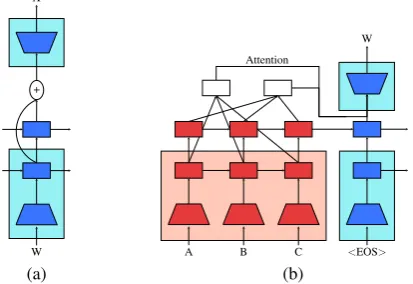
Pretraining and the monolingual language model-ing losses provide the vast majority of improve-ments to the model. However in early experimen-tation, we found minor but consistent improve-ments with two additional techniques: a) residual connections and b) multi-layer attention (see Fig-ure2).
W X
+
(a)
A B C <EOS>
W Attention
[image:3.595.74.281.190.332.2](b)
Figure 2: Two small improvements to the baseline model: (a) residual connection, and (b) multi-layer attention.
Residual connections: As described, the input vector to the decoder softmax layer is a random vector because the high level (non-first) layers of the LSTM are randomly initialized. This intro-duces random gradients to the pretrained param-eters. To avoid this, we use a residual connection from the output of the first LSTM layer directly to the input of the softmax (see Figure2-a).
Multi-layer attention: In all our models, we use an attention mechanism (Bahdanau et al., 2015), where the model attends over both top and first layer (see Figure 2-b). More concretely, given a query vector qt from the decoder, encoder states
from the first layerh1
1, . . . , h1T, and encoder states
from the last layerhL
1, . . . , hLT, we compute the
at-tention context vectorctas follows:
αi= exp(qt·h N i )
PT
j=1exp(qt·hNj )
c1t =XT
i=1
αih1i
cN t =
T
X
i=1
αihNi ct= [c1t;cNt ]
3 Experiments
In the following section, we apply our approach to two important tasks in seq2seq learning:
ma-chine translation and abstractive summarization. On each task, we compare against the previous best systems. We also perform ablation experi-ments to understand the behavior of each compo-nent of our method.
3.1 Machine Translation
Dataset and Evaluation: For machine trans-lation, we evaluate our method on the WMT English→German task (Bojar et al., 2015). We used the WMT 14 training dataset, which is slightly smaller than the WMT 15 dataset. Be-cause the dataset has some noisy examples, we used a language detection system to filter the training examples. Sentences pairs where ei-ther the source was not English or the target was not German were thrown away. This re-sulted in around 4 million training examples. Following Sennrich et al. (2015a), we use sub-word units (Sennrich et al., 2015b) with 89500 merge operations, giving a vocabulary size around 90000. The validation set is the concatenated new-stest2012 and newstest2013, and our test sets are newstest2014 and newstest2015. Evaluation on the validation set was with case-sensitive BLEU (Papineni et al., 2002) on tokenized text using multi-bleu.perl. Evaluation on the test sets was with case-sensitive BLEU on detokenized text usingmteval-v13a.pl. The monolingual training datasets are the News Crawl English and German corpora, each of which has more than a billion tokens.
con-BLEU
System ensemble? newstest2014 newstest2015
Phrase Based MT (Williams et al.,2016) - 21.9 23.7
Supervised NMT (Jean et al.,2015) single - 22.4
Edit Distance Transducer NMT (Stahlberg et al.,2016) single 21.7 24.1 Edit Distance Transducer NMT (Stahlberg et al.,2016) ensemble 8 22.9 25.7 Backtranslation (Sennrich et al.,2015a) single 22.7 25.7 Backtranslation (Sennrich et al.,2015a) ensemble 4 23.8 26.5 Backtranslation (Sennrich et al.,2015a) ensemble 12 24.7 27.6
No pretraining single 21.3 24.3
Pretrained seq2seq single 24.0 27.0
[image:4.595.102.492.64.184.2]Pretrained seq2seq ensemble 5 24.7 28.1
Table 1: English→German performance on WMT test sets. Our pretrained model outperforms all other models. Note that the model without pretraining uses the LM objective.
2.0 1.5 1.0 0.5 0.0
Difference in BLEU
2.1
Pretrain on parallel corpus
2.0
No pretraining
2.0
Only pretrain embeddings
2.0
No LM objective
1.6
Only pretrain encoder
1.6
Only pretrain embeddings & LSTM
1.0
Only pretrain decoder
0.3
Pretrain on Wikipedia
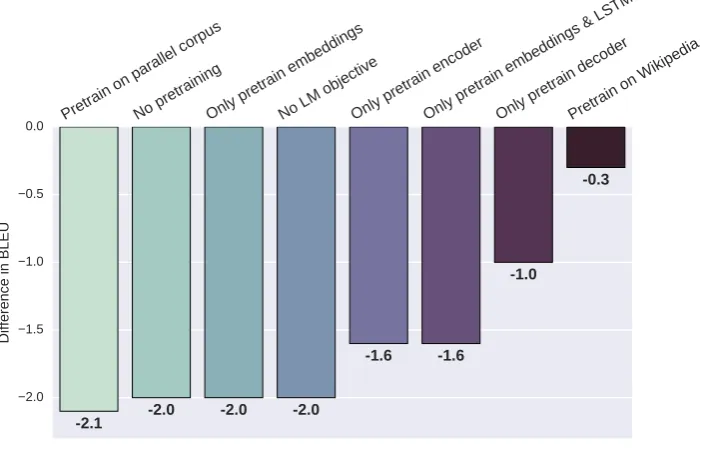
Figure 3: English→German ablation study measuring the difference in validation BLEU between various ablations and the full model. More negative is worse. The full model uses LMs trained with monolingual data to initialize the encoder and decoder, plus the language modeling objective.
structed with the 5 best performing models on the validation set, which are trained with different hy-perparameters.
Results: Table 1 shows the results of our method in comparison with other baselines. Our method achieves a new state-of-the-art for sin-gle model performance on both newstest2014 and newstest2015, significantly outperforming the competitive semi-supervisedbacktranslation tech-nique (Sennrich et al.,2015a). Equally impressive is the fact that our best single model outperforms the previous state of the art ensemble of 4 models. Our ensemble of 5 models matches or exceeds the
previous best ensemble of 12 models.
[image:4.595.132.486.244.472.2]follow-ing, we interpret the findings of the study. Note that some findings are specific to the translation task.
Given the results from the ablation study, we can make the following observations:
• Only pretraining the decoder is better than only pretraining the encoder: Only pretrain-ing the encoder leads to a 1.6 BLEU point drop while only pretraining the decoder leads to a 1.0 BLEU point drop.
• Pretrain as much as possible because the ben-efits compound: given the drops of no pre-training at all (−2.0) and only pretraining the encoder (−1.6), the additive estimate of the drop of only pretraining the decoder side is
−2.0−(−1.6) =−0.4; however the actual
drop is−1.0which is a much larger drop than the additive estimate.
• Pretraining the softmax is important: Pre-training only the embeddings and first LSTM layer gives a large drop of 1.6 BLEU points. • The language modeling objective is a strong
regularizer: The drop in BLEU points of pre-training the entire model and not using the LM objective is as bad as using the LM ob-jective without pretraining.
• Pretraining on a lot of unlabeled data is es-sential for learning to extract powerful fea-tures: If the model is initialized with LMs that are pretrained on the source part and target part of the parallel corpus, the drop in performance is as large as not pretrain-ing at all. However, performance remains strong when pretrained on the large, non-news Wikipedia corpus.
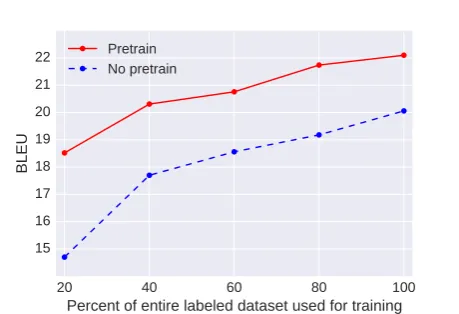
To understand the contributions of unsuper-vised pretraining vs. superunsuper-vised training, we track the performance of pretraining as a function of dataset size. For this, we trained a a model with and without pretraining on random subsets of the English→German corpus. Both models use the additional LM objective. The results are summa-rized in Figure 4. When a 100% of the labeled data is used, the gap between the pretrained and no pretrain model is 2.0 BLEU points. However, that gap grows when less data is available. When trained on 20% of the labeled data, the gap be-comes 3.8 BLEU points. This demonstrates that
the pretrained models degrade less as the labeled dataset becomes smaller.
20 40 60 80 100
Percent of entire labeled dataset used for training
15 16 17 18 19 20 21 22
BLEU
[image:5.595.308.538.102.259.2]Pretrain No pretrain
Figure 4: Validation performance of pretraining vs. no pretraining when trained on a subset of the entire labeled dataset for English→German trans-lation.
3.2 Abstractive Summarization
Dataset and Evaluation: For a low-resource abstractive summarization task, we use the CNN/Daily Mail corpus from (Hermann et al., 2015). FollowingNallapati et al.(2016), we mod-ify the data collection scripts to restore the bullet point summaries. The task is to predict the bullet point summaries from a news article. The dataset has fewer than 300K document-summary pairs. To compare against Nallapati et al. (2016), we used the anonymized corpus. However, for our abla-tion study, we used the non-anonymized corpus.1 We evaluate our system using full length ROUGE (Lin, 2004). For the anonymized corpus in par-ticular, we considered each highlight as a sepa-rate sentence followingNallapati et al.(2016). In this setting, we used the English Gigaword cor-pus (Napoles et al.,2012) as our larger, unlabeled “monolingual” corpus, although all data used in this task is in English.
Experimental settings: We use subword units (Sennrich et al., 2015b) with 31500 merges, re-sulting in a vocabulary size of about 32000. We use up to the first 600 tokens of the document and
1We encourage future researchers to use the
System ROUGE-1 ROUGE-2 ROUGE-L Seq2seq + pretrained embeddings (Nallapati et al.,2016) 32.49 11.84 29.47 + temporal attention (Nallapati et al.,2016) 35.46 13.30 32.65
[image:6.595.64.518.62.121.2]Pretrained seq2seq 32.56 11.89 29.44
Table 2: Results on the anonymized CNN/Daily Mail dataset.
5 4 3 2 1 0
Difference in ROUGE
No pretrainingOnly pretrain decoderNo LM objectiveOnly pretrain embeddingsOnly pretrain embeddings & LSTMOnly pretrain encoderPretrain on parallel corpus
ROUGE1 ROUGE2 ROUGEL
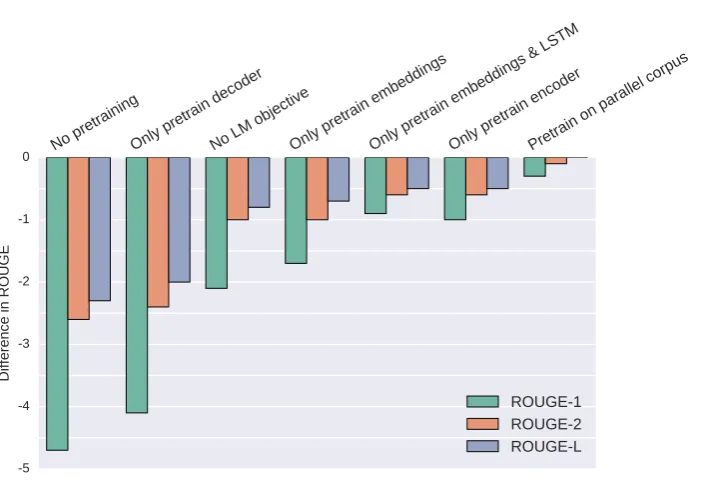
Figure 5: Summarization ablation study measuring the difference in validation ROUGE between various ablations and the full model. More negative is worse. The full model uses LMs trained with unlabeled data to initialize the encoder and decoder, plus the language modeling objective.
predict the entire summary. Only one language model is trained and it is used to initialize both the encoder and decoder, since the source and tar-get languages are the same. However, the encoder and decoder are not tied. The LM is a one-layer LSTM of size 1024 trained in a similar fashion to Jozefowicz et al.(2016). For the seq2seq model, we use the same settings as the machine transla-tion experiments. The only differences are that we use a 2 layer model with the second layer hav-ing 1024 hidden units, and that the learnhav-ing rate is multiplied by 0.8 every 30K steps after an initial 100K steps.
Results: Table2summarizes our results on the anonymized version of the corpus. Our pretrained model is only able to match the previous base-line seq2seq of Nallapati et al. (2016). Inter-estingly, they use pretrained word2vec (Mikolov et al., 2013) vectors to initialize their word
em-beddings. As we show in our ablation study, just pretraining the embeddings itself gives a large im-provement. Furthermore, our model is a unidirec-tional LSTM while they use a bidirecunidirec-tional LSTM. They also use a longer context of 800 tokens, whereas we used a context of 600 tokens due to GPU memory issues.
Ablation study: We performed an ablation study similar to the one performed on the ma-chine translation model. The results are re-ported in Figure5. Here we report the drops on ROUGE-1, ROUGE-2, and ROUGE-L on the non-anonymized validation set.
Given the results from our ablation study, we can make the following observations:
[image:6.595.139.492.149.396.2]sum-marization model. One interpretation is that pretraining enables the gradient to flow much further back in time than randomly initialized weights. This may also explain why pretrain-ing on the parallel corpus is no worse than pretraining on a larger monolingual corpus.
• The language modeling objective is a strong regularizer: A model without the LM objec-tive has a significant drop in ROUGE scores.
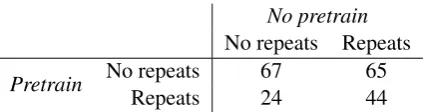
Human evaluation: As ROUGE may not be able to capture the quality of summarization, we also performed a small qualitative study to un-derstand the human impression of the summaries produced by different models. We took 200 ran-dom documents and compared the performance of a pretrained and non-pretrained system. The doc-ument, gold summary, and the two system out-puts were presented to a human evaluator who was asked to rate each system output on a scale of 1-5 with 5 being the best score. The system outputs were presented in random order and the evaluator did not know the identity of either output. The evaluator noted if there were repetitive phrases or sentences in either system outputs. Unwanted rep-etition was also noticed byNallapati et al.(2016). Table3and4show the results of the study. In both cases, the pretrained system outperforms the system without pretraining in a statistically signif-icant manner. The better optimization enabled by pretraining improves the generated summaries and decreases unwanted repetition in the output.
NP>P NP = P NP<P
29 88 83
Table 3: The count of how often the no pretrain system (NP) achieves a higher, equal, and lower score than the pretrained system (P) in the side-by-side study where the human evaluator gave each system a score from 1-5. The sign statistical test gives a p-value of<0.0001for rejecting the null hypothesis that there is no difference in the score obtained by either system.
4 Related Work
Unsupervised pretraining has been intensively studied in the past years, most notably is the work by Dahl et al.(2012) who found that pretraining with deep belief networks improved feedforward
[image:7.595.311.524.61.117.2]No pretrain No repeats Repeats Pretrain No repeatsRepeats 6724 6544
Table 4: The count of how often the pretrain and no pretrain systems contain repeated phrases or sentences in their outputs in the side-by-side study. McNemar’s test gives a p-value of< 0.0001for rejecting the null hypothesis that the two systems repeat the same proportion of times. The pre-trained system clearly repeats less than the system without pretraining.
acoustic models. More recent acoustic models have found pretraining unnecessary (Xiong et al., 2016;Zhang et al.,2016;Chan et al.,2015), prob-ably because the reconstruction objective of deep belief networks is too easy. In contrast, we find that pretraining language models by next step pre-diction significantly improves seq2seq on chal-lenging real world datasets.
Despite its appeal, unsupervised learning has not been widely used to improve supervised train-ing. Dai and Le(2015);Radford et al.(2017) are amongst the rare studies which showed the ben-efits of pretraining in a semi-supervised learning setting. Their methods are similar to ours except that they did not have a decoder network and thus could not apply to seq2seq learning. Similarly, Zhang and Zong(2016) found it useful to add an additional task of sentence reordering of source-side monolingual data for neural machine transla-tion. Various forms of transfer or multitask learn-ing with seq2seq framework also have the flavors of our algorithm (Zoph et al.,2016;Luong et al., 2015;Firat et al.,2016).
pretrained GloVe embedding vectors (Pennington et al.,2014) had more impact.
Related to our approach in principle is the work by Chen et al. (2016) who proposed a two-term, theoretically motivated unsupervised objective for unpaired input-output samples. Though they did not apply their method to seq2seq learning, their framework can be modified to do so. In that case, the first term pushes the output to be highly prob-able under some scoring model, and the second term ensures that the output depends on the input. In the seq2seq setting, we interpret the first term as a pretrained language model scoring the out-put sequence. In our work, we fold the pretrained language model into the decoder. We believe that using the pretrained language model only for scor-ing is less efficient that usscor-ing all the pretrained weights. Our use of labeled examples satisfies the second term. These connections provide a theoret-ical grounding for our work.
In our experiments, we benchmark our method on machine translation, where other unsupervised methods are shown to give promising results ( Sen-nrich et al.,2015a;Cheng et al.,2016). In back-translation (Sennrich et al., 2015a), the trained model is used to decode unlabeled data to yield extra labeled data. One can argue that this method may not have a natural analogue to other tasks such as summarization. We note that their tech-nique is complementary to ours, and may lead to additional gains in machine translation. The method of using autoencoders in Cheng et al. (2016) is promising, though it can be argued that autoencoding is an easy objective and language modeling may force the unsupervised models to learn better features.
5 Conclusion
We presented a novel unsupervised pretraining method to improve sequence to sequence learning. The method can aid in both generalization and op-timization. Our scheme involves pretraining two language models in the source and target domain, and initializing the embeddings, first LSTM lay-ers, and softmax of a sequence to sequence model with the weights of the language models. Using our method, we achieved state-of-the-art machine translation results on both WMT’14 and WMT’15 English to German. A key advantage of this tech-nique is that it is flexible and can be applied to a large variety of tasks.
References
Robert B. Allen. 1987. Several studies on natural lan-guage and back-propagation. IEEE First Interna-tional Conference on Neural Networks.
Dzmitry Bahdanau, Kyunghyun Cho, and Yoshua Ben-gio. 2015. Neural machine translation by jointly learning to align and translate. InICLR.
Ondˇrej Bojar, Rajen Chatterjee, Christian Federmann, Barry Haddow, Matthias Huck, Chris Hokamp, Philipp Koehn, Varvara Logacheva, Christof Monz, Matteo Negri, Matt Post, Carolina Scarton, Lucia Specia, and Marco Turchi. 2015. Findings of the 2015 workshop on statistical machine translation. InProceedings of the Tenth Workshop on Statistical Machine Translation.
William Chan, Navdeep Jaitly, Quoc V. Le, and Oriol Vinyals. 2015. Listen, attend and spell. arXiv preprint arXiv:1508.01211.
Jianshu Chen, Po-Sen Huang, Xiaodong He, Jianfeng Gao, and Li Deng. 2016. Unsupervised learning of predictors from unpaired input-output samples. abs/1606.04646.
Yong Cheng, Wei Xu, Zhongjun He, Wei He, Hua Wu, Maosong Sun, and Yang Liu. 2016. Semi-supervised learning for neural machine translation.
arXiv preprint arXiv:1606.04596.
Kyunghyun Cho, Bart Van Merri¨enboer, Caglar Gul-cehre, Dzmitry Bahdanau, Fethi Bougares, Holger Schwenk, and Yoshua Bengio. 2014. Learning phrase representations using RNN encoder-decoder for statistical machine translation. InEMNLP.
G. E. Dahl, D. Yu, L. Deng, and A. Acero. 2012. Context-dependent pre-trained deep neural networks for large-vocabulary speech recognition. IEEE Transactions on Audio, Speech, and Language Pro-cessing, 20(1):30–42.
Andrew M. Dai and Quoc V. Le. 2015. Semi-supervised sequence learning. InNIPS.
Orhan Firat, Baskaran Sankaran, Yaser Al-Onaizan, Fatos T. Yarman-Vural, and Kyunghyun Cho. 2016. Zero-resource translation with multi-lingual neural machine translation. arXiv preprint arXiv:1606.04164.
Ian J Goodfellow, Mehdi Mirza, Da Xiao, Aaron Courville, and Yoshua Bengio. 2013. An em-pirical investigation of catastrophic forgetting in gradient-based neural networks. arXiv preprint arXiv:1312.6211.
Karl Moritz Hermann, Tomas Kocisky, Edward Grefenstette, Lasse Espeholt, Will Kay, Mustafa Su-leyman, and Phil Blunsom. 2015. Teaching ma-chines to read and comprehend. InNIPS.
S´ebastien Jean, Orhan Firat, Kyunghyun Cho, Roland Memisevic, and Yoshua Bengio. 2015. Montreal neural machine translation systems for WMT’15. In
Proceedings of the Tenth Workshop on Statistical Machine Translation.
Rafal Jozefowicz, Oriol Vinyals, Mike Schuster, Noam Shazeer, and Yonghui Wu. 2016. Exploring the limits of language modeling. arXiv preprint arXiv:1602.02410.
Nal Kalchbrenner and Phil Blunsom. 2013. Recurrent continuous translation models. InEMNLP.
Diederik Kingma and Jimmy Ba. 2015. Adam: A method for stochastic optimization. InICLR. Chin-Yew Lin. 2004. ROUGE: a package for
auto-matic evaluation of summaries. InProceedings of the Workshop on Text Summarization Branches Out (WAS 2004).
Minh-Thang Luong, Quoc V. Le, Ilya Sutskever, Oriol Vinyals, and Lukasz Kaiser. 2015. Multi-task se-quence to sese-quence learning. InICLR.
Tomas Mikolov, Ilya Sutskever, Kai Chen, Greg S. Cor-rado, and Jeff Dean. 2013. Distributed representa-tions of words and phrases and their compositional-ity. InNIPS.
Ramesh Nallapati, Bing Xiang, and Bowen Zhou. 2016. Sequence-to-sequence RNNs for text summa-rization. arXiv preprint arXiv:1602.06023.
Courtney Napoles, Matthew Gormley, and Benjamin Van Durme. 2012. Annotated gigaword. In Pro-ceedings of the Joint Workshop on Automatic Knowl-edge Base Construction and Web-scale KnowlKnowl-edge Extraction. ACL.
Kishore Papineni, Salim Roukos, Todd Ward, and Wei-Jing Zhu. 2002. BLEU: A method for automatic evaluation of machine translation. InACL.
Razvan Pascanu, Tomas Mikolov, and Yoshua Bengio. 2013. On the difficulty of training recurrent neural networks. ICML.
Jeffrey Pennington, Richard Socher, and Christo-pher D. Manning. 2014. Glove: Global vectors for word representation. InEMNLP.
Alec Radford, Rafal Jozefowicz, and Ilya Sutskever. 2017. Learning to generate reviews and discovering sentiment. arXiv preprint arXiv:1704.01444. Hasim Sak, Andrew W. Senior, and Franc¸oise
Bea-ufays. 2014. Long short-term memory recurrent neural network architectures for large scale acoustic modeling. InINTERSPEECH.
Rico Sennrich, Barry Haddow, and Alexandra Birch. 2015a. Improving neural machine translation models with monolingual data. arXiv preprint arXiv:1511.06709.
Rico Sennrich, Barry Haddow, and Alexandra Birch. 2015b. Neural machine translation of rare words with subword units. arXiv preprint arXiv:1508.07909.
Felix Stahlberg, Eva Hasler, and Bill Byrne. 2016.
The edit distance transducer in action: The univer-sity of cambridge english-german system at wmt16. InProceedings of the First Conference on Machine Translation, pages 377–384, Berlin, Germany. As-sociation for Computational Linguistics.
Ilya Sutskever, Oriol Vinyals, and Quoc V. Le. 2014. Sequence to sequence learning with neural net-works. InNIPS.
Subhashini Venugopalan, Lisa Anne Hendricks, Ray-mond Mooney, and Kate Saenko. 2016. Improv-ing LSTM-based video description with lImprov-inguis- linguis-tic knowledge mined from text. arXiv preprint arXiv:1604.01729.
Philip Williams, Rico Sennrich, Maria Nadejde, Matthias Huck, Barry Haddow, and Ondˇrej Bojar. 2016. Edinburgh’s statistical machine translation systems for wmt16. In Proceedings of the First Conference on Machine Translation, pages 399– 410, Berlin, Germany. Association for Computa-tional Linguistics.
Wayne Xiong, Jasha Droppo, Xuedong Huang, Frank Seide, Mike Seltzer, Andreas Stolcke, Dong Yu, and Geoffrey Zweig. 2016. Achieving human parity in conversational speech recognition. abs/1610.05256. Wojciech Zaremba, Ilya Sutskever, and Oriol Vinyals. 2014. Recurrent neural network regularization.
arXiv preprint arXiv:1409.2329.
Jiajun Zhang and Chengqing Zong. 2016. Exploit-ing source-side monolExploit-ingual data in neural machine translation. InEMNLP.
Yu Zhang, William Chan, and Navdeep Jaitly. 2016. Very deep convolutional networks for end-to-end speech recognition. abs/1610.03022.
Barret Zoph, Deniz Yuret, Jonathan May, and Kevin Knight. 2016. Transfer learning for low-resource neural machine translation. InEMNLP.
Ramon P. ˜Neco and Mikel L. Forcada. 1997. Asyn-chronous translations with recurrent neural nets.