Irish Mobilities
Revised chapter submitted to
The Sociology of a Changing Ireland James Wickham
25 September, 2006
Please cite the published version:
Introduction
Like many people in the world today, Irish people spend a lot of time moving from place to place. The different sites where people live their lives are increasingly
separated by physical distance and linked by means of transport. For most people home and work are joined by the daily commute, but for an increasing number the
home is joined to a second holiday home by cheap air travel. ‘Ireland’ itself becomes less obviously the unit of people’s lives, when many people who are employed on the island consider their home to be Poland and travel frequently between the two.
Such phenomena fuel the ‘mobility turn’ in sociology which is outlined in the first part of the chapter. Sociological theorising is now coming to terms with the
importance of physical mobility. I suggest that the discussion of ‘fluidity’ opens up new empirical questions: how mobilities are created and also constrained and what usages actors make of their new opportunities. I then exemplify some of these issues
through four aspects of contemporary Irish mobilities: car usage in Dublin, migration to and from Ireland in particular by professional workers; the expansion of business
air travel; the growth of Irish-owned domestic property abroad.
The mobility turn
Until very recently sociology studied migration, but paid little attention to other forms
of physical travel. Although social commentary and social history have long studied tourism, it only entered sociology with Urry’s discussion of ‘the tourist gaze’ (Urry
Sociology’s increasing awareness of all forms of physical movement has followed its awareness of the importance of electronic communication or of what could be
called virtual travel. This has led to the ‘mobility turn’ in sociology. The most explicit representative is John Urry who has argued that sociology can no longer be the study of societies (2000). Whereas this appeared to call for a radical reformulation of the
entire discipline, his more recent call for a new ‘mobility paradigm’ (Sheller and Urry 2006) seems to set out a new area of research within sociology.
Even within Urry’s own writings, the mobility turn thus comes in a ‘strong’ and a ‘weak’ version. The weak version suggests that mobility is a valid general topic of research for sociology, just like gender, ethnicity, deviance or whatever. The study of
mobility involves not just the study of physical movement, but also the study of location: how particular activities are located in particular physical places to which or
from which people then have to move. This leads us to consider barriers to mobility (e.g. national boundaries) and also the technologies that enable people to move – the technologies of transport. From this perspective the commuter’s daily journey to work
and the movement of migrants from one country to another both form part of the study of mobility. This ‘weak’ version of the mobility turn highlights how mobility is
an important, and hitherto largely neglected, aspect of social life.
Alternatively, a strong version claims that that the very nature of social life has changed. Society is seen as involving ‘flows’ and has become ‘liquid’ (e.g. Bauman,
2005). Thus the strong version challenges the assumption – embedded in the title of this collection - that sociology studies ‘societies’, whereby a ‘society’ is a delimited
state. The equivalence of ‘society’ with the nation state was a defining characteristic of 20th century sociology – as in all those undergraduate courses in ‘Irish society’.
Intriguingly, there is some evidence that across Europe as a whole sociologists are more ‘national’ than some other social scientists: an ongoing study of the careers of Socrates students (Teichler 2006) notes that sociology graduates are particularly unlikely to use their experience of foreign study to develop careers outside their country of origin. One probable reason is that empirical sociology has long been
interwoven with social policy and hence with the specific institutions of each nation state. ‘Practical’ sociologists have needed to develop a national knowledge in a way that is now less true for those working in either conventional business or in the new
culture industries.
Social historians and political philosophers have long argued that nation states are
constructed, that whereas national ideologies always appeal to pre-existing nations, actually it was the national ideology and the institutions of the state that created – or at least constituted – the nation. The literature here is extensive and the titles
suggestive: from Peasants into Frenchmen (Weber 1979) to Britons (Colley 1992); as early as the late 19th century Renan remarked that nations are not eternal and that the
creation of the nation is a lesson in forgetting (Schnapper 2003). Furthermore, such studies also suggest that new forms of mobility were part of the creation of nation states. In Europe from the 19th century people became national citizens who could
national citizens within the national territory at the same time involved control by the state of the boundaries of the same national territory (Noiriel 2001).
Given this long intellectual tradition, it is not particularly novel to problematise the nation state analytically. The importance of the mobility theorists is rather their claim that the nation state no longer provides the main institutional framework for
people’s lives. The empirical sections of the chapter will show how many people are moving through the nation state of Ireland rather than simply living in Ireland, how people who work in Ireland spend time working outside of Ireland, and how many people whose home is in Ireland also have homes outside of Ireland. At the same time however, the policies that shape mobility are partly (though only partly) decided at
national level. The nation state has not disappeared, and so nor have national societies.
Studying mobility necessarily involves grappling with transport technologies. For 19th century social commentators it was self-evident that theirs was a society based on speed and the railway, epitomised by JMW Turner’s famous painting ‘Rain, Steam
and Speed – The Great Western Railway’ (1844). Equally, in the late 20th century information technology became seen as constituting contemporary ‘information
societies’ and sociologists such as Castells (1996) contributed to this view. By contrast, sociology has never really developed any extensive analysis of car transport technologies. Even more striking, while political journalists have noticed how cheap
air travel is changing Europeans’ self-understandings (Reid 2004), the sociology of air transport technology remains a complete blank. Here the mobility turn is drawing our
A focus on transport technology also brings into focus the material consequences of flows of mobility. Transport technologies, in particular the private car and the
airplane, have major environmental impacts. Understanding the form of mobility thus contributes to our understanding of how social actions impact on the environment.
The sociology of mobility has to deal with social structures. Just because people
move they do not enter a world without constraints. On the one hand different people have different resources, while on the other hand the available transportation
technologies facilitate some forms of movement and hamper others. As the empirical sections of this chapter will show, there are significant variations in the extent to which people are now ‘mobile’. While individuals’ mobility depends on the choices
they make, based on their personal values and ideologies, their opportunities for mobility are also shaped by political structures and public policies – not least transport
policies themselves.
The concept of mobility highlights certain aspects of contemporary life that are often not discussed within sociology; it also puts some issues in a new light. The
purpose of the rest of this chapter is not to construct a grandiloquent over-arching theory of ‘mobility’. Indeed, as Kaufman (2002) points out, one of the striking
features of sociological theories of mobility is that they seem to have no relationship to empirical research. Instead, this chapter works the other way round. It selects four aspects of mobility in contemporary Ireland. Each is seen as interesting in its own
Auto-mobility: the car system in Dublin
For most people in Ireland, the continued expansion of travel by car is the defining
feature of mobility over the last decades. Meanwhile the transport crisis in the capital city is now a major topic of public debate. This section of the chapter documents how the growing car dependency of Dublin is in part the result of socio-political choices. Dublin’s traffic jams thus are a long way away from the ‘liquid society’ of the mobility gurus. However, recent changes in mobility within Dublin do lend some support to the notion that greater physical mobility is part of a growing
individualisation of contemporary society.
The expanding car system
In Ireland as a whole car ownership has been rising faster than population, even
though Irish car ownership figures are still below the average for the EU15. Car usage has also been increasing. In 1981 45 per cent of all those at work reached travelled to work by private car; by 2002 this had reached 59 per cent. Equally, whereas in 1981
20 per cent of children travelled to school by private car, by 2002 this had reached fully 50 per cent (Wickham 2006: 67). All this has immediate physical consequences:
more space dedicated to cars, the growing physical impact on the environment through CO2 emissions (Chart 1). The expansion of car-based mobility in Ireland is thus a major component of the increasingly negative impact of Irish ‘society’ on the
Chart 1 Growth, Green House Gases and Energy Usage: Transport in Ireland 1990-2003 100.0 120.0 140.0 160.0 180.0 200.0 220.0 240.0 260.0
1990 1995 2000 2003
In d ex ( 1990= 100) Cars Population CO2 Energy GDP
CO2: emissions from road transport. Energy: final energy
consumption of transport sector
Source: CSO, Environment – Principal Statistics; ;CSO, National Income & Expenditure, 2004.
One response to this is that expanding car usage is somehow a ‘natural’ consequence of economic growth. However, even accepting conventional economic measures of economic growth, some societies are more successful than others at
‘uncoupling’ economic growth and (for example) energy usage or CO2 emissions. For example, Americans not only drive more than other people, they use more energy
than anybody else for every kilometre travelled (Olsthoorn 2003). In these terms Ireland really is closer to Boston (or Los Angeles) than Berlin: the country’s recent economic growth has been remarkable for the extent to which energy usage and CO2
emissions have simply risen in parallel with GDP..
If rising car usage was the inevitable result of economic growth, it would be
further issue is land-use planning. Some European cities such as Copenhagen or Helsinki have as low a population density as Dublin, but most development is
clustered around public transport nodes. Consequently, people can move relatively easily across much of the urban space by public transport. Such cities also invested continually in public transport in the second half of the 20th century, so ensuring that
they have relatively integrated public transport systems. By contrast, suburbanised Dublin has ineffective land-use planning and notoriously poor public transport. Thus
in 1990, before the ‘Celtic Tiger’ economic boom, Dublin already had one of the highest levels of travel to work by private car in Europe, but still had a low level of car ownership. Indeed, 1990 data from 15 European cities suggests that sometimes the
extent of driving to work and the extent of car ownership are negatively related. Thus in cities such as Helsinki or (especially) Bologna, car ownership was far higher than in Dublin, but people were significantly less likely to drive to work (Wickham 2006: 21).
Whereas public discussion often sees Dublin’s traffic problems as an unpleasant
by-product of recent economic success, the evidence shows that they are far more deep-rooted. From the 1950s onwards public transport in the city was destroyed,
ensuring that compared to many other European cities there was only a limited legacy system of tram and rail that could later be recycled and renovated. Equally unlike some other European cities there was little attempt in the 1970s to restrain car usage
in the city centre and, apart from the railway electrification programme that produced the DART in the 1980s, little investment in public transport. Accordingly, Dublin’s
by Yago (1984). And just as even a simple comparison between sprawling American cities and the less dispersed Canadian ones challenges some abstract geographical
determinism (Goldberg and Mercer 1992), comparisons within Europe show that Dublin’s precocious car usage highlights the role of socio-political choice.
Car usage and individualisation
Part of the attraction of the car as a form of mobility as long been its promise of freedom. The car-driver can travel where he or she wants to go, at a time of his or her
choice. More analytically, the expansion of car usage can be seen as a technology of greater individualisation, the process whereby individuals are more and more ‘freed’ from the constraints of specific institutions
The move from a situation where the car is owned by a household or family to one where the car is owned by the individual would parallel changes in other domestic
technologies, such as the shift from the family’s house phone to the individual’s mobile phone or even the move from the family to the individual television set.. The car can be used to connect spaces and activities. In a society in which activities have
become increasingly fragmented, occurring in different places and with their own distinct timetables, individuals can use the car, like the mobile phone, as a connecting
technology with which to manage and integrate disparate parts of their lives (Shove 1998)
A more political economy approach might refer to a shift from ‘fordist’ mobility
to post-fordist mobility, from mass consumption based on the domestic family unit to more individualised consumption. Thus previously car journeys were made (usually
work (‘nine to five’); work occurred in the city centre and home was located in the suburbs; recreation (which might also involve the car) was carried out by the family.
By contrast, post-fordist journeys are made by individuals across an urban space in which home and work are randomly located; both women and men work but their working hours vary so that travel times have become much more diverse.
We can assess the extent to which such changes have actually occurred by studying mobility within the Dublin city-region. The Greater Dublin Area (GDA)
comprises seven local authorities: Dublin City Council, here referred to as the city centre; South Dublin, Fingal, and Dun Laoghaire/Rathdown, the ‘inner suburbs’; Kildare, Meath and Wicklow, the ‘outer suburbs’. Mobility patterns within the GDA
can be explored using the micro-data from the 2002 census, which for the first time collected information from individuals about their place of residence, their place of
work and their travel to work1.
Census data clearly shows the rise of individual car ownership and individual car usage. According to the 2002 census, within the GDA 53 per cent of all households
have access to at least two cars; within ‘couple’ households (with or without children) the proportion rises to 62 per cent. Here as in so many other areas, liberal society
undermines gender differences, so that gendered access to private transport has become an issue only for the poorer income groups and for older people. Research in a low income suburb (Jobstown in Tallaght) showed that women were significantly
less likely to be able to drive than men; where there was a motor vehicle owned by the household it was usually used by men (Wickham 2006: 120). However, such gender
to 59) are more likely to drive to work than women of the same age, but in some of the younger age groups women are more likely to drive to work than men (Table 1).
Table 1 Driving to work by gender: selected age groups (GDA) Percentage in each category driving to work
Age group Men Women All
25-29 46.6 48.3 47.5
35-39 60.5 65.2 62.4
45-49 63.9 60.4 62.4
55-59 64.8 53.2 60.6
All age groups 54.6 52.5 53.7
Source: Place of Work Sample of Anonymised Records (POWSAR)
The travel to work data can also be used to see if car-drivers have a more ‘individualistic’ or at least more post-fordist mobility pattern. Not surprisingly, the further away from the city centre people live, the less likely they are to work there.
Thus of those who live in Dublin City 75 per cent also work there, as opposed to 40 per cent of those who live in South Dublin (as an example of the inner suburbs) and
only 23 per cent of those who live in Kildare (as an example of the ‘outer suburbs’). In the suburbs, those who do not work in the city centre tend to work within their own county.
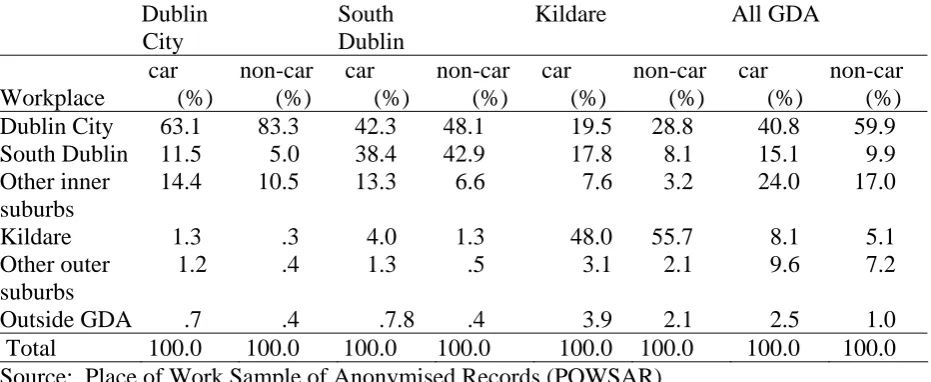
However, comparing those who travel to work by car with all those who travel by other means shows how car-drivers are distinctive (Table 2). Of all those who live in
the GDA, car-drivers are much less likely to work in Dublin City than non-car drivers (60 per cent as opposed to 41 per cent). Car-drivers are also less likely to work in their own area than those who do not travel by car. Thus 63 per cent of those who live in
Dublin City and who travel to work by car actually have workplaces in the city centre, as opposed to 83 per cent of non-car drivers. More than a third of these Dublin City
counts on the M50 around the city show a small peak of outward bound journeys in the morning as well as the much larger peak in the early evening (DTO 2005:15).
[image:13.595.90.556.285.476.2]Equally in the inner and outer suburbs car drivers are more likely to travel to other suburbs than those who do not travel by car. In other words, whereas non-car-drivers work locally or in the city centre, car-drivers’ workplaces are more dispersed across the entire city region.
Table 2 Place of residence and place of work, car-drivers and non-car-drivers, Greater Dublin Area 2002
Dublin City
South Dublin
Kildare All GDA
Workplace car (%) non-car (%) car (%) non-car (%) car (%) non-car (%) car (%) non-car (%)
Dublin City 63.1 83.3 42.3 48.1 19.5 28.8 40.8 59.9
South Dublin 11.5 5.0 38.4 42.9 17.8 8.1 15.1 9.9
Other inner suburbs
14.4 10.5 13.3 6.6 7.6 3.2 24.0 17.0
Kildare 1.3 .3 4.0 1.3 48.0 55.7 8.1 5.1
Other outer suburbs
1.2 .4 1.3 .5 3.1 2.1 9.6 7.2
Outside GDA .7 .4 .7.8 .4 3.9 2.1 2.5 1.0
Total 100.0 100.0 100.0 100.0 100.0 100.0 100.0 100.0 Source: Place of Work Sample of Anonymised Records (POWSAR)
These changes mean some movement away from ‘modern’ forms of mobility. Travelling from the suburb to the city centre in the morning and back in the evening
remains the most common journey to work. However, this is decreasingly the case as work places (and also working times) become more varied. And journeys to work probably amount to a declining proportion of all travel time within Ireland, in
particular where the car is concerned. The result is that traffic problems and above all traffic jams can occur anytime and in almost any place: the post-modern traffic jam
Such forms of mobility appear unstructured compared to the regular journeys to limited destinations of the previous period.. Yet this argument ignores both the variety
of individual values and the variety of social contexts, both of which challenge a simple one-to-one relationship between individualisation and universal car ownership. At the individual level it is quite clear that some people actively choose forms of life
and mobility which reduce their use of the private car. Thus a study of Bologna reported that older people preferred to use public transport because they found it more
sociable (Wickham 2006: 144). Equally, a study of mobility usage in Swiss and French cities identified minorities, mostly of young men and women, who preferred to use public transport ‘out of respect for the environment’ (Kaufmann 2002: 71). The
process of individualisation is not necessarily incompatible with an ‘individual’ choice not to use a car.
However, for individuals to effectively not to use the private car, alternatives to the car have to exist through which people can satisfy their mobility needs. In Kaufmann’s study for example, the groups who actively chose public transport were
larger in those cities with more effective public transport. In Dublin such minorities are probably very small. For most people, the interlocking policy failures of low
density suburbanisation and poor public transport provision ensure there is no realistic alternative to the car.
At the same time, the relationship between the car and individual freedom is itself
deceptive. The new mobility produces its own constraints on mobility. More roads encourage more cars, and the result is more congestion and even gridlock. The
whereby people have to use a specific technology if they are to participate in the society. As the city becomes built around the car, the expansion of the car system
drives out other forms of mobility, from walking and cycling to public transport. Such ‘car dependency’ is hardly a new age of freedom.
Migration and mobility: the temporary Irish workforce?
Car-based mobility in Ireland and particularly in Dublin, is, so we have seen, shaped by public policy. Another aspect of the increased mobility of contemporary Ireland is
the extent to which people move into Ireland from outside the country. Both the expansion of car-based mobility and the increase in immigration are sometimes presented as natural or inevitable consequences of economic growth and even of
‘globalisation’, but in the case of immigration the overall importance of public policy is more obvious. At its very simplest, government policy determines or at least
influences who is allowed to enter the country and on what basis2. However, it is useful to consider immigration as a form of migration and hence as another form of mobility (Salt 2001: 95). In particular understanding migration as mobility avoids the
common-sense assumption that ‘integration’ (or even ‘assimilation’) is the key issue both for policy and for research; as this section will show, it facilitates questions about
the extent of this mobility and the motivations of the mobile.
In Ireland today over 10 per cent of the population were born abroad, but it is also well known that, particularly during the 1990s, many ‘immigrants’ had themselves
been born in Ireland and were therefore returning emigrants. Rather than categorising the population into ‘natives’ and ‘immigrants’, it can be conceptualised as comprising
Between these extremes lie different forms of mobility, from those born in Ireland but who have lived abroad for some time, to those born abroad who have lived here for
some time.
Table 3 presents one such possible classification, again using the 2002 census micro-data3. The bottom row shows the share of the groups in the overall population.
The mobile can be defined as all those who have lived outside Ireland: those born in Ireland and lived abroad, those born abroad and long-term resident in Ireland, those
born abroad and recently arrived. In 2002 the mobile as a whole comprised just over a fifth of the total population. Comparing the top row (‘Professional workers’) with the bottom row shows the extent to which professional workers are more mobile than
other groups: nearly a third of all professionals were in some sense ‘mobile’. At the other extreme the ‘non-manual’ group were least mobile: here 83 per cent had never
[image:16.595.89.514.462.653.2]lived abroad.
Table 3 Mobility and social class
Born and
lived in Ireland Born in Ireland lived abroad Born abroad long-term resident Born abroad arrived 1996-2002 Total
Professional workers (%) 69.1 14.1 6.7 10.1 100.0 Managerial and technical (%) 77.2 11.5 3.9 7.4 100.0
Non-manual (%) 83.8 7.8 2.5 5.8 100.0
Skilled manual (%) 81.4 8.7 3.0 6.9 100.0
Semi-skilled (%) 81.6 8.1 3.0 7.3 100.0
Unskilled (%) 82.3 9.7 2.2 5.9 100.0
All others gainfully occupied and unknown (%)
77.3 7.7 3.9 11.0 100.0
All (%) 79.3 9.4 3.5 7.8 100.0
Source: Census of Population Sample of Anonymised Records (COPSAR).
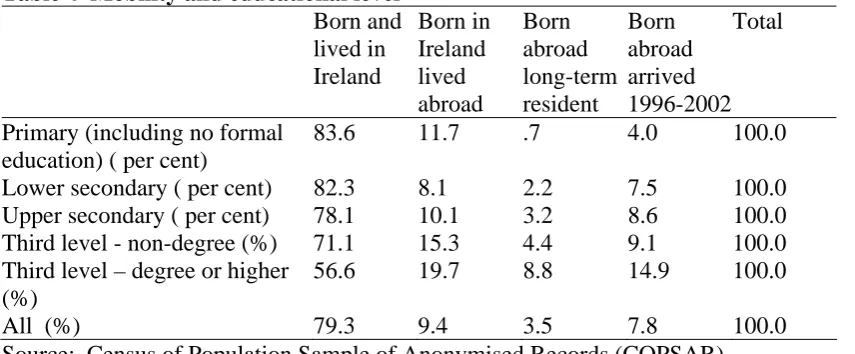
Mobility experience is also related to education. Table 4 shows that the higher the
of those who only had achieved primary education, 84 per cent had lived in Ireland all their lives. At the other extreme, of those with at least a third level degree only 57 per
cent were ‘immobile’ and had never lived outside of Ireland. In Ireland today, to be educated is to be mobile.
Within the mobile category however there is an interesting difference in the use of
educational qualifications. On the one hand returning emigrants who have third level qualifications do better occupationally than those than those graduates who have
stayed in Ireland. Further analysis of the data shows that of those who had a degree and who were working full time, 79 per cent of the ‘immobile’ held a managerial or professional job, but this rose to 82 per cent of all those who were born in Ireland but
had lived abroad. This demonstrates again the ‘emigration premium’ for Irish-born graduates (Gash and O’Connell 2000). By contrast, amongst graduates who were born
abroad, 71 per cent of long-term residents and 72 per cent of the recent arrivals had reached managerial or professional jobs. At the same time it is important to keep this in proportion. Most of those born abroad are in a job which is broadly consistent with
Table 4 Mobility and educational level
Born and
lived in Ireland Born in Ireland lived abroad Born abroad long-term resident Born abroad arrived 1996-2002 Total
Primary (including no formal education) ( per cent)
83.6 11.7 .7 4.0 100.0
Lower secondary ( per cent) 82.3 8.1 2.2 7.5 100.0 Upper secondary ( per cent) 78.1 10.1 3.2 8.6 100.0 Third level - non-degree (%) 71.1 15.3 4.4 9.1 100.0 Third level – degree or higher
(%)
56.6 19.7 8.8 14.9 100.0
All (%) 79.3 9.4 3.5 7.8 100.0
Source: Census of Population Sample of Anonymised Records (COPSAR)
The focus on ‘mobility’ rather than ‘immigration’ therefore alerts us to the extent to which the population of Ireland is actually flowing through or across Ireland Furthermore, this focus on the different mobility experiences within the population
alerts us to the importance of mobility over the life cycle. Rather than just considering those people currently in Ireland, we need to focus on mobile careers. Although immigrants’ current intentions are a notoriously bad guide to their future actions, it is clear that many of those currently resident in Ireland do not intend to stay here. For example, according to the Polish Labour Force Survey, most of those who have left
Poland recently define themselves as ‘temporary’ emigrants (Kaczmarczyk 2006). According to some theorists, much professional work now occurs within
increasingly trans-national labour markets: for ‘symbolic analysts’ (Reich 1993) or members of the ‘creative class’ (Florida 2004) traditional ties of place have little meaning. An ongoing study (Bruff and Wickham 2005) of migration within the Irish
software sector shows both the reality and the limits of such arguments. For many across the globe with some experience and/or qualifications in software, Ireland is
I was just looking at the Net, and I found some articles which said that after the US Ireland is the second biggest exporter of software. I hadn’t thought about it until then…I found these Irish job sites. Just for the heck of it I sent off my CVs (Javed, 32, Indian, has worked in the Irish software industry for a few years; emphasis added).
From this perspective, the initial decision to end up in Ireland has an almost arbitrary
quality. At the same time, for some the decision to stay in Ireland rather than move to the USA, allegedly the ultimate destination for many professionals, is sometimes based on a conscious rejection of US values:
I was the in the States eight, nine years ago…I didn’t like the lifestyle there: it’s so different. Ireland was different, but in a positive way…We have a lot of conference calls with the Americans, and they start at seven or earlier [in the morning], and sometimes they are still [working] when I arrive back at the office in the morning, and they have much fewer holidays [as well]. (Tibor, 34, Hungarian, has worked in the Irish software industry for several years).
This interviewee’s deliberate rejection of possible mobility exemplifies the argument that it is important to distinguish between mobility potential (‘motility’) and the actual
use of that potential (Kaufman 2002). Equally the decision to stay in Ireland is shaped by family considerations and position in the life-cycle: marriage and children make mobility more problematic:
My plan was to stay here for only two years and then go…wherever the opportunities were going to be. Unfortunately, or fortunately…I met my [Irish] wife, so I didn’t continue with the plan that I had. (Richard, 30, Venezuelan, has worked in Ireland for various software firms over several years) Sometimes however children are a spur to returning to the real ‘home’:
We are planning to move back even if the economy is doing well. I really would like our daughter to start her schooling in India, because after that it would be difficult to move back…So we are hoping that we can go back in two years (Murali, 36, Indian, has worked in the Irish software industry for several years).
omitted in the literature, their stage in the life cycle. In these terms at least, the new mobility opportunities have not removed some rather traditional constraints.
Business travel: working on the move
Travelling to work and travelling from one country to another are in one sense ‘traditional’ mobilities: the journey itself is a means to an end (to reach work, to
move home). Business travel often involves working while travelling, so that travel time is no longer ‘time out’, but another form of working time (Felstead et al 2005). On such journeys the physical location of the traveller becomes in one sense
irrelevant, in that s/he remains in contact with colleagues, customers and clients. As one interviewee in an ongoing study of business travel in the Irish software industry
(Wickham and Vecchi 2006b) remarks:
I travel with my laptop and often it doesn’t matter if I’m in the office, working from home, or away on business, but there are many reasons why I need to be with a customer or an analyst or a manager” CEO (Chief Executive Officer) of a company producing software for the telecommunications sector.
Chart 2 shows the travel pattern of a senior marketing communications manager
for a Dublin software company. For her, travel is clearly part of the job. Such mobility across national borders means that at any one time many Irish professionals
are away on business, even if, as we have already seen, they also remain connected to their organisation. Our research suggests that the software industry is in fact particularly travel-intensive, with managers and professionals continually on the
move. At first sight this is paradoxical, since precisely in this industry competence with ICT (Information and Communication Technologies) is most extensive and so
complementary in the 19th century, so at the end of the 20th century are electronic communication and air travel.
Chart 2 EK’s Business Travel Pattern
January Two periods in the UK
February Major trade show in France (1 week)
March Press talks in the US (2 weeks)
April No travel
May Two trade shows: one in Europe, one in Sri Lanka
June Two weeks in Singapore
July Little travel
August One foreign trip
September Three foreign trips (2 in the UK, 1 in the US)
October Some foreign travel
November Little travel
December Little travel
Such mobility is necessary to create temporary physical proximity. Business interaction requires ‘handshakes’ to build up trust and exchange complex information
in ways that cannot be achieved purely by phone calls, e-mail or other forms of electronic communication (Leamer and Storper 2001). However, as we shall now see,
such mobility is clearly patterned (Wickham and Vecchi 2006a). Consider for example the case of a small Irish software company producing videogames. Here the CEO, the CTO (Chief Technical Officer) and the sales director travel frequently, not
least to the USA which is its main market. The CTO goes to Los Angeles every 5-6 weeks and he stays there for ten days. The sales director travels extensively all around the
US to meet up with potential publishers and he on average gives a presentation every
three weeks. The entire team goes to two main tradeshows: one, the Game Developers
‘to keep everyone in the loop’; the other one is held in May in Los Angeles and is open to
the public.
Indeed, keeping up with technical developments thus requires frequent electronic
communication and intermittent physical proximity. The case also highlights another paradox. Precisely in this ‘weightless’ industry, certain physical locations become clusters of activity. Dublin itself is now a software cluster, just as Los Angeles is for
the videogame industry. Such clusters around the globe are linked by ‘pipelines’ (Bathelt et al 2004) transferring news and ideas, and here physical travel is as unavoidable as electronic communication. The two trade fairs which are so important for the company are temporary clusters – here industry members from around the globe meet in physical proximity for a few days, and although the actual location of
the trade show may be incidental to its purpose, it is essential that it occurs in some physical location. Finally, the rather different travel pattern of the sales director with
its wider range of destinations is produced by the need to liaise with actual and potential customers, and once again, there is no substitute for temporary physical proximity – and hence for extensive short-term mobility.
Foreign property: travelling to the second home
Another development creating more physical mobility is that many Irish people now
own assets outside the country. Ireland has one of the highest levels of home-ownership within the EU (Fahey 2003), yet today Irish residents seem more likely than almost all other Europeans to own second homes - and to be private landlords –
outside the country.
property is hard to draw. In 2004 ‘around 60,000 Irish residents’ were reported to have bought properties in Europe during the previous five years (Irish Independent 17
June 2004); Irish ‘investors’ are now reported to own 100,000 properties in Spain (Irish Times 10 July 2006). Individual Irish investors are particularly adventurous in Central and Eastern markets, buying property in Berlin (Financial Times 10-11 June
2006), and Croatia; newspaper property pages advertise apartments in Dubai and even exhibitions of Bulgarian property. Irish Property Buyer magazine has two pages in Polish about buying property in Ireland – and nearly thirty editorial pages on property abroad (Irish Property Buyer 2006).
In Europe in absolute terms the British own more second homes abroad than
residents of any other country. Over a quarter of a million UK households were estimated to own residential property outside the UK in 2003/04 (Aspden 2005); the
growing numbers of British retiring to their second homes probably explains the 60 per cent leap in British immigration to France between 1999 and 2004 (Borrel 2006; Financial Times 24 August 2006). However, in relative terms Irish households would
now appear to be at least twice as likely to own property abroad than households in the UK. By contrast, it is now Continental Europeans who are home-bound: a recent
survey in the leading Milan newspaper carefully listed second home prices per square metre in a range of Italian resorts, but did not even mention opportunities outside Italy (Corriere della Sera, 15 May 2006).
Affluent Irish families can now partly live outside Ireland because of cheap air travel, especially to smaller regional airports. For example Ryanair’s flights to
which is beginning to rival the British ‘Dordogneshire’ further North. Further afield, direct flights to Cape Town and more recently Dubai are making even these
destinations possible second homes.
This precocious level of second home ownership has little to do with the features of ‘liquid society’ in general and a lot to do with the specific national political economy. Two issues are important here. Firstly, the Irish-based carrier Ryanair has been central to the European low fares revolution (Creaton 2005). Ryanair is a
political lobbyist, skilled at creating new coalitions of interest (e.g. with small regional airports) which in turn promote further deregulation. Secondly, along with the UK, Ireland now has one of the highest levels of personal debt in Europe. The two
countries have extensive retail financial services which, compared to most other European countries, enable consumers to have easy access to retail credit and in
particular mortgage finance (RICS Research 2006; Donnelly et al 2005). In the context of economic boom this ensured that many people in Ireland have been able to turn housing from an immobile and illiquid asset into a financial asset which can be
leveraged to access further property. In turn, rising house prices in Ireland create financial opportunities for arbitrage between Irish and foreign property prices. Such
foreign property ownership generates a novel form of mobility and weakens the boundaries between home and abroad. The mobility occurs as some individuals seize the opportunities provided by a very specific national financial system combined with changes in the organisation of air travel..
Conclusion
rather conventional sociological concerns. The ‘strong’ version of the mobility turn thus appears an exaggeration of little relevance to empirical sociology.
By contrast, the ‘weak’ version of the mobility turn suggests many new areas of research. One issue suggested by the different case studies is the regulation or governance of mobility. Although mobility is partly about the crossing of national boundaries, the national state remains surprisingly important. While this is obvious in the case of the most local of our four mobilities, Dublin’s precocious car-based
mobility, the equally precocious extent of Irish foreign home ownership is also largely shaped by national level financial structures and policies. Mobility is at very least shaped by the broader political context. How the politics and social processes of
mobility interact is thus one important area for future study.
Footnotes
1 I acknowledge permission for the use of the POWSAR data set from the Central Statistics Office – Census Place of Work Microdata File © Government of Ireland. 2 Control over immigration is in fact an example of multi-level governance, since
decisions involve the European Union and to a limited extent other inter-governmental and even non-inter-governmental actors.
Bibliography
Aspden, D. 2005 'Methodological improvements to UK foreign property statistics’,
Economic Trends 619 (June): 54-60.
http://www.statistics.gov.uk/downloads/theme_economy/ET619.pdf
Accessed 25 September, 2006.
Bathelet, H., A. Malmberg and P. Maskell 2004 'Clusters and knowledge: local buzz, global pipelines and the process of knowledge creation', Progress in Human
Geography 28 (1): 31-56.
Bauman, Z. 2005 Liquid Life, Cambridge: Polity Press.
Borrel, C. 2006 ‘Enquêtes annuelles de recensement 2004 et 2005: Près de 5 millions
d’immigrés à la mi-2004’, INSEE Première no. 1098 (August).
http://www.insee.fr/fr/ffc/ipweb/ip1098/ip1098.html. Accessed 25 September, 2006.
Bruff, I. and J. Wickham 2005 'The implications of new forms of immigration for government socio-economic strategies and welfare state design: The case of Ireland', Network for European Social Policy Analysis Conference, Fribourg (Switzerland) 23 September.
Castells, M. 1996 Rise of the Network Society, Oxford: Basil Blackwell Colley, L. 1992 Britons: Forging the Nation 1707-1837, London: Pimlico. Creaton, S. 2005 Ryanair: How a small Irish airline conquered Europe, London: Aurum Press.
Donnelly, R. et al 2005 ‘Dynamics of National Employment Models: The UK National Report’, DYNAMO research project.
http://www.iatge.de/projekt/2005/dynamo/country-reports/dynamouk.pdf
DTO - Dublin Transportation Office 2005 Road User Monitoring Report 2005, Dublin: DTO. http://www.dto.ie/rumr.pdf. Accessed 25 September 2006.
Dupuy, G. 1999 'From the "magic circle" to "automobile dependence": measurements and political implications', Transport Policy 6: 1-17.
EPA – Environmental Protection Agency 2006, Environment in Focus 2006, Dublin: EPA. http://www.epa.ie/OurEnvironment/EnvironmentalIndicators/. Accessed 25 September, 2006.
Fahey, T. 2003 'Is there a trade-off between pensions and home ownership? An exploration of the Irish case?' Journal of European Social Policy 13 (2): 159-73. Felstead, A., N. Jewson and S. Walters 2005 Changing Places of Work, London: Palgrave.
Florida, R. 2004 The Rise of the Creative Class, New York: Basic Books. Gash, V. and P. O'Connell. 2000 The Irish Graduate Labour Market: A six-year follow up survey of third level graduates from 1992, Dublin: ESRI.
Goldberg, M. and J. Mercer 1992 The Myth of the North American City, Vancouver: UBC Press.
Irish Property Buyer, 2006 (September).
Kaczmarczyk, P. 2006. 'Labour migration from the new EU member states and its impact on sending and receiving countries.' Presentation to ERC/IIIS Workshop Employment in the Enlarging European Union, Dublin, 2 June.
Leamer, E. and M. Storper 2001 'The Economic Geography of the Internet Age’, Journal of International Business Studies 32 (4): 641-665.
Newman, P., J. Kenworthy and P. Zintila 1995 'Can we overcome automobile dependence? Physical planning in an age of urban cyncism', Cities 12 (1): 53-65. Noiriel, G. 2001 État, nation et immigration, Paris: Gallimard.
Olsthoorn, X. 2003 'Implications of Globalization for CO2 Emissions from Transport’, Transportation and Planning 26 (1): 105-133.
Reich, R. 1993 The Work of Nations: Preparing Ourselves For 21st Century Capitalism, London: Simon & Schuster.
Reid, J. 2004 The United States of Europe: The superpower that nobody talks about, from the euro to eurovision, London: Penguin.
RICS Research 2006, European Housing Review 2006,
http://www.rics.org/Property/Residentialproperty/Residentialpropertymarket/ehr_200
6.htm. Accessed 25 September, 2006.
Salt, J. 2001 'The business of international migration', pp. 86-108 in M. Siddque
(ed.), International Migration into the 21st Century, Cheltenham: Edward Elgar. Schnapper, D. 2003 La Communauté des Citoyens, Paris: Gallimard.
Sheller, M.and J. Urry 2006 'The new mobilities paradigm’, Environment and Planning A 38: 207-26.
Shove, E. 1998 ‘Consuming Automobility’. Dublin: Employment Research Centre -
Report for SceneSusTech research project.
Teichler, U. 2006 'Major Findings of the Survey of Former Erasmus students',
Urry, J. 1990 The Tourist Gaze: Leisure and travel in contemporary societies, London: Sage.
Urry, J. 2000 Sociology beyond societies: Mobilities for the twenty-first century, London: Routledge.
Weber, E. 1979 Peasants into Frenchmen: The modernization of Rural France 1870-1914, Stanford: Stanford UP.
Wickham, J. 2006 Gridlock: Dublin's transport crisis and the future of the city, Dublin: tasc at New Island.
Wickham, J. and A. Vecchi 2006a 'Travelling and connecting, messaging and
meeting: business travel, information technology and the virtual organisation', EGOS
European Group of Organisation Studies Colloquium, Bergen Norway, July.
Wickham, J. and A. Vecchi 2006b 'Clusters and pipelines, commuters and nomads:
Business travel in the Irish software industry’, Fifth Proximity Conference, Bordeaux, June.