Capturing User and Product Information for Document Level Sentiment
Analysis with Deep Memory Network
Zi-Yi Dou
National Key Laboratory for Novel Software Technology, Nanjing University, Nanjing, 210023, China
Abstract
Document-level sentiment classification is a fundamental problem which aims to pre-dict a user’s overall sentiment about a product in a document. Several methods have been proposed to tackle the problem whereas most of them fail to consider the influence of users who express the senti-ment and products which are evaluated. To address the issue, we propose a deep mem-ory network for document-level sentiment classification which could capture the user and product information at the same time. To prove the effectiveness of our algo-rithm, we conduct experiments on IMDB and Yelp datasets and the results indicate that our model can achieve better perfor-mance than several existing methods.
1 Introduction
Sentiment analysis, sometimes known as opinion mining, is the field of study that analyzes peo-ple’s opinions, sentiments, evaluations, attitudes and emotions from written language. It is one of the most active and critical research areas in natu-ral language processing (Liu, 2012). On the one hand, from the industry point of view, knowing the feelings among consumers based on their com-ments is beneficial and may support strategic mar-ket decisions. On the other hand, potential cus-tomers are often interested in other people’s opin-ion in order to find out the choices that best fits their preferences (Moraes et al.,2013).
Previous studies tackled the sentiment analysis problem at various levels of granularity, from doc-ument level to sentence level due to different ob-jectives of applications (Zhang et al.,2009). In this work, we mainly focus on document-level senti-ment classification Basically, the task is to predict
user’s overall sentiment or polarity in a document about a product (Pang and Lee,2008).
Most existing methods mainly utilize local text information whereas ignoring the influences of users and products (Tang et al.,2015). As is often the case, there are certain consistencies for both users and products. To illustrate, lenient users may always give higher ratings than fastidious ones even if they post the same review. Also, it is not surprising that some products may always receive low ratings because of their poor quality and vice versa. Therefore, it is necessary to leverage indi-vidual preferences of users and overall qualities of products in order to achieve better performance.
Tang et al. (2015) proposed a novel method dubbed User Product Neural Network (UPNN) which capture user- and product-level information for sentiment classification. Their approach has shown great promise but one major drawback of their work is that for users and products with lim-ited information, it is hard to train the representa-tion vector and matrix for them.
Inspired by the recent success of computa-tional models with attention mechanism and ex-plicit memory (Graves et al., 2014; Sukhbaatar et al.,2015), we addressed the aforementioned is-sue by proposing a method based on deep memory network and Long Short-Term Memory (LSTM) (Hochreiter and Schmidhuber, 1997). The model can be divided into two separate parts. In the first fart, we utilize LSTM to represent each document. Afterwards, we apply deep memory network con-sists of multiple computational layers to predict the ratings for each document and each layer is a content-based attention model.
To prove the effectiveness of our algorithm, we have conducted experiments on three datasets de-rived from IMDB and Yelp Dataset Challenge and compare to several other algorithms. Experimen-tal results show that our algorithm can outperform
baseline methods for sentiment classification of documents by leveraging users and products for document-level sentiment classification.
2 Related Work
2.1 Memory Network
In 2014, Weston et al. (2014) introduced a new class of learning models called memory networks. Memory networks reason with inference compo-nents combined with a long-term memory com-ponent. The long-term memory can be read and written to and then it can be used for prediction. Generally, a memory network consists of an array of objects called memorymand four components
I,G,OandR, whereI converts input to internal feature representation,Gupdates old memories,O
generates an output representation andR outputs a response.
Based on their work, Sukhbaatar et al. (2015) proposed a neural network with a recurrent atten-tion model over a possibly large external memory. Unlike previous model, their model is trained end-to-end and hence requires significantly less super-vision during training. They have shown that their model yields improved results in language model and question answering.
Inspired by the success of memory network, Tanget al. (2016) introduce a deep memory net-work for aspect-level sentiment classification. The architecture of their model is similar to the previ-ous model and experimental results demonstrate that their approach performs comparable to other state-of-the-art systems. Also, Liet al.(2017) de-compose the task of attitude identification into two separate subtasks: target detection and polarity classification; and then solve the problem by ap-plying deep memory network so that signals pro-duced in target detection provide clues for polarity classification and the predicted polarity provides feedback to the identification of targets.
2.2 Sentiment Classification
Most existing work tackle the problem of senti-ment classification by manually design effective features. such as text topic (Ganu et al., 2009) and bag-of-opinion (Qu et al.,2010) . Some work take user information into consideration. For ex-ample, in 2013, Gao et al. (2013) design user-specific features to capture user leniency. Also, Li
et al. (2014) incorporate textual topic and user-word factors with supervised topic modeling.
Tang et al. (2015) points out that it is criti-cal to leverage users and products for document-level sentiment classification. They assume there are four types of consistencies for sentiment clas-sification and validate the influences of users and products in terms of sentiment and text on massive IMDB and Yelp reviews. Their model represent each user and product as both vector and matrix in order to capture the consistencies and then apply convolutional neural network to solve the task.
To the best of our knowledge, no one has ever applied deep memory network to capture the user and product information and solve the tasks in sen-timent classification at document-level.
3 Proposed Methods
In this section, we present the details of User Prod-uct Deep Memory Network (UPDMN) for senti-ment classification at docusenti-ment level.
3.1 Basic Symbol and Definition
First we suppose U, P, D is the set of users, products and documents respectively. If useru ∈
U writes a document d ∈ D about a product
p ∈ P and give the rating, we denote U(d) = {ud|udis written byu, ud 6= d} and P(d) = {pd|pdis written aboutp, pd 6= d}. Then, our task can be formalized as follows: supposeuwrite a documentdabout a productp, we should output the predicted scoreyfor the documentdbased on the input< d, U(d), P(d) >. The detail of these symbols would be illustrated in the following part.
3.2 General Framework of UPDMN
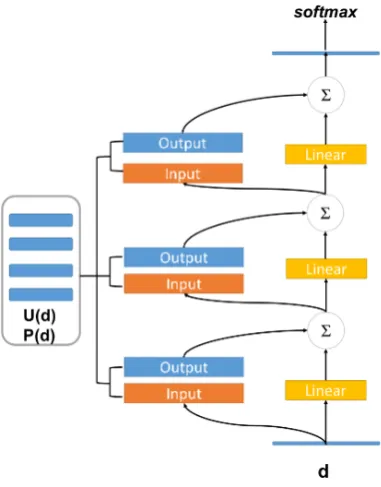
Figure 1 illustrates the general framework of our approach. Basically, inspired by the use of mem-ory network in question answering and aspect-level sentiment analysis (Sukhbaatar et al.,2015;
Tang et al.,2016), our model consists of multiple computational layers (hops), each of which con-tains an attention layer and a linear layer.
For every document inU(d)andP(d), we em-bed it into a continuous vector di and store it in
the memory. The model writes all document to the memory up to a fixed buffer size. Suppose we are given{di} = {d1, ..., dn}to be stored in
memory, for each layer we can convert them into memory vectors{mi}using an embedding matrix.
The documentdshould also be embedded intoq. Then, we compute the match{pi}betweenq and
Dataset #users #products #reviews #docs/user #docs/product #sents/doc #words/doc
IMDB 1,310 1,635 84,919 64.82 51.94 16.08 394.6
Yelp 2014 4,818 4,194 231,163 47.97 55.11 11.41 196.9
[image:3.595.103.498.62.105.2]Yelp 2013 1,631 1,633 78, 966 48.42 48.36 10.89 189.3
Table 1: Statistical information of datasets.
Figure 1: General Framework
output vector {ci} using another embedding
ma-trix and generate the output of attention layer. The output is further summed with the linear transfor-mation of q and considered as the input of next hop. The output vector at last hop is fed into a
softmaxlayer and then generates the final predic-tionyfor document-level sentiment classification.
3.3 Embedding Documents
Although there are several state-of-the-art tech-niques to embed word into vectors (Mikolov et al.,
2013a), for document-level sentiment classifica-tion, the document we need to classify is usually too long to be represented as a vector. People have tried different ways to solve the task. For exam-ple, Kalchbrenner et al. (2014) apply convolu-tional neural network for modeling sentences and Liet al.(2015) introduce an LSTM model that hi-erarchically builds an embedding for a paragraph from embeddings for sentences and words.Some of these work can be incorporated into our meth-ods. However, here we only use the LSTM model to embed each document, i.e. every word in the
document is fed into LSTM and the final represen-tation is obtained by averaging the hidden state of each word, and the experimental results shows that this simple embedding method can actually obtain satisfactory results.
3.4 Attention Model
After obtaining the embedding vectorqfor docu-mentdthe memory vectors{mi} for each
mem-ory, we calculate the match betweenqandmi
us-ing the followus-ing equation:
pi =softmax(Watt[mi;q] +batt) (1)
wheresoftmax(zi) =ezi/Pjezj.
Afterwards, we compute the corresponding out-put o for each hop by summing over the ci,
weighted by the probability vector from the input:
o=X
i
pici (2)
3.5 Final Prediction and Training Strategy
At last hop, the output vector is fed into asoftmax
layer and thus generates a probability distribution
{yi}over ratings. The score with the highest
prob-ability would be considered as our final prediction
py. During training, we try to minimize the cross entropy error of sentiment classification in a su-pervised manner. The specific equation is shown as follows:
Loss=−X
d∈D
X
yi∈Y
I(y=yi|d)log(P(y=yi|d))
(3) whereY is the collection of sentiment categories,
I(y = yi|d) is1or0, indicating whether the
cor-rect category fordisyi, and P(y = yi|d)
repre-sents the probability of classifying documentdas categoryyi.
4 Experiment
[image:3.595.87.278.149.393.2]IMDB Yelp 2014 Yelp 2013
Acc MAE RMSE Acc MAE RMSE Acc MAE RMSE
Majority 0.196 1.838 2.495 0.392 0.779 1.097 0.411 0.744 1.060 Trigram 0.399 1.147 1.783 0.577 0.487 0.804 0.569 0.513 0.814 TextFeature 0.402 1.134 1.793 0.572 0.490 0.800 0.556 0.520 0.845 AvgWordvec + SVM 0.304 1.361 1.985 0.530 0.562 0.893 0.526 0.568 0.898 SSWE + SVM 0.312 1.347 1.973 0.557 0.523 0.851 0.549 0.529 0.849 Paragraph Vector 0.341 1.211 1.814 0.564 0.496 0.802 0.554 0.515 0.832 RNTN + Recurrent 0.400 1.133 1.764 0.582 0.478 0.821 0.574 0.489 0.804 Trigram + UPF 0.404 1.132 1.764 0.576 0.471 0.789 0.570 0.491 0.803 TextFeature +UPF 0.402 1.129 1.774 0.579 0.476 0.791 0.561 0.509 0.822
JMARS N/A 1.285 1.773 N/A 0.710 0.999 N/A 0.699 0.985
UPNN 0.435 0.979 1.602 0.608 0.447 0.764 0.596 0.464 0.784
UPDMN(1) 0.428 0.936 1.443 0.588 0.457 0.757 0.596 0.454 0.747
UPDMN(2) 0.446 0.944 1.495 0.592 0.451 0.748 0.602 0.437 0.732
UPDMN(3) 0.459 0.883 1.397 0.599 0.444 0.742 0.627 0.386 0.681
[image:4.595.104.495.60.245.2]UPDMN(4) 0.465 0.853 1.351 0.609 0.432 0.731 0.639 0.369 0.662 UPDMN(5) 0.456 0.928 1.471 0.613 0.425 0.720 0.611 0.405 0.704
Table 2: Experimental results.
4.1 Experimental Settings
We use the same datasets as Tang et al. (2015), which are derived from IMDB (Diao et al.,2014) and Yelp Dataset Challenge in 2013 and 2014 1.
Statistical information of the datasets are given in Table 1.
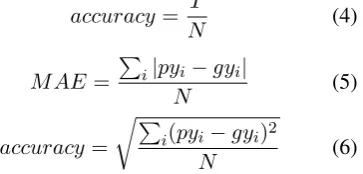
In order to measure the performance of our model, here we use three metrics. Specifically, we useaccuracyto measure the overall sentiment classification performance,MAEandRMSE to measure the divergences between prediction py
and ground truthgy. The formulas for these three metrics are listed as follows:
accuracy= T
N (4)
MAE =
P
i|pyi−gyi|
N (5)
accuracy= rP
i(pyi−gyi)2
N (6)
4.2 Baseline Models
We compare UPDMN with the following models: (1) Majority : it assigns each review in the test dataset with the majority sentiment category in training set.
(2) Trigram : it first takes unigrams, bigrams and trigrams as features and then trains a classifier with SVM (Fan et al.,2008).
(3)TextFeature: it takes hard-crafted text fea-tures such as word/character n-grams, negation features and then trains a classifier with SVM.
(4) UPF: it extracts user-leniency features and corresponding product features from training data
1http://www.yelp.com/dataset challenge
and then concatenates them with features in model (2) and (3) (Gao et al.,2013).
(5) AvgWordvec+SVM : it learns word em-beddings from training and development sets with
word2vec, averages word embeddings and then trains an SVM classifier (Mikolov et al.,2013b).
(6) SSWE+SVM : it learns sentiment-specific word embeddings (SSWE), uses max/min/average pooling to generate document representation and then trains an SVM classifier (Tang et al.,2014).
(7) RNTN+RNN : it represents each sentence with RNTN, composes document with recurrent neural network , and then averages hidden vectors of recurrent neural network as the features (Socher et al.,2013).
(8) Paragraph Vector: it implements the PVDM for document-level sentiment classifica-tion (Le and Mikolov,2014).
(9) JMARS: it is the recommendation algo-rithm which leverages user and aspects of a re-view with collaborative filtering and topic model-ing (Diao et al.,2014).
(10) UPNN : as has been stated above, it also leverages user and product information for senti-ment classification at docusenti-ment level (Tang et al.,
2015).
4.3 Experimental Results and Discussion
[image:4.595.111.293.476.563.2]more information to improve the performance. However, if there are too many hops, the perfor-mance would be not as well as before, which may be caused by over-fitting.
Compared with other models, we can see that with proper setting, our model achieve superior results. All these results prove the effectiveness of UPDMN and the necessity to utilizing user and product information at document level.
It should be noticed that there are still several improvements can be made, such as better repre-sentation of documents or more sophisticated at-tention mechanism. We believe that our model has great potential and can be improved in many ways.
Acknowledgments
We thank anonymous reviewers and Hao Zhou for helpful advice.
References
Qiming Diao, Minghui Qiu, Chao Yuan Wu, Alexan-der J. Smola, Jing Jiang, and Chong Wang. 2014. Jointly modeling aspects, ratings and sentiments for
movie recommendation (jmars). In Acm Sigkdd
International Conference on Knowledge Discovery and Data Mining, pages 193–202.
Rong En Fan, Kai Wei Chang, Cho Jui Hsieh, Xi-ang Rui WXi-ang, and Chih Jen Lin. 2008. Liblinear: A library for large linear classification. Journal of Machine Learning Research, 9(9):1871–1874.
Gayatree Ganu, Noemie Elhadad, and Amlie Marian. 2009. Beyond the stars: Improving rating
predic-tions using review text content. In International
Workshop on the Web and Databases, WEBDB 2009, Providence, Rhode Island, Usa, June.
Wenliang Gao, Naoki Yoshinaga, Nobuhiro Kaji, and Masaru Kitsuregawa. 2013. Modeling user leniency and product popularity for sentiment classification. InIJCNLP, pages 1107–1111.
Alex Graves, Greg Wayne, and Ivo Danihelka. 2014.
Neural turing machines. Computer Science.
Seppu Hochreiter and Jrgen Schmidhuber. 1997. Long
short-term memory. Springer Berlin Heidelberg.
Nal Kalchbrenner, Edward Grefenstette, and Phil Blun-som. 2014. A convolutional neural network for modelling sentences. Eprint Arxiv, 1.
Quoc V. Le and Tomas Mikolov. 2014. Distributed
rep-resentations of sentences and documents. Computer
Science, 4:1188–1196.
Fangtao Li, Sheng Wang, Shenghua Liu, and Ming Zhang. 2014. Suit: a supervised user-item based
topic model for sentiment analysis. In
Twenty-Eighth AAAI Conference on Artificial Intelligence, pages 1636–1642.
Jiwei Li, Minh Thang Luong, and Jurafsky Dan. 2015. A hierarchical neural autoencoder for paragraphs
and documents.Computer Science.
Bing Liu. 2012. Sentiment analysis and opinion
min-ing. In Synthesis Lectures on Human Language
Technologies, page 167.
Qiaozhu Mei, Qiaozhu Mei, and Qiaozhu Mei. 2017. Deep memory networks for attitude identification. pages 671–680.
Tomas Mikolov, Kai Chen, Greg Corrado, and Jeffrey Dean. 2013a. Efficient estimation of word represen-tations in vector space.Computer Science.
Tomas Mikolov, Ilya Sutskever, Kai Chen, Greg Cor-rado, and Jeffrey Dean. 2013b. Distributed repre-sentations of words and phrases and their
composi-tionality. Advances in neural information
process-ing systems, 26:3111–3119.
Rodrigo Moraes, Jo Valiati, and Wilson P O Neto. 2013. Document-level sentiment classification: An
empirical comparison between svm and ann.Expert
Systems with Applications, 40(2):621–633.
Bo Pang and Lillian Lee. 2008. Opinion mining and
sentiment analysis. Foundations and Trends in
In-formation Retrieval, 2(12):1–135.
Lizhen Qu, Georgiana Ifrim, and Gerhard Weikum. 2010. The bag-of-opinions method for review rat-ing prediction from sparse text patterns. InCOLING 2010, International Conference on Computational Linguistics, Proceedings of the Conference, 23-27 August 2010, Beijing, China, pages 913–921.
R. Socher, A. Perelygin, J. Y. Wu, J. Chuang, C. D. Manning, A. Y. Ng, and C. Potts. 2013. Recursive deep models for semantic compositionality over a sentiment treebank.
Sainbayar Sukhbaatar, Arthur Szlam, Jason Weston, and Rob Fergus. 2015. End-to-end memory
net-works. Computer Science.
Duyu Tang, Bing Qin, and Ting Liu. 2015. Learning semantic representations of users and products for
document level sentiment classification. In
Meet-ing of the Association for Computational LMeet-inguistics and the International Joint Conference on Natural Language Processing, pages 1014–1023.
Duyu Tang, Bing Qin, and Ting Liu. 2016. Aspect level sentiment classification with deep memory
net-work. InConference on Empirical Methods in
Duyu Tang, Furu Wei, Nan Yang, Ming Zhou, Ting Liu, and Bing Qin. 2014. Learning sentiment-specific word embedding for twitter sentiment clas-sification. InMeeting of the Association for Compu-tational Linguistics, pages 1555–1565.
Jason Weston, Sumit Chopra, and Antoine Bordes.
2014. Memory networks.Eprint Arxiv.
Changli Zhang, Daniel Zeng, Jiexun Li, Fei Yue Wang, and Wanli Zuo. 2009. Sentiment analysis of chinese
documents: From sentence to document level.