Word Etymology as Native Language Interference
Vivi Nastase University of Heidelberg
Heidelberg, Germany [email protected]
Carlo Strapparava Fondazione Bruno Kessler
Trento, Italy [email protected]
Abstract
We present experiments that show the influence of native language on lexical choice when producing text in another lan-guage – in this particular case English. We start from the premise that non-native En-glish speakers will choose lexical items that are close to words in their native lan-guage. This leads us to an etymology-based representation of documents written by people whose mother tongue is an Indo-European language. Based on this repre-sentation we grow a language family tree, that matches closely the Indo-European language tree.
1 Introduction
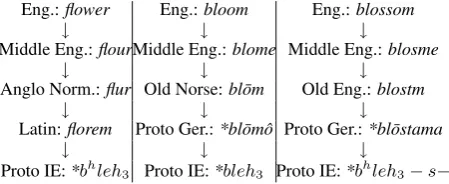
In second-language writing, vestiges of the native language such as pronunciation, vocabulary and grammar are well-attested, and the phenomenon is called native language interference (Odlin,1989). At the lexical level, the choice as well as the spelling can be indicative of the native language, through the choice of cognates, true or false friends – e.g. a writer with native language Ger-man may choosebloomcognate withblume, while a French one may choose flower, cognate with
fleur. Misspellings –cuestioninstead ofquestion
are also indicative, as the writer will tend to spell words close to the form from her original language
(Nicolai et al.,2013).
In this paper we also look at native language in-terference starting from the lexical level, but ab-stract away from the actual word forms, and focus instead on the language of the etymological an-cestors. The hypothesis we investigate is that the collective evidence of etymological ancestor lan-guages are indicative of the language of the native speaker, and that this effect is sufficiently strong
Eng.:flower Eng.:bloom Eng.:blossom
↓ ↓ ↓
Middle Eng.:flourMiddle Eng.:blome Middle Eng.:blosme
↓ ↓ ↓
Anglo Norm.:flur Old Norse:bl¯om Old Eng.:blostm
↓ ↓ ↓
Latin:florem Proto Ger.:*bl¯omˆo Proto Ger.:*bl¯ostama
↓ ↓ ↓
Proto IE:*bhleh
[image:1.595.298.523.222.314.2]3 Proto IE:*bleh3 Proto IE:*bhleh3−s− Figure 1: Examples of etymological ancestry from Wiktionary
to allow us to rebuild an Indo-European language family tree. We use a corpus of essays written by English language learners, whose native language cover the languages from the Indo-European fam-ily. Etymological information is provided by an et-ymological dictionary extracted from Wiktionary. The fact that word etymologies are included in the native-language interference phenomena could be used in various ways, i.a.: (i) to influence the selection of material for language learning, by fo-cusing on vocabulary closer etymologically to the native language of the student, thus facilitating lexical retention; (ii) to reveal lexical choice er-rors caused by “etymological interference”; (iii) together with other interference phenomena, for the automatic corrections of language errors.
2 Related Work
English is a widespread common language for communication in a variety of fields – science, news, entertainment, politics, etc. A consequence is that numerous people learn English as a sec-ond (or indeed nthlanguage). The study of native
language interference with the learning of English can be used in multiple ways, including devising methods to make the learning easier and correct-ing language errors (Leacock et al.,2014;Gamon,
2010;Dahlmeier and Ng,2011).
Massung and Zhai (2016) present an overview of approaches to the task of natural language iden-tification (NLI). Various surface indicators hold clues about a speaker’s native language, that make their way into language production in a non-native language. Nagata and Whittaker (2013),Nagata
(2014) find that grammatical patterns from the na-tive language seep into the production of English texts. Tsur and Rappoport (2007) verify the hy-pothesis that lexical choice of non-native speak-ers is influenced by the phonology of their native language, andWong and Dras(2009) propose the idea that (grammatical) errors are also influenced by the native language. One could draw the infer-ence that character n-grams then could be indica-tive of the naindica-tive language, and this was shown to be the case byIonescu et al.(2014).
The natural language identification task
(Tetreault et al., 2013) attracted 29
participat-ing teams, which used a variety of features to accomplish the NLI task as a classification exercise: n-grams of lexical tokens (words and POS tags), skip-grams, grammatical information (dependency parses, parse tree rules, preference for particular grammatical forms, e.g. active or passive voice), spelling errors.
Apart from morphological, lexical, grammati-cal features, words also have an etymologigrammati-cal di-mension. The language family tree itself is drawn based on the analysis of the evolution of lan-guages. Language evolution includes, or starts with, word etymologies. Word etymologies have been under-used for tasks related to NLI. They have been used implicitly in work that investi-gates cognate interference (Nicolai et al., 2013), and explicitly by (Malmasi and Cahill,2015) who use words with Old English and Latin etymolo-gies as unigram features in building classifiers for the TOEFL11 dataset. Etymological informa-tion is obtained from the Etymological WordNet
(de Melo and Weikum,2010).
We also investigate here the impact of ety-mological information, but unlike previous work, we do not extract unigram/n-gram features for classification, but we look at the collective evi-dence captured by the etymological “fingerprint” for each document and set of essays.
3 Etymological fingerprints
To investigate the influence of etymological an-cestor languages, we represent each essay through
etymological features, based on which we also built language vectors for each Indo-European lan-guage represented in the corpus. Essay vectors are then used to test native language identification po-tential, and the language vectors are used to grow a language family tree.
3.1 Word etymologies
Dictionaries customarily include etymological in-formation for their entries. Wikipedia’s Wik-tionary has amassed a considerable number of en-tries that joined this trend. The etymological in-formation can, and indeed has been extracted and prepared for machine consumption (de Melo and
Weikum,2010): Etymological WordNet1contains
6,031,431 entries for 2,877,036 words (actually, morphemes) in 397 languages. Because we pro-cess essays written in English, we use only the entries that give etymological origins for English words – 240,656. Figure1shows as an example of the kind of information formalized in the Ety-mological WordNet the etyEty-mological ancestry for the wordsflower, blossom, bloom.
3.2 Document/collection modeling
Essay representation After tokenization, POS tagging and lemmatization, each essay in the dataset is represented as a vector of etymological ancestry proportions obtained through the follow-ing processfollow-ing steps:
1. for each token that has an entry in the ety-mological dictionary, we replace it with the language of its etymological ancestor – e.g.
sightwill be replaced byang(Old English),
visionbylat(Latin) (Table1shows the num-ber of words with etymological ancestors in the subsets corresponding to each language);
2. compute the proportion of each etymological language in the essay, and represent the es-say as a vector of language proportions2. We
experimented with using etymological infor-mation going back through several ancestry levels, but using the first level led to the best results.
ei ∼ hpil1, ..., pilni where pilk =
nilk Ni,etym
1http://www1.icsi.berkeley.edu/ ˜demelo/etymwn/
nilk is the number of words with etymologi-cal ancestorlk in thei-th essay, andNi,etym
is the number of words with etymological in-formation in essayi.
Language vectors For each subcollection corre-sponding to one (student native) languageLj, we
build the language vectors by averaging over the essay vectors in the subcollection:
VLj =hpLjl1, ..., pLjlmi
where pLjlk =
P lang(ei)=Ljpilk
|{ei|lang(ei)=Lj}|
pLjlk is the proportion of etymological an-cestor languagelk in all essays whose author has
as native languageLj.
The essay and language vectors are filtered by removing etymological languages whose corre-sponding values in the language vectors are less than10−4.
4 Experiments
We investigate the strength of the etymological “fingerprint” of individual and collective essays written by non-native speakers of English, through two tasks – native language identification and lan-guage family tree construction. Towards this end, we work with a collection of essays written by contributors whose native language is an Indo-European language. The dataset is described in Section4.1. For etymological information we rely on an etymological dictionary, described briefly in Section 3.1. Data modeling and the experiments conducted are described in Section3.2.
4.1 Data
We used the ICLE dataset (Granger et al.,2009), consisting of English essays written by non-native English speakers. We filter out those that were written by people whose mother tongue is not from the Indo-European family (i.e. Chinese, Japanese, Turkish and Tswana). Table1 shows a summary of the data statistics, including the num-ber of words for which we have found ancestors in the etymological dictionary used. The corpus con-sists entirely of essays written by students. Two types of essay writing are present: argumentative essay writings and literature examination papers. Table2displays a list of topics in the corpus. The essays should be at least 500 words long and up to
1,000, and contain all the spelling mistakes made by their authors.
Following Nagata and Whittaker (2013), who also built the Indo-European family tree based on n-grams composed of function words and open-class parts of speech, essays that do not respect one of the following rules are filtered out: (i) the writer has only one native language, (ii) the writer has only one language at home; (iii) the two lan-guages in (i) and (ii) are the same as the native language of the subcorpus to which the essay be-longs. Table1shows a summary of the data statis-tics after filtering, including the number of words for which we have found ancestors in the etymo-logical dictionary used.
Native language # essays # tokens (with etym) Bulgarian 302 226,407 (149,151)
Czech 243 226,895 (148,391)
Dutch 263 264,981 (169,040)
French 347 256,749 (161,136) German 437 259,967 (170,056) Italian 392 253,798 (165,500) Norwegian 317 238,403 (156,764) Polish 365 263,223 (172,319) Russian 276 259,510 (167,938) Spanish 251 225,341 (139,565) Swedish 355 224,948 (146,143)
Table 1: Statistics on the subset of ICLE dataset used.
1 Crime does not pay.
2 The prison system is outdated. No civilized society should punish its criminals: it should rehabilitate them.
3 Most university degrees are theoretical and do not prepare students for the real world. They are therefore of very little value. 4 A man/woman’s financial reward should be commensurate with
their contribution to the society they live in. 5 The role of censorship in Western society.
6 Marx once said that religion was the opium of the masses. If he was alive at the end of the 20th century, he would replace religion with television.
7 All armies should consist entirely of professional soldiers : there is no value in a system of military service.
8 The Gulf War has shown us that it is still a great thing to fight for one’s country.
9 Feminists have done more harm to the cause of women than good. 10 In his novel Animal Farm, George Orwell wrote “All men are equal: but some are more equal than others”. How true is this today?
11 In the words of the old song “Money is the root of all evil”. 12 Europe.
13 In the 19th century, Victor Hugo said: ”How sad it is to think that nature is calling out but humanity refuses to pay heed. ”Do you think it is still true nowadays ?
14 Some people say that in our modern world, dominated by sci-ence technology and industrialization, there is no longer a place for dreaming and imagination. What is your opinion ?
Table 2: Topics in the ICLE dataset.
overes-timation of the results of NLI when random split-ting, particularly for groups of contributors that were presented with very different topics – e.g. students from Asia vs. students from Europe. We have analyzed the distribution of essays into top-ics using the essay titles, and observed that con-tributions from Europe (which are our focus) have similar distributions across the featured topics. Growing the language tree To grow the lan-guage tree from the lanlan-guage vectors built from the English essays, we use a variation of the UPMGA – Unweighted Pair Group Method with Arithmetic Mean – algorithm. Starting with the language vectorsVLj, we compute the distance be-tween each pair of vectors using a distance met-ric algorithm. At each step we choose the closest pair(La, Lb)and combine them in a subtree, then
combine their corresponding sub-collection of es-says, and build the language vector for the “com-posite” languageLa,b, and compute its distance to
the other language vectors. 4.2 Results
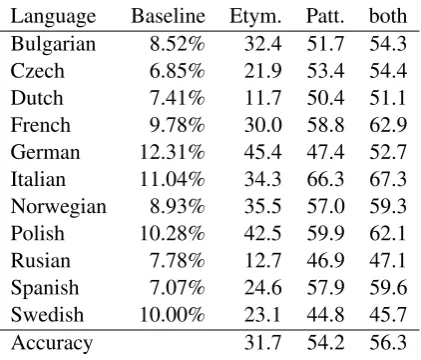
We test whether etymological information sur-faces as native language interference that is de-tectible through the tasks of native language iden-tification and reconstruction of the language fam-ily tree. Table3 shows results on the multi-class classification of essays according to the native lan-guage of the author, in the form of F-score av-erage results using SVM classification in 5-fold cross-validation (using Weka’s SMO implementa-tion3 with polynomial kernel and default
param-eters). The baseline corresponds to the language distribution in the dataset. We use as additional comparison point another set of features used to reconstruct the language family tree – the (closed-class) word and POS 3grams Nagata and
Whit-taker(2013), such asthe NN of; a JJ NN; the JJ
NN. We build all such patterns for the data, and keep the top 1000 by overall frequency.
Adding etymological features that capture the distribution of etymological ancestors for each es-say led to improved results for all languages, vary-ing from a non-significant improvement of 0.2% point for Russian, to a significant and high 5.3% improvement for German. Using only words, the accuracy is 73.2%, which increases marginally to 73.7 when etymology information is added. Us-ing a full complement of standard features – word,
3http://www.cs.waikato.ac.nz/ml/weka/
Language Baseline Etym. Patt. both Bulgarian 8.52% 32.4 51.7 54.3 Czech 6.85% 21.9 53.4 54.4 Dutch 7.41% 11.7 50.4 51.1 French 9.78% 30.0 58.8 62.9 German 12.31% 45.4 47.4 52.7 Italian 11.04% 34.3 66.3 67.3 Norwegian 8.93% 35.5 57.0 59.3 Polish 10.28% 42.5 59.9 62.1 Rusian 7.78% 12.7 46.9 47.1 Spanish 7.07% 24.6 57.9 59.6 Swedish 10.00% 23.1 44.8 45.7
[image:4.595.308.519.61.241.2]Accuracy 31.7 54.2 56.3
Table 3: 5-fold cross-validation F-scores and ac-curacy for language classification
lemma and character ngrams (n=1..3) (built fol-lowing (Lahiri and Mihalcea, 2013)) – gives an average accuracy (over 5 fold cross-validation) of 85.7%. Adding etymology does not lead to im-provements when added to this set.
Despite the rather low results when etymology is used on its own for language identification, the cumulative evidence leads to a language family tree that closely matches the gold standard (Figure
2). The tree on top is the gold standard cf. (
Na-gata and Whittaker,2013;Crystal,1997). The tree
is grown by computing the euclidean distance be-tween pairwise vectors, and then iteratively group-ing together the closest vectors at each step as de-scribed in Section4.1.
Spanish French Italian Russian Bulgarian Polish Czech Norwegian Swedish German Dutch
Spanish French Italian Russian Dutch Bulgarian Polish Norwegian Swedish Czech German
Romance Slavic Germanic
Indo-European family tree
Family tree generated based on etymology distributions in ICLE essays
Figure 2: Language family trees – the gold stan-dard and the automatically generated one
is grouped with the Germanic languages. Histori-cally, the country which is now the Czech Repub-lic has been under German occupation for long pe-riods of time. We propose the hypothesis that this has influenced the Czech language at the lexical level, and our etymological fingerprinting charac-terizes mostly the lexical aspects of language. We plan to verify this theory as etymological informa-tion for Czech and German becomes more read-ily available in sufficient quantities. We have not yet found an explanation for the grouping of Dutch with the Slavic languages. Like mentioned before, the language vectors we built rely exclusively on lexical information, and it is possible that Dutch’s grammatical structure is what defines it best as be-ing a part of the Germanic language family, as op-posed to the lexical dimension.
5 Conclusion
In this paper we have shown an exploration of a novel indicator of native language interference in second language learning, particularly etymol-ogy. While cross-linguistically related words (cognates, false and true friends) have been part of the repertoire of features for native language iden-tification and cross-language studies, we have fo-cused here on the language of etymological ances-tors of words, and in particular their distribution in documents. Experiments in recreating the Indo-European family tree have shown that the com-position of a document in terms of etymological languages is indicative of the native language of the writer to the extent that fundamental charac-teristics of languages – typological relatedness be-tween languages – emerge.
References
Julian Brooke and Graeme Hirst. 2012. Robust, lexi-calized native language identification. In Proceed-ings of COLING 2012, pages 391–408, Mumbai, In-dia. The COLING 2012 Organizing Committee. David Crystal. 1997. The Cambridge Encyclopedia of
Language. Cambridge University Press.
Daniel Dahlmeier and Hwee Tou Ng. 2011. Cor-recting semantic collocation errors with l1-induced
paraphrases. InProceedings of the Conference on
Empirical Methods in Natural Language Process-ing, EMNLP ’11, pages 107–117, Stroudsburg, PA, USA. Association for Computational Linguistics. Michael Gamon. 2010. Using mostly native data to
correct errors in learners’ writing: A meta-classifier
approach. InHuman Language Technologies: The
2010 Annual Conference of the North American Chapter of the Association for Computational Lin-guistics, HLT ’10, pages 163–171, Stroudsburg, PA, USA. Association for Computational Linguistics. Sylviane Granger, Estelle Dagneaux, Fanny Meunier,
and Magali Paquot. 2009. International Corpus of Learner English v2 (ICLE).
Radu Tudor Ionescu, Marius Popescu, and Aoife Cahill. 2014. Can characters reveal your native language? a language-independent approach to na-tive language identification. In Proceedings of the 2014 Conference on Empirical Methods in Natural Language Processing (EMNLP), pages 1363–1373, Doha, Qatar. Association for Computational Lin-guistics.
Shibamouli Lahiri and Rada Mihalcea. 2013.Using n-gram and word network features for native language
identification. InProc. of BEA@NAACL-HLT 2013,
pages 251–259.
Claudia Leacock, Martin Chodorow, Michael Gamon, and Joel Tetreault. 2014. Automated grammatical error detection for language learners, 2nd edition. In Graeme Hirst, editor,Synthesis Lectures on Human Language Technologies. Morgan and Claypool. Shervin Malmasi and Aoife Cahill. 2015. Measuring
feature diversity in native language identification. In Proceedings of the Tenth Workshop on Innova-tive Use of NLP for Building Educational Applica-tions, pages 49–55, Denver, Colorado. Association for Computational Linguistics.
Sean Massung and Chenkxiang Zhai. 2016. Non-native text analysis: A survey. Natural Language Engineering, 22(2):163186.
Gerard de Melo and Gerhard Weikum. 2010. Towards universal multilingual knowledge bases. In Prin-ciples, Construction, and Applications of Multilin-gual Wordnets. Proceedings of the 5th Global Word-Net Conference (GWC 2010), pages 149–156, New Delhi, India.
Ryo Nagata. 2014. Language family relationship
pre-served in non-native english. In Proceedings of
COLING 2014, the 25th International Conference on Computational Linguistics: Technical Papers, pages 1940–1949, Dublin, Ireland. Dublin City Uni-versity and Association for Computational Linguis-tics.
Ryo Nagata and Edward Whittaker. 2013. Recon-structing an indo-european family tree from
non-native english texts. In Proceedings of the 51st
Garrett Nicolai, Bradley Hauer, Mohammad Salameh, Lei Yao, and Grzegorz Kondrak. 2013. Cognate and misspelling features for natural language identifica-tion. InProceedings of the Eighth Workshop on In-novative Use of NLP for Building Educational Ap-plications, pages 140–145, Atlanta, Georgia. Asso-ciation for Computational Linguistics.
Terence Odlin. 1989. Language Transfer. Cambridge University Press.
Joel Tetreault, Daniel Blanchard, and Aoife Cahill. 2013. A report on the first native language identi-fication shared task. InProceedings of the Eighth Workshop on Innovative Use of NLP for
Build-ing Educational Applications, pages 48–57, Atlanta, Georgia. Association for Computational Linguistics. Oren Tsur and Ari Rappoport. 2007. Using classifier features for studying the effect of native language on the choice of written second language words. In
Proceedings of the Workshop on Cognitive Aspects of Computational Language Acquisition, CACLA ’07, pages 9–16, Stroudsburg, PA, USA. Associa-tion for ComputaAssocia-tional Linguistics.