Proceedings of the 12th Conference of the European Chapter of the ACL, pages 103–111,
Bayesian Word Sense Induction
Samuel Brody
Dept. of Biomedical Informatics Columbia University
Mirella Lapata School of Informatics University of Edinburgh
Abstract
Sense induction seeks to automatically identify word senses directly from a cor-pus. A key assumption underlying pre-vious work is that the context surround-ing an ambiguous word is indicative of its meaning. Sense induction is thus typ-ically viewed as an unsupervised cluster-ing problem where the aim is to partition a word’s contexts into different classes, each representing a word sense. Our work places sense induction in a Bayesian con-text by modeling the concon-texts of the am-biguous word as samples from a multi-nomial distribution over senses which are in turn characterized as distributions over words. The Bayesian framework pro-vides a principled way to incorporate a wide range of features beyond lexical co-occurrences and to systematically assess their utility on the sense induction task. The proposed approach yields improve-ments over state-of-the-art systems on a benchmark dataset.
1 Introduction
Sense induction is the task of discovering automat-ically all possible senses of an ambiguous word. It is related to, but distinct from, word sense disam-biguation (WSD) where the senses are assumed to be known and the aim is to identify the intended meaning of the ambiguous word in context.
Although the bulk of previous work has been
devoted to the disambiguation problem1, there are
good reasons to believe that sense induction may be able to overcome some of the issues associ-ated with WSD. Since most disambiguation meth-ods assign senses according to, and with the aid
1Approaches to WSD are too numerous to list; We refer
the interested reader to Agirre et al. (2007) for an overview of the state of the art.
of, dictionaries or other lexical resources, it is dif-ficult to adapt them to new domains or to lan-guages where such resources are scarce. A re-lated problem concerns the granularity of the sense distinctions which is fixed, and may not be en-tirely suitable for different applications. In con-trast, when sense distinctions are inferred directly from the data, they are more likely to represent the task and domain at hand. There is little risk that an important sense will be left out, or that ir-relevant senses will influence the results. Further-more, recent work in machine translation (Vickrey et al., 2005) and information retrieval (V´eronis, 2004) indicates that induced senses can lead to im-proved performance in areas where methods based on a fixed sense inventory have previously failed (Carpuat and Wu, 2005; Voorhees, 1993).
Sense induction is typically treated as an un-supervised clustering problem. The input to the clustering algorithm are instances of the ambigu-ous word with their accompanying contexts (rep-resented by co-occurrence vectors) and the output is a grouping of these instances into classes cor-responding to the induced senses. In other words, contexts that are grouped together in the same class represent a specific word sense. In this paper we adopt a novel Bayesian approach and formalize the induction problem in a generative model. For each ambiguous word we first draw a distribution over senses, and then generate context words ac-cording to this distribution. It is thus assumed that different senses will correspond to distinct lexical distributions. In this framework, sense distinctions arise naturally through the generative process: our model postulates that the observed data (word con-texts) are explicitly intended to communicate a la-tent structure (their meaning).
Our work is related to Latent Dirichlet Allo-cation (LDA, Blei et al. 2003), a probabilistic model of text generation. LDA models each
doc-ument using a mixture over K topics, which are
The words in the document are generated by re-peatedly sampling a topic according to the topic distribution, and selecting a word given the chosen
topic. Whereas LDA generates words fromglobal
topicscorresponding to the whole document, our
model generates words from local topics chosen
based on a context window around the ambiguous word. Document-level topics resemble general
do-main labels (e.g.,finance, education) and cannot
faithfully model more fine-grained meaning dis-tinctions. In our work, therefore, we create an in-dividual model for every (ambiguous) word rather than a global model for an entire document col-lection. We also show how multiple information sources can be straightforwardly integrated with-out changing the underlying probabilistic model. For instance, besides lexical information we may want to consider parts of speech or dependen-cies in our sense induction problem. This is in marked contrast with previous LDA-based mod-els which mostly take only word-based informa-tion into account. We evaluate our model on a recently released benchmark dataset (Agirre and Soroa, 2007) and demonstrate improvements over the state-of-the-art.
The remainder of this paper is structured as fol-lows. We first present an overview of related work (Section 2) and then describe our Bayesian model in more detail (Sections 3 and 4). Section 5 de-scribes the resources and evaluation methodology used in our experiments. We discuss our results in Section 6, and conclude in Section 7.
2 Related Work
Sense induction is typically treated as a cluster-ing problem, where instances of a target word are partitioned into classes by considering their co-occurring contexts. Considerable latitude is allowed in selecting and representing the co-occurring contexts. Previous methods have used first or second order co-occurrences (Purandare and Pedersen, 2004; Sch¨utze, 1998), parts of speech (Purandare and Pedersen, 2004), and gram-matical relations (Pantel and Lin, 2002; Dorow and Widdows, 2003). The size of the context win-dow also varies, it can be a relatively small, such as two words before and after the target word (Gauch and Futrelle, 1993), the sentence within which the target is found (Bordag, 2006), or even larger, such as the 20 surrounding words on either side of the target (Purandare and Pedersen, 2004).
In essence, each instance of a target word is represented as a feature vector which
subse-quently serves as input to the chosen clustering method. A variety of clustering algorithms have
been employed ranging fromk-means (Purandare
and Pedersen, 2004), to agglomerative clustering (Sch¨utze, 1998), and the Information Bottleneck (Niu et al., 2007). Graph-based methods have also been applied to the sense induction task. In this framework words are represented as nodes in the graph and vertices are drawn between the tar-get and its co-occurrences. Senses are induced by identifying highly dense subgraphs (hubs) in the co-occurrence graph (V´eronis, 2004; Dorow and Widdows, 2003).
Although LDA was originally developed as a generative topic model, it has recently gained popularity in the WSD literature. The inferred document-level topics can help determine coarse-grained sense distinctions. Cai et al. (2007) pro-pose to use LDA’s word-topic distributions as fea-tures for training a supervised WSD system. In a similar vein, Boyd-Graber and Blei (2007) infer LDA topics from a large corpus, however for un-supervised WSD. Here, LDA topics are integrated with McCarthy et al.’s (2004) algorithm. For each target word, a topic is sampled from the docu-ment’s topic distribution, and a word is generated from that topic. Also, a distributional neighbor is selected based on the topic and distributional sim-ilarity to the generated word. Then, the word sense is selected based on the word, neighbor, and topic. Boyd-Graber et al. (2007) extend the topic mod-eling framework to include WordNet senses as a latent variable in the word generation process. In this case the model discovers both the topics of the corpus and the senses assigned to each of its words.
Our own model is also inspired by LDA but cru-cially performs word sense induction, not disam-biguation. Unlike the work mentioned above, we do not rely on a pre-existing list of senses, and do not assume a correspondence between our auto-matically derived sense-clusters and those of any
given inventory.2A key element in these previous
attempts at adapting LDA for WSD is the tendency to remain at a high level, document-like, setting. In contrast, we make use of much smaller units of text (a few sentences, rather than a full doc-ument), and create an individual model for each (ambiguous) word type. Our induced senses are few in number (typically less than ten). This is in marked contrast to tens, and sometimes hundreds,
2Such a mapping is only performed to enable evaluation
of topics commonly used in document-modeling tasks.
Unlike many conventional clustering meth-ods (e.g., Purandare and Pedersen 2004; Sch¨utze 1998), our model is probabilistic; it specifies a probability distribution over possible values, which makes it easy to integrate and combine with other systems via mixture or product models. Fur-thermore, the Bayesian framework allows the in-corporation of several information sources in a principled manner. Our model can easily handle an arbitrary number of feature classes (e.g., parts of speech, dependencies). This functionality in turn enables us to evaluate which linguistic informa-tion matters for the sense inducinforma-tion task. Previous attempts to handle multiple information sources in the LDA framework (e.g., Griffiths et al. 2005; Barnard et al. 2003) have been task-specific and limited to only two layers of information. Our model provides this utility in a general framework, and could be applied to other tasks, besides sense induction.
3 The Sense Induction Model
The core idea behind sense induction is that con-textual information provides important cues re-garding a word’s meaning. The idea dates back to (at least) Firth (1957) (“You shall know a word by the company it keeps”), and underlies most WSD and lexicon acquisition work to date. Under this premise, we should expect different senses to be signaled by different lexical distributions.
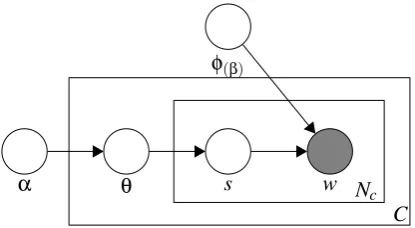
We can place sense induction in a probabilis-tic setting by modeling the context words around the ambiguous target as samples from a multino-mial sense distribution. More formally, we will
write P(s) for the distribution over senses s of
an ambiguous target in a specific context
win-dow and P(w|s) for the probability distribution
over context wordswgiven senses. Each wordwi
in the context window is generated by first sam-pling a sense from the sense distribution, then choosing a word from the sense-context
distribu-tion.P(si= j)denotes the probability that the jth
sense was sampled for the ith word token and
P(wi|si= j)the probability of context wordwi
un-der sense j. The model thus specifies a distribution
over words within a context window:
P(wi) =
S
∑
j=1
P(wi|si= j)P(si= j) (1)
whereSis the number of senses. We assume that
each target word hasCcontexts and each contextc
α θ s w Nc
C
[image:3.595.312.520.61.175.2]φ(β)
Figure 1: Bayesian sense induction model; shaded nodes represent observed variables, unshaded nodes indicate latent variables. Arrows indi-cate conditional dependencies between variables, whereas plates (the rectangles in the figure) refer to repetitions of sampling steps. The variables in the lower right corner refer to the number of sam-ples.
consists ofNcword tokens. We shall writeφ(j)as a
shorthand forP(wi|si=j), the multinomial
distri-bution over words for sense j, andθ(c)as a
short-hand for the distribution of senses in contextc.
Following Blei et al. (2003) we will assume that
the mixing proportion over sensesθis drawn from
a Dirichlet prior with parameters α. The role of
the hyperparameterαis to create a smoothed sense
distribution. We also place a symmetric Dirichletβ
on φ (Griffiths and Steyvers, 2002). The
hyper-parmeterβcan be interpreted as the prior
observa-tion count on the number of times context words are sampled from a sense before any word from the corpus is observed. Our model is represented in graphical notation in Figure 1.
α θ
s f Nc
1
C
s f
Nc2
.. .
s f
Ncn
φ1(β1)
φ2(β2)
[image:4.595.73.293.59.276.2]φn(βn)
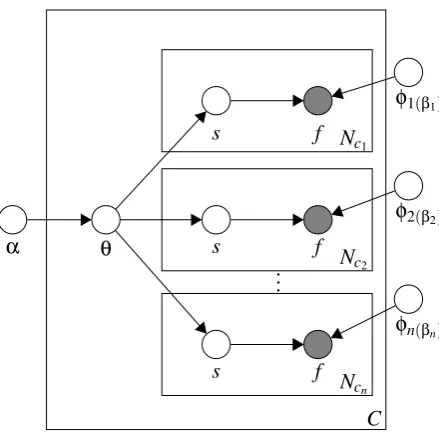
Figure 2: Extended sense induction model; inner rectangles represent different sources (layers) of information. All layers share the same, instance-specific, sense distribution (θ), but each have their own (multinomial) sense-feature distribution (φ).
Shaded nodes represent observed features f; these
can be words, parts of speech, collocations or de-pendencies.
smaller ones (e.g. 1 word window).
Our solution is to treat each information source (or feature type) individually and then combine all of them together in a unified model. Our un-derlying assumption is that the context window around the target word can have multiple represen-tations, all of which share the same sense distribu-tion. We illustrate this in Figure 2 where each inner rectangle (layer) corresponds to a distinct feature type. We will naively assume independence be-tween multiple layers, even though this is clearly not the case in our task. The idea here is to model each layer as faithfully as possible to the empirical data while at the same time combining information from all layers in estimating the sense distribution of each target instance.
4 Inference
Our inference procedure is based on Gibbs sam-pling (Geman and Geman, 1984). The procedure begins by randomly initializing all unobserved random variables. At each iteration, each random
variablesi is sampled from the conditional
distri-bution P(si|s−i) where s−i refers to all variables
other thansi. Eventually, the distribution over
sam-ples drawn from this process will converge to the
unconditional joint distributionP(s) of the
unob-served variables (provided certain criteria are ful-filled).
In our model, each element in each layer is a variable, and is assigned a sense label (see Fig-ure 2, where distinct layers correspond to differ-ent represdiffer-entations of the context around the tar-get word). From these assignments, we must de-termine the sense distribution of the instance as a whole. This is the purpose of the Gibbs sampling procedure. Specifically, in order to derive the up-date function used in the Gibbs sampler, we must
provide the conditional probability of thei-th
vari-able being assigned sense si in layer l, given the
feature value fiof the context variable and the
cur-rent sense assignments of all the other variables in the data (s−i):
p(si|s−i,f)∝p(fi|s,f−i,β)·p(si|s−i,α) (2)
The probability of a single sense assignment, si,
is proportional to the product of the likelihood (of
feature fi, given the rest of the data) and the prior
probability of the assignment.
(3)
p(fi|s,f−i,β) =
Z
p(fi|l,s,φ)·p(φ|f−i,βl)dφ=
#(fi,si) +βl
#(si) +Vl·βl
For the likelihood term p(fi|s,f−i,β), integrating
over all possible values of the multinomial
feature-sense distributionφgives us the rightmost term in
Equation 3, which has an intuitive interpretation.
The term #(fi,si) indicates the number of times
the feature-value fi was assigned sense si in the
rest of the data. Similarly, #(si)indicates the
num-ber of times the sense assignmentsiwas observed
in the data.βlis the Dirichlet prior for the
feature-sense distribution φin the current layerl, andVl
is the size of the vocabulary of that layer, i.e., the number of possible feature values in the layer. In-tuitively, the probability of a feature-value given a sense is directly proportional to the number of times we have seen that value and that sense-assignment together in the data, taking into
ac-count a pseudo-ac-count prior, expressed throughβ.
This can also be viewed as a form of smoothing. A similar approach is taken with regards to the
prior probability p(si|s−i,α). In this case,
how-ever, all layers must be considered:
p(si|s−i,α) =
∑
l
Hereλlis the weight for the contribution of layerl,
andαl is the portion of the Dirichlet prior for the
sense distribution θin the current layer. Treating
each layer individually, we integrate over the
pos-sible values ofθ, obtaining a similar count-based
term:
(5)
p(si|l,s−i,αl) =
Z
p(si|l,s−i,θ)·p(θ|f−i,αl)dθ=
#l(si) +αl
#l+S·αl
where #l(si) indicates the number of elements in
layerlassigned the sensesi, #lindicates the
num-ber of elements in layerl, i.e., the size of the layer
andSthe number of senses.
To distribute the pseudo counts represented by
α in a reasonable fashion among the layers, we
defineαl=##ml ·αwhere #m=∑l#l, i.e., the total
size of the instance. This distributes α according
to the relative size of each layer in the instance.
p(si|l,s−i,αl)=
#l(si) +##ml ·α
#l+S· #l #m·α
=#m·
#l(si)
#l +α
#m+S·α (6)
Placing these values in Equation 4 we obtain the following:
p(si|s−i,α) =
#m·∑lλl·# l(si)
#l +α
#m+S·α (7)
Putting it all together, we arrive at the final update equation for the Gibbs sampling:
p(si|s−i,f)∝
#(fi,si) +βl
#(si) +Vl·βl
·#m·∑lλl· #l(si)
#l +α
#m+S·α (8)
Note that when dealing with a single layer, Equa-tion 8 collapses to:
p(si|s−i,f)∝
#(fi,si) +β
#(si) +V·β·
#m(si) +α
#m+S·α (9)
where #m(si) indicates the number of elements
(e.g., words) in the context window assigned to
sense si. This is identical to the update equation
in the original, word-based LDA model.
The sampling algorithm gives direct estimates
ofs for every context element. However, in view
of our task, we are more interested in estimatingθ,
the sense-context distribution which can be ob-tained as in Equation 7, but taking into account all sense assignments, without removing
assign-menti. Our system labels each instance with the
single, most probable sense.
5 Evaluation Setup
In this section we discuss our experimental set-up for assessing the performance of the model pre-sented above. We give details on our training pro-cedure, describe our features, and explain how our system output was evaluated.
Data In this work, we focus solely on inducing
senses for nouns, since they constitute the largest portion of content words. For example, nouns rep-resent 45% of the content words in the British Na-tional Corpus. Moreover, for many tasks and ap-plications (e.g., web queries, Jansen et al. 2000) nouns are the most frequent and most important part-of-speech.
For evaluation, we used the Semeval-2007 benchmark dataset released as part of the sense induction and discrimination task (Agirre and Soroa, 2007). The dataset contains texts from the Penn Treebank II corpus, a collection of articles from the first half of the 1989 Wall Street Jour-nal (WSJ). It is hand-annotated with OntoNotes senses (Hovy et al., 2006) and has 35 nouns. The average noun ambiguity is 3.9, with a high (almost 80%) skew towards the predominant sense. This is not entirely surprising since OntoNotes senses are less fine-grained than WordNet senses.
We used two corpora for training as we wanted to evaluate our model’s performance across differ-ent domains. The British National Corpus (BNC) is a 100 million word collection of samples of written and spoken language from a wide range of sources including newspapers, magazines, books (both academic and fiction), letters, and school es-says as well as spontaneous conversations. This served as our out-of-domain corpus, and con-tained approximately 730 thousand instances of the 35 target nouns in the Semeval lexical sample. The second, in-domain, corpus was built from se-lected portions of the Wall Street Journal. We used all articles (excluding the Penn Treebank II por-tion used in the Semeval dataset) from the years 1987-89 and 1994 to create a corpus of similar size to the BNC, containing approximately 740 thou-sand instances of the target words.
Additionally, we used the Senseval 2 and 3 lex-ical sample data (Preiss and Yarowsky, 2001; Mi-halcea and Edmonds, 2004) as development sets, for experimenting with the hyper-parameters of our model (see Section 6).
Evaluation Methodology Agirre and Soroa
scheme, the system output is compared to the gold standard using standard clustering evalua-tion metrics (e.g., purity, entropy). Here, no at-tempt is made to match the induced senses against the labels of the gold standard. Under the second scheme, the gold standard is partitioned into a test and training corpus. The latter is used to derive a mapping of the induced senses to the gold stan-dard labels. The mapping is then used to calculate the system’s F-Score on the test corpus.
Unfortunately, the first scheme failed to dis-criminate among participating systems. The one-cluster-per-word baseline outperformed all sys-tems, except one, which was only marginally bet-ter. The scheme ignores the actual labeling and due to the dominance of the first sense in the data, encourages a single-sense approach which is fur-ther amplified by the use of a coarse-grained sense inventory. For the purposes of this work, there-fore, we focused on the second evaluation scheme. Here, most of the participating systems outper-formed the most-frequent-sense baseline, and the rest obtained only slightly lower scores.
Feature Space Our experiments used a feature set designed to capture both immediate local con-text, wider context and syntactic context. Specifi-cally, we experimented with six feature categories:
±10-word window (10w),±5-word window (5w),
collocations (1w), word n-grams (ng), part-of-speech n-grams (pg) and dependency relations (dp). These features have been widely adopted in various WSD algorithms (see Lee and Ng 2002 for a detailed evaluation). In all cases, we use the lem-matized version of the word(s).
The Semeval workshop organizers provided a small amount of context for each instance (usu-ally a sentence or two surrounding the sentence containing the target word). This context, as well as the text in the training corpora, was parsed us-ing RASP (Briscoe and Carroll, 2002), to extract part-of-speech tags, lemmas, and dependency in-formation. For instances containing more than one occurrence of the target word, we disambiguate the first occurrence. Instances which were not cor-rectly recognized by the parser (e.g., a target word labeled with the wrong lemma or part-of-speech), were automatically assigned to the largest sense-cluster.3
3This was the case for less than 1% of the instances.
3 4 5 6 7 8 9
Number of Senses
83 84 85 86 87 88
F-Score (%)
[image:6.595.310.517.68.227.2]In-Domain (WSJ) Out-of-Domain (BNC)
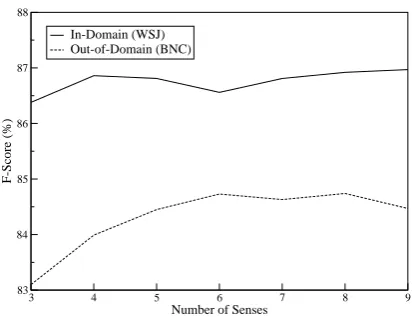
Figure 3: Model performance with varying num-ber of senses on the WSJ and BNC corpora.
6 Experiments
Model Selection The framework presented in
Section 3 affords great flexibility in modeling the empirical data. This however entails that several parameters must be instantiated. More precisely, our model is conditioned on the Dirichlet
hyper-parametersα and βand the number of senses S.
Additional parameters include the number of iter-ations for the Gibbs sampler and whether or not the layers are assigned different weights.
Our strategy in this paper is to fix α and β
and explore the consequences of varying S. The
value for the α hyperparameter was set to 0.02.
This was optimized in an independent tuning ex-periment which used the Senseval 2 (Preiss and Yarowsky, 2001) and Senseval 3 (Mihalcea and Edmonds, 2004) datasets. We experimented with
αvalues ranging from 0.005 to 1. Theβ
parame-ter was set to 0.1 (in all layers). This value is often considered optimal in LDA-related models (Grif-fiths and Steyvers, 2002). For simplicity, we used uniform weights for the layers. The Gibbs sampler was run for 2,000 iterations. Due to the random-ized nature of the inference procedure, all reported results are average scores over ten runs.
de-Senses ofdrug(WSJ)
1. U.S., administration, federal, against, war, dealer 2. patient, people, problem, doctor, company, abuse 3. company, million, sale, maker, stock, inc. 4. administration, food, company, approval, FDA
Senses ofdrug(BNC)
1. patient, treatment, effect, anti-inflammatory 2. alcohol, treatment, patient, therapy, addiction 3. patient, new, find, effect, choice, study 4. test, alcohol, patient, abuse, people, crime 5. trafficking, trafficker, charge, use, problem 6. abuse, against, problem, treatment, alcohol 7. people, wonder, find, prescription, drink, addict 8. company, dealer, police, enforcement, patient
Table 1: Senses inferred for the word drug from
the WSJ and BNC corpora.
tail). For the model trained on WSJ, performance peaks at four senses, which is similar to the av-erage ambiguity in the test data. For the model trained on the BNC, however, the best results are obtained using twice as many senses. Using fewer senses with the BNC-trained system can result in a drop in accuracy of almost 2%. This is due to the shift in domain. As the sense-divisions of the learning domain do not match those of the target domain, finer granularity is required in order to en-compass all the relevant distinctions.
Table 1 illustrates the senses inferred for the
word drugwhen using the in-domain and
out-of-domain corpora, respectively. The most probable words for each sense are also shown. Firstly, note that the model infers some plausible senses for
drug on the WSJ corpus (top half of Table 1).
Sense 1 corresponds to the “enforcement” sense
ofdrug, Sense 2 refers to “medication”, Sense 3
to the “drug industry” and Sense 4 to “drugs
re-search”. The inferred senses fordrugon the BNC
(bottom half of Table 1) are more fine grained. For example, the model finds distinct senses for “med-ication” (Sense 1 and 7) and “illegal substance” (Senses 2, 4, 6, 7). It also finds a separate sense for “drug dealing” (Sense 5) and “enforcement” (Sense 8). Because the BNC has a broader fo-cus, finer distinctions are needed to cover as many senses as possible that are relevant to the target do-main (WSJ).
Layer Analysis We next examine which
indi-vidual feature categories are most informative in our sense induction task. We also investigate whether their combination, through our layered
1-Layer 10w 86.9
5w 86.8
1w 84.6
ng 83.6
pg 82.5
dp 82.2
MFS 80.9
5-Layers -10w 83.1
-5w 83.0
-1w 83.0
-ng 83.0
-pg 82.7
-dp 84.7
all 83.3
Combination
10w+5w 87.3%
5w+pg 83.9%
1w+ng 83.2%
10w+pg 83.3%
1w+pg 84.5%
10w+pg+dep 82.2%
[image:7.595.314.520.62.172.2]MFS 80.9%
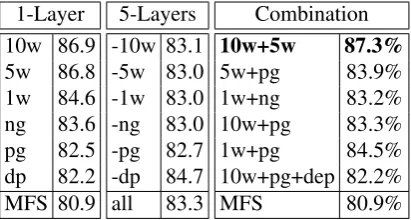
Table 2: Model performance (F-score) on the WSJ with one layer (left), five layers (middle), and se-lected combinations of layers (right).
model (see Figure 2), yields performance im-provements. We used 4 senses for the system trained on WSJ and 8 for the system trained on
the BNC (αwas set to 0.02 andβto 0.1)
Table 2 (left side) shows the performance of our model when using only one layer. The layer
com-posed of words co-occurring within a±10-word
window (10w), and representing wider, topical, in-formation gives the highest scores on its own. It
is followed by the ±5 (5w) and ±1 (1w) word
windows, which represent more immediate, local context. Part-of-speech grams (pg) and word n-grams (ng), on their own, achieve lower scores, largely due to over-generalization and data sparse-ness, respectively. The lowest-scoring single layer is the dependency layer (dp), with performance only slightly above the most-frequent-sense base-line (MFS). Dependency information is very infor-mative when present, but extremely sparse.
Table 2 (middle) also shows the results obtained when running the layered model with all but one of the layers as input. We can use this informa-tion to determine the contribuinforma-tion of each layer by comparing to the combined model with all layers (all). Because we are dealing with multiple lay-ers, there is an element of overlap involved. There-fore, each of the word-window layers, despite rel-atively high informativeness on its own, does not cause as much damage when it is absent, since the other layers compensate for the topical and lo-cal information. The absence of the word n-gram layer, which provides specific local information, does not make a great impact when the 1w and pg layers are present. Finally, we can see that the ex-tremely sparse dependency layer is detrimental to the multi-layer model as a whole, and its removal
1-Layer 10w 84.6
5w 84.6
1w 83.6
pg 83.1
ng 82.8
dp 81.1
MFS 80.9
5-Layers -10w 83.3
-5w 82.8
-1w 83.5
-pg 83.2
-ng 82.9
-dp 84.7
all 84.1
Combination
10w+5w 85.5%
5w+pg 83.5%
1w+ng 83.5%
10w+pg 83.4%
1w+pg 84.1%
10w+pg+dep 81.7%
[image:8.595.351.482.60.131.2]MFS 80.9%
Table 3: Model performance (F-score) on the BNC with one layer (left), five layers (middle), and se-lected combinations of layers (right).
of the sense distribution, which confuses the com-bined model.
Other layer combinations obtained similar re-sults. Table 2 (right side) shows the most informa-tive two and three layer combinations. Again, de-pendencies tend to decrease performance. On the other hand, combining features that have similar performance on their own is beneficial. We obtain the best performance overall with a two layered model combining topical (+10w) and local (+5w) contexts.
Table 3 replicates the same suite of experiments on the BNC corpus. The general trends are similar. Some interesting differences are apparent, how-ever. The sparser layers, notably word n-grams and dependencies, fare comparatively worse. This is expected, since the more precise, local, infor-mation is likely to vary strongly across domains. Even when both domains refer to the same sense of a word, it is likely to be used in a different immediate context, and local contextual informa-tion learned in one domain will be less effective in the other. Another observable difference is that the combined model without the dependency layer does slightly better than each of the single layers. The 1w+pg combination improves over its compo-nents, which have similar individual performance. Finally, the best performing model on the BNC also combines two layers capturing wider (10w) and more local (5w) contextual information (see Table 3, right side).
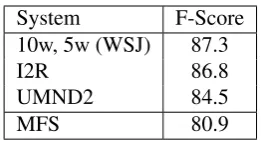
Comparison to State-of-the-Art Table 4 com-pares our model against the two best performing sense induction systems that participated in the Semeval-2007 competition. IR2 (Niu et al., 2007) performed sense induction using the Information Bottleneck algorithm, whereas UMND2
(Peder-sen, 2007) used k-means to cluster second order
co-occurrence vectors associated with the target
System F-Score
10w, 5w (WSJ) 87.3
I2R 86.8
UMND2 84.5
[image:8.595.77.286.62.172.2]MFS 80.9
Table 4: Comparison of the best-performing Semeval-07 systems against our model.
word. These models and our own model signif-icantly outperform the most-frequent-sense
base-line (p < 0.01 using a χ2 test). Our best
sys-tem (10w+5w on WSJ) is significantly better than
UMND2 (p<0.01) and quantitatively better than
IR2, although the difference is not statistically sig-nificant.
7 Discussion
This paper presents a novel Bayesian approach to sense induction. We formulated sense induction in a generative framework that describes how the contexts surrounding an ambiguous word might be generated on the basis of latent variables. Our model incorporates features based on lexical in-formation, parts of speech, and dependencies in a principled manner, and outperforms state-of-the-art systems. Crucially, the approach is not specific to the sense induction task and can be adapted for other applications where it is desirable to take mul-tiple levels of information into account. For exam-ple, in document classification, one could consider an accompanying image and its caption as possi-ble additional layers to the main text.
In the future, we hope to explore more rigor-ous parameter estimation techniques. Goldwater and Griffiths (2007) describe a method for inte-grating hyperparameter estimation into the Gibbs sampling procedure using a prior over possible values. Such an approach could be adopted in our framework, as well, and extended to include the layer weighting parameters, which have strong po-tential for improving the model’s performance. In addition, we could allow an infinite number of senses and use an infinite Dirichlet model (Teh et al., 2006) to automatically determine how many senses are optimal. This provides an elegant so-lution to the model-order problem, and eliminates the need for external cluster-validation methods.
Acknowledgments The authors acknowledge
References
Agirre, Eneko, Llu´ıs M`arquez, and Richard Wicentowski, ed-itors. 2007. Proceedings of the SemEval-2007. Prague, Czech Republic.
Agirre, Eneko and Aitor Soroa. 2007. Semeval-2007 task 02: Evaluating word sense induction and discrimination systems. InProceedings of SemEval-2007. Prague, Czech Republic, pages 7–12.
Barnard, K., P. Duygulu, D. Forsyth, N. De Freitas, D. M. Blei, and M. I. Jordan. 2003. Matching words and pictures.
J. of Machine Learning Research3(6):1107–1135. Blei, David M., Andrew Y. Ng, and Michael I. Jordan. 2003.
Latent dirichlet allocation. Journal of Machine Learning Research3:993–1022.
Bordag, Stefan. 2006. Word sense induction: Triplet-based clustering and automatic evaluation. InProceedings of the 11th EACL. Trento, Italy, pages 137–144.
Boyd-Graber, Jordan and David Blei. 2007. Putop: Turning predominant senses into a topic model for word sense dis-ambiguation. In Proceedings of SemEval-2007. Prague, Czech Republic, pages 277–281.
Boyd-Graber, Jordan, David Blei, and Xiaojin Zhu. 2007. A topic model for word sense disambiguation. In Pro-ceedings of the EMNLP-CoNLL. Prague, Czech Republic, pages 1024–1033.
Briscoe, Ted and John Carroll. 2002. Robust accurate statis-tical annotation of general text. InProceedings of the 3rd LREC. Las Palmas, Gran Canaria, pages 1499–1504. Cai, J. F., W. S. Lee, and Y. W. Teh. 2007. Improving word
sense disambiguation using topic features. InProceedings of the EMNLP-CoNLL. Prague, Czech Republic, pages 1015–1023.
Carpuat, Marine and Dekai Wu. 2005. Word sense disam-biguation vs. statistical machine translation. In Proceed-ings of the 43rd ACL. Ann Arbor, MI, pages 387–394. Dorow, Beate and Dominic Widdows. 2003. Discovering
corpus-specific word senses. InProceedings of the 10th EACL. Budapest, Hungary, pages 79–82.
Firth, J. R. 1957.A Synopsis of Linguistic Theory 1930-1955. Oxford: Philological Society.
Gauch, Susan and Robert P. Futrelle. 1993. Experiments in automatic word class and word sense identification for in-formation retrieval. InProceedings of the 3rd Annual Sym-posium on Document Analysis and Information Retrieval. Las Vegas, NV, pages 425–434.
Geman, S. and D. Geman. 1984. Stochastic relaxation, Gibbs distribution, and Bayesian restoration of images. IEEE Transactions on Pattern Analysis and Machine Intelli-gence6(6):721–741.
Goldwater, Sharon and Tom Griffiths. 2007. A fully Bayesian approach to unsupervised part-of-speech tagging. In Pro-ceedings of the 45th ACL. Prague, Czech Republic, pages 744–751.
Griffiths, Thomas L., Mark Steyvers, David M. Blei, and Joshua B. Tenenbaum. 2005. Integrating topics and syn-tax. In Lawrence K. Saul, Yair Weiss, and L´eon Bottou, editors,Advances in Neural Information Processing Sys-tems 17, MIT Press, Cambridge, MA, pages 537–544. Griffiths, Tom L. and Mark Steyvers. 2002. A probabilistic
approach to semantic representation. InProeedings of the 24th Annual Conference of the Cognitive Science Society. Fairfax, VA, pages 381–386.
Hovy, Eduard, Mitchell Marcus, Martha Palmer, Lance Ramshaw, and Ralph Weischedel. 2006. Ontonotes: The 90% solution. InProceedings of the HLT, Companion Vol-ume: Short Papers. Association for Computational Lin-guistics, New York City, USA, pages 57–60.
Jansen, B. J., A. Spink, and A. Pfaff. 2000. Linguistic aspects of web queries.
Lee, Yoong Keok and Hwee Tou Ng. 2002. An empirical evaluation of knowledge sources and learning algorithms for word sense disambiguation. In Proceedings of the EMNLP. Morristown, NJ, USA, pages 41–48.
McCarthy, Diana, Rob Koeling, Julie Weeds, and John Car-roll. 2004. Finding predominant senses in untagged text. InProceedings of the 42nd ACL. Barcelona, Spain, pages 280–287.
Mihalcea, Rada and Phil Edmonds, editors. 2004. Proceed-ings of the SENSEVAL-3. Barcelona.
Niu, Zheng-Yu, Dong-Hong Ji, and Chew-Lim Tan. 2007. I2r: Three systems for word sense discrimination, chinese word sense disambiguation, and english word sense dis-ambiguation. InProceedings of the Fourth International Workshop on Semantic Evaluations (SemEval-2007). As-sociation for Computational Linguistics, Prague, Czech Republic, pages 177–182.
Pantel, Patrick and Dekang Lin. 2002. Discovering word senses from text. In Proceedings of the 8th KDD. New York, NY, pages 613–619.
Pedersen, Ted. 2007. Umnd2 : Senseclusters applied to the sense induction task of senseval-4. In Proceedings of SemEval-2007. Prague, Czech Republic, pages 394–397. Preiss, Judita and David Yarowsky, editors. 2001.
Proceed-ings of the 2nd International Workshop on Evaluating Word Sense Disambiguation Systems. Toulouse, France. Purandare, Amruta and Ted Pedersen. 2004. Word sense
dis-crimination by clustering contexts in vector and similarity spaces. InProceedings of the CoNLL. Boston, MA, pages 41–48.
Sch¨utze, Hinrich. 1998. Automatic word sense discrimina-tion.Computational Linguistics24(1):97–123.
Teh, Y. W., M. I. Jordan, M. J. Beal, and D. M. Blei. 2006. Hierarchical Dirichlet processes.Journal of the American Statistical Association101(476):1566–1581.
V´eronis, Jean. 2004. Hyperlex: lexical cartography for information retrieval. Computer Speech & Language
18(3):223–252.
Vickrey, David, Luke Biewald, Marc Teyssier, and Daphne Koller. 2005. Word-sense disambiguation for machine translation. InProceedings of the HLT/EMNLP. Vancou-ver, pages 771–778.