Proceedings of the 2013 Conference on Empirical Methods in Natural Language Processing, pages 244–254,
Interactive Machine Translation using Hierarchical Translation Models
Jes ´us Gonz´alez-Rubio, Daniel Ortiz-Mart´ınez, Jos´e-Miguel Bened´ı, Francisco Casacuberta D. de Sistemas Inform´aticos y Computaci´on
Universitat Polit`ecnica de Val`encia Camino de Vera s/n, 46021 Valencia (Spain)
{jegonzalez,dortiz,jbenedi,fcn}@dsic.upv.es
Abstract
Current automatic machine translation sys-tems are not able to generate error-free trans-lations and human intervention is often re-quired to correct their output. Alternatively, an interactive framework that integrates the human knowledge into the translation pro-cess has been presented in previous works. Here, we describe a new interactive ma-chine translation approach that is able to work with phrase-based and hierarchical translation models, and integrates error-correction all in a unified statistical framework. In our experi-ments, our approach outperforms previous in-teractive translation systems, and achieves es-timated effort reductions of as much as48% relative over a traditional post-edition system.
1 Introduction
Research in the field of machine translation (MT) aims to develop computer systems which are able to translate between languages automatically, with-out human intervention. However, the quality of the translations produced by any automatic MT sys-tem still remain below than that of human transla-tion. Typical solutions to reach human-level quality require a subsequent manual post-editing process. Such decoupled post-edition solution is rather inef-ficient and tedious for the human translator. More-over, it prevents the MT system from taking advan-tage of the knowledge of the human translator and, reciprocal, the human translator cannot take advan-tage of the adapting ability of MT technology.
An alternative way to take advantage of the exist-ing MT technology is to use them incollaboration with human translators within a computer-assisted
translation(CAT) orinteractiveframework (Isabelle and Church, 1998). TheTransTypeandTransType2 projects (Foster et al., 1998; Langlais and Lapalme, 2002; Barrachina et al., 2009) entailed an interesting focus shift in CAT technology by aiming interaction directly at the production of the target text. These research projects proposed to embed an MT system within an interactive translation environment. This way, the human translator can ensure a high-quality output while the MT system ensures a significant gain of productivity. Particularly interesting is the interactive machine translation(IMT) approach pro-posed in (Barrachina et al., 2009). In this scenario, a statistical MT (SMT) system uses the source sen-tence and a previously validated part (prefix1) of its translation to propose a suitable continuation. Then the user finds and corrects the next system error, thereby providing a longer prefix which the system uses to suggests a new, hopefully better continua-tion. The reported results showed that IMT can save a significant amount of human effort.
Barrachina et al,. (2009) provide a thorough de-scription of the IMT approach and describe algo-rithms for its practical implementation. Neverthe-less, we identify two basic problems for which we think there is room for improvement. The first prob-lem arises when the system cannot generate the pre-fix validated by the user. To solve this problem, the authors simply provide an ad-hoc heuristic error-correction technique. The second problem is how the system deals with word reordering. Particularly, the models used by the system were either
mono-1
We use the terms prefix and suffix to denote any sub-string at the beginning and end respectively of a string of characters (including spaces and punctuation). These terms do not imply any morphological significance as they usually do in linguistics.
tonic by nature or non-monotonic but heuristically defined (not estimated from training data).
We work on the foundations of Barrachina et al., (2009) and provide formal solutions to these two challenges. On the one hand, we adopt the statistical formalization of the IMT framework de-scribed in (Ortiz-Mart´ınez, 2011), which includes a stochastic error-correction model in its formaliza-tion to address prefix coverage problems. Moreover, we refine this formalization proposing an alternative error-correction formalization for the IMT frame-work (Section 2). Additionally, we also propose a specific error-correction model based on a statisti-cal interpretation of the Levenshtein distance (Lev-enshtein, 1966). These formalizations provide a unified statistical framework for the IMT model in comparison to the ad-hoc heuristic error-correction methods previously used.
In order to address the problem of properly deal with reordering in IMT, we introduce the use of hi-erarchical MT models (Chiang, 2005; Zollmann and Venugopal, 2006). These methods provide a natural approach to handle long range dependencies and al-low the incorporation of reordering information into a consistent statistical framework. Here, we also de-scribe how state-of-the-art hierarchical MT models can be extended to handle IMT (Sections 3 and 4).
We evaluate the proposed IMT approach on two different translation task. The comparative results against the IMT approach described by Barrachina et al., (2009) and a conventional post-edition ap-proach show that our IMT formalization for hier-archical SMT models indeed outperform other ap-proaches (Sections 5 and 6). Moreover, it leads to large reductions in the human effort required to gen-erate error-free translations.
2 Statistical Framework
2.1 Statistical Machine Translation
Assuming that we are given a sentencesin a source language, the translation problem can be stated as finding its translationtin a target language of max-imum probability (Brown et al., 1993):
ˆ
t= arg max t
Pr(t|s) (1)
= arg max t
Pr(t)·Pr(s|t) (2)
source(s): Para ver la lista de recursos desired translation(ˆt): To view a listing of resources
IT-0 p
ts To view the resources list
IT-1
p To view
k a
ts list of resources
IT-2
p To view a list
k list i
ts listing resources
IT-3
p To view a listing
k o
ts o f resources
[image:2.612.316.539.87.260.2]END p To view a listing of resources
Figure 1: IMT session to translate a Spanish sentence into English. The desired translation is the translation the hu-man user wants to obtain. At IT-0, the system suggests a translation (ts). At IT-1, the user moves the mouse to accept the first eight characters “To view” and presses the
a key (k), then the system suggests completing the sen-tence with “list of resources” (a newts). Iterations2and
3are similar. In the final iteration, the user accepts the current translation.
The terms in the latter equation are the lan-guage model probability Pr(t) that represents the well-formedness of t (n-gram models are usu-ally adopted), and the (inverted) translation model
Pr(s|t)that represents the relationship between the source sentence and its translation.
In practice all of these models (and possibly oth-ers) are often combined into alog-linear modelfor Pr(t|s)(Och and Ney, 2002):
ˆt= arg max t
( N
X
n=1
λn·log(fn(t,s)) )
(3)
wherefn(t,s)can be any model that represents an
important feature for the translation,N is the num-ber of models (or features), andλnare the weights
of the log-linear combination.
2.2 Statistical Interactive Machine Translation
paradigm (Barrachina et al., 2009). Under this paradigm, translation is considered as an iterative left-to-right process where the human and the com-puter collaborate to generate the final translation.
Figure 1 shows an example of the IMT approach. There, a source Spanish sentence s =”Para ver la lista de recursos” is to be translated into a target En-glish sentenceˆt. Initially, with no user feedback, the system suggests a complete translationts=”To view the resources list”. From this translation, the user marks a prefix p =”To view” as correct and begins to type the rest of the target sentence. Depending on the system or the user’s preferences, the user might type the full next word, or only some letters of it (in our example, the user types the single next charac-ter “a”). Then, the MT system suggests a new suffix
ts =“list of resources” that completes the validated
prefix and the input the user has just typed (p =”To view a”). The interaction continues with a new pre-fix validation followed, if necessary, by new input from the user, and so on, until the user considers the translation to be complete and satisfactory.
The crucial step of the process is the production of the suffix. Again decision theory tells us to max-imize the probability of the suffix given the avail-able information. Formally, the best suffix of a given length will be:
ˆ
ts= arg max ts
Pr(ts|s,p) (4)
which can be straightforwardly rewritten as:
ˆ
ts= arg max ts
Pr(p,ts|s) (5)
= arg max ts
Pr(p,ts)·Pr(s|p,ts) (6)
Note that, since p ts = t, this equation is very similar to Equation (2). The main difference is that now the search process is restricted to those target sentencest that containsp as prefix. This implies that we can use the same MT models (including the log-linear approach) if the search procedures are adequately modified (Och et al., 2003). Finally, it should be noted that the statistical models are usu-ally defined at word level, while the IMT process described in this section works at character level. To deal with this problem, during the search process it is necessary to verify the compatibility between t
andpat character level.
2.3 IMT with Stochastic Error-Correction
A common problem in IMT arises when the user sets a prefix which cannot be explained by the statistical models. To solve this problem, IMT systems typi-cally include ad-hoc error-correction techniques to guarantee that the suffixes can be generated (Bar-rachina et al., 2009). As an alternative to this heuris-tic approach, Ortiz-Mart´ınez (2011) proposed a for-malization of the IMT framework that does include stochastic error-correction models in its statistical formalization. The starting point of this alternative IMT formalization accounts for the problem of find-ing the translation t that, at the same time, better explains the source sentences and the prefix given by the userp:
ˆ
t= arg max t
Pr(t|s,p) (7)
= arg max t
Pr(t)·Pr(s,p|t) (8)
The following na¨ıve Bayes’ assumption is now made: the source sentencesand the user prefixpare statistically independent variables given the transla-tiont, obtaining:
ˆt= arg max t
Pr(t)·Pr(s|t)·Pr(p|t) (9)
wherePr(t) can be approximated with a language model,Pr(s |t)can be approximated with a trans-lation model, andPr(p | t) can be approximated by an error correction model that measures the com-patibility between the user-defined prefixp and the hypothesized translationt.
Note that the translation result,ˆt, given by Equa-tion (9) may not contain pas prefix because every translation is compatible withpwith a certain prob-ability. Thus, despite being close, Equation (9) is not equivalent to the IMT formalization in Equation (6). To solve this problem, we define an alignment,
a, between the user-defined prefix p and the hy-pothesized translationt, so that the unaligned words of t, in an appropriate order, constitute the suffix searched in IMT. This allows us to rewrite the error correction probability as follows:
Pr(p|t) =X a
Pr(p,a|t) (10)
Under this assumption, a determines an alignment fort, such thatt=tpts, wheretpis fully-aligned to pandtsremains unaligned. Taking all these things into consideration, and following a maximum ap-proximation, we finally arrive to the expression:
(ˆt,ˆa) = arg max t,a
Pr(t)·Pr(s|t)·Pr(p,a|t) (11)
where the suffix required in IMT is obtained as the portion ofˆtthat is not aligned with the user prefix.
In practice, we combine the models in Equa-tion (11) in a log-linear fashion as it is typically done in SMT (see Equation (3)).
2.4 Alternative Formalization for IMT with Stochastic Error-Correction
Alternatively to Equation (11), we can operate from Equation (9) and reach a different formalization for IMT with error-correction. We can re-write the first and last terms of Equation (9) as:
Pr(t)·Pr(p|t) = Pr(p)·Pr(t|p) (12)
As in the previous section, we introduce an align-ment variable,a, betweentandp, giving:
Pr(t|p) =X a
Pr(t,a|p) (13)
=X
a
Pr(a|p)·Pr(t|p,a) (14)
If we consider monotonic alignments, a defines again an alignment between a prefix of the system translation (tp) and the user prefix, producing the
suffix required in IMT (ts) as the unaligned part. Thus, we can re-writePr(t|p,a)as:
Pr(t|p,a) = Pr(tp,ts |p,a) (15)
≈Pr(tp|p,a)·Pr(ts|p,a) (16)
where Equation (16) has been obtained following a na¨ıve Bayes’ decomposition.
Combining equations (12), (14), and (16) into Equation (9), and following a maximum approxima-tion for the summaapproxima-tion of the alignment variablea, we arrive to the following expression:
(ˆt,aˆ) = arg max t,a
Pr(s|t)·Pr(tp|p,a)·Pr(ts|p,a) (17)
wherePr(p)andPr(a|p)have been dropped down because the former does not participate in the maxi-mization and the latter is assumed uniform.
The terms in this equation can be interpreted sim-ilarly as those in Equation (9):Pr(s|t)is the trans-lation model, Pr(tp | p,a) is the error-correction probability that measures the compatibility between the prefixtp of the hypothesized translation and the user-defined prefixp, andPr(ts | p,a) is the lan-guage model for the corresponding suffixts
condi-tioned by the user-defined prefix. Again, in the ex-periments we combine the different models in a log-linear fashion.
The main difference between the two alternative IMT formalization (Equations (11) and (17)) is that in the latter the suffix to be returned is conditioned by the user-validated prefix p. Thus, in the fol-lowing we will refer to Equation (11) as indepen-dent suffix formalizationwhile we will denote Equa-tion (17) byconditioned suffix formalization.
3 Statistical Models
We now present the statistical models used to esti-mate the probability distributions described in the previous section. Section 3.1 describes the error-correction model, while Section 3.2 describes the models for the conditional translation probability.
3.1 Statistical Error-Correction Model
Following the vast majority of IMT systems de-scribed in the literature, we implement an error-correction model based on the concept of edit dis-tance (Levenshtein, 1966). Typically, IMT systems use non-probabilistic error correction models. The first stochastic error correction model for IMT was proposed in (Ortiz-Mart´ınez, 2011) and it is based on probabilistic finite state machines. Here, we pro-pose a simpler approach which can be seen as a particular case of the previous one. Specifically, the proposed approach models the edit distance as a Bernoulli process where each character of the candi-date string has a probabilitype of being erroneous.
Under this interpretation, the number of characters that need to be edited E in a sentence of lengthn is a random variable that follows a binomial distri-bution, E ∼ B(n, pe), with parameters n and pe.
sentence of n characters is given by the following probability mass function:
f(k;n, pe) =
n! k!(n−k)!p
k
e(1−pe)n−k (18)
Note that this error-correction model penalizes equally all edit operations. Alternatively, we can model the distance with a multinomial distribution and assign different probabilities to different types of edit operations. Nevertheless, we adhere to the binomial approximation due to its simplicity.
Finally, we compute the error-correction proba-bility between two strings from the total number of edits required to transform the candidate translation into the reference translation. Specifically, we define the error-correction distribution in Equation (11) as:
Pr(p,a|t)≈ |p|! k!(|p| −k)!p
k
e(1−pe)|p|−k (19)
where k = Lev(p,ta) is the character-level Lev-enshtein distance between the user defined prefixp
and the prefixta of the hypothesized translation t defined by alignmenta. The error-correction prob-abilityPr(tp | p,a) in Equation (17) is computed
analogously.
The probability of editionpeis the single free
pa-rameter of this formulation. We will use a separate development corpus to find an adequate value for it.
3.2 Statistical Machine Translation Models
Next sections briefly describe the statistical transla-tion models used to estimate the conditransla-tional proba-bility distributionPr(s | t). A detailed description of each model can be found in the provided citations.
3.2.1 Phrase-Based Translation Models
Phrase-based translation models (Koehn et al., 2003) are an instance of the noisy-channel approach in Equation (2). The translation of a source sentence
sis obtained through a generative process composed of three steps: first, thesis divided intoKsegments (phrases), next, each source phrase,˜s, is translated into a target phrase˜t, and finally the target phrases are reordered to compose the final translation.
The usual phrase-based implementation of the translation probability takes a log-linear form:
Pr(s|t)≈λ1· |t|+λ2·K+
K
X
k=1
λ3·log(P(˜sk|˜tk)) +λ4·d(j)
(20)
whereP(˜s|˜t)is the translation probability between source phrase˜s and target phrase ˜t, and d(j) is a function (distortion model) that returns the score of translating thek-th source phrase given that it is sep-aratedjwords from the(k−1)-th phrase. Weightsλ1
andλ2play a special role since they are used to
con-trol the number of words and the number of phrases of the target sentence to be generated, respectively.
3.2.2 Hierarchical Translation Models
Phrase-based models have shown a very strong performance when translating between languages that have similar word orders. However, they are not able to adequately capture the complex relationships that exist between the word orders of languages of different families such as English and Chinese. Hi-erarchical translation models provide a solution to this challenge by allowing gaps in the phrases (Chi-ang, 2005):
yuX1youX2→haveX2withX1
where subscripts denote placeholders for sub-phrases. Since these rules generalize over possi-ble phrases, they act as discontinuous phrase pairs and may also act as phrase-reordering rules. Hence, they are not only considerably more powerful than conventional phrase pairs, but they also integrate re-ordering information into a consistent framework.
These hierarchical phrase pairs are formalized as rewrite rules of a synchronous context-free grammar (CFG) (Aho and Ullman, 1969):
X→<γ,α,∼> (21)
whereXis a non-terminal,γandαare both strings of terminals (words) and non-terminals , and ∼ is a one-to-one correspondence between non-terminal occurrences inγ andα. Given the example above,
γ≡“yuX1youX2”,α≡“haveX2withX1”, and∼
is indicated by the subscript numbers.
Additionally, twoglue rulesare also defined:
These give the model the option to build only par-tial translations using hierarchical phrases, and then combine them serially as in a phrase-based model.
The typical implementation of the hierarchical translation model also takes the form of a log-linear model. Letsδandtδbe the source and target strings
generated by a derivation δof the grammar. Then, the conditional translation probability is given by:
Pr(sδ |tδ)≈λ1· |tδ|+λ2· |δ|+λ3·#g(δ)+
X
r∈δ
[λ4·w(r)] (22)
where |δ| denotes the total number of rules used in δ, #g(δ) returns the number of applications of
the glue rules, r ∈ δ are the rules in δ, andw(r) is the weight of rule r. Weights λ1 and λ2 have
a similar interpretation as for phrase-based models, they respectively give some control over the total number of words and rules that conform the trans-lation. Additionally,λ3controls the model’s
prefer-ence for hierarchical phrases over serial combination of phrases. Note that no distortion model is included in the previous equation. Here, reordering is defined at rule level by the one-to-one non-terminal corre-spondence. In other words, reordering is a property inherent to each rule and it is the individual score of each rule what defines, at each step of the derivation, the importance of reordering.
It should be noted that the IMT formalizations presented in Section 2 can be applied to other hier-archical or syntax-based SMT models such as those described in (Zollmann and Venugopal, 2006; Shen et al., 2010).
4 Search
In offline MT, the generation of the best trans-lation for a given source sentence is carried out by incrementally generating the target sentence2. This process fits nicely into a dynamic program-ming(DP) (Bellman, 1957) framework, as hypothe-ses which are indistinguishable by the models can be recombined. Since the DP search space grows exponentially with the size of the input, standard DP search is prohibitive, and search algorithms usually resort to a beam-search heuristic (Jelinek, 1997).
2Phrase-based systems follow a left-to-right generation or-der while hierarchical systems rely on a CYK-like oror-der.
6
1
5
I saw a man with a telescope
2
3
4
[image:6.612.318.528.58.193.2]I saw a man with a telescope I saw with a telescope a man
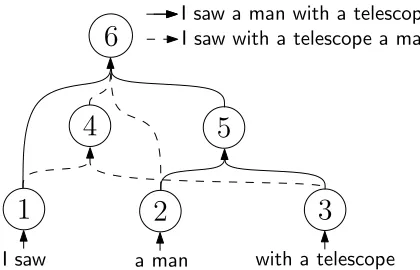
Figure 2: Example of a hypergraph encoding two differ-ent translations (one solid and one dotted) for the Spanish sentence “Vi a un hombre con un telescopio”.
Due to the demanding temporal constraints inher-ent to any interactive environminher-ent, performing a full search each time the user validates a new prefix is unfeasible. The usual approach is to rely on a certain representation of the search space that includes the most probable translations of the source sentence. The computational cost of this approach is much lower, as the whole search for the translation must be carried out only once, and the generated represen-tation can be reused for further completion requests. Next, we introduce hypergraphs, the formalism chosen to represent the search space of both phrase-based and hierarchical systems (Section 4.1). Then, we describe the algorithms implemented to search for suffix completions in them (Section 4.2).
4.1 Hypergraphs
shown in Figure 2. Two alternative translations are constructed from the leave nodes (1, 2 and 3) up to the root node (6) of the hypergraph. Additionally, hypernodes and hyperedges may be shared among different derivations if they represent the same in-formation. Thus, we can achieve a compact repre-sentation of the translation space that allows us to derive efficient search algorithms.
Note that word-graphs (Ueffing et al., 2002), which are used to represent the search space for phrase-based models, are a special case of hyper-graphs in which the maximum arity is one. Thus, hypergraphs allow us to represent both phrase-based and hierarchical systems in a unified framework.
4.2 Suffix Search on Hypergraphs
Now, we describe a unified search process to obtain the suffixts that completes a prefix pgiven by the
user according to the two IMT formulations (Equa-tion (11) and Equa(Equa-tion (17)) described in Sec(Equa-tion 2. Given an hypergraph, certain hypernodes define a possible solution to the maximization defined in the two IMT formulations. Specifically, only those hy-pernodes that generate a prefix of a potential trans-lation are to be taken into account3. The prob-ability of the solution defined by each hypernode has two components, namely the probability of the SMT model (given by the language and translation models) and the probability of the error-correction model. On the one hand, the SMT model ity is given by the translation of maximum probabil-ity through the hypernode. On the other hand, the error-correction probability is computed betweenp
and the partial translation of maximum probability actually covered by the hypernode. Among all the solutions defined by the hypernodes, we finally se-lect that of maximum probability.
Once the best-scoring hypernode is identified, the rest of the translation not covered by it is returned as the suffix completion required in IMT.
5 Experimental Framework
The models and search procedure introduced in the previous sections were assessed through a series of
3
For example, in Figure 2 the hypernodes that generate pre-fixes are those labeled with numbers 1 (“I saw”), 4 (“I saw with a telescope) and 6 (“I saw a man with a telescope” and “I saw with a telescope a man”).
EU (Es/En)
Train Development Test
Sentences 214K 400 800
Token 5.9M / 5.2M 12K / 10K 23K / 20K Vocabulary 97K / 84K 3K / 3K 5K / 4K
TED (Zh/En)
Train Development Test
Sentences 107K 934 1664
[image:7.612.317.538.61.206.2]Token 2M / 2M 22K / 20K 33K / 32K Vocabulary 42K / 52K 4K / 3K 4K / 4K
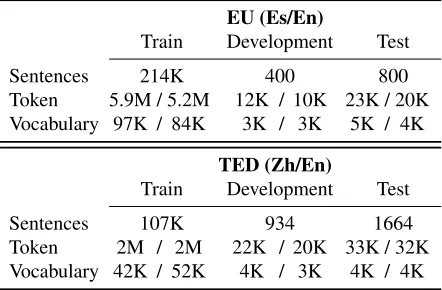
Table 1: Main figures of the processed EU and TED cor-pora. K and M stand for thousands and millions of ele-ments respectively.
IMT experiments with different corpora. These cor-pora, the experimental methodology, and the evalu-ation measures are presented in this section.
5.1 EU and TED corpora
We tested the proposed methods in two different translation tasks each one involving a different lan-guage pair: Spanish-to-English (Es–En) for theEU (Bulletin of the European Union) task, and Chinese-to-English (Zh–En) for theTED(TED4talks) task.
The EU corpora were extracted from the Bul-letin of the European Union, which exists in all of-ficial languages of the European Union and is pub-licly available on the Internet. Particularly, the cho-sen Es–En corpus was part of the evaluation of the TransType2 project (Barrachina et al., 2009). The TED talks is a collection of recordings of public speeches covering a variety of topics, and for which high quality transcriptions and translations into sev-eral languages are available. The Zh–En corpus used in the experiments was part of the MT track in the 2011 evaluation campaign of the workshop on spoken language translation (Federico et al., 2011). Specifically, we used thedev2010partition for de-velopment and thetest2010partition for test.
We process the Spanish and English parts of the EU corpus to separate words and punctuation marks keeping sentences truecase. Regarding the TED cor-pus, we tokenized and lowercased the English part (Chinese has no case information), and split Chi-nese sentences into words with the Stanford word
4
segmenter (Tseng et al., 2005). Table 1 shows the main figures of the processed EU and TED corpora.
5.2 Model Estimation and User Simulation
We used the standard configuration of the Moses
toolkit (Koehn et al., 2007) to estimate one phrase-based and one hierarchical model for each cor-pus; log-linear weights were optimized by minimum error-rate training (Och, 2003) with the development partitions. Then, the optimized models were used to generate the word-graphs and hypergraphs with the translations of the development and test partitions.
A direct evaluation of the proposed IMT proce-dures involving human users would have been slow and expensive. Thus, following previous works in the literature (Barrachina et al., 2009; Gonz´alez-Rubio et al., 2010), we used the references in the corpora to simulate the translations that a human user would want to obtain. Each time the system suggested a new translation, it was compared to the reference and thelongest common prefix(LCP) was obtained. Then, the first non-matching charac-ter was replaced by the corresponding characcharac-ter in the reference and a new system suggestion was pro-duced. This process is iterated until a full match with the reference was obtained.
Finally, we used this user simulation to optimize the value for the probability of edition pe in the
error-correction model (Section 3.1), and for the log-linear weights in the proposed IMT formulations. In this case, these values were chosen so that they min-imize the estimated user effort required to interac-tively translate the development partitions.
5.3 Evaluation Measures
Different measures have been adopted to evaluate the proposed IMT approach. On the one hand, dif-ferent IMT systems can be compared according to the effort needed by a human user to generate the de-sired translations. This effort is usually estimated as the number of actions performed by the user while interacting with the system. In the user simulation described above these actions are: looking for the next error andmoving the mouse pointerto that po-sition (LCP computation), and correcting errors with somekey strokes. Hence, we implement the follow-ing IMT effort measure (Barrachina et al., 2009):
Key-stroke and mouse-action ratio (KSMR): number of key strokes plus mouse movements per-formed by the user, divided by the total number of characters in the reference.
On the other hand, we also want to compare the proposed IMT approach against a conventional CAT approach without interactivity, such as a decoupled post-edition system. For such systems, character-level user effort is usually measured by the Charac-ter Error Rate(CER). However, it is clear that CER is at a disadvantage due to the auto-completion ap-proach of IMT. To perform a fairer comparison be-tween edition and IMT, we implement a post-editing system with autocompletion. Here, when the user enters a character to correct some incor-rect word, the system automatically completes the word with the most probable word in the task vo-cabulary. To evaluate the effort of a user using such a system, we implement the following measure pro-posed in (Romero et al., 2010):
Post-editing key stroke ratio (PKSR): using a post-edition system with word-autocompleting, number of user key strokes divided by the total num-ber of reference characters.
The counterpart of PKSR in an IMT scenario is (Barrachina et al., 2009):
Key-stroke ratio (KSR): number of key strokes, divided by the number of reference characters.
PKSR and KSR are fairly comparable and the rel-ative difference between them gives us a good es-timate of the reduction in human effort that can be achieved by using IMT instead of a conventional post-edition system.
We also evaluate the quality of the automatic translations generated by the MT models with the widespread BLEU score (Papineni et al., 2002).
EU TED WG HG WG HG
[image:9.612.316.537.61.120.2]1-best BLEU [%] 45.0 45.1 11.0 11.2 1000-best Avg. BLEU [%] 43.6 44.2 10.2 11.0
Table 2: BLEU score of the word-graphs (WG) and hy-pergraphs (HG) used to implement the IMT procedures.
IMT EU TED
Setup PB HT PB HT
ISF 27.4±.5∗ 26.5±.5∗ 53.0±.4∗ 52.3±.4∗
CSF 26.6±.5∗25.1±.5F 52.2±.4∗50.8±.4F
Table 3: IMT results (KSMR [%]) for the EU and TED tasks using the independent suffix formalization (ISF) and the conditioned suffix formalization (CSF). PB stands for phrase-based model and HT stands for hierar-chical translation model. For each task, the best result is displayed boldface, an asterisk∗denotes a statistically significant better result (99% confidence) with respect to ISF with PB, and a starF denotes a statistically signifi-cant difference with respect to all the other systems.
6 Results
We start by reporting conventional MT quality re-sults to test if the generated word-graphs and hyper-graphs encode translations of similar quality. Ta-ble 2 displays the quality (BLEU (Papineni et al., 2002)) of the automatic translations generated for the test partitions. The lower 1-best BLEU results obtained for TED show that this is a much more dif-ficult task than EU. Additionally, the similar aver-age BLEU results obtained for the 1000-best transla-tions indicate that word-graphs and hypergraphs en-code translations of similar quality. Thus, the IMT systems that use these word-graphs and hypergraphs can be compared in a fair way.
Then, we evaluated different setups of the pro-posed IMT approach. Table 3 displays the IMT re-sults obtained for the EU and TED tasks. We report KSMR (as a percentage) for the independent suffix formalization (ISF) and the conditioned suffix for-malization (CSF) using both phase-based (PB) and hierarchical (HT) translation models. The KSMR result of ISF using a phrase-based model can be con-sidered our baseline since this setup is comparable to that used in (Barrachina et al., 2009). Results for HT consistently outperformed the corresponding re-sults for PB. Similarly, rere-sults for CSF were
con-EU TED
PE IMT PE IMT
PKSR [%] KSR [%] PKSR [%] KSR [%]
27.1 14.1 (48%) 40.8 29.7 (27.2%)
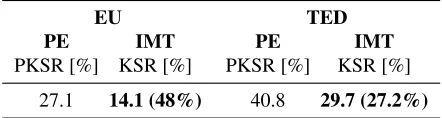
Table 4: Estimation of the effort required to translate the test partition of the EU and TED tasks using post-editing with word-completion (PE) and IMT under the independent suffix formalization (IMT). We used hierar-chical MT in both approaches. In parenthesis we display the estimated effort reduction of IMT with respect to PE.
sistently better than those for ISF. More specifically, no statistically significant difference were found be-tween ISF with HT and CSF with PB but both sta-tistically outperformed the baseline (ISF with PB). Finally, CSF with HT statistically outperformed the other three configurations reducing KSMR by∼2.2 points with respect to the baseline. We hypothe-size that the better results of HT can be explained by its more efficient representation of word reorder-ing. Regarding the CSF, its better results are due to the better suffixes that can be obtained by taking into account the actual prefix validated by the user.
Finally, we compared the estimated human effort required to translate the test partitions of the EU and TED corpora with the best IMT configuration (inde-pendent suffix formalization with hierarchical trans-lation model) and a conventional post-editing (PE) CAT system with word-completion. That is, when the user corrects a character, the PE system auto-matically proposes a different word that begins with the given word prefix but, obviously, the rest of the sentence is not changed. According to the results, the estimated human effort to generate the error-free translations was significantly reduced with respect to using the conventional PE approach. IMT can save about48%of the overall eastimated effort for the EU task and about27%for the TED task.
7 Summary and Future Work
into account the prefix validated by the user. More-over, since word-graphs constitute a particular case of hypergraphs, we are able to manage both phrase-based and hierarchical translation models in a uni-fied IMT framework.
Simulated results on two different translation tasks showed that hierarchical translation models outperform phrase-based models in our IMT frame-work. Additionally, the proposed alternative IMT formalization also allows to improve the results of the IMT formalization previously described in the literature. Finally, the proposed IMT system with hierarchical SMT models largely reduces the esti-mated user effort required to generate correct trans-lations in comparison to that of a conventional post-edition system. We look forward to corroborating these result in test with human translators.
There are many ways to build on the work de-scribed here. In the near future, we plan to explore the following research directions:
• Alternative IMT scenarios where the user is not bounded to correct translation errors in a left-to-right fashion. In such scenarios, the user will be allowed to correct errors at any position in the translation while the IMT system will be required to derive translations compatible with these isolated corrections.
• Adaptive translation engines that take advan-tage of the user’s corrections to improve its sta-tistical models. As the translator works and corrects the proposed translations, the transla-tion engine will be able to make better predic-tions. One of the first works on this topic was proposed in (Nepveu et al., 2004). More re-cently, Ortiz-Mart´ınez et al. (2010) described a set of techniques to obtain an incrementally up-dateable IMT system, solving technical prob-lems encountered in previous works.
• More sophisticated measures to estimate the human effort. Specifically, measures that esti-mate the cognitive load involve in reading, un-derstanding and detecting an error in a trans-lation (Foster et al., 2002), in contrast KSMR simply considers a constant cost. This will lead to a more accurate estimation of the improve-ments that may be expected by a human user.
Acknowledgments
Work supported by the European Union7th Frame-work Program (FP7/2007-2013) under the Cas-MaCat project (grans agreement no 287576), by Spanish MICINN under grant TIN2012-31723, and by the Generalitat Valenciana under grant ALMPR (Prometeo/2009/014).
References
Alfred V. Aho and Jeffrey D. Ullman. 1969. Syn-tax directed translations and the pushdown assembler.
Journal of Computer and Systems Science, 3(1):37– 56, February.
Sergio Barrachina, Oliver Bender, Francisco Casacu-berta, Jorge Civera, Elsa Cubel, Shahram Khadivi, An-tonio Lagarda, Hermann Ney, Jes´us Tom´as, Enrique Vidal, and Juan-Miguel Vilar. 2009. Statistical ap-proaches to computer-assisted translation. Computa-tional Linguistics, 35:3–28, March.
Richard Bellman. 1957. Dynamic Programming. Princeton University Press, Princeton, NJ, USA, 1 edi-tion.
Peter F. Brown, Vincent J. Della Pietra, Stephen A. Della Pietra, and Robert L. Mercer. 1993. The mathemat-ics of statistical machine translation: parameter esti-mation. Computational Linguistics, 19:263–311. David Chiang. 2005. A hierarchical phrase-based model
for statistical machine translation. InProceedings of the 43rd Annual Meeting on Association for Computa-tional Linguistics, pages 263–270.
M. Federico, L. Bentivogli, M. Paul, and S. St¨uker. 2011. Overview of the iwslt 2011 evaluation campaign. In
Proceedings of the International Workshop on Spoken Language Translation, pages 11–20.
George Foster, Pierre Isabelle, and Pierre Plamondon. 1998. Target-text mediated interactive machine trans-lation. Machine Translation, 12(1/2):175–194, Jan-uary.
George Foster, Philippe Langlais, and Guy Lapalme. 2002. User-friendly text prediction for translators. In Proceedings of the 2002 conference on Empirical methods in natural language processing - Volume 10, pages 148–155.
Jes´us Gonz´alez-Rubio, Daniel Ortiz-Mart´ınez, and Fran-cisco Casacuberta. 2010. Balancing user effort and translation error in interactive machine translation via confidence measures. InProceedings of the ACL 2010 Conference Short Papers, pages 173–177.
Pierre Isabelle and Ken Church. 1998. Special issue on: New tools for human translators, volume 12. Kluwer Academic Publishers, January.
Frederick Jelinek. 1997. Statistical methods for speech recognition. MIT Press.
Philipp Koehn, Franz Josef Och, and Daniel Marcu. 2003. Statistical phrase-based translation. In Pro-ceedings of the 2003 Conference of the North Ameri-can Chapter of the Association for Computational Lin-guistics on Human Language Technology - Volume 1, pages 48–54.
Philipp Koehn, Hieu Hoang, Alexandra Birch, Chris Callison-Burch, Marcello Federico, Nicola Bertoldi, Brooke Cowan, Wade Shen, Christine Moran, Richard Zens, Chris Dyer, Ondrej Bojar, Alexandra Con-stantin, and Evan Herbst. 2007. Moses: Open Source Toolkit for Statistical Machine Translation. In Pro-ceedings of the Association for Computational Lin-guistics, demonstration session, June.
Philippe Langlais and Guy Lapalme. 2002. TransType: development-evaluation cycles to boost translator’s productivity. Machine Translation, 17(2):77–98, September.
Vladimir Levenshtein. 1966. Binary codes capable of correcting deletions, insertions and reversals. Soviet Physics Doklady, 10(8):707–710, February.
Laurent Nepveu, Guy Lapalme, Philippe Langlais, and George Foster. 2004. Adaptive language and trans-lation models for interactive machine transtrans-lation. In
Proceedings of the conference on Empirical Methods on Natural Language Processing, pages 190–197. Franz Josef Och and Hermann Ney. 2002.
Discrimi-native training and maximum entropy models for sta-tistical machine translation. In Proceedings of the 40th Annual Meeting on Association for Computa-tional Linguistics, pages 295–302.
Franz Josef Och, Richard Zens, and Hermann Ney. 2003. Efficient search for interactive statistical ma-chine translation. In Proceedings of the European chapter of the Association for Computational Linguis-tics, pages 387–393.
Franz Och. 2003. Minimum error rate training in statisti-cal machine translation. InProceedings of the 41st An-nual Meeting on Association for Computational Lin-guistics - Volume 1, pages 160–167. Association for Computational Linguistics.
Daniel Ortiz-Mart´ınez, Ismael Garc´ıa-Varea, and Fran-cisco Casacuberta. 2010. Online learning for inter-active statistical machine translation. InProceedings of the 2010 Conference of the North American Chap-ter of the Association for Computational Linguistics, pages 546–554.
Daniel Ortiz-Mart´ınez. 2011. Advances in Fully-Automatic and Interactive Phrase-Based Statistical
Machine Translation. Ph.D. thesis, Universitat Polit`ecnica de Val`encia. Advisors: Ismael Garc´ıa Varea and Francisco Casacuberta.
Kishore Papineni, Salim Roukos, Todd Ward, and Wei-Jing Zhu. 2002. BLEU: a method for automatic evaluation of machine translation. InProceedings of the 40th Annual Meeting on Association for Computa-tional Linguistics, ACL ’02, pages 311–318. Associa-tion for ComputaAssocia-tional Linguistics.
Veronica Romero, Alejandro H. Toselli, and Enrique Vi-dal. 2010. Character-level interaction in computer-assisted transcription of text images. InProceedings of the 12th International Conference on Frontiers in Handwriting Recognition, pages 539–544.
Libin Shen, Jinxi Xu, and Ralph Weischedel. 2010. String-to-dependency statistical machine translation.
Computational Linguistics, 36(4):649–671, Decem-ber.
Huihsin Tseng, Pichuan Chang, Galen Andrew, Daniel Jurafsky, and Christopher Manning. 2005. A condi-tional random field word segmenter. InProceedings of the Fourth SIGHAN Workshop on Chinese Language Processing.
Nicola Ueffing, Franz J. Och, and Hermann Ney. 2002. Generation of word graphs in statistical machine trans-lation. InProceedings of the conference on Empirical Methods in Natural Language Processing, pages 156– 163.
Ying Zhang and Stephan Vogel. 2004. Measuring confi-dence intervals for the machine translation evaluation metrics. InProceedings of The international Confer-ence on Theoretical and Methodological Issues in Ma-chine Translation.
Andreas Zollmann and Ashish Venugopal. 2006. Syntax augmented machine translation via chart parsing. In