Bilingual Word Embeddings for Phrase-Based Machine Translation
Will Y. Zou†, Richard Socher, Daniel Cer, Christopher D. Manning Department of Electrical Engineering†and Computer Science Department
Stanford University, Stanford, CA 94305, USA
{wzou,danielcer,manning}@stanford.edu, [email protected]
Abstract
We introduce bilingual word embeddings: se-mantic embeddings associated across two lan-guages in the context of neural language mod-els. We propose a method to learn bilingual embeddings from a large unlabeled corpus, while utilizing MT word alignments to con-strain translational equivalence. The new em-beddings significantly out-perform baselines in word semantic similarity. A single semantic similarity feature induced with bilingual em-beddings adds near half a BLEU point to the results of NIST08 Chinese-English machine translation task.
1 Introduction
It is difficult to recognize and quantify semantic sim-ilarities across languages. The Fr-En phrase-pair
{‘un cas de force majeure’, ‘case of absolute neces-sity’}, Zh-En phrase pair{‘依然故我’,‘persist in a stubborn manner’}are similar in semantics. If co-occurrences of exact word combinations are rare in the training parallel text, it can be difficult for classi-cal statisticlassi-cal MT methods to identify this similarity, or produce a reasonable translation given the source phrase.
We introduce an unsupervised neural model to learn bilingual semantic embedding for words across two languages. As an extension to their monolingual counter-part (Turian et al., 2010; Huang et al., 2012; Bengio et al., 2003), bilin-gual embeddings capture not only semantic infor-mation of monolingual words, but also semantic re-lationships across different languages. This
prop-erty allows them to define semantic similarity met-rics across phrase-pairs, making them perfect fea-tures for machine translation.
To learn bilingual embeddings, we use a new ob-jective function which embodies both monolingual semantics and bilingual translation equivalence. The latter utilizes word alignments, a natural sub-task in the machine translation pipeline. Through large-scale curriculum training (Bengio et al., 2009), we obtain bilingual distributed representations which lie in the same feature space. Embeddings of di-rect translations overlap, and semantic relationships across bilingual embeddings were further improved through unsupervised learning on a large unlabeled corpus.
Consequently, we produce for the research com-munity a first set of Mandarin Chinese word embed-dings with 100,000 words trained on the Chinese Gigaword corpus. We evaluate these embedding on Chinese word semantic similarity from SemEval-2012 (Jin and Wu, 2012). The embeddings sig-nificantly out-perform prior work and prunedtf-idf
base-lines. In addition, the learned embeddings give rise to 0.11 F1 improvement in Named Entity Recognition on the OntoNotes dataset (Hovy et al., 2006) with a neural network model.
We apply the bilingual embeddings in an end-to-end phrase-based MT system by computing seman-tic similarities between phrase pairs. On NIST08 Chinese-English translation task, we obtain an im-provement of 0.48 BLEU from a competitive base-line (30.01 BLEU to 30.49 BLEU) with the Stanford Phrasal MT system.
2 Review of prior work
Distributed word representations are useful in NLP applications such as information retrieval (Pas¸ca et al., 2006; Manning et al., 2008), search query ex-pansions (Jones et al., 2006), or representing se-mantics of words (Reisinger et al., 2010). A num-ber of methods have been explored to train and ap-ply word embeddings using continuous models for language. Collobert et al. (2008) learn embed-dings in an unsupervised manner through a con-trastive estimation technique. Mnih and Hinton ( 2008), Morin and Bengio ( 2005) proposed efficient hierarchical continuous-space models. To system-atically compare embeddings, Turian et al. (2010) evaluated improvements they bring to state-of-the-art NLP benchmarks. Huang et al. (2012) intro-duced global document context and multiple word prototypes. Recently, morphology is explored to learn better word representations through Recursive Neural Networks (Luong et al., 2013).
Bilingual word representations have been ex-plored with hand-designed vector space mod-els (Peirsman and Pad´o , 2010; Sumita, 2000), and with unsupervised algorithms such as LDA and LSA (Boyd-Graber and Resnik, 2010; Tam et al., 2007; Zhao and Xing, 2006). Only recently have continuous space models been applied to machine translation (Le et al., 2012). Despite growing in-terest in these models, little work has been done along the same lines to train bilingual distributioned word represenations to improve machine translation. In this paper, we learn bilingual word embeddings which achieve competitive performance on seman-tic word similarity, and apply them in a pracseman-tical phrase-based MT system.
3 Algorithm and methods
3.1 Unsupervised training with global context
Our method starts with embedding learning formu-lations in Collobert et al. (2008). Given a context window cin a document d, the optimization mini-mizes the following Context Objective for a wordw
in the vocabulary:
JCO(c,d)= X wr∈V R
max(0,1−f(cw, d) +f(cwr, d))
(1)
Here f is a function defined by a neural network.
wr is a word chosen in a random subsetVR of the
vocabulary, andcwr is the context window contain-ing word wr. This unsupervised objective func-tion contrasts the score between when the correct word is placed in context with when a random word is placed in the same context. We incorporate the global context information as in Huang et al. (2012), shown to improve performance of word embed-dings.
3.2 Bilingual initialization and training
In the joint semantic space of words across two lan-guages, the Chinese word ‘政府’ is expected to be close to its English translation ‘government’. At the same time, when two words are not direct transla-tions, e.g. ‘lake’ and the Chinese word ‘潭’ (deep pond), their semantic proximity could be correctly quantified.
We describe in the next sub-sections the methods to intialize and train bilingual embeddings. These methods ensure that bilingual embeddings retain their translational equivalence while their distribu-tional semantics are improved during online training with a monolingual corpus.
3.2.1 Initialization by MT alignments
First, we use MT Alignment counts as weighting to initialize Chinese word embeddings. In our ex-periments, we use MT word alignments extracted with the Berkeley Aligner (Liang et al., 2006)1. Specifically, we use the following equation to com-pute starting word embeddings:
Wt-init= S X
s=1
Cts+ 1 Ct+S
Ws (2)
In this equation, S is the number of possible tar-get language words that are aligned with the source word.Ctsdenotes the number of times when wordt
in the target and wordsin the source are aligned in the training parallel text;Ct denotes the total
num-ber of counts of wordt that appeared in the target language. Finally, Laplace smoothing is applied to this weighting function.
1
Single-prototype English embeddings by Huang et al. (2012) are used to initialize Chinese em-beddings. The initialization readily provides a set (Align-Init) of benchmark embeddings in experi-ments (Section 4), and ensures translation equiva-lence in the embeddings at start of training.
3.2.2 Bilingual training
Using the alignment counts, we form alignment matrices Aen→zh and Azh→en. For Aen→zh, each
row corresponds to a Chinese word, and each col-umn an English word. An element aij is first
as-signed the counts of when the ith Chinese word is aligned with the jth English word in parallel text. After assignments, each row is normalized such that it sums to one. The matrixAzh→en is defined
sim-ilarly. Denote the set of Chinese word embeddings as Vzh, with each row a word embedding, and the
set of English word embeddings as Ven. With the
two alignment matrices, we define the Translation Equivalence Objective:
JT EO-en→zh =kVzh−Aen→zhVenk2 (3)
JT EO-zh→en=kVen−Azh→enVzhk2 (4)
We optimize for a combined objective during train-ing. For the Chinese embeddings we optimize for:
JCO-zh+λJT EO-en→zh (5)
For the English embeddings we optimize for:
JCO-en+λJT EO-zh→en (6)
During bilingual training, we chose the value of λ
such that convergence is achieved for bothJCOand JT EO. A small validation set of word similarities
from (Jin and Wu, 2012) is used to ensure the em-beddings have reasonable semantics.2
In the next sections, ‘bilingual trained’ embed-dings refer to those initialized with MT alignments and trained with the objective defined by Equa-tion 5. ‘Monolingual trained’ embeddings refer to those intialized by alignment but trained without
JT EO-en→zh.
2
In our experiments,λ= 50.
3.3 Curriculum training
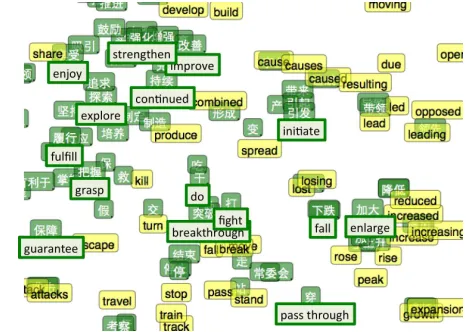
[image:3.612.304.537.356.522.2]We train 100k-vocabulary word embeddings using curriculum training (Turian et al., 2010) with Equa-tion 5. For each curriculum, we sort the vocabu-lary by frequency and segment the vocabuvocabu-lary by a band-size taken from{5k, 10k, 25k, 50k}. Separate bands of the vocabulary are trained in parallel using minibatch L-BFGS on the Chinese Gigaword cor-pus3. We train 100,000 iterations for each curricu-lum, and the entire 100k vocabulary is trained for 500,000 iterations. The process takes approximately 19 days on a eight-core machine. We show visual-ization of learned embeddings overlaid with English in Figure 1. The two-dimensional vectors for this vi-sualization is obtained with t-SNE (van der Maaten and Hinton, 2008). To make the figure comprehen-sible, subsets of Chinese words are provided with reference translations in boxes with green borders. Words across the two languages are positioned by the semantic relationships implied by their embed-dings.
Figure 1: Overlaid bilingual embeddings: English words are plotted in yellow boxes, and Chinese words in green; reference translations to English are provided in boxes with green borders directly below the original word.
4 Experiments
4.1 Semantic Similarity
We evaluate the Mandarin Chinese embeddings with the semantic similarity test-set provided by the
or-3
Table 1: Results on Chinese Semantic Similarity
Method Sp. Corr. K. Tau
(×100) (×100)
Prior work (Jin and Wu, 2012) 5.0
Tf-idf
Naive tf-idf 41.5 28.7
Pruned tf-idf 46.7 32.3
Word Embeddings
Align-Init 52.9 37.6
Mono-trained 59.3 42.1
Biling-trained 60.8 43.3
ganizers ofSemEval-2012Task 4. This test-set con-tains 297 Chinese word pairs with similarity scores estimated by humans.
The results for semantic similarity are shown in Table 1. We show two evaluation metrics: Spear-man Correlation and Kendall’s Tau. For both, bilin-gual embeddings trained with the combined objec-tive defined by Equation 5 perform best. For pruned tf-idf, we follow Reisinger et al. (2010; Huang et al. (2012) and count word co-occurrences in a 10-word window. We use the best results from a range of pruning and feature thresholds to compare against our method. The bilingual and monolingual trained embeddings4 out-perform pruned tf-idf by 14.1 and 12.6 Spearman Correlation (×100), respec-tively. Further, they out-perform embeddings initial-ized from alignment by 7.9 and 6.4. Both ourtf-idf
implementation and the word embeddings have sig-nificantly higher Kendall’s Tau value compared to Prior work (Jin and Wu, 2012). We verified Tau cal-culations with original submissions provided by the authors.
4.2 Named Entity Recognition
We perform NER experiments on OntoNotes (v4.0) (Hovy et al., 2006) to validate the quality of the Chinese word embeddings. Our experimental set-up is the same as Wang et al. (2013). With em-beddings, we build a naive feed-forward neural net-work (Collobert et al., 2008) with 2000 hidden neu-rons and a sliding window of five words. This naive setting, without sequence modeling or sophisticated
4
Due to variations caused by online minibatch L-BFGS, we take embeddings from five random points out of last105 mini-batch iterations, and average their semantic similarity results.
Table 2: Results on Named Entity Recognition
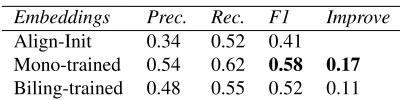
Embeddings Prec. Rec. F1 Improve
Align-Init 0.34 0.52 0.41 Mono-trained 0.54 0.62 0.58 0.17
Biling-trained 0.48 0.55 0.52 0.11
Table 3: Vector Matching AlignmentAER(lower is bet-ter)
Embeddings Prec. Rec. AER
Mono-trained 0.27 0.32 0.71 Biling-trained 0.37 0.45 0.59
join optimization, is not competitive with state-of-the-art (Wang et al., 2013). Table 2 shows that the bilingual embeddings obtains 0.11 F1 improvement, lagging monolingual, but significantly better than
Align-Init(as in Section3.2.1) on the NER task.
4.3 Vector matching alignment
Translation equivalence of the bilingual embeddings is evaluated by naive word alignment to match word embeddings by cosine distance.5The Alignment
Er-ror Rates (AER) reported in Table 3 suggest that bilingual training using Equation 5 produces embed-dings with better translation equivalence compared to those produced by monolingual training.
4.4 Phrase-based machine translation
Our experiments are performed using the Stan-ford Phrasal phrase-based machine translation sys-tem (Cer et al., 2010). In addition to NIST08 train-ing data, we perform phrase extraction, filtertrain-ing and phrase table learning with additional data from GALE MT evaluations in the past 5 years. In turn, our baseline is established at 30.01 BLEU and rea-sonably competitive relative to NIST08 results. We use Minimum Error Rate Training (MERT) (Och, 2003) to tune the decoder.
In the phrase-based MT system, we add one fea-ture to bilingual phrase-pairs. For each phrase, the word embeddings are averaged to obtain a feature vector. If a word is not found in the vocabulary, we disregard and assume it is not in the phrase; if no word is found in a phrase, a zero vector is assigned
5
[image:4.612.79.296.87.208.2]Table 4: NIST08 Chinese-English translationBLEU
Method BLEU
Our baseline 30.01
Embeddings
Random-Init Mono-trained 30.09
Align-Init 30.31
Mono-trained 30.40
Biling-trained 30.49
to it. We then compute the cosine distance between the feature vectors of a phrase pair to form a seman-tic similarity feature for the decoder.
Results on NIST08 Chinese-English translation task are reported in Table 46. An increase of 0.48 BLEU is obtained with semantic similarity with bilingual embeddings. The increase is modest, just surpassing a reference standard deviation 0.29 BLEU Cer et al. (2010)7evaluated on a similar sys-tem. We intend to publish further analysis on statis-tical significance of this result as an appendix. From these suggestive evidence in the MT results, random initialized monolingual trained embeddings add lit-tle gains to the baseline. Bilingual initialization and training seem to be offering relatively more consis-tent gains by introducing translational equivalence.
5 Conclusion
In this paper, we introduce bilingual word embed-dings through initialization and optimization con-straint using MT alignments The embeddings are learned through curriculum training on the Chinese Gigaword corpus. We show good performance on Chinese semantic similarity with bilingual trained embeddings. When used to compute semantic simi-larity of phrase pairs, bilingual embeddings improve NIST08 end-to-end machine translation results by just below half a BLEU point. This implies that se-mantic embeddings are useful features for improv-ing MT systems. Further, our results offer sugges-tive evidence that bilingual word embeddings act as high-quality semantic features and embody bilingual translation equivalence across languages.
6
We report case-insensitive BLEU 7
With 4-gram BLEU metric from Table 4
Acknowledgments
We gratefully acknowledge the support of the Defense Advanced Research Projects Agency (DARPA) Broad Operational Language Transla-tion (BOLT) program through IBM. Any opinions, findings, and conclusions or recommendations ex-pressed in this material are those of the author(s) and do not necessarily reflect the view of the DARPA, or the US government. We thank John Bauer and Thang Luong for helpful discussions.
References
A. Klementiev, I. Titov and B. Bhattarai. 2012. Induc-ing CrosslInduc-ingual Distributed Representation of Words.
COLING.
Y. Bengio, J. Louradour, R. Collobert and J. Weston. 2009. Curriculum Learning.ICML.
Y. Bengio, R. Ducharme, P. Vincent and C. Jauvin. 2003. A Neural Probabilistic Language Model. Journal of Machine Learning Research.
Y. Bengio and Y. LeCunn. 2007. Scaling learning algo-rithms towards AI.Large-Scale Kernal Machines.
J. Boyd-Graber and P. Resnik. 2010. Holistic sentiment analysis across languages: multilingual supervised la-tent dirichlet allocation.EMNLP.
D. Cer, M. Galley, D. Jurafsky and C. Manning. 2010. Phrasal: A Toolkit for Statistical Machine Translation with Facilities for Extraction and Incorporation of Ar-bitrary Model Features. In Proceedings of the North American Association of Computational Linguistics -Demo Session (NAACL-10).
D. Cer, C. Manning and D. Jurafsky. 2010. The Best Lexical Metric for Phrase-Based Statistical MT Sys-tem Optimization.NAACL.
R. Collobert and J. Weston. 2008. A unified architecture for natural language processing: Deep neural networks with multitask learning.ICML.
G. Foster and R. Kuhn. 2009. Stabilizing minimum error rate training. Proceedings of the Fourth Workshop on Statistical Machine Translation.
M. Galley, P. Chang, D. Cer, J. R. Finkel and C. D. Man-ning. 2008. NIST Open Machine Translation 2008 Evaluation: Stanford University’s System Description.
Unpublished working notes of the 2008 NIST Open Machine Translation Evaluation Workshop.
S. Green, S. Wang, D. Cer and C. Manning. 2013. Fast and adaptive online training of feature-rich translation models.ACL.
and B. Kingsbury. 2012. Deep Neural Networks for Acoustic Modeling in Speech Recognition.IEEE Sig-nal Processing Magazine.
E. Hovy, M. Marcus, M. Palmer, L. Ramshaw and R. Weischedel. 2006. OntoNotes: the 90% solution.
NAACL-HLT.
E. H. Huang, R. Socher, C. D. Manning and A. Y. Ng. 2012. Improving Word Representations via Global Context and Multiple Word Prototypes.ACL.
P. Jin and Y. Wu. 2012. Sem2012 Task 4: Eval-uating Chinese Word Similarity. Proceedings of the First Joint Conference on Lexical and Computational Semantics-Volume 1: Proceedings of the main confer-ence and the shared task, and Volume 2: Proceedings of the Sixth International Workshop on Semantic Eval-uation. Association for Computational Linguistics.
R. Jones. 2006. Generating query substitutions. In Pro-ceedings of the 15th international conference on World Wide Web.
P. Koehn, F. J. Och and D. Marcu. 2003. Statistical Phrase-Based Translation. HLT.
H. Le, A. Allauzen and F. Yvon 2012. Continuous space translation models with neural networks.NAACL.
P. Liang, B. Taskar and D. Klein. 2006. Alignment by agreement.NAACL.
M. Luong, R. Socher and C. Manning. 2013. Better word representations with recursive neural networks for morphology.CONLL.
L. van der Maaten and G. Hinton. 2008. Visualizing data using t-SNE.Journal of Machine Learning Research.
A. Maas and R. E. Daly and P. T. Pham and D. Huang and A. Y. Ng and C. Potts. 2011. Learning word vectors for sentiment analysis. ACL.
C. Manning and P. Raghavan and H. Schtze. 2008. Intro-duction to Information Retrieval. Cambridge Univer-sity Press, New York, NY, USA.
T. Mikolov, M. Karafiat, L. Burget, J. Cernocky and S. Khudanpur. 2010. Recurrent neural network based language model.INTERSPEECH.
T. Mikolov, K. Chen, G. Corrado and J. Dean. 2013. Ef-ficient Estimation of Word Representations in Vector Space.arXiv:1301.3781v1.
A. Mnih and G. Hinton. 2008. A scalable hierarchical distributed language model.NIPS.
F. Morin and Y. Bengio. 2005. Hierarchical probabilistic neural network language model.AISTATS.
F. Och. 2003. Minimum error rate training in statistical machine translation.ACL.
M. Pas¸ca, D. Lin, J. Bigham, A. Lifchits and A. Jain. 2006. Names and similarities on the web: fact extrac-tion in the fast lane.ACL.
Y. Peirsman and S. Pad´o. 2010. Cross-lingual induction of selectional preferences with bilingual vector spaces.
ACL.
J. Reisinger and R. J. Mooney. 2010. Multi-prototype vector-space models of word meaning.NAACL.
F. Sebastiani. 2002. Machine learning in automated text categorization.ACM Comput. Surv., 34:1-47, March.
R. Socher, J. Pennington, E. Huang, A. Y. Ng and C. D. Manning. 2011. Semi-Supervised Recursive Autoencoders for Predicting Sentiment Distributions.
EMNLP.
R. Socher, E. H. Huang, J. Pennington, A. Y. Ng, and C. D. Manning. 2011. Dynamic Pooling and Unfold-ing Recursive Autoencoders for Paraphrase Detection.
NIPS.
E. Sumita. 2000. Lexical transfer using a vector-space model.ACL.
Y. Tam, I. Lane and T. Schultz. 2007. Bilingual-LSA based LM adaptation for spoken language translation.
ACL.
S. Tellex and B. Katz and J. Lin and A. Fernandes and G. Marton. 2003. Quantitative evaluation of passage retrieval algorithms for question answering. In Pro-ceedings of the 26th Annual International ACM SIGIR Conference on Search and Development in Informa-tion Retrieval, pages 41-47. ACM Press.
J. Turian and L. Ratinov and Y. Bengio. 2010. Word rep-resentations: A simple and general method for semi-supervised learning.ACL.
M. Wang, W. Che and C. D. Manning. 2013. Joint Word Alignment and Bilingual Named Entity Recognition Using Dual Decomposition.ACL.
K. Yamada and K. Knight. 2001. A Syntax-based Statis-tical Translation Model.ACL.