3394
Decomposed Local Models for Coordinate Structure Parsing
Hiroki Teranishi1 Hiroyuki Shindo1 Yuji Matsumoto1,2 1Nara Institute of Science and Technology
2RIKEN Center for Advanced Intelligence Project (AIP)
{teranishi.hiroki.sw5, shindo, matsu}@is.naist.jp
Abstract
We propose a simple and accurate model for coordination boundary identification. Our model decomposes the task into three sub-tasks during training; finding a coordinator, identifying inside boundaries of a pair of con-juncts, and selecting outside boundaries of it. For inference, we make use of probabilities of coordinators and conjuncts in the CKY parsing to find the optimal combination of coordinate structures. Experimental results demonstrate that our model achieves state-of-the-art results, ensuring that the global structure of coordina-tions is consistent.
1 Introduction
Coordination is a frequently occurring structure that consists of conjuncts joined by a coordina-tor word. Since conjunct spans are one of the major ambiguities, identifying them is difficult, even for humans. For instance, in the sentence “Toshiba’s line of portables, for example, features the T-1000, which is in the same weight class but is much slower and has less memory, and the T-1600, which also uses a 286 microprocessor, but which weighs almost twice as much and is three times the size,” we cannot find correct conjuncts for each coordinator at a glance. The presence of coordina-tion makes a sentence more ambiguous and longer, resulting in errors in syntactic parsing.
To identify the conjuncts of a given coordina-tor, previous studies have explored two properties of coordinate structures: (1) similarity – conjuncts tend to be similar; (2) replaceability – conjuncts can be replaced. Ficler and Goldberg (2016b) combine the syntactic parser and neural networks to compute the similarity and replaceability fea-tures of conjuncts. Teranishi et al. (2017) also exploit the two properties without deploying any syntactic parser, and achieve state-of-the-art re-sults. Although both approaches outperform the
similarity-based approaches (Shimbo and Hara,
2007;Hara et al.,2009), they cannot handle more than two conjuncts in a coordination, and multiple coordinations in a sentence at one time. Hence, their systems may produce coordinations that con-flict with each other. In contrast,Hara et al.(2009) define production rules for coordination in order to output consistent coordinate structures.
Here, we propose a new framework for coordi-nation boundary identification. We generalize a scoring function that takes a pair of spans with a coordinator and returns a higher score when the two spans appear to be coordinated. Using this function in the CKY parsing with produc-tion rules for coordinaproduc-tion, our system produces globally consistent coordinations in a given sen-tence. To obtain such a function, we decompose the task into three independent subtasks – find-ing a coordinator, identifyfind-ing the inner boundaries of a pair of conjuncts and delineating its outer boundaries. We use three different neural net-works for the tasks, and the netnet-works are trained on the basis of their local decisions. Our method is inspired by recent successes with locally-trained models for structured inference problems such as constituency parsing (Teng and Zhang,2018) and dependency parsing (Dozat and Manning, 2017) without globally-optimized training. Experimen-tal results reveal that our model outperforms ex-isting systems and our strong baseline, an exten-sion ofTeranishi et al.(2017), and ensures that the global structure of the coordinations is consistent. In summary, our contributions include the fol-lowing:
• We propose a simple framework that trains a generalized scoring function of a pair of con-juncts and uses it for inference.
• We establish a system that can accommodate more than two conjuncts in a sentence.
• Our system outperforms existing ones, par-ticularly because it produces globally consis-tent coordinate structures.
2 Coordination Boundary Identification
2.1 Coordinate Structure
A coordinate structure or coordination is a syn-tactic structure in which two or more elements, known asconjuncts, are linked bycoordinator(s). In addition to coordinating words, such as “and,” “or,” or “but,” some punctuation marks function secondarily to connect two conjuncts. We refer to those punctuation marks as sub-coordinators. Sub-coordinators cannot independently conjoin phrases to form a coordinate structure. The pres-ence of a coordination is usually signaled by the appearance of a coordinator; however, coordinat-ing words do not always lead to coordinations. For instance, “but” is not a coordinator when it func-tions as a preposition. In this paper, we refer to a word that can be a coordinator or sub-coordinator as acoordinator key.
2.2 Task Definition and Difficulties
The task of coordination boundary identification is to find conjunct spans of a given coordinating word. If a coordinating word does not act as a coordinator, a system must return NONE; denot-ing the absence of a coordinate structure. The difficulties in this task arise when there are mul-tiple coordinate structures in a sentence or more than two conjuncts in a single coordinate ture. If there is more than one coordinate struc-ture in a sentence, each coordinate strucstruc-ture must be isolated from the others or integrated into the other(s). In other words, coordinate structures cannot be partially overlapped. When there are more than two conjuncts in a coordinate structure, it has to be ascertained whether the punctuation marks are sub-coordinators that bring one more conjunct, and if so, which coordinate structure they belong to. Thus, we must identify how many conjuncts a coordinate structure contains and the location of those conjuncts in the coordinate struc-ture — whether it is nested in or isolated from other coordinate structures.
nurses’ demanding work schedules It also
recommends
basing pay on
education experience and ,
coord
conj conj
cc conj
, and benefits day-care retirement
and coord
conjccconj
better
conj
coord
cc
. cc-sub
conj
[image:2.595.306.527.67.165.2]e.g.) It also recommends better retirement and day-care benefits, and basing pay on education, experience and nurses’ demanding work schedules.
Figure 1: An example of a coordinate tree.
2.3 Coordinate Structures as a Tree
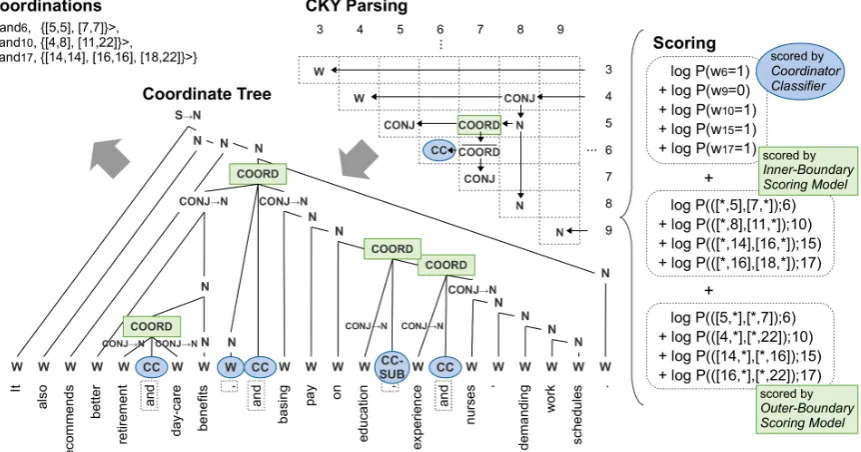
InvokingShimbo and Hara(2007), we use a tree to represent the coordinate structures in a sentence. We call this tree acoordinate tree. Figure1shows an example of a coordinate tree. Tree structures are particularly suitable because the ranges of co-ordinate structures are always consistent, and con-juncts are shown as nodes without being limited by the frequency of their occurrence. Our system pro-duces a coordinate tree using the CKY algorithm and then retrieves well-formed coordinate struc-tures from the tree. In this work, we focus on how to learn the scoring function that assigns higher scores to probable pairs of conjuncts for the CKY parsing.
3 Proposed Method
Figure 2: Overview of the proposed framework for coordination boundary identification. The scores of circular nodes are assigned by the coordinator classifier, and the scores of rectangular nodes are assigned by the inner and outer-boundary scoring models.
3.1 Model
Given a sentence that consists of N words
w1:N =w1, . . . , wN with the corresponding
part-of-speech (POS) tags p1:N =p1, . . . , pN, our
model outputs a set of coordinate structures
{hc,{[b1, e1], . . . ,[bn, en]}i}(n≥2)wherecis a
coordinator and[bk, ek]is thek-th conjunct
span-ning from the bk-th word to the ek-th word.
Al-though we cannot know the number of coordinate structures and conjuncts in each coordinate struc-ture, we can use coordinator keys as clues to find pairs of conjuncts. Our model tries to find pairs of conjuncts, rather than coordinate structures, in a sentence.
X={w1:N, p1:N, C} C={t|wt∈Scc∪Ssub-cc} Y ={hytckey, ypairt i|t∈C}
(1)
where yckeyt is a label that indicates whether
wt is the actual coordinator (ytckey= 1) or not
(ytckey= 0), andytpair is a pair of conjunct spans.
ytpair=∅whenytckey= 0. Whent= 1ort=N, ytckey= 0 because it does not form a coordinate structure within the sentence. In this paper, we de-fineScc andSsub-cc as{“and”, “or”, “but”, “nor”,
“and/or”}and{“,”, “;”, “:”}, respectively. We use two different models to identify inner and outer boundaries ofytpair, because enumerating all
pos-sible inner and outer boundaries ofypairt requires time complexity O(N2) + O(N2) = O(N2), whereas enumerating all possible ytpair requires time complexityO(N4)1.
Coordinator Classifier
The coordinator classifier is a binary classifier that predicts the label of a coordinator key.
P(yckeyt |wt, θ) = softmax(fckey(wt)) (2)
The training loss of the binary classification is computed by the following equation:
`ckeyθ (X, Y) =− X
hytckey,y pair t i∈Y
logP(ytckey|wt, θ)
(3)
Inner-Boundary Scoring Model
The inner-boundary scoring model assigns a score to a pair of conjunct spans on the basis of inner boundaries. We usebl, el, br, erto denote the be-ginning of a left conjunct, the end of the left con-junct, the beginning of a right concon-junct, and the end of the right conjunct, respectively. The score
1
of the inner-boundary pair(el, br)for a coordina-tor keywtis calculated as follows:
SCOREinnerθ (el, br, wt) =finner(el, br, wt) (4)
The probabilities of the inner boundaries are normalized distributions over all possible inner boundary pairs:
Iwt ={(1, t+ 1),(1, t+ 2), . . . ,(1, N),
(2, t+ 1), . . . ,(t−1, N)} (5)
P(ypairt = ([∗, el],[br,∗])|wt, θ) =
exp (SCOREinnerθ (el, br, wt))
P
(e0l,b0r)∈I wt
exp (SCOREinnerθ (e0l, b0r, w t))
(6)
`innerθ (X, Y) =
− X
hytckey,ypairt i∈Y
yckeyt logP(ypairt |wt, θ) (7)
The term ytckeylogP(ytpair|wt, θ) means the
cross-entropy loss is activated only for positive co-ordinator keys (yckeyt = 1) and is disabled other-wise (yckeyt = 0).
Outer-Boundary Scoring Model
Similarly to the inner-boundary scor-ing model, we define the probability
P(ytpair = ([bl,∗],[∗, er])|wt, θ) based on the
set of all the outer-boundary pairs Owt; the loss
is defined as `outerθ using the scoring function SCOREouterθ (bl, er, wt) =fouter(bl, er, wt).
Note that Iwt and Owt are identical
be-cause their possible pairs are the same. Based on the inner pair probability
P(ytpair = ([∗, el],[br,∗])|wt, θ) and the outer
pair probability P(ytpair= ([bl,∗],[∗, er])|w t, θ),
the most probable pair is produced by:
ytpair = arg max
(ˆel,ˆbr)
P(([∗,ˆel],[ˆbr,∗])|wt, θ)
∪arg max
(ˆbl,eˆr)
P(([ˆbl,∗],[∗,eˆr])|wt, θ)
(8)
3.2 CKY Parsing
Our three models predict coordinators including sub-coordinators, and the inner and outer bound-aries of their coordinating conjuncts. Such local predictions may cause conflicts between different coordinate structures. Furthermore, two conjuncts
Non-terminals
COORD Coordination
CONJ Conjunct
CC Coordinating conjunction CC-SUB Sub-coordinator
W Word
N Non-coordination
S Sentence
Rules for coordinations
(1) COORD → CONJ N? CC N? CONJ (2) COORD → CONJ CC-SUB COORD
(3) CONJ → COORD
(4) CONJ → N
Rules for non-coordinations
(5) S → COORD
(6) S → N
(7) N → COORD N
(8) N → W COORD
(9) N → W N
(10) N → W
Rules for pre-terminals
(11) CC → (and|or|but|nor|and/or) (12) CC-SUB → (,|;|:)
[image:4.595.308.519.67.356.2](13) W → *
Table 1: Production rules for coordinate trees. (. . .|. . . ) matches one of the elements and “*” matches any word. “?” indicates zero or one occurrence of the preceding element.
linked by a sub-coordinator must be embedded in another coordinate structure formed by a coordi-nator. To overcome these limitations, we use the CKY algorithm to find the optimal coordinations in a sentence. In particular, we define the CFG rules to produce a coordinate tree, as used inHara et al.(2009). Our CFG rules, distinct from those of
Hara et al.(2009)2, are shown in Table1. Based on these rules, we can map a coordinate tree to the one-to-one corresponding syntactic tree, covering 99.5% coordinations in the Penn Treebank3.
3.2.1 Scoring
We give scores only to coordination nodes de-noted as COORD, and pre-terminals. When scor-ing pre-terminals, we assignlogP(wk = 1)to CC
and CC-SUB, andlog(P(wk= 0))to W ifwk ∈
Scc∪Ssub-cc, otherwise0. When scoring the
CO-2Our rules can produce coordinate structures that contain
arbitrary length phrase(s) around coordinators, while con-juncts always appear next to coordinators in their rules.
3Most of the non-derivable coordinations are in the form
ORD, we take the left conjunct and the right con-junct which are linked by the CC. Thus, in the rule (2), the conjunct pair linked by a CC-SUB is the incoming CONJ and the leftmost CONJ in the child COORD. Using a coordinator and its pair of conjuncts, we assign logP(([i, j],[l, m])) = logP(([∗, j],[l,∗])) + logP(([i,∗],[∗, m]))to the COORD. The best scoring coordinate tree can be found efficiently using dynamic programming with time complexityO(N3).
3.3 Neural Network Models
We use neural networks as instantiations offckey, finner, andfouter that we have introduced in this
section.
Encoder
To get sentence-level representations for a se-quence of words and POS tags, we use bidi-rectional long short-term memories (BiLSTMs) (Hochreiter and Schmidhuber,1997).
h1:N = BiLSTMs(finput(w1:N, p1:N)) (9)
The dimensionality of each resulting vectorhtis
2dhidden. For the BiLSTMs inputs, we usefinput
to map words and POS tags onto their representa-tions. We can use different word representations including a pretrained word model, ELMo ( Pe-ters et al., 2018), BERT (Devlin et al., 2018) or character-level LSTMs/convolutional neural net-works (CharCNNs). We demonstrate the differ-ences between the different choices in Section4. The entire network consisting offinput and
BiL-STMs is referred to as the encoder; it is shared by the three neural networks in the higher layer.
Coordinator Classifier
We use a linear transformation of the sentence-level representation of a coordinator key forfckey.
fckey(wt) =Wckeyht+bckey (10)
whereWckey ∈ R2×2d
hidden
andbckey ∈ R2 are
the model parameters of the classifier.
Inner-Boundary Scoring Model
From the sentence-level representations produced by the encoder, the inner-boundary scoring model concatenates two representations of inner bound-aries, and then feeds the produced vector into a multilayered perceptron (MLP).
finner(el, br, wt) =
win2 ReLU(W1in[hel;hbr] +bin1 ) + bin2
(11)
whereWin1 ∈ Rdin×4dhidden
,bin1 ∈ Rdin
,w2in ∈ Rd
in
andbin2 ∈R1are the parameters of the inner-boundary scoring model.
Outer-Boundary Scoring Model
Using sentence-level representations, the outer-boundary scoring model takes two vectors that are calculated by subtracting the adjacent vectors to the coordinator from the boundary vectors. These subtraction operations are intended to capture the semantic distance and relatedness between two spans (Teranishi et al., 2017). The model then passes the vector to a MLP.
ff eature(bl, er, wt,h1:N) =
hbl−ht+1;her −ht−1
(12)
fouter(bl, er, wt) =
wout2 ReLU(Wout1 r) +bout1 ) + bout2
r=ff eature(bl, er, wt,h1:N)
(13)
where Wout1 ∈ Rdout×4dhidden
, bout1 ∈ Rdout
,
wout2 ∈ Rdout
andbout2 ∈ R1 are the parameters of the outer-boundary scoring model.
3.4 Learning
To train the set of parameterθ of our neural net-works, we minimize the following loss function:
L(θ) = X
(X,Yˆ)∈D
`ckeyθ (X,Yˆ)
+`innerθ (X,Yˆ) +`outerθ (X,Yˆ)
(14)
where D is a set of pairs of a sentence and its correct coordinate structures in a training dataset. Thus, our submodels are trained jointly.
Why local training?
4 Experiments
4.1 Settings
4.1.1 Datasets
We use the coordination-annotated Penn Treebank
(Ficler and Goldberg, 2016a) (PTB) and Genia
Treebank beta (Kim et al.,2003) (GENIA). Unlike the evaluation byTeranishi et al.(2017) andFicler and Goldberg(2016b), we strip the PTB of all quo-tation marks (“) and (”) to normalize irregular co-ordinations such ash. . . “Daybreak,” “Daywatch,” “Newsday,” and “Newsnight,” . . .i. We follow the standard train/development/test split on the PTB. For the GENIA, we do not apply the preprocessing described above. We evaluate the model through a five-fold cross-validation, as inHara et al.(2009).
4.1.2 Model
We use pretrained word vectors, POS tags, and character vectors produced by the CharCNN (Ma
and Hovy, 2016), regarded as the default. We
also investigate the performance of the model, us-ing three different word representations for the en-coder: (1) pretrained word embeddings; GloVe
(Pennington et al., 2014) for the PTB, BioASQ
(Tsatsaronis et al.,2012) for the GENIA, (2) con-textualized sentence embeddings; ELMo, (3) ran-domly initialized word vectors. For the PTB, POS tags are obtained using the Stanford POS Tagger (Toutanova et al.,2003) with 10-way jackknifing. For the GENIA, we use the gold POS tags, as in
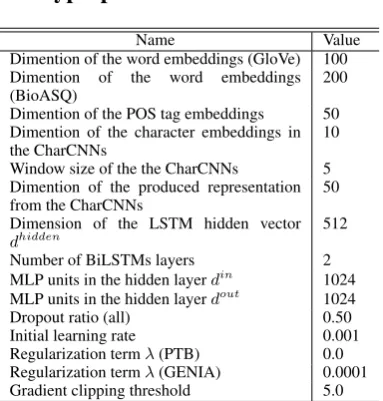
Hara et al.(2009). To optimize the model parame-ters, we use Adam (Kingma and Ba,2015). Other hyperparameters are described in AppendixA.
4.1.3 Baseline Model
We adopt our implementation of Teranishi et al.
(2017) as the baseline. The original model of
Teranishi et al.(2017) predicts the beginning and the end of a coordinate structure, and then splits it into conjuncts by commas. Their model de-cides the boundary of a coordinate structure in-dividually, which may cause conflicts with that of other coordinate structure(s). Thus, we extend their model to find the best combination of coor-dinate structures, greedily choosing most proba-ble boundaries without conflicts4. For the baseline model, we use the same encoder as that of our de-fault model. Hereinafter, we refer to this baseline model asTeranishi+17:+ext.
4We did not add the constraint to situate a nested
coordi-nation in the parent conjunct.
4.1.4 Evaluation
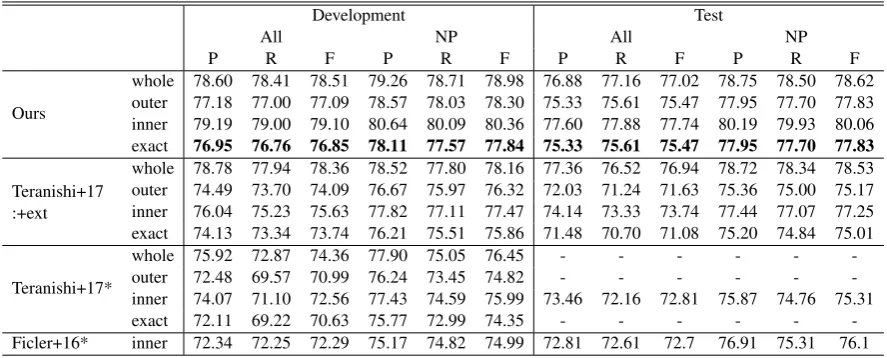
We evaluate the systems on the basis of the abil-ity to predict conjunct spans with the precision, recall, and F1 measures on the PTB. To compare the performance of our model withTeranishi et al.
(2017), we adjudge the predicted conjuncts correct based on the following metrics.
• whole: matches at the beginning of the first conjunct and the end of the last conjunct.
• outer: matches in the first conjunct and the last conjunct.
• inner: matches in the two conjuncts adjacent to the coordinator.
• exact: matches in all the conjuncts.
In addition, we pay particular attention to the eval-uation of NP coordination.
For the GENIA, we measure the recall values of coordinate structures by the aforementioned met-rics; previous studies, on the other hand, evalu-ated their systems based only on the whole metric. Also, we evaluate the performance of our model based on syntactic categories.
4.2 Results
base-Development Test
All NP All NP
P R F P R F P R F P R F
Ours
whole 78.60 78.41 78.51 79.26 78.71 78.98 76.88 77.16 77.02 78.75 78.50 78.62 outer 77.18 77.00 77.09 78.57 78.03 78.30 75.33 75.61 75.47 77.95 77.70 77.83 inner 79.19 79.00 79.10 80.64 80.09 80.36 77.60 77.88 77.74 80.19 79.93 80.06 exact 76.95 76.76 76.85 78.11 77.57 77.84 75.33 75.61 75.47 77.95 77.70 77.83
Teranishi+17 :+ext
whole 78.78 77.94 78.36 78.52 77.80 78.16 77.36 76.52 76.94 78.72 78.34 78.53 outer 74.49 73.70 74.09 76.67 75.97 76.32 72.03 71.24 71.63 75.36 75.00 75.17 inner 76.04 75.23 75.63 77.82 77.11 77.47 74.14 73.33 73.74 77.44 77.07 77.25 exact 74.13 73.34 73.74 76.21 75.51 75.86 71.48 70.70 71.08 75.20 74.84 75.01
Teranishi+17*
[image:7.595.77.521.62.241.2]whole 75.92 72.87 74.36 77.90 75.05 76.45 - - - -outer 72.48 69.57 70.99 76.24 73.45 74.82 - - - -inner 74.07 71.10 72.56 77.43 74.59 75.99 73.46 72.16 72.81 75.87 74.76 75.31 exact 72.11 69.22 70.63 75.77 72.99 74.35 - - - -Ficler+16* inner 72.34 72.25 72.29 75.17 74.82 74.99 72.81 72.61 72.7 76.91 75.31 76.1
Table 2: Evaluation per coordination by the different metrics. Preprocessing for quotation marks are not reported in “Teranishi+17” and “Ficler+16”.
NP VP ADJP S PP UCP SBAR ADVP Others All
# 2317 465 321 188 167 60 56 21 3 3598
Ours
whole 59.30 65.16 78.19 53.19 55.68 48.33 66.07 90.47 0.00 61.31 outer 59.21 64.94 78.19 53.19 55.68 48.33 66.07 90.47 0.00 61.22 inner 70.60 67.74 81.61 55.31 55.68 53.33 69.64 90.47 33.33 69.51 exact 59.21 64.94 78.19 53.19 55.68 48.33 66.07 90.47 0.00 61.22
Teranishi+17 :+ext
whole 67.19 63.65 76.63 53.19 61.67 35.00 78.57 85.71 33.33 66.31 outer 57.14 54.83 72.27 8.51 55.68 28.33 57.14 85.71 0.00 55.22 inner 57.61 54.83 72.27 8.51 55.68 28.33 57.14 85.71 0.00 55.53 exact 57.14 54.83 72.27 8.51 55.68 28.33 57.14 85.71 0.00 55.22 Teranishi+17 whole 66.59 63.87 78.50 52.65 53.89 50.00 78.57 85.71 33.33 65.98 Ficler+16 whole 65.08 71.82 74.76 17.02 56.28 51.66 91.07 80.95 33.33 64.14 Hara+09 whole 64.2 54.2 80.4 22.9 59.9 36.7 51.8 85.7 66.7 61.5
Table 3: Recall with Genia Treebank beta. The numbers in the rows “Teranishi+17,” “Ficler+16” and “Hara+09” are taken from their papers.
line model cannot predict coordinated clauses la-beled as “S,” that are likely to be longer and to con-tain non-coordinating commas. The shortcoming of our model is that our bottom-up parsing may cause errors due to wrong decisions in the early stage of the parsing; this is observed as poor per-formance in the whole metric.
4.3 Analysis
Complete match in a sentence
We investigate the ability of our system to dict all the coordinate structures in a sentence pre-cisely. We categorize sentences into the following four groups5.
All: All sentences that have any coordinate structure.
• Simple: Sentences that have only one coor-dinate structure consisting of two conjuncts.
5
ConsecutiveandMultipleboth contain sentences that are Consecutive and Multiple.
• Complex: Sentences that are categorized as Consecutive and/or Multiple.
– Consecutive: Sentences that have a coor-dinate structure consisting of more than two conjuncts.
– Multiple: Sentences that have multiple co-ordinate structures.
Sentences categorized as “All” are the union of the mutually exclusive sets of Simple and Complex.
Model Sentence Development Test
Ours
All 489 / 673 =72.65 619 / 873 =70.90
- Simple 378 / 481 =78.58 476 / 609 =78.16
- Complex 111 / 192 =57.81 143 / 264 =54.16
- Consecutive 41 / 66 =62.12 56 / 96 =58.33
- Multiple 79 / 146 =54.10 96 / 197 =48.73
Teranishi+17 :+ext
[image:8.595.155.442.63.193.2]All 468 / 673 = 69.53 577 / 873 = 66.09 - Simple 358 / 481 = 74.42 444 / 609 = 72.90 - Complex 110 / 192 = 57.29 133 / 264 = 50.37 - Consecutive 40 / 66 = 60.60 48 / 96 = 50.00 - Multiple 78 / 146 = 53.42 92 / 197 = 46.70
Table 4: Complete match rates of coordinations per sentence.
All (exact) All (inner)
P R F F
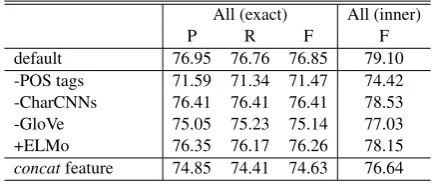
default 76.95 76.76 76.85 79.10 -POS tags 71.59 71.34 71.47 74.42 -CharCNNs 76.41 76.41 76.41 78.53 -GloVe 75.05 75.23 75.14 77.03 +ELMo 76.35 76.17 76.26 78.15 concatfeature 74.85 74.41 74.63 76.64
Table 5: Performance comparison between different settings of the proposed models.
a coordinator fails and causes errors. Our system also outperforms Teranishi+17:+ext on Consecu-tive and Multiple coordination sentences. Teran-ishi+17:+ext predicts a coordination span, and then splits it into conjunct spans. Therefore, it can mistakenly segment coordinations when false sub-coordinators appear in a sentence. In contrast, our approach ascertains whether sub-coordinating words are true sub-coordinators; thus, it can lead to more robust production of Consecutive sen-tences.
What helps for Coordination Parsing?
We conduct an ablation study for our model. Ta-ble5shows the results. Without the POS tags, the model performs poorly. It is worthy of note that the pretrained word embedding is beneficial infor-mation for the task. On the other hand, the use of contextual embedding, ELMo, does not improve performance. We deduce that POS tags and mor-phological information, and not contextual word senses, are clues for shorter and similar coordina-tions such as NP coordinacoordina-tions. For the feature extraction function of the outer-boundary scoring model, theconcatfunction that performs the same function as the inner-boundary scoring model does not achieve competitive advantage. The feature function described as Eq.12 is designed to
cap-ture the similarity and replaceability of two spans; while theconcatfunction has only the contextual information of the outer boundaries of a pair.
5 Related Work
5.1 Similarity-based Approaches
For the coordination identification task in Japanese, Kurohashi and Nagao (1994) used a chart to find the highest similarity pair of conjuncts using dynamic programming. Hogan
(2007) developed a generative parsing model for coordinated noun phrases, incorporating symme-try in conjunct structures and head words.Shimbo
and Hara(2007) proposed a discriminative model
that computes scores based on the syntactic and morphological features assigned to edges and nodes in a sequence alignment. While their method focused on non-nested coordinations,
Hara et al.(2009) extended their work to
accom-modate nested coordinations using CFG rules. A consistent global structure of coordinations is produced using discriminative functions based on the similarity of conjuncts with dynamic programming. Our concept of the CKY parsing is borrowed from their work; however, a key differ-ence of our approach lies in how it computes the score of conjuncts and trains the score function.
Hanamoto et al.(2012) used dual decomposition
to combine HPSG parsing with the discriminative model developed byHara et al.(2009).
5.2 Non Similarity-based Approaches
Kawahara and Kurohashi (2008) focused on
[image:8.595.72.289.234.326.2]Eis-ner algorithm by adding new rules to accommo-date coordinations during dependency parsing.
5.3 Coordination Boundary Identification using Neural Networks
Ficler and Goldberg(2016b) used neural networks
for the coordination boundary identification task. They incorporated the replaceability property be-tween conjuncts, in addition to the similarity prop-erty, in the computation of a score for a pair of conjuncts. They first used a binary classi-fier for coordinating words; then, they extracted probable candidate pairs of conjuncts using the Berkeley Parser (Petrov et al., 2006); afterward, they assigned scores to the pairs using neural net-works. However, the shortcoming of their work is that it is highly dependent on the external parser. The work ofTeranishi et al.(2017) developed an end-to-end model, as opposed to the pipeline ap-proach ofFicler and Goldberg(2016b). They also used similarity and replaceability feature repre-sentations without information from a syntactic parser. While Ficler and Goldberg (2016b) cut off improbable pairs of conjuncts ahead of train-ing,Teranishi et al.(2017) calculated scores for all possible pairs of the beginning and the end of co-ordinate structures instead of conjuncts. We apply the same strategy to the inner-boundary pairs and the outer-boundary pairs because assigning low probabilities to improbable inner and outer pairs makes the model robust for the CKY parsing.
6 Conclusion
We proposed a simple and accurate model for co-ordination boundary identification. Our system decomposes this task into three subtasks, and uses three different neural networks to tackle them. For inference, the CKY algorithm is applied using the CFG rules in order to produce globally consistent coordinate structures in a sentence. Experimental results demonstrated that our locally-trained mod-els interoperate to obtain the optimal combination of coordinate structures and outperform existing systems and the strong baseline. Through empir-ical analysis, we found that our system performs better than the baseline in complete matches of sentences that contain more than two conjuncts and/or multiple coordinations.
Acknowledgments
This work was partly supported by JST CREST Grant Number JPMJCR1513 and JSPS KAK-ENHI Grant Number 18K18109. We are grateful to the anonymous reviewers for their helpful in-sights and comments.
References
Jacob Devlin, Ming-Wei Chang, Kenton Lee, and Kristina Toutanova. 2018. Bert: Pre-training of deep bidirectional transformers for language
understand-ing.arXiv preprint arXiv:1810.04805.
Timothy Dozat and Christopher D. Manning. 2017.
Deep biaffine attention for neural dependency
pars-ing. InProceedings of the 5th International
Confer-ence on Learning Representations.
Jessica Ficler and Yoav Goldberg. 2016a. Coordina-tion annotaCoordina-tion extension in the penn tree bank. In
Proceedings of the 54th Annual Meeting of the As-sociation for Computational Linguistics (Volume 1:
Long Papers), pages 834–842, Berlin, Germany.
As-sociation for Computational Linguistics.
Jessica Ficler and Yoav Goldberg. 2016b. A neural net-work for coordination boundary prediction. In Pro-ceedings of the 2016 Conference on Empirical
Meth-ods in Natural Language Processing, pages 23–32,
Austin, Texas. Association for Computational Lin-guistics.
Atsushi Hanamoto, Takuya Matsuzaki, and Jun’ichi Tsujii. 2012. Coordination structure analysis us-ing dual decomposition. InProceedings of the 13th Conference of the European Chapter of the
Asso-ciation for Computational Linguistics, pages 430–
438, Avignon, France. Association for Computa-tional Linguistics.
Kazuo Hara, Masashi Shimbo, Hideharu Okuma, and Yuji Matsumoto. 2009. Coordinate structure analy-sis with global structural constraints and
alignment-based local features. In Proceedings of the Joint
Conference of the 47th Annual Meeting of the ACL and the 4th International Joint Conference on
Natu-ral Language Processing of the AFNLP, pages 967–
975, Suntec, Singapore. Association for Computa-tional Linguistics.
Sepp Hochreiter and J¨urgen Schmidhuber. 1997.
Long short-term memory. Neural Computation,
9(8):1735–1780.
Deirdre Hogan. 2007. Coordinate noun phrase
disam-biguation in a generative parsing model. In
Pro-ceedings of the 45th Annual Meeting of the
Associ-ation of ComputAssoci-ational Linguistics, pages 680–687,
Daisuke Kawahara and Sadao Kurohashi. 2008. Co-ordination disambiguation without any similarities.
InProceedings of the 22nd International Conference
on Computational Linguistics (Coling 2008), pages
425–432, Manchester, UK. Coling 2008 Organizing Committee.
Jin Dong Kim, Tomoko Ohta, Yuka Tateisi, and Jun’ichi Tsujii. 2003. Genia corpusa semantically
annotated corpus for bio-textmining.
Bioinformat-ics, 19(suppl 1):i180–i182.
Diederik P. Kingma and Jimmy Ba. 2015. Adam: A
method for stochastic optimization. In
Proceed-ings of the 3rd International Conference on
Learn-ing Representations.
Sadao Kurohashi and Makoto Nagao. 1994. A syntac-tic analysis method of long japanese sentences based on the detection of conjunctive structures.
Compu-tational Linguistics, 20(4):507–534.
Xuezhe Ma and Eduard Hovy. 2016. End-to-end se-quence labeling via bi-directional lstm-cnns-crf. In
Proceedings of the 54th Annual Meeting of the
Asso-ciation for Computational Linguistics, pages 1064–
1074, Berlin, Germany. Association for Computa-tional Linguistics.
Jeffrey Pennington, Richard Socher, and Christo-pher D. Manning. 2014. Glove: Global vectors
for word representation. In Proceedings of the
2014 Conference on Empirical Methods in Natural
Language Processing (EMNLP), pages 1532–1543,
Doha, Qatar. Association for Computational Lin-guistics.
Matthew Peters, Mark Neumann, Mohit Iyyer, Matt Gardner, Christopher Clark, Kenton Lee, and Luke Zettlemoyer. 2018. Deep contextualized word
repre-sentations. InProceedings of the 2018 Conference
of the North American Chapter of the Association for Computational Linguistics: Human Language
Technologies, Volume 1 (Long Papers), pages 2227–
2237. Association for Computational Linguistics.
Slav Petrov, Leon Barrett, Romain Thibaux, and Dan Klein. 2006. Learning accurate, compact, and inter-pretable tree annotation. InProceedings of the 21st International Conference on Computational Lin-guistics and 44th Annual Meeting of the Association
for Computational Linguistics, pages 433–440,
Syd-ney, Australia. Association for Computational Lin-guistics.
Masashi Shimbo and Kazuo Hara. 2007. A discrimi-native learning model for coordinate conjunctions.
In Proceedings of the 2007 Joint Conference on
Empirical Methods in Natural Language Process-ing and Computational Natural Language LearnProcess-ing
(EMNLP-CoNLL), pages 610–619, Prague, Czech
Republic. Association for Computational Linguis-tics.
Zhiyang Teng and Yue Zhang. 2018. Two local mod-els for neural constituent parsing. InProceedings of the 27th International Conference on
Computa-tional Linguistics, pages 119–132. Association for
Computational Linguistics.
Hiroki Teranishi, Hiroyuki Shindo, and Yuji Mat-sumoto. 2017.Coordination boundary identification with similarity and replaceability. InProceedings of the Eighth International Joint Conference on
Natu-ral Language Processing (Volume 1: Long Papers),
pages 264–272, Taipei, Taiwan. Asian Federation of Natural Language Processing.
Kristina Toutanova, Dan Klein, Christopher D. Man-ning, and Yoram Singer. 2003. Feature-rich
part-of-speech tagging with a cyclic dependency network.
InProceedings of the 2003 Conference of the North
American Chapter of the Association for Computa-tional Linguistics on Human Language Technology
- Volume 1, NAACL ’03, pages 173–180,
Strouds-burg, PA, USA. Association for Computational Lin-guistics.
George Tsatsaronis, Michael Schroeder, Georgios Paliouras, Yannis Almirantis, Ion Androutsopoulos, Eric Gaussier, Patrick Gallinari, Thierry Artieres, Michael R Alvers, Matthias Zschunke, and Axel-Cyrille Ngonga Ngomo. 2012. Bioasq: A chal-lenge on large-scale biomedical semantic indexing
and question answering. InAAAI Fall Symposium
Series: Information Retrieval and Knowledge
Dis-covery in Biomedical Text.
Akifumi Yoshimoto, Kazuo Hara, Masashi Shimbo, and Yuji Matsumoto. 2015. Coordination-aware de-pendency parsing (preliminary report). In Proceed-ings of the 14th International Conference on Parsing
Technologies, pages 66–70, Bilbao, Spain.
Associa-tion for ComputaAssocia-tional Linguistics.
A Hyperparameters
Name Value
Dimention of the word embeddings (GloVe) 100 Dimention of the word embeddings (BioASQ)
200
Dimention of the POS tag embeddings 50 Dimention of the character embeddings in the CharCNNs
10
Window size of the the CharCNNs 5 Dimention of the produced representation from the CharCNNs
50
Dimension of the LSTM hidden vector
dhidden
512
Number of BiLSTMs layers 2 MLP units in the hidden layerdin 1024
[image:10.595.310.502.519.720.2]MLP units in the hidden layerdout 1024 Dropout ratio (all) 0.50 Initial learning rate 0.001 Regularization termλ(PTB) 0.0 Regularization termλ(GENIA) 0.0001 Gradient clipping threshold 5.0