2959
GenderQuant: Quantifying Mention-Level Genderedness
Ananya
University of California Irvine, CA
Nitya Parthasarthi Massachusetts Institute of
Technology Cambridge, MA
Sameer Singh University of California
Irvine, CA
Abstract
Language is gendered if the context surround-ing a mention is suggestive of a particular bi-nary gender for that mention. Detecting the different ways in which language is gendered is an important task since gendered language can bias NLP models (such as for coreference resolution). This task is challenging since gen-deredness is often expressed in subtle ways. Existing approaches need considerable anno-tation efforts for each language, domain, and author, and often require handcrafted lexicons and features. Additionally, these approaches do not provide a quantifiable measure of how gendered the text is, nor are they applicable at the fine-grained mention level.
In this paper, we use existing NLP pipelines to automatically annotate gender of mentions in the text. On corpora labeled using this method, we train a supervised classifier to predict the gender of any mention from its context and evaluate it on unseen text. The model con-fidence for a mention’s gender can be used as a proxy to indicate the level of gendered-ness of the context. We test this gendered lan-guage detector on movie summaries, movie re-views, news articles, and fiction novels, achiev-ing an AUC-ROC of up to0.71, and observe that the model predictions agree with human judgments collected for this task. We also pro-vide examples of detected gendered sentences from aforementioned domains.
1 Introduction
Language can be extraordinarily gendered (Moul-ton et al.,1978).Genderednessin language is when we use words or phrases that are stereotypical or indicative of a particular gender (we only consider male vs female in this work) (Prior,2017). It is im-portant to detect this bias in language since not only is this bias propagated to the readers (Menegatti and Rubini,2017), but also machine learning algo-rithms trained on gendered corpora tend to become
biased (Zhao et al.,2018a;Rudinger et al.,2018), often aggravating the disparity (Zhao et al.,2017). Bias in language and machine learning sys-tems can lead to unfair treatment, e.g., early work byMoulton et al.(1978) shows that males have an advantage in contexts where they are referred to by a putative neutral term. Recent work on corefer-ence resolution systems (Zhao et al.,2018a) shows that bias in machine learning systems originates from training on existing corpora, resulting in male-stereotyped professions like surgeon and president incorrectly resolved to males instead of females. Such biases in machine learning systems can lead to unintentional biases in downstream tasks pro-ducing effects like preferential treatment to male candidates over female candidates when selecting resumes (Dastin,2018). Detecting these biases is the first step in finding a solution.
Most of the current works for related problems tend to be domain-specific (Fu et al.,2016), rely on techniques such as simple counting of gender occurrences (Ali et al.,2010), or use manually con-structed lexicons and features for analysis (Trix and Psenka,2003), and thus do not generalize well and require expensive manual supervision. Exist-ing approaches also tend to either focus on the whole corpus/article being gendered (Schmader et al.,2007;Trix and Psenka,2003) or a specific word being gendered (Caliskan et al.,2017; Boluk-basi et al.,2016;Zhao et al.,2018b), thus failing to capture the subtle occurrences of genderedness at mention-level or giving a quantifiable measure of how gendered the text is.
gen-Female Their client is who has got gorgeous hair.
Male intends to marry lovely Gauri.
Female Raja intends to marry lovely .
Figure 1: Examples of gendered sentences. Our model predicts gender for mentions located at positions indicated by colored boxes.
der classifier for names to get the gender of the mentions. We build a classifier using this annota-tion to predict gender of a menannota-tiononly from its context and quantitatively analyze the gendered-nessof various contexts using this model. Figure1 shows example inputs and outputs for our model. Input to the model is the context sentence around a target mention (indicated by colored boxes), and the model prediction is the gender of this mention. For the first sentence, the model uses context in-formation coming from ‘gorgeous hair’ to predict the gender of mention to be female, indicating a more gendered sentence. Similarly for the third sentence, model uses contextual information from the adjective ‘lovely’ and its proximity to the target mention to predict female. For the second sentence, the target mention is subject for the verb in phrase ‘intends to marry’ and the object to be married is ‘lovely Gauri’. Our model uses this information to
predict gender of target mention as male.
Since our data labeling pipeline is automated, we can easily annotate millions of documents and train complex classifiers that can accurately model the context. These classifiers can be used to predict the gender of a mention from given context and quan-tify genderedness. We present instantiations of this framework on four domains: news articles, nov-els, movie summaries, and movie reviews. Since we are the first to study the task of mention-level gender detection, we evaluate the difficulty of the task and introduce the first benchmark using a user study. We find that the task is challenging, and our model predictions corroborate with human predic-tions. We present qualitative results of our model showing genderedness at different granularities – word, phrase, sentence, and corpus.
2 Related Work
Gender Bias in Datasets A number of
ap-proaches have considered gendered language use. Blatt(2017) shows thatshivered, wept, screamed
are disproportionately used to describe women whilemuttered, grinnedare used to describe men.
Studies on gender bias in student evaluations for instructors (Eidinger,2017;MacNell et al.,2015; Boring et al.,2016;Centra and Gaubatz,2000), and recommendation letters (Trix and Psenka, 2003; Schmader et al.,2007) also show similar dispari-ties in terms of harshness of evaluations, length of letters, descriptive words, and use of standout ad-jectives. Bias in language has also been studied for textbooks (Otlowski,2003;Gharbavi and Mousavi, 2012;Macaulay and Brice,1997), Wikipedia ed-its (Recasens et al.,2013), political text (Yano et al., 2010), media content (Ali et al.,2010;Len-R´ıos et al.,2005;Smith,1997), sports journalism (East-man and Billings,2000;Tyler Eastman,2001; Kin-nick, 1998; Fu et al., 2016) and in movie char-acter portrayals (Ramakrishna et al., 2017; Sap et al.,2017). These approaches are domain-specific and rely on techniques like counting gender occur-rences, manually annotating words or mentions, constructing list of keywords and lexicons, carry-ing out surveys, etc. Our approach works across domains, and does not require manual annotations.
There has been significant amount of work in detecting author’s gender (Koppel et al., 2002; Herring and Paolillo,2006;Sarawgi et al.,2011; Mukherjee and Liu,2010;Burger et al.,2011) for text, speaker gender for dialogues (Schofield and Mehr, 2016) in films, and to detect and reduce biases in these (Tatman, 2017; Thelwall, 2018; Koolen and van Cranenburgh, 2017). While we do not focus on predicting the gender of the author, our framework can be used as a tool to compare the use of gendered language across various authors, or across various works by the same author.
that datasets for multi-label object classification and visual semantic role labeling are gender-biased and that models trained on these datasets amplify this bias, whileRudinger et al.(2017) find racial, religious and gender stereotypes in the SNLI cor-pus andPark et al.(2018) analyze gender bias in abusive language datasets.Zhao et al.(2018a) and Rudinger et al.(2018) detect bias in existing coref-erence resolution systems, andWebster et al.(2018) build a gender-balanced labeled corpus of ambigu-ous pronoun-name pairs to understand this bias. All of these either focus on whether the corpus as a whole is gendered or if a single word is gendered (in case of word embeddings). Instead, we train a classifier to detect and quantify gendered language at mention-level. Our framework can also be used to quantify genderedness at different levels – men-tion, sentence, document, or corpus.
3 Gendered Language Detection
In this section, we elaborate on gendered language, and describe our proposed architecture and training method to detect and quantify it.
Gendered Language Gendered language is the use of words and phrases that discriminate1 the gender of a subject. In other words, the gender of mentioned person should be easy to predict from context if the text is gendered. Examples of gen-dered language can be found in the use of stereo-types like linking women to homemakers and men to programmers (Bolukbasi et al.,2016) or when pronouns, adverbs, adjectives, nouns are used care-lessly, e.g., when a masculine pronoun mention ‘he’ is used to refer to both sexes (Cottier, 2018; Stout and Dasgupta,2011) or when pronoun men-tions are used exclusively to define professions by gender (using ‘she’ when talking about a nurse). Detecting gendered language is incredibly challeng-ing since the ways in which gender is expressed can vary considerably across authors, domains, and time periods, making any approach that requires annotations to be corpus-specific.
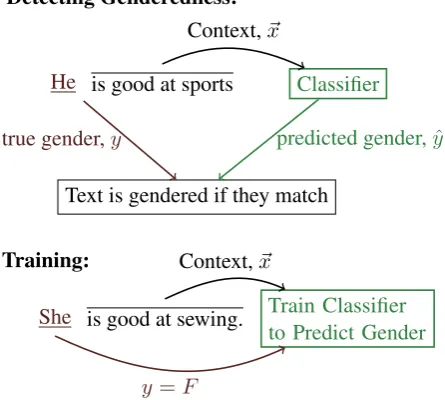
Proposed Architecture We are interested in de-termining the extent to which language in context of the mention reveals the gender. Humans learn to detect gendered language based on a lifetime of reading and observing society, and learning lan-guage specific to each gender. We use this intu-ition to propose an automated framework for
de-1in the machine learning sense of the word
Detecting Genderedness:
He is good at sports Classifier
Text is gendered if they match Context,~x
predicted gender,yˆ true gender,y
Training:
Train Classifier to Predict Gender
She is good at sewing. Context,~x
[image:3.595.310.533.72.272.2]y=F
Figure 2:Model overview. Using an automatically la-beled corpus, we train a classifier to predict the gender for each mention given its context (without the men-tion). For each target mention and its context sentence, we check whether the predicted gender matches the true prediction; the level of agreement indicates the
genderednessof the text.
tecting mention-level genderedness for any corpus (an overview is shown in Figure2).
The input to the gender detector is the context (sentence) without the target mention and the out-put is the detector prediction for gender of that mention. For a mention i, let Cbi be the context before the mention, Cai be the context after the mention andfθbe the gender detector. Then,
pi =fθ(Cai, Cbi) (1)
is the detector’s probability (confidence) that the mentioni is female, i.e. pi close to 0 indicates high confidence for predicting male while close to 1indicates high confidence for females.
We use the detector’s probability of thetrue gen-der of the mention (gi) as an estimate of how gen-dered the text is: a high probability indicates that gender is heavily reflected in the context. We de-fine this as the gendered score, given byGim here:
Gim =
(
pi True gendergiis female
1−pi True gendergiis male (2)
We define gendered score for a document as the average of gender score for all of its mentions. i.e.
Gdoc=
1 N
N
X
i=1
Gim (3)
Dataset Male Mentions Female Mentions
Reviews 298,580 104,632
Summaries 405,368 186,626
News 19,012,473 3,902,510
Novels 18,433,400 6,982,348
Table 1:Dataset details. Number of male and female mentions in the different datasets are shown.
As detector, rather than relying on frequency-based linear models or Naive Bayes model, we can use simple as well as more complex classifiers that can accurately model semantics and syntax of the context. For example, we use bag-of-words models (with logistic regression classifier) and recurrent neural network models as described in Section4.2.
4 Datasets and Classifiers
In this section, we give details about the datasets, our pipeline for automated data labeling, filtering and processing applied to contexts in order to re-move obvious gender information, and the classi-fiers used to classify gender of a given mention.
4.1 Datasets and data processing
To illustrate the utility of our proposed approach, we analyze text from four different domains:
• New York Times articles from the Annotated Gigaword corpus (Napoles et al.,2012) • Novels from Gutenberg corpus2
• IMDB Movie Reviews (Maas et al.,2011) • Movie Summaries (Bamman et al.,2013) These domains cover a variety of writing styles. While the novels represent fictional writing, news articles are non-fictional. Movie summaries dataset describes the plot of the movies, i.e., how gender is represented in the plots, and the movie reviews dataset provides the ways in which people express their views on the plots, i.e., how gender is repre-sented in user perception of the movie.
We train classifiers for each domain to predict the gender of mentions from the context they ap-pear in, and use the resulting classifiers to detect gendered language. Similar idea is explored in Choi et al. (2018) to detect the type of mention from the context. For news, data from the first6 months for every year is used for training, next three for validation, and last three for testing. For novels and movie summaries, we divide the data randomly into50 : 20 : 30split for train, validation
2Project Gutenberg, fromwww.gutenberg.org
1 Miss Mary Briganza will go to Korea with her parents.
2 Miss<female>will go to Korea with her parents. 3 <Title> <female>will go to Korea with<their>parents. 4 <Title> will go to Korea with<Their>parents.
Figure 3: Annotation pipeline. We show the anno-tation and data processing pipeline step-by-step. 1is the original sentence. 2is the sentence after detecting positions of all mentions in the sentence, and replac-ing them with a placeholder for gender of that mention.
3is the sentence after removing obvious gender infor-mation such as replacing gendered-pronouns (he,she) with a gender-neutral pronoun (them), and titles Mr., Mrs., Miss with a placeholder title word. 4 is the fi-nal input to our classifier where is the position of mention for which classifier needs to predict gender (male or female).
and test data. For movie reviews, we use the pre-defined split for train and test data, further dividing the training data into training and validation data.
Labeling Gender for Mentions We illustrate our processing pipeline via the example sentence in Figure3. For mention-level gender prediction, we need a dataset with identified person mentions and their genders. Since we do not have labeled data, we need to identify mentions in contexts, and assign gender labels to them. Along with pronouns ‘he’ and ‘she’, we use spacy3to tag all corpora with NER tags to identify the set of person mentions. We use the SSN baby names dataset4 from 1880 to 2016 to assign gender to each name. If a name is associated with more than one sex, we exclude it if it is ambiguous (being less than4times more frequent for one sex), but otherwise assign it to the more frequent sex. If a name is absent from our list of names, we replace the mention with a placeholder<Person>. Table 1shows the count of male and female mention-context pairs gener-ated using this pipeline. Processed sentence after this step is sentence 2 in Figure3.
Filtering and Input Context Processing To re-move obvious, uninteresting gender information, we discard sentences that contain any word from a gender-specific lexicon as used by Bolukbasi et al. (2016) such as gender-specific occupation words and gender-specific familial relation words, e.g., ‘man’, ‘woman’, ‘prince’, and ‘hostess’. Complete list is given in AppendixA. For contexts that con-tain gender-indicative pronouns (‘him’, ‘her’, ‘his’,
3
https://spacy.io
‘hers’, ‘himself’, ‘herself’), we replace them with a gender-neutral pronoun (‘them’, ‘their’). All other mentions in the context (including ‘he’ and ‘she’) are replaced with a gender neutral word, and ti-tles (‘Mr’,‘Mrs’,‘Miss’) are replaced with a gender-neutral title word. Sentence 3 in Figure 3 is the result after this stage.
4.2 Classifier Details
The input to classifier is sentence 4 in Figure 3 and the target is 1 (for female). We extract such mention-context pairs from large text corpora to train classifiers that can predict the gender of indi-vidual mentions from their context using minimal manual supervision (as illustrated in Figure2).
Bag-of-words and ngrams We construct bag-of-word classifiers by selecting the50,000most fre-quent words from the training subset, and bag-of-ngrams models by selecting the100,000most fre-quent n-grams (up to 3-grams), for each dataset. We explore a number of classifiers like logistic re-gression, support vector machines, random forest classifier, and choose logistic regression classifier since it consistently performs better than others.
LSTMs and CNNs We use both uni- and bidi-rectional LSTM recurrent neural networks for the context. In the 2-way LSTM model, we use two separate LSTMs: one for context before the men-tion, and the other for context after the mention. The direction of LSTM for latter part is reversed so that the model gives more importance to words closer to the target mention. This is followed by a sigmoid layer after the concatenation of the final hidden states. The input layers are initialized using the Glove vectors (Pennington et al., 2014), and are updated during training. We train the classifier with log-loss and Adam (Kingma and Ba,2014) op-timization algorithm, including dropout (Srivastava et al.,2014) and early stopping for regularization. Hyper-parameters are tuned for different domains separately. We experiment with ELMo embed-dings (Peters et al., 2018), convolutional neural network (CNN)-based architectures, vanilla recur-rent neural network (RNN), and gated recurrecur-rent unit (GRU) (Cho et al.,2014) models as well.
Performance Since our datasets are imbalanced, we use AUC-ROC as a performance metric. Table 2 shows AUC-ROCs for various models for all the datasets. Conventional bag-of-word/ngrams classifiers exhibit AUC-ROCs comparable to more
Reviews Summaries News Novels
Bag-of-ngrams 0.64 0.62 0.70 0.71
Bag-of-word 0.63 0.62 0.70 0.71
Single LSTM 0.67 0.62 0.63 0.63
2-way LSTM 0.67 0.66 0.68 0.67
2-way LSTM + ELMo 0.67 0.65 0.70 0.69
2-way RNN 0.65 0.63 0.65 0.63
2-way GRU 0.67 0.66 0.69 0.66
CNN 0.66 0.64 0.68 0.64
Table 2:AUC-ROCs for different models (evaluated on test data).
complex LSTM and CNN classifiers. We use 2-way LSTM as the classifier for our final analysis.
5 Human Annotation Evaluation
To assess the difficulty of this task and to compare performance of our gendered language detector against a human baseline, we use Amazon Mechan-ical Turk to get human annotations for500random sentences from the test sets of each domain.
Task Description Turkers are shown sentences with missing mention, e.g.,‘Sandwich maker said mojo and fresh roasted pork are key to a great Cuban sandwich’, and are asked to guess the gender of the missing mention. We sample the sentences such that the true labels (male/female) are balanced. For our study, we use two tasks that slightly dif-fer from one another in the decisions turkers need to make. In one task, turkers are given only two options,maleandfemale, forcing them to make a choice. In the second task, turkers are given five options on the Likert scale:extremely likely male, likely male, neutral, likely female, extremely likely femaleallowing for a finer scale of decision. We include examples in the instructions, and a few extremely easy examples as probes to verify qual-ity (Munro et al.,2010). Each worker is shown35 sentences from a single domain. On average, we collect7human annotations per sentence.
Do humans predict gender well? Sentences
Dataset Pairwise Majority 2-Scale 5-Scale 2-Scale 5-Scale
Reviews 0.62 0.32 0.74 0.52
News 0.65 0.38 0.77 0.55
Novels 0.60 0.33 0.73 0.52
Summaries 0.61 0.33 0.73 0.53
[image:6.595.307.524.62.189.2]Combined 0.62 0.35 0.74 0.53
Table 3: Pairwise and majority inter-annotator
agreement for instances with clear majority.2-Scale
indicates when users are asked to indicate male or fe-male, while 5-Scale indicates gender on a scale of 5.
Extremely maleLikely male NeutralLikely femaleExtremely female
Human predictions
0 40 80 120 160 200 240 280 320 360 400 440 480 520
Count
[image:6.595.97.266.63.144.2]Male Female
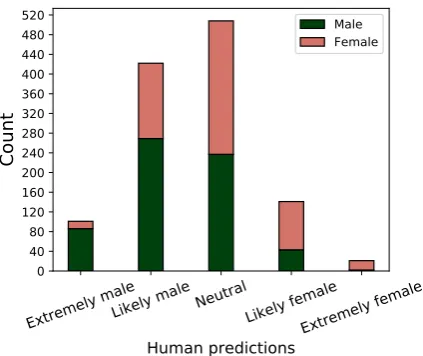
Figure 4: Comparing Human Predictions to Truth.
x-axis represents the human prediction for mentions, while the green and pink bars represent counts of true male and female mentions respectively.
5-scale task). To analyze the kind of mistakes hu-mans make, we show the true distribution of male and female mentions compared against human pre-dictions in Figure4. 42% of examples are predicted
‘Neutral’by humans showing that the task is pretty difficult for humans as they often find mention gen-der ambiguous. Further,‘Likely male’and‘Likely female’categories have around 30% wrong predic-tions as well. These high error rates explain low F1 of0.52for human annotations. ‘Extremely male’
and‘Extremely female’have the least error rates showing that humans are more precise when they are more confident about the predictions.
Does our model match humans? In order to
compare human annotations against model predic-tions more concretely, we choose to use Kendall’s τcstatistic (Berry et al.,2009), because it allows us to compare two variables when their underly-ing scales have different numbers of values. Like correlation coeeficients,τc ranges from -1 (fully negative association) to +1 (fully positive
associ-0.0 0.2 0.4 0.6 0.8 1.0 Model probability for female
Extremely male Likely male Neutral Likely female Extremely female
Figure 5: Human and Model Predictions. x-axis is the classifier probability where higher probability indi-cates female prediction. The points outside the range indicate outliers. Right shift of green line (representing median values) as we move from extremely male pre-dictions to extremely female prepre-dictions corroborates the agreement between humans and classifiers.
ation).τcbetween humans and our LSTM model predictions vary from0.23to0.36showing posi-tive correlation. We also look at classifier probabil-ity distribution for human decisions shown in box and whisker plot in Figure5, where x-axis is the classifier probability of the mention being female. The median value of classifier prediction for each category (shown in green line) shifts towards fe-male prediction as we move from ‘Extremely fe-male’ to ‘Extremely female’ category, corroborating the agreement between humans and model.
6 Analysing Gendered Language
We first show aggregate word level and phrase level analysis, then show more complex and subtle sources of gendered language on sentence level.
Word-level Analysis Table 4 shows the top nouns and verbs extracted using bag-of-word clas-sifier. We also train separate classifiers only on nouns, on adjectives, and on verbs in order to find out which are most informative for gen-der. Classifiers trained only on nouns performs best, indicating that nouns have most information. Top male-indicative nouns stem from typically male-dominated sports, while top female-indicative nouns are related to fashion and home industry.
Phrase-level Analysis Table 5 shows some of the top phrases for predicting males and females for different domains extracted using bag-of-ngrams models. We see phrases like‘clasped their hands’,
[image:6.595.75.287.215.393.2]Female-specific Nouns Male-specific Nouns Summaries: cherie, elisabet, crawlers, plastics, governess,
cheerleader, prostitution, overdosing, bimbo, spinner Novels:godmother, melvina, skirt, girlhood, lucile, womanly, eyebright, womanhood, shawl, dressmaker, demurely Reviews:comedienne, floriane, slut, adela, tch, topless, ac-tress, tits, feminist, modeling, redhead, helen, vamp, bettie News:gymnasts, dietitian, lpga, hingis, feminist, dowd, soren-stam, wie, receptionist, omnimedia, quilting, homemaker
Summaries:quacker, platoon, tweety, shemp, cellmate, ham, nibbles, falstaff, pup, towel, mousehole, bullies
Novels:disciples, yussuf, rifle, jr, pepe, cigar, colleague, fol-lowers, erasmus, judas, opponents
Reviews: seagal, inventor, panther, opponent, sellers, ratso, comedian, lawman, yossi, creators, brutus, ted
News:spurs, astros, nicks, jets, sprewell, nets, vikings, clip-pers, lakers, holyfield, sonics, councilman, nba, bucs, pitches
Female-specific Verbs Male-specific Verbs
Summaries: giggles, conceive, type, spurned, distorted, strokes, railing, rehearse, gag, disowned, plaguing, forgo Novels: sobbed, sew, blushed, wailed, pouted, scream, moaned, giggled, weeping, blushing, sob, shrieked, faltered Reviews:swims, bare, willed, raped, married, pouting, plead-ing, glows, kisses, liberated, seduces, fled, numbed
News:fax, widowed, choreograph, raped, graduates, decorat-ing, sobbdecorat-ing, majordecorat-ing, giggldecorat-ing, married, cries, decorate
Summaries:commanding, barks, crack, credited, embezzled, executes, opposing, foils, relying, assassinate, engineered Novels: preached, elected, growled, states, yelled, roared, nominated, voted, grinned, slew, preach, fire, attack
Reviews:direct, assuming, elected, defeat, casted, laid, mum-bles, rule, directing, flicks, drinking, produce
[image:7.595.83.517.288.409.2]News:coach, pitching, batted, disarm, sacked, benched, fum-bled, lightning, averaged, traded, sprained, vetoed
Table 4: Most important nouns and verbs for predicting male/female.
News Reviews Summaries Novels
Female gendered phrases
was pregnant femme fetale fashion show suffrage association
administrative assistant nude scenes jealous rage claspedtheirhands
theirbaby strong willed same way that glass eye
staff to vice pop star was asked to corresponding secretary
social worker is hot unborn child dressing room
Male gendered phrases
defense secretary action hero construction worker lieut col
theirlocker theirscreenplay of the next theirpipe
super tuesday clockwork orange school bully theirrifle
offensive coordinator court martial Vietnam war old fellow
majority leader nothing like the make living jimmy skunk
Table 5:Most important phrases for predicting male/female.‘their’represents gender-neutral pronoun.
‘construction worker’occur for males. Similarly, the term‘secretary’occurs frequently with females, however phrases like‘defense secretary’, ‘treasury secretary’are positive features for male mentions indicating male-domination of certain fields.
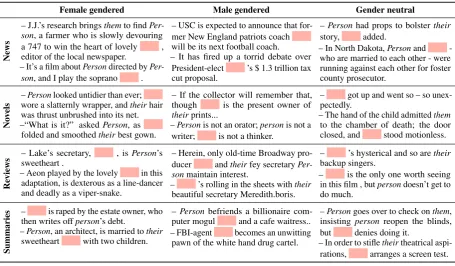
Sentence-level Analysis Our approach is the first to find gendered sentences from a huge cor-pora. We present examples of detected gendered language in Table 6; the first two columns show contexts for which a high level of gendering is es-timated (most confident estimates), while the clas-sifier has very low confidence for the examples in third column, indicating gender-neutral use of lan-guage. We see several interesting examples, e.g., male-gendered contexts from summaries show that society attributes roles like billionaire computer moguls and FBI-agents to males. The first female gendered example from novels depicts the way in which females are described and portrayed in fic-tion, which is in stark contrast to male descriptions.
Corpus-level Analysis Our approach allows us to automatically analyze large corpus of text,
en-abling high-level analysis of what documents are most, or least, gendered. Table7shows such an analysis, where the languages for movie reviews and summaries, genres for novels, and news desks for news are organized by their estimated gendered-ness. We see that children’s history books are more gendered than their literature books. Books related to opera and one-act plays are among the least gendered ones, while those related to war, history, and philosophy use gendered language the most. Movie reviews for movies in Vietnamese, Turkish and Polish are among the most gendered, while Greek and Japanese are the least gendered. We see a similar pattern in movie summaries - summaries for movies filmed in Polish and Turkish are more gendered than for movies in Korean or Romanian.
Sportsis the most gendered category for news ar-ticles, whileCultural,Leisure,Society, andHome
Female gendered Male gendered Gender neutral
News
– J.J.’s research bringsthemto find
Per-son, a farmer who is slowly devouring
a 747 to win the heart of lovely ,
editor of the local newspaper.
– It’s a film aboutPersondirected by
Per-son, and I play the soprano .
– USC is expected to announce that for-mer New England patriots coach will be its next football coach. – It has fired up a torrid debate over
President-elect ’s $ 1.3 trillion tax
cut proposal.
–Personhad props to bolstertheir
story, added.
– In North Dakota,Personand
-who are married to each other - were running against each other for foster county prosecutor.
No
v
els
–Personlooked untidier than ever;
wore a slatternly wrapper, andtheirhair
was thrust unbrushed into its net.
–“What is it?” askedPerson, as
folded and smoothedtheirbest gown.
– If the collector will remember that,
though is the present owner of
theirprints...
–Personis not an orator;personis not a
writer; is not a thinker.
– got up and went so – so
unex-pectedly.
– The hand of the child admittedthem
to the chamber of death; the door
closed, and stood motionless.
Re
views
– Lake’s secretary, , isPerson’s
sweetheart .
– Aeon played by the lovely in this
adaptation, is dexterous as a line-dancer and deadly as a viper-snake.
– Herein, only old-time Broadway
pro-ducer andtheirfey secretary
Per-sonmaintain interest.
– ’s rolling in the sheets withtheir
beautiful secretary Meredith.boris.
– ’s hysterical and so aretheir
backup singers.
– is the only one worth seeing
in this film , butpersondoesn’t get to do much.
Summaries
– is raped by the estate owner, who
then writes offperson’s debt.
–Person, an architect, is married totheir
sweetheart with two children.
–Personbefriends a billionaire
com-puter mogul and a cafe waitress..
– FBI-agent becomes an unwitting
pawn of the white hand drug cartel.
–Persongoes over to check onthem,
insistingperson reopen the blinds,
but denies doing it.
– In order to stifletheirtheatrical
[image:8.595.73.529.61.327.2]aspi-rations, arranges a screen test.
Table 6:Examples of gendered and non-gendered mention-context pairs from different domains.them/their
represents a gender-pronoun replaced with a gender neutral pronoun.Personrepresents mention. Note that in the first example for news (in female-gendered column),J.J.has not been identified as a mention. This is a weakness in the preprocessing.
Reviews Summaries Novels News
Language Language Genre News Desk
Vietnamese Serbian US Civil War Sports
Turkish Arabic US Politics Foreign
Polish Thai Mathematics Financial
Cantonese Czech Military Science Week in Review
Arabic Polish Evolution National
Mandarin Turkish Dictionaries Business
Korean Khmer Girls Living
Latin Korean Young women Travel
Portuguese Sinhala Sisters Society
French Hungarian Family Life Home
Greek Punjabi Marriage Style
Japanese Romanian Italy Performing Arts
Table 7: High-level Analysis of Corpora. Most and least gendered languages for movie reviews and sum-maries; genre for novels; news desk for news articles.
7 Discussion and Future Work
Sex vs Gender Since the current English lan-guage use is mostly limited to binary gender iden-tities (both due to grammar and usage), we treat gender as a binary concept in this work. Inclu-sion of genderqueer and non-binary identities will require data annotated by humans with sufficient domain knowledge, which was out of scope for this work. We assume that mentions for which our
label-ing has associated the wrong ‘gender’ because of difference in sex/gender identities are sufficiently low in proportion that model is still able to learn relevant signals when trained on large corpora.
Facts vs Stereotypes In this work, we do not delineate between factual information (women get
pregnant) and the intentional use of stereotypes (women aresweethearts). In some domains, such as news, ignoring this difference can be misleading, and exploring approaches that are able to better separate these different biases is important.
Extension to New Domains There remain a
[image:8.595.72.291.400.558.2]8 Conclusions
We present a concrete implementation and eval-uation of our gendered language detector. The main advantages of our pipeline and method are: (1)Flexibility, in application to different domains with minimal manual intervention, (2) Mention-levelanalysis, instead of article-level analysis in previous works, enabling more granular analysis, and (3)Quantitative measureof the extent of gen-deredness of context given a mention, allowing large-scale and detailed analyses and comparisons.
Our pipeline automatically extracts person men-tions from a corpus, and by using an accurate gender predictor, trains a classifier to learn the ways in which language is genderedfor that cor-pus. This automation provides multiple benefits; not only are there no humans in the loop to inject their biases about what is, and is not, gendered language, but further, collection of a large anno-tated corpus allows us to train sophisticated neural models that are able to capture semantic and syn-tactic constructions in the language. Evaluation suggests that our model is fairly accurate on this challenging task, and further, allows us to carry out analysis on multiple domains at varying levels of granularity, demonstrating potential applications of this work. The code to support such endeav-ours, and to reproduce the results, is available at https://ucinlp.github.io/GenderQuant.
Acknowledgements
We would like to thank Dheeru Dua, Matt Gardner, Robert L. Logan IV, and the reviewers for their feedback and suggestions. This work is supported in part by Allen Institute for Artificial Intelligence (AI2) and in part by NSF award #IIS-1756023.
References
Omar Ali, Ilias Flaounas, Tijl De Bie, Nick Mosdell, Justin Lewis, and Nello Cristianini. 2010. Automat-ing news content analysis: An application to gender bias and readability. InWorkshop on Applications of Pattern Analysis.
David Bamman, Brendan O’Connor, and Noah A Smith. 2013. Learning latent personas of film char-acters. In Annual Meeting of the Association for Computational Linguistics (ACL).
Kenneth J Berry, Janis E Johnston, Sammy Zahran, and Paul W Mielke. 2009. Stuarts tau measure of effect size for ordinal variables: Some methodological con-siderations. Behavior Research Methods, 41(4).
Ben Blatt. 2017. Nabokov’s favorite word is mauve. Simon & Schuster.
Tolga Bolukbasi, Kai-Wei Chang, James Y Zou, Venkatesh Saligrama, and Adam T Kalai. 2016. Man is to computer programmer as woman is to homemaker? debiasing word embeddings. In Ad-vances in Neural Information Processing Systems (NeurIPS).
Anne Boring, Kellie Ottoboni, and Philip B Stark. 2016. Student evaluations of teaching (mostly) do not mea-sure teaching effectiveness.ScienceOpen Research.
John D Burger, John Henderson, George Kim, and Guido Zarrella. 2011. Discriminating gender on twitter. InEmpirical Methods in Natural Language Processing (EMNLP).
Aylin Caliskan, Joanna J Bryson, and Arvind Narayanan. 2017. Semantics derived automatically from language corpora contain human-like biases.
Science, 356(6334).
John A Centra and Noreen B Gaubatz. 2000. Is there gender bias in student evaluations of teaching? The Journal of Higher Education, 71(1).
Kyunghyun Cho, Bart van Merri¨enboer, Dzmitry Bah-danau, and Yoshua Bengio. 2014. On the properties of neural machine translation: Encoder-decoder ap-proaches. Syntax, Semantics and Structure in Statis-tical Translation.
Eunsol Choi, Omer Levy, Yejin Choi, and Luke Zettle-moyer. 2018. Ultra-fine entity typing. In Annual Meeting of the Association for Computational Lin-guistic (ACL).
Cody Cottier. 2018. From mouth to mind: How lan-guage governs our perceptions of gender.
Jeffrey Dastin. 2018. Amazon scraps secret ai recruit-ing tool that showed bias against women.
Susan Tyler Eastman and Andrew C Billings. 2000. Sportscasting and sports reporting: The power of gender bias. Journal of Sport and Social Issues, 24(2).
Andrea Eidinger. 2017. She’s hot: Female sessional instructors, gender bias, and student evaluations.
Liye Fu, Cristian Danescu-Niculescu-Mizil, and Lil-lian Lee. 2016. Tie-breaker: Using language mod-els to quantify gender bias in sports journalism. In
IJCAI Workshop on Natural Language Processing meets Journalism.
Nikhil Garg, Londa Schiebinger, Dan Jurafsky, and James Zou. 2018. Word embeddings quantify 100 years of gender and ethnic stereotypes.Proceedings of the National Academy of Sciences, 115(16).
Abdullah Gharbavi and Seyyed Ahmad Mousavi. 2012. The application of functional linguistics in exposing gender bias in iranian high school english textbooks.
Hila Gonen and Yoav Goldberg. 2019. Lipstick on a pig: Debiasing methods cover up systematic gender biases in word embeddings but do not remove them. In North American Chapter of the Association for Computational Linguistics: Human Language Tech-nologies (NAACL-HLT).
Susan C Herring and John C Paolillo. 2006. Gender and genre variation in weblogs. Journal of Sociolin-guistics, 10(4).
Diederik Kingma and Jimmy Ba. 2014. Adam: A method for stochastic optimization. InInternational Conference on Learning Representations (ICLR).
Katherine N Kinnick. 1998. Gender bias in newspaper profiles of 1996 olympic athletes: A content analysis of five major dailies. Women’s Studies in Communi-cation, 21(2).
Corina Koolen and Andreas van Cranenburgh. 2017. These are not the stereotypes you are looking for: Bias and fairness in authorial gender attribution. In
ACL Workshop on Ethics in Natural Language Pro-cessing.
Moshe Koppel, Shlomo Argamon, and Anat Rachel Shimoni. 2002. Automatically categorizing written texts by author gender. Literary and Linguistic Com-puting, 17(4).
Mar´ıa E Len-R´ıos, Shelly Rodgers, Esther Thorson, and Doyle Yoon. 2005. Representation of women in news and photos: Comparing content to perceptions.
Journal of Communication, 55(1).
Andrew L Maas, Raymond E Daly, Peter T Pham, Dan Huang, Andrew Y Ng, and Christopher Potts. 2011. Learning word vectors for sentiment analysis. In An-nual Meeting of the Association for Computational Linguistics: Human Language Technologies (ACL-HLT).
Monica Macaulay and Colleen Brice. 1997. Don’t touch my projectile: Gender bias and stereotyping in syntactic examples. Language.
Lillian MacNell, Adam Driscoll, and Andrea N Hunt. 2015. What’s in a name: Exposing gender bias in student ratings of teaching. Innovative Higher Edu-cation, 40(4).
Michela Menegatti and Monica Rubini. 2017. Gender bias and sexism in language. Oxford Research Ency-clopedia of Communication.
Janice Moulton, George M Robinson, and Cherin Elias. 1978. Sex bias in language use: Neutral pronouns that aren’t. American Psychologist, 33(11).
Arjun Mukherjee and Bing Liu. 2010. Improving gen-der classification of blog authors. In Empirical Methods in Natural Language Processing (EMNLP).
Robert Munro, Steven Bethard, Victor Kuperman, Vicky Tzuyin Lai, Robin Melnick, Christopher Potts, Tyler Schnoebelen, and Harry Tily. 2010. Crowd-sourcing and language studies: The new generation of linguistic data. InNAACL HLT Workshop on Cre-ating Speech and Language Data with Amazon’s Me-chanical Turk.
Courtney Napoles, Matthew Gormley, and Benjamin Van Durme. 2012. Annotated gigaword. In Joint Workshop on Automatic Knowledge Base Construc-tion and Web-scale Knowledge ExtracConstruc-tion, AKBC-WEKEX.
Marcus Otlowski. 2003. Ethnic diversity and gender bias in efl textbooks. Asian EFL Journal, 5(2).
Ji Ho Park, Jamin Shin, and Pascale Fung. 2018. Re-ducing gender bias in abusive language detection. In
Empirical Methods in Natural Language Processing (EMNLP).
Jeffrey Pennington, Richard Socher, and Christopher Manning. 2014. Glove: Global vectors for word rep-resentation. InEmpirical Methods in Natural Lan-guage Processing (EMNLP).
Matthew E Peters, Mark Neumann, Mohit Iyyer, Matt Gardner, Christopher Clark, Kenton Lee, and Luke Zettlemoyer. 2018. Deep contextualized word repre-sentations. InNorth American Chapter of the Asso-ciation for Computational Linguistics: Human Lan-guage Technologies (NAACL-HLT).
Jemma Prior. 2017. Teachers, what is gendered lan-guage?
Anil Ramakrishna, Victor R Mart´ınez, Nikolaos Ma-landrakis, Karan Singla, and Shrikanth Narayanan. 2017. Linguistic analysis of differences in portrayal of movie characters. InAnnual Meeting of the Asso-ciation for Computational Linguistics (ACL).
Marta Recasens, Cristian Danescu-Niculescu-Mizil, and Dan Jurafsky. 2013. Linguistic models for an-alyzing and detecting biased language. In Annual Meeting of the Association for Computational Lin-guistics (ACL).
Rachel Rudinger, Chandler May, and Benjamin Van Durme. 2017. Social bias in elicited natural lan-guage inferences. In ACL Workshop on Ethics in Natural Language Processing.
Rachel Rudinger, Jason Naradowsky, Brian Leonard, and Benjamin Van Durme. 2018. Gender bias in coreference resolution. In North American Chap-ter of the Association for Computational Linguistics: Human Language Technologies (NAACL-HLT).
Maarten Sap, Marcella Prasettio, Ari Holtzman, Han-nah Rashkin, and Yejin Choi. 2017. Connotation frames of power and agency in modern films. In
Ruchita Sarawgi, Kailash Gajulapalli, and Yejin Choi. 2011. Gender attribution: tracing stylometric evi-dence beyond topic and genre. In Computational Natural Language Learning (CoNLL).
Toni Schmader, Jessica Whitehead, and Vicki H Wysocki. 2007. A linguistic comparison of letters of recommendation for male and female chemistry and biochemistry job applicants. Sex Roles, 57(7-8).
Alexandra Schofield and Leo Mehr. 2016. Gender-distinguishing features in film dialogue. In Work-shop on Computational Linguistics for Literature.
Kevin B Smith. 1997. When all’s fair: Signs of parity in media coverage of female candidates. Political Communication, 14(1).
Nitish Srivastava, Geoffrey E Hinton, Alex Krizhevsky, Ilya Sutskever, and Ruslan Salakhutdinov. 2014. Dropout: A simple way to prevent neural networks from overfitting. Journal of Machine Learning Re-search, 15(1).
Jane G. Stout and Nilanjana Dasgupta. 2011. When he doesn’t mean you: Gender-exclusive language as ostracism.
Rachael Tatman. 2017. Gender and dialect bias in youtube’s automatic captions. InACL Workshop on Ethics in Natural Language Processing.
Mike Thelwall. 2018. Gender bias in machine learning for sentiment analysis. Online Information Review, 42(3).
Frances Trix and Carolyn Psenka. 2003. Exploring the color of glass: Letters of recommendation for fe-male and fe-male medical faculty. Discourse & Soci-ety, 14(2).
Susan Tyler Eastman, Andrew C. Billings. 2001. Bi-ased voices of sports: Racial and gender stereotyp-ing in college basketball announcstereotyp-ing. Howard Jour-nal of Communication, 12(4).
Kellie Webster, Marta Recasens, Vera Axelrod, and Ja-son Baldridge. 2018. Mind the gap: A balanced cor-pus of gendered ambiguous pronouns. In Transac-tions of the Association for Computational Linguis-tics (TACL).
Tae Yano, Philip Resnik, and Noah A Smith. 2010. Shedding (a thousand points of) light on biased language. In NAACL HLT Workshop on Creating Speech and Language Data with Amazon’s Mechan-ical Turk.
Jieyu Zhao, Tianlu Wang, Mark Yatskar, Ryan Cot-terell, Vicente Ordonez, and Kai-Wei Chang. 2019. Gender bias in contextualized word embeddings. In
North American Chapter of the Association for Com-putational Linguistics: Human Language Technolo-gies (NAACL-HLT).
Jieyu Zhao, Tianlu Wang, Mark Yatskar, Vicente Or-donez, and Kai-Wei Chang. 2017. Men also like shopping: Reducing gender bias smplification using corpus-level constraints. In Empirical Methods in Natural Language Processing (EMNLP).
Jieyu Zhao, Tianlu Wang, Mark Yatskar, Vicente Or-donez, and Kai-Wei Chang. 2018a. Gender bias in coreference resolution: Evaluation and debiasing methods. In North American Chapter of the Asso-ciation for Computational Linguistics: Human Lan-guage Technologies (NAACL-HLT).
Jieyu Zhao, Yichao Zhou, Zeyu Li, Wei Wang, and Kai-Wei Chang. 2018b. Learning gender-neutral word embeddings. InEmpirical Methods in Natural Lan-guage Processing (EMNLP).
A Set of Gender-Specific Words
List fromBolukbasi et al.(2016) without pronouns: man, women, men, woman, spokesman, wife, son, mother,
fa-ther, chairman, daughter, husband, guy, girls, girl, boy, boys, brother, spokeswoman, female, sister, male, herself, brothers, dad, actress, mom, sons, girlfriend, daughters, lady, boyfriend,
sisters, mothers, king, businessman, grandmother, grandfather, deer, ladies, uncle, males, congressman, grandson, bull, queen, businessmen, wives, widow, nephew, bride, females, aunt,
prostate cancer, lesbian, chairwoman, fathers, moms, maiden, granddaughter, younger brother, lads, lion, gentleman, frater-nity, bachelor, niece, bulls, husbands, prince, colt, salesman, dude, beard, filly, princess, lesbians, councilman, actresses,
gentlemen, stepfather, monks, ex girlfriend, lad, sperm, testos-terone, nephews, maid, daddy, mare, fiance, fiancee, kings, dads, waitress, maternal, heroine, nieces, girlfriends, sir, stud,
mistress, lions, estranged wife, womb, grandma, maternity, estrogen, ex boyfriend, widows, gelding, diva, teenage girls, nuns, czar, ovarian cancer, countrymen, teenage girl, penis,
bloke, nun, brides, housewife, spokesmen, suitors, menopause, monastery, motherhood, brethren, stepmother, prostate, host-ess, twin brother, schoolboy, brotherhood, fillies, stepson,
con-gresswoman, uncles, witch, monk, viagra, paternity, suitor, sorority, macho, businesswoman, eldest son, gal, statesman, schoolgirl, fathered, goddess, hubby, stepdaughter, blokes,
dudes, strongman, uterus, grandsons, studs, mama, godfather, hens, hen, mommy, estranged husband, elder brother, boyhood, baritone, grandmothers, grandpa, boyfriends, feminism,
coun-tryman, stallion, heiress, queens, witches, aunts, semen, fella, granddaughters, chap, widower, salesmen, convent, vagina, beau, beards, handyman, twin sister, maids, gals, housewives,