4077
Benchmarking Hierarchical Script Knowledge
Yonatan Bisk1 Jan Buys1 Karl Pichotta∗ Yejin Choi1,2
1Paul G. Allen School of Computer Science and Engineering, University of Washington
2Allen Institute for Artificial Intelligence
{ybisk, jbuys}@cs.washington.edu
Abstract
Understanding procedural language requires reasoning about both hierarchical and
tempo-ral relations between events. For example,
“boiling pasta” is a sub-event of “making a
pasta dish”, typically happensbefore“draining
pasta,” andrequires the use of omitted tools
(e.g. a strainer, sink...). While people are able to choose when and how to use abstract ver-sus concrete instructions, the NLP community lacks corpora and tasks for evaluating if our models can do the same. In this paper, we
in-troduceKIDSCOOK, a parallel script corpus,
as well as a cloze task which matches video captions with missing procedural details. Ex-perimental results show that state-of-the-art models struggle at this task, which requires inducing functional commonsense knowledge not explicitly stated in text.
1 Introduction
The level of detail used in natural language com-munication varies: descriptive or instructive text for experts may elide over details the reader can seamlessly infer, while text for more novice audi-ences may be more verbose. A given document typically adheres to a single level of verbosity suited to its presumed audience (Grice, 1975), so learning correspondences between abstract and detailed descriptions of similar concepts from text is a challenging problem.
Commonsense knowledge of how complex events decompose into stereotypical sequences of simpler events is a necessary component of a sys-tem that can automatically understand and rea-son about different types of discourse. Hierarchi-cal correspondences between abstract and detailed representations of concepts and events were an im-portant aspect of the original formulation of scripts for natural language understanding (Schank and
∗
Author now at Google. Work done while unaffiliated.
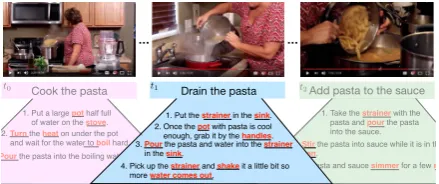
1. Take the strainer with the pasta and pour the pasta into the sauce. 2.Stir the pasta into sauce while it is in the
pan.
3. Let the pasta and sauce simmer for a few minutes. Add pasta to the sauce t2
<latexit sha1_base64="P4+gfywhwn2dG1TBnMWEEbekCJE=">AAAB6nicbVBNS8NAEJ3Ur1q/qh69LBbBU0mKUI9FLx4r2g9oQ9lsN+3SzSbsToQS+hO8eFDEq7/Im//GbZuDtj4YeLw3w8y8IJHCoOt+O4WNza3tneJuaW//4PCofHzSNnGqGW+xWMa6G1DDpVC8hQIl7yaa0yiQvBNMbud+54lrI2L1iNOE+xEdKREKRtFKDzioDcoVt+ouQNaJl5MK5GgOyl/9YczSiCtkkhrT89wE/YxqFEzyWamfGp5QNqEj3rNU0YgbP1ucOiMXVhmSMNa2FJKF+nsio5Ex0yiwnRHFsVn15uJ/Xi/F8NrPhEpS5IotF4WpJBiT+d9kKDRnKKeWUKaFvZWwMdWUoU2nZEPwVl9eJ+1a1XOr3v1VpXGTx1GEMziHS/CgDg24gya0gMEInuEV3hzpvDjvzseyteDkM6fwB87nDwccjZ0=</latexit><latexit sha1_base64="P4+gfywhwn2dG1TBnMWEEbekCJE=">AAAB6nicbVBNS8NAEJ3Ur1q/qh69LBbBU0mKUI9FLx4r2g9oQ9lsN+3SzSbsToQS+hO8eFDEq7/Im//GbZuDtj4YeLw3w8y8IJHCoOt+O4WNza3tneJuaW//4PCofHzSNnGqGW+xWMa6G1DDpVC8hQIl7yaa0yiQvBNMbud+54lrI2L1iNOE+xEdKREKRtFKDzioDcoVt+ouQNaJl5MK5GgOyl/9YczSiCtkkhrT89wE/YxqFEzyWamfGp5QNqEj3rNU0YgbP1ucOiMXVhmSMNa2FJKF+nsio5Ex0yiwnRHFsVn15uJ/Xi/F8NrPhEpS5IotF4WpJBiT+d9kKDRnKKeWUKaFvZWwMdWUoU2nZEPwVl9eJ+1a1XOr3v1VpXGTx1GEMziHS/CgDg24gya0gMEInuEV3hzpvDjvzseyteDkM6fwB87nDwccjZ0=</latexit><latexit sha1_base64="P4+gfywhwn2dG1TBnMWEEbekCJE=">AAAB6nicbVBNS8NAEJ3Ur1q/qh69LBbBU0mKUI9FLx4r2g9oQ9lsN+3SzSbsToQS+hO8eFDEq7/Im//GbZuDtj4YeLw3w8y8IJHCoOt+O4WNza3tneJuaW//4PCofHzSNnGqGW+xWMa6G1DDpVC8hQIl7yaa0yiQvBNMbud+54lrI2L1iNOE+xEdKREKRtFKDzioDcoVt+ouQNaJl5MK5GgOyl/9YczSiCtkkhrT89wE/YxqFEzyWamfGp5QNqEj3rNU0YgbP1ucOiMXVhmSMNa2FJKF+nsio5Ex0yiwnRHFsVn15uJ/Xi/F8NrPhEpS5IotF4WpJBiT+d9kKDRnKKeWUKaFvZWwMdWUoU2nZEPwVl9eJ+1a1XOr3v1VpXGTx1GEMziHS/CgDg24gya0gMEInuEV3hzpvDjvzseyteDkM6fwB87nDwccjZ0=</latexit><latexit sha1_base64="P4+gfywhwn2dG1TBnMWEEbekCJE=">AAAB6nicbVBNS8NAEJ3Ur1q/qh69LBbBU0mKUI9FLx4r2g9oQ9lsN+3SzSbsToQS+hO8eFDEq7/Im//GbZuDtj4YeLw3w8y8IJHCoOt+O4WNza3tneJuaW//4PCofHzSNnGqGW+xWMa6G1DDpVC8hQIl7yaa0yiQvBNMbud+54lrI2L1iNOE+xEdKREKRtFKDzioDcoVt+ouQNaJl5MK5GgOyl/9YczSiCtkkhrT89wE/YxqFEzyWamfGp5QNqEj3rNU0YgbP1ucOiMXVhmSMNa2FJKF+nsio5Ex0yiwnRHFsVn15uJ/Xi/F8NrPhEpS5IotF4WpJBiT+d9kKDRnKKeWUKaFvZWwMdWUoU2nZEPwVl9eJ+1a1XOr3v1VpXGTx1GEMziHS/CgDg24gya0gMEInuEV3hzpvDjvzseyteDkM6fwB87nDwccjZ0=</latexit>
1. Put a large pot half full
of water on the stove.
2.Turn the heat on under the pot
and wait for the water to boil hard.
3.Pour the pasta into the boiling water.
Cook the pasta t0
<latexit sha1_base64="apCCl0QQ/pUAKLQ3uBGKSWYytus=">AAAB6nicbVBNS8NAEJ3Ur1q/oh69LBbBU0lE0GPRi8eK9gPaUDbbTbt0swm7E6GE/gQvHhTx6i/y5r9x2+agrQ8GHu/NMDMvTKUw6HnfTmltfWNzq7xd2dnd2z9wD49aJsk0402WyER3Qmq4FIo3UaDknVRzGoeSt8Px7cxvP3FtRKIecZLyIKZDJSLBKFrpAfte3616NW8Oskr8glShQKPvfvUGCctirpBJakzX91IMcqpRMMmnlV5meErZmA5511JFY26CfH7qlJxZZUCiRNtSSObq74mcxsZM4tB2xhRHZtmbif953Qyj6yAXKs2QK7ZYFGWSYEJmf5OB0JyhnFhCmRb2VsJGVFOGNp2KDcFffnmVtC5qvlfz7y+r9ZsijjKcwCmcgw9XUIc7aEATGAzhGV7hzZHOi/PufCxaS04xcwx/4Hz+AAQUjZs=</latexit>
<latexit sha1_base64="apCCl0QQ/pUAKLQ3uBGKSWYytus=">AAAB6nicbVBNS8NAEJ3Ur1q/oh69LBbBU0lE0GPRi8eK9gPaUDbbTbt0swm7E6GE/gQvHhTx6i/y5r9x2+agrQ8GHu/NMDMvTKUw6HnfTmltfWNzq7xd2dnd2z9wD49aJsk0402WyER3Qmq4FIo3UaDknVRzGoeSt8Px7cxvP3FtRKIecZLyIKZDJSLBKFrpAfte3616NW8Oskr8glShQKPvfvUGCctirpBJakzX91IMcqpRMMmnlV5meErZmA5511JFY26CfH7qlJxZZUCiRNtSSObq74mcxsZM4tB2xhRHZtmbif953Qyj6yAXKs2QK7ZYFGWSYEJmf5OB0JyhnFhCmRb2VsJGVFOGNp2KDcFffnmVtC5qvlfz7y+r9ZsijjKcwCmcgw9XUIc7aEATGAzhGV7hzZHOi/PufCxaS04xcwx/4Hz+AAQUjZs=</latexit>
<latexit sha1_base64="apCCl0QQ/pUAKLQ3uBGKSWYytus=">AAAB6nicbVBNS8NAEJ3Ur1q/oh69LBbBU0lE0GPRi8eK9gPaUDbbTbt0swm7E6GE/gQvHhTx6i/y5r9x2+agrQ8GHu/NMDMvTKUw6HnfTmltfWNzq7xd2dnd2z9wD49aJsk0402WyER3Qmq4FIo3UaDknVRzGoeSt8Px7cxvP3FtRKIecZLyIKZDJSLBKFrpAfte3616NW8Oskr8glShQKPvfvUGCctirpBJakzX91IMcqpRMMmnlV5meErZmA5511JFY26CfH7qlJxZZUCiRNtSSObq74mcxsZM4tB2xhRHZtmbif953Qyj6yAXKs2QK7ZYFGWSYEJmf5OB0JyhnFhCmRb2VsJGVFOGNp2KDcFffnmVtC5qvlfz7y+r9ZsijjKcwCmcgw9XUIc7aEATGAzhGV7hzZHOi/PufCxaS04xcwx/4Hz+AAQUjZs=</latexit>
<latexit sha1_base64="apCCl0QQ/pUAKLQ3uBGKSWYytus=">AAAB6nicbVBNS8NAEJ3Ur1q/oh69LBbBU0lE0GPRi8eK9gPaUDbbTbt0swm7E6GE/gQvHhTx6i/y5r9x2+agrQ8GHu/NMDMvTKUw6HnfTmltfWNzq7xd2dnd2z9wD49aJsk0402WyER3Qmq4FIo3UaDknVRzGoeSt8Px7cxvP3FtRKIecZLyIKZDJSLBKFrpAfte3616NW8Oskr8glShQKPvfvUGCctirpBJakzX91IMcqpRMMmnlV5meErZmA5511JFY26CfH7qlJxZZUCiRNtSSObq74mcxsZM4tB2xhRHZtmbif953Qyj6yAXKs2QK7ZYFGWSYEJmf5OB0JyhnFhCmRb2VsJGVFOGNp2KDcFffnmVtC5qvlfz7y+r9ZsijjKcwCmcgw9XUIc7aEATGAzhGV7hzZHOi/PufCxaS04xcwx/4Hz+AAQUjZs=</latexit>
… …
Drain the pasta
1. Put the strainer in the sink. 2. Once the pot with pasta is cool enough, grab it by the handles.
3.Pour the pasta and water into the strainer
in the sink.
4. Pick up the strainer and shake it a little bit so more water comes out.
t1
<latexit sha1_base64="FVaQdjUWZVLyUUalbbTR1NMDoKM=">AAAB6nicbVBNS8NAEJ3Ur1q/oh69LBbBU0lE0GPRi8eK9gPaUDbbTbt0swm7E6GE/gQvHhTx6i/y5r9x2+agrQ8GHu/NMDMvTKUw6HnfTmltfWNzq7xd2dnd2z9wD49aJsk0402WyER3Qmq4FIo3UaDknVRzGoeSt8Px7cxvP3FtRKIecZLyIKZDJSLBKFrpAft+3616NW8Oskr8glShQKPvfvUGCctirpBJakzX91IMcqpRMMmnlV5meErZmA5511JFY26CfH7qlJxZZUCiRNtSSObq74mcxsZM4tB2xhRHZtmbif953Qyj6yAXKs2QK7ZYFGWSYEJmf5OB0JyhnFhCmRb2VsJGVFOGNp2KDcFffnmVtC5qvlfz7y+r9ZsijjKcwCmcgw9XUIc7aEATGAzhGV7hzZHOi/PufCxaS04xcwx/4Hz+AAWYjZw=</latexit>
<latexit sha1_base64="FVaQdjUWZVLyUUalbbTR1NMDoKM=">AAAB6nicbVBNS8NAEJ3Ur1q/oh69LBbBU0lE0GPRi8eK9gPaUDbbTbt0swm7E6GE/gQvHhTx6i/y5r9x2+agrQ8GHu/NMDMvTKUw6HnfTmltfWNzq7xd2dnd2z9wD49aJsk0402WyER3Qmq4FIo3UaDknVRzGoeSt8Px7cxvP3FtRKIecZLyIKZDJSLBKFrpAft+3616NW8Oskr8glShQKPvfvUGCctirpBJakzX91IMcqpRMMmnlV5meErZmA5511JFY26CfH7qlJxZZUCiRNtSSObq74mcxsZM4tB2xhRHZtmbif953Qyj6yAXKs2QK7ZYFGWSYEJmf5OB0JyhnFhCmRb2VsJGVFOGNp2KDcFffnmVtC5qvlfz7y+r9ZsijjKcwCmcgw9XUIc7aEATGAzhGV7hzZHOi/PufCxaS04xcwx/4Hz+AAWYjZw=</latexit>
[image:1.595.307.527.222.314.2]<latexit sha1_base64="FVaQdjUWZVLyUUalbbTR1NMDoKM=">AAAB6nicbVBNS8NAEJ3Ur1q/oh69LBbBU0lE0GPRi8eK9gPaUDbbTbt0swm7E6GE/gQvHhTx6i/y5r9x2+agrQ8GHu/NMDMvTKUw6HnfTmltfWNzq7xd2dnd2z9wD49aJsk0402WyER3Qmq4FIo3UaDknVRzGoeSt8Px7cxvP3FtRKIecZLyIKZDJSLBKFrpAft+3616NW8Oskr8glShQKPvfvUGCctirpBJakzX91IMcqpRMMmnlV5meErZmA5511JFY26CfH7qlJxZZUCiRNtSSObq74mcxsZM4tB2xhRHZtmbif953Qyj6yAXKs2QK7ZYFGWSYEJmf5OB0JyhnFhCmRb2VsJGVFOGNp2KDcFffnmVtC5qvlfz7y+r9ZsijjKcwCmcgw9XUIc7aEATGAzhGV7hzZHOi/PufCxaS04xcwx/4Hz+AAWYjZw=</latexit><latexit sha1_base64="FVaQdjUWZVLyUUalbbTR1NMDoKM=">AAAB6nicbVBNS8NAEJ3Ur1q/oh69LBbBU0lE0GPRi8eK9gPaUDbbTbt0swm7E6GE/gQvHhTx6i/y5r9x2+agrQ8GHu/NMDMvTKUw6HnfTmltfWNzq7xd2dnd2z9wD49aJsk0402WyER3Qmq4FIo3UaDknVRzGoeSt8Px7cxvP3FtRKIecZLyIKZDJSLBKFrpAft+3616NW8Oskr8glShQKPvfvUGCctirpBJakzX91IMcqpRMMmnlV5meErZmA5511JFY26CfH7qlJxZZUCiRNtSSObq74mcxsZM4tB2xhRHZtmbif953Qyj6yAXKs2QK7ZYFGWSYEJmf5OB0JyhnFhCmRb2VsJGVFOGNp2KDcFffnmVtC5qvlfz7y+r9ZsijjKcwCmcgw9XUIc7aEATGAzhGV7hzZHOi/PufCxaS04xcwx/4Hz+AAWYjZw=</latexit>
Figure 1: An exampleKIDSCOOKsequence with
mul-tiple types of hierarchy and abstraction: the example contains sequences of complex instructions, given both as sentences and sequences of simpler instructions.
Abelson,1977;DeJong,1981) but required
hand-written data structures encoding world knowledge. However, the automatic induction of such com-monsense knowledge from open-domain noisy text corpora remains an open problem (Chambers,
2013;Weber et al.,2018;Zellers et al.,2018). As a
step towards solving this problem we consider tex-tual descriptions of actions in a cooking domain.
We introduce a dataset,KIDSCOOK, targeted at exploring the automatic acquisition of correspon-dences between abstract and concrete descriptions of actions. The dataset consists of higher-level single-sentence imperative descriptions paired with lower-level descriptions with elided details included. Descriptions come from real grounded actions, built on top of the YouCookII video cap-tion dataset (Zhou et al.,2017).
commonsense world knowledge by YouCookII. The KIDSCOOK dataset allows us to learn mappings between abstract and concrete descrip-tions via sequence-to-sequence prediction. We ap-ply several standard neural sequence-to-sequence models; however, since these models do not ex-pose explicit, interpretable correspondences be-tween abstract and concrete descriptions, we also propose the application of neural transduction models which capture correspondences with latent hard alignment variables. We define a cloze-style evaluation to complement our dataset, in which models must predict the values of held-out tokens which target knowledge of tool usage, temporal ordering, and kitchen commonsense. We find that our neural transduction models are able to match the predictive power of traditional neural sequence models while providing interpretable alignments between abstract and concrete subsequences use-ful for our primary goal of analysis of implicit hi-erarchical script knowledge.
2 Data & Task
Our approach situates script learning as a case of grounding. For simplicity of exposition, let us assume there are three levels of abstraction to grounding: abstract → concrete → motor con-trol. Most prior work in grounding treats language monolithically1and ignores the issue of audience. In practice, this means the task formulation or ex-posed API may implicitly bias the language to be more concrete. By viewing the task as purely lin-guistic, we have no API or robot that constrains our language; instead, we define our audience as children. By eliciting child-directed instructions, we collect concrete language capturing otherwise implicit world knowledge that a child would not know. Because annotators assume a smart and ca-pable but uninformed listener, we posit this lan-guage corresponds closely to the most “concrete” form in which language naturally occurs.
2.1 Data Collection
We construct a task on Amazon’s Mechanical Turk, where workers are asked to explain a video action caption to a child.2 Every instruction is paired with the original YouTube video and YouCook caption so the annotator could see how
1
Notable exceptions include the hierarchical instructions of (Regneri et al.,2013) and (Bisk et al.,2016).
2Pay was calculated based on $15/hr and assuming
work-ers took 1.5x as long to complete a task as the experimentwork-ers.
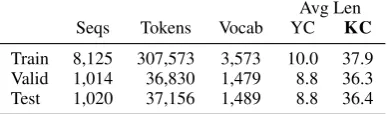
Avg Len
Seqs Tokens Vocab YC KC
Train 8,125 307,573 3,573 10.0 37.9
Valid 1,014 36,830 1,479 8.8 36.3
[image:2.595.319.513.67.124.2]Test 1,020 37,156 1,489 8.8 36.4
Table 1:KIDSCOOKcorpus statistics
the action was performed, rather than hallucinat-ing additional details. All captions received three simplifications. The instructions ask users to fo-cus on missing information and allow them up to five steps. Finally, we explicitly asked annotators to simplify complex actions (e.g.dice) that can be defined by a series of more basic actions (e.g.cut). Our KIDSCOOKcorpus statistics are shown in Table1. In total we collected over 10K action se-quences (∼400K tokens). The average caption is approximately 4x longer than a YouCook caption. Most importantly 1,536 lemmas and 2,316 lexical types from KIDSCOOK’s vocabulary do not ap-pear in any of the original captions. This indicates that there are over 1,500 new concepts, tools, and procedures that were assumed by YouCookII but are now explicit inKIDSCOOK.
2.2 Cloze Task
To investigate what new knowledge is being in-troduced and whether a model has captured it, we construct a cloze-style slot-filling task (
Cham-bers, 2017;Hermann et al.,2015). We drop key
content words from the concrete realization of an abstract instruction and ask the model to predict them. Several examples from the validation set are shown in Table2. Correctly predicting the missing words requires knowledge of the manner of exe-cuting a task and the tools required.
To choose candidate words to drop, we only allow words that occur primarily in the concrete instructions. Additionally, we do not drop stop words, numbers, or words occurring fewer than five times. We do, however, drop units of mea-sure (cup, minute, etc.). This ensures we create blanks whose answers are previously omitted con-crete details. Relatedly, under this filter the answer to a blank is very rarely an ingredient, as our goal is not to memorize recipes, but to infer the tool knowledge necessary to execute them. In total, we whitelist∼1,000 words that can be dropped to cre-ate blanks. We prefer longer blanks when avail-able to give preference to compound nouns (e.g.
ABS chop garlic into small pieces .
CON put garlic oncutting board.presson back ofknifewithhand,cuttinginto small pieces.
ABS add some parmesan cheese into the bowl and mix them well.
CON use agratertogratesome parmesan cheese into the bowl. use awire whisktostirthe cheese in.
ABS add the tofu to the wok.
CON drain thewaterfrom the tofu using astrainer. add the tofu into thepan. use aspoontostirthe tofu in the mixture.
Table 2: Example abstract/concrete pairs with blanks (red) where predictions and surprisal are computed.
from the concrete sentence if they occur in the ab-stract description. This restriction eliminates any benefits that might have been achieved via mod-els with copy mechanisms. Examples that do not meet our criteria are removed from the corpus.
3 Models
We investigate the utility of sequence-to-sequence models with attention (Bahdanau et al., 2015) to generate concrete realizations of abstract task de-scriptions. We hypothesize that models that learn explicit alignments are particularly amenable to interpretable analysis on the task. Therefore, in addition to using the global attention model of
(Luong et al., 2015), we adapt the transducer
model proposed by Yu et al. (2016), which uses learned latent discrete variables to model phrase-to-phrase alignments. In contrast to many standard neural models, this approach enables us to incor-porate prior knowledge about the alignment struc-ture, and to extract interpretable alignments be-tween task phrases. Closely related architectures have been proposed for segmental sequence mod-eling (Wang et al.,2017) and phrase-based neural machine translation (Huang et al.,2018).
We train the transducer models using Viterbi EM (after doing marginal likelihood training for the initial iterations), as we found it gave higher predictive accuracy than marginal likelihood train-ing only. Followtrain-ing Yu et al. (2016) we experi-ment with both a fixed alignexperi-ment transition prob-ability model and a transition model with a neu-ral parameterization. Cloze task prediction is per-formed greedily.3 At each slot the Viterbi align-ment of the prefix of the sequence up to that slot is computed. See appendix7 for model details.4 We also evaluate the performance of a language modelling baseline and a seq2seq model without attention (Sutskever et al., 2014), to compare the
3
During preliminary experiments beam search did not im-prove performance.
4All code and data is available athttps://github.
com/janmbuys/ScriptTransduction.
effect of not modeling alignment at all.
We expect all the models to implicitly capture aspects of world knowledge. However, the dis-crete latent variable models provide Viterbi align-ments over the training data, from which we can compile a look-up table with the extracted knowl-edge. In neural attention models, this knowledge is only weakly recoverable: extracting information requires hand tuning attention thresholds and there is no direct way to extract contiguous alignments for multi-word phrases.
4 Results
4.1 Evaluation Metrics
During generation, we provide the model with the number of words in each blank to be predicted. We consider two setups for evaluating examples with multiple blanks, both assuming that predictions are made left-to-right: Oracle, where the gold pre-diction of each blank is fed into the model to con-dition on for future predictions, and Greedy, where the model prediction is used for future predictions. We compute the proportion of exact word matches over each blank and the precision of the topk= 5
predictions for both setups. Additionally we com-pute the average surprisal of the gold prediction (conditioning on oracle predictions). The
sur-prisal of a word (Attneave, 1959; Hale, 2001)
is its negative log probability under the model:
−log(P(wi|w1:i−1)). The higher the probability
of the ground truth, the lower the model’s “sur-prise” at seeing it in that context.
Finally, as a quantitative proxy for interpretabil-ity, we report the length of the transducer mod-els’ average Viterbi alignment span: our goal is a model which balances low average alignment lengths and high matching or ranking scores.
4.2 Cloze Task Results
We report results on the prediction task in Table
abstract→concrete concrete→abstract
parmesan sprinkle grated, grate, hold a grater, ... whisk eggs, mayonnaise, milk, combine, pour, stir, ...
macaroni stove on high heat, large pot, bowl, ... spatula colors, thickens, coated, simmer, grill, ...
egg place the boiled, gently crack the, crack, ... tongs shrimp, bratwurst, turn, bun, marinate, ...
sauce stir hot, pour gravy, lower setting, find a spoon, ... cutting board onions, bell pepper, meat, bok choy, ...
[image:4.595.348.484.173.333.2]oil spray cooking, splashing, slowly pour, ... preheat oven, broil, medium, degrees, ...
Table 3: Example Viterbi Alignments. For concrete to abstract, we match any phrase containing the word(s).
Oracle Greedy
Model Match Top-5 Match Top-5 Surp
Language Model 21.59 52.32 21.72 43.33 3.970
Seq2seq 23.57 53.38 23.44 45.76 3.755
+Att 24.52 53.98 24.57 47.34 3.780
Transducer 24.72 55.09 24.91 47.80 4.780
+ParamTran 23.81 53.98 24.00 46.19 3.547
OpenAI GPT 23.19 42.43 15.55 32.86 4.781
+ fine-tuning 38.01 63.69 31.05 57.05 3.151
Table 4: Results on the Cloze prediction task (Match = Exact Match, Top-5 = Precision of Top 5
predic-tions, Surp = Surprisal). Transducer results are
re-ported for models with unparameterized and parame-terized (+ParamTran) alignment transition models. The
bestandsecond bestresults are emphasized.
do not. We see that our transducer model with fixed alignment transition probabilities performs best in terms of predictive accuracy (exact match and top-5 precision), while the seqseq model with attention is the next best in most comparisons. The model with parameterized transitions has the low-est surprisal though, as it is more confident about the alignment predictions it is making.
Using average alignment length to quantify whether the phrase alignments exhibit desirable structure, we see that the alignments found by the unparameterized transition model (average length 6.18) are significantly shorter than those of the parameterized model (average length 16.61). In-vestigation shows that the paramaterized model mostly learns degenerate alignments, aligning most of the concrete sequence to either the start or end of the abstract sentence. In contrast, qual-itative analysis of the unparameterized transition model show that its alignments learn desirable cor-respondences (see Figure 2). Therefore among our proposed models (trained on in-domain data only) the transducer with unparameterized tran-sitions satisfies our desiderata of displaying both good predictive power for word generation, and learning interpretable alignments.
Given the recent success of massively
pre-cut the dough in half and shape each half into a ball . <S> place the dough on a cutting board . using a sharp tool such as a knife , cut the dough in half . shape each half of the dough into a ball . weigh the cabbage and add salt . <S> pour the cabbage into the big bowl . use a spoon and scoop some salt into the bowl place the bread over high flame . <S> take the tongs and pick up the bread . set the bread on a grill . put on the grill over the high flame .
...<latexit sha1_base64="Ul1zjHMk9xZA8oyRXJLJOxn4TQw=">AAAB6nicbVBNS8NAEJ3Ur1q/qh69LBbBU0hE0GPRi8eK9gPaUDbbTbt0swm7E6GE/gQvHhTx6i/y5r9x2+agrQ8GHu/NMDMvTKUw6HnfTmltfWNzq7xd2dnd2z+oHh61TJJpxpsskYnuhNRwKRRvokDJO6nmNA4lb4fj25nffuLaiEQ94iTlQUyHSkSCUbTSg+u6/WrNc705yCrxC1KDAo1+9as3SFgWc4VMUmO6vpdikFONgkk+rfQyw1PKxnTIu5YqGnMT5PNTp+TMKgMSJdqWQjJXf0/kNDZmEoe2M6Y4MsveTPzP62YYXQe5UGmGXLHFoiiTBBMy+5sMhOYM5cQSyrSwtxI2opoytOlUbAj+8surpHXh+p7r31/W6jdFHGU4gVM4Bx+uoA530IAmMBjCM7zCmyOdF+fd+Vi0lpxi5hj+wPn8AUvkjSI=</latexit><latexit sha1_base64="Ul1zjHMk9xZA8oyRXJLJOxn4TQw=">AAAB6nicbVBNS8NAEJ3Ur1q/qh69LBbBU0hE0GPRi8eK9gPaUDbbTbt0swm7E6GE/gQvHhTx6i/y5r9x2+agrQ8GHu/NMDMvTKUw6HnfTmltfWNzq7xd2dnd2z+oHh61TJJpxpsskYnuhNRwKRRvokDJO6nmNA4lb4fj25nffuLaiEQ94iTlQUyHSkSCUbTSg+u6/WrNc705yCrxC1KDAo1+9as3SFgWc4VMUmO6vpdikFONgkk+rfQyw1PKxnTIu5YqGnMT5PNTp+TMKgMSJdqWQjJXf0/kNDZmEoe2M6Y4MsveTPzP62YYXQe5UGmGXLHFoiiTBBMy+5sMhOYM5cQSyrSwtxI2opoytOlUbAj+8surpHXh+p7r31/W6jdFHGU4gVM4Bx+uoA530IAmMBjCM7zCmyOdF+fd+Vi0lpxi5hj+wPn8AUvkjSI=</latexit><latexit sha1_base64="Ul1zjHMk9xZA8oyRXJLJOxn4TQw=">AAAB6nicbVBNS8NAEJ3Ur1q/qh69LBbBU0hE0GPRi8eK9gPaUDbbTbt0swm7E6GE/gQvHhTx6i/y5r9x2+agrQ8GHu/NMDMvTKUw6HnfTmltfWNzq7xd2dnd2z+oHh61TJJpxpsskYnuhNRwKRRvokDJO6nmNA4lb4fj25nffuLaiEQ94iTlQUyHSkSCUbTSg+u6/WrNc705yCrxC1KDAo1+9as3SFgWc4VMUmO6vpdikFONgkk+rfQyw1PKxnTIu5YqGnMT5PNTp+TMKgMSJdqWQjJXf0/kNDZmEoe2M6Y4MsveTPzP62YYXQe5UGmGXLHFoiiTBBMy+5sMhOYM5cQSyrSwtxI2opoytOlUbAj+8surpHXh+p7r31/W6jdFHGU4gVM4Bx+uoA530IAmMBjCM7zCmyOdF+fd+Vi0lpxi5hj+wPn8AUvkjSI=</latexit><latexit sha1_base64="Ul1zjHMk9xZA8oyRXJLJOxn4TQw=">AAAB6nicbVBNS8NAEJ3Ur1q/qh69LBbBU0hE0GPRi8eK9gPaUDbbTbt0swm7E6GE/gQvHhTx6i/y5r9x2+agrQ8GHu/NMDMvTKUw6HnfTmltfWNzq7xd2dnd2z+oHh61TJJpxpsskYnuhNRwKRRvokDJO6nmNA4lb4fj25nffuLaiEQ94iTlQUyHSkSCUbTSg+u6/WrNc705yCrxC1KDAo1+9as3SFgWc4VMUmO6vpdikFONgkk+rfQyw1PKxnTIu5YqGnMT5PNTp+TMKgMSJdqWQjJXf0/kNDZmEoe2M6Y4MsveTPzP62YYXQe5UGmGXLHFoiiTBBMy+5sMhOYM5cQSyrSwtxI2opoytOlUbAj+8surpHXh+p7r31/W6jdFHGU4gVM4Bx+uoA530IAmMBjCM7zCmyOdF+fd+Vi0lpxi5hj+wPn8AUvkjSI=</latexit>
e0
<latexit sha1_base64="1NSVA7XC5wla7NGfXitfHcXtZN8=">AAAB6nicbVBNS8NAEJ3Ur1q/oh69LBbBU0lE0GPRi8eK9gPaUDbbSbt0swm7G6GE/gQvHhTx6i/y5r9x2+agrQ8GHu/NMDMvTAXXxvO+ndLa+sbmVnm7srO7t3/gHh61dJIphk2WiER1QqpRcIlNw43ATqqQxqHAdji+nfntJ1SaJ/LRTFIMYjqUPOKMGis9YN/ru1Wv5s1BVolfkCoUaPTdr94gYVmM0jBBte76XmqCnCrDmcBppZdpTCkb0yF2LZU0Rh3k81On5MwqAxIlypY0ZK7+nshprPUkDm1nTM1IL3sz8T+vm5noOsi5TDODki0WRZkgJiGzv8mAK2RGTCyhTHF7K2EjqigzNp2KDcFffnmVtC5qvlfz7y+r9ZsijjKcwCmcgw9XUIc7aEATGAzhGV7hzRHOi/PufCxaS04xcwx/4Hz+AO0rjYw=</latexit><latexit sha1_base64="1NSVA7XC5wla7NGfXitfHcXtZN8=">AAAB6nicbVBNS8NAEJ3Ur1q/oh69LBbBU0lE0GPRi8eK9gPaUDbbSbt0swm7G6GE/gQvHhTx6i/y5r9x2+agrQ8GHu/NMDMvTAXXxvO+ndLa+sbmVnm7srO7t3/gHh61dJIphk2WiER1QqpRcIlNw43ATqqQxqHAdji+nfntJ1SaJ/LRTFIMYjqUPOKMGis9YN/ru1Wv5s1BVolfkCoUaPTdr94gYVmM0jBBte76XmqCnCrDmcBppZdpTCkb0yF2LZU0Rh3k81On5MwqAxIlypY0ZK7+nshprPUkDm1nTM1IL3sz8T+vm5noOsi5TDODki0WRZkgJiGzv8mAK2RGTCyhTHF7K2EjqigzNp2KDcFffnmVtC5qvlfz7y+r9ZsijjKcwCmcgw9XUIc7aEATGAzhGV7hzRHOi/PufCxaS04xcwx/4Hz+AO0rjYw=</latexit>
<latexit sha1_base64="1NSVA7XC5wla7NGfXitfHcXtZN8=">AAAB6nicbVBNS8NAEJ3Ur1q/oh69LBbBU0lE0GPRi8eK9gPaUDbbSbt0swm7G6GE/gQvHhTx6i/y5r9x2+agrQ8GHu/NMDMvTAXXxvO+ndLa+sbmVnm7srO7t3/gHh61dJIphk2WiER1QqpRcIlNw43ATqqQxqHAdji+nfntJ1SaJ/LRTFIMYjqUPOKMGis9YN/ru1Wv5s1BVolfkCoUaPTdr94gYVmM0jBBte76XmqCnCrDmcBppZdpTCkb0yF2LZU0Rh3k81On5MwqAxIlypY0ZK7+nshprPUkDm1nTM1IL3sz8T+vm5noOsi5TDODki0WRZkgJiGzv8mAK2RGTCyhTHF7K2EjqigzNp2KDcFffnmVtC5qvlfz7y+r9ZsijjKcwCmcgw9XUIc7aEATGAzhGV7hzRHOi/PufCxaS04xcwx/4Hz+AO0rjYw=</latexit>
<latexit sha1_base64="1NSVA7XC5wla7NGfXitfHcXtZN8=">AAAB6nicbVBNS8NAEJ3Ur1q/oh69LBbBU0lE0GPRi8eK9gPaUDbbSbt0swm7G6GE/gQvHhTx6i/y5r9x2+agrQ8GHu/NMDMvTAXXxvO+ndLa+sbmVnm7srO7t3/gHh61dJIphk2WiER1QqpRcIlNw43ATqqQxqHAdji+nfntJ1SaJ/LRTFIMYjqUPOKMGis9YN/ru1Wv5s1BVolfkCoUaPTdr94gYVmM0jBBte76XmqCnCrDmcBppZdpTCkb0yF2LZU0Rh3k81On5MwqAxIlypY0ZK7+nshprPUkDm1nTM1IL3sz8T+vm5noOsi5TDODki0WRZkgJiGzv8mAK2RGTCyhTHF7K2EjqigzNp2KDcFffnmVtC5qvlfz7y+r9ZsijjKcwCmcgw9XUIc7aEATGAzhGV7hzRHOi/PufCxaS04xcwx/4Hz+AO0rjYw=</latexit>
e6
<latexit sha1_base64="12MfjmJDqM21J4rd2GarPcwFAso=">AAAB6nicbVBNS8NAEJ3Ur1q/qh69LBbBU0lEqseiF48V7Qe0oWy2k3bpZhN2N0IJ/QlePCji1V/kzX/jts1BWx8MPN6bYWZekAiujet+O4W19Y3NreJ2aWd3b/+gfHjU0nGqGDZZLGLVCahGwSU2DTcCO4lCGgUC28H4dua3n1BpHstHM0nQj+hQ8pAzaqz0gP1av1xxq+4cZJV4OalAjka//NUbxCyNUBomqNZdz02Mn1FlOBM4LfVSjQllYzrErqWSRqj9bH7qlJxZZUDCWNmShszV3xMZjbSeRIHtjKgZ6WVvJv7ndVMTXvsZl0lqULLFojAVxMRk9jcZcIXMiIkllClubyVsRBVlxqZTsiF4yy+vktZF1XOr3v1lpX6Tx1GEEziFc/DgCupwBw1oAoMhPMMrvDnCeXHenY9Fa8HJZ47hD5zPH/ZDjZI=</latexit>
<latexit sha1_base64="12MfjmJDqM21J4rd2GarPcwFAso=">AAAB6nicbVBNS8NAEJ3Ur1q/qh69LBbBU0lEqseiF48V7Qe0oWy2k3bpZhN2N0IJ/QlePCji1V/kzX/jts1BWx8MPN6bYWZekAiujet+O4W19Y3NreJ2aWd3b/+gfHjU0nGqGDZZLGLVCahGwSU2DTcCO4lCGgUC28H4dua3n1BpHstHM0nQj+hQ8pAzaqz0gP1av1xxq+4cZJV4OalAjka//NUbxCyNUBomqNZdz02Mn1FlOBM4LfVSjQllYzrErqWSRqj9bH7qlJxZZUDCWNmShszV3xMZjbSeRIHtjKgZ6WVvJv7ndVMTXvsZl0lqULLFojAVxMRk9jcZcIXMiIkllClubyVsRBVlxqZTsiF4yy+vktZF1XOr3v1lpX6Tx1GEEziFc/DgCupwBw1oAoMhPMMrvDnCeXHenY9Fa8HJZ47hD5zPH/ZDjZI=</latexit><latexit sha1_base64="12MfjmJDqM21J4rd2GarPcwFAso=">AAAB6nicbVBNS8NAEJ3Ur1q/qh69LBbBU0lEqseiF48V7Qe0oWy2k3bpZhN2N0IJ/QlePCji1V/kzX/jts1BWx8MPN6bYWZekAiujet+O4W19Y3NreJ2aWd3b/+gfHjU0nGqGDZZLGLVCahGwSU2DTcCO4lCGgUC28H4dua3n1BpHstHM0nQj+hQ8pAzaqz0gP1av1xxq+4cZJV4OalAjka//NUbxCyNUBomqNZdz02Mn1FlOBM4LfVSjQllYzrErqWSRqj9bH7qlJxZZUDCWNmShszV3xMZjbSeRIHtjKgZ6WVvJv7ndVMTXvsZl0lqULLFojAVxMRk9jcZcIXMiIkllClubyVsRBVlxqZTsiF4yy+vktZF1XOr3v1lpX6Tx1GEEziFc/DgCupwBw1oAoMhPMMrvDnCeXHenY9Fa8HJZ47hD5zPH/ZDjZI=</latexit><latexit sha1_base64="12MfjmJDqM21J4rd2GarPcwFAso=">AAAB6nicbVBNS8NAEJ3Ur1q/qh69LBbBU0lEqseiF48V7Qe0oWy2k3bpZhN2N0IJ/QlePCji1V/kzX/jts1BWx8MPN6bYWZekAiujet+O4W19Y3NreJ2aWd3b/+gfHjU0nGqGDZZLGLVCahGwSU2DTcCO4lCGgUC28H4dua3n1BpHstHM0nQj+hQ8pAzaqz0gP1av1xxq+4cZJV4OalAjka//NUbxCyNUBomqNZdz02Mn1FlOBM4LfVSjQllYzrErqWSRqj9bH7qlJxZZUDCWNmShszV3xMZjbSeRIHtjKgZ6WVvJv7ndVMTXvsZl0lqULLFojAVxMRk9jcZcIXMiIkllClubyVsRBVlxqZTsiF4yy+vktZF1XOr3v1lpX6Tx1GEEziFc/DgCupwBw1oAoMhPMMrvDnCeXHenY9Fa8HJZ47hD5zPH/ZDjZI=</latexit>
...<latexit sha1_base64="Ul1zjHMk9xZA8oyRXJLJOxn4TQw=">AAAB6nicbVBNS8NAEJ3Ur1q/qh69LBbBU0hE0GPRi8eK9gPaUDbbTbt0swm7E6GE/gQvHhTx6i/y5r9x2+agrQ8GHu/NMDMvTKUw6HnfTmltfWNzq7xd2dnd2z+oHh61TJJpxpsskYnuhNRwKRRvokDJO6nmNA4lb4fj25nffuLaiEQ94iTlQUyHSkSCUbTSg+u6/WrNc705yCrxC1KDAo1+9as3SFgWc4VMUmO6vpdikFONgkk+rfQyw1PKxnTIu5YqGnMT5PNTp+TMKgMSJdqWQjJXf0/kNDZmEoe2M6Y4MsveTPzP62YYXQe5UGmGXLHFoiiTBBMy+5sMhOYM5cQSyrSwtxI2opoytOlUbAj+8surpHXh+p7r31/W6jdFHGU4gVM4Bx+uoA530IAmMBjCM7zCmyOdF+fd+Vi0lpxi5hj+wPn8AUvkjSI=</latexit><latexit sha1_base64="Ul1zjHMk9xZA8oyRXJLJOxn4TQw=">AAAB6nicbVBNS8NAEJ3Ur1q/qh69LBbBU0hE0GPRi8eK9gPaUDbbTbt0swm7E6GE/gQvHhTx6i/y5r9x2+agrQ8GHu/NMDMvTKUw6HnfTmltfWNzq7xd2dnd2z+oHh61TJJpxpsskYnuhNRwKRRvokDJO6nmNA4lb4fj25nffuLaiEQ94iTlQUyHSkSCUbTSg+u6/WrNc705yCrxC1KDAo1+9as3SFgWc4VMUmO6vpdikFONgkk+rfQyw1PKxnTIu5YqGnMT5PNTp+TMKgMSJdqWQjJXf0/kNDZmEoe2M6Y4MsveTPzP62YYXQe5UGmGXLHFoiiTBBMy+5sMhOYM5cQSyrSwtxI2opoytOlUbAj+8surpHXh+p7r31/W6jdFHGU4gVM4Bx+uoA530IAmMBjCM7zCmyOdF+fd+Vi0lpxi5hj+wPn8AUvkjSI=</latexit><latexit sha1_base64="Ul1zjHMk9xZA8oyRXJLJOxn4TQw=">AAAB6nicbVBNS8NAEJ3Ur1q/qh69LBbBU0hE0GPRi8eK9gPaUDbbTbt0swm7E6GE/gQvHhTx6i/y5r9x2+agrQ8GHu/NMDMvTKUw6HnfTmltfWNzq7xd2dnd2z+oHh61TJJpxpsskYnuhNRwKRRvokDJO6nmNA4lb4fj25nffuLaiEQ94iTlQUyHSkSCUbTSg+u6/WrNc705yCrxC1KDAo1+9as3SFgWc4VMUmO6vpdikFONgkk+rfQyw1PKxnTIu5YqGnMT5PNTp+TMKgMSJdqWQjJXf0/kNDZmEoe2M6Y4MsveTPzP62YYXQe5UGmGXLHFoiiTBBMy+5sMhOYM5cQSyrSwtxI2opoytOlUbAj+8surpHXh+p7r31/W6jdFHGU4gVM4Bx+uoA530IAmMBjCM7zCmyOdF+fd+Vi0lpxi5hj+wPn8AUvkjSI=</latexit><latexit sha1_base64="Ul1zjHMk9xZA8oyRXJLJOxn4TQw=">AAAB6nicbVBNS8NAEJ3Ur1q/qh69LBbBU0hE0GPRi8eK9gPaUDbbTbt0swm7E6GE/gQvHhTx6i/y5r9x2+agrQ8GHu/NMDMvTKUw6HnfTmltfWNzq7xd2dnd2z+oHh61TJJpxpsskYnuhNRwKRRvokDJO6nmNA4lb4fj25nffuLaiEQ94iTlQUyHSkSCUbTSg+u6/WrNc705yCrxC1KDAo1+9as3SFgWc4VMUmO6vpdikFONgkk+rfQyw1PKxnTIu5YqGnMT5PNTp+TMKgMSJdqWQjJXf0/kNDZmEoe2M6Y4MsveTPzP62YYXQe5UGmGXLHFoiiTBBMy+5sMhOYM5cQSyrSwtxI2opoytOlUbAj+8surpHXh+p7r31/W6jdFHGU4gVM4Bx+uoA530IAmMBjCM7zCmyOdF+fd+Vi0lpxi5hj+wPn8AUvkjSI=</latexit>
e0
<latexit sha1_base64="1NSVA7XC5wla7NGfXitfHcXtZN8=">AAAB6nicbVBNS8NAEJ3Ur1q/oh69LBbBU0lE0GPRi8eK9gPaUDbbSbt0swm7G6GE/gQvHhTx6i/y5r9x2+agrQ8GHu/NMDMvTAXXxvO+ndLa+sbmVnm7srO7t3/gHh61dJIphk2WiER1QqpRcIlNw43ATqqQxqHAdji+nfntJ1SaJ/LRTFIMYjqUPOKMGis9YN/ru1Wv5s1BVolfkCoUaPTdr94gYVmM0jBBte76XmqCnCrDmcBppZdpTCkb0yF2LZU0Rh3k81On5MwqAxIlypY0ZK7+nshprPUkDm1nTM1IL3sz8T+vm5noOsi5TDODki0WRZkgJiGzv8mAK2RGTCyhTHF7K2EjqigzNp2KDcFffnmVtC5qvlfz7y+r9ZsijjKcwCmcgw9XUIc7aEATGAzhGV7hzRHOi/PufCxaS04xcwx/4Hz+AO0rjYw=</latexit><latexit sha1_base64="1NSVA7XC5wla7NGfXitfHcXtZN8=">AAAB6nicbVBNS8NAEJ3Ur1q/oh69LBbBU0lE0GPRi8eK9gPaUDbbSbt0swm7G6GE/gQvHhTx6i/y5r9x2+agrQ8GHu/NMDMvTAXXxvO+ndLa+sbmVnm7srO7t3/gHh61dJIphk2WiER1QqpRcIlNw43ATqqQxqHAdji+nfntJ1SaJ/LRTFIMYjqUPOKMGis9YN/ru1Wv5s1BVolfkCoUaPTdr94gYVmM0jBBte76XmqCnCrDmcBppZdpTCkb0yF2LZU0Rh3k81On5MwqAxIlypY0ZK7+nshprPUkDm1nTM1IL3sz8T+vm5noOsi5TDODki0WRZkgJiGzv8mAK2RGTCyhTHF7K2EjqigzNp2KDcFffnmVtC5qvlfz7y+r9ZsijjKcwCmcgw9XUIc7aEATGAzhGV7hzRHOi/PufCxaS04xcwx/4Hz+AO0rjYw=</latexit>
<latexit sha1_base64="1NSVA7XC5wla7NGfXitfHcXtZN8=">AAAB6nicbVBNS8NAEJ3Ur1q/oh69LBbBU0lE0GPRi8eK9gPaUDbbSbt0swm7G6GE/gQvHhTx6i/y5r9x2+agrQ8GHu/NMDMvTAXXxvO+ndLa+sbmVnm7srO7t3/gHh61dJIphk2WiER1QqpRcIlNw43ATqqQxqHAdji+nfntJ1SaJ/LRTFIMYjqUPOKMGis9YN/ru1Wv5s1BVolfkCoUaPTdr94gYVmM0jBBte76XmqCnCrDmcBppZdpTCkb0yF2LZU0Rh3k81On5MwqAxIlypY0ZK7+nshprPUkDm1nTM1IL3sz8T+vm5noOsi5TDODki0WRZkgJiGzv8mAK2RGTCyhTHF7K2EjqigzNp2KDcFffnmVtC5qvlfz7y+r9ZsijjKcwCmcgw9XUIc7aEATGAzhGV7hzRHOi/PufCxaS04xcwx/4Hz+AO0rjYw=</latexit>
<latexit sha1_base64="1NSVA7XC5wla7NGfXitfHcXtZN8=">AAAB6nicbVBNS8NAEJ3Ur1q/oh69LBbBU0lE0GPRi8eK9gPaUDbbSbt0swm7G6GE/gQvHhTx6i/y5r9x2+agrQ8GHu/NMDMvTAXXxvO+ndLa+sbmVnm7srO7t3/gHh61dJIphk2WiER1QqpRcIlNw43ATqqQxqHAdji+nfntJ1SaJ/LRTFIMYjqUPOKMGis9YN/ru1Wv5s1BVolfkCoUaPTdr94gYVmM0jBBte76XmqCnCrDmcBppZdpTCkb0yF2LZU0Rh3k81On5MwqAxIlypY0ZK7+nshprPUkDm1nTM1IL3sz8T+vm5noOsi5TDODki0WRZkgJiGzv8mAK2RGTCyhTHF7K2EjqigzNp2KDcFffnmVtC5qvlfz7y+r9ZsijjKcwCmcgw9XUIc7aEATGAzhGV7hzRHOi/PufCxaS04xcwx/4Hz+AO0rjYw=</latexit>
e6
<latexit sha1_base64="12MfjmJDqM21J4rd2GarPcwFAso=">AAAB6nicbVBNS8NAEJ3Ur1q/qh69LBbBU0lEqseiF48V7Qe0oWy2k3bpZhN2N0IJ/QlePCji1V/kzX/jts1BWx8MPN6bYWZekAiujet+O4W19Y3NreJ2aWd3b/+gfHjU0nGqGDZZLGLVCahGwSU2DTcCO4lCGgUC28H4dua3n1BpHstHM0nQj+hQ8pAzaqz0gP1av1xxq+4cZJV4OalAjka//NUbxCyNUBomqNZdz02Mn1FlOBM4LfVSjQllYzrErqWSRqj9bH7qlJxZZUDCWNmShszV3xMZjbSeRIHtjKgZ6WVvJv7ndVMTXvsZl0lqULLFojAVxMRk9jcZcIXMiIkllClubyVsRBVlxqZTsiF4yy+vktZF1XOr3v1lpX6Tx1GEEziFc/DgCupwBw1oAoMhPMMrvDnCeXHenY9Fa8HJZ47hD5zPH/ZDjZI=</latexit>
<latexit sha1_base64="12MfjmJDqM21J4rd2GarPcwFAso=">AAAB6nicbVBNS8NAEJ3Ur1q/qh69LBbBU0lEqseiF48V7Qe0oWy2k3bpZhN2N0IJ/QlePCji1V/kzX/jts1BWx8MPN6bYWZekAiujet+O4W19Y3NreJ2aWd3b/+gfHjU0nGqGDZZLGLVCahGwSU2DTcCO4lCGgUC28H4dua3n1BpHstHM0nQj+hQ8pAzaqz0gP1av1xxq+4cZJV4OalAjka//NUbxCyNUBomqNZdz02Mn1FlOBM4LfVSjQllYzrErqWSRqj9bH7qlJxZZUDCWNmShszV3xMZjbSeRIHtjKgZ6WVvJv7ndVMTXvsZl0lqULLFojAVxMRk9jcZcIXMiIkllClubyVsRBVlxqZTsiF4yy+vktZF1XOr3v1lpX6Tx1GEEziFc/DgCupwBw1oAoMhPMMrvDnCeXHenY9Fa8HJZ47hD5zPH/ZDjZI=</latexit><latexit sha1_base64="12MfjmJDqM21J4rd2GarPcwFAso=">AAAB6nicbVBNS8NAEJ3Ur1q/qh69LBbBU0lEqseiF48V7Qe0oWy2k3bpZhN2N0IJ/QlePCji1V/kzX/jts1BWx8MPN6bYWZekAiujet+O4W19Y3NreJ2aWd3b/+gfHjU0nGqGDZZLGLVCahGwSU2DTcCO4lCGgUC28H4dua3n1BpHstHM0nQj+hQ8pAzaqz0gP1av1xxq+4cZJV4OalAjka//NUbxCyNUBomqNZdz02Mn1FlOBM4LfVSjQllYzrErqWSRqj9bH7qlJxZZUDCWNmShszV3xMZjbSeRIHtjKgZ6WVvJv7ndVMTXvsZl0lqULLFojAVxMRk9jcZcIXMiIkllClubyVsRBVlxqZTsiF4yy+vktZF1XOr3v1lpX6Tx1GEEziFc/DgCupwBw1oAoMhPMMrvDnCeXHenY9Fa8HJZ47hD5zPH/ZDjZI=</latexit><latexit sha1_base64="12MfjmJDqM21J4rd2GarPcwFAso=">AAAB6nicbVBNS8NAEJ3Ur1q/qh69LBbBU0lEqseiF48V7Qe0oWy2k3bpZhN2N0IJ/QlePCji1V/kzX/jts1BWx8MPN6bYWZekAiujet+O4W19Y3NreJ2aWd3b/+gfHjU0nGqGDZZLGLVCahGwSU2DTcCO4lCGgUC28H4dua3n1BpHstHM0nQj+hQ8pAzaqz0gP1av1xxq+4cZJV4OalAjka//NUbxCyNUBomqNZdz02Mn1FlOBM4LfVSjQllYzrErqWSRqj9bH7qlJxZZUDCWNmShszV3xMZjbSeRIHtjKgZ6WVvJv7ndVMTXvsZl0lqULLFojAVxMRk9jcZcIXMiIkllClubyVsRBVlxqZTsiF4yy+vktZF1XOr3v1lpX6Tx1GEEziFc/DgCupwBw1oAoMhPMMrvDnCeXHenY9Fa8HJZ47hD5zPH/ZDjZI=</latexit>
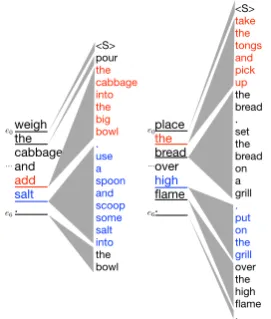
Figure 2: Example Viterbi alignments
trained language models (Peters et al.,2018), we are interested if these approaches transfer to our cloze task. We evaluate the OpenAI GPT trans-former language model (Radford et al.,2018) with and without fine-tuning.Without fine-tuning this model does slightly worse than our best domain-specific model. With fine-tuning, its accuracy is substantially higher, but it still suffers from the same fundamental limitations as our other mod-els (see Table5). The transformer (Vaswani et al.,
2017) attention is multi-headed and multi-layered which prohibits direct interpretability.
5 Qualitative Analysis
We visualize alignments of our transduction model over two partial sequences in Fig.2. This shows which hidden vector of the abstract sentence aligned to every region of the concrete sequence. Specifically, we see how tools like the big bowl,
spoon, and tongs are introduced to facilitate the
actions. There are also implications, e.g. thathigh
Abs shape each dough ball into a circle and add tomato sauce .
Pred flatten out your dough into a flat circle using yourhands. take aknifeto add tomato sauce to the center of your dough.
use the back side of theknifetocutthe sauce out. makesureyou keep the sauce aboutan inchfrom the edges.
Gold flatten out your dough into a flat circle using yourhands. take aspoonto add tomato sauce to the center of your dough.
use the back side of thespoontospreadthe sauce out. makesureyou keep the sauce aboutan inchfrom the edges.
Abs place the kale cucumber bell peppers carrots and radishes on the wrapper .
Pred put thecuton acutting. put acuttingamount of kale on thecutting. add acutamount of cucumber ...
Gold put thewrapon aplate. put asmallamount of kale on thewrap. add asmallamount of cucumber ...
Abs wrap the pizza .
Pred find alarge pieceto put the pizza om . place the pizza in the center for it not tostickaround . grab the plastic wrap and
startwrappingtheentire thingand pizza . wrap all around untilcompletely coveredon all corners . put in freezer
on acold waterand freeze overnight
Gold find ahard surfaceto put the pizza om . place the pizza in the center for it not toslidearound . grab the plastic wrap
and startwrappingthehard surfaceand pizza . wrap all around untilfully coveredon all corners . put in freezer on
[image:5.595.72.523.63.230.2]aflat surfaceand freeze overnight
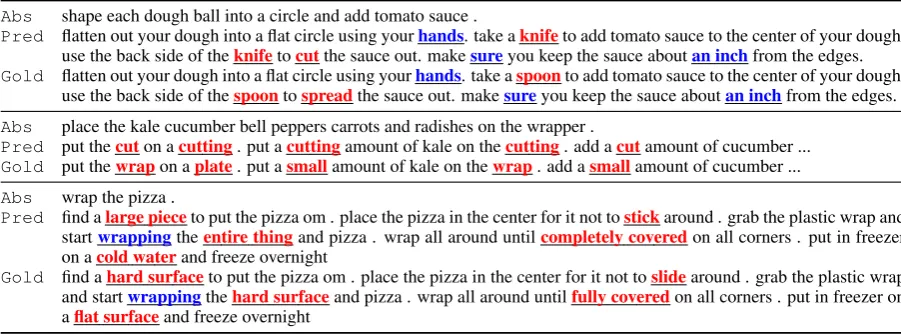
Table 5: Above is the output of OpenAI GPT when forced to greedily decode answers to blanks in validation.
of the phenomena we would hope to see (Table3). The left-hand side of the table shows words from the abstract YouCook annotations and corre-sponding phrases in the concrete annotation. For the righthand side we searched for common con-crete terms that may be preceded or followed by other terms, and present the abstract terms they were most often generated by.
Finally, Table 5 shows three randomly chosen examples (from the validation set) of greedy de-codings for slot filling with GPT fine-tuned on our dataset. These examples demonstrate that, first, there are cases where GPT is successful or pro-duces a semantically valid answer (e.g. fully vs
completely). Second, as is common with greedy
decoding, the model can get stuck in a loop (e.g.
cut, cutting, cutting, ...). Finally, note there are
nonsensical cases where the model appears to have discarded the abstract context (e.g. knife to add
tomato sauceorfreezer on a cold water).
6 Related Work
Many script learning systems are based on event co-occurrence and language modeling in large text corpora, and can infer implicit events without cre-ating explicit situation-specific frame structures
(Chambers and Jurafsky, 2008; Rudinger et al.,
2015;Pichotta and Mooney,2016). Other systems
induce situation-specific frames from text (
Che-ung et al., 2013; Balasubramanian et al., 2013).
However, these methods do not explicitly target the commonsense correspondence between differ-ing levels of detail of complex events.
Most relevant to this paper is the pioneering work of Regneri et al. (2013) as extended by
Senina et al. (2014) and Rohrbach et al. (2014).
These papers present the TACOS corpus,
consist-ing of natural language descriptions of activities in videos paired with low-level activity labels.
Sen-ina et al. (2014) collect an additional level of
multi-sentence annotations on the corpus, which allowing for video caption generation at multiple levels of detail. Rohrbach et al. (2014) describe a similar corpus of natural descriptions of com-posite actions, useful for activity recognition in video. These corpora differ in a number of impor-tant ways fromKIDSCOOK; in particular, the lan-guage has somewhat limited complexity and “nat-uralness” when describing complex scenarios, a phenomenon also observed in the robotics litera-ture (Scalise et al.,2018). Our data collection pro-cess avoids more formulaic language by eliciting “child-directed” descriptions.
7 Conclusion
We introduce a new hierarchical script learning dataset and cloze task in which models must learn commonsense world knowledge about tools, pro-cedures and even basic physics to perform well. Our aim is to begin a conversation about abstrac-tion in language, how it is modeled, and what is implicitly hidden. Our abstract and concrete in-structions are grounded in the same videos yet dif-fer dramatically due to their assumed audiences. We show that a neural transduction model pro-duces interpretable alignments for analyzing these otherwise latent correlations and phenomena.
Acknowledgements
References
Fred Attneave. 1959. Applications of information
the-ory to psychology: A summary of basic concepts,
methods, and results. Henry Holt.
Dzmitry Bahdanau, KyungHyun Cho, and Yoshua Bengio. 2015. Neural machine translation by jointly
learning to align and translate. InICLR.
Niranjan Balasubramanian, Stephen Soderland,
Mausam, and Oren Etzioni. 2013. Generating
coherent event schemas at scale. InEMNLP.
Yonatan Bisk, Daniel Marcu, and William Wong. 2016. Towards a dataset for human computer
communica-tion via grounded language acquisicommunica-tion. In
Proceed-ings of the AAAI 2016 Workshop on Symbiotic Cog-nitive Systems, pages 729–732, Phoenix, AZ.
Peter F Brown, Vincent J Della Pietra, Stephen A Della Pietra, and Robert L Mercer. 1993. The mathemat-ics of statistical machine translation: Parameter
esti-mation. CL, 19(2):263–311.
Nathanael Chambers. 2013. Event schema induction
with a probabilistic entity-driven model. InEMNLP.
Nathanael Chambers. 2017. Behind the scenes of an
evolving event cloze test. InLSDSem.
Nathanael Chambers and Dan Jurafsky. 2008.
Unsu-pervised learning of narrative event chains. InACL.
Jackie Chi Kit Cheung, Hoifung Poon, and Lucy Van-derwende. 2013. Probabilistic frame induction. In NAACL.
Gerald F. DeJong. 1981. Generalizations based on
ex-planations. InIJCAI.
Arthur P Dempster, Nan M Laird, and Donald B Rubin. 1977. Maximum likelihood from incomplete data
via the em algorithm. Journal of the royal statistical
society., pages 1–38.
Jason Eisner. 2016. Inside-outside and
forward-backward algorithms are just backprop (tutorial
pa-per). InWorkshop on Structured Prediction for NLP.
H. Paul Grice. 1975. Logic and conversation. Syntax
and Semantics 3: Speech Acts, pages 41–58.
John Hale. 2001. A probabilistic earley parser as a
psy-cholinguistic model. In Proceedings of the second
meeting of the North American Chapter of the Asso-ciation for Computational Linguistics on Language technologies, pages 1–8. Association for Computa-tional Linguistics.
Karl Moritz Hermann, Tomas Kocisky, Edward
Grefenstette, Lasse Espeholt, Will Kay, Mustafa
Su-leyman, and Phil Blunsom. 2015. Teaching
ma-chines to read and comprehend. InNIPS.
Sepp Hochreiter and J¨urgen Schmidhuber. 1997.
Long short-term memory. Neural Computation,
9(8):1735–1780.
Po-Sen Huang, Chong Wang, Sitao Huang, Dengyong Zhou, and Li Deng. 2018. Towards neural
phrase-based machine translation. InICLR.
Thang Luong, Hieu Pham, and Christopher D Man-ning. 2015. Effective approaches to attention-based
neural machine translation. InEMNLP.
Jeffrey Pennington, Richard Socher, and Christopher Manning. 2014. GloVe: Global vectors for word
representation. InEMNLP.
Matthew Peters, Mark Neumann, Mohit Iyyer, Matt Gardner, Christopher Clark, Kenton Lee, and Luke Zettlemoyer. 2018. Deep contextualized word
rep-resentations. InNAACL.
Karl Pichotta and Raymond J Mooney. 2016. Learning statistical scripts with LSTM recurrent neural
net-works. InAAAI.
Alex Radford, Karthik Narasimhan, Tim Salimans, and Ilya Sutskever. 2018. Improving language under-standing by generative ptraining. Technical re-port, OpenAI.
Mechaela Regneri, Marcus Rohrbach, Dominikus Wet-zel, Stefan Thater, Bernt Schiele, and Manfred
Pinkal. 2013. Grounding action descriptions in
videos.TACL, 1.
Anna Rohrbach, Marcus Rohrbach, Wei Qiu, An-nemarie Friedrich, Manfred Pinkal, and Bernt Schiele. 2014. Coherent multi-sentence video
de-scription with variable level of detail. InGCPR.
Rachel Rudinger, Vera Demberg, Ashutosh Modi, Benjamin Van Durme, and Manfred Pinkal. 2015. Learning to predict script events from
domain-specific text. In*Sem.
Rosario Scalise, Yonatan Bisk, Maxwell Forbes, Daqing Yi, Yejin Choi, and Siddhartha
Srini-vasa. 2018. Balancing shared autonomy with
human-robot communication. arXiv preprint
arXiv:1805.07719.
Roger C. Schank and Robert P. Abelson. 1977.Scripts,
Plans, Goals and Understanding: An Inquiry into Human Knowledge Structures. LEA.
Anna Senina, Marcus Rohrbach, Wei Qiu, Annemarie Friedrich, Sikandar Amin, Mykhaylo Andriluka, Manfred Pinkal, and Bernt Schiele. 2014. Coherent multi-sentence video description with variable level
of detail. arXiv preprint arXiv:1403.6173.
Valentin I Spitkovsky, Hiyan Alshawi, and Daniel
Jurafsky. 2011. Lateen EM: Unsupervised
train-ing with multiple objectives, applied to dependency
grammar induction. InEMNLP.
Ilya Sutskever, Oriol Vinyals, and Quoc V. Le. 2014. Sequence to sequence learning with neural
net-works. InNIPS.
Ashish Vaswani, Noam Shazeer, Niki Parmar, Jakob Uszkoreit, Llion Jones, Aidan N Gomez, Łukasz Kaiser, and Illia Polosukhin. 2017. Attention is all
you need. InAdvances in Neural Information
Pro-cessing Systems, pages 5998–6008.
Chong Wang, Yining Wang, Po-Sen Huang, Abdel-rahman Mohamed, Dengyong Zhou, and Li Deng. 2017. Sequence modeling via segmentations. In ICML.
Noah Weber, Leena Shekhar, Niranjan Balasubrama-nian, and Nathanael Chambers. 2018. Hierarchical quantized representations for script generation. In EMNLP.
Lei Yu, Phil Blunsom, Chris Dyer, Edward Grefen-stette, and Tomas Kocisky. 2017. The neural noisy
channel. InICLR.
Lei Yu, Jan Buys, and Phil Blunsom. 2016. Online
segment to segment neural transduction. InEMNLP.
Rowan Zellers, Yonatan Bisk, Roy Schwartz, and Yejin Choi. 2018. Swag: A large-scale adversarial dataset
for grounded commonsense inference. In
Proceed-ings of the 2018 Conference on Empirical Methods in Natural Language Processing (EMNLP).
Luowei Zhou, Chenliang Xu, and Jason J Corso.
2017. Towards automatic learning of procedures
from web instructional videos. arXiv preprint
A Transducer Model
We briefly describe the model of Yu, Buys, and Blunsom (2016) and our minor modifications thereto.
A.1 Alignment with Latent Variables
We model the conditional probability of a concrete sequenceygiven abstract sequencexthrough a la-tent alignment variableabetweenxandy, which is a sequence of variablesaj, withaj =i
signify-ing thatyjis aligned toxi. The marginal
probabil-ity ofygivenxis
p(y|x) =X
a
p(y, a|x). (1)
In the following, we use m to denote the length ofxandnto denote the length of y. The model formulation restricts alignments to be monotonic, i.e.aj+1≥aj for allj.
The model factorizes over timesteps into align-ment and word prediction probabilities, such that the word prediction at each timestep is informed by its alignment:
p(y, a|x) =Y
j
p(aj|aj−1, x1:aj−1, y1:j−1)
×p(yj|aj, x1:aj, y1:j−1) (2)
The abstract and concrete sequences are both en-coded with LSTM Recurrent Neural Networks
(Hochreiter and Schmidhuber,1997). In contrast
to standard attention-based models, the aligned encoder representation is not fed into the decoder RNN state, but only used to make next word pre-dictions. Due to the small size of the training data, words in both sequences are embedded using fixed GloVe embeddings (Pennington et al.,2014). The word emission probability is then defined as
p(yj|aj, x1:aj, y1:j−1) = softmax(MLP(eaj, dj)) (3)
withethe encoder hidden states anddthe decoder hidden states.
The alignment probability factorizes into shift
andemitprobabilities, where a shiftaction incre-ments the alignment to the next word in the input sequence, and an emit action generates the next output word. We refer to these astransition prob-abilities. This formulation enables us to restrict the hard alignment to be monotonic.
We consider two parameterizations of this dis-tribution. In the first, the probabilities are param-eterized by the neural network, using the encoder
and decoder hidden state in a similar manner to how the word emission probability was computed. The alignment probability at a given timestep is therefore parameterized as
p(aj|aj−1, x1:aj−1,y1:j−1) =p(emit|aj, x1:aj, y1:j−1)
×
aj−1 Y
i=aj−1
p(shift|i, x1:i, y1:j−1), (4)
where
p(shift|i, x1:i, y1:j−1) =σ(M LP(ei, dj)), (5)
p(emit|i, x1:i, y1:j−1) = 1−p(shift|i, x1:i, y1:j−1). (6)
We also consider using the simpler, fixed align-ment parameterization in Yu, Buys, and Blunsom (2016), where the transition probability is condi-tioned only on sequence length, not onxory, and can therefore be estimated using the ratio between input and output sentence lengths. The alignment probabilities are not updated during training, and consequently the posterior distribution over the alignments is biased towards this prior, favoring alignments close to the diagonal.
The parameterized alignment model contains as special cases two degenerate solutions: (1) an unconditional language model and (2) a seq2seq model. These occur if the model performs all emits before shifting or all shifts before emitting, respectively. To prevent the creation of a language model we force the last output word to be aligned to the last word in the abstract sequence, similar to Yu et al. (2017). However, the parameterized tran-sition model could still in practice revert to a pure sequence-to-sequence model.
A.2 Marginalization
Next we briefly describe the dynamic program used to marginalize over alignments during train-ing and to find the most likely alignments of a given alignment during inference; we refer the reader to Yu, Buys, and Blunsom (2016) for a more thorough treatment.
The forward variable αi(j) representing
p(y1:j, aj =i|x1:i)is recursively as
αi(j) =p(yj|i, x1:i, y1:j−1)
×
i
X
k=1
αk(j−1)p(aj=i|k, x1:k, y1:j−1). (7)
m|x1:m). The gradients are computed with
au-tomatic differentiation; as this is is equivalent to using the forward-backward algorithm to estimate the gradients (Eisner, 2016), only the forward al-gorithm has to be implemented.
To make the implementation GPU-efficient, we vectorize the computation of α. The computa-tion iterates through decoding steps, each of which can be generated from an alignment to any of the encoder tokens. We can efficiently construct a transition matrixT, corresponding to all possible encoder states performing all possible shifts, and emission matrixEj which is a gather by word
in-dexj.
To compute the forward probabilities at each timestep, the current forward probabilities are first multiplied by all possible transitions. A sum in logspace collapses all paths, and the emis-sion (word generation) probabilities are multiplied to obtain the new forward probabilities. When fixed transition probabilities are used, T is pre-computed.
A.3 Viterbi EM Training
Latent variable models can be trained either through directly optimizing the likelihood objec-tive through gradient descent (as described above), or with the Expectation Maximization (EM) algo-rithm (Dempster et al.,1977), which alternates be-tween calculating expectations over the values of the latent variables given the current parameters, and maximizing the expected complete data log likelihood given those expectations. We consider training our alignment model with Viterbi EM
(Brown et al., 1993), also known as “hard” EM,
where at each iteration the most likely assignment of the hidden variables (alignments) are found and the parameters are updated to optimize the log likelihood given those alignments. Viterbi EM has been shown to give superior performance to standard EM on unsupervised parsing (Spitkovsky
et al., 2010), due to better convergence
proper-ties in practice by making the distribution more peaked.
We perform batched Viterbi EM training by computing the Viterbi alignments for a batch, and then performing a gradient step based on treating those alignments as observations.
We follow a two-stage training procedure: we first directly optimize the marginal likelihood with batched SGD to find a reasonable initial
distribu-tion over alignments, before switching to Viterbi EM training. Such a strategy has been shown to reduce the chance that the model will get stuck in local optima (Spitkovsky et al.,2011).
A.4 Inference
We apply the trained models to multiple inference problems to evaluate how well they are capturing script knowledge. The first is finding the most likely alignment given a pair of abstract and con-crete sequences. We use the standard Viterbi al-gorithm, in which we replace the sum in equation (7) withmax, and keep track of the index corre-sponding to each value of α during the forward computation. The most likely alignment can then be traced back froman=m.
The second inference problem is slot-filling, for application to the cloze task. Given an abstract sentence and a partially-filled concrete sequence, we want to use the model to predict words to fill the given blanks. To make the prediction, we sam-ple 5 candidate sequences by predicting words for each slot, in left-to-right order, and then choosing the sequence with the highest overall probability. Words are predicted by sampling with temperature
0.1, in order to peak the distribution while still al-lowing some diversity in the samples. The moti-vation for selecting the final output from multiple samples is that the original samples are biased, as they are only conditioned on the left context.